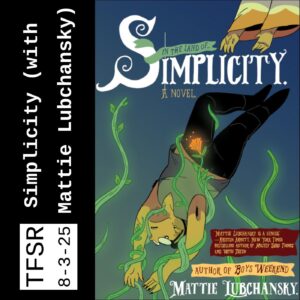
This week, Ian talks with cartoonist Mattie Lubchansky about her new book, Simplicity, out July 29 from Pantheon Graphic Library. The conversation touches on Mattie’s work as Associate Editor for The Nib, her history with comics, and her ambitions beyond the printed page, but mostly focuses on the role of art in organizing and living our politics amid all the compromises required of life in the Real World.
- Instagram: @mattielubchansky
- x/twitter: @Lubchansky
- website: https://mattielubchansky.com
- tour: mattielubchansky.com/tour
- bluesky: @mattielubchansky.com
- podcast website: https://nogodsnomayors.com
- podcast bluesky: @nogodsnomayors.com
. … . ..
Featured Track:
- Take The ‘A’ Train by Duke Ellington from The Duke – The Essential Collection (1927-1962)
. … . ..
Transcription
TFSR: Today, we are talking to Mattie Lubchansky about their new book, Simplicity. Mattie, can you please introduce yourself to listeners who may be unfamiliar with you and your work?
Mattie: Sure thing. I am a cartoonist and illustrator. I’ve been doing a weekly comic online for 15 years. I realized that the day after ‘Simplicity’ comes out, it’ll be exactly 15 years of me doing this work. I was then also an editor and a contributor to the Nib, which was a non-fiction and political satire comics publication that we ran for about 10 years, and a bunch of print issues as well. I’ve got two books already out, one, a novella with Silver Sprocket called the Antifa Super Soldier Cookbook. And then a couple of years ago, my debut, a graphic novel, Boys Weekend, which came out with Pantheon, and very soon, we’ll be out with Simplicity, my newest with Pantheon.
TFSR: Fantastic. Thank you very much. So, can you talk a little bit about the work on “Simplicity”? We’re here to discuss specifically what was the genesis of the project? Was it conceived in parallel to your other projects, or was it started after those were done?
Mattie: Yeah, so this one was when Boys Weekend was written. It takes about a year to draw, and drawing and writing use completely different parts of my brain. When I’m drawing, I just start thinking about what’s next. What’s the next thing I want to do? And Boys Weekend, for people who haven’t read it, was about a trans feminine person who has to go on a bachelor party weekend with their old college friends, who are all men, and they’re the “best man at the wedding”. It’s based loosely on something that happened to me. Here was a plot in search of characters and wider themes and stuff, and I jerry rigged all that stuff in as I went along, and threw a bunch of iterations until I ended up with something I was happy with.
Simplicity was a very different process for me. I had this idea about someone living in a fascist future, essentially, and then leaving to go upstate. A lot of it came to me when I was myself in the Catskills, sitting in a hammock and looking at this gnarled tree that was sitting above me. It had in it a gnarl very anatomically correct to a vagina. I cannot describe to you how perfectly resembling it was. I was just sitting there, staring at it, thinking, and then I came up with this. The thing that came to me was these ecstatic visions, that Lucius (the main character around whom so much of the book is about) has. The book came to me like that. I had this guy, and I had these visions that he was having. Then I asked myself, What is this? Where is he from? What’s the world like? And it all spun out of there.
I started thinking about it, and then I ended up at this cult place. I was thinking about cults and upstate New York, and I was talking to a good friend of mine, who is a novelist called Calvin Kasulke. He was telling me about this era of American history where, in the 19th century, all over upstate New York, Ohio, Pennsylvania, and into the Midwest, existed all these millenarian, pre-Marxist socialist communes. I read this book called “Paradise Now”, which is about a bunch of these groups by another author, Chris Jennings, and I just started learning more about the way that all these things function. And I asked myself – Why? Why did all these political, separatist groups spring up around the dawn of the Industrial Revolution? I got really invested in that. I was doing a lot of research about those groups, specifically followers of a French thinker called Etienne Cabet, and then also the Shakers. It is where the book ended up springing out of. All that’s to say that I was in a hammock and I saw a weird tree, I guess.
TFSR: The notion of getting away from everything is an attractive one. It’s very interesting how that opens things up. To start right from the cover, you build Simplicity, which was conveyed in the idiom of comics as a novel rather than a graphic novel. I thought that that was a very interesting choice, and I wonder if you could explain what that choice means to you?
Mattie: I guess I have less of a fascinating answer for this than anything else, but it was on the cover of my last book, too. I think if you go to a bookstore, all the novels have a novel on them, right? I think we’re also experiencing a moment now in comics where non-fiction comics are an enormous market, there’s an enormous amount of interest in them, and they do very well. A lot of my work editing is from the non-fiction world, and I’m very invested in it myself. This is very much literature. It’s a novel. It’s not super complicated to me. Also, in Simplicity, specifically, it’s right on the cover, because I was in 19th-century mode when I was doing a lot of this book. You’ll also notice the inside, the title page, has a very, very long subtitle, which is another thing that these travel log novels from the 19th century had. They always would have these really elaborate subtitles, and I just became obsessed with it.
TFSR: So diving in. In the novel, you show many of the complexities involved when a person tries to live out their values, I felt. This entails an exploration of the overlap and divisions between living a theoretical life and living a practical life. That, to me, went all the way through it. I think the story is better for not being expressly prescriptive. I didn’t find it to be. But can you talk about the tensions that you wanted to get into the story?
Mattie: Thank you. I’m very glad that it doesn’t come off as prescriptive, because I very much was trying to avoid that. When you’ve done so much political satire like I have, it’s really the impulse to just have a character turn to the camera and say what I’m thinking. It’s quite tough, but I was really trying to come at it from a place of making characters that feel real to me and then having them hash it out. So what was really top of mind when I was making this, I was thinking about the idea of political separatism. It’s this understandable impulse, especially when things are as gnarly as they are now. As a trans person, everybody knows somebody that’s gone off to start a farm or whatever, and there’s this, this deep impulse that is also very endemic to America, straight up from The City on the Hill speech, or some of the first white settlers in America. This idea that we are going to go live a certain way, and everybody is going to see what we’re doing, and they’re going to be so enamored with how good we are running society that they will go run their society in the same way. That’s just never borne out. But on the other hand, it’s a really understandable impulse – why would you not want to live in safety? Why would you not want to be able to live in a place that tomorrow could look like how you want it to look, but just for you and the people you know? So, yeah, it’s this really understandable impulse. I was just actually struggling with it when I was writing the book, because I’m from a place where I live in the city, I live my life a certain way, and the idea of just running away – me and five people – and making a world that we want, but in my yard, it feels ridiculous to me, but it also sounds nice sometimes. There’s no easy solutions, right? The only thing I know for sure is that it’s our imperative to fight like we live in this society, right? And the only thing we have is the fight, and it’s hard to think about running away.
TFSR: It’s interesting that you overtly made an effort not to be expressively prescriptive. I find that that’s an increasingly common strain. What do you make of storytelling that is often associated with a politics? I feel that it often falls flat, and I sometimes wonder why. It’s a delicate thing to have a point, but allow the reader to get there on their own. Why do you think that’s important? And how do you do that?
Mattie: That’s a very good question, because I’m obviously no fan of subtlety. If anyone has read my work, they will be familiar with it. Sometimes there’s no way to subtly say something, and you can only state it plainly. There are plenty of things in this book that are stated very plainly. But something like, how should society look like, is to your point of why does it work sometimes, and why it doesn’t? The best I can figure out is, if something is trying to make the reader see the world the same way that the author does, by a character just saying stuff, or the world being a certain way, is different than it just being stated to you, the reader.
TFSR: Along those lines, I see that storytelling takes a position. Do you think storytelling is as important as all the other forms of activism that may result in more material gains? And do you think the role of storytelling is to pave the way for some more expressly political conversation? It can certainly be both, but I just wondered what your thinking was there?
Mattie: This is something I think about a lot, because, when you make expressly political work like I have for most of my career, people tend to tell you that it’s making a difference without outlining how it is. I certainly know a lot of people who do political work, like the older guard of political cartoonists, who tend to think that they are changing the world with their work. I just have a hard time seeing it, and it’s something I really struggle with. I try to tell myself often that my art is my art, and the work is the work, if there’s work to be done in the world. I’m a materialist, right? What does my little book do? I think a lot about that Kurt Vonnegut quote about the custard pie.
TFSR: Remind me, please.
Mattie: He’s got some quote that was about every artist of his generation being laser focused with their art on the Vietnam War. They were all hyper-focused, and they’re all shooting with one big laser beam at this thing. I think the quote is about dropping a custard pie off a six-foot step ladder, and I just try to keep it in mind. I think that you can’t sit there thinking that if you’ll make a book, it’s gonna change the world. I was talking to a friend of mine about this who’s a little more optimistic about things, and he was telling me that it is our job as people, as writers of fiction to talk about how the world can be. I take it for granted, that I have an imagination where I can spin up all this crap. If I have this imagination, I should use it. It is important, people need to expand their consciousness, but you can only think of yourself as a pebble in an avalanche. You can’t think of yourself as the effect of the thing, or else your work is gonna start getting very ego maniacal.
TFSR: Sure, and to tack on to that, I feel that whether it is a thing where you can see the outcome or not, I would imagine that that does not diminish your desire to tell the stories in any way.
Mattie: Yeah, exactly. I think I would be doing this anyway. In any universe, no matter what’s happening, we deserve to have art. It’s important to me, no matter what, that this stuff, art, literature, exists. I think a person’s inner life should be rich, and these are helpful tools for that.
TFSR: Many listeners would have been introduced to your work by way of The Nib. Those comics really got around. Those were generally shorter works, so how do your concerns and your approach differ in producing longer work? Was that a skill that you had to learn to do? Were you always thinking this stuff in parallel to making that shorter stuff?
Mattie: Yeah. It is a very natural progression. What happened is, I very rarely did single-panel work for the Nib. It was almost always four panels, which is not a huge distinction, but it was to me, because then it’s storytelling, it’s not just a single image. It was always the idea of a sequential narrative that was important to me. I also don’t like to draw caricatures. I am not a gifted caricaturist. I was always trying to draw on these science fiction concepts into what I was doing, because it was an easier way to engage with the stuff. There’s a lot of monsters and goo and aliens and shit all over my political work, and that’s by design. I find it more interesting than drawing Ted Cruz 1,000 times.
I kind of fell backwards into doing political comics. It was always my hope and my dream to do books. It was always in the back of my mind. I got lucky that I got to do a novella first with The Antifa Silver Sprocket Book. That to me was a real education – how do I draw this out into an interesting narrative? I think every time I’m getting better. The approach I had to learn a while ago was that this has to be based on characters, not ‘the thing you want to say in X amount of time,’ because readers can’t keep track, and it doesn’t hold their interest for more than a page or two. So if I want people give a crap about what’s happening to the world that I’m depicting, I have to put them in the shoes of somebody. That’s just sort of how it is.
TFSR: Okay, maybe a little digression here. You mentioned that you don’t consider yourself a good caricaturist. I think that your style is very distinctive. Your art style certainly zips the narrative along very well, and it’s pleasing to look at. How did you arrive at that style? Would you say it’s more of a utilitarian style that you work in?
Mattie: Yeah. I know a lot of artists who can work in a lot of styles. I am not one of them. I draw the way that I draw. I’m self-taught. So, that’s me doing the best I can. I’m lucky that people like looking at it. I think at this point in my life, with the amount of comic pages I’ve got under my belt, if I wanted to draw more realistic, to go back and relearn how to draw comics and make it look more the Marvel way, or whatever, I think I could go do it, but it just doesn’t hold any interest for me. I’m used to my big, stupid eyeballs at this point. All it is to me is that it’s effective in being able to convey emotion and motion in the characters really well, and to be able to draw realistically enough to get by in terms of setting. It’s a fun way to draw, and I am quite used to it at this point.
TFSR: Maybe another one, just for me. Now that you are something of a known quantity and people can tune into your work and know roughly what to expect, at least from the look of it or from the tone of it. Do you find that there is maybe a hesitation… let’s say it weren’t convenient to you, and you did try to draw comics, the Marvel way? Do you know what I mean? Do you feel like that would be starting over?
Mattie: I think so. I think there’s a shorthand at this point to seeing my work and knowing it’s me and knowing what the point of view is. There’s a specific tonal balance I’m going for in my books, and that is somewhere between satire, horror, politics, trans stuff, and science fiction. There is a lot of stuff I’m throwing into the stew, like in these first two books. I think knowing me is helpful, like it is for any author. You don’t have to start over with your point of view. I think my point of view is fairly distinct, or at least I strive for it to be. Starting over, if it looks like other people’s comics, then I think a reader wouldn’t know what to expect. The whole idea with comedy and horror and a lot of things is about knowing the audience’s expectations and working with them one way or another.
TFSR: Okay. Thank you very much for that. So in Simplicity, technology turns a metaphorical guiding light and a literal one. I think that in practice, technology’s use is increasingly dictated by terms of service and a production environment that often runs afoul of our ethics. How do you delineate boundaries with technology in executing your work and enacting your politics?
Mattie: So do you mean the actual, literal production of my work?
TFSR: I guess I mean, I guess….I’m not sure what I mean [laughs]. What is your level of skepticism of technology, for instance?
Mattie: Oh, sure, it’s massively high. It’s the future in this book, so technology is obviously going to play a role, but I don’t think anyone creating technology in any of the books I’ve done is shown in an even moderately flattering light, and that’s more to do with their current culture and who’s creating technology and why they’re doing it. American technology, American “tech”, is completely soaked in blood. Like eugenics and stuff. Read Palo Alto by Malcolm Harris, if you haven’t and if you’re listening. But it’s just one more cursed thing in our cursed country. Some form of technology has always existed. Like an atlatl is technology. A pulley is technology. Who’s creating it, and why is it so important to think about it? I’m such a massive skeptic of any technology thing at this point, just because of who’s in charge of the production of it, and very few people inventing things are inventing them for the good of humanity. I don’t know if that was ever true, but it’s definitely not true at this point in history.
TFSR: Sure. And there’s no not using it and participating in society.
Mattie: Yeah. That’s another thing in the book, the sort of walled New York City that the main character, Lucius, lives in, is massively inundated with technology. There are advertisements everywhere. Drones are flying around, and people have computers embedded in their foreheads. People are just surveilled, nonstop, even more than they are now. But for the people in Simplicity (the town upstate) there’s no technology to speak of, really. There are solar panels, right? And it’s the sort of thing where they can live like that because they’re segregated from society, but that doesn’t stop tech from showing up. Let’s try not to spoil anything.
TFSR: Many of the interactions on the commune remind me of interactions in both organizing spaces and religious spaces that I have experienced. For me, these interactions brought to mind the dimensions of religiosity and their similarity to deeply held political beliefs. Discussion of these spaces outside of them is often met by “normal people” with derision and accusations of fanaticism. Maybe this is unique to me, but what do you make of the skepticism of self-assuredness?
Mattie: I think moral clarity is terrifying to most people because so much of society sees that there are all these problems that are so cut and dry, and people spend so much time constructing these little brittle gray areas around it, and try to convince you that it’s complicated when it’s not. So when you just say, “here’s what things are like,” people often react poorly or violently or disdainfully. And on the other hand, if you’re living in a way that’s very much like us against the world, then it creates a situation a lot of the time that the world is against you, right? It kind of goes both ways. So if you cordon yourself off completely, like a commune, for instance, people will treat it with disdain; they’re not going to look at it for inspiration. They’re going to be asking: “Why are these people living outside of society?” It feels almost like they’re trying to take a shortcut or something. I don’t have a lot of experience as an adult in religious spaces. I was raised with a medium amount of religion. I’m Jewish, and I was B’nei Mitzvahed, but I stopped studying. After that, my religious education did not extend past my 13th birthday. So I have enough time in the religious community to understand it. But most of this was more out of my experience with organizing spaces, mutual aid, and things of that nature.
TFSR: So in action, I felt that Lucius, the main character, was initially put off or confused by the way that the spiritual association of peers, the commune, communicated. I think that underscored how people outside of affinity groups react to the directness of communication within them. This is, along the lines of my previous question, but do you think it’s more important to demonstrate values or to explain values in terms of the audience? Let’s say, if you are trying to convince them of something, maybe within or outside a narrative?
Mattie: Yeah, I think that’s a really good way to think about it. The idea of demonstrating values can mean a lot of things. I hate nothing more than when people say that you’ve got to meet people where they are. I’m not so sure about that. There’s this whole strain of what they’re calling Popularism, where you just endorse whatever things people think already. That’s where you run, if you’re an elected official or whatever. It’s demented to me, the arguments write themselves. Look at any poll of any civil rights issue in human history. But you definitely have to communicate your ideas to people, right? You can’t just say, “My ideas are so good”, and everyone’s just going to come on board. That’s where knowing people comes into play, regardless of where they’re at. You have to be in the world. This is why I’m a huge believer in mutual aid spaces. Here’s a place where you can go and meet your neighbors and talk to them, and then if the people handing out food happen to have radical ideas, perhaps they will disseminate them over a meal or in a friendly way, the way that sounds normal. And it is in the same way in a narrative. What doesn’t work is when an author or director or whatever just says, “here’s how things are”, and just tells you and has someone give a big speech or whatever. I am no master of subtlety. I can present the world in a really bare bones way, like: “Here’s how things are” in a way that isn’t subtle. But as an author, I think you have to spend a lot of time bringing people in, and that’s where character work shows up. Lucius, the main character of the book, is not right about the way the world is at the beginning of the book. All the signs are there. So I’d rather have the reader say: “No, you moron, can you not see what’s right in front of you?”, than someone turning to the camera and saying what’s up.
TFSR: Lucius was an academic in the story. Do you think scholarship and historiography archiving exist outside of the process of organizing and activism? I wonder if maybe you would place them, perhaps in parallel to storytelling. And I wonder if you can speak to how you view the relationship of scholarship and the academic side of things to organizing and activism?
Mattie: When I was developing this book, so much of it to me was about history. The way the book is framed, it’s about history and scholarship, and what’s in the record and what’s not, how it’s there, who put it there, who’s reading it. It’s all so important. I had a lot of back and forth with the copy editors on this book (bless their hearts, because I had a lot of copy editing), who are making sure references to certain things are consistent. I keep changing how things are referred to because different people are referring to them – organizations, places, and people, and that’s all on purpose, not consistent on purpose, because real life is not consistent. After all, it really depends on who’s talking to you about what and where. I was thinking a lot about history and scholarship. I think that stuff has an important role to play in the same way that storytelling does. Especially in activist spaces, the churn is so, so serious and volatile, because people get burned out, they get less radical, or they leave. Or new people come, and there’s state violence to reckon with; they get arrested. So it’s really important to have a cultural memory of what’s happening. A lot like technology it all folds together. It so deeply depends on who’s doing it and to what end that I don’t have a blanket statement on or even a thought about the idea of scholarship. To me, it’s more of a cautionary tale about who enters what into the historical record, and to be skeptical of that.
TFSR: Yes, and the thing that kept coming to me as I was reading this was just the insidiousness of philanthropy. I do not doubt that people who work in philanthropic spaces are the same people who are doing work in organizing spaces, and that is such an insidious thing to force someone who wants to do good and make a change into that dichotomy.
Mattie: Yeah. I certainly know people who are in organizing spaces, whose day jobs are in NGOs or nonprofits or what have you. I think it’s just a common way to draw a paycheck in a way that you don’t feel so evil. I do not begrudge anybody whatsoever. No, but it is this thing where, as a society, we spend so much time offloading everything to philanthropic organizations instead of asking ourselves if perhaps that money or that energy could be spent better through, let’s say, the public ownership of certain things? I just don’t know, sorry.
TFSR: It’s just a way to ensure that anybody with moral clarity, as you say, does not get any kind of moral high ground. Because it just makes them complicit, in a sense.
Mattie: I’m just gonna say: “Here’s this person that knows exactly where to go and how to get there”. It’s a straight line. And you’ve put them in the labyrinth, right? I’ve placed you in this thing where all of a sudden there’s this huge bureaucratic structure between you and the thing you want, right?
TFSR: Yes. So my understanding of your role in The Nib, as you’ve said earlier, was largely editorial. To the end of releasing work that I felt was broadly left in character. What do you make of efforts like the Cartoons Cooperative and the various nascent unions in the comic book industry attempting to organize along the lines of leveraging power? And what do you think are the challenges that are unique to organizing creative work?
Mattie: I think you’ve characterized me correctly as broadly left, but I’m definitely a Unionist. I think there are things unions can and cannot do. I think there are things that NLRB-backed unions can and cannot do, and I think it’s important to know those limitations going into organizing these sorts of spaces and organizations, but I do think they are important for living a life with dignity. The Cartoonist Co-op is great. I’m a member of it. I’ve also been involved with the Freelance Solidarity Project early on. I designed their logo, for instance. So, I’m very much on board with these nascent organizing movements. The biggest obstacle is the Taft-Hartley Act, which basically bans these things from being a real union. You can’t; independent contractors cannot be considered employees, according to the Taft-Hartley Act. And it’s an old law, right? It’s got Taft right in the name.
Because of that, there are huge obstacles to organizing these things. You can’t just say we’re in a union. There’s no way to get it set up, like let’s say Hollywood has it set up, and we’re also atomized and spread out. There’s not like one place where all the cartoonists live, and there’s no one Publishers Association that we can go bargain with. So it is this hard thing in terms of the dispersement. We’re all freelancers. There’s another big problem where a lot of it is changing massively now. If you ask somebody five years ago, 10 years ago, compared to now, it’s a different answer, but I think a lot of artists and visual artists don’t think of ourselves as workers, because we’re not drenched in crude oil. It’s a real issue with people who work in creative fields. My wife, until very recently, was in the labor management community at her union. She’s an author, she’s a journalist, and it’s so hard to get writers to admit that they’re workers, but, it’s like “well, you don’t own the company, do you?” It is a fairly cut-and-dry distinction in the Marxist sense of it. I think it’s really hard to get creative people who think of themselves as through and through snobs to say something other than: “Well, I’m not a worker. I don’t work in a factory”. And I think that’s a big obstacle mentally.
TFSR: Do you think that’s a vestige of what was once conceived of as the middle class?
Mattie: Yeah, I think so. It’s propaganda, I think. That’s the whole reason for the middle class to exist, to make these distinctions a little wiggly. There are incredible black and white photos from an animator strike in the ‘30s or ‘40s of all these animators at Disney wheeling a guillotine up to the offices that go around every so often. It was not that long ago that we had a better understanding of this. Again, what’s so lovely about unions is that they tend to radicalize the members in the creative fields. I know so many people who work in animation, journalism or screenwriting, these creative fields that are heavily unionized, who are much more class aware than they were before they got in the Union. I think it is a good thing. One of the main things I love about unions is that they are a funnel for class consciousness.
TFSR: Do you have ambitions in other media?
Mattie: Not particularly, I love comics. They’re my favorite. Last year, I pitched a TV show based on an old graphic novel pitch that I had. At The Nib, we did animation, which I really loved writing, producing, and I was drawing key frames for that, which was the main posing and backgrounds, which I really love doing. I think, if the door is not shut on it, if somebody came up to me and said that they want to adapt something of mine, I would love to work on it again. The idea of designing for a TV show or a movie sounds cool to me, but I’m deep in the comic world. The one thing is, comics don’t pay very well, so the idea of doing other stuff is more eyeballs and a more stable living situation for me, so I can make more books. But to me, comics are the best medium. They’re so accessible, they’re easy to make and easy to read. And I just love them very much.
TFSR: Can you point to works or people in or out of comics that have helped shape your approach? Would you say you benefited from mentorship in your early efforts?
Mattie: Yes, mentorship came early on. When I was young, my main entry into a lot of comics was Web Comics 1.0, early Web Comics, late 90s, early 2000s Web Comics, when I was 15. One cartoonist, I read a lot back then, who turned out to be my uncle’s cousin, John Rosenberg. He did an old comic called Goats, which is still going. He was very early on very encouraging to me, and mentored me a lot about the sort of business of how comics work. That was really, really valuable to me, and I’ll never, ever forget it. And Matt Boris, who was the editor of The Nib, was the first person to ever buy a comic from me, to commission a comic, an original comic to run in a publication with the first year of The Nib. And by the second year of The Nib, I was working there, and he really stewarded me through becoming a professional cartoonist, and it gave me a lot of free rein, and taught me a lot about editing. It was a perfect start to my career with him in terms of really taking me from someone who’s doing it nights and weekends to doing it full-time, and thinking of myself as a cartoonist. Even now, when The Nib is shut down, we constantly are talking about new work with each other, and it’s really inspiring to be able to do that with him, outside of comics and outside of mentorship.
On this book, specifically, there were a lot of really direct influences. In terms of science fiction, I’m always thinking about the work of Ursula Le Guin, who’s my favorite novelist, and she’s really important to me. The way that she constructs Science Fiction in such a human way is so inspiring to me. I’ve always had it in mind. There’s a really specific Margaret Atwood book called Oryx and Crake, which is one of my favorites, that is so good at drawing this direct line from the present to the future that I’m always striving to achieve, the same sort of foresight almost. Alan Moore and Steve Bissette’s The Swamp Thing – this book was also inspirational. Mainly, The Swamp Thing is about a guy who wants to have sex with his girlfriend and get high, which is just incredible comics work. The Ursula K LeGuin Earthsea books, just in setting and mood. And then there are some very strange ones. I was looking at my list of inspiration stuff, and this was huge for me – Kelly Reichardt movie, First Cow. The opening of this book is not ripped off from it, but there’s an earlier version of this book where the opening was ripped off from the opening of First Cow. It’s a movie about history and who tells it, and what we know about it. And in that vein, the Stephen Sondheim musical Pacific Overtures. I don’t know if you’re familiar.
TFSR: I’m not.
Mattie: Ok. It is a little-loved Stephen Sondheim; the epigraph for this book is from a song called Someone in a Tree. The musical is about the US forcing Japan to open at the end of the Edo period. US basically rolled up with a bunch of Navy ships and pointed all the cannons at Tokyo and said: “Open up the country! So the US economic interests can flood in.” There’s this big treaty that they signed. The song is about someone recounting himself as a young boy in a tree watching them sign the treaty. He can see, but he can’t hear. Then he’s talking to this guy who was a guard at the house, and he could hear, but he couldn’t see. It says the idea of history being this thing that’s happening all around us, but only because we observe it. Then the other stupid thing is the work of Henry Selick, who is a stop-motion animator. Everybody’s always entering these big sticky holes in his movies. The working title of this book was A Big Wet Sticky Hole, and there is one in the book. It’s really stupid, but I just love the idea of crawling into a hole and ending up in another universe. So much of this book is that to me.
TFSR: So as you accrue experience and your body of work progresses, do you find yourself playing the role of a mentor? And if so, what do you bring to that? I ask this as a way to tie this up, because a lot of the crucial points in the book, I feel like, came from intergenerational transmission of sentiment.
Mattie: I’m not actively involved in any mentorship with anybody at this point, but it is something I’m very open to. I think of myself as a really open book. When I do conventions and stuff, people always bring work to me, and I’m happy to look at it. I basically never, ever turned down talking to a class, especially if it is something like a community college or a state school or somewhere that is more accessible for regular people to get to. I’ve gone and reviewed work at a comics class in the community center, where a friend of mine was teaching. I went and gave it, and that kind of stuff is so rewarding to me. It’s so fulfilling to do, which sounds corny, but it really is. I love to talk shop with people who are getting through it. I think it’s really important to pay it forward. And so many people early in my career were so good about their time and attention, that I feel very indebted to the cosmos, to not close myself off.