
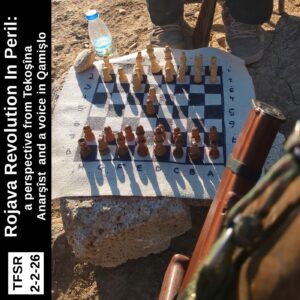
We’re sharing this episode a little early so it’s still timely as relates to the threats faced by the Rojava revolution in north and east Syria.
First up, we’ll hear some updates and assessments from Garzan, a member of Tekoşîna Anarşîst, an internationalist anarchist structure based in Rojava and aligned with the Syrian Defense Forces. Garzan’s voice has been re-recorded for anonymity and a transcript of their audio is available in the show notes.
- Transcripts
- PDF (Unimposed)
- Zine (Imposed PDF)
Then, we hear from Jînda a western activist engaged in solidarity with the Rojava Revolution to speak about what the spread of Syrian transitional government and the Turkish-backed so-called Syrian National Army militia into areas formerly under control of the Syrian Defense Forces means for women and different ethnic and religious minorities.
Some Further Reading
- You can follow TA by visiting https://tekosinaanarsist.noblogs.org/ where you can also follow their war updates
- To check out that report by Rojava Information Center on ISIS prisoners under the Syrian transitional government, visit https://rojavainformationcenter.org/2026/01/isis-escapes-as-a-result-of-syrian-army-assault/
- An article that TA shared recently, though with some disagreement in the critique “Kurdish Reaction To The Current Situation In Rojava” by Zaher Baher is available here: https://libcom.org/article/kurdish-reaction-current-situation-rojava
- Our past interviews on Rojava: https://thefinalstrawradio.noblogs.org/post/category/rojava/
- Revolution In Rojava: Democratic Autonomy and Women’s Liberation in Syrian Kurdistan : https://classautonomy.info/revolution-in-rojava-democratic-autonomy-and-womens-liberation-in-the-syrian-kurdistan/
- Rojava Information Center interview with Lonjin Abdo who founded Lelun organization to support survivors of human trafficking by Turkish-backed SNA in Afrin: https://rojavainformationcenter.org/2025/07/lonjin-abdo-lelun-interview/
Some Internationalist Structures to Keep Up with Calls for Support
- Emergency Committee For Rojava: https://www.defendrojava.org/
- Internationalist Commune: https://internationalistcommune.com/
- Rise Up For Rojava: https://riseup4rojava.org/en/
. … . ..
Featured Track:
- TFSR by The Willows Whisper
. … . ..
TA Transcription
Garzan of TA: Yeah, I’m Garzan. I’m speaking as a spokesperson for Tekoşîna Anarşîst, an anarchist organization working and currently fighting on the front lines of Rojava in northern Syria. For pronouns, I can use they/them for now.
TFSR: For folks who don’t know, could you describe Tekoşîna Anarşîst, your shared values as a group, and maybe something about your relationship to the Syrian Democratic Forces and the Democratic Autonomous Administration in northeast Syria?
Garzan of TA: Yes. Tekoşîna Anarşîst is an international anarchist organization that’s based in northeast Syria, and it’s taking part in the local structures and the communes as well as other institutions of the revolution. We are also working with the SDF, the Syrian Democratic Forces, in the field of combat medicine. As anarchists, of course, we share many values and political ideas with the Kurdish liberation movement, and with the implementation of Democratic Confederalism in northern Syria. We can see many of our ideas being reflected in the implementation of Democratic Confederalism. But we also have a specific role as anarchists, trying to also bring some critiques and some perspective that maybe we don’t always see reflected in what’s going on in northern Syria.
TFSR: So in December of 2025, the Final Straw had an interview with Leila Al-Shami about the prior year of updates since the ousting of Bashar al-Assad and the foundation of the Syrian Transitional Government, or STG. Where we left that conversation about the relationship between the STG and the Syrian Democratic Forces, or SDF, was that there were plans to integrate the SDF into the Ministry of Defense at the end of 2025. I wonder if you could talk about the last couple of months of conflict and how the maps have been redrawn.
Garzan of TA: Yeah, a lot has happened in these last two months. Let’s say maybe the starting point is the agreements that were signed on March 10th, 2025. That was when Mazloum Abdi, commander in chief of SDF, visited Damascus. There were long negotiations with mediation by the US about the integration of the SDF into what would have become the new Syrian army. That is an ongoing process. It seemed that the negotiations started off good and there was an agreement reached, but it has been said by many sides that these negotiations suffered a lot due to external pressure from Turkey. It is important to remember how Turkey has a lot of presence and power in what is now becoming the new Syrian government. Turkey has been aiding the Syrian transitional government in reaching power and also have been making the negotiations between this transitional government and Western states possible. As a NATO member, it had access that allowed HTS, this group that grabbed power in Damascus, to have direct talks with Western powers. Turkey, with its neo-Ottoman dreams to expand their territory and also together with the long term war against the Kurdish people, has been pushing for things that were not acceptable for the autonomous administration. They were making really heavy demands of the SDF, like that it offers a full surrender to the central government of Damascus, making it very difficult to reach agreements. So, at the end of the year, there were several points that were agreed to between the autonomous administration and the Damascus government. But at last minute, Turkish envoys made new demands that were unacceptable to the SDF. Immediately following that, the attacks on Aleppo started at the beginning of January.
So, that has been the trigger point for this last escalation. And one of the things that has always been on the table was how much this centralized government, this new government in Damascus, was trying to impose a model of a unitary centralized state. Meanwhile the autonomous administration was demanding a project of a federal nation, a federal Syria, where minorities can have rights for their autonomous administrations. And that was one of the main discussions where reaching agreements, of course, was not always easy. The other point that was always on the table with the integration of SDF into the new Syrian army was that the SDF was demanding to integrate as an autonomous division, while the traditional government was demanding integration of the SDF soldiers as individuals, dismantling the structure of SDF. So these were two of the main points that were portrayed as difficult to reach agreements on. But every time that the agreements were finally reached, Turkey was also pressuring for more. This caused the collapse of the agreement of March 10th and is what triggered this escalation at the beginning of January.
Of course, when it comes to the political formation of the state, it is very relevant for minorities to be able to have some autonomy on how they administer their areas. This point of the military integration is also very important, not only for the Kurds, but for all minorities to have access to means of self-defense. We saw what happened when ISIS entered and the Syrian army withdrew from many places was that minorities really suffered a lot. And that is one of the points: this diversity that exists in Syria requires that minority communities have access to to self-defense to prevent other genocides. One of the most frequently pointed to examples of this has been the genocide that the Yezidi people suffered in 2013 at the hands of Daesh. And of course, these kind of attacks on minorities can repeat over and over again and the solution that the Rojava revolution is proposing is community self-defense. That’s why it was so important to sustain this autonomy of armed forces that are connected to their own communities.
When it comes to how the situation has developed, it is important to see how at the beginning of January, there was a siege on the Kurdish neighborhoods of Aleppo where it became impossible to to bring in food, medicines and especially fuel. We know that this has been an extremely cold winter and it was a really difficult situation. The siege of these Kurdish neighborhoods of Aleppo was followed by a military buildup, and then clashes started. It’s important to remark that these neighborhoods in Aleppo have been home to Kurdish people for a long time and that they had been defending their neighborhoods for a while. They had been confronting both the different Islamist forces that attacked them since 2012, but also confronted the Assad regime, defending autonomy in the region. Now with the siege of Aleppo, there was a risk of massacre in those Kurdish areas. After negotiations, there was an agreement that SDF forces would withdraw from these neighborhoods and some other areas close to Aleppo, especially Deyr Hafir and Maskanah.
It seems that the agreement was also mediated by the US, but the Syrian transitional government forces advanced beyond the lines that were agreed and they attacked different SDF groups that were withdrawing. This made the situation extremely chaotic because it was presented in media as “some Arab tribes decided to attack areas under control of SDF” and that “some Arab tribes inside SDF decided to change sides and support the transitional government.” And with this chaotic situation, SDF forces decided to withdraw further, making it possible for transitional government troops to take control of Tabqa and later all of Raqqa. And I think it’s important to make clear that this seizure was not clean, like there has been a lot of infighting and there have been many fighters of the Syrian Democratic Forces that stayed behind to defend the people, in order to make possible for non-combatants to withdraw as the transitional government forces advance. The numbers are still unclear because it has unfolded quite recently, but UN is already publishing numbers of more than 130,000 people displaced by these attacks.
And of course, in this chaotic withdrawal, one of the critical points has been the prisons holding ISIS. In Raqqa, there was an important prison where high ranking ISIS fighters were held and the prison was also sieged because SDF forces held their ground to maintain security in the prison. It is known that another prison for ISIS, allegedly civilians, in Raqqa was emptied as soon as the transitional government forces entered the city of Tabqa. So there is a lot of uncertainty of how much these ISIS prisoners will be kept in those prisons, or if SDF was withdrawing, how much the transitional government will just open the prisons. Because of course, we know that the transitional government forces are not a unitarian force: it is a big mixture with Hay’at Tahrir al-Sham at it’s core, an Islamist force that in recent years has presented itself as more moderate. But we also see how in the last month there have also been the SNA, the Turkish proxy forces, being included. And at the same time, there are many forces that are presented as Arab tribes that are joining the ranks of this this new, improvised Syrian army. There have been videos and pictures of some of these fighters openly wearing patches of Daesh. So, how much these Islamist forces that are present in these attacks were aiming to open the gates of the prisons is something that is still not clear and we will have to see.
Maybe the most extreme example has been in Al-Hol camp, the biggest prison camp that is holding ISIS members, mostly families. Al-Hol was mainly for women or children of ISIS and the SDF was running the security for many years. But there is an extensive report on the attacks that that camp suffered and stating that the SDF at some point decided to withdraw from the Al-Hol camp because they were under attack by forces connected to the transitional government. We invite everyone who wants to dive in to read the report of the Rojava Information Center that has an accurate timeline, including videos on how this happened, because this has been heavily covered in the media. And some media are using this incident as an excuse to withdraw support from the SDF, portraying it as the SDF withdrawing from Al-Hol. But, in fact, the reality and the videos that the Rojava Information Center published in this report shows how there was an attack that made it very difficult for SDF to sustain security. This attack was coordinated on one side in the town of Al-Hol itself with an attack that also was pushing towards the camp. Immediately after SDF forces withdrew, the forces of Syrian transitional government that were already approaching the camp allegedly took control of security. Until now, it hasn’t been clear how many of the people that were held in those camps managed to escape.
In addition, once the transitional government forces took control of Raqqa, they continued advancing north, taking control of Ayn Issa and surrounding Kobanê. Kobanê is a very symbolic city for us. The resistance against the Islamic State in 2015 was one of the main events that made the revolution of Rojava reach international press. And it’s well known how Turkey has been making moves for several years to make sure that the Kurdish forces can’t keep their presence in Kobanê, often threatening invasion. Right now, Kobanê is again under siege and is surrounded by government forces that had been attacking the outskirts of the city.
So the situation is changing every day, every hour, every minute. And I’m not sure what the situation will be when this is published. A couple of days ago, the end of January, a humanitarian convoy entered the city and was able to provide some food, some blankets, because the situation in Kobanê is a humanitarian crisis. We can see how the whole population from surrounding towns and villages have been withdrawing towards the city for safety. There is an immense influx of refugees arriving to the city but there is no place to host them. And this is a really cold winter: there were several years that we didn’t see snow in Rojava, but this year it has snowed a lot. More than five children already died from cold because of the cuts of electricity and the lack of of petrol for heating. The cold is really, really extreme. And of course, all these displaced people that don’t have access to shelter are in extreme need of humanitarian support.
With this situation, it seems that there was a big reorganization of the map as the SDF decided to withdraw to prevent a bloodbath, letting the areas of Arab majority fall under control of the advancing forces and withdrawing to the areas of Kurdish majority population. This was also followed by advances in other areas, like Tell Hamis, where the transitional government forces took control of one of the border crossings with Iraq. And right now the situation is still changing, but it seems that a new round of negotiations have started with this extension of the ceasefire that was made at the end of January. Today, January 30, SDF made an announcement explaining that agreement was reached, that they want to prevent a massive war and therefore they made an agreement that can be found in many media and that probably will make it to the mainstream news soon. What this statement means is something that we will need to wait and see. As for the statement, it is saying that there will be a stop to the armed conflict, to withdraw from contact lines, ensuring that SDF will be integrated into the new Syrian army as an autonomous force and allowed to deploy in their areas in the Hasake governorate and another brigade in Kobanê.
The big question is not only the military one, but is the civilian and political one. How the institutions and the structures of government of the autonomous administration will merge with the new Syrian state structures is still a big question. We know that the autonomous administration has been the most stable force in Syria in when it comes to political administration. The experience that the people running this self-administration acquired is remarkable. We have been witnessing a society without the state able to administer all the aspects of society: from art and culture, defense, economy to the most simple things of even waste management, health… Health is not the simple one. It is quite a complicated one. But it has been proven that governance without a state is not only possible, but that it works. And that has been one of the main issues for the surrounding forces, that they want to exterminate this example of how democratic self-administration, self-management works. And the need of a centralized nation-state is not an imperative. This is the proof that there is an alternative, that this State system that is totally dependent on a centralized authority is not mandatory. This shows proof that administration and organization can exist without a central authority.
So, yeah. So many things happened in these last two months that is even difficult to summarize. But maybe that’s what we can say for now.
TFSR: So, we’ve heard and you mentioned that a large proportion of Arab tribes, according to mainstream media, left the SDF, but also that a large proportion of the fighters in the YPG and YPJ in the last few years have been Arabs, not just Kurds. When people talk about Rojava or the SDF or the DAANES, oftentimes it’s referred to in the media as “Kurdish-led” or “the Kurdish movement” or what have you. But just to put a point that it’s not just Kurds that are participating in these structures. Is your understanding that there has been this Arab exodus from the structures? It sounds like not exactly the way that the media portrays it. Or was it that membership of pre-existing clan militia and brigades that were within the SDF defected? And what of other ethnic and religious groups like Christians that had been a part of the SDF?
Garzan of TA: Yeah, that is a really complicated question also for people who are not familiar with Middle East, because we need to understand how important and how alive the tribal structures still are, especially for Arab peoples. The tribal structure is quite infused with patriarchal logic where hierarchical decisions are made by the male heads of the tribe. And also it has a component of community in the sense of the loyalty to the tribe is far more important for all these people than the authority of any state or any political body or any force that is there. I won’t get deep into the political aspects of this, but this also comes with a reality of tribal conflicts and tribal dynamics where some of these tribes also compete among each other for influence, for power, for access to resources. And there are inner conflicts and inner wars even in between tribes where this brings some of these tribes to change alliances, not only according to what they think or to what they want, but also according to who they have been fighting against. We saw during the times of the Islamic State, how some tribes were pledging allegiance to the Islamic State while some of the tribes that were maybe in conflict with those tribes were directly pledging allegiance to the SDF. So, there is an internal dynamic of tribal conflict that played a role in this situation and that also made it possible for the Syrian transitional government to contact and ensure alliances with some tribes, not always because of proximity or for ideological lines, but because of the tribes that they are fighting against.
With that said, it’s true that there were some tribes that also changed sides, having been with the SDF and then decided to pledge loyalty to the Syrian transitional government. But there are still many Arab people and even many Arab tribes that are integrated and working alongside the SDF. It isn’t a secret that the Syrian government was in negotiations with many tribes for a long time. Even after the attacks at the end of 2025 in Suweida, the government has been creating a really strong narrative of defending the tribes using this claim that the Arab tribes that are attacking the Druze are not always government forces, but these tribal armies that decided to fight for the national unity of Syria. So we saw this narrative from the transitional government used to get closer to and to get support from these tribes. Clearly they were expecting some of the tribes to join there and probably there were previous agreements. This situation, of course, create a very dangerous narrative about ethnic conflict. The democratic self-administration has been working for a long time to overcome these ethnic tensions and these ethnic conflicts to try to create with a sisterhood of the peoples, trying to work along ethno-nationalist divisions, trying to bring people’s unity. And now these divisions are again an important issue.
Many Kurdish people seeing what has happened are again mistrustful of Arab people. There are large concerns about parts of SDF changing sides. So this is a really dangerous path that leads again to ethnic tensions that will be difficult to balance because the media is using it a lot, exacerbating tensions and isolating the SDF, presenting it as just Kurds and presenting it as if the transitional government is the rightful representation of Arabs. This simply is not true, but it’s a narrative that presents this government as the legitimate power of Syria. This is a very dangerous thing to do and we will probably see in the coming years, even decades how these ethnic conflicts will bring disastrous consequences not only for Syria but for the whole Middle East.
When it comes to other minorities, especially Christians, they are siding with SDF because they know the Islamist roots of the current government. Also Christians suffered horribly when ISIS attacked in 2014, so they know how dangerous Islamist forces can be when they portray Islam as their political force. I think it’s important to also point this out: that we don’t want this to fall into ethnic conflict, but it’s also important to not fall into religious conflict because the problem is not the religion. I think the autonomous administration made huge steps here in the sense of understanding that religion as an ethical component, it’s something that needs to be protected, but it’s something that should not go into politics. Religion is something that people can experience as they want in their life, but it’s not something that should guide political elements of society. Still, we can see that these Christian minorities that right now are probably very afraid to see what’s happening. We have already saw attacks in Damascus, mostly by ISIS and other jihadist groups attacking churches, attacking Christian centers, and the transitional government is very aware of how much these Christian groups often have stronger connections with Western states and that massacres on Christian communities will also bring a price in the media, in the credibility that they have. So the STG will probably try to make deals, to make agreements with these minorities promising some degree of autonomy in exchange for defecting from their support of the autonomous administration. And we can see how all authoritarian governments always work with this imperialist logic of divide and rule.
I think it’s also important to note that in this narrative of ethnic tensions, we also see how it’s affecting the Kurdish people. We see in their expressions of solidarity a rejection of this sisterhood of the peoples, this importance of working together with the Arabs, with the Armenians, with Syrians, with all the different ethnicities and we can see a rebirth of tendencies of Kurdish national unity. And these more nationalist tendencies, that this is also encouraging for other Kurdish forces, especially connected with the Kurdistan Regional Government in Iraq. In this we see how this nationalist narrative for Kurdish people are also gaining some traction and this is something that we should also be be aware and challenge.
I think the experience that have been developed in North East Syria, it’s a really important experience to always remember that this brotherhood, this sisterhood of peoples, is not only possible, but it is the only way to really bring autonomy for the different communities and to co-exist, building unity in this diversity.
I think there is this really interesting sentence also, from Dr. Kizilhan, a Kurdish neurologist working in southern Kurdistan, in the Iraqi Kurdistan, in an article that he wrote about what is going on in northeast Syria, and mentioned that Rojava was not attacked because it was unstable, but because it worked. Because it demonstrated that diversity, participation and self-governments are not a weakness. For authoritarian states, this is the real threat. And I think it’s important to to remark on this, to know that what Rojava is proving is that building unity in diversity creates really strong communities. And strong communities don’t need a centralized government, don’t need a nation-state.
TFSR: Yeah. And the model doesn’t need, like, nationalism because there are ways for people to express their identities as well as participate through shared identity, through councils with other people that share those identities and advocate for their own rights, right?
Garzan of TA: Right.
TFSR: So you mentioned that Kobanê is under siege and surrounded by SNA militia and Syrian transitional government forces, and Hasakah in Cizîrê seems to be being divided by ethnicity and on the edge of conflict. Can you talk about the apparently shared vision of the Syrian Arab Republic and the Turkish state under Erdoğan of ethnic division and rule, which you’ve already sort of touched on, and why the system of Democratic Confederalism poses such a threat to them through this stability, as you mentioned, that it offers?
Garzan of TA: Yeah, it’s exactly what we were talking about. You know, like how this nation-state logic, this imperialist interest, these power games… Nation-states always rely on this, trying to exploit the differences in between peoples to pit them against each other, to be able to control them and to rule them and impose a central authority. So this is a reality that is valid for Middle East, this is also valid for anywhere else. And this is something that I think, from an anarchist perspective, we can see how this narrative is always presented and that it’s our responsibility to challenge it. People can organize themselves. The states need for central authority is always creating this narrative that centralization is imperative. This comes even from Hobbes, from the Leviathan: the understanding of a state as necessary to control the wild humans, this homo homini lupus, the “man is a wolf to man.” Well, this narrative of a need for an external force to control people is something that we have been challenging as anarchists for almost two centuries. But of course, we also need to consider the dynamics of the Middle East when when we think about how these attacks on Rojava are happening right now. Because, I think, it’s important to look at the ideological aspects of what is happening. But we can also look at the current powers that are playing these roles of imperialist forces in Middle East. We can always look at the big geopolitical force and at the tensions between NATO states and Russia. But in the Middle East, we have also important regional powers like Turkey, like Israel, like Iran. And they are players on the game board that the Western colonialism imposed in the Middle East, this model of nation-state. They are trying to become the hegemonic forces of the Middle East, following this model of centralized authority of the model of nation-states. And of course, Democratic Confederalism questions that not only on an ideological level, but at a practical level. Rojava has been the greatest example of practical implementation of Democratic Confederalism. And it’s proof that local autonomy is possible, that self governance outside the national state is possible. So, imperial forces are more interested in centralized governments that can be lured into following their agendas in exchange for some crumbs of the pie. And we can see how they are exactly doing that.
Now, the US that has been supporting military SDF is openly stating their support for this transitional government. And they are very aware that the leading forces of the transitional government come from Al-Qaeda and that the man that is today’s president of Syria had been on a terrorist list. But they are also aware that a centralized government is much easier to control, to manipulate, to make agreements, and especially is much more susceptible of corruption. That we saw how the self-administration of north eastern Syria, where power is decentralized into the communities, into the peoples, there is not a central authority that you can bribe to have access to the resources or to whatever outside powers want. And this has been one of the elements that at the end of the day made the forces that are based on this nation-state model decide to support whoever follows their nation-state model. This new transitional government is openly playing that game, not because it’s what they want, because it’s what Turkey told them to do. And it worked: they followed the instructions of Turkey and they now are being accepted as the new government of the Syrian nation-state.
What is also important to point out is the role of women in the revolution of north east Syria, because this is one of the foundational pillars of Democratic Confederalism. And this is not a coincidence, because we are very aware that state logic is a deeply patriarchal logic that does not recognize humanity in women. Democratic Confederalism does a lot to encourage the full participation of women in society and in all the realms of society, especially in political and military areas. This means a fundamental shift in the approach and not only in the political life and even military life, but also in the meaning of how to organize society, how to build community. This different way to look at society, to look at organization of governance, it’s a clear threat to how the power is organized.
So, maybe a last point that we want to make on this is how ISIS is also using the tensions of the moment to reorganize. As we mentioned before, there are many images out there of fighters that are formally fighting for this new Syrian army that are going around with ISIS patches on their arms. And as we have said, this government has its roots in Al-Qaeda and there is not so much ideological difference with ISIS. Nevertheless, there is a political difference, because right now, one of the conditions that the U.S. is imposing in order to accept this transitional government as a legitimate government of Syria as a nation-state is that it joins the international coalition against ISIS. And we can see how they have been collaborating until now, and with the U.S., on eradicating the most radical elements of their own movement. So, this plays out in a really strange way. Like, recently we saw an attack on U.S. soldiers, and the person who did that attack was openly part of this Syrian transitional government. The statement of the Ministry of Defense was almost funny, saying that, “Yes, we knew that this person was really radical and we were about to kick him out before he made this attack on the U.S. soldiers.” So, this is something that they are very aware of, that these people are close to ISIS. But I think it’s important to see that that’s what the logic of nation-state is about: it’s about centralization, it’s about power, it’s about, especially, patriarchal way of understanding power. And this comes, at the end, to fascism in the sense of this really male way of organizing force, of organizing society based on hierarchy, based on control, based on domination. And that’s also why they can understand each other so well.
I think it is important to look at the experiences of northern Syria through this lens that the main point of this revolution was to put the role of woman in the center of political life, in the center of social organization, and to think in ways that can escape the patriarchal logic that is the foundation of nation-state.
TFSR: What has been the result so far of the pushing of the SDF out of control of the prisons housing the tens of thousands of ISIS prisoners, and what is feared? Like, I recognize that the situation was untenable, the situation was not a situation that the SDF wanted to be in, and (as has been discussed in a number of the interviews that we’ve conducted on the show before) it was basically foisted onto the SDF. This was because, among other things, other countries, nation-states, refused to repatriate (and possibly put through trials) individuals that came from abroad who had gone to join the caliphate in Syria. So, it was a problem that all of these people are coming from all over the world. In some cases, some people are from the Levant, from the region, but they just sort of get foisted because the SDF doesn’t want to just kill a bunch of people. They have to hold them until something kind of comes to a resolution and people can face some sort of actual trial for what they’ve participated in. And you mentioned the situation with Al-Hol and the timeline on the Rojava Information Center’s website, which I want to put that report into the show notes. But yeah, could you talk about what’s feared and what’s happening with those prisons in a little more detail?
Garzan of TA: Yeah, this is a really complicated topic right now because it’s also in the center of the debate in some aspects. Like on one side, we have really dangerous people with deep military experience in those prisons that are a threat not only for Syria, but for the whole region and for the whole world. As you already mentioned, there are people that have passports of many, many nations still in those prisons and, of course, the home-states don’t want to repatriate those people. But then the problem was what can the self-administration do with them? There was an important push for calling for international trials, for looking a bit at the example of what happened in Nuremberg after the Second World War and to demand some international court that can do that. But then the corona virus pandemic happened and everyone kind of forgot about it. And it is a really big problem that also takes a lot of resources: not only to being able to feed and take care of those people, but also in security, because there have been constant attacks for from ISIS cells on those prisons. And even in 2022, if I’m not wrong, there was a big attack where some of those fighters in Hasakah managed to escape and create a big conflict in the city that lasted for almost two weeks. So this has been a constant threat, a constant risk that the self-administration had to navigate the best they could.
But now there is this agreement of the Syrian traditional government taking control of those prisons. Interesting to remark that the U.S., knowing that this is what’s happening, the first thing that they did during this extension of the ceasefire was to start a mass transfer of the most dangerous prisoners, the most dangerous commanders and leaders of the Islamic State that were in those prisons in Syria and into high security prisons into Iraq. So the numbers that they are saying is over seven thousand ISIS militants that have been extracted from those prisons and being transported to high security prisons in Iraq. They are also aware that it is not clear what will happen when the transitional government takes control of those prisons. Well, they are moving those people like they have reasons to doubt how much the security of those prisons will stop ISIS to become a threat again. And this is not something completely unthinkable. We saw in this last year, a massive resurgence of the Islamic State, especially with the collapse of the Assad regime. There was several attacks on military posts of the Assad regime, where ISIS cells acquired new weapons, acquired new areas of control in the deserts of Syria.
So ISIS is growing again. There was a report recently from Iraqi intelligence saying that they counted the active militants of Islamic State in Syria and Iraq in the last year jumped from 2,000 to 10,000. So, it is not unthinkable at all that in these next months, we’ll start to see a massive resurgence of the Islamic State, not only from those people that are already loyal to the Caliphate fighting on the ground, not only from these people in prisons that can escape, but also from opposition lines inside what is becoming the new government of Syria that disagree with how this transitional government is handling the negotiations with Western powers. There are many voices of more Islamist voices inside the current government complaining about this approach to US and demanding a much more Islamist way of government like they had before in Idlib, before getting control of the central government in Damascus. So we are seeing statements of groups that are defecting from the Syrian transitional government and joining the ranks of Islamist groups that are in almost complete alliance with the Islamic State. So this is something probably would lead to to a resurgence of Islamic State in Syria and Iraq, but maybe in the whole Middle East in this year to come.
TFSR: So updates from Tekoşîna Anarşîst included mention of a Druze uprising in Suweida while the STG is busy in the north east and also fears by members of the Yezidi population of a renewal in Shengal of the recently released ISIS prisoners continuing their genocide against the ethnic religious minority. I wonder if you could talk a little bit about like what is happening in your awareness in other parts of the country? And again, how this is sort of reverting back to the destabilization that was experienced, you know, during the rising of ISIS and the Assad regime?
Garzan of TA: Yeah, in regards to other minorities, it is true. There were some Druze figures calling for an uprising and there was even some clashes between Druze militias and the transitional government forces. But the situation did not escalate further. That doesn’t mean that it cannot change. As I said before, things are changing every day, every hour. But for now, it seems to not be something that is escalating further. But with the new rising of the Islamic State and other groups aligned with this Salafist ideology, the threats for minorities are skyrocketing. Like Damascus already saw bombs in churches, as I mentioned before. So, these Salafist groups are kidnapping, are torturing, especially in the central, desert area of Syria. Their attacks are increasing a lot in the last months and their activity is much wider than it has been before, in the last years since the collapse of the Caliphate. And of course, that brings to the question, like, how will the new Syrian state react to that? Because they can, for example, do what the Taliban are doing in in Afghanistan, presenting themselves as the new state that’s fighting against the insurgency of the Islamic State and similar groups. But they can also decide to lean more on cooperation with those groups, because at the end of the day, they share a similar path, they share the same roots. So it’s difficult to know how this will develop. For sure, minorities in Syria are scared of the developments.
TFSR: Can you talk more about the role in the current situation that the US is playing on the ground? And how is Trump’s conflict with the UN and foundation of the “Board of Peace”? How is that shifting the tensions around?
Garzan of TA: Yeah, we already mentioned a bit on the role of the US now. But what seems clear is that they are trying to get out of Syria and they are making this media campaign of presenting that Syria now has a stable government, that the war is over. So this is a strong media narrative that the White House is currently pushing that will allow them to do similar to what they did in Afghanistan: i.e. withdrawing forces. And how much this is just because of what Trump was promising when he entered the White House? How much of this is preparing a new war against Iran? That’s something that’s still not clear. The role that the US Special Envoy in Syria is playing is very visible, really grabbing the headlines. And we want to remind everyone that Thomas Barrack is not only a Special Envoy for Syria, but also ambassador for Turkey. And he’s a real estate businessman that some years ago made it into the Forbes Magazine billionaire list. This is a person that has been an old business buddy of Trump. So he’s not there because of his political career, but because of his business career. We see that this current government in the US, more than a political government, is a business board. And that’s how they are doing politics.
TFSR: Yeah, Trump has even commented in the past that “Well, we’re there so that we can get access to the oil that’s under the ground at a decent price” or whatever, or doing this quid pro quo exchange of defense support in exchange for resource extraction.
Garzan of TA: Yeah, and this is creating a narrative. And I think that maybe that’s, for us, one of the main points that we also want to remark on. Of course, in this conversation, we’ve been talking a lot about like geopolitics and like military development. But what Rojava has been bringing is hope, is the praxis of a dream on the ground. Bringing this way of imagining, of thinking other ways to organizing societies. It’s possible that it’s something that we often forgot. It happened in the ‘90s with the Zapatistas and it’s happened now also with Rojava. This proof that when people organize themselves, they can put into practice systems that are much more human, that are much more respectful of life. And this is putting into question the current powers that are really focused on business, on management of economical growth. They are not looking at humanity, they are not looking at people, they are not looking at life, they are looking at resources.
This is probably the most important experience of Rojava: that it is possible to build models that are looking at society, that are looking at people, and trying to bring people together to discuss together with your neighbors, with your friends, even with people that speak other languages and have other religions in order to sit together. Then we can realize that, “Well, we are the ones living here. And we are in this together. And if we can solve our conflicts, if we can find solutions by ourselves, we can build our own administration, we can run our own towns, we can build and develop our systems of governments based on the municipality that we are living.” And this is an example that, for sure, even if the autonomous administration of north east Syria is now being assimilated by this nation-state model in Syria. The examples and the imaginary that it developed are something from which we can learn a lot. And we will need to learn a lot, because the times that are coming are really difficult times. So these examples of freedom, of liberation are the things that can bring blueprints in what we can imagine new futures.
TFSR: I’ve seen the request for international solidarity answered by marches, in some places by protests at Turkish Airlines (which is like 50% owned by the Turkish military, or the Turkish state), and by a caravan or a convoy to bring aid. What are some good ways that people can engage from abroad to support the hevals and comrades in the Democratic Autonomous Administration of North and East Syria?
Garzan of TA: Yeah, that is a really good point. And of course, comrades are calling for everyone to go to Rojava because as we were saying: this is a model that is based on building together. And there, all comrades who want to support it are welcome. And the more we are, the more we can think about different ways of solving this issue. But of course, we are aware that not everyone can travel. And there are things that are always needed for now, as we mentioned, the humanitarian situation in Kobanê is desperate.
One group to support is Heyva Sor, the Kurdish Red Crescent, the main humanitarian organization that has been sustained for many years now for the internally displaced people. It’s doing an amazing job, you can look for them and donate to them. We always recommend that if people want to donate money to humanitarian organizations, that’s the most reliable one and it has been working on the ground with the people on the ground. Unlike many international NGOs where money often doesn’t go to what one hopes, Heyva Sor are really present on the ground.
The main thing is also following the situation, get updated on the things, and pay attention to the different calls and initiatives that the different solidarity groups are putting.
TFSR: Also a great source of info here’s the Rojava Information Center. There are other internationalist initiatives that people can get news and try to put into the show notes.
In the US, there’s the Emergency Committee for Rojava and I think there are regional initiatives that are either focused on Kurdish culture and Kurdish community, or on the Rojava Revolution and Democratic Confederalism properly. So yeah, I’ll try to include some notes of that.
Garzan, is there anything else that I didn’t ask about that you want to mention while we’re on this call?
Garzan of TA: I want to remind people to remember that there are many comrades that are still on the front lines getting ready to defend this revolution, because even if now it seems that a new agreement has been reached, we know that agreements were reached before that were not respected. So the threats of military escalation is always there. And it’s important to remember and to also think about all those comrades that are in this cold winter, resisting on the front lines. And of course, to think also of all the comrades that already gave their lives to make this revolution possible, to make Rojava and all that it means possible. Because it’s also thanks to their sacrifice that we can talk about it today.
TFSR: All right. Well, thank you for taking the time to have this conversation and for the work that you’re doing.
Garzan of TA: Thank you very much for the time here. And yeah, keep up the struggle, love and rage.
TFSR: Love and rage.
. … . ..
Jinda Transcript
Jînda: So my name is Jînda, and pronouns, she her. I’m currently in Rojava in northeast Syria. That’s enough. I think.
TFSR: I wonder if you could say a bit about the big news of the last year of [Abdullah] Öcalan declaring from the prison island that he’s been held on since 2003 about the disarming of the PKK and its reintegration back into civil, democratic organizing?
Jînda: Sure. So this is very hard question to start with, and it’s a very big ongoing process, which honestly, in a lot of ways, feels quite separate from the process on the ground here of what’s happening in Rojava. But then in other ways, we can see how these things are connected geopolitically with Turkey’s policy on the Kurdish movement as a whole, on repression in back or in northern Kurdistan, and also the kind of rhetoric that’s used against northeast Syria and and Rojava and the Kurdish people as a whole as well. Currently, the PKK is still in a peace process, but in terms of development on this, it hasn’t moved that much. Turkey is still calling this “terror-free Turkey” process, and the PKK has symbolically laid down arms. In terms of its dissolution, they’ve also said that it’s a requirement for Turkey to become a Democratic Republic before there can actually be a true dissolution into the state, essentially, or kind of alongside the state, is perhaps more accurate. And I think there were a lot of different reactions to this in places outside of Kurdistan, but also within Kurdistan, to what this looks like, or what people can imagine this to look like: people have been grieving; people have been excited; people have been confused, also. But I think that when these big statements are made. For example, some months ago, there was this burning of weapons that happened in the mountains. At this point, it’s still at the level of negotiation, I would say. But on the ground, what this looks like really depends a lot on what steps Turkish state decides to take, and this depends on their broader goals in the area. And also which wars they want to fight in with who. Now also with Iran and Israel, for example, and the US seeming to gear up to attack Iran. Turkey’s role in this, in terms of how it decides to protect its territorial integrity on the border with Iran, but also in Syria: all of these things are kind of like different parts of this broader strategy to maintain influence, defend the state, expand influence, and so on. And the PKK peace process is just part of this.
But in terms of also the ideological aspect, from the outside a lot of people thought, “Okay, this must mean that Abdullah Öcalan and the PKK, they’ve just completely given up on their Democratic Confederalist model. They had no longer Revolutionary Socialists, etc, etc.” But actually, this has been, in some ways, it’s actually a kind of reaffirmation of the same paradigm that’s been present since 2003. For example, there’s a new manifesto that Öcalan released in the beginning of 2025 and in this he is saying that there actually needs to be the building of communes, like communes as a kind of basis of a grassroots self governance model, physically in neighborhoods and so on. But also in this more socio-political sense as well, in terms of collectivity. It’s actually a very philosophical meaning of, like “What does it mean to be a commune?” And here, in Rojava, there are very physical manifestations of this. Every neighborhood actually has a commune. They’re also the People’s Houses. Now the communes have become very active because of the emergency situation, because of this new war situation, but also they have been present since close to the beginning of the revolution. And essentially this is part of the kind of broader idea of the Democratic Confederalist model. The Democratic confederalist model is being implemented here in Rojava, but also it’s something that Abdullah Öcalan is saying actually should be implemented everywhere, ideally everywhere in the world, to overcome capitalism and the nation state and ecocide. He’s actually saying the PKK has kind of outlived its purpose because it has this fossilized presence as a party, and it hasn’t been able to let go of its internal hierarchies and older models of working. [He’s saying] hat really there needs to be full participation of society, of the people, and of all kinds of people, to build this really grassroots self governing existence, a free existence. He does say, also, [that] “this cannot happen if the Turkish state is operating as it currently is, and there needs to be very big changes there too.”
The peace process of the PKK in Turkey is a distinct process from what’s happening in Rojava. And as you can see now, there’s a very hot war situation here. The YPG and YPJ, they’ve also said very explicitly the entire time, and including since the PKK peace process has been happening. that “We are not related to this process. We are the defense forces of northeast Syria. We will continue to exist. We will continue to defend the people and defend ourselves.” And especially now, for example, with the YPJ, the women’s defense forces, it’s a very strong red line that they will absolutely not be dissolved.
TFSR: So, the democratic autonomous administration of north and east Syria has been often described as a Kurdish movement. However, the goal, as I understand it, has been to foster a more direct democracy through participation of many ethnic and religious groups in the area, as well as increasing participation of oppressed populations, such as women in these areas and aong the ethnic lines. Are you able to get an impression of what non-Kurdish communities want to continue or want to get involved in the Democratic Confederalist model versus under the centralized model of the Syrian transitional government or something else?
Jînda: Yeah, so this is also very good question, and it’s quite a complicated question, and it really depends on where you’re answering from: like, which city, which rural area and so on. For example, now with the hot war situation and the big military offensive by the transitional government against the SDF-held areas, this changing power structure has forced a lot of changes in allegiance. Some of these are very unsurprising, like in Deyr Ez-Zor, for example. I don’t think that the Autonomous Administration system was never really present there, honestly. Also, like in Raqqa and Tabqa, I think the situation is quite complicated. It was not the same as in Qamishlo or in Derik or in Tirbespi or these other areas where the autonomous administration had more support or was built more by the people there.
And I don’t want to go too much into this because my information and experiences is also limited in these areas. But, for example, now we can see that where the kind of military front lines are we can also see that there’s a lot more support for the Autonomous Administration structure as well. And it’s not to say that in the other areas there was none. For instance, in Raqqa there was Zenobia Women’s Organization, which is a organization run by and also for Arab women (it’s very similar to Kongra Star) and they faced a lot of difficulties in their work. And they also have had to flee, now, which I can also talk about a bit later. But it’s quite different from the situation here in Qamishlo, which is also not an only-Kurdish city: there’s also quite a big Arab population here. Or in Tirbespi, there’s a lot of Yazidis, for example, and in other places, like in Qamishlo but also in Darbasiye, there are also Christians. Some of them are Armenian, some Assyrians. Some also Orthodox, as well some Syriacs. So I think it really depends. Sure, a lot of people do support the transitional government in Syria, at least to some extent. The tribal context creates a different social terrain rather than this kind of very urbanized context of places like Qamishlo. We had some conversations in Qamishlo with members of the Christian community and some groups who were previously quite supportive of the Autonomous Administration now aren’t saying they’re against the Administration, but they’re also not saying that they will any longer publicly state that they’re with them. But they’re also not aligning with the transitional government either. And this is coming a lot through fear, especially from the ethnic minorities. But We’ve also had conversations with other Christian groups who are saying the opposite, actually: who are fighting on the front lines, who are saying, “You know, if this transitional government, if their forces come, then we know what will happen to us, because it’s the same as ISIS, and we don’t want to face this type of annihilation, so we’ll just defend ourselves.”
So I also don’t want to collapse all of these different truths purely into ethnic lines, because I don’t think that that would do justice to the reality on the ground. And I mean everywhere, but especially in Syria and there’re many truths that sometimes seem to contradict, but actually do exist alongside each other. I think that in the ethnic context, this is one of the places where it’s most present and also most difficult. But I would also say now that I think there is more ethnic tension than ever in some areas. And I think this is a very big test for the revolution and the ethic that it’s tried to build over these 15 years. Because the Democratic Nation concept, actually, and also this phrase in Kurdish, which a lot of people are talking about now, which is biratîya gel… It’s is kind of like the “fraternity of people”, or “the brotherhood of people”… A lot of people are kind of criticizing this, like people from outside are criticizing this. For instance, Barzani in southern Kurdistan, in Iraqi Kurdistan, people who support this ideological strand which is very ethno-nationalist, also very capitalist, also has very good links with, like the Turkish state and so on. There’s a very big critique now [from these quarters] of the Autonomous administration saying, “Oh, why did you support this fraternity between people? When now you see that everyone has betrayed you?”
But it’s actually not as simple as this, although there is some fracturing along ethnic lines as well. I think that now what we’re seeing on the ground is that everyone is very worried for what the future holds. And that goes for all communities here in the major cities. Recently, we met a lot of Alawite Arabs, for example, who fled the rest of Syria and have come here to northeast Syria They’re really worried about the transitional government. There’s people who say, “We don’t support the transitional government” but they’re also worried what the future will bring if there is a hot war here. And we can see that imperialist forces depend a lot on divide and conquer, and especially by trying to concentrate down all of these different conflicts and nuances into nationalist lines and ethno-nationalist lines.
TFSR: A part of the model of Democratic Confederalism is to make spaces where people can talk through these conflicts that have been exacerbated and promoted and ruled along the lines of, for you know, centuries, if not millennia, depending on which structures we’re talking about. Whether it’s Western colonialism or if it’s going back to patriarchy… The fact that a 15 year project operating under emergency has come in and challenged some of these lines and invited people to organize in different paradigms, if you will, and then other organizations supported by from the outside, but also, including some of the social ground that people have been living through generationally. Trying to undo this much in 15 years, we can’t be surprised if those pre-existing lines of divide and rule don’t get brought back out of the closet, trying to get reimposed on the population. Right? It’s kind of not surprising if these divisions (despite whatever good idea or however powerful it’s been for people to get involved in Democratic Confederalist approaches) that divide and rule by ethnicity, by tribe, by religion, by gender, is still a thing that is being fought against. The revolution is a verb that is still ongoing and not just something that’s been completed.
Jînda: Yeah, yeah, absolutely,. I think in some ways, it’s so unsurprising, but then in other ways, it still feels a bit shocking to see how much in such a short time, after so much labor, and honestly so much pain that people have given… We visited a neighborhood commune just a couple of weeks ago, this was around the time that Şêx Meqsûd and As-Safira and Aleppo were under attack, and the war hadn’t spread out of there yet, or it was maybe just beginning, it was maybe just around like Deyr Hafir. We visited a neighborhood commune and sat with some women, two of them were the mothers of martyrs here, and one of them was the co-chair of the commune. We were just talking to them, like just spending some time with them and they were really worried, honestly. In that moment, they were still feeling like, “Okay, we’re losing our neighborhoods in Aleppo” and a lot of displaced people from Afrin were also living there. There was this worry that it would spread, that the war would spread. And they just said to us, “You know, for this whole revolution, we gave everything. We gave our sons, we gave our siblings, we gave our own blood. We gave our own sweat for this, and our dreams and our lives also. And you know, we’re not afraid of death because we’ve already come face to face with death. We’ve already lost the things most important to us, but we’re not willing to lose what we’ve gained in this revolution, and if the transitional government comes here and they attack us, if Turkey attacks us, then we’ll also fight back.” They said “We’re too old to join the YPJ or the SDF. But we also know how to use weapons, and if we have to, we’ll also use them against the enemy to protect ourselves.”
There’s also this big feeling now of loss and a worry for what can come. This point you just said about how these kind of unhealed or unresolved wounds and conflicts that have happened or been ongoing for sometimes years, sometimes decades and sometimes longer: they’re being exacerbated now. For example, now, the Woman’s Line and the Women’s Revolution, which I think this is also one of the most advanced parts of the Revolution, one of the most developed parts of it now clearly under threat. People are feeling this very strongly. There’s a very big anger, very big fear about this. And we can see this everywhere as well in the world, like when fascist forces take over. You know, patriarchy is reasserting itself, including in Europe and in the West in general. White supremacy is utilized, and anti-immigrant rhetoric is utilized as this very strong forefront of the far right rhetoric. But also, there’s so much patriarchal ideology in this as well. And [the] woman’s position is very incorporated into the fascist mentality in a specific way. I think this is also what we will see here. So, here the Woman’s Line is kind of on the forefront. It’s the thing that people are talking about most in society.
TFSR: You mentioned, for instance, [Zenobia Womens Organization] having to withdraw from a space that was fearing a takeover by either SNA or STG. As these changes are coming fast, are you aware of how the position of women in areas that are either under the control of government forces or SNA militias.. If their position has changed, or is it too soon to sort of know that?
Jînda: Yeah, so this is something that we’re also trying to understand, and at the moment, there’s very limited information on the situation. We know that the women who were in Zenobia, especially in Raqqa, they have mostly fled. And also some women who were involved in the administration or the Women’s Liberation Movement in general, they’ve also gone into hiding. We did also hear that some of the transitional government forces have been searching for specific women as well, like having their names and pictures and this kind of thing. In general, for the kind of day to day situation of the population in general, I don’t actually know how this is now. We don’t have very much information. And I think also, again, it can be very mixed, right? Where, for example, for a lot of people, probably the situation hasn’t really changed in reality. But also, the women who are very active in the political organizing, then, yeah, their lives are in danger.
TFSR: So the Al-Sharaa government had promised some forms of limited equality along gender lines, but I’ve also read that femicide is increased in those parts of Syria that are under the control of the transitional government, and Al-Sharaa is publicly refusing to shake hands with women and sort of giving these telltale signs that this is not the direction that his administration wants to go. I wonder if you have any comments on what the administration so far has been telegraphing, and what kind of speculation you have about where they’re going with that “limited equality”.
Jînda: From here, there’s complete, complete distrust of the transitional government’s line on women from many different women here, from many different organizations, and just in general, in the population. People are telling us that they are extremely worried, but not in the sense of shrinking from this, but they’re very, very, very willing to defend what they fought for here. Because also in northeast Syria, the rights of women were not always something taken as a given right? Like, there’s been a very strong struggle: physically, socially, politically, philosophically, ideologically, and all of these things have been really fought for. Within the family, within the community, within the political structure. Yeah, women are not willing to give that up. And I also think about how this was born in the revolution here. It’s not like everyone, all of the men, or even all of the women here, just accepted this from the beginning. And we really see that on the ground in northeast Syria. For example, there are many, many workshops and educations all of the time. Like in the commune system, in the schools, you know, on Jineology, this kind of decolonial woman science in workplaces, in the Mala Jin (women’s houses for reconciliation) and all these other things. And there’s this very strong attempt to change the mentality of society itself in line with a Woman’s Revolution paradigm. It’s an ongoing struggle here, really. It’s really an ongoing struggle. Today, one woman said to me that the Syrian transitional government, “They don’t want women to be economically independent. They don’t want women to be, in general, independent and liberated from the family.” This is something that is really, really ugly as a social reality, and they won’t accept this to be implemented here. This woman that I spoke to earlier, she was saying that “We’re really concerned about the rights of women, about the rights of children. And also families in general, because our ultimate aim is to create the democratic family.” When I use this word “democratic,” this is like part of the language of the movement here. It doesn’t mean this democracy that you might think of in the US context, which is a completely neoliberal, assimilated concept. It’s something that kind of means this very grassroots liberation, we can say. And she also said that “We are implementing here this 50 / 50 like men and women participation in political structures, and we have the co-chair system: having one man, one woman.” And this is something that the transitional government, for sure, doesn’t accept and it doesn’t implement.
I think it’s important to see the HTS and the Syrian transitional government, they’re pragmatic, you know, they’re not completely blind to how to create a level of societal support for their structure. They also governed for quite some time in Idlib and elsewhere. I also think that their approach to women was a bit flexible over time, it wasn’t completely, you know, 100% rigid. I really think it’s yet to be seen how this will actually work in the long term, because in the transitional government now there are a couple of women that have positions, but very, very few. And also how the legal system will be implemented. For example, under the Assad regime it was also very, a very patriarchal system, actually. This even though not all of Syria is so conservative. Like, there’s also the opposite of this, but the legal system always would prefer men over women. For example for the custody of the child: it was in very, very recent years there was a reform in the law where, basically the mother would also have a right to custody. In the past be only the father, automatically the father, because the father would be considered the head of the family and so on.
And I think that what people are saying here is that they have zero trust [in the STG]. They don’t see anything positive for women in the transitional government spaces. Even if there’s some show now that seems like there’s not a liberal approach, but a kind of a moderate approach. They believe that as soon as international attention is a little bit turned away, that it will become even more repressive. And people are saying “You know, they’re the same as ISIS.” Basically, there are also a lot of integrated military factions, like these paramilitaries that were directly backed by Turkey, funded by Turkey. They’re called SNA like Syrian National Army. And some of the commanders in these paramilitaries have also been linked to very, very extreme violations against women, including illegal prisons, especially in Afrin. There’s a CNN investigation into this actually, and also the Rojava Information Center did an interview with a woman who has a human rights organization to support survivors of these illegal prisons and from the sexual abuse that happens in them, it’s called Lelun Association. And these are people who are now integrated into the Syrian army itself. Some of these people are also internationally sanctioned for these crimes.
So there’s just no faith at all where, especially these commanders are potentially going to be in charge. I mean, with the new integration deal, maybe it won’t be the case, but it’s yet to be seen. But they are essentially responsible militarily for areas where they have committed these crimes and violations against the population itself. It’s impossible for people to accept this here,
TFSR: understanding that the Democratic autonomous administration itself is also not a monolith, do you have any sense of what are lines that they’ve drawn in terms of integration into the central government to create ceasefires? Because they’ve been implementing all of these structures, particularly importantly with women as the pillar and the women’s movement. Does it seem like the administration could give up some of these advances that the revolution has made in order to stop the possibility of a hot war?
Jînda: Honestly, it’s impossible for me to say right now, because as much as the diplomatic part of the administration and also the military side as well are very keen to avoid a physical annihilation of the people and of the movement as well, there are certain red lines. And there are other types of annihilation that can happen: it’s not only physical. And people see, for example, full integration and control by the centralized state, even being paid by the centralized authority in some kind of civic institution, they see this really, really negatively. Just yesterday, actually, one woman friend here was saying to me that “Okay, these last weeks, we’ve been seeing videos of them burning the bodies of our friends and comrades, you know, cutting off their hair, desecrating the bodies of women fighters. So, how can we work with and for these people and for this government?” But what this really looks like on this kind of granular level of like the administration, and, for example, how the women’s houses, like the Mala Jin will be incorporated or not, or if they’ll become an NGO, or if they’ll become somehow under the central state, or if they’ll just be shut down, we really don’t know, There’re so many lines of negotiation that are happening right now. And yeah, anything can happen. That’s the feeling like in the streets with different people that we speak to. Literally anything can happen.
TFSR: What sorts of solidarity Have you seen present from other parts of Kurdistan, including parties and formations ideologically at odds with the messaging goals of democratic confederalism?
Jînda: So from Bashuri Kurdistan, from the Kurdistan region of Iraq, there’s been a very strong show of support from especially from the people, but actually, interestingly, even the Barzani-aligned parties and groups have to some extent been quite sympathetic and fairly supportive of Rojava, In this moment, I think that it’s really difficult to stress just how much the revolution, but also the people, are experiencing an existential threat. And I already said earlier that there is this annihilation policy. Of course, what people are most worried about here is this physical, military, very immediate annihilation. But also assimilation over a long period of time and the kind of ideological political coercion and influence over a longer period of time: this is also a massive threat to people and to the revolution.
I can’t say exactly what has been going on with the Barzani side of things because I don’t follow this so closely. On one hand, they are working directly with Turkey and have really quite antagonistic politics with the administration in quite a lot of ways, certainly with the political project itself. But at the same time, although there is this antagonism, there is also the feeling of maybe a nationalist sentiment and a kind of protective sentiment where, despite these ideological antagonisms, and people also still see the need to protect the “brothers and sisters” that they see in especially other Kurdish people in Syria that are coming under very direct attack.
There were a lot of young people that came from Bashri Kurdistan in the last weeks to actually fight on the front lines. Like one young person, I think he was just 22 maybe 23 years old. He was actually killed, martyred on the front lines. Just few days ago, we went to his funeral. His body was taken from Haseke and then through to Qamishlo, and then through to Semalka, like the border, to go back to his hometown, his home city in Kirkuk. And something that I found something really interesting in his Shehid photo. Usually people have the symbol of the organization that they’re in in these photos, it could be a military organization or it could be a civil organization. But actually, he had the map of Kurdistan and also the three colors: the green, the red and the yellow. I’ve never seen this before, maybe it has happened before. Maybe there are other photos like this, but it’s the first time that I’ve seen this. And at the funeral, the speakers were saying a lot about how this is really significant for the unity of the people. Very often Kurdish people say, you know, “As many enemies as we have, as many times different states or forces have attacked us and are our enemy, it’s still very hard to come together as a people”. But I really see from Bakur in the Turkish nation-state, in Bashur in the Iraqi nation-state, and also, to an extent with Rojhilat (although there’s so much going on in Iran right now, you know, they’re really fighting their own struggle there very strongly). There’s a very strong sense of unity at the moment. And I think this is very, very meaningful to people here.. There was a different funeral a few days ago before that, and this was for 10 different people that were killed in fighting. It was a very, very, very heavy mood; very, very sad. Not all of the bodies of the fighters could be returned, also, because the enemy still has them. And for this young man who came from Bashuri Kurdistan, for sure people were also really grieving. But I also saw some type of… It was like a hope somehow also was produced from this, like there was something really beautiful in the fact that people from essentially another territory would risk their lives for this struggle and for their people.
And in Bakur Kurdistan, many 1000’s of people have gone onto the streets to protest as well, I think there’ve been many arrests. I also haven’t followed the situation super closely to be up to date on that. But there is a lot of repression against anyone who is politically active there. And even I saw a nurse was arrested in, I think, Ankara for braiding her hair in solidarity with the Kurdish woman fighter who was martyred and had had her braid cut off by one of the Syrian army forces. That nurse was then arrested and charged with terrorism offenses. People are facing a lot to do this and to show the solidarity, and it’s really important now. People here are saying that this revolution has never faced this level of threat. It’s never been in such a difficult process as now.
TFSR: So there have been calls for grassroots mobilization of solidarity from abroad to pressure the Syrian transitional government to back off and for support to be sent to bolster the Democratic Autonomous Administration of North and East Syria and the revolution that it’s a part of. Can you talk about the calls for international support? Where are effective places to apply pressure, and what hopes or reactions that you’ve seen in this endeavor?
Jînda: Yeah, this is a difficult question. This is just my view, but right now, this entire revolution is facing the biggest existential threat of its life. What can be done to support it, whether that’s here or internationally, it really depends. I think now I would say anything that anyone can do is necessary. But we also see, for example, for Palestine, for Gaza, you know, people mobilized a lot. And, for example, [Palestine Action prisoners] are on hunger strike, or were on hunger strike in England. People have destroyed millions of pounds worth of military equipment of Elbit Systems, military equipment in the UK to try and pressure this arms company to leave. And to support the BDS movement. There’s been the biggest protests for maybe a generation across many countries, but it hasn’t stopped the genocide in Gaza, you know. And I think this is a massive question that is actually the same for all struggles in the world now: “What can be done? Of course, we can protest. Of course, we can write letters. And of course, here you can record [human rights] violations. You can share voices from the ground. You can fight on the front lines. You can even just to visit people, to share in their sorrow, to share in their anger, to also share it in their joy. But what will be a victory in this situation?” We don’t know. And especially when so much is lost in these different struggles, “What is victory and what is defeat?” is another question as well. I don’t have a good answer for this, because right now, in general, the Left everywhere is not strong enough to really answer to the level of material and ideological force that is used against peoples across the world. So in some ways, like the real answer is to create a strong enough revolutionary struggle everywhere to actually be this force that can make imperialist forces recede or to stop existing. But until that happens, I mean, what can we do?
We have to organize on every front, sometimes that is by joining these very specific things, like it could be like supporting the local initiatives in different places, and that will look different in, for example, the US, than it does in different countries in Europe or in South America. But if there are initiatives, for example, to come here, then yeah, I would also encourage people to look into it. Right now, there’s a situation of everything to lose and also everything to gain. And I have a strong faith and strong belief that people here won’t stop resisting. They won’t stop struggling in whatever form the future takes. It’s not the end of the revolution, even if it’s now being really pressured by all of the regional and international imperialist actors. I know that it’s not a very clear answer, but just whatever you can do no it’s very important for this revolution.
TFSR: On that note, is there anything that you wanted to mention that I didn’t ask about?
Jînda: Actually, one thing that I should have mentioned is that while now there is this more firm ceasefire and this more thorough agreement worked out with multiple shared points and actual time frames to implement them and stuff. But just in a few weeks with such a huge amount of territory being lost,, the front line has arrived to about an hour away from Qamishlo in different directions. And this is a very, very big change from previous wars. For example, 2018 in Afrin and also 2019 in Sere Kaniye and in Girê Spî, these were very specific operations by the Turkish state. But now there is this feeling that “everywhere can be wiped out”, or “everywhere can be occupied”. And there’s this feeling that “the front line can be here”, and it’s not this kind of fear driven fantasy or something like this. It’s a very real, material possibility that people are also actually preparing for. What we see in the neighborhoods, in the communes, on the streets are young people, old people, everyone is actually preparing for. [this] If there is another full scale military invasion, like if the transitional government forces do move past Haseke, if they cut the road between commissioner and Derik, which goes to the border crossing with Iraqi Kurdistan, then there is a feeling for about a week that Qamishlo could be completely under siege at some point in the near future. Now that possibility seems a little bit further away because of this agreement that’s been made [with the Syrian transitional government and the SDF]. It just oscillates drastically from being like, “Okay, we, in the general sense of the population, really 1000’s and 1000’s of people are arming themselves, preparing.” People are doing neighborhood night shifts with the kalashnikovs, etc. And then we are oscillating to this thing of “Okay, maybe there will be this kind of murky integration with the details yet to be truly understood, but some type of peace. And, honestly, sometimes by the people’s reaction it feels much like what Öcalan says: “that peace is much more difficult than war, but for sure, people are ready for war.”
I wanted to add this because it’s something that is very different to just even one month ago. The situation here is completely different. The feeling is completely different, the material reality is completely different. The dams, for example, have been taken over by the transitional government. And this affects the electricity, this affects the water. There were quite a few days where we didn’t have any water coming into Qamishlo. We didn’t have almost any electricity. And, of course, compared to Kobani, the situation here is so much easier in the like Cizre Canton. But, still, people are really prepared for any possibility.
TFSR: Thank you so much for taking the time to schedule this chat with me, and I really appreciate you sharing your perspectives and your experience.
Jînda: Thank you for having me. It’s always really good to try and speak about what’s happening here and elevate the voices of people who are on the ground here. And I know it’s not always the perfect translation, but I’ve shared a lot in English for your listeners of what people people here are telling me in Kurdish. Everything that I’m learning here is informed by all of the people around me. So I hope that it’s useful to help create some more clarity on the situation.
TFSR: I think that the work of being on the ground and listening to people and communicating that to comrades and potential comrades elsewhere, hopefully will strengthen these bonds between movements and inspire and influence. So yeah, again, really, thank you very much for doing that work and for being willing to chat.
Jînda: No problem. Thank you. Bye.