
This week, we’re featuring three segments.
Peter Gelderloos of Weaving Paths to Ecological Revolution
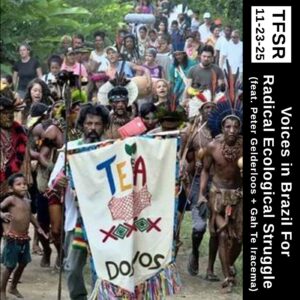
First up, you’ll hear from anarchist and author Peter Gelderloos speaking about his ongoing trip to Brazil as a member of Weaving Paths to Ecological Revolution to listen to and network with indigenous, anarchist, autonomous, ecological and land reclamation projects in that country, coinciding with the COP30 UN climate conference.
- Transcript
- PDF (Unimposed)
- Zine (Imposed PDF)
- Article about Weaving Paths to Ecological Revolution: https://organisemagazine.org.uk/2025/10/27/further-weavings-international/
- Article about Peters time so far in Brazil: https://inthesetimes.com/article/cop30-brazil-farce-not-failure-indigenous-territory-struggles
- Antimidia: https://antimidia.org/
- Its Revolution Or Death: https://sub.media/its-revolution-or-death-a-three-part-series-from-submedia-and-peter-gelderloos/
Gah Te Iracema of the Kaingang
Then, we hear an interview with Gah Te Iracema of the Kaingang people from southern Brazil, speaking about their land reclamation, reforestation, their post-flood water distribution mutual aid in 2024 and other topics.
Links
- ANMIGA: https://anmiga.org/en/home-english/
- Teia Dos Povos: https://teiadospovos.org/the-web-of-the-peoples/
Anti-Maersk Action for Palestine, Copenhagen 2025
Finally, Črna luknja from the November 2025 episode of B(A)D News spoke with a Danish activist about the February 2025 Cut Ties With Genocide action camp in Copenhagen which included an action against Maersk, a Danish shipping and logistics company facilitating arms transfers from the US to Israel. You can hear the rest of this interview in the upcoming B(A)D News, Angry Voices from Around The World, episode 96 for November of 2025 from the A-Radio Network.
Links
- Cut Ties With Genocide Action Camp: https://cuttheties.ukrudt.net/
- Mask Off Maersk: https://www.maskoffmaersk.com/
- B(A)D News: https://www.a-radio-network.org/bad-news-angry-voices-from-around-the-world/
- Crna Luknja: http://radiostudent.si/druzba/crna-luknja
Announcement
Prisoners for Palestine Hunger Strike
Collective members of Prisoners for Palestine (PrisonersForPalestine.Org), a prisoner-led collective in Britain representing all those detained under charges related to Palestinian liberation, have entered their fourth week of their hunger strike as of the day of this podcast, with participation of Qesser, Amu, Heba, Jon, T, and Kamran. This week, the first of the Filton 24 trials began as well. From a press release of the collective’s website:
While suffering physically due to the effects of the hunger-strike, the six prisoners currently taking part in the protest remain strong, defiant, and committed to winning their… demands:
- An end to the censorship of letters and books, and freedom of expression.
- Immediate bail.
- The right to a fair trial.
- The deproscription of Palestine Action.
- The closure of all Elbit weapons factories in Britain.
We hope to conduct an interview soon with members of the Prisoners for Palestine on the proscription of Palestine Action, Elbit Systems, the conditions of confinement case and the hunger strikes.
. … . ..
Featured Track:
- Radiation Ruling The Nation (Protection) by Massive Attack v Mad Professor from No Protection off Wild Bunch Records
. … . ..
Peter Gelderloos Transcription
TFSR: Hi, Peter.
Peter Gelderloos: I am currently in Brazil in Belém do Pará, and I am here—both because and not because—COP30, the United Nations conference on climate change, is happening here.
TFSR: To hit the not because, just because you mentioned it. So, the visit coincides with COP30, or the Conference of Parties conference or however that goes, which I think offers a counter example to the listening audience of the sort of networking and listening that you’re doing while you’re down there, hoping the sort of bridges that you’re trying to build or burn. Can you talk about what the COP is, what it’s supposed to do, and what it does?
Peter Gelderloos: It’s called the COP30 because it’s the 30th year that it’s happened. It’s an annual conference started by the United Nations, supposedly to address climate change. They bring together world leaders, business leaders, lobbyists, major NGOs and supposedly it’s to deal with climate change. But the range of responses that they’re willing to consider are actually completely unable to really address the root of the issue or to make things significantly better.
They focus on agreements around government regulations. They focus on investment, including, like, major donations. But, in general, the investments tend to be pegged towards economic growth. So, for example, they’ll get hundreds of millions or billions of dollars in anything from investments to donations, and then they invest it in the market to pay for different programs. So, it’s very much pegged to the current model of economic growth.
Basically, the question that they’re not asking is, “What do we need to do to address climate change?” The question that they’re asking is, “What responses to climate change are compatible with capitalism and the state?” And if it just so turns out that capitalism in the state are the causes of, not just climate change, but a much broader, interconnected ecological crisis, then they will refuse to see that. They are refusing to see that.
One quick addition to that. A lot of people have heard of the Paris Agreement, which sets different targets for slowing down emissions to prevent the world from getting to dangerous tipping points of, like, 1.5 degrees Celsius temperature rise or 2 degrees Celsius temperature rise. And it’s already too late. Those targets are not being met. Meanwhile, it came out that corporate lobbyists were bragging that they got certain mechanisms written into the Paris Agreement— like carbon trading in a specific form of carbon accounting that they use, which makes it look like they’re making reductions, even though every year carbon emissions— and greenhouse gas emissions in general—continue to go up.
TFSR: Kind of crazy, because those same lobbyists live on the same planet as we do, right?
Peter Gelderloos: I think they’ll be investing in a plane ticket to Mars, I think, in the next 10 years.
TFSR: Yeah, I just happened to catch a little bit of Democracy Now Thursday of this week when we’re recording, and she mentioned that there are 1000 indigenous leaders and voices out in the streets at the Belém COP 30 conference, and 1600 fossil fuel industry representatives present. Which is a pretty devastating comparison, especially in such a place in the world that has so many indigenous voices. There’s not like a huge limitation to participation in that manner, right?
Peter Gelderloos: Even if there were no fossil fuel lobbyists and 360 indigenous representatives, the fossil fuel lobbyist would have more power. And in the end, I mean all of the indigenous representation, it’s just that, it’s representation. It’s a democratic tool to integrate marginalized peoples in their own oppression.
A lot of indigenous leaders, not just in Brazil but around the world, are either appointed or propped up by the governments occupying their territories. That’s definitely often the case here in Brazil. Brazil is much more progressive regarding indigenous peoples than the US, in the sense of, like, recognizing some kind of legitimate right to their territory. But that often manifests as just more integration into the state system. It often manifests as the Brazilian government agency tasked with protecting indigenous peoples. Basically, modifying indigenous leader leadership leadership structures to make indigenous communities more easy to manipulate, to control.
And this probably isn’t really a contradiction. At the same time that there’s greater visibility and representation for indigenous peoples in Brazil, there’s an extremely brutal war being waged against them constantly. I mean, just at the beginning of this week, there was a brutal attack against a Guarani-Kiowa community in the far south of Brazil. Gunmen descended on the community late at night and shot five people, killing one of them, burned down all their houses and their belongings. There are cases of ranchers who have a lot of political power, and they’re one of the main drivers of deforestation in Brazil— ranchers using drones to drop Round Up and other highly lethal pesticides directly on indigenous communities and their water supply. So it’s a state of war, and also a situation of integration, all at the same time.
TFSR: So, I understand that you’ve been collecting interviews as you’ve been traveling around and being introduced to people engaged in various struggles around Brazil. Could you speak a bit about some of the projects you’ve seen, and some of the people that you’ve met?
Peter Gelderloos: Yeah. The actual reason that I’m in Brazil is part of a collective project, Weaving Paths to Ecological Revolution. That’s a project we’re doing together with compas from different parts of Brazil. It involves a number of things. It involves making stronger connections of solidarity across distances, both within Brazil— because Brazil is a huge, huge country, in which those distances are exacerbated by the cost of long-distance transportation here being inaccessible for a lot of people—then also some increasing international connections, of international solidarity with me coming in from from outside. We have people in various countries stepping up to help translate, to help spread some of these things. One part of it is that strengthening relations.
Another part is showing that there are effective responses to the ecological crisis, they just can’t be found at COP30. COP30 has been doing nothing, but the presence of that conference and the way that environmental movements put so much — and even left wing media— put so much attention on the conference. It really helps to invisibilize these amazing projects that are often targeted with repression, but that take a very multifaceted approach to look at the intersections of how we feed ourselves, how we house ourselves, medicine, culture, colonialism, deforestation and other factors that contribute both to the ecological crisis and the social crisis. We’re seeing people increasingly subject to precarity, to poverty, to health problems, to growing right-wing repression.
We have been talking with people in the housing movement in Belo Horizonte, where through direct action, around 100,000 people have gotten themselves housing— whether by occupying entire abandoned buildings, or whether by occupying abandoned land. For example, land that’s been farmed to death in the peripheries, around Belo Horizonte. They’re building entire self-constructed, self-organized neighborhoods. We’ve been visiting a couple indigenous communities that have been using direct action to reclaim their lands. We stayed a week at one community that’s part of the Teia dos Povos network. Teia dos Povos translates as “Web of the Peoples.” It’s basically a network or a web between different communities that are asserting their autonomy. It’s very interracial. There’s indigenous communities in this network, there are quilombos— which are communities founded by people who escaped from slavery in Brazil.
Slavery wasn’t abolished until the 1880s, and there was a lot of resistance, including guerrilla resistance, against that institution and against the other forms of white supremacy and forced labor that have followed it. There’s a strong tradition of quilombos in Brazil. Then also just lower class communities— often people who are either resisting the pressure to abandon rural areas and move to poverty in the cities. Or people who are leaving poverty in the cities and favelas, and then go and occupy land. Often it’s land that’s been abandoned by the plantation system, because the plantation system— through monocropping and reliance on petrochemicals and poisonous fertilizers— farms the land to death. So, these communities either reclaim, defend, or occupy land. They network, they share things that they produce, and they’re based on principles of decentralization, solidarity, mutual aid, direct action.
TFSR: And listeners might be familiar with the term quilombo, but, I think it’s pretty comparable, in some ways, to maroonage, as you would say in North America or similar communities. Just to point out, I imagine that the continued existence of that model, the quilombo, relates also to the continued conditions that are slavery-adjacent or parallel to slavery—even in the 1880s having abolished that formation as it stood [legally]. There’s a lot of instances that have come up over decades of studies and journalists saying, look, this is clearly still going on in a lot of rural places. There’s either government oversight or not government oversight. But people are being exploited and not allowed to leave the conditions of their employment, right?
Peter Gelderloos: Absolutely. Actually, at this community in Bahia Terra Vista where I was staying, most of the buildings that are there— housing over 300 people—have been constructed by the members of the community themselves. But, when they took over the land, which was an abandoned chocolate plantation, there were two buildings that remained from before, when it was this standard chocolate plantation. I was staying in the workers quarters, which are small, cramped. Then the other building were the overseers’ quarters. So basically, these workers worked on the plantation with armed overseers. So, you know, if that doesn’t clarify things, then I don’t know what will.
TFSR: Coming up next for listeners, a segment that Peter actually facilitated this interview that I conducted with Gah Te Iracema, a leader and shaman among the Kaingang people from so-called Porto Alegre. We had a limited time to have the conversation, with the translation going on. I wonder if you could give some additional context for the conversation about their land reclamation, the floods that we talk about and the deforestation that she speaks about during the interview.
Peter Gelderloos: So, basically, she had a dream. A call from her ancestors, calling on her to defend their historical land. She found out about a major development plan that would have destroyed their lands— and they’d already been kicked off lands— but they occupied their lands. They took them over by force.
As a part of this, they started changing their leadership structure to move away from patriarchal forms. A point of background on that: there are thousands of indigenous peoples around the world, and they’re extremely diverse. So, it’s really important not to make any generalizations. Some of them might have been more patriarchal. Some of them, the complete opposite. But in most cases, when indigenous peoples are occupied, governments impose more patriarchal and more centralizing, hierarchical forms of organization on them. In Brazil that’s often seen in the cacique system.
Cacique is like a male chief, or one male leader. It will often even be a hereditary position. Some indigenous peoples did have that (or something very much like it,) but many others didn’t. With the Kaingang, they moved away from this more patriarchal, more centralizing system. She helped encourage networking between different Kaingang communities. They’re actually in the city of Porto Alegre. Some of the other communities are in the periphery.
Just through building and using direct action to take back a small part of their land that’s been stolen, to start reforesting some of these lands, to have more autonomy, to practice their spirituality, their their culture, their relationship with the land, with food, with all of that, they’ve created strength and greater health, not just for themselves, but for everybody. Because of racism in Brazil, a lot of people— even other lower class people— opposed them at first. They might have even supported violent actions against them.
But there were huge floods, and as part of the trend of catastrophic weather events being intensified by global warming. There were these huge floods in Porto Alegre that knocked out the water supply for the entire city, which is a very large city. But the Kaingang, they had been revitalizing and protecting their water source. It’s like a really important part of their spirituality, and of their practice, how they feed themselves, how they relate to the land. They were the only ones with clean water. And so, all these people who, previously would have been like, you know, insulting them or opposing them, were coming with empty bottles. They were giving water to everyone, not just members of their communities. That helped a lot of people survive a climate disaster.
Their reforestation efforts and their move towards food autonomy are other major ways that projects like this— in this case, these indigenous communities taking their land back— are making real significant impacts on the ecological crisis. I mean, deforestation is a huge driver of greenhouse gas emissions. Whereas reforestation— if it’s real forests… Any middle class academic or professional person who uses the word “reforestation”— find out what they mean by that, because nine times out of ten, they’re going to be lying. They might not even know that they’re lying. But they’ll be talking about a monocrop tree plantation, which is a desert in terms of biodiversity, in terms of healthy ecosystem, in terms of an ability to actually help heal the atmosphere and heal the soil. It’s a horrible, horrible thing.
A forest is an ecosystem. It’s not a bunch of genetically modified pine or eucalyptus trees planted all at the same time. A real forest draws down a whole lot of carbon out of the atmosphere, so it can actually lead towards negative carbon emissions. Additionally, if you look at all the various aspects of agriculture, from land use change, to all of the fuels and chemicals that go into capitalist agriculture, to global transportation… Under capitalism, the norm is that a lot of our food is going to be coming from other continents. All of these things that they’re doing are drastically reducing or even reversing these trends in greenhouse gas emissions that the United Nations Climate Conference, for example, has been completely unable to do anything about.
TFSR: I remember in college, in the `90s, hearing about import substitution industrialization projects and industrializing economies in the Global South. In this case, Brazil was one example where the economy was turning towards exportable food products, enclosing the commons, destroying the natural environment and the forests, displacing indigenous people and just communities generally, clearing forest and selling the lumber, bringing out beef cows to sell the beef internationally, or replacing staple locally-grown and nutritious crops, like black beans, for instance, with soy, for the international market. Thanks to pressures from international institutions like the IMF and the World Bank, where they’re structurally adjusting economies that are borrowing money. If you want to comment on that, please do.
But also, I wonder about the people that she mentioned are staying on the lands and that are cutting trees? If they’re a part of the clearing lands for these bigger projects, or if they’re individuals who are poor and they’re trying to sell the lumber themselves, or some mixture of those?
Peter Gelderloos: I’m glad that you brought up soy, because it’s a good example of reforms that actually don’t go anywhere. The left-wing government of Lula in Brazil has been talking a lot about reducing soy production. I think they’ve even been making considerable results in that, if I’m remembering the data correctly. But in many cases, it’s just shifting to, like, corn, which is also used as animal feed for the export beef industry. So whether it’s corn or soy, they’re still deforesting the land where they’re going to do that planting.
How the reform currently works is, it’s kind of like a dance, between the NGOs and the governments. The NGOs, they refuse to take a broad approach where they analyze the entire problem. They have the siloed, single issue approach. They’ll make a big stink about soy and so then if it’s like oil or gas, it’s a little bit harder for them to shift away. That requires a much bigger infrastructural change, which is happening now. They will eventually shift away from oil and gas, just not soon enough to keep us all from dying. But if they’re making a big stink about soy, it’s relatively easy for a government to switch from or push a shift from soy to corn. Then they claim that they’re fixing the problem.
The other question that you’re asking about is this problem of land usurpers or squatters. It can be difficult to use the word squatters, because there is a really big movement of ocupação—both urban and rural occupations— hat lower class people—whether black, indigenous, white—are using really legitimately to get housing. But there’s a specific [case] where they will come on to indigenous lands.
And in some cases, it’s to carry out logging. That is often the case in the Amazon, for example, the struggle of the Ka’apor people against logging. In the Amazon, you have hardwoods, which are more likely to be the target of extractive activity, since they can get a lot more money on those. A lot of Brazil has already been—just like, North America has already been—deforested and reforested in some sense. Not in terms of necessarily the most thriving forest ecosystem, but at the very least… some [trees] planted or have grown back. Sometimes their intention is to cut down trees and to sell them. Other times, they’re just cutting down burning trees to clear land, whether it’s for crops or especially for cattle for the international market.
Now, the cattle industry is extremely powerful, both economically and politically in Brazil. They’re connected to the police, to major political parties. They often have paramilitaries working for them who are willing to kill indigenous people or other people who get in their way. But there’s still a lot of small holders that will have a small parcel of land, whether they have legal access to it, or whether they’re stealing it from indigenous communities or quilombos or others. You know, they’ll just put cattle out to graze and then sell the cows to the big companies. I guess it’s important to mention that’s one of the ways that colonial systems are very good at pitting different sectors of the oppressed against each other. Because a lot of the people who are directly involved in stealing or pillaging indigenous land these days are not wealthy. They’re getting their backing from the wealthy and powerful, but a lot of the ones going in cutting down the trees, or that have twenty, thirty cows to graze are not necessarily wealthy.
TFSR: So, there’s a lot more that I could ask you about, but I know you have limited time. I wanted to get in here — what other interviews are you expecting to put out? What’s the platform you’ll be releasing them on, and do you still need fundraising at this point to cover the trip?
Peter Gelderloos: Let’s see… So, in the next few months, we’ll be releasing a video that kind of shows some common patterns between a lot of these different projects and struggles. We are hoping to get an interview with someone from one of the quilombos that is still very much at the forefront of an anti-colonial, anti-racist resistance. There was also an interview that I was hoping to do in Belo Horizonte, but there was a really hard rain, so we couldn’t go out to this peripheral neighborhood— which is one of these self organized, self constructed neighborhoods, where a lot of unhoused or housing-precarious people took over some land and started building their own houses. And then finally, the Passe Livre movement, which has been going on for years and years, but in 2013, that actually sparked a major uprising for free public transportation. There’s someone who’s been involved in that movement for a long time that we’re hoping to organize still.
Yeah, as far as the fundraiser, we got enough money to to cover the basic logistics, materials and travel costs for a few of us, and the FireFund is closed now. But of the different projects that we’re in touch with, or that the Brazilian comrades are a part of—there’s a chance that we might do another fundraiser in the near future to help them get some resources, tools, other things that they might need in their struggles. So about half of the first fundraiser is already going to those kinds of things, but it would be nice to be able to get even more support.
So for example, a major obstacle to a lot of indigenous or rural communities is, you know, is (the question of) “how can you have food autonomy if you don’t have seed autonomy?” To paraphrase one of the folks I spoke with at Terra Vista, the Teia dos Povos settlement. So there are some projects that are focused on growing ancestral seeds and also breeding varieties of seeds that work really well in different climates, different soil types, and that work really well without any pesticides or industrial synthetic fertilizers. So that’s really necessary for communities to be able to feed themselves, to be able to have their own seed supply. But to make those exchanges to share that seed stock, you know, they need to travel, and gasoline is quite expensive here relative to people’s income.
So that is the way that— unlike the way that NGOs are wasting so much money on big salaries and on like, propping up hierarchies of whatever groups they work—just being able to directly get money to groups that they can pay for gasoline, take a road trip for a week and then share, like dozens of varieties of seeds and get their own agricultural system started. It’s just one example of many, ways that help support some of these struggles and movements.
And then the other thing—and we’re really hoping to drive this home with the video that we’re going to put out in a couple months—is realizing that none of this is unique to Brazil, right? Like, the crises are playing out in unique ways in every different territory, but they’re global. They affect all of us, and all of us need to be doing things that increase our own resilience, our own possibilities for collective survival and our ability to abolish capitalism, to abolish the state, and to completely change our relationship with the land and with the ecosystem. Because a lot of people are dying every year already, and it’s only going to get worse until we really, really step up, throw out all the clowns with their decades and decades of failure.
Stop taking seriously the COP, anyone who works for the COP, stop taking seriously anyone who advocates for green capitalism. Be very clear how they’re putting people in danger. Be very clear how people who are advocating those kinds of, you know, false solutions that have been proven failures for years and years, how they’re on the payroll and they shouldn’t be given any legitimacy. We shouldn’t be listening to them. We need to be helping spread the kinds of responses that are actually based in the real world.
TFSR: I didn’t catch if you said where the interviews were going to go out. Are they a part of “It’s Revolution or Death,” or are they going to be independent of that series?
Peter Gelderloos: That’s a good question. I actually don’t know quite yet where they’re going to be published, possibly Antimedia Collective, which is a Brazilian radical video collective. You mentioned “It’s Revolution or Death,” and there is some overlap between them. “It’s Revolution or Death” is a video trilogy from subMedia. There is some overlap between that project and this Weaving Paths project in Brazil. But what we’re doing here is not technically a subMedia project. So, we still have to figure that out, but we will boost it as widely as we can once it’s out.
TFSR: Well, I’m sure people can keep up with your writing, at least, and some info about this at your Substack, right?
Peter Gelderloos: That’ll get going again in probably a couple weeks. But actually, today, I have an article stemming from this trip out on In These Times. And there should also be one out, if not today, then I guess tomorrow, from TruthOut. Both of them about a lot of the different things that we’ve been trying to focus on with this trip.
. … . ..
Gah Te Iracema Transcription
TFSR: We’re joined by Gah Te Iracema, a Kaingang People leader from Aldeia Gah Re in the south of Brazil, joining us from the COP30 conference in Belem, Brazil. Thank you very much to you and to the people facilitating this conversation through translation.
Would you introduce yourself and what brings you so far from Aldeia Gah Re in the south to the north of Brazil, to the location of the UN conference in Belém do Pará?
Gah Te Iracema: I’m of the Kaingang people, from the south of Brazil. I’m also a kujá (a role of spiritual leadership and healing). I’m part of an organization called Alminga. This organization called and asked me to attend the COP30 to provide healing for the people who are visiting Belém and also all the indigenous people there.
Also, I came here to speak about the situation in my community, because we have recovered a part of our land, but it’s not recognized by the government. So, we are here to speak about our fight.
TFSR: I would like to lean more about the recovery of your territory, but I wonder if first you could talk a bit about how climate change has affected your community? For instance, the extent of the flooding and how that impacted the people you live with.
Gah Te Iracema: We call it land reclamation, but it’s like coming back to our house. Because this land was stolen from us a long time ago, we decided to recover it. We learned about a development project on the land that we didn’t want to happen, so we decided to save the land and reclaim it. I heard a call from my ancestors and during a dream, they came to me and told me that we have to recover that land now. They said that they wanted us to take care of the natural springs, which are in the land. And they wanted us to come back to the place where we buried the placenta of my great grandfather. In the past, we had a small house made of wood and mud, where we could sell artisanal crafts. When we returned to the land, the house had been burned down.
The reclamation is also very important because it’s where we can find a lot of medicinal plants for healing the body and the spirit. My grandfather taught us to take care of the water and always take care of these plants which are really important to us. Now that we succeeded in reclaiming the lands, we have to struggle against the bankers and squatters [might want to translate this as usurpers or interlopers instead] who cut down the trees.
So I’m here to start struggling with my life. i can lose my life and my community is also in danger. But I’m here to struggle to protect the land and also our spirits because protecting nature and our medicine, the plants and the forest is protecting our body but also our spirit.
[Context, there were devastating floods in and around Porto Alegre a couple years back]
TFSR: The region where I live in southern and central Appalachia was hurt by large floods last year and we saw large efforts across communities like what you describe with sharing water, bringing water to people. Here we saw people doing rescues, providing shelter, bringing food, rebuilding houses… Would you talk about the sort of cross-community strengthening that you saw through this effort, through this recovery, and if it brings you hope for further direct actions?
Gah Te Iracema: We are an original people of Brazil, we knew that this flooding would happen. We are tired of speaking to the politicians and governors. We’ve already told the government that we thought that this would happen and they didn’t do anything. We live in Porto Alegre near the river we call Guaíba. Once, this river was surrounded by trees but the government decided to cut the trees and install wood and cement along the banks of the river, covering the ground. This causes a lot of problems when it rains, the soil can no longer absorb water and flooding occurs. I’ve met with government representatives and I said to them that floods would happen when there are heavy rains.
Climate change is caused by Agri-businesses cutting down all the trees to plant soy beans. We experience such hot times, the warm seasons didn’t used to be this hot. It has become imbalanced. It wasn’t our people who cut down the trees, but we are seeking to plant trees where the land is devastated, to recuperate a lot of forest. We didn’t do the damage, but we want to heal the forest. So we’re seeking to reforest our recovered lands. We planted our ancestral tree, the Araucaria, a type of evergreen. It will give a lot of strength to our people, protecting us from flooding.
During the flooding in Porto Alegre, we gave water to the people who had lost access. We were able to because we had our clean sources. The people who had lost access to clean water came to us with empty bottles and we gave them water. It was good to show them that it’s possible to protect the forest and that if you destroy all the forest, you destroy what gives you life.
I had to change my phone sim card three times because I was being harassed for defending our recovered lands from the settlers and those who work with the bankers. Some of these people who had been squatting our recovered land or people who hadn’t respected our ancestral lands came to us for clean water after the floods and we were very happy to give them clean water. Afterwards, they showed respect for our people.
The indigenous peoples’ lands in the south of Brazil were historically the first to be destroyed and we are struggling very hard to recover them. It’s very important to spread the struggle around the world, to spread the word about the struggle so that you can know about it and you can pressure the Brazilian government here to give recognition to indigenous peoples reclaiming their lands like we are doing.
Thank you uh for this interview. I hope that our friend here can visit our village and bathe in the waterfall. Thank you to the blue sky. Thank you to the green fields. As well as to Mother Earth, who has lots of love inside of her.
The peoples of southern Brazil have a lot of solidarity. There was a community kitchen that gave food to the people that needed it after the flood, it was an autonomous initiative. Our people were not able to help with food because our kitchen broke, but we helped with water. And a lot of people came to take water from our source.
Also, hospitals used our water for the medical clinics that they set up on our tribal lands because Porto Alegre was without water. Porto Alegre is built upon our lands and there was a source of clean water there. People who stayed in shelters, went to the Kaingang people and brought our water to the shelters.
After the flood, a lot of people came to believe more in the ancestral knowledge of the Kaingang people. And they came to the land so that they could receive healing from me. We received people who had lost everything and they were so upset, that they wanted to kill themselves, so I gave them healing, too.
And I have hope, yes, that the young generation is not going to wait for governments to resolve the problems. We have to have solidarity between us, and also with nature, so that we can build again, all we have lost. We must have hope in order to build our projects, building with people from different origins. I am of the Kaingang people but I work with people of the urban periphery, the people of the poor neighborhoods, the people of the Quilombos. Our community is part of the Teia dos Povos, the Web of the Peoples, and we receive support from other collectives that include anarchists. We have many councils, including a women’s council, also, that provides lots of ideas and counsel.
We must trust in the ability of our mother earth always to renew herself and because we’re the children of the earth, we need to renew ourselves as well. We have to accompany the technologies, we have to be close companions and to reforest the land because as members of the human race, we have destroyed the the air. We must ask the Mother Earth to forgive us so that things like this flood and other climate disasters will not happen again.
TFSR: I guess the last question that I have, is: For people here in the USA where most of our listeners are, what are forms of solidarity action that you are requesting so that we can help pressure government and industries in Brazil to recognize your lands? Or, how can we help support your movement?
Gah Te Iracema: Please, spread what the governments are doing to us: poisoning the land; the deforestation; their refusal to recognize our lands. We need people to make campaigns so that they won’t be able to use poisons, agri-toxins like dangerous pesticides and fertilizers that poison the soil and the water that were banned in most of the world after the second World War. These poisons are prohibited in most places around the world, but not in Brazil. There are many people here that are really sick because of the agri-toxins, including on indigenous lands, many who are born with diseases because of dangerous pesticides.
Another problem that we are working to resolve is that many young people leave our communities for employment, getting work in conditions that are analogous to slavery. We are working to keep our young people and give them dignified work. We are seeking strategies to have them be paid to help in reforestation, replanting the ancestral trees from Kaingang.
I’m really happy that our voice and our struggle will be broadcast in the United States, as it has been in France and Germany. Also that the Brazilian government might receive a lot of pressure from people who would know about our struggle.
We also need help creating a project to strengthen our access to medicinal plants. There are some medicinal plants that we must travel far to get and it would be really nice to make some exchanges with other indigenous communities for special medicines. I am a healer and a leader of the Kaingang people but also a spiritual leader. I know that it’s a really important to have good medicine, to have healthy bodies and spirits so that we can resist and fight back.
TFSR: Yeah, thank you again so much to our guest and the translators.
. … . ..
Mask-Off Maersk Transcription
Črna luknja 1: Hello, Saba, how are you?
Saba: Hello, very good, thank you.
Črna luknja 2: Yeah, maybe we start with a brief introduction of why we invited our comrade here to the radio show. So in February, activists in Copenhagen organized the “Cut Ties with Genocide” protest camp, which included an occupation of Maersk headquarters. Maersk is the world’s largest shipping and logistics company, playing a key role in the debt supply chain, transporting military cargo weapons from the US to Israel. We are here with the comrades. Thanks so much for taking the time. Who will tell us a bit more about this camp and the action that took place? Maybe for the start, you could start with a bit of a context of who Maersk is, why do you read it as a legitimate target of this kind of direct action?
Saba: Yeah. So, you know, Denmark is a very small country, but we do have one of the largest shipping companies in the world that are from Denmark— Maersk. They are one of the biggest companies in Denmark, so everybody knows who they are. And when the solidarity movement kind of started to mobilize in ’23, there’s been large demonstrations for a very long time, where mostly it was like a call for the government to do something. And then the Palestinian Youth Movement in May ’24 made this call to target the corporations that are actually facilitating the genocide. That gave an opportunity in Denmark to target the specific company. Then we were made aware what crucial role they are playing in facilitating the war machine. So then there started to be actions also against Maersk.
Maersk in Denmark has a fairly good reputation. Many people in Denmark know them and are maybe proud of the company because it’s a famous company around the world and so on, even though they don’t pay a lot of tax in Denmark, even though they have kind of a dark history during the World War, when we were occupied by the Nazis. During that time one of their subsidiary companies, the Rifle Syndicate, was actually selling weapons directly to the Nazi regime. But that’s not commonly—not everybody knows that in Denmark, they’ve been able to keep a good reputation and have a fairly good name in Denmark. They finance a lot of philanthropic projects. They financed the big, prestigious opera house in Denmark. They actually use a lot of money also in creating this image of them being a good company in Denmark.
Črna luknja 1: It’s nothing good to kill people around the world, to give all the tools for killing people. Maybe, if we can go to the camp more? How was the camp— and action following it— organized?
Saba: So, in the end of last year, there was made this open call. There was a website that was made called “Cut Ties with Genocide,” where there was an open invitation for an action camp, a five-day camp. There was a program also where you could get skills and information. So it started on Friday, and then on Monday, there would be some kind of action related to this. This open call was made for everybody, also from outside of the country. You could sign up for accommodation if you needed that. Around 800 people from outside of Denmark came to the camp, so a lot of people. We haven’t seen that many international activists, comrades, coming to Copenhagen to participate in something like this for a very, very, very long time.
It was organized around different venues in Copenhagen, five different venues, but the main venue was Ungdomshuset, the Youth House in Copenhagen. For the first days, there was different workshops, presentations by dock workers from Italy, by the “Mask Off Maersk” campaign, So you could get more information about what exactly is the role that these companies are playing in transporting arms or military equipment to to the Israelis and to fuel the genocide? But there was also more practical action trainings. There was information about the legal framework in Denmark.
So (there were) a lot of different levels, skills and information, so that you could kind of prepare yourself, even though nobody, or very few people, knew exactly what is going to happen. We just knew we’re gonna do something together on Monday, so we need to prepare for different scenarios, even though we don’t know exactly what’s the target or what’s the specific action that we’re gonna do.
But I think already, during this preparation, there was a really good energy. Already there. I think it was like “phew.” It was a kind of injection of energy, because also, there had already been a long time of doing all these smaller actions or large mobilizations. But there was also a sense of not really getting across the message. The media didn’t really cover it a lot. So this gave some new energy. I think it was very well organized. It didn’t matter if you had a lot of experience or maybe less experience. There was something you could pick out in the program where you could get prepared.
Črna luknja 2: And how did the action go? And what was the aftermath of it?
Saba: So during these days we prepared, and nobody really knew exactly what is gonna happen. People arrived on Friday, Saturday and Sunday, and there was all these different things that you could participate in. And then on Sunday, there was a briefing where people could come and get a little bit more information about how to get prepared for the next day and to also establish, what are the ground rules? What is expected from people that participate? One is that people are organized in small affinity groups, where you make an agreement of what you’re willing to do, how you’re going to take care of each other during the action. And then the information that was given was, we’re gonna meet at this particular place and people also got white coveralls and a face mask. So they brought that to the place where we had to meet at six o’clock in the morning, quite early.
Črna luknja 2: Early, yeah.
Saba: And this place, it’s in Copenhagen. It was February. It’s quite dark. In February, we don’t get a lot of sun, so, you know, just before six, actually you couldn’t really see if anybody was there. It was completely dark. Maybe also a lot of people had dark color [clothing]. You couldn’t really see anything. And then suddenly at six o’clock, when people started, you know, dressing up in in white… then you could kind of see— boom, boom, boom, boom, OK, there’s actually a lot of people. Already then it was like, okay, we are more people than we have seen in a long time for something like this. And then people lined up.
There was like two big blocks, and then we started walking like a traditional protest or demonstration, walked in a line. We passed by the American embassy, and then a little bit, before reaching the Maersk headquarters. Maersk is located in the center of Copenhagen, and it’s actually in that part of town, close to the royal palace. It’s close to a lot of the important institutions of Denmark and there’s an old kind of fortress or fortification just beside it. Just when we reached a point before getting there, then the group split in two and we came around to reach Maersk from two different points.
Črna luknja 1: Police couldn’t block that?
Saba: No, there wasn’t that much. I’m not sure how much police there was, but there was a lot of these police cars. They did try to stop people, but I think they didn’t seem like they were prepared for just how many people participated. I would guess that maybe a little bit over 1000 protesters were there. Most of the people came from outside of Denmark. So, I would say, around 800 people there were not from Denmark, and then some couple of hundred Danish activists also. But yeah, basically, it was very fast to actually break through the police chain and get into the headquarters, like, outside the entrance of the headquarters. And then there was some people that brought up a ladder to get on the roof and put banners on the roof. Some people climbed the big flagpole where they have their flag. The Maersk flag there was exchanged with a Palestinian flag.
The police seemed kind of confused and kind of overwhelmed by the amount of people. But also that people didn’t really follow when they said, “you can’t do that.” Nobody, really. They were a little bit surprised that people didn’t follow their orders, it seemed. And it also took them some time—it’s my impression—to understand that people didn’t really speak Danish because they were speaking Danish in the beginning, and most people didn’t understand exactly what they were what they were saying. Then we sat in front of the main entrance and blocked the entrance to the headquarters of Maersk. We were there for I think around four hours. So that also meant that there was time enough.
Previously, there’s been smaller blockades of the headquarters, but with way fewer people, where the police have been able to get rid of people or take people away very fast. This was kind of a new situation. It meant also that it was possible for the media to go there and actually cover what was going on and interview. There were some spokespeople that they could talk to. So there was already starting to be live coverage of the action. That’s also a new thing. We haven’t been able to do that before.
We were there for around 4 hours, and then when we decided that we were gonna leave, that we made our point…then just when people were trying to get down from the roof, they started using a lot of violence, basically. So hitting people, and they also brought dogs. Some people were bitten by the police dogs. They used pepper spray, and they also used a lot of tear gas. People were hit in the neck, with the gas grenades and everything. And then we were dispersed from the place. But, you know, since they waited this long, there was also a lot of journalists that got gassed. I think that was maybe also [seen as] violence. If they repress protesters, probably you did something, probably there was a reason.
Črna luknja 2: Yeah.
Saba: But on this occasion, they could actually see for themselves that people were sitting down, people were dancing around a monument in front of the building. There was not really… you know… this place wasn’t smashed. There was no kind of confrontational attitude towards the police or the Maersk building, nobody inside the building.
So I think even a lot of the journalists that were there could see that, okay, that seemed a little bit disproportionate. I think that’s what really was a game changer. Also in this the media coverage changed a little bit. Before, you know, generally, the whole Palestinian solidarity movement have been ignored by the big media for a very, very long time. So even though there’s been thousands and thousands of people on the streets, it’s rarely been mentioned in the media. If there’s been something, it’s been very critical, criticizing the people a lot. [Saying] that they’re sympathizing with terrorists, or that people got arrested here and there. But the message—the content—of why people are protesting was never really mentioned.
That changed during this action. Maersk had to go on air and actually explain, you know? They were asked, “So the protesters say that you are transporting arms to Israel while there’s an ongoing—what they claim is, or some people would say is—a genocide.” And Maersk said, “No, we don’t transport arms. It’s just military equipment.”
Črna luknja 1: “Oh, it’s not the same.” [scoffs]
Saba: It’s just for F-35s and it’s for tanks, armored vehicles, all this. I think even regular people that were sitting at home, drinking coffee and watching the news, for them it became obvious. This doesn’t really… this sounds like rubbish. That it’s not arms because there’s no ammunition? But you know, what do you use a fighter jet for? What do you use tanks for? Armored vehicles? It kind of ruined… It opened a crack in the official narrative of Maersk. But also in the media after that a lot of the bigger media and newspapers started digging into this and started also quoting, the documentation, the reports there’s been done, and some of the research documenting how they are transporting arms from the US to Israel and how they are actually a very fundamental part of it. It’s the company that had the most transports to Israel during this time. I think the first year [of the genocide] there was, I believe, 30 ships that went to Israel, and 18 of them were from Maersk. It kind of broke this narrative and changed the narrative a little bit. Since then I think the media has been a little bit more like, okay, this is actually happening. It’s not just something that protesters claim. They lost control a little bit of the narrative after this.
Črna luknja 1: I think that you actually explained everything. So, the other questions maybe I will skip, because you go to this media, the impact was really big. So, maybe just for the end, Maersk is working everywhere. It’s not just in Copenhagen. Ships are going around the world. Maybe this gives us some inspiration, to think that Maersk is also in Slovenia— I mean, everywhere. Do you have something else to add for us, for the listeners?
Saba: I think that in Denmark it may be said that it was a symbolic action most of all. We achieved that they couldn’t go into the office on one day, but it’s a fairly small thing. We didn’t stop any ships, you know? There, it was mostly about the image. Because in Denmark, they care about their image, unlike in other places where they don’t really care about it. Now it’s public knowledge, the role that they’re playing. They are active all over the world. I think if you start noticing their logo, you’ll start seeing them also here. In Slovenia, I’ve seen many trains carrying Maersk containers. They’re pretty much everywhere, which also makes them a target that we can all kind of attack.
I think this “Mask Off Maersk” international campaign has showed that it is efficient to kind of go after, and also attack the corporations that are making money and that are making profit out of this. I think it’s maybe an open invitation to do something where you are, because they are all over the place. We are also all over the place. So if we get organized, inspire each other, I think we can really hurt them. Just this week, there was a international call for a People’s Embargo for Palestine. If you get curious, you could check that out, and maybe see where is it that you can hurt them here, where there’s actually the transportation going on?
Črna luknja 2: Yeah. On this point, I would just like to add that if someone got inspired, there is an office of Maersk also in Ljubljana. It’s located on Letališka cesta 29A. And maybe with this, we can close the interview?
Črna luknja 1: Thank you very much for coming. Thanks for telling the news.
Saba: Thank you very much.