
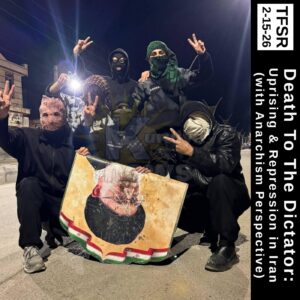
This week, an interview with Aryanum, a member of the Persian-language anarchist group Anarchism Perspective, based in Iran and Afghanistan. Anarchism Perspective is a synthesist anarchist group based mostly in the region that organizes solidarity and resistance as well as publishing writings at Anarshism.com . For this episode, we speak about the recent uprising in Iran that was met with bloody repression by the regime, with internet blackouts and low-ball estimates of 30,000 dead at government hands from January 8th and 9th 2026 alone. Aryanum speaks about the posturing by monarchists supporting the return and enthroning of Reza Pahlavi II, the son of the last Shah, and the weaponization of Islam by the Mullahs of the regime and other topics.
Anarchism Perspective links
- Website: https://anarshism.com
- email: contact@anarshism.com
- Anarchism Perspective Telegram: https://t.me/+RRUTo6xyoT468fgO & https://t.me/anarchism_perspective
- Insurrection Library: https://t.me/Insurrection_Library
Other Links
- Critique of Mass Mobilization by Anarchism Perspective: https://www.anarshism.com/critique-mass-mobilization-strategy/
- Aryanum’s past writing on religion as a type of power: https://www.anarshism.com/funeral-theocracy-religious-capital-en/
- Article on labor struggles in the run up to the uprising: https://classautonomy.info/workers-councils-reportedly-forming-in-iran/
- It Could Happen Here interview: https://www.iheart.com/podcast/105-it-could-happen-here-30717896/episode/whats-happening-in-iran-317260060/
- CNN report on mass deaths: https://www.cnn.com/2026/01/10/middleeast/tehran-iran-protests-deaths-arrests-intl
- Basij volunteer milita of IRGC: https://en.wikipedia.org/wiki/Basij
- Hrana (Kurdish human rights group): https://www.en-hrana.org/category/news/
- https://theanarchistlibrary.org/library/decolonize-anarchism-in-praise-of-burning-down-clerical-fascism-in-iran
- https://www.hauntologies.net/p/iranian-protesters-dont-owe-us-an
- Thread on mastodon about the usefulness of Delta Chat via locally run servers when the internet (and therefore connection to Signal) was cut off: https://archive.ph/GBR6A
- 70% of Iraniun population suffers from malnutrition: https://ghalamrorefah.ir/id/1959/
Another Farsi Group, Anarchist Front:
- https://t.me/AnarchistFront1
- https://links.anarchist-front.org/
- https://link.kompektiva.org/@anarchistfront
- https://anarchistfront.noblogs.org
- https://t.me/anegofromworldgap
- https://t.me/AnarchistFront
. … . ..
Featured Track:
- TFSR by The Willows Whisper
. … . ..
Transcription
Aryanum: Hello. My name is Aryanum. He/him. I’m from the Anarchism Perspective group, and thank you very much for having me here again.
TFSR: It’s my pleasure. If folks who want to listen back to past conversations that we’ve had, I will link them in the show notes. We have spoken before when you were acting as a voice for the Federation of Anarchism Era. What is the Anarchism Perspective, and how does it differ from FAE?
A: The Anarchism Perspective is one of the groups that formed after the dissolution of the Anarchism Era. We neglected to publish information about ourselves and describe ourselves more clearly in the last year. I can remedy that a little bit here. We are a synthetic anarchism without adjective group for all anarchist tendencies except capitalist, nationalist, pacifist, and religious. We do not accept any of those four tendencies as anarchist ones. But the majority of our comrades have individualist and post-leftist tendencies, especially after what transpired with the dissolution of the Anarchism Era. We base our organizational form on insurrectionary anarchism, based on affinity and informal organization, which best fits our experience and tendencies. We probably won’t form any federation under this name. Can you imagine — the “Federation of Anarchism Perspective”, FAP, or Confederation, CAP? [laughs] Even in Persian, the acronym of the Federation of Anarchism Perspective is FANA, which means “doom, destruction.” Although it’s intriguing for its comedic value, we don’t see the need or desire to become a federation.
To describe our shared perspective among comrades, we can start with power. Power is best described as the confidence of the rulers in the obedience of the ruled. All social hierarchies and authoritarian structures establish and reproduce obedience through deception, coercion, sabotage, appropriation, or exploitation; all of them are about control and making us obey. Anarchy basically means no rulers, no rule, to be ungovernable. This doesn’t need to be a mass conversion to anarchist tenets, like all ideologies. We don’t need to be like Marxists trying to advertise our thing. We just need to be ungovernable, and our action will speak for itself. We just need people not to obey. However, leftist anarchist tendencies, knowingly or unknowingly, reproduce structures of obedience even before we are free. They are either worried about the chaos or they’re worried about the complexity of being free without even experiencing it. How do we know what free is before experiencing it? The death toll and sacrifices made so far for a vague revolutionary salvation, fueled by faith and piety rather than critical thinking, are unreasonable; they are not worth it. We have to try different paths.
Regarding the logo of Anarchism Perspective, we packed a lot of symbolism and meaning into it. For one, it looks like a sun. It is long overdue for the sun to rise on the Anarchism Era. Anarchism Perspective will be the sun of anarchism rising. The logo also resembles an anarchist arrow expanding in every direction, symbolizing diversity and multiplicity. Then the circle can resemble a symbol of heaven, and the square symbolizes the earth. And the people circling the anarchist symbol, together, it implies connecting or bringing heaven on earth through collaboration and association in anarchism. We inherited the A for anarchism [symbol] from the Anarchism Era because we are trying to show respect for where we spent all our efforts in the previous organization, and we think that symbol is a general anarchist symbol for our region. The general design also shows our roots in the region. It shows a common geometric design.
For what we have done so far, other than what comrades do in the field, we have translated some anarchist and post-leftist texts, such as Armed Joy by Alfredo Bonanno, articles on insurrection, post-left anarchy, and we are in the process of translating Anarchy in the Age of Dinosaurs and Quiet Rumors: An Anarcha-Feminist Reader. At this moment, most of us come from the Persian-speaking region of Iran and Afghanistan. There are, I believe, only a couple of people outside the region, like myself. Due to what transpired during the dissolution of the Anarchism Era, we can say that we have all the Afghan anarchist membership.
TFSR: Can you speak a bit about the waves of protest and repression that inflamed Iran starting on December 28, 2025 — how they began, around what topics, and where in the country they spread? A bit of a chronology, maybe from the bazaars of Tehran through the universities and across the countryside?
A: Sure, the protest started at Alaeddin and Charsou malls on December 28, where business owners closed their shops and went on a strike because of a rising dollar rate, gold prices, and economic instability. The dollar rate is 143,000 toman per dollar. Later on, I can expand on that, but that is astounding. I don’t think it was like that eight years ago. Eight years ago, it might have been 50,000 toman per dollar. I’m just thinking out of my head. I know that 20 years ago, around 2006, the value of the dollar was not even more than 1,000 toman per dollar, so the rate is now 143 times more than 20 years ago. This economic instability, the rising dollar rate, and gold prices are putting their businesses on the verge of bankruptcy. That was the reason they started the strike and protested. The slogans and demands were not very radical at first. They were mentioning economic mismanagement.
The next day, on the 29th, the strike spread to the Great Bazaar in Tehran, which is huge, and protests began in Shiraz, Hamadan, Karaj, and multiple other cities. The students of Tehran University were also — in the middle of the night in their dormitory — expressing their solidarity by chanting.
Then, on the 30th, the day after, universities across Tehran, including Tehran University, Sharif University, and Beheshti University, experienced suppression. They closed the university doors, and even then, the students were chanting “Death to tyranny” or slogans similar to that. After that, the fire of uprising kept rising, and more cities joined the protests and the slogans became more radical, like “Death to the dictator” and “Mullahs must get lost.” In Qom, the ideological center of the regime, people attacked the police and there was good news of disarming them. In many cities, people fought against the police and the IRGC and pushed them back. In some cities, even small ones, they managed to control the city completely, if only for a short time. Kurds were not participating at first because of the appropriation and the sacrifices that they endured during the Jina’s uprising, but eventually they joined as well. I know there was an interview with It Could Happen Here about what was happening in Iran. They gave a good description of what was happening in Iran, and the person being interviewed there also mentioned heavy snowfall in the Kurdish area and that could be another reason that the Kurds did not join at the beginning. But appropriation, in our opinion at Anarchism Perspective, was the main reason. The fact that what they call the “center,” — the central power, the Persians — they appropriated the slogans. They appropriated the movement; they didn’t help the Kurds as much; they just took. So that was that.
After that, in Ilam, people shredded the regime’s ideological banners. By the fourth day, the regime responded with tear gas and shooting and killing the protesters. People took over and burned police precincts, IRGC bases, banks, mosques, and seminary schools. Mosques and seminary schools are the structures of suppression and the authoritarian fascist regime of Iran. They were made as structures of power. They’re not a place of worship or religion. There are structures of power, and people of Iran recognize that, and they burn them every time.
The conflicts in Malekshahi and Ilam was very severe. On the eighth day of the protests, the hospitals ran out of blood. There were many resistances by the hospital staff everywhere in Iran against the regime taking the injured and the dead away to unknown locations. Basically, the regime stormed hospitals, like what Israel did with Palestinian hospitals, similar to that.
It is worth noting that the protests lacked formal leadership organizations and were organized spontaneously and horizontally. The monarchists attempted to co-opt the uprising multiple times for their own benefit, with one or a few people are yelling, “Long live the Shah.” But they didn’t have much of a presence. If you ask me, I couldn’t even say there were a thousand of his supporters across Iran. Some of the videos were doctored. The actual video does not say “Long live the Shah”, but they added it in; they doctored it.
The suppression became more deadly when Reza Pahlavi, the leader of the fuck-face monarchists, made a call to protest and claimed that thousands of military and IRGC personnel would defect and join the people on January 8. And Trump, on January 13, claimed that help is on the way to all the Iranian protesters. Many people believed it, they bought all that, and they went to the street. January 8 and January 9 were the deadliest days of the protests. The regime killed thousands of protesters with machine guns. The hospitals and homes got raided, abducting dangerous and suspected protesters. There are reports, one report is by CNN interviewing some Iranian doctors and hospital staff who said the regime shot and killed injured protesters in the hospital. They shot and killed them in the hospital. The Bazaar of Rasht was burned down by the regime, and the protesters who were there were killed. There were people at the bazaar; not all of them were protesters. Some raised their hands and surrendered. That’s the news we got. The estimated death toll now is 36,000 people, and that’s probably a lowball, because many injured protesters went into hiding, went to their homes, and died there, and their families would not report it for fear of the regime and suppression. There were reports of body bags upon body bags upon body bags. We have a comrade who went through so many of them just to identify, to see if they can identify a comrade. We didn’t get the news. We don’t know if he was killed or arrested. We don’t have any news about it. They went to morgues after morgues after morgues, trying to identify body after body after body. This is very demoralizing for him, and he was injured during the protest. He was trying to help another person, and the police hit him with a baton in the back. His back is still hurting, he’s throwing up blood, and he still went to the morgue trying to identify a comrade. I haven’t heard that we know anything new. They couldn’t find the body in the morgues, and they could not find their names within the RSC. There is stuff like that, too.
So there are so many bodies, and in the middle of it, the regime is demanding thousands of dollars to release the victims’ bodies to their loved ones. Given the economic situation of most Iranians, that’s not possible. The other option that they were given is to announce the loved ones who were killed by Basij as Basij, to claim them to be members of the regime, to retrieve their loved ones. The prisons are filled with protesters at the moment, there’s not enough space. People are sleeping in prison hallways with no amenities, no privacy, nothing. There are reports of prisoners being poisoned, being injected with excessive amounts of acetaminophen and other drugs, which may cause multi-organ failure later, after their release. This has been reported before, during the previous protest, and we are seeing it again this time. That would be the report.
TFSR: Okay, just to reiterate what you said — the state is demanding to release a body, in many cases, of someone who died in protests, saying you could pay thousands of dollars to release it. And if people aren’t able to do that, then if the survivors make a claim that the person was working for the Iranian government, then [the state] will release the body to increase their claim of a wider social contract with the population or wider approval rating with the population. Is that the purpose?
A: The Basij are the militia members of the IRGC. They are doing that to claim that more of them died than is actually the case, so they can claim victimhood. They can claim, “Oh, this person was a Basij.” They’re trying to bolster the numbers after death. Even though they come into so many atrocities, they are trying to justify it by saying, “Oh, this many of us died as well.”
TFSR: That got us about up to the 10th of January, obviously, as you’re describing, some people were imprisoned after that, and have been being injected with acetaminophen to cause organ failure a few days later after release. Is it fair to say that the repression was successful, and at this point, to your knowledge, the demonstrations are on hold?
A: Right now, people cannot protest. There is a massive regime agent presence in all the streets, and the demand to see people’s cell phones. They look into the content. They look at Instagram, Telegram, Signal, and whatever else they can get their hands on to see if the person may possibly be against the regime. Then they would arrest them. But small demonstrations are still happening on university campuses. Also in Iran, there’s the 40 days of mourning after death. All these people that died, on the 40th day after their death, those people need to be observed, and people are talking about making a protest, making a movement out of that as well. This happened during Jina’s uprising, and they’re planning to do the same thing during this uprising as well.
TFSR: Since you’ve mentioned the Jina uprising a few times, I wonder if you could talk about the longer history of revolts, starting from the Bread Revolt in 2017 (or earlier, if it feels like it makes sense), and how these have accumulated into the uprising that we’ve seen over the last month and a half across territories controlled by the so-called Islamic Republic.
A: The protests in 2017 and 2018 show that economic pressures that the people of Iran experience and the political suppression that they experience create very anti-regime sympathies. Each cycle that happens, it happened in 2017, 2019, 2022. In 2025 it was supposed to happen until the Iran-Israel war ruined the movement. All of them keep coming back in cycles of 2 years, and it keeps intensifying because every time people learn from the previous time. First, there were many reformist tendencies. In 2017, the reformist tendencies went away. In 2019, there was a lot of “Let’s invite the police and IRGC to join us.” They were giving flowers to the police. That went away after the killings of thousands of people; that went away, too. In 2022, Jina’s uprising was the most progressive uprising. That was about Woman, Life, Freedom. That went beyond the economic situation, even to the suppression via patriarchy, the suppression of the ethnic minorities in Iran, and the religious suppression and viewing Islam as a political mode of power, which is demanding control. In 2025, strikes were going on with the truck drivers, and the morality police came back, and they were starting to suppress women in the same way again. The Woman, Life, Freedom — Jina’s — uprising was gaining momentum again to resist the new oppression, which are the same as all the oppression. But the war put us back for a long time. And after that, the regime became more violent, with fascist actions.
After the war, they started arresting anybody who was against the regime and claiming that they were Mossad agents and betraying the regime. That they were doing this and doing that, and they increased their executions. They increased the anti-immigration sentiments. They deported thousands of people from Afghanistan. When they returned to Afghanistan, the Taliban executed a lot of people because some of them were either soldiers or somehow related to resisting the Taliban during the previous government. That increased the fascist sentiment in Iran. That really put us back.
And the 2026 uprising forced the Iranians to learn that mass movements do not work. A regime that kills 30,000 people in two days with no bombs and just shooting them, you cannot expect that regime to see a mass of people and feel remorse and feel that they want to join the ranks of people. That strategy does not seem to work. We have heard it from multiple directions that they have the same symptom, and they were critiquing this mass movement going en masse on the street, and it’s been criticized as easy to appropriate, easy to steal, and the regime doesn’t care. It kills every single one of us if we go on the street. We need to have a more focused, more dispersed organization. So the regime feels the pressure from everywhere, not from one street or one square, one neighborhood. They need to experience it from every angle, and that’s the only way we can reduce casualties and increase our effectiveness.
TFSR: I know you already responded to the collapse of the national currency, but if you could go into a bit more detail about the economics, I would be curious about the causes and the impacts on various classes and demographics in Iran. How have changing sanctions imposed by the West been felt or weaponized within the country?
A: As I was saying, the toman at this moment is 143,00 toman per dollar. 20 years ago, it was less than 1,000 toman per dollar. It’s 143 times more. This affects every sector of the Iranian economy: the truck drivers who are protesting in 2025; last year, they were protesting about the same thing because their gas was too expensive. They couldn’t pay for the gas to drive their trucks to do their jobs. Economic instability was the problem then. The majority of people cannot afford meat or any other protein for subsistence. The regime cannot pay any subsidies. The subsidies for different businesses are being phased out. This is mostly due to corruption, and there are so many people, even when the economy was better and mafias controlled parts of the economy, they were eating really well. Now the same people are experiencing hardship. This is for the petit bourgeoisie, the bourgeois section of the Iranian population. For the working class and for the marginalized, it’s a lot worse, yet they cannot even afford it. They cannot afford protein; they cannot afford good-quality food. That’s the gist of it.
TFSR: That’s one part of it; there’s corruption in the distribution of funding. You had said before in past conversations that the sanctions strangle the upper classes and keep the state from being able to do even worse repression against the general population. There were some articles that I had read saying that, as the country is under the stranglehold of the sanctions, the lack of wealth brings the capacity of the regime to further strangle the lower classes and keep them in line, because they don’t have any economic means to escape or rely on, or any self-sufficiency. The idea being maybe they’ll become more docile because they don’t have access to the protein, for instance. Do you see the implication of increased sanctions, or does it not seem to really change much on the ground?
A: Oh no, it’s definitely making things worse for the people in the lower class, because the regime tries to mitigate as much as possible. They’re not going to cut their military spending. They’re not going to cut their spending on the tools of suppression. They need that. They’re not going to cut back on buying the tear gas canisters or bullets. They’re going to keep that going. So the pressure is going to trickle down to everybody else. The upper class may not experience it as much. They can leave. They have the option to leave, go to Turkey, or another country that doesn’t require Iranians to obtain a visa. And live there happily, live in excess over there, however they want. They won’t experience it. The people who experience it are the lower and the working classes.
The way they experience it is that, for example, retired workers and teachers were also protesting because their pensions are being cut, and they cannot afford anything. Those were already bad, and it’s getting worse and worse. The prices of everyday goods depend on the value of the dollar or the regime’s ability to purchase and import goods. But if the value of money, of the rial is so bad, they cannot purchase as many, and there’s going to be a shortage. So what happens is they start rationing. They rationed goods, including dried milk, and prevented the refugees (even mothers) from Afghanistan from purchasing them. They all justify that as, “Hey, we have a shortage.” That’s how they push their fascism and anti-immigration sentiment. Yeah, it’s every aspect of society.
TFSR: One of the reasons that it’s been so hard to get good information at times out of Iran is because of the government being able to cause internet blackouts. I know that, in many cases, information coming in relies on satellite TV networks that people can subscribe to or access without using the internet, which the government can control. I wonder if you could talk about how information about dissent within Iran has been getting out during this period, and if there’s anything interesting to share.
A: During the internet blackout….it wasn’t only the internet blackout. They even cut the telephone and messaging within Iran. Nobody could message each other. They couldn’t call each other. They didn’t do that before; they did this time. One thing we heard is that satellite internet was unreliable. Sometimes, even that was being tampered with. We don’t have any inclination of how that’s possible, of how they could mess with the Starlink internet. But I know some people have had success communicating with Starlink internet, but we did not. Adding to that, there was no communication, no video, and no text. This was an opportunity for the regime to massacre the people, and also, on this side, gave opportunity to the monarchists to better appropriate and co-opt the movement. There was no voice coming down from Iran, and they could do whatever they wanted.
I know there was some success near the borders, but communication was completely out for at least 2 to 3 days, including inside Iran; they couldn’t even talk to each other. Complete communication blockade. This blackout was implemented following an agreement with the Chinese government. We are experiencing similar things that China has implemented within its borders. I haven’t seen any example of it within China. It doesn’t come to mind, but if they implemented it in Iran, a similar thing might be happening in China if the uprisings there become severe enough, hot enough.
TFSR: That’s technology that could be deployed to jam satellite signals, basically, or signal reception from the ground, communication between the ground and satellites. That’s the jamming that you’re talking about in this instance?
A: I knew that with the satellite TV, Iran was doing that for a while. They have been doing that for 20 years, 30 years. But jamming the internet, satellite internet, it didn’t happen during the Jina uprising, as far as I remember. It is something new.
TFSR: Off the cuff, I wouldn’t be surprised if Musk decided that he wanted to shut off the internet. He was doing that in Ukraine at some point during military operations to reduce the effectiveness of the Ukrainian military in responding to a Russian surge.
In some articles I’ve read, there was a classautonomy.info article quoting communist parties about large labor strikes in the past few months. You talked about the truckers, but they were speaking about August and September — 4,000 Arak aluminum workers engaging in hunger strikes, as well as steel workers in the Fars province striking in December, and they were attempting to, or claiming they were forming, workers’ councils. Can you talk about workplace actions or halts in relation to the growing economic woe and the nationwide waves of revolt?
A: We are skeptical of becoming a party for the labor movement, but we defend the workplace spontaneous actions, like a spontaneous strike, cross-sectoral solidarity, care networks, and support funds. It’s important that we have the ability to stop the work. Unfortunately, after the Israel-Iran war, the actions of the labor movement became more restricted. The fact that the government goes to the hospital and shoots injured protesters and imprisons doctors and nurses means that the labor movement by itself cannot do anything to enact changes in Iran. It might start something, but it cannot finish it. It cannot even be a major part of it at this moment, unless they become more radical. And that’s hard to do because even if they go on a little strike, they’re met with severe worker suppression and oppression, especially in heavy industries like petrochemicals, oil, and gas. The regime is very sensitive to those and would not allow them to strike at the workplace. If people continue to strike, they get accused of being agents of a foreign government, something like that. We support the labor movement, but at this point, similar to the mass movement, we are not optimistic that, as a party, as only a labor movement, they can have much impact.
TFSR: The international media is focused on the calls — that you mentioned — by Crown Prince Reza Pahlavi, the son of the Shah of the last dynasty. My understanding is that Pahlavi has support and funding from Israel and Saudi Arabia, as well as parts of the diaspora who have been creating the appearance of a demand for the return of his family to the throne. You mentioned the doctoring of these videos from during the uprising, where someone had inserted subtitles to make it look like there was a call for monarchy again. Can you talk about these dynamics and the demands, whatever demands there are in Iran, for the return of a Shah who could “make Iran great again”?
A: Before the Iranian Revolution in 1979, Khomeini was being propped up by France and the Western media. That’s how he got his attention; that’s how he managed to steal the revolution. The same thing happened with the media and Trump. The same thing is happening with Pahlavi, the media, and the diaspora in the US, as well as with the US media. The majority of US media, but I see other Western media are interviewing him. They’re being more critical, but he shouldn’t get any interviews. We’ll see.
What’s happening is that Iran International is the largest media outlet in the diaspora, and the majority of diaspora TV channels broadcasting to Iran via satellite are supporting the monarchy. A small number of them are for Mojahedin-e-Khalq, or MEK, which is another problem. They have their own problems, and even they get supported by the US. The majority of the media the diaspora consumes, day in and day out they are propping up Pahlavi. And during the Jina’s uprising, they couldn’t co-opt the movement at first. Later, they co-opted the movement; they perverted that: from “Woman, Life, Freedom,” they added “Man, Nation, Prosperity,” and diluted the message. Later, when it was no longer useful to them, they discarded the “Woman, Life, Freedom” slogan. And this monarchist movement within the diaspora is conservative. They take everything, appropriate it, and pervert it to their own ends.
For example, a distant cousin of mine died in this uprising. The only people who would broadcast his face showing as a victim of their state violence are the media within the diaspora, outside the country. Our family members sent it to Iran International, and they used it even though he was not a monarchist. He had a wife and children; he was not a monarchist, but they used it. They appropriated his image, his name, his image, for their goal of monarchy. To propose that “He was a monarchist. He was supporting Reza Pahlavi,” which there was no inclination he was. So they’re lying, and they’re lying about thousands of victims the same way. We know that the supporters of Pahlavi have no victims because they don’t grieve. They don’t grieve like they lost somebody. If you ask them, “Do you know anybody, any friend, any family member, any close acquaintances, anybody that you know personally that was affected in this uprising?” No, they did not. The sad thing is that some of them do, and they lie for their ideology; it’s like a different religion. Some people are pious to a religion called monarchy, and there is no reasoning with them.
What happened during the Jina’s uprising? They appropriated, they co-opted the movement as much as possible. They kept sending calls after calls, do this, do that. They kept talking about a nationalist tendency. They’re talking about the national unity. Now the minorities like Baluchis, Kurds, and Arabs that were participating in “Woman, Life, Freedom” got marginalized, and they were the main people that were moving this forward. People in Tabriz, people in Shahr-e Kord, Turks in Tabriz, Kurds, Gilak and Rasht. All of these people were marginalized, people who were at the front of the “Woman, Life, Freedom” uprising, Jina’s uprising. The movement died. The movement got slowed down.
And now, those same supporters of Pahlavi…Somebody went to one of those protests and was waving the Jina’s uprising flag, which reads “Zan, Zendegī, Āzādī“, “Woman, Life, Freedom.” The monarchist protesters started objecting, ridiculing this person, and trying to pull on the flag to try to get rid of it. These are the conservative forces that are Zionist. They support Israel’s action against Iran because it’s campism. And they support Trump because Trump is hard on Iran. They take examples from other movements. During the 2020 George Floyd uprising, they took “I can’t breathe,” and they co-opted it for Iran, and they have no shame. I saw the monarchists in Hong Kong waving their flags. These people, during 2019, were comparing the suppression in Iran with the suppression in Hong Kong. Instead of having solidarity with those people, they were comparing themselves. I am deeply angry, and they are the same people who were supporting Israel in massacring the Palestinian people. I believe it was an Iranian International report that went to Israel, I think, went to Gaza, and wrote “Woman, Life, Freedom” in Persian or in English there, I don’t remember. But they basically insulted the name, insulted the message.
What they do: they have money, and they have been working for a decade on building up Reza Pahlavi’s personality. He has no support in Iran. He knows that. That’s why he keeps trying to push a certain version of fascism. They keep pushing that it was foreign mercenaries that killed the Iranian people, not the IRGC, not the Iranian police. Why? He wants to use the IRGC, the Iranian military, and the Iranian police in his future government. These people are going to be staying in power. They are just going to change their name. They’re going to change their uniform, maybe the structure a little bit, too. The same people who are killing people today are going to be the same people who are going to kill people during Pahlavi’s government, if he comes back, if he comes to power.
Like Trump, he lacks the competence to organize any movement or coalition. He is an absolute nepo baby, even his degree in political science is questionable. He keeps excusing the IRGC, the police, and regime agents from killing people, and diverting the blame to the supposed foreign mercenaries. And this is only helping the Iranian regime right now, because it’s preventing people from defending themselves against the police. Because they think, “Oh, they’re going to come back. They’re going to come and join us.”
As I was saying before, he lied on January 8 that the IRGC and military would defect and join his cause, join his ranks, to defend the Iranian people, and that this was the last fight. That gave many people hope that it might be true, because they kept building this guy up in Western and diaspora media, portraying him as the last hope, the only chance for liberation. People believed him, went to the street, and all the deaths are on his hands, every single one.
TFSR: What do you understand about how the revolt has been engaged by marginalized ethnic populations under the boot of Iran? For instance, you mentioned that Kurdish groups took a while to get engaged because of the experience of repression and lack of support that they’d been the focus of since the Jina Amini uprisings. It sounded like when you were describing the chronology that it did spread to all parts of the country, because everyone is being affected by this, especially communities that are marginalized under the Iranian government, which are, I’m sure, even more so, experiencing the economic devastation of the collapse of the currency, right?
A: Yes, according to the reports that we received, the intensity of the fighting and the security presence and the suppression in the Kurdish regions and Sistan and Baluchestan region was really high. Kurdish human rights, even though the Kurdish people joined later, just one or two days later, they experienced the full brunt of the suppression. Especially Kurdistan, during the Jina’s uprising, multiple cities near the border got fully liberated, and the regime had to send military forces to take them back from the people. We have reports that some of that is happening. I don’t believe all of it was in Kurdistan, but I don’t have further, specific information about that. The regime does not want to learn from its previous experience as well, and when there is any chance of uprising within those regions, they immediately suppress.
A Kurdish human rights group, Hana, is publishing their toils daily, and I think they are still increasing at the moment. I would recommend that people review their reporting. They have simultaneous dangers. One is suppression by the regime or by the center [the Persian majority]. During the Jina’s uprising, regarding Kurdistan, they were Kurdish workers who had loans. They went on a strike during the uprising, but the loan owners were Persian. They were from the center, the affluent Persian. They did not give them any leniency during the uprising. That’s one of the things that the Kurdish people experience. The oppression by the center, not only the regime, but also the monarchists. Monarchists are affluent people who show no leniency. They are even worse, like, “Why are you protesting? Where is my money?” Stuff like that. Also, the regular Persians they take, they appropriate, and they don’t give back, it’s not a collaboration. Right now, the conversation about Rojava doesn’t happen in the Iranian news. In the diaspora, only maybe a leftist, even Iranian leftists, if they are one of those communist parties, they already were critical of Rojava. They’re not going to talk about it now. The only leftist party, the Communist Party, that might talk about it has already shown some sympathy for Rojava. And there’s a seizure of struggle as well, which I already mentioned. It keeps happening, mostly by the monarchists, because they’ve been emboldened by being unimpeded for multiple years outside the country.
TFSR: You’ve talked a little bit about reactionary forces that are not exactly in the hands of the state, in terms of the monarchists, but what sorts of progressive or revolutionary philosophies did you see motivating people during the unrest? Maybe through their messaging, through the interviews they gave, or through other forms of knowledge. Of these, what role do anarchists and fellow comrades play, and is there room for spreading these ideas during the revolt, even if it’s not in the form of a mass organization?
A: Yeah. During the Jina’s uprising, during the 2019 uprising, during the December 2025 and early 2026 uprising, all of them were quite experienced in the situation. They were all anti-authoritarian. All of them had informal organization because during the 2019 uprising, truck drivers and other workers would start strikes and protests, but they were always small because they were centrally organized. They are slow-moving. They’re not reacting as fast. When people start going on the street, it is dispersed. There is no leadership or central organization. Each person would do whatever they could, based on what they believed was right. And that’s basically anarchist, that’s what the anarchists want to do. We always encourage these tendencies. The problem is, it keeps, after a while, one group or another tries to seize the movement, tries to co-opt it, and they keep sending calls out like “All gather at this place at this time, that place at that time.” And they destroy the informal organizations people spontaneously form, effectively suffocating the movement. If we have any roles, it would be to prevent that from happening. It cannot happen during because, as Alfredo Bonanno said, revolution is not a pious event. It’s not organized. Everybody does what they can, what they must. These ideas need to proliferate before the uprisings. So people can be ready when it happens.
During the last one, the conclusion that many people, not only anarchists, came to about the critique of mass movements: going to the street, going to a square, having a million people present. It’s not something that we said, even though we should have, even though we have texts like Anarchy in the Age of Dinosaurs that made that criticism many years ago. But this is something people came up with on their own. They made that criticism themselves, based on their experience and what they want to accomplish. We can only encourage that saying, “Yes, what you’re experiencing, what you’re thinking about, seems to be right, on the right track. At least, other people were thinking the same thing. There might be some new ideas; we can share them with you. There might be some new ideas that might be helpful in our liberation — or not.”
TFSR: The US regime has threatened to punish the Iranian state for its brutality against demonstrators following the bombing of boats around and cities in Venezuela, as well as the capture of the government and privatization of the nationalized oil industry in Venezuela. Do you see the possibility that the US might try something similar with Iran by taking out resistant elements and keeping in place those who do business, who are willing to do business with Western capital? Similar to what the pro-Shah folks are talking about, it sounds like… Keeping the police and the military in, if possible, but just swapping out the ruling class to a degree. Do you have any assessments in relation to this, to the talks between the US and Iranian state representatives that have happened this past weekend?
A: Regarding the first question, yes, this is not the first time that the US government overthrew the Iranian government and installed its own puppet. They did that during the Mosaddegh government, and they reinstated the father of Reza Pahlavi, Mohammad Reza Pahlavi, the last Shah of Iran. We believe they plan to do the same, and they’re going to do it through Pahlavi, which seems a part of this resistance. Pahlavi seems to be eager to do so. They don’t make any criticism of the Trump government, which is the same as the Iranian government. I’m going on a tangent, but what I witnessed in Minneapolis was so similar to what we witnessed in Iran. Church becoming base of state agents, that’s a mosque in Iran. People are going to houses without warrants. That’s Iran. People getting beaten up and killed on the street, that’s Iran. The fact that none of the monarchists are speaking about that is because they are either very stupid, which I wouldn’t put past them, or some of them might be smart enough to realize that, but they’re not going to talk about it because they want to come to power with the help of the US government.
Regarding the conversations that Iranian state representatives may have with the Trump government, I personally do not think this has much value, because just last year, they had the same conversations. What ended up happening was that it was a ruse by the Trump and Israeli government to lure the Iranian regime into bombing them, and possibly a regime change, which they felt was necessary. Their incompetence is just masked by the sheer violence and force they’re using.
TFSR: But there’s the geopolitical question of what these ruling classes and ruling regimes are deciding amongst themselves? They have their claims about their intentions and interests; they claim to speak on behalf of the best interests of the populations they govern. Trump is saying that the cruelty to the protesters is unacceptable, as you point out, the cruelty that’s happening on the streets of the US is unacceptable. I agree not to take any claims of humanitarian interest or of piety seriously from either of the parties at the table. But I wonder what you think about the possibility of the US deciding to bomb Tehran or to bomb cities in Iran to further extend the pain onto the population in hopes that they’ll overthrow the Iranian regime. Because however the US government or regime decides to deploy its military might, it’s going to be regular people, or people in Iran who are suffering under the bombs, right?
A: Right. This happened during the 12-day Iranian-Israeli war. Some people were deluded enough to think that, at least, it would be better for the bombing to happen. Deluding themselves that it would be limited to government targets, the regime targets. And the regime would change, and they would be free. I’m not sure if they have the same delusions now, after Trump made a claim that he’s going to help Iranians, help is on the way, and the help never came. I don’t think they’re going to forget that betrayal. I wouldn’t put it past monarchists, but I don’t know the ordinary Iranian people anymore. The fact that this might do that is possible, but they tried that during the Iran-Israel war and the US backed off. When the trade stopped after closing down the Hormuz Straight, the Trump government backed off, and they stopped the Israeli from continuing the war. That was the first and last time Israel bombed Lebanon, Syria, Yemen, every country around them that they could at the war here and there, and they didn’t stop. The only thing that stopped them was the pain that the Iranian government could put them through. We don’t know how much support the Russian and Chinese governments provided. They threatened something during that war. They might follow through with it, and I’m not sure the Trump government is capable of withstanding all that, given what’s happening within the US and what it’s doing outside. What it’s doing to Venezuela, it felt no pressure, but we know it felt pressure when it tried Iran. Iran, if it survives one day, two days, or a week, as it did, can cause so much economic and social pressure that I’m not sure if the US is willing to endure. Trump is not a rational person, so we cannot talk about him in a rational way, and so I speculate like that. I’m not sure if I can add more to this conversation, to be honest.
TFSR: How can people abroad offer solidarity to the people of Iran in their resistance or after the repression following this uprising?
A: There are multiple ways that people abroad can help people in Iran. One: funding for human rights networks, individuals, or independent legal or treatment services. The amount of help that anarchists provided to the people of Iran during the 2022 uprising, just through us, is more than any help that the monarchists provided at all. They do not send money. That’s just one example. What we can do is more than what their big, flashy organizations can do. They don’t do anything. They just fly big flags so they can be seen from the helicopter, and they provide little flags during protests in the diaspora to bolster the numbers. But, they don’t offer any monetary or physical help to actual people in Iran. Also people can help push for demonstrations to the right to communicate and protest against internet shutdowns, and support independent digital rights organizations.
Also, something that I always said and said in the previous conversation we had, is that your actions against your own state are beneficial. We are in international solidarity. Our action matters, not for ourselves, but for everybody else. As I mentioned, if Trump hadn’t been elected the first time, if he hadn’t handed over Afghanistan back to the Taliban, which the Biden government went ahead with, we would not have the immigration crisis that was in Iran. Another Islamic group, like the Taliban in Iran, would not suppress the people in Afghanistan. Another religious fascist group would not suppress them, they would not experience the anti-immigration sentiments, and they would not be deported back to Afghanistan just because they are from Afghanistan. Or if the Iran-Israel war didn’t happen, we would have a better possibility, and we would have a much stronger movement than today. That war is basically handed the Iranian government a gift to be able to say “All these people are foreign agents.” To say they are affected by foreign agents, and they’re gonna use full force. Before, they couldn’t do it, but now, with the Trump government and Israeli government, they keep yapping about, “Hey, we have this many people affected.” They keep terrorizing one or two persons that can be replaced easily, even though they are high military officials who didn’t cause the downfall of the regime, so they didn’t matter that much. If that didn’t happen, we might have had a better chance. Instead of that, people of Iran should have received funding, individual funding, independent funding to procure the tools to resist the oppression, to fight back.
If the war in Russia and Ukraine had not happened, it would not have changed the public perception from the atrocities that were happening in Afghanistan. When that happened, people mostly forgot about Afghanistan. All those immigration opportunities for the victims of the Taliban dried up. They went to people in Ukraine, which is fine; everybody is a victim, but it’s a chain of misery. We keep failing at stopping the states here and there, and it’s affecting all of us everywhere. What people of Portland, what people of Minneapolis, what people of Los Angeles, and everywhere else in the US are doing by reducing the fascist regime of Trump, it might not show as a direct help to the Iranian people, but it helps.
Also, I would implore people not to allow or give space to monarchists to continue their bolstering. They are, like I said, a conservative force. They are Trump supporters. One of the Iranians was on a show wearing that little stupid flag and showing up in front of Mehdi Hassan as a Zionist supporter. There are Zionists. They don’t even care about the people of Iran because they keep co-opting their wars, co-opting their sentiments, and, as I said before, the majority of them don’t know anybody personally who went through this process or was personally affected by the death or imprisonment; they don’t have anybody. I’m not sure why they are allowed to march on your streets. These are your streets, and they are against every one of your ideals. They are supportive of the imperialists. Let’s talk about the anti-imperialist left that is supporting the regime of Iran. I don’t want to say anything that will get the FBI on my ass [laughs], but maybe I shouldn’t talk about that. I’m getting heated up.
TFSR: Getting a little fired up. [laughs] We can agree we don’t like campism. Leftist anti-imperialists that are shoring up authoritarian administrations and backing them because they are “opposition to the US”, right?
A: That, but even they should not be allowing the monarchists on the street. What is happening? They are supportive of US imperialism, they are Zionist, and they take monarchists. Where is this camp of anti-imperialist left? They’re not doing anything. If they’re not doing anything, they are just posturing. If you see them, you know what to do. [laughs] Send them to oblivion.
TFSR: Send the cake with them. [laughs]
Is there anything I didn’t ask about that you wanted to mention while we’re on this line?
A: Oh, yes. One last thing: one of the comrades made me promise to mention that solidarity with the Iranian people seems very fragmented. One reason is the anti-imperialist campism. That’s one aspect. The other aspect is the question of Islamophobia. We are not Islamophobic. We know what Islam is. The phobia comes from not knowing. We know what Islam is. We hate Islam. Islam is the mode of power. It is the structural power. It’s a dominant force within the theocratic fascist state of Iran. Every mosque they built is a part of a network of power that they enforce and control the population. The fact that many people frown upon people of Iran burning down mosques, burning down seminary schools. Iran is not the West, where Muslims are a minority; a racialized, surveilled, marginalized group. Islam in Iran is the dominant sovereign. The mullahs are the sovereigns of Iran. Every action we take against this state, taking against their ideology, and their ideology is Islam. There is a good article by @decolonize_anarchism on Instagram titled “In Praise of Burning Down Clerical Fascism in Iran.” This mentions this idea in a better detailed text that we shared. We share this sentiment. Some people do not think that people in Iran can have their own political ideas. They have to be subservient to Western ideas, and if they diverge from them, they need to apologize to the West. They need to explain themselves to the West. No, not only Islam, but all religions are a mode of power. This is becoming clearer. If you want, I can go into length on Christianity.
TFSR: If you want to…
A: Do you? Okay, let’s do it, we don’t need to go far. We just start from Jesus. Jesus was an apocalyptic cult leader. Cult leader. He thought it was the end of the world. He didn’t care about the future. This is something that annoys me about the atheists who are coming from a Christian background. This is like, “Oh, Christ, he wasn’t God, but he was an okay man.” From their stories, he was a carpenter, they said, so he was a person who had forsaken his working-class roots. Every text, every Bible, and every other religious book should be treated as propaganda, because they are. What they say is the same as state propaganda to a T. You could get inspired by it because they are trying to inspire you. You could do a good thing with the propaganda. But it doesn’t mean it’s not propaganda. It means to reproduce that religion. The way they say it, the way they narrate their story, is propaganda; it is for propagating their version of history.
He was a cult leader, and he had the finance manager, Judas. Look how bad it was that Judas was like, “Okay, this is getting too far. Let me go ahead and report this.” Reporting to the state was bad. We are taking the story as it is; if the state executed him as a criminal, he was. He exploited the working class. He marginalized to restrict people like political parties that do that. He might have done philanthropy here and there. Do we accept that if it’s a religious person, but we don’t accept it when a capitalist does that? It’s the same thing. There are multiple parables. One of them was like, he goes, “Oh, let the dead bury themselves.” Is that something acceptable without them making excuses? If you hear anybody else say that, if a normal person said that, would you accept that? If it was a normal person, is that a good person?
Or there was one lady, a widow, who gave everything, gave everything to the cult. Instead of giving it back, rejecting it, and giving more to the widow, the most marginalized part of the society of that time, the one who didn’t have money. They’re too old and in the patriarchal society of that time, as a woman, they don’t have any support. She gave everything to the cult of Jesus, and they just get praised, and wanted her to do more, instead of rejecting it and giving it back and giving more to support the widow. These are the stories that the Christian churches now are taking away from, and they are not corrupting the text; they’re just taking exactly what the text says. The good thing that people are doing is actually corrupting the text. The power relation, the control aspect, that is in the religion, is in the text. Whether it is the Quran, the Bible, or the Torah, they are in there. Jesus wasn’t the Son of God, but he claimed to be. Now, some people might mention that in the earliest text, they didn’t say he’s a son of god. We are talking about the cult. Cult has other layers. He may not have said that the propaganda he was spreading. But once you get into the inner sanctum, the more controlling, more real aspect of the religion comes up, like Mormons, like Scientology, like whatever, like all the other cults and religions. That’s what they are.
TFSR: I think for you to give the critique of people in the West, criticizing the critique of the employment of Islam by a theocratic regime- To criticize people who are experiencing this thing directly, or have experienced this thing directly, especially as an Islamophobic thing, as you said, it doesn’t make any sense. I think these same critiques can apply whether or not you like Christianity or some version of Hinduism or Buddhism, or if you’re an atheist or whatever, the imposition of a religious doctrine and then- Basically, I’m just making a secularist view. I’m not a Christian. I am not a theist. My main issue is when someone imposes power over someone else and gets into their head, trying to explain why it’s actually what the Creator of the universe wants. So when you mention the burning of any house of worship that is a product of and a tool of a repressive regime, it doesn’t sound like a bad thing to me.
A: Yeah, it’s not a bad thing. We mentioned that Iran is a theocratic fascist regime. But regardless, in any setting, the theory we are developing is that religion is a mode of power, just like capital and the state. There are questions that no theory of religion ever answers. I’m personally writing about this and drafting a text on the matter. One is that every first ruling class that we observe in any society in the world was the clerical class, the religious upper class. Every first one. The first example of the ruling class was the clergy. The earliest example of property was sacred. The notion of the sacred. The first example of money was the sacrifices offered to the sacred. In every state that we observed, either the clergy was the ruling class or part of the ruling elites. If their question is about corruption, okay, how is the religion corrupted? To what extent does it go? Is it recoverable or not? Nobody has answered that after all these years. The answer that we are coming up with is that religion is a mode of power. Religion should be defined as a system of beliefs and customs revolving around the sacred. Any belief, no matter how irrational, no matter how fantastic, no matter if it involves spirit or not, if it does not involve the concept of sacred, it is not religion. For example, a society may believe that everything has a spirit. Within this definition that I provided, that’s not a religion. It could become a religion; given historical observations, it is likely to do so. As you could go, “Everything has a spirit, but some spirits are sacred. They are above others. They need to be revered. Now, for us to access the blessing and get closer to these sacred beings, we need to follow this set of rituals. And who would tell us about these rituals?” A new class that arises when the notion of the sacred is introduced is the clergy class. Priest class, mullah class, and clergy seem to be understood as a universal concept.
Now, the concept of sacred is not a zero-sum game. It could be weaker in some societies and religions. Or it could be stronger. It could be more prominent. It could be less prominent. That does not depend on the will of the religious leaders, but on the resistance that the people of that society provide. It could be a systematic resistance, culturally, that does not allow certain concepts until it becomes corroded and corrupted over time. Then the concepts of religion and the sacred become more prominent, and with the greater prominence of the sacred, more authoritarian and hierarchical concepts emerge. What I didn’t mention is that, from observation, every hierarchical concept has some relationship to religion. Like patriarchy. It used to be, at least in ancient Mesopotamia, the temples employed women at first; sex was viewed as a sacred thing, which was when the concept of sacred was weaker, I think, they had more freedom. When it became more restrictive and the religious elites had greater power, religion wielded greater influence. The concept of sacred is like an exclusionary topic, similar to property, an earlier example of property. Exclusionary concept, which means it separates the common from a certain thing. It could be property. It could be knowledge. It could be permission to exercise certain rights, permission to share a procedure, or the exclusion of the common from something deemed sacred. And the only way to get access to those sacred things is that you cannot have access to them because it’s taboo. Taboo is another example of a sacred exclusionary nature. David Graeber, in his last book, The Dawn of Everything, mentioned a tribe with a sacred object accessible only to men of the tribe. Women and children could not touch it. They could not even think about touching it or talking about it, and the sacred was getting protected by the deception, coercion, threat of violence, all the things that are property, protected. As I said, it’s the same thing. And anthropological scholars have observed the similarity, and it’s been noted, and it’s been discussed.
In the case of patriarchy, now, access to women means that women become property. I think every hierarchical concept can be viewed through the lens of property. I think it’s helpful and informative. A woman becomes property. It happened because of a religious notion; they enforced it first, and now women must follow certain rituals, rules, and moral codes to be deemed worthy. Men need to follow other rules to get access to this woman, who has become property. The more pious they are, the more they follow certain rituals, and the more easily they can access it. They can get access to the higher-quality ones. That’s what patriarchy essentially is. I’m sorry if I’m being too general.
Same as white supremacy relations, whiteness becomes a property, basically. And you need to do labor and resource extraction to become closer to and get access to whiteness, for example, for white supremacy. For ethnic supremacy, it’s the same thing. Even that, religion had a hand in it. For example, from my findings, my name is Aryanum. In the beginning, I was thinking that “aryan” meant being free, that they freed themselves. They call themselves free. There was a society that was enslaving them, suppressing them. They became free. That’s one of the reasons I call myself Aryanum. Then later on, I found out, no, no, they were the masters, and the reason they were free was that they were not slaves. They separated themselves because they are masters, and are free because they’re not slaves, because they were enslaving other people. In the ancient Avestan texts and in the Zoroastrian texts, more ancient ones, whenever the name of the Aryans comes up, it is presented as a protector of the good religion. So they were either the high-echelon religious or military group that basically enslaved other people. They call themselves “aryan” while enslaving other minority groups within the region. I’m going way off on a tangent here.
Jamshid is a mythical king in Iran. Kurdish people may not refer to it. They start their mythology after, but Jamshid was the sacred king, the first king, and he was God. He achieved godhood, divinity. The myth goes that Jamshid separated the society into four parts, four castes: religious, military, farmers, and the workers, like smiths. Four separate groups, with farmers at the lower echelon and the priest at the highest. In that story, Jamshid is the same as Yama in Hinduism. He kept his divinity within Hinduism as a god of the dead and the god of debtors; he collected debts. But in Iran, during what I think was a social upheaval in the Iranian plateau, he lost his divinity. People do not refer to him as a god. They refer to him as a person who falsely claimed to be God and got punished. The reason I mentioned that is that —I’m off tangent, but — there’s a belief among Iranians, where there was a sacred king who divided society into four castes, and the religious are the highest caste. I’m sorry I went on all that tangent. I’m not sure whether you can include it.
TFSR: I started [the tangent] too.
Are you near to publishing that? Or do you know where it’ll be published, where people can look for it? Will it be on anarshism.com or another site?
A: It will be on anarshism.com. I am halfway done. I started that first as an anarchist critique of Islam, but because of what was happening in Palestine in 2023, I didn’t want to give any ammunition to the racist people who are racializing and “othering” Muslim people. I stopped that. I was on and off on it, and I changed the conversation. Maybe I’ll start from the base. I’ll start from the anarchist critique of religion. Once it’s done, I might go back to the critique of Islam, specifically because Islam is a conversation for another day. I’ll try to finish it as soon as I can. But I’m sorry, I cannot promise the date because every day something new comes out, and I get distracted.
TFSR: No worries. We got to mention the website, and for people looking for updates on the situation in Iran from people on the ground, anarshism.com is one place, and I know there are frequently Telegram channels. Are there any other sources you would suggest people pay attention to where people’s viewpoints on the grounds are expressed?
A: Yes, anarshism.com is good. Telegram is better because we can share other content from comrades who are posting on different channels directly there. Iranians use Telegram a lot. I know that in the West, it is getting used by the fascists more, but it’s convenient for people in Iran. It is a tool widely used in recent years. We have BlueSky, Twitter, and Instagram. Anybody is free to reach out and ask any question in any of them. My apologies if I cannot reach you promptly, as only one person is currently trying to organize this. I’m basically one or two people outside the country who can monitor all social media. I’ll do my best to reach you promptly, but my apologies if I don’t.
TFSR: That’s great. Well, thank you so much for taking the time to have this chat, and I’m excited to share it with the audience. Thank you very much, Aryanum.
A: Thank you very much for having me again.