
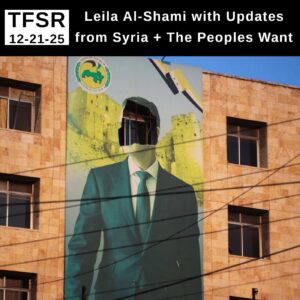
This week, we’re sharing a recent chat with Leila Al-Shami, co-author of Burning Country: Syrians in Revolution and War and host of Syria: The Inconvenient Revolution Podcast, to give us an assessment and update on situations in Syria since our last episodes on the subject, as well as an introduction to The Peoples Want, an initiative towards a new anti-authoritarian internationalism in which Leila is a participant.
- Our prior interview with Leila Al-Shami and Elia Ayoub
- Last year’s interviews with a member of Tekoşîna Anarşist and another with the Interstices-Fajawat
- Leila’s recent presentation on a year since Assad on From The Periphery
- Sub.Media short film on The Peoples Want
- Interstices-Fajawat blog (with an upcoming film on Khazama’s return to Suweda) has posted about the tension and conflict experienced by the Druze
- After The Fall, a podcast following women in AANES (Rojava) since the fall of Assad, made by comrades: https://afterthefallpod.libsyn.com/
. … . ..
Featured Track:
- Yal Harak Qalbe by Omar Souleyman from Elbir
. … . ..
Transcription
TFSR: Our guest, Leila Al-Shami, was the co-author of Burning Country: Syrians in Revolution and War. We had her on The Final Straw Radio in 2020 to speak about some of the background of the Syrian revolution, repression, and civil war in that country. She’s a Syrian-British activist and journalist based in the UK, and is part of the From The Peripheries Media Collective. I’m excited to have her back on to share some assessments of the current situation in Syria, nearly one year since the ousting of Bashar al-Assad’s regime, whose family had headed the ruling Ba’ath party from 1970 until December of 2024. Leila, I wonder if you’d care to introduce yourself further and thank you for coming on to the show.
Leila: Hi. Thank you very much for having me. It’s good to be back after such a long time. Things have rapidly changed in Syria since we last spoke, so I’m looking forward to getting into it.
TFSR: What can you say about the transitional government under the rule of Ahmed Hussein al-Sharaa? What degree of popular consent is there to that rule? What is your assessment of the jihadist insurgent leader claiming to have turned moderate statesmen and his backers in the West?
Leila: I’ll start with the second part of that question, which is asking whether Ahmed al-Sharaa has moderated over time, because I think that’s the question that a lot of international media focus on. He undoubtedly has moderated over time, and this hasn’t been overnight with the fall of the regime. It’s been a process spanning a decade. We know that he came out of the Islamic State of Iraq and had roots in Al Qaeda. He was sent to Syria by Abu Bakr al-Baghdadi, the leader of the Islamic State in Iraq. And he founded Jabhat al-Nusra, which, when it came on the scene, was involved in suicide bombings, killing civilians, and sectarian attacks. By 2015, it was a powerful force in Syria and started taking up some roles in the state. And when it was doing that, it started to prohibit the mixing of men and women. It imposed Islamic hudud punishments and public punishments, and it also cracked down a lot on independent local councils that were operating in Idlib and arrested many revolutionary figures, including assassinating key revolutionary figures like Raed Fares, who was very active in Kafranbel and was a media activist and involved in lots of revolutionary projects.
But at some point, Jabhat al-Nusra realized that ISIS’s levels of brutality were unpopular, and it was responsive, in many ways, to popular pressure. It broke with the Islamic State in Iraq, which became ISIS, which they fought. Jabhat al-Nusra fought ISIS a lot, and it broke with Al Qaeda.
In 2017, they rebranded as HTS and set up the Salvation Government across Idlib and really began to focus on service provision and took a very managerial approach to governance, rather than ideological. And it broke in many ways with Salafist doctrine. It started to implement much more moderate forms of Islamic jurisprudence, which were much more in line with the local population. The education system remained largely secular, and it managed to gain respect from many Syrians for the stability that it brought to Idlib. And the fact that Idlib managed to develop in that period, even though it was under attack often, it developed much more than other parts of the country. I mean, when the regime fell, people from Damascus started traveling to Idlib to go to the big malls there, and were astounded that you could use the internet in the street and things like that.
It’s also started building relations with NGOs to help with service provision, the Americans under the first Trump administration, and Turkey, mainly around security issues, fighting against ISIS, etc. So it definitely did moderate, and since it came to power after the fall of the regime, it’s not ruling as a Salafi jihadist government. But for me, the question is not the correct question to ask, because I think the question that is much more interesting is whether he is ruling as an authoritarian or as a democrat. This is a guy who gained power through force of arms and declared himself president. There’s no real sharing of power. Most of the decisions are being made by militiamen. It’s meant to be a transitional government for between four and five years until elections, and there are very good reasons for that. It will take that time for Syrians to return to the country, to build up political movements and opposition parties. But the question is, to what extent is he consolidating power now?
The transitional government has 23 ministers. Nine of them are affiliated with HTS, and the four most strategic positions, the Foreign Ministry, Defense Ministry, and Ministry of Interior and Minister of Justice, are all held by militiamen close to al-Sharaa. But there are some aspects of it that are more positive. He brought in a Kurd as Minister of Education, a Druze as Minister of Agriculture, and an Alawite as transport minister. And a Christian, Hind Kabawat, who is also the only woman, is the Minister of Social Affairs. And Raed Al-Saleh, who was the much-loved head of the White Helmets in Syria, holds the Ministry for Disaster and Emergencies. There’s a question, to what extent these appointments, whilst they’re positive on the surface, that there’s more diversity in the government, are they just tokenistic? Because the individuals that have been brought in do not really represent any political constituency or political party or movement, they’re just there because they are a Kurd or they are a Christian.
So there have been things that haven’t gone so well. There was meant to be a national dialogue conference. This happened early on, after the fall of the regime. I think it was in February or March, but there was only one day of discussion on key issues relating to the future of Syria. There was no participation from the SDF or the Autonomous Administration, which represents Kurds in the north. Many people could not participate because the conference was announced two days before, so important political figures from exile couldn’t return to the country. Also, the Constitution was drafted without any meaningful participation, and that’s something that has angered a lot of people. And whilst it does have some good clauses, like it protects the rights of women and freedom of belief and linguistic and cultural rights for minorities, all power is given to the presidency basically. There’s also been no law on the formation of political parties, and that’s a key issue, because Syrians need to organize an opposition now. And it was announced that a law on the formation of political parties would be passed, but until now, it hasn’t.
So I think this is the key question. To what extent is al-Sharaa consolidating power? or to what extent is he going to allow more political participation and a transition to a democratic, civilian-run system, which is what the majority of Syrians want?
But you asked about popular consent, and overall, al-Sharaa is very popular with the majority of the Syrian population. There’s obviously, and we’re going to come into it, certain constituencies which are very fearful of the new government, but there’s also a big part of the population which is very supportive of the moves that he’s taken since he’s been in power.
TFSR: Thank you for that. And to move back to the creation of political parties, or the culture around that. It seems like it would have been difficult not to say that people weren’t organizing around political ideas and attempting to make change in that venue during that period of time, the 54 years of rule by just that iteration of the Ba’athist Party under the Assad family. But it seems like there’s a lot between all the displacement, the new generations that have come up under the war or under the Ba’athist regime, that there has to be some creation of the culture of political parties and a finding of a new road towards that multilateralism in Syria.
Leila: Yeah, 100%. Under the Assad regime, for like five decades, the whole political society was totally repressed. Nobody could form independent parties or movements. Anyone who tried was arrested and imprisoned. And then, of course, over the past decade of the counter-revolution, war, civil society activists and political democrats in particular were arrested and imprisoned, and many of them died under torture, as you’ve seen the horrific scenes from Sednaya Prison and places like that. So the political culture has been completely destroyed in Syria, and it’s rebuilding from ground zero, really. And the question at this moment is, is there an alternative to Ahmed al-Sharaa? And there isn’t really on the political level. The alternative is other militias. And a lot of the militias are quite radical and extreme in Syria. So my main concern is whether the political space will stay open over the next four-year period so people can really start to organize and build political movements, build a political culture, and go forward to achieve the democracy and social justice that they’ve sacrificed so much for.
TFSR: Just going through some points from this year that I noticed when I was trying to prepare for this conversation. In March of this year, HTS-aligned militia and the Syrian state forces conducted massacres of Alawites, an ethno-religious minority to which the al-Assad family belongs. During clashes in western Syria, killing some 1500 and leading to the exodus of possibly some 13,000 Alawites seeking safety across the border in Lebanon. This follows the burning of a public Christmas tree in Damascus and an attack last year, and an attack and arson on the Alawite shrine of Al-Khasibi, in which government-aligned militia partook. Can you talk about the current philosophy behind HTS and what it bodes for the rights of religious or ethnic minorities and other parts of Syrian society, often marginalized by conservative religious and governance models? You mentioned that there is in this new constitution the protection of freedom of beliefs for various people. So moving from there, if you would?
Leila: Yeah, I think minority groups are very fearful because of the Islamist background that the current government comes out of, and because there’s been some horrific sectarian massacres on the coast in March targeting the Alawite population, and then later on in the summer in the south of Syria in Sweida, targeting the Druze population. I just want to focus a little bit on what happened on the coast in March, because it actually didn’t start out as sectarian slaughter. What it started out as was an uprising by fulool or remnants of the former regime who are against the transitional governments and trying to agitate against it. Security forces went in to quell that uprising, and things got very out of control, and it did turn into widespread sectarian slaughter. But I think some of the initial killings that were reported as sectarian attacks actually weren’t. It was the case, for example, of Shuja al-Ali, who, in May 2012, was responsible for the Houla massacre of more than 100 people. And he was really agitating following the liberation, agitating, stoking sectarian tensions, and calling for an uprising against the government. And when he was killed by security forces, his body was dragged through the streets of Houla. And many media outlets reported this as a sectarian attack, but actually, it was a revenge killing.
This really links into the issue of transitional justice, because one of the main problems with the new government is that it hasn’t moved on the issue of transitional justice, and that’s really a key thing for Syrians. They want to see the old regime, and not only the old regime, but all those responsible for war crimes, brought to justice. And until that’s really moving forward, we are going to see these revenge killings. But undoubtedly, it got out of control. Many civilians were killed. Many women and children were killed. The vast majority of killings of civilians were by the Syrian National Army militia, which is a Turkish-aligned militia from the north. But it was clear also that some forces that were clearly part of the general security or part of HTS also carried out massacres. On the other hand, other elements of the general security and HTS did go to villages to try to protect the villagers from attack.
So it’s unclear how much this was directed by the central government, or how much it got out of control. What is clear is that the government said that it would set up an investigation into what happened. That investigation was never made public and was really criticized for not being transparent. But in recent days, something positive has happened in that there is now a trial being held, which includes both fulool remnants of the regime, but also members of the militia allied to the transitional government, to judge their crimes and the killing of civilians in the coastal region. So that’s really positive. It’s the first time in Syria’s history that there’s been a trial in which the authorities are implicated and being held to account.
But to go back to the original question, I think one of the main issues is not just about HTS ideology, but it’s about the sectarian breakdown of Syrian society as a whole. For the past decade, the people who suffered the most under the Assad regime undoubtedly were the Sunni Muslim majority. They’re the ones who faced the barrel bomb attacks on their communities, the chemical attacks, mass arrests and torture, being driven from their homes and forced into exile. They really have this sense of Sunni victimhood, which is now causing this revival of Sunni identity. And this is very problematic, because whilst the Sunni majority feels that they’ve been victimized, the minorities also feel that they’ve been victimized and have legitimate grievances.
So what we’re seeing is this sectarian engineering, which was specifically engineered by the Assad regime to produce societal breakdown, is now being carried over, and we’re seeing that play out. Unless Syrians can come together and put their identity politics aside and start working together as Syrian citizens to try and build a secure and safe future, we’re just going to have constant instability going forward and constant conflict going forward.
TFSR: Sticking to the concept of transitional justice that you brought up, I wonder whether in the diasporic communities or with the folks that are on the ground in Syria that you’ve been speaking with or hearing from, if there are any models, methods or approaches that you have found interesting that you’d want to share with the audience towards the idea of transitional justice. Maybe you could define the term. When I hear it, it makes me think of attempts at truth and reconciliation processes that have often been facilitated by outside NGO, UN, or third-party agencies, as faulty as they have been in circumstances like Ireland and South Africa. I wonder if you could go a little bit deeper, if you can, into the transitional justice idea.
Leila: Syrians have been looking at different models over the past decade–those that focus on transitional justice–and trying to take examples and inspiration from elsewhere. You mentioned South Africa, also, Bosnia is a very pertinent example for us because of the sectarian breakdowns and the religious divides in the society there. At the moment, there’s a big call from Syrian civil society on the international community to really give support to justice processes inside Syria, and I think that’s the main focus that they want these trials to be held inside Syria, with support and expertise from the international community. The transitional government has been very slow to move on this and actually released some key war criminals from its custody, which caused massive public outrage. But then also, in recent weeks, it’s just set up a commission to start discussing with civil society and moving forward on that issue. So there is some hope that things are going to move on that, but time will tell how serious the government is about pursuing this issue.
I think the sticking point for the government is that it’s very happy to try former Assad regime officials for the mass crimes that they’ve committed. But there’s also the question of justice for the victims of opposition militia, including, of course, HTS, and I think this is what the government’s fearful of.
TFSR: Yeah, I could see from the position of stabilization of a state, especially during the awkward period of transition, that this thing could easily move into destabilizing of that transition. Particularly when for a regime to have operated, let alone the civil war, but for a regime to have operated for that many decades, there’s a huge amount of the population that were complicit with the operation of the Assad regime.
Leila: There has been some amnesty given, which I think is totally right for low-level soldiers and things like that. But the people who were responsible for directing the near-genocide of the Syrian population really do need to be held accountable.
TFSR: So, as HTS took a leading role in the post-Assad period, with the backing of many foreign powers, critics have voiced concerns about the role of women in Syrian society under HTS rule, considering the conservative religious views of what they might propose as an ideal society. How has the situation developed? What policies have been put forth and what practices are in place at this point in terms of the rights of women to participate in social, economic, and political life in Syria?
Leila: Well, I think at the moment, Ahmed al-Sharaa is trying to court and to build legitimacy amongst two key constituencies. The first is the Syrian public, and the second is the Western powers that need to help it rebuild the country going forward. And I think it knows very clearly that if it brings in strong Salafist interpretations of women’s freedoms, it’s going to be vastly unpopular and it’s not going to be able to rule the country.
There were some things that happened, like shortly after the liberation, a media spokesperson for the new government said that women were unable to do many jobs that men could do. I think he gave the example of the Ministry of Defense. This sparked massive public backlash, and there were protests held by women across the country. There was also another incident where the Ministry of Tourism tried to ban the wearing of bikinis on public beaches, and this again provoked a massive public backlash, and the government ended up saying that nobody is able to interfere with women’s dress, and if they do, they will be punished.
The situation for women is not just an issue stemming from the government. Syria is like a deeply patriarchal and socially conservative society, and even within opposition circles, it’s very difficult for women to carve a place and be politically active in many cases. The exception to that, of course, is civil society, and women are really at the forefront of many of the civil society organizations, particularly working on the transitional justice issue, which is often being led by wives and mothers of the detained and disappeared.
There are some very concerning things happening in terms of women’s rights, and one of these is reports of kidnappings of Druze and Alawite women, specifically Alawite women. There have been many reports of kidnappings. It’s difficult to know how widespread this is, because definitely some of that has been inflated for propaganda purposes from people who are against the new government. But it’s definitely happening in large numbers. The government tried to do an investigation into it. They investigated, I think, 42 cases, something like that and they said that only one case was real and the rest were fabricated. But this has been widely condemned by Syrian human rights organizations, who said it’s the government’s not taking the issue seriously.
TFSR: I’m sure that there are lots of theories coming from different directions about who could be behind these kidnappings. Are there any plausible explanations? Is this coming from outside of Alawite communities? Is this coming from people within Alawite communities kidnapping their neighbors? Do you have any thoughts on that?
Leila: I think a lot of it is revenge, often colored through a sectarian lens. That’s what I imagine it is. People are thinking that these communities oppressed us and collaborated with the Assad regime, so they’re taking revenge into their own hands. And there has to be much more concerted action by the government to ensure that minority communities are safe and to stop these incidents from happening.
TFSR: My understanding is that there was a peace deal between the Autonomous Administration of Northeast Syria, sometimes known as Rojava, and the transitional government under al-Sharaa, in which the Syrian Defense Forces, the SDF, which are dominated by the YPJ and YPG, plan to integrate into the national army by the end of 2025. But clashes have continued between the Ministry of Defense Forces, being offered promises of advanced weaponry by Turkey, which has been very much against the organization of the Kurdish majority in northeast Syria, and also Arab militia that support it, versus the SDF. This comes at a time when the USA, under the first Trump administration, was already withdrawing its backing, in a lot of ways, from the SDF and its fight against ISIS. During the second Trump administration, this has just gone further, and has withdrawn troops.
Leila: There has been continued fighting in the north between the SDF and specifically Turkish-backed militia, the Syrian National Army. The Syrian National Army is well-known for its brutality and the atrocities that it has carried out in areas that it controls, specifically targeting the Kurdish population. There’s also been outbreaks of fighting in the areas that the SDF rules, where it’s not popular.
So if we go back to March 2019, the SDF controlled all the territory from which the global coalition had expelled ISIS. And that was not only the Kurdish Northeast, but also the almost entirely Arab southeast, including the city of Raqqa. Many revolutionary Syrians were not happy with this, they saw it as a power grab. They saw it as outside interference in their local governance. So the PYD rule, whilst it was a success for many Kurds in areas which had a Kurdish majority, was not the case in these areas. So when the regime collapsed in late 2024, the SDF captured Deir ez-Zor from the regime and Iranian fighters, and residents protested to demand the SDF’s withdrawal. Many local SDF units defected to HTS, and the city returned to central control. In Raqqa, there’s still very high tensions. It is still under SDF control, and men who have raised the Free Syria flag have been imprisoned for two or three years for doing so. There’s also the issue of forced conscription. The SDF is forcibly conscribing young men and youth, which is undermining the agreement that the SDF has made with the central government.
So, to return to the agreement that on the 10th of March, al-Sharaa and the SDF signed an agreement to integrate the institutions of the SDF into the central government and national army in exchange for recognizing the rights of all Syrians to representation and participation in the political process, regardless of ethnicity or sect. But when the constitutional declaration came out, it failed to offer any concessions on equal citizenship, decentralization, and local democracy. It was rejected on this basis, not only by the SDF, but also by the Kurdish National Council, which is opposed to the SDF and has worked with the Syrian opposition throughout the past decade.
So the Kurds felt that their rights were not being taken seriously. They didn’t want to give up their arms, and then, obviously, with the violence that broke out in the coast in March, with the Alawite community, and in the south in the summer, with the Druze community, the minorities are much more fearful, and they want the SDF to keep their weapons and maintain a local Self-Defense Force, understandably. But on the 16th of October, there was another agreement between the SDF and Damascus to merge the SDF into the Syrian army. This time, the government said that they could join as a cohesive force, so the Kurds do maintain their own Self-Defense Force. In reality, then, it means there is some form of decentralization, at least in security issues. Going forward, I think the deadline is the end of this year. Let’s see what the progress is over the next month.
TFSR: Bringing up the idea of Syrian citizenship, especially after the amount of conflict that’s occurred since the civil war began and since the revolution, how does citizenship work in Syria, or how has it worked? Are there populations that were born on the soil that lack documentation or acceptance by either the past or the current Syrian regime in a way that that has been held over their heads?
Leila: Yeah, definitely. Specifically, the Kurdish population. There was an exceptional census carried out. If I remember rightly, it was 1962, but I may have got the dates wrong. This stripped many Kurds on Syrian soil of their nationality, and because they didn’t have their nationality, they didn’t have access to their basic rights, either civil or political rights. They couldn’t participate politically, although nobody could really. They were denied a lot of their social and economic rights because they couldn’t, for example, go to certain hospitals or universities for higher education. When the Assad Regime started working more closely with the SDF, because it handed over control of the northeast to the SDF, did give some of those Kurds back their citizenship, I think, as a way to make some concessions and have more support from the Kurdish community. But I think there are still a large number of Kurds who don’t have citizenship. I don’t know. I’ve not seen any discussions happening on that, and it will be interesting to see, going forward, if those people are granted citizenship or not in the future.
TFSR: Thank you for letting me just spitball that one at you. I appreciate it. So the Kurdish-led SDF has estimated that there are some 10,000 ISIS or Daesh fighters still active in Syria, and there are an estimated 10,000 suspected ISIS fighters and supporters held in prisons like al-Hol. Can you talk about the continued attacks by affiliates of Daesh, particularly as the US forces have further withdrawn, the likelihood of resurgence, and the continued incarceration of suspected militants and their families?
Leila: Sure. Well, ISIS was defeated as a state in 2019, but since then, it has still managed to launch guerrilla attacks and assassinations in eastern Syria, and there have been dozens of those that have happened since the fall of Assad. It once had a force of 100,000 fighters in Syria and Iraq. 40,000 of them were foreigners, and that’s really estimated to have gone down to about 3000 men now, mainly locals who are hiding out in desert areas. But they are trying to rebuild, and my fear is that they will attract many of the men from al-Sharaa’s own base, who are disgruntled with the more moderate turn that he’s taken. I think that’s quite a worry going forward that that will happen.
As you mentioned, there are up to 10,000 ISIS fighters and supporters of ISIS in SDF custody, including tens of thousands of women and children in places like al-Hol camp. Many of these youth have had no education. They have no options. Most of them have not committed any crimes. They’ve just been, unfortunately, born into an ISIS-supporting household. All of those foreigners, the issue is, what is the international community going to do about it? Because international states are refusing to take these people back, but they’re not Syrians. Many of them are foreign nationals, so they should be returned to their country of origin, either to face trial or, in the case of women and children who haven’t participated in atrocities, to be rehabilitated. And foreign powers are not willing to do that. There’s a very famous case in the UK of a woman called Shamima Begum, who was a UK national, who left Britain at the age of 15 to join ISIS and travel to the Islamic State, and the UK Government’s scripture on citizenship. So what’s going to happen to these people now? Just sitting there in this prison camp is just a disaster waiting to happen, really.
TFSR: This year, you featured two interviews on your podcast, Syria: The Inconvenient Revolution, with Khuzama and Cedric of Interstices-Fajawat, who are based in Sweida, to speak about the attacks on members of the Druze faith and conflicts with Syrian authorities, as well as with Bedouin militia over land, ostensibly. Could you talk about some of the topics that you covered, but also share with the audience some of the insights that you have into this and the status of that conflict now?
Leila: I won’t go into all the details of what happened in the summer. People can go and listen to those podcasts and hear first-hand accounts of what happened, but on the eve of liberation, there was a large section of the Druze population that was willing to work with the transitional governments, and that’s really not the case anymore. The reason for that is that violence broke out. First of all, there was a fabricated audio recording of a Druze Sheik insulting the Prophet Muhammad, which was proven to be a fabrication. But this stirred up a lot of animosity against the Druze. There were outbreaks of violence in Jaramana, which is a suburb of Damascus. There were attacks on Druze students, I think, in Aleppo and in Damascus.
In Sweida, things got totally out of control. There was a massive mobilization by Bedouin militias that carried out many atrocities against Druze civilians. There were awful videos that circulated of people being shot simply because they said that they were a Druze, not a Sunni Arab. There was the killing of a medic, which was horrific. There were videos circulating of Druze men having their mustaches forcibly shaven, because the mustache is often a symbol of the Druze faith. So things really broke down, and the government failed to establish control over the province, and actually sided with the Bedouin militia, which created a massive mistrust amongst the Druze population.
This Druze Sheik called al-Hijri wasn’t popular. The first time that I spoke to Cedric and Khuzama for the podcast, we were asking about the different militia groups and what they were standing for, and it was very clear from what they said that the majority of the Druze, those who had opposed the Assad regime, wanted to work in some form with the transitional government. Some of them wanted more decentralization and autonomy than others, but there was a willingness to cooperate. And al-Hijri was quite isolated. People didn’t like him because he was known for his connections with the Assad regime, and they didn’t like him because he started calling on Israel to intervene, to protect the Druze from the slaughter that he said was coming, and in effect, did happen. But now al-Hijri has got a massive amount of support from the Druze population because of the sectarian violence that happened, and he’s eliminating the opposition of other groups and now ruling Sweida with quite an iron fist, it seems, internally.
Meanwhile, there were Syrians who were sympathetic to the Druze at the beginning, but after Israel’s intervention – Israel even bombed Damascus, claiming it was to protect the Druze – there quickly became a lot of animosity amongst the Syrian population towards the Druze, who began to see them as traitors and collaborators. For example, on the 15th of July, there was a demonstration in Al-Hasakah in support of Sweida, but then after Israel’s bombing, there were protests all around the country, including in Al-Hasakah, calling for support for the transitional governments and against Israel. So it’s a very difficult situation. The government has so far failed to punish anyone who was involved in committing the atrocities. After the massacres, rather than trying to help the government, it imposed the siege on Sweida, and there were food and fuel shortages. So it’s in a deadlock now. It’s another example of sectarian breakdown in Syria, which is going to take so much work on so many levels to really try to overcome if we’re going to have any stability going forward.
TFSR: And I guess in relation to the Druze and Israeli connection, regional powers have been jockeying to expand their influence in Syria since the fall of Assad. For instance, with Turkey increasingly backing armed elements and attacks in the northeast, the PKK, aligned with the Autonomous Administration of Northeast Syria, but across the border in Turkey, has declared that it would leave the Bakur region and disarm and struggle through civil methods inside of Turkey. Israel has taken advantage of the war and the ongoing conflicts, and particularly has been, I think, for a while, courting the Druze population that is in the occupied Golan Heights around the idea of protecting them from the Syrian state. At times, launching aerial attacks, which you mentioned, into Syria. Do you see these pressures as increasing or significant at this moment?
Leila: It was inevitable that when the regime fell, the entire international community would descend on Syria like vultures, trying to set their influence, trying to get what they can out of the country, trying to set the agenda and ensure that whatever happens is in their interests. That’s how so many states have dealt with Syria throughout the civil war, and it’s how they’re dealing with it now, going forward. Unfortunately, Syria is in a very weak position. We don’t have a unified country. We don’t have a government that’s in control of the entire country. During the battle for liberation, Israel actually bombed all the military installations in Syria. So Syria doesn’t actually have any advanced weaponry from which to protect itself. These realities render Syria dependent on international states, and it’s building a lot of relations with America, with the Gulf states, and with Turkey, both in terms of trying to get support for reconstruction going forward, but also in terms of resisting Israel. Because Syria cannot resist Israel on its own. It needs powerful states behind it. Israel is such a huge threat to Syria at the moment; it’s really been expanding its territory, carrying out raids into Syria. There have been videos of settlers going in and trying to set up places for them to live inside Syria. There have been reports of Israelis kidnapping Syrian citizens from the south. It’s a very dangerous situation. I don’t know what more to say about it. The only thing that we can hope for is that Syrians manage to set the agenda, and that Syrians are able to make the decisions going forward.
TFSR: How do you feel about the international media covering the issues faced by Syrians? Do you see much life of independent media on the ground among Syrians?
Leila: The international media, as we touched on earlier, has really been quite focused on whether Syria’s now an Al Qaeda state, and whether it’s going to turn into another jihadist entity. There’s been a lot of focus on that. But then I’ve also been very surprised by the international media’s support for Syria going forward as well. Certainly, al-Sharaa has been courting international dignitaries, people like Trump, and even things which were very unpopular, like speaking with Russia, but recognizing that’s the reality that we’re in now. So there has been positive coverage of that.
In terms of independent media, I’ve been very saddened to see that some independent media and independent voices have just fallen into support for the transitional governance, and they’re not being critical in any way or form. They’re not trying to push forward and hold to account for these human rights violations that are still happening. Also, there’s been a problem that when there are critical voices, and there of course are many critical voices, they’re also being silenced on social media by supporters of the government. This is very worrying that that democratic space, or the freedom to express your views, is being controlled not just by the government, but actually by people, including people who were once key revolutionary figures, or supported the struggle against the Assad regime.
TFSR: Over 54 years of the al-Assad dictatorship and the civil war, many people have chosen to leave Syria. Many made homes elsewhere. Some likely longed to return. Is it your impression that people are returning in significant numbers to Syria, or are people that you’ve spoken to taking a wait-and-see approach as the country continues to experience some destabilization and the need for rebuilding?
Leila: Many people have returned. I think the UN estimates around a million people have returned to Syria after the fall of the Assad regime. About 1.7 million people who were internally displaced have returned to the communities from which they were displaced. Many of these people were living in appalling situations in camps in Turkey, in Lebanon, in Jordan, so they didn’t have good options open to them, and they’ve returned to a really desperate situation, because there are no houses, there are no jobs inside Syria now.
But then there are many people as well, especially those who have been more fortunate, maybe have made it to Western states, or have managed to get property or have jobs or have their children in school outside Syria, who are much more nervous just to give up everything that they have and return back whilst the future of the country is still so uncertain.
TFSR: Yeah, that makes a lot of sense. More particularly, what is the economic situation like in Syria in terms of employment or the cost of everyday needs, such as utilities, flour, oil, water, fuel, and meat?
Leila: It’s a disaster. Basically, it’s a depressing situation. When I went back, the first thing I noticed was the extent of the destruction. I was mainly based in Damascus and if you go outside Damascus city center, into the suburbs, the suburbs are entirely destroyed, and the cost of reconstruction is estimated to be around $250 billion to $400 billion. So there’s a huge amount of money and investment that’s needed to rebuild the country. Meanwhile, 90% of the population is living below the poverty line. There are no jobs, there are no homes. There are massive challenges there. Food prices are very high. Electricity was in very short supply. When I was in Damascus; there was only electricity for two hours a day. But I believe that that’s really improved massively over the past weeks.
But there have been some positive things as well. Certainly, the lifting of sanctions was a positive, and people were very happy that it happened and that there is a chance for reconstruction now going forward. Trade deals have been made with Qatar, with Turkish companies, with American companies to revive the energy sector and various other things. I think the real question is to what extent there’s going to be popular participation in reconstruction and in economic decision-making going forward. Because a key feature of the old regime was this cronyism, crony capitalism, in which all the money and business contracts were really concentrated in the hands of Assad and his family and loyalists. I think this is the fear that a lot of people have going forward, whether the developments that are brought in, the trade deals, the reconstruction will really benefit the most disadvantaged of the population and will actually filter down to people who don’t have homes, who don’t have jobs.
TFSR: I guess another part of the legacy of the Assad regime and of the war was the introduction of production and distribution of captagon, which is a brand of fentanyl. And I know that it seems pretty common that in areas of depressed economic situations, drug trade, drug trafficking, and drug use are escalated. I wonder if you have any insights about what’s going on with captagon in Syria at the moment, with the distribution and the usage, or the treatment or harm reduction around it?
Leila: Over the past decade, Syria, in effect, became a narco state. All the money towards the Assad regime was coming from the production, distribution, and trade in captagon, this amphetamine-like substance, which is being exported all around the world. You would hear regularly every other week, there would be massive seizures of shipments in Jordan and the Gulf countries, even as far afield as Italy. Then, of course, captagon was very popular with Syrians taking it, especially Syrian fighters. It’s an amphetamine-like substance, so it gives people energy. It stopped them from feeling hungry. It took away some of their fear of fighting, and many, many people became addicted to it.
The new authorities are very openly saying that they want to clamp down on captagon. They’re very anti-drug use, and there have been some big seizures of drugs which were destroyed, and also the destruction of drug-producing factories. It’s been very public about that. But of course, the trade is still going on. It’s the war economy. People made their living and their money by that, and it’s not going to stop overnight. Just in terms of rehabilitation, I think that’s one of the main problems, is how to deal with people who have unfortunately got addicted to this substance, because there isn’t that much sympathy for drug use in the population. I think there are some initiatives which are working to rehabilitate addicts, but they’re not as widespread as they need to be.
TFSR: Pivoting a bit, we’ve talked a bit about the legacy of sectarianism that was exacerbated through Assad’s rule, and the repression of the Sunni Arab majority, as well as other minority groups within the country, and then the breakdown across ethnic and religious lines and regional lines during the conflict of the civil war. One of the things that you covered in Burning Country, which I thought was really interesting, and that I’ve seen come out in some of your blog posts or articles since, was the revolutionary impulse for a new identity of Syrians that would not be drawn along these lines and couldn’t be used by sectarian impulses to create conflict. Some sort of new Syrian identity. I wonder, despite these instances that I’ve asked you about so far during this conversation, if you see that revolutionary impulse right now in Syria?
Leila: The sad thing is that so many people who started the revolution are no longer with us. Many of the democrats, the people who were working across sectarian and community divides, who were really fighting for democracy and social justice, many of them were imprisoned, killed, a few of them went out into exile and are now able to return. The movement as a movement was almost completely destroyed, and the fall of the Assad regime came by an armed militia that wasn’t involved in the original revolutionary movements, unfortunately.
I was quite hopeful when the regime fell that we would see a massive revival of civil society, and unfortunately, that hasn’t been the case. There are lots of initiatives happening. There are many people working on the ground, but we can’t start talking about a movement. Will we see more of a revival going forward? At the moment, the government is very popular with the majority of the population, but if it doesn’t deliver on things like democracy, transitional justice, stopping these sectarian killings, and trying to implement much more security and stability, it is going to rapidly lose its popularity over time. So, there is stuff happening, but we can’t really be talking about a big movement of opposition at this stage.
TFSR: Switching topics a bit, I wonder if you’d mind sharing a bit about this project, The Peoples Want, that you’re a member of. How did it come to be, and what are the goals and hopes of this?
Leila: The Peoples Want is a network. It came out of the struggles and revolts that were happening primarily in 2019. And maybe it’s good to talk about how it started, because that will explain a bit what The Peoples Want is trying to do. But in 2011, there was a massive wave of transnational uprisings. There was the Arab Spring. There were uprisings in Spain, in Greece, at that time, in the US, with the Occupy movement. And specifically, the Syrian revolution had a massive impact on a whole generation of activists, because people felt very disillusioned that large sections of the left did not support the Syrian struggle, and instead took this campist, state-centric analysis, where everything was a power game between states and the people were basically invisible.
A lot of conversation started to happen, especially with the next round of transnational revolts, which happened in 2019. The Syrian Canteen, which was a self-organized collective in the Paris suburbs, started to ask, what could internationalism look like? And started to invite participants from those revolts and revolutions that were happening across the world together, to gatherings, to festivals, to start having this discussion around internationalism and how we could really support popular powers during the time of revolt. And that’s how The Peoples Want was born. There have been five festivals so far, and at the fourth festival, the participants got together and said, “Actually, rather than just having this yearly gathering, let’s actually try to build a network based on principles of solidarity and mutual aid, where we can support each other, we can increase our strength, and we can ensure that the revolts and struggles of the future don’t just get wiped out, like many of the ones that we’ve been involved in up until now have.” So that’s where we’re at. The network was officially launched in March of this year, opened up to membership, and some really exciting work is going on, but ultimately, it’s a space for people to come together and to share their experience, to share their tactics of struggle, to learn from each other, and to try to build support amongst ourselves.
TFSR: I really suggest that listeners check out, and I’ll put it in the show notes. But there was just recently a video that Submedia did with a portion of the text from the manifesto ,set as they always do, with some really striking images and video of uprisings. One quote that I was struck by was on page 19 of the manifesto. “Unity is enabled by the sharing of experiences from the margins, insurrectionary practices, resistance in the face of repression, and the organization of immediate survival, more than by visions of change or ideological convictions.” I wonder if you could speak a bit about these margins and the challenge that The Peoples Want is attempting to face.
Leila: Yeah, what we realized was that when these uprisings happened, they weren’t really going out because of grand ideologies or political proposals. They were really based on the local experiences of injustice, lack of socio-economic justice, and repression that people faced at the local level. So the question that we had was to think of internationalism not as putting forward necessarily a new proposal, but thinking about how we can better support these diverse and local struggles that are operating at the margins all around the world, and try to create internationalism based on people’s real experience.
Of course, the reason why we felt this is so important is that we’re facing so many multiple challenges going forward, whether that’s rising authoritarianism and fascism across the globe, societal and ecological collapse. These are issues that concern all of us, and in order to be powerful going forward to resist these things or respond to these things, we need to work together.
TFSR: Because of the traditions and the languages, there are going to be different representations of visions that people have in different struggles. For me, one of the weaknesses that I saw in the Occupy movement in the United States was having a very broad and undefined set of shared values around class. There was generally this concept of the 99% and the 1% which is very populist, but I think it lacked an analysis for people to cohere around, while pointing at a common anger or resentment or difficulty that people were facing in their lives. The manifesto gives examples of many uprisings around the world that looked different, and that also had commonalities around, I guess, composition around social justice as a concept. I wonder, in your understanding with The Peoples Want as a project, what lines are drawn between what uprisings are considered to be ones that emulate values that you want to engage with and work around and find solidarity with, and what are uprisings that don’t, or where are values being expressed that you would distinguish yourselves from? Does that make sense?
Leila: I understand the question that you’re asking. We’re not trying to put forward a dogmatic political basis. There’s no monolithic or homogenous position, because we come from a variety of territories and struggles. We come from popular feminist movements, from ecology and food autonomy struggles, from autonomous spaces and collectives of exiles. The thread that weaves us together, I suppose, is our commitment to coming together, to start asking these questions, and to start asking what internationalism should look like based on the principles that are set out in the manifesto. We’re working with popular powers, people who are trying to build material and political autonomy within their struggles. It’s not even necessarily taking the struggle in its totality. We’re seeing who our people are within those struggles that align with these certain values, and how we can support them and give them more strength to grow. Because they’re focused on building material and political autonomy. They have a strong anti-authoritarian vision, etc.
TFSR: Great. And you mentioned the festivals that you all have put on, I wonder if you could talk about what happened with that, and if there are ways that people can find out when the next one’s happening to try to participate.
Leila: The model for the festivals that we’ve done up until now is that we had a week where participants in revolt were invited to come and to discuss together, strategizing in private for one week, in which, over the past few years, we’ve actually been developing the concepts and the basis for the network. But we always had a public festival for two days in which anybody could attend, where people involved in The Peoples Want would have a platform to talk about their struggles. People could learn from people involved in the resistance committees in Sudan, from the local councils in Syria, and from struggles in the US. We had people from the US from the Defend Atlanta struggle, for example. So, to provide a forum where these different ideas could be heard by the public at large. Then we also always had a bit of a party on that weekend as well, with DJs, live bands, based on the idea that if you’re going to dance and celebrate and eat good food with people, it will become much easier to work together politically going forward.
TFSR: I’m reminded of when the Zapatistas in ‘96 had this First Intercontinental Encounter for Humanity and Against Neoliberalism, which they called the Intergalactic. It sounds like the two-front event where there’s a public facing side of it that’s bringing together people to share ideas that the rest of the world who can’t participate or aren’t participating, can interface with ideas and struggles, and then also the internal facing of the participants hanging out. I wonder, was that an influence at all, or were there other influences on the model?
Leila: Definitely, it was an influence. Actually, there’s just been another Zapatista gathering this summer, and three of our members traveled to Chiapas to attend that and to talk about The Peoples Want and talk about the manifesto. We’re such a diverse group of people from so many different backgrounds. There are so many different influences and different experiences to learn from, and we’re trying to provide a forum where people can come together and share and pull that experience and see what comes out of it.
TFSR: Well, it’s very exciting. I’ll be sure to link in the show notes the website for The Peoples Want, where people can read the manifesto and also news updates, find further materials. If listeners want to find more of your work, Leila, where can they find you? Are there any projects that you’re currently working on that you want to share about?
Leila: I have a blog, which I hardly ever write in, called Leila’s Blog. I think it’s leilashami.wordpress.com. I would encourage people to read the manifesto, I’m very involved with The Peoples Want at the moment, Also check out the media collective that I’m involved in, From The Periphery. There are a number of different podcasts on there on different issues, from mutual aid, and I have one called Syria: The Inconvenient Revolution, which we’ve not put out that much content recently, but we’re hoping to get more regular content out there.
TFSR: Awesome. Thank you so much for taking the time to have this conversation with me. I really appreciate it and all the work that you do.
Leila: Thank you so much for inviting me.