
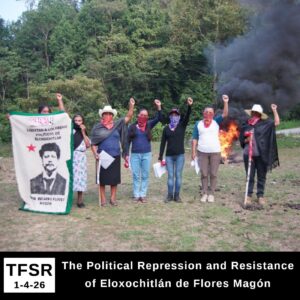
This week, an interview we just conducted with Madeleine Wattenbarger and Axel Hernández of the Cooperativa de Periodismo in Mexico and Ambar Ruiz of Radio Zapote about the case of autonomous resistance and repression in the Mazateca community of Eloxochitlán de Flores Magón in Oaxaca, Mexico, so named for being the birthplace of the Cipriano Ricardo Flores Magón, revolutionary Mexican anarchist who was murdered by medical neglect by the US prison system in 1922 (check out our 2022 episode on the history).
We talk about the rise to economic and political power of the family of Manuel Zepeda and his daughter Elena, their weaponization of the judiciary against community defenders resisting a hijacking in 2014 of the traditional community assembly and the years of organizing by Mazateca women whose loved ones face long prison sentences. We also speak about the case of Miguel Peralta, a Mazateca anarchist challenging his 5 decade sentence related to this case, as well as the recent murder by medical neglect while in prison of militant anarcho-punk Yorch Esquivel at the hands of the Mexican state at the behest of UNAM.
Media mentioned:
- Observatorio Memoria y Libertad: https://observatoriomemoriaylibertad.org
- Radio Zapote: https://radiozapote.org/
- Avispa Midia: https://avispa.org/en/
- Cooperativa de Periodismo Instagram: https://www.instagram.com/chingadamadrx/
- Cooperativa de Periodismo Youtube: https://www.youtube.com/channel/UCSIrcSb3v_q8hxD1iqulLSw
Groups to follow:
Further reading:
- “A Oaxacan Indigenous Community Fights a New Round of Bogus Charges,” NACLA
- “Communal care, backbone of resistance in Oaxaca,” Ojalá
- Excerpts of our translation of the MANIFESTO OF THE FEMALE SELF-DEFENSE FORCES IN SUPPORT OF FREEDOM (June 2023, translated & narrated): https://ahuehuete.substack.com/p/eloxochitlan
- And finally, a letter from Miguel Peralta to Yorch, narrated by Miguel Peralta
Announcements
Xinachtli Phone Zap Continues
First up, Chicano anarchist prisoner Xinachtli (state name Alvaro Luna Hernandez) was transferred on December 23rd from a hospital in Galveston back into solitary at McConnell Unit in Texas as punishment for the call-in campaign. He’s still lacking access to an ADA-accessible bathroom and shower unit and has not had his property or commissary card returned. According to his supporters, Xinachtli is still experiencing weakness in his legs and has now been forced back into a completely inaccessible space, where he faces a serious risk of another life-threatening fall or injury.
Xinachtli’s supporters demand remains: Xinachtli must be moved out of McConnell into an ADA-accessible facility that can address his medical needs. McConnell has already proven it can’t and won’t provide adequate resources to care for Xinachtli in his current state. They are putting his life in danger.
- Updated phone blast at https://bit.ly/xphoneblast
- Instagram at @FreeXinachtliNow
- McConnell Unit: +1 361 362 2300
- McConnell Unit Director Angela Chevalier +1 361 362 6328
- TDCJ Executive Director: +1 936 437 2101
To learn more about his case, check out our interview with Xinachtli from late 2024, or the earlier recording of him telling the story of his case.
Prisoners for Palestine Hunger Strike Continues
Four members of the Prisoners for Palestine collective, which we covered in our November 30th 2025 episode, continue their hunger strike with 3 of them at around or beyond 60 days without food as of this recording. As the situation is shifting daily, we suggest you get updates for ways to provide solidarity and the current demands of the hunger strikers at PrisonersForPalestine.org
Imam Jamil Al-Amin, Presente!
Revolutionary Jamil Al-Amin, formerly known as H. Rap Brown, returned to the ancestors on November 23, 2025 after 25 years in federal prison. The Imam was convicted in 2002 for the murder of a sheriff’s deputy and Al-Amin continued to be incarcerated despite the video-taped confession of another man with the means and the motivation for the killing. You can find a brief writeup and further readings, right before notes about the state murder by medical neglect of Yorch in the December 10th issue of In Contempt
Stop Cop City RICO Dismissed
Judge Farmer finally decided to dismiss the RICO charges against the 61 defendants in the Stop Cop City case on the grounds that they were filed improperly. This doesn’t remove the domestic terrorism or arson charges against some remaining defendants, and the state says it will refile the RICO charges but for now that’s a little off our comrades’ plates. To learn more, check out our latest episode on the subject from October.
Jessica Reznicek In Transitional Housing
Catholic Worker and pipeline saboteur Jessica Reznicek has entered transitional housing and left prison, proper. You can read her address to the public at the ABCF website. To hear an interview on her case, check out the one linked in our shownotes.
You can write directly to Jess at:
Fresh Start Women’s Center (Women’s Residential Correctional Facility)
1917 Hickman Rd,
Des Moines, IA 50314
Northumberland 2 Has Some Charges Dismissed
Judge Rosini dismissed 11 charges total between defendants Cara and Celeste—including one count of ecoterrorism and several misdemeanors. The two friends from Massachusetts were accused of liberating hundreds of minks from a fur farm in PA that kills thousands of minks every season.
As Phily Anarchist Black Cross says:
There is a pretrial conference in February. After that will come trial.
While this is big and exciting news, the case isn’t over yet. Cara and Celeste still have many charges to fight. Trial will come with extra costs on top of the other legal fees.
You can donate and learn more at phillyabc.org/nu2
Prairieland Defendants Trails Scheduled
Finally from DFW Support Committee:
A date has been set for the start of the Prairieland Defendants’ federal jury trial: February 17th! We have been told by multiple lawyers this date is very unlikely to change. The North Texas federal court circuit in Fort Worth is well know for being fast and firm with trial dates. Also, Dario Sanchez’s state trial is set for 1/12 in Johnson County. This is not a lot of time! We’re calling on supporters everywhere to do everything you can to help the defendants get the best defense possible. That means continued fundraising for expert witnesses and other trial expenses, writing letters to keep their spirits up, and raising awareness to highlight the importance of this case. If you’re able to come to DFW for the trial please do! We will have other concrete asks soon, so please stay tuned!
Letter writing info is available at: https://dfwdefendants.noblogs.org/getinvolved/
Fundraiser links:
-
https://www.givesendgo.com/supportDFWprotestors
-
https://www.gofundme.com/f/get-artist-des-revol-an-immigration-attorney
-
https://www.gofundme.com/f/help-maricelas-family-while-she-fights-for-justice
. … . ..
Featured track:
- De Cara A La Pared by Lhasa from La Llorona
Transcription
TFSR: Would you please introduce yourselves for the audience with any names, pronouns, location and affiliations that you care to share for this conversation?
Madeleine Wattenbarger: Sure, I am Madeleine Wattenbarger. I am an independent journalist based between Mexico City and Philadelphia, currently. Pronouns she/her. Along with Axel, I’m a member of the Cooperativa de Periodismo which is an independent journalist collective in Mexico City. And I work for various other independent media projects covering mostly social conflicts, social movements, human rights, land defense and disappearances in Mexico. We’re very happy to be here.
Axel Hernández: Yes, hi everyone. My name is Axel Hernandez. I’m a journalist in Mexico City, and I’m also a photojournalist, documentarian. We use the media to tell stories at the Cooperativa de Periodismo. My pronouns are he/him. I’m here with our partner, Ambar Ruiz, who is an anthropologist and has been participating in some studies about the community which we are talking today.
Ambar Ruiz: Hi, I’m Ambar. I’m a social anthropologist. I work in photojournalism and independent media. I also support resistance movements. My pronouns are she.
TFSR: Great, thank you all so much for taking the time to have this conversation. I really appreciate it. We’re here to speak about ongoing political repression in Eloxochitlán de Flores Magón in Oaxaca, Mexico. I’d like to build out context over the next few questions. First, can you tell us who is facing this repression, what they’re accused of and what penalties they face?
Madeleine Wattenbarger: Those who are facing the repression in Eloxochitlán are primarily members of the community. Specifically, it’s a Mazateca indigenous community that has a historic struggle for autonomy and self governance—so seeking to make decisions and organize daily life through a community assembly and through collective work, as opposed to through political parties as occurs in most of Mexico. So there’s a historic tension between those who defend this self governance and the Mexican political powers and structures. Those who have been resisting especially the last 11 years–but it really is a fight that spans a few decades–now they’ve been in prison. Many of the women who came together in this collective, Mazatecas por la Libertad, “Mazatecas for Freedom,” spent much of the last 10 years displaced from their hometown in protest camps as well. In Mexico City, they maintained one there for two years to demand the freedom of their family members. That’s who we’re seeing in this struggle, primarily the community assembly in Eloxochitlán and those who are defending the community’s autonomy and self governance, which is a right they have that’s recognized in the Mexican Constitution and in the international labor organizations, Convention 169. That’s a key conflict here.
Axel Hernández: I want to add that these people in the Eloxochitlán land are like peasants. They live from ground coffee, corn, beans. And that relation with the Earth and with the land, makes them the community defenders of the territory. It’s like a natural relationship with place. These persecutions affect 50 families and over 200 people in the community. Despite political oppression, at least 11 people actually are free, but the persecution is for all the community.
TFSR: That makes sense. In any small community—particularly where everyone relies on each other in common employment, and also where extended family exists—it makes sense that the persecution of some would lead to the pressure on everyone in the community. Could you tell us a bit more about the community and who lives there? You said that it was mostly folks who are Mazatecan. If you wanted to talk a little bit more about that? And also the legacy of communal autonomy that, as you mentioned, is constitutionally promised in Mexico.
Madeleine Wattenbarger: One important legacy in the community is that it is the hometown of Ricardo Flores Magón, who was an important thinker in Mexico’s revolution and an anarchist. He wrote a lot about autonomy, land, freedom, these ideas that were so important in the Mexican Revolution and I think, for a lot of movements today in Mexico and other places. As Axel mentioned, the main sustenance of the community is from coffee farming. That’s something that in the last several decades has been a key point of organization for the community. In the late 80s, early 90s, around NAFTA-era free trade, there were a lot of political changes in Mexico. One of the big ones that affected communities like this is the elimination of Mexican coffee’s INMECAFE. That eliminated checks on coffee prices, which really destroyed the livelihood for a lot of people. Their response in Eloxochitlán was to organize themselves into a co-op. Coming together through this organization, through this work, they managed to get some certifications to export coffee abroad on their own and stay afloat as a community. Despite these whims that were really affecting a lot of peasants out of the countryside, a lot of communities like theirs throughout Mexico, and I would say globally too. I think that resilience is something that’s really present today. It’s a very hospitable community. We were there in June with a civilian observation mission, which we’ll talk about in a little bit. Anytime you visit someone’s house, everyone receives you with so much care and coffee. I think that community ethos is really helpful in the orms of how they work and organize themselves, and also just in everyday life.
Axel Hernández: The story of Eloxochitlán is a story of resistance, but also a story of violence. As my partner says, this is the birthplace from Ricardo Flores Magón. He was the founder of the Mexican Liberty Party, Partido Liberal Mexicano, who fought against the dictator Porfirio Diaz in the Mexican Revolution. His anarchist thought mixed the European anarchists and the Russian theorists with the Mazatecan community’s practices. That remains in the collective memory of the people in Eloxochitlán. They’re so proud that Ricardo Flores Magón was born there. They are glad for that. It’s one of the explanations from that resistance. The resistance in Eloxochitlán was attacked violently since the last century. We have to explain this political concept that we have here in Mexico; we call them caciques. A cacique is a person—mostly originally from this place, in this case, in Eloxochitlán—who has power and uses it against the community. And this figure has ruled in Eloxochitlán since ever. The people there tell us about these kind of person who leads the community with violence, with terror. Stole the land, exploits the people. The community always have fought against that. Who, precisely, in this case? There’s a political figure or a political family who has business in the region, and also has political influence at local, at federal level even.
Ambar Ruiz: Eloxochitlán is a community located in the Mazatec mountains in the state of Oaxaca, in the south of Mexico. It’s a very green place with a cloud forest climate, which allows for fertile soil suitable for specific crops, such as coffee, corn, macadamia nuts and other products. These conditions make agriculture possible. Furthermore, it’s a very small community with fewer than 5000 people. It’s very rich in water and stone resources, trees and fertile lands. These conditions make Eloxochitlán an attractive site for extraction, which contributes to one of the many territorial conflicts, like the one we’re talking about today. As a Mazatec community, its political organization is traditional, and has been local for a lot of years and different from the Mexican nation-state. This detail is important for understanding the conflict, since the decision-making is done communally. This represents an obstacle to individual interests or economic interests.
TFSR: When speaking of the cacique–and caciquismo–in the US, at least, I think of the term “chief”, in terms of how the colonizing forces identified someone that they felt that they could work with in indigenous communities in order to anchor themselves for extraction. Could you speak a little more about that and sort of that political connection of the family?
Axel Hernández: Yeah, I think “chief” is a good term to try to understand the caciquismo way. This political family began like any other family in the town. The father of this family, called Manuel Zepeda, was a teacher in the local school, but the people tell us that he didn’t love that work. He started a business because his house is next to the river, and he began to extract the stones and transform them into construction material. This economic activity was his motivation to start his search for power. He started to incolate with political parties who never were present in the political life of Eloxochitlán. With the political party support came the power in Eloxochitlán in buying votes, trading with people. He assumed the position of municipal president, like mayor, and when he got the power, his business started to grow.
Ambar Ruiz: For explaining caciquismo or cacique in Mexico, this is like a system of local power where caciques, that are the local leaders, politically control our region through clientelistic networks, dominating resources, votes and social demands for their own benefit and that of their political allies. It arises from institutional weakness, the colonial legacy of indigenous chiefdoms and the need for a social and political control in a weak national democracy. These caciques exercised total control in the rural area. And this is not just in Eloxochitlán. This caciquism is a phenomenon that we can watch in other places in Mexico, in Oaxaca and Chiapas. In the south of Mexico, it’s very common to see this local political figure. Caciquismo consolidated in some sectors for the control of key resources. That’s something important, because it’s not just power for power, but it’s like a form of personalistic and clientelistic power that originated from historical structures. The caciquism led the caciques to exploit and extract resources from the area. So that’s important, they control the territory and they use it for the resources in the area.
Madeleine Wattenbarger: Another aspect of this is kind of like you said, Bursts. It is a figure, in this case case Manuel Zepeda, who not only is extracted from within the community, is also a link to outside political power. In this case, we see judicial power being used on many levels in a way that backs up Zepeda’s practices in his persecution of the community. So there’s that aspect of being a figure that the different state institutions give that backing. In Eloxochitlán the persecution has primarily been judicial. The justice system in Oaxaca and nationally has been an important link in that chain of persecution that Manuel Zepeda has set off.
Axel Hernández: To add some information, in 2011 Manuel Zepeda came to power with the support of political parties, expanding his river stone business and his political influence. His daughter, Elisa Zepeda also entered into politics, holding various public offices and switching political parties, accumulating more and more power. These two people lead the persecution against the community which opposes him and faces his power.
TFSR: Before we get to the specific causes for the repression and the way that’s panned out, I had a couple more questions about the community. Madeline had said that the community was, in a way, exemplary for its economic resilience in light of the changes that NAFTA brought to farming communities around Mexico. Destabilizing many communities and also forcing a lot of community members to migrate for—if nothing else—economic reasons with the controls going away and, for instance, cheap US corn flooding the Mexican market. I wonder, with that resilience, has the community in Eloxochitlán de Flores Magón been able to retain itself generationally? Have young people been able to stay within the community and get involved in the cooperative farming? Clearly, a lot of young people will leave agricultural communities for cities and different opportunities. But demographically, has that been a relative stabilizing thing? That cooperative structure within Eloxochitlán?
Madeleine Wattenbarger: That’s definitely something that we’ve heard a lot about, at least in my case when we were there in June. The importance of the community not becoming a place where all young people have to leave to seek work elsewhere. The displacement that has happened as a result of this conflict, people having to leave the community to avoid political persecution, to avoid this constant being-watched, not sure if they’re going to be arrested arbitrarily at any time. That has been something that has been really disruptive to the community that has resisted and maintained its integrity for a while.
Axel Hernández: For the Mazateca people, agriculture is part of their daily systems and income. That’s why the farming of coffee and corn is so important. They also preserve seeds from native corn. That’s a very important thing in this way of life; the agriculture is part of the Mazateca identity. When NAFTA came into the communities, the game rules changed for everyone—the peasants, the coffee farmers. So they started to organize themselves, trying to make better conditions from the farms, from the work, but also looking for benefits in the community. They started to organize and share the profits to build schools, highway roads in the community. This kind of organization, it’s different from the NAFTA way. They founded the UCOCAM. It’s the name of this coffee farmers organization. This organization has soon been attacked because it faced off with the economic way which benefits only a few people.
Ambar Ruiz: This happened in other communities.
TFSR: To recap, Manuel Zepeda started extracting river stones from the river and making a business out of this collective space–a river is a pretty important thing, I’m sure, for an agricultural community–and accumulating power. Why has judicial authority been weaponized against members of the community? What exactly brought this conflict to a head? Was it just about him accumulating power and bringing in state and federal authority? Was it about the health of the river and the agriculture of the community?
Ambar Ruiz: This territorial conflict has two axes. The first one is destruction of stone material from the river. This river is very important for our culture, but also for the identity of the community. The way they see the world, their history, their relationship with the land, with the water, with themselves, and also with their language. It’s all crucial for understanding the relationship with the river. It’s more than just this economic interdependence. It’s a lot more. It’s useful for their economic activities, but also their history as Mazatec community. And it’s not just for Eloxochitlán, because Eloxochitlán is in the mountains. There are also other communities where their identity is based on the river and the land and trees and all that stuff. This is the first axis. The second one is the struggle for power through the imposition of the political party system. Because before this conflict, there were no political parties in the area. They were just organized by local political systems, like the assembly. There’s two things that we need to understand, first, the river is public. You cannot buy the river. The familia Zepeda exploitss this river without permission or agreement. They’re just stealing the river stone. That is important for the community. The other reason for all the struggle and the persecution, is that the Zepeda family wants to a place of power, local power, then regional power, then state power. We don’t know if there is more that they want, but they need power. And they are imposing this power, which makes this persecution and this violence to exploit in the area.
Axel Hernández: When Manuel Zepeda won the municipal presidency in Eloxochitlán, his business began to give him more profit. The community realized that the public money that the Mexican state gives to Eloxochitlán hadn’t been used to benefit the community. It was being used to increase the Zepedas’ business. That was just a suspicion. But when the next municipal president was elected by community–not by the local parties–he realized that there was over a million dollars missing that had been spent in the last administration. Even the local government from Oaxaca required explanation fron Manuel Zepeda. His response was to take power violently. He attacked the Palace of Governance and took power again. That was the beginning of this conflict. This happened in 2014 and when the community organized to face him, to reclaim the popular power, they went and attacked with guns.
Ambar Ruiz: In the first moment, Manuel Zepeda won democratically. But then in the next administration, Zepeda lost. So their family attacked the government palace and removed the actual president by violence. Then he declared himself president in the next administration. That happened with Elisa, they are family. But that’s the conflict: that they didn’t win. Then they take the power in 2014 by violence, and that made a lot of problems and conflict with all the members that comprise the assembly.
Axel Hernández: Since the attack to the community assembly in December 2014, the persecution began. The Zepeda family fabricated an alternative version of what happened that day. They said that the town attacked his family because the community doesn’t want women a participate in politics. He presents himself as a defender of the rights of the Indigenous women, like a feminicidio survivor. Elisa Zepeda, Manuel Zepeda’s daughter, began this construction for her political career. With this alternative version of the facts, they began a political persecution but also a legal persecution. They fabricated accusations against the people. They accused the community and participants of the assembly of trying to murder them and to burn his house, presenting the community like a bunch of savage people, when the facts are different. Because Zepeda has armed people who protect him, and the people of Eloxochitlán didn’t have any guns, this is the origin of the conflict. Since then, the Mazatecas por Libertad have been fighting. Again, the political system and the judicial system in Mexico has a long history of corruption and inefficiency. But in this case, the accusations worked. When the poor people tried to access justice, it’s always so slow. But in this case, the justice has been very effective to persecute the indigenous people.
Ambar Ruiz: We need to clarify that, as Elisa Zepeda, Manuel Zepeda’s daughter, says: this isn’t a conflict about gender, but rather an imposition of power. It’s important to note that other women had previously served in the cabinet of municipal presidents without any issues with the community. The problem lies in the fact that the family appointed themselves as the current government when this wasn’t done democratically. But Elisa Zepeda says it’s because she is a woman and the Mazateca community doesn’t want a woman to be in the politics, when that’s a lie. Alfredo Bolaños was the president that was kicked out of the government palace and in his administration there was a woman in their team. That wasn’t a problem to the community. So it’s not a gender issue, it’s a fight for the power issue because they took the power in their moment by force.
Madeleine Wattenbarger: December 14, 2014, is really where this all began. Zepeda attempted to take over the Municipal Palace. There ended up being several different groups of people taken to the nearby prosecutor’s office in the town of Huautla. After Zepeda’s men opened fire in the community assembly, there were several people seriously injured. The community made barricades to defend themselves. The community took one of the shooters, Manuel Zepeda’s son, into custody of a group of traditional authorities. They handed him over to the prosecutor’s office in Huautla. Another group took the wounded people to receive medical attention. That night is when the fabrication began. Those who were wounded and the traditional authorities were taken to prison without a warrant. The series of accusations and charges against them began. At this point, I believe there’s between one and two dozen. I don’t have the exact number. That’s kind of where this all begins, December 2014 is when that phase of the struggle, political prison, was set off.
TFSR: When I was learning a bit about this in conversation with you, the name, Miguel Peralta, came up for me. I had heard this name before in political prisoner circles. This is obviously just one of many people that have faced political persecution expanding out of this situation. From those arrests that happened in December of 2014, can you talk about how long people were in prison for? Are they out from that initial wave of repression, or do they continue to sit in prison? Give a roundup of the outcome of that.
Ambar Ruiz: I will talk about Miguel Peralta only. Miguel Peralta is an Mazatec indigenous man who identifies as an anarchist and who has been persecuted and criminalized by the Zepeda family. His case is one of the most serious because it involves the fabrication of crimes of homicide and attempted homicide. In addition to facing high-impact charges, Miguel is being criminalized even though he resided in Mexico City at that time, while the conflict was taking place in Eloxochitlán, far away from Mexico City. At that time, Miguel was studying for a degree in social anthropology at the National School of Anthropology and History in Mexico City. Miguel was an active student when he was arrested in Mexico City. Miguel Peralta was arrested in April 2015 on fabricated charges related to the events of December 14. More than two years later, in October 2018, he was sentenced to fifty years in prison for homicide and attempted homicide. Following an appeal by his legal team, his 50-year sentence was overturned and his case returned to the final stage of the process, his sentencing hearing. At the last hearing before the sentence was handed down, Miguel’s right to be present was violated. They literally said that they lacked sources to pay the fuel for the patrol car that would have transported Miguel from the prison in San Juan Cuicatlán to the courthouse in Huautla, Oaxaca, where his hearing was taking place. We’re not just talking about a case full of irregularities, it’s also framed by the deficient Mexican justice system, which aggravates any criminal process, like this violation of his right to be present in his hearing. Continuing in October ’19, Miguel was acquitted of both charges and released after spending almost four and a half years in prison. Following an appeal by the prosecution by the Zepeda family in March 2022, his release was revoked and his 50-year sentence was reinstated with a warrant issued. He was re-arrested after nearly two years of freedom. Resolving a direct appeal, the court in Oaxaca sent the legal process back almost eight years to the confrontation stage and evidence gathering. Against seeking to have Miguel face this process from prison, his defense filed an appeal against that ruling and requested that the Supreme Court of Justice of the Nation resolve this case. Miguel Peralta is currently free and a victim of political persecution.
When he was in jail, he wasn’t in the best conditions. Not just in Miguel’s case, but in other anarchist cases, we noticed that the treatment that they received is different from the people that did not identify as anarchists. The Mexican government, the Mexican justice system and the jails are worse for anarchist people and also for indigenous people, and Miguel was both. Also, Miguel was an active college student in that time. There are 55 more cases, not just Miguel’s. He decided to separate his legal defense from the other cases, but it’s also the same case. This is for Miguel specifically, but also applies for the other 55 people. On the legal side, his case was not judged by an intercultural perspective. I’m not sure in the States, but in Mexico, we say that in his trial, the justice system didn’t consider that he was indigenous or consider the context of his indigenous town on the legal side for his defense. In addition to collecting the evidence, we just integrated an anthropologist. It’s called “expert reports” in Mexico, I don’t know in English. An expert clarifies Miguel’s ethnic context within his community, since his case was not judged with the corresponding intercultural perspective. That is to say, his trial must consider his context and ethnic identity as an indigenous Mazatec man, as well as the territorial conflict over the river, the power imbalance between the Zepeda family and the community defenders, the struggle between the traditional political organization, the imposition of the political parties system, and the persecution and harassment suffered by the defenders of the territory and their families.
Today, we are currently awaiting for the Supreme Court’s decision, which, if it’s favorable to Miguel, would set an important legal precedent for other defenders of Eloxochitlán territory. But if the Supreme Court says that Miguel is guilty, this could be devastating for the community and all the ones that have been on trial for this case. Whatever the outcome, we continue to support Miguel and the fight for justice in Eloxochitlán de Flores Magón. And of course, we support Miguel because of his anarchist perspective. Miguel has a team at his back: his legal defense, his anthropologist for his expert information. That’s the case of Miguel specifically, it’s a little different from the others because of it’s very tough. But it’s one of the most important cases, because it’s the only case of these 56 people that came to the Supreme Court. So it’s the highest organism of justice in Mexico. This resolution is crucial for the general case of Eloxochitlán. That’s the Miguel Peralta part from my perspective.
Axel Hernández: Miguel Peralta was one of the most visible faces of the resistance against the Zepeda family’s political machine. He denounced the exploitation of the river, and as an anarchist activist, was particularly active in promoting the autonomy of his community. His family is one of the most persecuted in Eloxochitlán. His father, Pedro Peralta, was also arrested and tortured, and his mother now has an arrest warrant. His brother, the photojournalist David Peralta, survived an assassination attempt earlier this year while he was documenting the Zepeda family’s industrial operations in the Eloxochitlán River. This is one of the cases, but there are also a lot of cases in this conflict. The political prisoners of Eloxochitlán who remained in prison the longest were the community leaders. They spent nearly a decade, like 10 years behind bars. The last one of them was released the last year ,thanks to the efforts of their community.
Ambar Ruiz: I will want to add that Miguel Peralta’s father was also brutally tortured and imprisoned. As Axel already said, his mother and his siblings were also persecuted, David and Martine. His house is under constant surveillance, even with drones. When you visit his family in Eloxochitlán, when we were doing the social anthropology expert report, we came to Miguel Peralta’s house. We were just like five or six people, and in two or three hours, a drone arrived. The harassment is really cruel to this family, very frequent.
Axel Hernández: The case of Miguel Peralta has resonated with the anarchist movement, because it seems that these political beliefs are one of the reasons why he’s being persecuted so fiercely. It’s important because any day in January, the trial restarts. And as Amber says, the last sentence was like 50 years in prison. We don’t want that to repeat again.
Ambar Ruiz: In the case of Miguel, these charges of homicide and attempt homiciderelate directly to Elisa Zepeda, Manuel Zepeda’s daughter, and to Manuel’s Zepeda son, also named Manuel. He died in December 2014. So these charges to Miguel Peralta are for attempted homicide for Elisa Zepeda and homicide for Manuel Zepeda’s son, also Manuel.
Axel Hernández: Yeah, Manuel Zepeda’s son, who died that day. They’re so shady about that, because the community, the Mazatecas por la Libertad have a document that proves Manuel Zepeda was alive when he came to the police station at Huautla de Jiménez. Manuel Zepeda’s son died. But everything points to the fact that he was murdered by police, not by the community. That’s a very delicate part of the case, because his death has been used to criminalize over 200 people. That’s an important fact. After the attack at the community assembly, the persecution began. The community leadership was arrested. The rest of the people who participate in the assembly and their families had to escape from Eloxochitlán. They’ve been displaced for years, escaping from the arrest warrants. That was a complicated period of this fight, because there also was a media operation imposed by Zepeda family to fabricate one version of the story. Because they had all the power and all the money, they could instigate this version. The people of Eloxochitlán have been forced hide, to live far from this community. It was difficult to face oppression when you had to live in hiding. That situation changed when the Mazateca women decided to face the political system with political activities. After several years of audiences and legal processes full of inconsistencies, they understood that this wasn’t a judicial problem. This is a political problem and they have to face it with political actions.
They decided to camp in the Consejo de la Judicatura. This was an institution in the judicial system that watched the activities from the judges. All the judges in the case of Eloxochitlán were influenced by the Zepeda family to keep persecution against the community, despite the lack of evidence. Despite nonsense accusations, as in the case of Miguel Peralta; he wasn’t in the state when these supposed activities happened. All the cases are the same, they are so unsustainable. Then the Mazateca women—who had husbands, sons, brothers imprisoned or displaced—came to Mexico City and they started this camp in one of the most important avenues in the city, where a lot of people could see them. That made a difference in this fight, because a lot of people—including me—can know him, and know his history, and realize that there is a fight there. It’s a legitimate fight. A lot of people could meet through the camp in Mexico City and start a movement of solidarity with Eloxochitlán. A lot of collectives, militants and journalists, like in my case, started to talk about it. To talk about Eloxochitlán, to talk about the political prisoners, and start supporting the activities from the Mazateca women. They spent two years camping outside this justice office, and started to inoculate with other fights around the country and the world.
Ambar Ruiz: The Zepeda family is really powerful in Mexico. They’re linked to the judges, linked to the ruling Morena. That’s the most powerful party. They’re also linked with the governor of Oaxaca, Salomón Jara. The fabrication of these crimes ranges from jewelry theft and arson to attempted murder and feminicide. Furthermore, the media narrative that Zepeda used is far away from the legal narrative. The media details a terrible story that they suffer. But it’s very different what they say in the media, then what is in the legal file. This fabrication of crimes included housewives to university students to defenders of the territory. It’s a joke, because it resulted in those arbitrary arrests and affected a lot of people. These arbitrary arrests came in periods ranging from one week to ten years. Families that depend on the men that were arrested suffered a lot, because in Eloxochitlán, the figure of the father or the man is really important to sustain the family. So families went down. Some who were released were forced to leave their communities. Others, facing prison were in degrading conditions and they suffered punishment. Also, is few of the men who were imprisoned, a few of the territory defenders, were mono-linguistic. They were people that didn’t even speak Spanish, just Mazatec. In jail, the Mexican state does not care if you don’t speak Spanish. So their human rights were violated in so many ways: torture, lack of intercultural perspective in their trials and in their period in jail. Of course, they are criminalized for political reasons, political postures just like the anarchism of Miguel Peralta. Also, the people who were released and came back to their homes, can’t even go out of their houses. Not the Peraltas, but in another family that was affected, David Arias, many of the siblings were persecuted and stayed in their homes. For like a year. they can’t even watch the window. They can’t work. They can’t work their coffee, cultivars and corn. Nothing. So also the children and their wives started working, started leaving the community to have more money. What I’m trying to say is that it’s not just one fabricated crime. There are more than 56 crimes and more than 56 nuclear families and extended families that were affected in all the ways of their lives. Even the children suffered harassment in their schools because the Zepeda family. It’s a big family; Manuel Zepeda was a teacher. Other people from his family are in the church, in the government, in the schools, in the streets, in social spaces. They were harassing and being violent with the kids, with the wives, and also, of course, with the community territory defenders. This conflict is more than just a little conflict. It’s a conflict that affects an entire community. And it’s a community of five thousand people. It’s very little, but the social and political life of these people was totally transformed by this conflict. Also, we’re not talking about this a lot, but this traditional organization of the communal assembly was also affected. A lot of social spaces where people interact were affected: parties, traditional celebrations, rituals, the church. All Eloxochitlán was paralyzed a few years because people couldn’t even go out of their homes. They couldn’t go for bread, for water, they couldn’t work the land. It’s a very important conflict, not just because it’s similar to other conflicts in the area, but because of the dimension of the damage.
Axel Hernández: Yes. With their relatives imprisoned by a judicial system complicit with their persecutors, in 2021 the women of Eloxochitlán began this protest camp outside the Council of the Judiciary. This is the institution who oversees the country’s judicial system. These women demanded the freedom of their relatives, but also the intervention of this Council of the Judiciary in the case. That was a crucial thing, because after two years, they won this solicitude. Now there’s a Federal Defender who’s part of the case. The strategy is to make pressure possible on all the fronts—in the judicial process, yes, but also in the streets. Like I was telling before, this camp in Mexico City allowed a lot of people to incolate with this fight, this Mazateca fight for freedom. That changed everything. The Mazatecan women shared with us that the solidarity of a lot of collectives and a lot of people has been crucial to them to continue this fight, to advance. Also, the government now knows that Eloxochitlán is not alone. Maybe 10 years before, it was just the community organizing themselves and fighting alone. But now there’s a lot of solidarity around them. It increases the pressure against the judge who has the case in his hands.
Madeleine Wattenbarger: I would add too, that as Axel said, alongside the strategy in the streets, there was the Mazatecas’ judicial defense going through many different courts and judges to discard each of the charges, individually, at times, against each of the people in prison. Since 2018, this was happening in the context of a progressive government. Currently, it’s a government administration that, is seeking to put forth an image of reclaiming and bringing justice and dignity to Indigenous women and indigenous communities. For example, the administration named this year “the Year of the Indigenous Woman.” Meanwhile, the party Morena is the one that Elisa Zepeda is a part of. There’s a lot of complex things happening here also with the relationship of the state to indigenous communities and autonomy. Just in the last year, Mexico had a judicial reform and elections for new judges and magistrates. There’s now the first ever indigenous head of the Supreme Court after 170 years, who’s also from Oaxaca. His name is Aguilar. That’s where Miguel Peralta’s case is right now. I think in that national context, it’s important to understand and see these cases in that context. It’s also a case that exemplifies these tensions between what is called the state’s indigeneity—or what the state recognizes as legitimate. In this case, these autonomous communities have been really persecuted. That’s something important to keep our eyes on, how this new judicial system has this discourse of prioritizing justice for indigenous people and inclusion of indigenous people in the state in a way that hasn’t been seen before. How that will play out in the case Miguel Peralta, whose case is awaiting the Supreme Court, but also in general, for Eloxochitlán?
TFSR: How can listeners learn more and support the efforts to defend the river Xangá Ndá Ge, the defenders, and the community in Eloxochitlán and see the swift return of those who are hounded by the state? Are there any resources or news outlets in particular that are covering the struggles there? Or places that people can make donations to the legal costs and such?
Madeleine Wattenbarger: In terms of following the developments, the Mazatecas Collective on Facebook updates pretty frequently. The page is called Presos Politicos Eloxochitlán de Flores Magón. If you search Eloxochitlán de Flores Magón, Oaxaca, that page should come up. Or Mazatecas por la Libertad. Radio Zapote—which is a collective that Ambar is also part of—has been covering. There are a few stories that Axel and I have published as well. One of them in NACLA, another in an outlet called Ojala. That’s Ojala.mx. For calls for solidarity, I believe Mazatecas por la Libertad have called for people to contact or write letters in their support. On their page, there’s a few more specific things, but showing support for their struggle via letter-writing to the Mexican consulate is one thing that the Mazatecas por la Libertad have specifically asked for.
Ambar Ruiz: The way that people could help is, first, as Maddy already said, people could follow the work of different organizations, collectives, and media that talk about the case. Maybe we can send you this in a message. I am in Radio Zapote. It’s a media collective that documents this resistance process in Eloxochitlán and more. Radio Zapote is one. Another independent media is Avispa Media, which has been following the case for a long time. I think the main organization is Observatorio Memoria y Libertad. We can send you their social media. Observatorio Memoria y Libertad is an organization that documents and defends human rights. It’s the main organization that has followed this case. I think that one thing to do is to follow the work of these groups that talk about the case, that write, make videos, podcasts. Another way could be money, but unfortunately, in this moment, the Mazatecan women and the people of Eloxochitlán don’t have a crowdfunding platforms or something like that. Right now that isn’t available, but we are going to talk with them. If we could convince them, or they decide that it could help them, we can talk with you about money, but in this moment, it’s not available. The other thing is that we as anarchists, or organized people think muestras de solidaridad.
TFSR: Displays of solidarity?
Ambar Ruiz: Yeah, like actions, pronouncements, videos, art, graffitis, collage, articles from other places. They need to talk about the Eloxochitlán and they can use their own language to do it, this international solidarity. The way that they want to send a message to our justice authorities to put pressure on the case. I think that could be helpful. So they can make art, articles, videos. Direct it to the Supreme Court. Direct it to our minister, Hugo Aguilar. That’s the president of the Supreme Court that was also indigenous from Oaxaca. He’s not Mazateca, but is from Oaxaca also. I think he’s Zapotec, I don’t know. This sends a message to the justice authorities from Mexico in their own language. Send it to us. We could post it, publish and repost it. That’s helpful. But, I think it’s important that these actions or this message are to the authorities, because it’s a way to make pressure. In Mexico they bury our stuff, sadly. It’s the first cases that have attention. That will work and have a resolution. So that kind of media pressure and actions of international solidarity and we are grateful for that, and that’s all.
Axel Hernández: This year, the first civilian human rights observation mission was carried out in the community. This was a collective and independent effort. The final version of this mission report will be presented soon. It will be available to read. This is a full document with a lot of information, so you can know a lot of the things that are happening in Eloxochitlán. Stay tuned, because in January, things are going to be happening.
Ambar Ruiz: Freedom for political prisoners and those persecuted.
Axel Hernández: Freedom for Eloxochitlán.
Ambar Ruiz: Freedom for Eloxochitlán and freedom to Miguel Peralta and all the territory defenders.
TFSR: Just in closing, an anarchopunk political prisoner Jorge “Yorch” Esquivel died after extended imprisonment in Mexico City’s southern and eastern reclusorios, or prisons. I wonder if you could say a few words about Yorch, his case, and what his death says about general medical conditions faced by prisoners in Mexico.
Axel Hernández: Yorch, the anarchopunk partner who died in prison recently, was murdered by the state. He was murdered because he remained in prison and the prison made him sick. The authorities didn’t attend to him at the right time, and that caused his death. It’s very sad. It’s a very sad thing that the partneres in the fight died in that way. In fact, Ricardo Flores Magón also died imprisoned and sick, maybe murdered. But it’s very sad. We also point at the National University of Mexico (UNAM) because of the accusations of the university, Yorch was imprisoned. So the Mexican government and the National University of Mexico were the murderers of Yorch Esquivel.
Ambar Ruiz: Yorch Esquivel, like Miguel Peralta, was an anarchist militant, and that factor obstaclized their justice process even more. In Mexico, there’s also a political persecution for opposers of the current government and administration. This factor became a really difficult process in the life of Yorch because of his health. He was sick. It’s not only the case in Mexico, but it’s common that in jail they don’t have access to health services of good quality. Because of his condition, he was treated in the worst conditions for a long time. The responsibility of the state is to keep their citizens alive, even if they are prisoners. If you are a prisoner, in theory, you only lose your freedom. But here in Mexico, if you’re in prison, you are not just suffering without your freedom, but for your health and for your ideology. This case is not the only one. A lot of anarchist militants, defenders of the territory, organized political people are punished worst in our prisons and in our jails. The state killed Yorch Esquivel. Directly killed him, because his case was special and he was persecuted for a lot of years. He was in prison a few years ago, he was released, and then, in a very arbitrary way, he was kidnapped by the state. Literally kidnapped by the state in an espacio autónomo, an autonomous space in UNAM, in the National University of Mexico. It’s a place where, for autonomy, the police and the army cannot enter. So in a shady way, Yorch was kidnapped at UNAM and he was tortured. He was beat up. His case is a reflection of how the Mexican state kills their opposition directly.
TFSR: I really appreciate this conversation.