
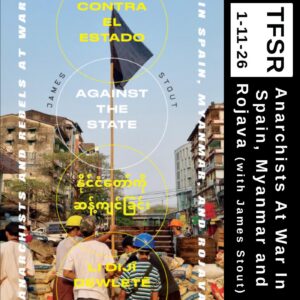
This week, an interview with James Stout on his upcoming AK Press book: Against The State: Anarchists and Comrades at War in Spain, Myanmar, and Rojava, due out early January. You may recognize James as a contributor to the Cool Zone podcast It Could Happen Here (including the recent four parter, “Darién Gap: One Year Later” December 1-4th episodes, 2025), distributed by IheartMedia. For this episode, we talk about the idea of anarchist armies, discuss those three conflicts, left libertarian approaches to formalized armed resistance beyond a guerrilla unit, some of the novel technologies and international solidarities that have developed and a lot more.
Other podcasts James has worked on
Reports Related To Child Soldiers and Conscription among the SDF
- https://www.hrw.org/news/2024/10/02/northeast-syria-military-recruitment-children-persists
- https://snhr.org/blog/2025/10/08/condemning-the-widespread-detention-for-forced-conscription-by-the-syrian-democratic-forces-in-raqqa-and-deir-ez-zor-since-29-september-2025/
. … . ..
Featured Track:
- Canción de Soldados by Chicho Sanchez Ferlosio from Canciones De La Resistencia Española Año 1963
. … . ..
Transcription
TFSR: Would you please introduce yourself to the audience with any name, pronouns, affiliations, or other details that you want to share for this conversation?
James Stout: Yeah, sure. Nice to be here. My name is James Stout. I use he/him pronouns. Relevant affiliations for this: I work for Cool Zone Media. If people have heard of me, that’s where they’ve heard of me. I suppose the other relevant affiliations would be that I’ve spent time with rebels fighting against Burmese junta, with the Kurdish freedom movement, and doing a lot of mutual aid and reporting along the so-called border between Mexico and the United States.
TFSR: Cool, thank you so much for having this conversation and for writing this book and being willing to talk to me about it. I much appreciate it. We’re here to talk about the upcoming AK Press title — or it might actually be released by the time this comes out — that you authored and titled Against the State: Anarchists and Comrades at War in Spain, Myanmar, and Rojava. You’ve mentioned spending time with rebels in various situations. Let’s talk about your journalistic and academic background that provides the groundwork for this book and why you chose to write on these subjects.
James Stout: Yeah, certainly. Academically, I did a PhD in what they call modern European history. But my interest was specifically in the Spanish Revolution, and more specifically in the Catalan revolution, and more and more specifically in the use of sports and physical culture to create an anti-fascist identity within that revolution. I had always been very interested in the way that anarchism played into conflict. Because you have this big debate within the CNT going into the civil war in the years before it, being like, “How do we prepare for this?” They have this moment in the early Republic where they do have uprisings, and they do secure liberty very briefly, and then they get crushed. Then you have these moments before the Republic, where they are fighting, but it’s– During my undergraduate studies, we were allowed to do a dissertation. Because the place I did my undergraduate was a very old university, you can upgrade that to a master’s if you want, not that I’m particularly concerned with it. But I wrote about violence in the Catalan Builders’ Union, and I wrote about armed violence there. I was interested in this.
Generally, anarchists have been opposed to war. They’ve seen it and denounced it as a racket, and it was a very good reason. I don’t think that anything I’ve written or said in this book should ever lose count of that and I tried to be very clear about that throughout the text. But I was interested in how they met it. Then I was reading some other stuff. I’m reading Graeber and these things, and seeing there’s this line in the New Anarchist where they say that essentially, conflict is a domain of state communism and always will be. We have to cede the ground of warfare to the Stalinists. I just thought that was odd, because if we believe that people can organize themselves, and that people don’t need to be compelled through violence from the state to do good things, to do the right thing — which is the sine qua non of what anarchism is — why don’t we think they can organize themselves in this specific place? Why is it different? That has hung out in my mind for a while.
Then in my reporting, I have been very interested in recent years, in 3D-printed firearms, because I think that they represent a significant change in the ability of the state to have a monopoly on violence. Not necessarily in this country, where firearms are readily accessible to most people — not all people, of course, but to many people — but in other parts of the world. So, I was keeping an eye on those. As someone who’s reporting a lot of conflicts, I saw all the reporting on 3D-printed firearms focusing on crime in the United States. I thought that was a lame framing, because there is a potential here for someone to liberate themselves, for someone to defend their community or another community from violence. So, when I saw those being used in Myanmar, that immediately became interesting to me, and that’s how I began reporting on Myanmar five years ago.
The third element of this is a revolution in Kurdistan, which had always been very interesting to me. It was something I’d followed closely and taken a great interest in, both as someone who was interested in organizing and building democracy without the state, and as somebody who was interested in the topic I grappled with in my dissertation, this Catalan National project, which tried to cast itself as an anti-fascist project. Ultimately, now, I wouldn’t say it has become fascist, but there’s a very conservative vision of Catalan identity which is not compatible with a progressive one that I was interested in in the 1930s. So, I’m interested in how the Kurdish freedom movement balanced these things, and we see the answer to that in the way that they’re conducting themselves and in the writings of Öcalan.
Those were the three areas that were of interest to me. I’ve been fortunate to travel through work to all those places, to talk to people. I kept coming back to that Graeber piece and thinking a lot when I was in Spain; the scars of the civil war, both physically and emotionally, are very present. I am lucky enough to have been of the last generation, probably, that got to spend significant time talking to people who fought in the conflict there. I was just always thinking about their stories and their experiences. At the time, I was cycling a lot, so I’d be riding around Spain being like, “There’s so much here that we don’t talk about.” I just felt that little line in that little essay just bothered me, because these people had been capable. Sometimes when we talk about anarchism and Spanish anarchism, specifically, we do it in terms of heroes and saints, and I don’t think we should. We should do it in terms of people and the things they accomplished, and also the mistakes they made. We should learn from them. So I sort of brought all those experiences together, and that was what led me to want to write the book.
TFSR: Graeber — according to the Anarchist Library, that essay came out in 2002. I read it years ago, I think. But when I think of Graeber and we have this conversation about where Rojava is a part of it, then I think about Graeber’s promotion of the organizing as an interesting project. He must have had reflections at some point where he was like, “Well, let me rethink this.”
James Stout: Yeah, I think he did because he went to Rojava, and he supported what happened in Rojava. To be clear, I don’t see myself as opposed to his work. I’m a huge enjoyer of his work. I found the way he phrases things to be really beautiful in its simplicity. I frequently turn to his work for understanding, and his terminology, particularly, I find perfectly well-suited to what I’m trying to do, which is make these things accessible and not try to write like an academic. It was more than that line of thought — it’s not just his line of thought, that’s not a unique line of thought — it’s an assumption that many of us have made. The other thing is that it appears all the time in the Spanish Civil War literature. Everyone talks about the anarchists when you read these big histories of the Spanish Civil War, and it’s just like, “Oh, yeah, the anarchists were over there.” Or like, “Oh, huh, the anarchists managed to do very well. Oh, well, moving along.” There’s never a why or a how, outside of movement texts, obviously things like Paz is excellent work, for example. But in the general histories, they just appear as this closed box, when we’re looking at Beevor’s work and stuff. Even late in the war, you see these units after militarization — which we can explain what that means later — you see these things like, “Huh, at this point, when this battle was particularly gruesome, particularly hellish and difficult, there was this militarized unit of anarchists who were particularly effective, or particularly courageous.” Even if you’re not interested in the movement, you’ve got to look at that as a historian and be like, “Why? What were they doing? How were they doing that?” Because there’s this received wisdom that to be effective in conflict, there has to be extreme discipline, with the extreme threat of sanctions and punishment for any breach in that hierarchical order, and I don’t think they would do that, so how did they do it? What I became really interested in knowing is specifically that, because I’ve been in situations of great physical danger, and it wasn’t particularly somebody who had a different badge than me telling me what to do, which allowed me to emerge from them safely. And so, I was very interested in how they had approached that, especially as a relatively ad hoc militia. Not a militia that had been drilling for years and years and years.
The other thing that I should add — sorry I’m meandering here — but talking to this young guy called Zaw, Zaw Lin Htun this young fighter in Myanmar, who I’d met because he was live-streaming his combat on Facebook. I was watching them fight, and I thought this was remarkable. These young people are using homemade rifles to take on the illegitimate coup government of their country, which is one of the strongest militaries in Southeast Asia, which has aircraft, tanks, and missiles. And in his case, these guys were making .22 rifles out of pipes. They post little how-tos on their Facebook about how to make them because they wanted other people to be able to do the same, to liberate themselves. So, we started talking, and he said, “We don’t really have anyone in charge.” He described the process of what was essentially a modified consensus — what Graeber would call modified consensus — where someone proposes a plan, and people can either veto it or say, “I am opposed, but I’m okay with us going forward. But I want to note my opposition.” But there wasn’t even a majority vote, which was what one might expect. Even young people raised in the idea of a neoliberal democracy might adopt a majoritarian plan of vote, but they didn’t. They adopted a consensus plan. Their logic was that all of their lives were on the line, so all of them should be part of the decision-making process. Not that it was surprising, but it dug back to that question I had about how they’ve done it in Spain. And I was like, “Well, that’s how they’re doing it here. These guys have very clearly not read David Graeber, Jim Scott, or Paz. They are doing this because it seems inherently the fairest way to organize, and they have invented this consensus system from a blank sheet. And I was like, “That’s fascinating!” that these people — who would not describe themselves ideologically as libertarian or anarchist — they’re just young people who want to build a better future. And they have arrived at this consensus system because of mutual respect, because of a desire for each person to be treated with dignity and fairness. That particular conversation was a moment when I was like, “Okay, this is a human instinct,” and this human instinct is one we can see in Spain, we can see in Rojava, we can see in Myanmar and many other places where I haven’t had the resources or means. This should be documented because it’s not something that’s well discussed in the literature.
TFSR: That’s a great way of addressing my question. And there’s a bunch in there that I hope we can get to in more detail, further in the conversation also. Recognizing that some of these people that you document in the book do not identify as libertarian socialists or anarchists or any of these. Just to talk about anarchism, because anarchism is in the title, it’s an anarchist publisher, we’re anarchists, there’s a strong trend of anti-militarism and pacifist commitment through much of anarchism and the libertarian left. I believe, it is a byproduct of the horrors of war experienced through the 19th and 20th century. Maybe it’s fair to describe these two concerns as overlapping, if at times, distinct. Not everyone who is anti-militarist is a pacifist, for instance. I wonder if you could speak to some ways that you’ve witnessed the anarchist and anarchistic subjects of your work and reporting approach the question of war-making, and why left libertarians would choose these methods to fight?
James Stout: You’re right that there’s a very well-justified anti-militarism. I mention it in a chapter where I talk about gender. I talk about how the CNT did embrace a militarism which was antithetical to that, and which has been rightly criticized since, this hyper masculine hero worship, and even in some cases, medals and uniforms and things like that. But the way that the majority of people, and to be clear, lots of these people wear uniforms. That’s not necessarily a bad thing or a good thing. It’s just a thing, and sometimes it makes sense. You would like to know who–
TFSR: You wear uniforms at work. A lot of these people had been in formations where they had met as co-workers or been in the same union, or already they’re in formations, right?
James Stout: Exactly. Often, the stuff that they wore was the same stuff they would wear to work in the CNT. They would wear their mono, the blue overall, which became a uniform, just purely from a “I don’t want to shoot somebody who’s pushing the same direction as me” perspective. That’s why they wear the sashes and the union hats. But the way that they approached war-making was interesting to me, because they approached it with, I’m thinking “reluctance” is the word. When I speak to young people — I spoke to people fighting in Myanmar 12 hours ago, this morning, I speak to them most days — I don’t think they want to be fighting. They’ve seen their friends die. All of them have seen people die. They’ve lost people they love. They’ve seen their communities and their homes destroyed. At least, to my knowledge, we have certain people within the world at large who consider war to be their calling. And I don’t think these people do. They consider war to be a means through which they’re able to defend their communities and advance the cause of human liberation. I see that in Kurdistan, too. People there obviously have been fighting for a very long time. They have a long history, and it’s a proud history, and I can see why they’re proud, because the things they’ve achieved are remarkable. There’s a pride in what they’ve done, but it’s a different way of approaching war-making to the Western way.
In the United States, people who fight are considered almost a cast apart, taken aside from society and separate from it. In some cases, considered superior to it, in some regards. Whereas for them, war is a thing that the community is doing to defend itself, so everyone is part of it. I remember speaking to some fighters in Myanmar a few months ago, and I had just lost a friend, and I was saying that I had been speaking to that friend’s mother just to try and be as supportive as I could. And they were saying, “Yes, it’s very hard when someone passes away, and we always try to support the friend’s parents as well.” And I asked them where their parents were, and they were like, “Oh, well, our mothers have this position just behind the front lines. Because when we casualty evacuate.” This was, I suppose you could call it a combat search-and-rescue team, or a medical unit, that’d go to casualties and remove them from the battlefield, triage them, and then take them back to another level of care. It was behind the front lines, where their families would be providing care to these people. So, this was a community struggle in a way that it very rarely is in the United States, obviously. Because war has not come to where we are, we have gone to it. So, they approach it very differently because of that. War is happening in their homes. Every bomb that drops, drops in a place where they and their communities will live. Every land mine that is dug into the ground will be there until their grandchildren are running around on those same fields, unless they take it upon themselves to remove it, which they very often do. So, their approach is inherently different because of that. There are very reasonable criticisms of when it strays away from that and when there’s a glorification in violence or a fetishization of certain aesthetics of conflict. It’s important to remember that war is regrettable. But I am not the person who should be hectoring those people who are out there seeing their friends die. They’re very aware that war is regrettable.
TFSR: As you make the point, there’s a difference between war being brought to you versus going out and seeking it and bringing it to someone else. These are people in communities that are facing a military coup, whether it be Spain, Myanmar, or Rojava, facing insurgent groups like IS that are proto-state or the Turkish SNA or whatever formations that happen to be there.
James Stout: Yeah, the choice to live a life without violence is one that they don’t have. They can choose to resist in non-violent ways, but state violence is coming for all of these people, and they don’t have a choice. The language that the state has spoken to them for generations, in many cases, is violence. And in many cases, if you look at the young people in Myanmar, they tried to respond in the way that they had been told to respond. They tried to do peaceful protests. They tried to do funny memes so that the Internet would catch on, and then the world would care. They tried to appeal to the responsibility to protect and the United Nations. None of it worked. They’re left with very few choices. They have to respond to the state in the language that the state is speaking to them, and that language is bullets and bombs. They went through this process in months, and they will articulate it to you. I’ve heard this from dozens of people that they never expected to be fighting because they expected someone to come in on their behalf. Like the states of the world to protect them. The rules-based world order that they’ve been told is real, and it wasn’t real for them. So, they had to take their own liberation into their own hands. But the choice to live a life devoid of violence was not on the table for them. It was either that they were using violence too, or they were allowing violence to be visited on their communities.
TFSR: I’d also like to know how you came across the situations in Rojava, the resistance there, and the society that they’re trying to build, and decided to go visit, meet people, travel around, cover it, and continue to contact. And the same with Myanmar. You describe it in the book, but if you want to talk about what drew you to cover these. And also, you had already been working on these, so it makes sense to pull these topics together, but why these and not others? For instance, these three have revolutionary horizons to them, and maybe autonomy of action of the people who are partaking of it?
James Stout: Yeah, there were other struggles I would love to have covered. There are parts of Africa that I would have very much like to have spent time in, but there’s only so much money one can spend before they go broke. I would have very much liked to go to Ukraine. It just took a long time for me to get a visa, so the window of time that was allocated to travel had already passed. I have very dear friends who are anarchists who have died fighting in Ukraine. I would very much have liked to have spent time with them in those units before they passed. I wish I had been able to go there. I would still like to go there. Just to give a quick geopolitical overview, the future of Myanmar and Ukraine are not distinct. If Russia is strained in Ukraine, it can’t arm the junta. The conflict in Myanmar is about the state. It’s not a conflict between two states. It’s about the existence of the state. We could say the same, to an extent, in Kurdistan. Therefore, the states have stacked up behind the junta. There were pre-existing insurgencies in Myanmar since 1948, don’t get me wrong. But if people can download guns from Reddit and liberate themselves, that’s not good for Russia, that’s not good for China, that’s not good for a lot of other countries, so they have stacked up behind the junta there.
Those examples were also interesting to me. Like I said, I came to think of the conflict in Spain in this way, because I was interested in the way the anarchists had organized. I was very interested in writing about internationalists at a point, because the idea of risking one’s life in someone else’s war is interesting to me, and it’s inherently something that people are interested in. This idea of the noble cause. To be clear, not every international volunteer is fighting for the noble cause. There are people fighting for money or this is just what they do now. There are many reasons why people volunteer, but a good number of people went to Spain because they thought that this was how to stop fascism. I’ve written little bios of some of them, and I was interested in these people. But reading more of their diaries, I came across this pretty consistent thing where they’d go to Spain and they felt that there was a noble cause and they were fighting for human liberation, and then they were just under the boot of Stalinism, of Soviet communism when they got there. And that wasn’t compatible with their ideas of human liberation and anti-fascism. That’s when I started looking at the internationalists in the Durruti Column and thinking about these people. It’s a single line in the book, but a lot of the people who died defending Spain live on forever in the memories of the people who appreciate their sacrifice, but also their passports live on forever in the Soviet secret service, where their identities were taken by spies. Because they had to hand their passports in when they arrived. So, it always seemed odd to me that the International Brigades were cast as this noble cause, and for many of them, it was a noble cause, but what they ended up in was not compatible with that idea of advancing human liberty and pushing back against authoritarianism and state violence and all the things that existed in the Soviet Union, as well as in Nazi Germany or Francoist Spain or fascist Italy. That really took me to be more interested in the anarchist formations, along with my own political feelings.
I was interested in Kurdistan because, throughout the 2010s, we watched this group of people confound so many of the things that we thought we knew about warfare. You will still hear this. You can go on to Elon Musk’s website any day and see people arguing that women can’t fight in warfare for one of a dozen contrived reasons from people who, in many cases, have never been within 100 miles of a front line. And we watched Kurdish women push back this disgusting misogynist movement, the Islamic State. We watched them win, and we watched them center love for each other and joy. It’s something remarkable. I remember there was one night in Kurdistan when there was a particularly heavy number of drone strikes. I’ve been in situations before where you have to be conscious of your own safety. But we were all sitting around a tambur, a musical instrument, and they were playing, and someone had brought a song book, they had a folder, there were these ring binders with the plastic sheets, and all this different music and the words were there. I thought it was remarkable that after a decade of war, someone had been like, “Okay, well, let’s not go out due to the drone threat, but I’ll get my songbook and my tambur.” The way that they still centered the spontaneity and joy and welcome and friendliness. Because war can understandably make people hard. And people can shut off the part of ourselves that has the capacity for love and the capacity for solidarity and empathy. I can see why. But it was remarkable to me that these people had done that. I thought that was something quite beautiful in such an ugly situation. I can remember seeing images and videos from Kurdistan in the very early days of the fight against the Islamic State, and just being like, “Huh, this reminds me of the things that I’ve heard about the Spanish Revolution in the early days of the Spanish Revolution.” The way that people were able to maintain the joy of liberation at the same time as the horrors of war visited on them. It was the first time they hadn’t been under the boot of an oppressive state. So that was very interesting to me.
You see the same thing in Myanmar. Pretty frequently, they’ll get their formation together and then have a dance party and do karaoke, as opposed to march around in circles. When you saw the early PDF, the People’s Defense Forces, which were the units that formed to counter the coup, a lot of them were younger people who were interested in music or pursuing a vocation as musicians. So, they’d record music videos, but out there in their combat fatigues with their weapons and stuff, they were still maintaining this creativity, which, according to conventional wisdom would not be compatible with being a fighter. But for them, it was. Seeing that is a weird thing. But for some reason, their ability to not forget that they were people in the midst of so much horror was one thing that really appealed to me about all three of these movements.
TFSR: I’ve heard before that — this is probably not everyone’s experience — but that a great amount of time that somebody spends at war is downtime and just waiting for something to happen. It makes sense that someone would start filming TikTok music videos or whatever. You’ve got the technology, and you are Gen Z. Why not?
James Stout: Yeah, but it was still nice. They didn’t take themselves so seriously, that they were like, “Oh yeah, we’ll put this out.” American forces would do funny dances as well when they were deployed to Iraq. But it certainly was not on their unit’s official website.
TFSR: Yeah, and US soldiers just aren’t charming in the same way that–
James Stout: (laughs) Yeah. I do like that.
TFSR: I am sure listeners are a bit familiar with the conflict in Spain, the revolutionary period. There was the Second Republic, and Franco attempted to lead a coup. Word got out early inside the Republic, and people were able to prepare to some degree. Franco brought a bunch of troops from Morocco, but they weren’t able to steamroll. But there were a few years of fighting, plus other states either got involved or didn’t get involved, such as France, the US, and Britain, or Stalin taking over a good part of it. This is well-documented. That’s a terrible summary, but–
James Stout: It’s perfectly adequate. That’s great.
TFSR: And then in Syria, with the Kurdish region, there had been generational resistance and repression of that ethnicity, specifically in the northeast of the country, as well as a resistance movement. A resistance movement in multiple states where Kurdish populations identify as Kurdistan, including Turkey across the border. There became solidarity — the existing PKK, the Kurdish Workers Party, that Öcalan was the ideological leader of, joined in with the resistance that was already forming in Syria. And then with the civil war occurring in Syria, Assad’s state withdrew from the region, and de facto autonomy was formed. They were able to take their pre-existing foundations of organizing and build up off of that and create the autonomous administration. I’m sober, but this is kind of drunk history stuff. Could you give a brief description of the conflict in Myanmar for folks? We’ve talked about it way less on the show than we have about the other two conflicts.
James Stout: Yeah, it’s one that is less reported on generally. Even if people have been following your legacy media, they wouldn’t really have gotten very much. Okay, potted version. People will be familiar with Daw Aung San Suu Kyi, maybe. People should also be familiar that the United States refers to Myanmar as Burma, and both of those are fine; they derive from the same words. One is not a particularly offensive one; it was, in fact, a military dictatorship that changed the name to Myanmar. A lot of people within the revolution will also use Burma.
TFSR: And they’re different words for the same ethnic majority that often finds itself in a ruling position in the country.
James Stout: Correct, which dominates the military. That’s the Bamar, or sometimes I refer to it as Burman. And it was when that military, which is dominated in its higher ranks by Bamar people began to lose power after an election, that it decided that the outcome of the game was more important than the rules of the game, shall we say. In 2021, the military famously arrived in APCs and pick-up trucks behind a woman doing an aerobics demonstration and essentially seized power around the country. They tried to arrest leading politicians, Aung San Suu Kyi was and still is detained, and they cut off the Internet at that time. Power went out for a while. The Internet came very late to Myanmar because the state was essentially an autocratic one. So, you have a very distinct generational divide. I don’t particularly like generational discourse, but in this case, people who we might call Zoomers have been more exposed to ideas on the Internet than people who have who are of older generations. This is not to suggest that older folks have not participated in the liberation struggle, because they have.
Coup happens – people get out into the streets. They begin a mass campaign of peaceful protest. That mass campaign of peaceful protest is met with violence. That violence first starts in the way that many of us are familiar with – it looks a lot like what we saw in the US in 2020 –but it very quickly escalates. Very soon, it’s not rubber bullets, it’s real bullets. Very soon, on Armed Forces Day, for instance, the military is killing more than 150 people in a single day. And people continue to show up, because this has happened before. The Saffron Revolution, the 1988 revolution in Myanmar — every generation has asked for some form of what they would call democracy. The phrase they would use would be democracy. How that has been envisioned is different over time, but the catch-all term they would use is democracy. And this time, the young people realize that if they go back now, then they will be burying their children in 20 years. It’s a way that I’ve most often heard expressed to me. And I’ve heard older folks — I have spoken to people who participated in ATA, or people who participated in Saffron Revolution or what have you, or were present at that time — say that, this was their advice for young people, “This shouldn’t happen again, this has to be the time where we refuse to concede.” Obviously, what that means is risking your life. Because they’ve already seen people die. They know, they’re very familiar with what refusing to concede and go home means. And so, they decide that they need to respond to the state in the way that state is speaking to them, which is with violence.
At that point, there are dozens of insurgent groups already in Myanmar. They have existed since 1948 because there were dozens of ethnic groups within Myanmar, and those major ethnic groups have been excluded from state power since the get-go. From the moment that Burma left the British Empire, there have been insurgencies because those groups have been excluded. There was a power-sharing agreement that was supposed to be put in place but never was. So, these long-standing insurgencies are suddenly joined by a flood of young people coming from cities, coming from rural areas. When Jim Scott is writing about Zomia, this is where Zomia is. When he’s talking about people going to the mountains to avoid the state, these are the mountains that those people were going to. He did his field work in Myanmar and actually was a board member of Mutual Aid Myanmar and solicited donations for mutual aid in Myanmar, instead of flowers at his funeral, or his family did, I suppose.
So, these young people go into the mountains, and they bring with them a different attitude to many of these groups. The existing insurgent groups are generally referred to as ethnic revolutionary organizations because they’re largely organized along ethnic lines. The Karen National Liberation Army. There are dozens of them. The Chin, the Kachin, the Mon. I can name many more ethnicities, but I think people get the picture. Their ideologies are all over the ideological map. But these young people come with their commitment to democracy, as they would call it, to mutual respect, to mutual dignity. In some cases, they receive training from the EROs, and then they operate alongside them, sometimes under their authority structure, but sometimes adjacent to their authority structure, in formal and informal relationships. And it’s one of the only places in the world where access to weapons was an issue. Very early on in the conflict, you saw young revolutionaries in Chinland fighting the government with muzzle-loading muskets that they call a tumee. A firearms technology, which was outdated by the turn of the 20th century, but here they are a quarter of the way through the 21st century. They’re doing it because they realize that they don’t want to have what their parents had — a lifetime of knowing that they had the moment, and that the moment has passed, and that the state can now use violence with impunity. That at least there was some way to fight back. They used air rifles that they made out of lighter gas, old lighters and plumbing. Then, at some point, I found them on Reddit asking for information about 3D-printed guns, and they began to use those. They also got some more traditional weapons through the EROs. Of course, they were able to obtain weapons from government soldiers who had died or abandoned them or who had defected, and many of them did defect.
The fight has been ongoing since 2021; it continues. The revolution had massive gains in 2023; there have since been setbacks. Previously, China had maintained a more standoffish relationship, but it’s now come down pretty solidly on the side of the junta, as has Russia. This has led to them equipping the junta’s military much more effectively than they were equipped and training them much more effectively than they were trained, particularly by bringing drones. It continues to be the case that the revolution doesn’t really have much in the way of surface-to-air missiles. While they are more than capable, let’s say, in small arms combat, they’re very vulnerable to air attack. They have drones in massive numbers — little civilian commercial over-the-shelf drones. They use those to drop grenades, mortars, and stuff like that. But the military has fighter bombers, and they have used those fighter bombers to bomb schools. They bombed a hospital. A friend lost six members of his family last week when the junta bombed a hospital. They have bombed preschools. This campaign of indiscriminate revenge killings against liberated areas has been a characteristic of the junta for decades, but it’s grown during this time of revolution.
TFSR: I’m just looking through my questions, because you spoiled my reference to Zomia!
James Stout: Oh, sorry, I get so excited about it.
TFSR: I was going to push up my glasses and — I wanted to talk to Scott on the show. I reached out one time in 2010 or 2011, and he wasn’t interested. He was busy, maybe, but I wanted to talk about Two Cheers and some of his earlier work. I’m glad that he wrote all those books. They’re a bit dry.
James Stout: Yeah, I like some of them. I feel he improves throughout his trajectory. I wrote to him just after I got back from Myanmar, but I didn’t hear back.
TFSR: Yeah, the reference to, or the influence of, James C Scott, is clear throughout the book. You also shout out different concepts and different books a few times in it, but you mentioned covering these topics in some ways through an anarchist squint. Maybe somebody doesn’t actively use the term for themselves, but if you were to approach them with a term that you could understand them by, then they would fit generally within this framework. So, I wonder if you would talk about the anarchism among the hevals and comrades that you do speak to in the book, where they adhere to an anarchist vision, and where they diverge. You talked to people from TA, which is an internationalist group that we’ve spoken with on the show a few times. You also mentioned that there have been anarchists; there was, at least at one point, an anarchist formation. I think it was a Karenni one that you mentioned.
James Stout: Karen, yeah, there was a Black Army. I’ve heard very little about the Black Army. First of all, you will see anarchism in rural communities around Myanmar. You will see “no gods, no masters,” certainly “no masters”-type language used in protest, quite a lot there. I grew up in a very rural setting. I’m very familiar with the attitudes like “we don’t want people messing with our stuff,” and “when someone needs help, you help them.” Those are things that I grew up with. So, to me, it’s a knee-jerk anarchism. Maybe I would think of it as that. It’s an anarchism that doesn’t call itself that, but it certainly shares many of the things that we would ideologically be committed to.
Where these revolutions differ from what we would call doctrinaire anarchism, or however we want to phrase it, aside from in Spain, the majority of people who would not use that word to describe themselves. The friends in Rojava will call themselves Democratic Confederalists or Apoists; they are inspired by the writings of Abdullah Öcalan. There are anarchists within the revolution, like TA. One of the things that I really want to — to borrow a phrase from Graeber in a second here — I want to ham on, is what Graeber called the “loser left.” People who thought that a revolution could never succeed, and they’re incapable of conceiving of it succeeding, so they spend their time attacking the ones that have, rather than being there in solidarity. What I got from the folks in TA was that they are there to provide solidarity, and sometimes even a critique, but a critique from a place of solidarity. Not a critique from a place of — I can’t help but think there’s some colonial relationship to the condescension of seeing American people on the Internet attack their friends in Rojava for not being anarchist in this way or that way, while the friends are trying to work out how to administer society in the midst of one of the most brutal wars of the 21st century.
So where do these bases differ? They do, and I can talk about this idea of having commanders in certain fashions but not having the status that accrues to that. They do sometimes do so for important reasons, also because maybe that’s not what they’re going for. They would not say “we’re here to enact anarchism.” They would talk about liberation, and they are pursuing liberation in the way that makes the most sense to them. But where we make criticisms, we should do it from a place of solidarity, not a place of condescension and sometimes just misunderstanding. I have been there, but I am not always there. I do not have the grasp of a situation that they do, and I trust that they are people who believe in the same things, broadly speaking, that I do, and that they are pursuing those in a way that makes the most sense to them.
To give this one concrete example, which was very interesting in that it came up in all the things that I studied, all the things that I wrote about, was this idea that in the moment of combat, it is beneficial to have one person who can make decisions on behalf of the group, because there is not time to deliberate, discuss and achieve consensus. If you’re going to go left or go right, you have to decide. If you’re being ambushed, you have to decide. You have very little time. So what most of them said was that in a situation like that, they will have a person whom they decide is going to be in charge, and that person is going to make decisions on behalf of the group. But it is very important that that person does not accrue status outside of that moment of combat, or of that mission, or of that action that they have decided to place that person in that position for. It’s not a status rank. No one is saluting them the rest of the time. I’d always ask them, “Oh, do you guys salute?” And their response is generally, in Rojava, that if someone is saluting, you know it’s a joke. They’re mocking, or they’re having a laugh. Versus, that’s integral to the discipline culture of militaries in the United States or other more conventional militaries, I suppose. So, they do have the situation where they have something that almost appears absolute authority. Like a person who makes the decisions that the others then follow, but that person is still accountable to those people and can be changed or removed by those people. But the exigencies of combat mean that it is most efficient and safer for everyone if somebody makes those decisions on behalf of the group while that is ongoing.
TFSR: A lot of historical examples of anarchist organization of violence, usually it would come as maybe the attentat — one individual going out and doing propaganda of the deed in order to influence other people — an assassination, maybe a rural insurrection in Malatesta’s days, or possibly a guerilla outfit, some affinity group of pistoleros, what Durruti was doing alongside his other comrades. But one of the things that you talk about, and to point back to that line from the New Anarchists, is not being able to imagine that anarchists could organize violence in a more coordinated, larger manner, even if they had desired to. We should leave this to the state communists. Can you talk about some of the dilemmas around the idea of an anarchist army and the forms that you saw that tension take in conflicts that you present in Against the State?
James Stout: Yeah, definitely. This is the fundamental question I wanted to answer. How do they move from that guerrilla or affinity model to a big formation that has logistics, has all these things? This is, again, a discussion that only really happens on the Internet. People seem to think that anarchists can’t do logistics or any organization at-scale, but anarcho-syndicalism is right there, actually, and it’s pretty well documented. And so they do that, perhaps the best, most well, easily-structured example is in the anarchist columns in Spain, where they generally have units of ten, which then elect a delegate, not a representative, but a delegate to a centuria of hundred, and then the centuria elects a delegate who then goes to the group, and then the group elects delegates who go to the column which has then its war committee. Because it is not possible to organize consensus across thousands of people spread across dozens of miles of front lines, some of whom are being shot at all times. That is how they’re able to comply with what they consider to be egalitarian and consensus-based organizing, without having everybody get in one place. Also, just be it’d be horrendous, you present a very large target. If you get everyone in one place, it’s not a very smart move. That is how they deal with that.
There are some wonderful discussions between [Buenaventura] Durruti and Emma Goldman that I talk about in the book, where he talks about this. He’s been an anarchist his whole life and doesn’t want to become a general. He doesn’t want to die as an officer, having been committed his whole life to organizing horizontally. So, a lot of what they rely on is what they call duty. Deber is the Spanish word. The idea that people will comply with their duty because it’s their duty — both to each other, and they have a sense of historical duty, as well. That is what will motivate people.
There is still a question of discipline, and it’s one I spend a lot of time on in the book. What do you do when someone doesn’t? There are examples of that. Somebody who I met, who had been part of the SDF, Syrian Democratic Forces, talked about a time when a member of their unit had not been present with the unit at a time when they were supposed to be, and that had put other people in danger and led to other people having to do extra stuff. So, when that person came back, they all sat down together, and they discussed an appropriate sanction. And with that person’s consent, they arrived at a sanction. Because you have to make sure that everyone can rely on everyone on a bigger scale. In the affinity group, you know you can rely on everyone because it’s such a small group. But how do you do that at-scale? It’s through things like this. It’s also through a genuine commitment that everybody feels they’re pushing in a direction that is important, and they’re willing to be there. That’s the other thing. Nobody has joined these revolutions because they need college money and they can’t afford it. No one has joined because they don’t want to go to jail. No one has joined because they come from a small town, and there is no other economic opportunity. There are many reasons that lead people to join conventional militaries. Those aren’t really present. It’s “my community is under attack,” or “I’m here to participate in this revolution because it will make the world better.” That is the case in all of these. In a sense, that therefore becomes less of a problem. But the way that they generally organize things, for instance, in the CNT, is along the same lines that they organized everything else – through workers’ committees. An example I delved into – my editor and I debated whether we should leave in or not, but I tried to leave most of it in – it was the construction of tiznaos, which is like an up-armored vehicle, a rudimentary tank? They are kind of iconic.
TFSR: They’re amazing. They’re so fun to look at.
James Stout: I bought this incredible book that said in the early 2000s and late 1990s, there were magazines that one could get. You would get one a month for a year, and they would send a small part of a thing, and you would construct the item over time. There was one magazine such as that in Spain, dedicated entirely to these tiznaos, and I have bought the annuals, possibly one of the five copies that still exist. It, to my mind, is the most authoritative work on these incredible machines. It took less than a week from when the coup began to when boiler factories in Barcelona were churning out rudimentary tanks, and they weren’t very good. But over time, they iterated, and they improved things. The way they improved things was not because there was a profit motive, but because there was a motive that was more important to them, which was defeating Franco — well, Franco wasn’t in charge at that point, but defeating the Spanish military. So, when one person worked out high, if you put a grill on the front, they don’t overheat, okay, but they can shoot through the grill. What if we put two grills opposed to each other? Air can still pass through, but bullets can’t. Okay, now everyone’s doing that because I don’t have to file a patent and extract income from it. I can immediately share this with everyone who’s doing this. We see this really rapid development of these vehicles, which is remarkable. It didn’t need a commissar in the factories to come in and threaten to send people to the Gulag. They didn’t do it.
One of the things that really interests me about 3D printing is that the majority of the stuff, if you go on to one of the 3D printing websites, people are not extracting income from. They’ve made it because they needed it, or someone they knew needed it, and they’re happy to share it with the world in case they need it too. That, in a sense, is not devoid of capitalism, because these websites host files and things like that. There’s capitalism happening, but the impulse there to make something and to do innovation for the betterment of mankind. And sometimes, they’re making a battery cap of the remote control on your TV — I understand that that’s not directly the betterment of mankind. But people are making things. They’re being creative in a way that capitalism tells us isn’t possible. They’re not innovating for profit. They’re just innovating because it’s something that they have a passion for and they want to share it with the world.
That always interested me about 3D printing when it started. I thought that was really cool in a world where increasingly everything is a subscription-based service, that this wasn’t; this was just people sharing things. So, when I saw the 3D-printed guns, that made me think of this model in Spain, where Spanish workers were also making firearms. When the Basque Country started to lose — some of its factories were bombed in Guernica, and some towns were lost where these factories were — Basque workers came to Catalonia and made pistols, sometimes with Francisco Ascaso’s name on them. It’s maybe the only anarchist-branded firearm to exist in human history. But again, it was this really fascinating way of organizing that, if we’ve read about anarcho-syndicalism, it makes sense, but I don’t know why people didn’t think it could apply to war when we had examples of it happening.
TFSR: It just makes me think of the free and open-source software movement also. People are constantly putting in work to create and keep updated, and working in forums or collaborating to keep updated, and improve on all of these apps and programs that are alternatives to the subscription payment thing. Not because they’re getting anything out of it necessarily; oftentimes, they might have a secondary job that’s working in this industry, but they’d use their free time to be like, “Hey, here’s something I could share with people. This is awesome.”
James Stout: Yeah, actually, the community where I first met one of the sources from my book is called FOSSCAD, Free Open-Source [Software and] Computer-Aided Design. That’s what CAD stands for. Again, that very much is a good dovetail.
TFSR: The military order of the Dacian state is lauded as efficient in not only its destructive force, but also its creative, for instance, shaping its constituents, the soldiers, through structured violence. As they talk in the US about going to boot camp, you get broken down and reconstructed in the way that the army wants you to be. Can you talk about left libertarian debates on militarization and discipline? You’ve spoken a little bit about discipline and deber in the historical moments that you explore in the book. But if you could talk a little bit about the imposition of that structure and the fighting back against that model.
James Stout: Yeah, the clearest place where we see this again is in Spain, with the militarization or regularization of these anarchist columns, and the way that that was enforced was by withholding pay and withholding weapons. The anarchists in Spain, as with much of the Republic, went into the war with an absolutely chaotic bundle of weapons. Often, you’d have people fighting alongside each other with completely different weapons, completely different rounds. It made logistics a nightmare. Literally dozens of different types of bullets are needed for a single unit. They’d have to source those and distribute those, absolute chaos. The withholding of weapons was a big deal. And this causes a debate among the anarchists. But they have also made mistakes. You can see this sometimes in the newspaper, the Durruti Column, where they’re being like, “Hey, you can’t just start an attack by yourself, guys, we’ve got to work together on this,” or like, “Don’t just be shooting. Check in with everyone else before you start sending rounds down range.” They are thinking, “Can we be better?” That is clearly part of that discussion. What they have as a benefit is that anyone can have an idea, and that idea can quickly become implemented in a way that it probably couldn’t if that person was considered to be of too low a rank or status. We see them using, for instance, anti-aircraft flat cannons in direct fire configurations, which is really interesting to me, because this was a very common tactic of the Nazis in World War II, but not so much before that. I don’t know when it began, but this is one of the first documented instances I can find. So, I’m really interested in the Durruti Column doing this in 1936. They’re being like, “Hey, this gun that’s supposed to shoot in the air and then drop down an aircraft or land, arc down and drop on people. What if we just pointed it at them?” It’s not rocket science, but the way that they were using that was very effective, and so that is to their advantage.
But by the end of 1936, they’re clearly having this discussion about how do we meet this moment? Because the rest of the Republic is becoming increasingly controlled by the Soviet Union and increasingly dominated by the Soviet extremely authoritarian model. Even when we look at the Russian military, which uses that model. If you look at a Western military, let’s say the United States military or the British military, the role of junior leaders — what they were called, corporals, lance corporals, things like these — isn’t just to enforce the orders. They also do some actual leadership and decision-making on a very small scale with your sergeants and going up. As the rank increases, the scale of the decision-making they would be doing would increase. But in the Soviet military, the role of those people was just to punish people who stepped out of line, to enforce the orders from above. They did not make decisions. They enforced other people’s decisions. Even amongst conventional militaries, this was a particularly authoritarian one. We see this in the way the international brigadiers loathe the commissars who were in their units. They called them “comic stars” a lot. But the anarchists don’t want this. I quote extensively from some pieces of writing at the time, but there are meetings and debates. Different units come to different consensuses or different solutions. Some of them are not consensuses, like the unit militarizes, but people leave because they’re unwilling to militarize. Some of them are like, “Hey, what if the people who have been elected to be our delegates, what if we let them wear the badge like they were a lieutenant, but we still treated each other like friends, like equals?” Some of them say, “I think we need this stuff. That’s how everyone else does war. We haven’t really fought at this scale before, so maybe this is how you got to do it.” Some of them are like, “No, fuck that, we’re not doing it.” Like the Iron Column. The Anarchist Encyclopedia describes them as rabid in their anarchism, their refusal to accept hierarchy. They called the little badges of rank that people would get sardines because they were shiny, and so they’d be like, “Oh, these people keep turning up with the sardines, but we don’t give a shit we’re the Iron Column. We accept no gods, no masters.” And they sent a detachment back from the front lines because they didn’t have weapons, and the police in the rear did. They were going to assault the cops and take their weapons. Because they felt that they were more useful at the front. They continued to pursue this more hardcore approach. Their commitment to “no gods, no masters” is absolute. We see different settlements throughout both in Spain and across history.
TFSR: One thing that we keep coming back to when we talk about Spain is the influence of the Soviets as this one national formation, or whatever you want to call it, a union that is willing to offer weapons and leadership training in exchange for gold. There are never too many times that somebody breaks down the Stalinist influence on the revolution in Spain and the civil war in Spain. Would you mind briefly doing that? What this meant for the revolution there, and the revolutionaries of all different stripes, and in particular, what it meant for non-Stalinists?
James Stout: Yeah, this doesn’t have to be the case. It’s really important that Spain was not a communist country; that Soviet communism, Marxism-Leninism generally, was not a significant force in Spain on the eve of the revolution. It existed in Catalonia. It barely existed in the rest of Spain. It did exist, but it was not the predominant means of organizing on the left. We then see the “democracies” — Britain, France, and the United States — very quickly abandon the people of Spain as they continue with their appeasement strategy. What they call it — Spain is “non-intervention.” The US sent some weapons early on. Somebody got some handguns out of the embassy, and at one point, they’re sending a plane, and there’s a filibuster on non-intervention in the Senate until that plane can take off. But we’re talking about a single aircraft here. This is a debate. I’ve read a lot about non-intervention, because it’s the moment that liberal democracy allows fascism to happen. The world would look fundamentally different if these democracies had intervened in Spain.
TFSR: Well, except in Germany, where liberal democracy led to fascism.
James Stout: Yeah. Abyssinia and these other places, too. You get a lot of young Black Americans who have watched Abyssinia and are like, “I’ll get them back in Spain,” and then we’ll push on. Just to digress, the role of Black Americans in the International Brigades is very interesting to me. And even beforehand in the popular Olympics, which I wrote a book about, the Catalan Popular Front is financing Black people’s travel to the popular Olympics because they believe the anti-fascist struggle and the struggle for Black liberation are one in the same. So, these people do have criticisms of the US “democratic model,” especially in the 1930s. But nonetheless, they’re abandoned by people operating in that paradigm.
The Soviet Union, therefore, is the only place where Spain can get weapons. Now, what does the Soviet Union want? It wants gold. It wants a source of hard currency, especially since it’s still a relatively young state project — 20 years old by the second year of the Spanish Civil War. It doesn’t have a lot of those gold reserves because they’ve left it in the First World War under the Tsarist Russian government. And there was a moment, which I talk about in the book, in which the anarchists had a plan to seize the gold and use it themselves, which they never enacted. But the Spanish government, which has much of its gold in Paris at this time, starts sending the gold to Russia in return for weapons. What the Soviet Union first did was offload all of the weapons it captured in World War I. Just random junk, like old Italian rifles, just a whole hodgepodge of weapons, and then later it starts sending over other weapons. I have one on my wall over there. The Mosin Nagant is one of the more famous ones.
At the same time, the Soviet Union starts sending over military advisors, and the people it sends are all operating under code names. Interestingly, you also have a number of White Russians who come here and fight at this time. What they are seeking is either, in some cases, they’re committed to a revolution that is not Marxist-Leninist, and they want to see that succeed, and then push on to their home. In many cases, they’re seeking like, “If I do this, I’ve shown my commitment to a new regime, then I can go back, and they’ll let me live safely.” Didn’t work out that way.
TFSR: White Russians is a term, not an ethnic term, but a term for reactionary forces that would have supported the Tsar initially.
James Stout: Exactly. You see a lot of people who have been in the Tsarist army come over to Spain. And perhaps some of them are in what you would call a liberal democratic paradigm at the time, and therefore, interested in Spain. But overwhelmingly, what you see is the Soviet Union sending its generals — who, again, are operating under pseudonyms with fake passports and such — but they begin to assume command. They’re supposed to be advisors, but they’re very clearly not. You see the Soviet Union sending equipment. This is the first modern combined arms war. The fighting we see at the very end of the First World War, it’s maybe like this, but this is where Nazi Germany develops its blitzkrieg. It’s using aircraft, it’s using tanks, and it’s using infantry together to move quickly and to seize large areas of ground before people have time to set up defensive. You need tanks, and you need aircraft for that. If you don’t have them, it doesn’t matter. At the start of the war, the Republic had most of the weapons and most of the people. Very quickly, Italy and Germany come in on the side of the Francoists. They’re also signatories to the non-aggression pact. They just don’t care about lying; it’s a thing with fascism. When you mentioned the Francoists come over from Morocco, it wasn’t Spanish planes, it was planes provided to them by the fascists. So, the Republic needs weapons and military expertise, and it gets both of these from the Soviet Union. Very quickly, the Soviet Union also brought over the NKVD. Very quickly, we start to see this paranoid purging of the ranks of the Republic, to include, by the way, many of these generals who had been brought over by the Soviets to command or advise. Kléber is the most famous one. He had orchestrated some incredible Republican victories. Genuinely remarkable feats of arms. Then there became this concept of Kléberism, where people were accruing personal glory, rather than being super monastic in their devotion to the revolution. Many of these generals may not have been politically aligned with the way the Republic was or the way I am, but they had orchestrated the Battle of Madrid. These incredible feats ended up being purged back in Russia as well.
But by 1937, the Spanish military intelligence was spending far, far more time purging its own ranks of people who had different types of leftism. The other one being the POUM. The Workers Unification Marxist Party, which is an anti-Stalinist Marxist or non-Stalinist Marxist party. Incidentally, you will see in many texts the POUM referred to as Trotskyists. They are not. You can look at their letters of open disagreement with him. You can see Trotsky writing to them and arguing with them. This is a Stalinist slander that they put upon them as they began to purge, torture, and remove them. Of course, people will have read Orwell’s book Homage to Catalonia, and will be aware that by May of 1937 this manifests itself in open street fighting in Barcelona between the anarchists and the state. Because at that point, many anarchists felt that they had a choice of living under fascism and being pursued and hunted and eventually killed, or living under state communism and being pursued and hunted and eventually killed. And they thought that while they still had weapons in their hands, they should fight against either of those things.
But the Soviet Union very quickly acquires all of Spain’s gold, and then it is, in theory, pursuing this Popular Front anti-fascist policy, where it’s not opposed to liberal democracy. But it becomes very clear, gradually, for instance, Largo Caballero is no longer Prime Minister. All these figures who had had some degree of autonomy or who did not entirely owe their power to the Soviets are removed, and people who have no autonomy and who do entirely owe everything they have to the Soviets are installed. And it becomes, by the end, for many of these anarchists, a revolution not worth fighting for, because it is just another authoritarian state project. And they’ve seen what it will do, because it’s already done it to them in the military. It’s catastrophic for the efficacy. Don’t get me wrong, many people still continue fighting to the very end, and many of them remain in the mountains afterwards and continue to resist fascism. But the spontaneity of the revolution and the real liberation that it could have been is gone by two years into the war, because it has come to be dominated by this Soviet influence.
TFSR: I could ask a million questions about that specifically. That definitely, to say it one way, hamstrung the revolutionary possibilities, or even just the survival of the Republic and the Republican forces. It’s easy to look at this in retrospect. There are tons of books and scholarship that are written on this. With the two current struggles, I do not have the impression that the Autonomous Administration has been allowed to rely quite as heavily, or anywhere near as heavily, on the US, for instance. The US has done strategic bombing, or unstrategic bombing — dumb-bombing at times — and has provided small arms, but has not provided a lot of other weaponry that’s been requested by the people of Rojava in order to defend, for instance, against Turkish drones. It doesn’t sound like there’s any outside state that is, at this point, aiding the movement in Myanmar and the struggle there that would be able to step in and swipe administrative control. There’s no fair comparison.
James Stout: Yeah, at times you had EROs that are dedicated to the model that the CCP is now pursuing. At times, those EROs, because they had access to better weapons, were able to influence the revolution. But now many of those EROs are returning land to the junta because they have been called to alignment by China, called to make peace, or in certain places to return. For instance, this happened in one area in northeastern Myanmar recently, where an ethnic revolutionary organization was asked to return a city to the junta. Then you have PDF units just outside that city being like, “Yeah, well, we’re still fighting. If the junta wants to come past us, we will shoot at them.” In that sense, the ideological capture, or whatever, that exercise in control has not happened. Because you have zero state support, in any official form, you have the majority of support that comes is from the diaspora, from aligned people who just care about the cause. And those people are generally willing to support those people because they’re fighting for liberation, and they’re not asking them to comply with any particular ideology.
In Rojava, if people are honest, they will ask you. And I understand why they ask because they have fought alongside the American people in some cases. They have bled alongside them in some cases. It is hard to understand, when you’ve gone to a war and had this experience alongside people, and they then abandon you when your children are dying in drone strikes. That is a betrayal, and it’s a very great betrayal. For people who see that whole movement in terms of friendship, it can be hard to grasp that. But they also know that the Americans were not in this for the revolution. They were in it to defeat the Islamic State. Now, there are American service people whose entire political world has changed because of their time in Rojava and their experiences with the revolution. That is wonderful. But they do understand that the United States is a state, and in their analysis, the state is a project which may be incapable of solidarity with a people. And they would not see themselves as a state. So, they have retained that ideological outlook.
The Kurdish freedom movement as a whole — this group of aligned groups in solidarity with each other that are inspired by the political thought of Abdullah Öcalan — has changed over time. And certainly, we see this with the PKK, which is a distinct organization from the SDF, but its ideology has changed based on Öcalan’s ideology. But it’s an excellent illustration of the differences between the two groups — your average SNA shill will collapse and that — this is always a thing that you will see — the YPG, YPJ are the same as the PKK. It’s very demonstrably not the case. The PKK is laying down its weapons based on its movement to a new paradigm, they would say, a new democratic paradigm. The SDF is categorically not laying down its weapons. Even in that sense, sometimes people see this movement as a monolith.
TFSR: SDF is, though, not just ideologically related to the Kurdish movement or the PYD. SDF is more of a coalition.
James Stout: Yeah, the SDF is a coalition. So, you could look at the SDF as the coalition that defends the AANES. Specifically aligned with the PYD philosophy, would be the YPG and YPJ, the People’s Protection Defense Forces, and the Women’s Defense Forces.
TFSR: Sorry to cut you off on that.
James Stout: No, no. It’s an alphabet soup of shit. Between Spain, Myanmar, and Rojava, I made a very conscious effort to not use too many acronyms, and there are still several pages of acronyms.
TFSR: And you also have a glossary, which is very helpful, especially because I kept coming across ERO in there and was like, “Where is this index?”
James Stout: Yeah, I wanted to make sure people had that. You can screenshot it on your phone, so you don’t have to flick back and forth. Having read enough books about Spain and Myanmar, I became a big fan of glossaries.
But those movements have successfully avoided that. They have not been captured by a state because they needed to rely on that state for supplies. The relationship the Syrian Democratic Forces had with US forces was as partners, not as subsidiaries.
TFSR: You’ve already talked a bit about the 3D printing in Myanmar, but it would be cool to just talk about– Well, actually, scratch that. I want to talk about fifth-generation warfare. Okay, just kidding.
James Stout: I’m not ready to talk about that [laughs].
TFSR: Okay [laughs]. I do want to talk a little bit about some of the 3D printing innovations and the communication between different war zones and different, ideally, liberatory movements. If stuff is free and open source, then who knows who’s reading it and using it. But there’s been innovations in the production of parts for tourniquets that have been able to be produced in Palestine, for instance. This is generation of tourniquets that have been developed since the global war on terror, and their application has saved so many lives compared to when I took Advanced Wilderness First Aid in 1998. They were like, “Don’t put a tourniquet on anything you don’t want to fall off.” And it’s amazing, it’s not a foolproof thing, but it saves lives, and people can actually mass-manufacture them now. But drone parts, tourniquets, firearms, the plans and the models for these, and the innovations have been traded and shared. Information about how to set up manufacturing has been traded between units in Ukraine, Myanmar, and in Rojava, and I’m assuming, in other conflict zones as well. Or innovations with radio technology. There have been all of these small military counter-state units that have been able to employ these things for saving lives or for more effectively surveilling or striking back at larger infrastructure or larger armies. I wonder if you could talk a little bit about this networking, information sharing and innovation.
James Stout: Yeah, a lot of it happens in an indirect way. Because it’s free and open source, someone can develop something and share it back. I have a whole chapter where I talk about the 3D-printed guns, or about the weapons, generally, that have been developed. I’ve interviewed the surviving designer of the gun that really defines this, which is the FGC-9 MK2. FGC stands for “Fuck gun control,” if you’re wondering. Nine is the caliber of the round. What’s really interesting about this is not a person who was particularly engaged in the revolution in Myanmar, and that gun printing community was not particularly engaged in Burmese politics in 2021, but it’s been quite sweet to see. There are certainly people who are involved in the making or the designing of these 3D-printed guns, who are just interested in things from a mechanical point of view. I can relate to that. I like how things work. I like to work on my own vehicles. I like to fix things. I’m not very good with electronics, so I like it when something makes a small explosion, and then stuff moves. And it’s pretty much cars and firearms and some other stuff. But I’m just interested in that. I like to look at cross sections of engine and things and how they work. Some of these people are interested in that, and they happen to live in the United States, where it is not illegal for them to apply that knowledge to the creation of firearms. Many of them, I don’t particularly know their politics, but clearly they believe that one should be able to manufacture the means of defending oneself, and they felt that it was important that the state should not have a monopoly on that. So, those people began developing these guns and sharing them openly. It’s heartwarming to watch — geartwarming is the wrong word because these are machines for killing people — but to watch young people in Myanmar pop up on this subreddit where people are talking about it, and just be like, “Hey, I’m trying this. It’s not working.” People are like, “Oh, adjust your printer settings or what have you.” And then they start posting pictures. I remember when they started posting pictures of me being like, “That person’s not in America. That’s clearly somewhere else.” And then they are like, “Yeah, well, this is who we are.” To see that community embrace that revolution, it’s been quite heartwarming. Especially in America, the gun community can be incredibly toxic and incredibly bigoted. So it was nice to see parts of that community not do that, to support their liberation in whatever terms they want to be liberated.
This goes far beyond machines for killing people. You talked about the Gaza tourniquet. It’s developed by some folks called Glia, and it is being used to save lives. As you said, these tourniquets were developed during the global war on terror era. The most dominant one is called the Combat Application Tourniquet, the CAT. The CAT, for reasons that probably aren’t to do with the fact that combat is in its name, is embargoed for entry into Palestine, so people are reusing them there very frequently. So, this 3D-printed tourniquet gives people the ability to save lives, anywhere they have a 3D printer. Maybe these movements are united by the first to come to know of each other, maybe when looking at this technology, and the sharing of technology. But what is beautiful is that they’ve moved beyond that. Like, if we look at Karenni state in particular, which is a part of Myanmar on the eastern side. If people are looking at a map, they can look for Demoso and find it nearby. We’ve seen the KNDF, the Karenni Nationalities Defense Force. It’s interesting that it’s nationalities, plural, not nationality. It’s not a national liberation movement; it’s nationalities. They’re consciously inter-nationalist in there. If I were being academic, I would hyphenate between inter and national.
TFSR: But recognizing that a lot of different people exist within this state that is called this, that happens to be named after one of the ethnic groups.
James Stout: Yeah, and they wish to defend that plurality rather than extinguish it. They have made these statements — and I write about these in the book — but I remember waking up in Rojava to my phone going mental, and it being these videos from Myanmar at a time when they, too, were under attack. Being like, “We see that your revolution is under threat, we want you to know that we’re here in solidarity with you, and we see you, and we’ve learned from you more than maybe you’re aware. We admire the example you have given us.” This exchange has been very beautiful because both of them approach it from a place of humility. Within days of that video coming out, the people in Rojava were reading about Myanmar. There is still reporting in the Kurdish press about the revolution in Myanmar, and it was really beautiful to see the people in Myanmar saying, “Hey, we have progress to make in gender terms. We see where you are, and we want that, but we’re not there. But we admire that.” A really genuine, humble solidarity that really comes from two groups of people wanting to achieve liberation, not from just these open UN letters saying they are deeply concerned all the time, but they don’t really care. They don’t see each other as people. These two groups did.
From there, we’ve seen other statements of solidarity. A statement was returned by the YPG and the YPJ in Rojava to the KNDF and to the women of Myanmar. We now see that KNDF made a statement of solidarity with the children of Palestine, and it was a particularly beautiful statement. We’ve seen more and more statements about solidarity with Rojava. We now see internationalists who have been in Rojava fighting in Myanmar and bringing with them this idea that a revolution that isn’t a women’s revolution, if the revolution is not in some sense about women, then it’s not really a revolution. If we’re not liberating women, then what is the point of liberating territory? If people are living in subjugation in our families, why are we bothering to liberate countries? So, you see women in Chinland fighting alongside or in distinct units using the same salute that we see from the YPG and the YPJ, the peace sign, and consciously emulating that model.
While the exchange has been about technology, it’s also the other things that they have learned from each other, which are really special. And that throughout five years of war in Myanmar, they’ve shown a capacity to care. And just to be clear, for people who aren’t as familiar with history, this is a country in which genocide has happened and has continued to be perpetrated against a Muslim majority ethnic group, the Rohingya. This is a country where Islamophobia has deep roots, really horribly bigoted stuff was said, not even 10 years ago, that led to that genocide. So, to see people coming from that milieu and saying a revolution that isn’t for everyone isn’t a revolution that’s worth being part of and therefore, we stand in solidarity with Palestine, with Muslim people here. To see young women in hijab fighting alongside young Buddhist men, it’s an incredible leap forward. That only comes from this exchange and this realization that all those struggles are connected.
TFSR: I’ve kept you on for a long time. I’ve only got a few more questions. And I feel like this is a very big subject. Clearly, these are all really big subjects. People should check out the book and a number of other books that are written on these subjects. But one revolutionary horizon that you explore in the conflict in Against the State is that of how heteropatriarchy plays out among the anarchistic actors. Clearly, there’s the YPJ; the women’s revolution is one of the foundations of the Rojava project. You describe this one instance, this one image of people fighting alongside each other from not only different ethnicities, different faith practices, different genders. Can you talk about what you saw, including warts and all, as you want to address, in these three instances that you cover, how gender and, if you want to throw it in there too, sexuality, play into the revolutionary horizons of these moments?
James Stout: Definitely. Like I said before, it’s right to give criticism from a place of solidarity, and in these cases, too. First of all, there should be more Burmese women in my book. I had a couple of folks who had wanted to talk to and it just didn’t pan out to be the right thing to do, to use their voices. But obviously, the revolution in Rojava stands out as the one that is a women’s revolution. The revolution is for everyone, but it’s very much led by women. We should look back at Spain, and we should learn from that. Because, yes, women were part of the militia and, in many cases, they were deeply respected comrades in arms. But in other cases, they were saddled with this dual burden of being, “yes, you can fight, but also we expect you to cook.” That is something that should be criticized. It’s not commensurate with equality to do that. That criticism has been raised more about the communist formations, where perhaps this may have been more obviously the case. There’s this famous line that I opened a chapter with, “I didn’t join the militia to die with a dishcloth in my hand,” which I think is a very reasonable critique to make.
If you look at a lot of Burmese formations, there are women’s fighting formations, there are entirely women’s formations. There are also formations where women are boot camp instructors. There are women’s drone squads, that kind of thing. But there are also formations where women are not taking on combat or frontline roles, and that is an area where improvement could be made. If we’re fighting to liberate people, we should be fighting to liberate everyone. Otherwise, it’s not worth all the people who are going to die. Likewise, when we talk about cis-hetero patriarchy, I am aware of trans women fighting in both of the contemporary revolutions as women, and they’re living as themselves, and they’re accepted for who they are, and that’s beautiful. But in those revolutions, they are not often centered or even spoken about. I directly asked the Kongra Star, the Kurdish women’s movement. We spoke about transphobia, because not often, but it has occurred that people who will try to speak on behalf of the Kurdish women’s movement in a transphobic fashion. And they reject that. They believe that if you’re with them, you’re with them. I wanted to ask them, give them a chance to speak on that, because people seek to speak for them. I’m glad that they spoke about that, openly and very emphatically. These revolutions should continue to do that, to make it very clear where they stand on these issues.
The queer youth of Myanmar have been embraced by the revolution because there wasn’t really a place for them in the dictatorship. The circumstances were such that the only way for them to continue being who they are was to join the fight. But the revolution has embraced them, and you see things that you wouldn’t have seen, even from EROs. The EROs, in their encounter with queer youth, have realized that these people are their community, that “they are us.” So that has been beautiful to witness, but there are probably also areas where those people are having a pretty rough time. They are being who they are, but they’re maybe not always having– there’s still probably growth. And growth sometimes takes time; they should acknowledge that. But I still think, like in Spain, we should look back at that example and use it to guide how we go forward. And we should be very aware of the prevalence of cis-hetero patriarchy and the way it can creep back in.
As units begin to formalize — not necessarily militarized, but they have names and things — it’s fine for women and men to separate — that’s a YPG-YPJ model — but as long as women don’t just disappear. Sometimes it’s hard for me to see, because I’m only seeing these people through their public communications. But one would hope that they would look at the example of Rojava and see that one could center women in one’s public communications, and could center their liberation in everyone’s liberation, and still succeed. It’s reasonable to demand that. It’s certainly reasonable for young women in Myanmar to demand that.
TFSR: Yeah, as you say, assessing our compromises for how far they draw us from our ideals and values is critical and should be done in a comradely and honest manner. I noted that the book didn’t discuss questions of child soldiers or conscription in anarchistic armies. Though in Spain, there was the question of anarchists leading the fight. I guess, a similar one, was that you brought up where someone in the SDF had stepped away from their unit and had to deal with the consequences with their comrades. As far as the topic of child soldiers or forced conscription, I wonder if you could talk about in these three scenarios a little bit what you understand and how anarchistic or comradely groups thought or dealt with these things?
James Stout: Conscription is not compatible with anarchism. Forcing someone at the point of a gun to do something is the sine qua non of the state. If you’re doing that, then you have become the state now. That’s pretty cut and dried. I have heard of allegations of it in Myanmar, but none that I’ve really and certainly not with the units I speak to. I’m not aware of that. With regards to young people fighting, child soldiers, we ought to bring some more precision to the terms. No young person should be forced to fight against their will. No person of any age should be forced to fight against their will. I am aware of situations where young women in Rojava have left their families and come towards the movement if they’re in a family situation where maybe women are not as liberated and valued as they might be in the movement. If those young women are 16 or 17, then they may end up in either training with or in military formations. And in those instances, it’s reasonable to want those young people to be protected because they are still young, but also to respect their autonomy as people who can make their own decisions. It is not unfeasible that their families would then accuse the SDF of having child soldiers or something. In those instances, what’s happening is defensible.
If there is either forced recruitment or even unforced recruitment of people who are much younger than that, then that’s very problematic. Every time I’m in a conflict, I’m reminded how young soldiers are. Even in conventional militaries, they are very young. They are just out of high school in the US military. In Britain, you can join before you’re high school-leaving age. You can be 15 or 16. It’s not that states don’t do this. They do. You can’t deploy until you’re older, to be clear. But there is somewhere a line that should not be crossed. It is abusive to ask young people to fight when they’re not really old enough to know the consequences of fighting and when they will have to live for the rest of their lives with the consequences of that, even if they do survive. At the same time, I understand that when communities are under attack, people want to defend them, and so they might ask for that. It’s a complicated topic, but it’s not to absolve responsibility. If young people are being made to fight, or even beneath a certain age — or a maturity level, it’s probably a better way of saying it — are allowed to fight, then that is wrong. But once young people reach a certain maturity level, we ought to respect their autonomy, too, and their ability to make their own choices.
It’s a topic that we have to approach — I don’t know how to say this — as long as we have a genuine solidarity with each other and genuinely want the best for each other, then we can approach the nuances. If we don’t, then we have to have rules. If we have to have rules, we shouldn’t be letting children fight. And that’s okay to maybe have those rules if the structures that we have in place can’t be such that nuance is allowed. There is sometimes nuance, especially in the case of women who might be escaping homes that are either abusive or just don’t respect their autonomy, and them then coming towards a movement which they see as fighting for their autonomy, and then wanting to be involved in that, especially in the times of the Islamic State, I understand.
I remember a little girl in Rojava, we were playing football, and I scored a goal and went for a high five. She just walked out to me and punched my hand. I was like, “Oh, fair enough. Okay, guess I wasn’t much help really.” But the punch was inexpertly. I was like, “Would you like to practice punching a bit more while we’re here?” She said, “yeah.” So, we’re throwing a punch, and within five minutes, I’m regretting my choice. My palms are getting smashed by a bunch of eight-year-olds.
But a young woman who grows up in a society which sees women as being capable of fighting, but maybe in a family that doesn’t see women as capable of autonomy, I can see where that tension would arise. There is a way that we can respect both of those things, as long as we approach the topic with the understanding that no one should be compelled to do anything that they don’t wish to do. That’s what the state does. That’s the whole point of us fighting. That’s the whole point of all my friends dying.
TFSR: But there is, in these situations, without being physically coercive, there can be manipulation of younger people. We’re getting into hypotheticals — I don’t want to go too far into it — but leaving a bad situation, the alternative is to fight for the women’s revolution, “here’s a gun and a uniform.” There are Mala Jin. There are women’s houses set up.
James Stout: Yes, there should be safe places, and there are.
TFSR: It was pointed out to me by a recent guest, Leila al-Shami, that there are continued criticisms of the Autonomous Administration areas as relating to or allowing organizations that affiliate with them to recruit youth.
James Stout: Some of those organizations are often not directly the SDF. It’s these organizations that affiliate with them and share an ideology that have recruited youth in a militaristic way. And I think that recruiting children to do that isn’t really respecting their autonomy. It’s not right because they are proselytizing to them in a way that glorifies militarization. Again, I’ve spoken about this. We don’t want to do that. We don’t want to glorify that aesthetic or the practice of violence. Places like Mala Jin are really important for that, places where young women can go and be safe but not have to make a commitment to do anything they don’t wish to do. Because, again, if we’re asking them to move from one structure, which makes choices on their behalf and doesn’t allow them to be autonomous, to another structure, by saying that these are your only two choices, then we’re not respecting their autonomy. And that is not, to me, compatible with the way I would want anarchists to approach the world. That is not compatible with women’s liberation either. If they are older and then they choose to do so, that’s fine, but they should be able to experience autonomy first, without that being the cost of it, and then decide from a place where they are autonomous and not constrained, what they wish to do.
So, it’s very reasonable for people like Leila to give that criticism, and it’s one that should be taken to heart. One of the foundational principles of the revolution in Rojava is Tekmil, and this is one of the areas that I spoke about before. If this is occurring, we should identify it and call it out, and we should give criticism about that.
TFSR: I’ll link a couple of human rights organizations’ articles that relate to these criticisms in the show notes for people to read further. Because you did bring up Tekmil, the second-to-last question that I wanted to ask was about some of the tools available for internal conflict resolution and decision-making in fighting structures. Tekmil is one of these, I think, three levels of decision-making, conflict resolution related to crit-self-crit that exist in the military structures. But I wonder if you could talk about these, some interesting approaches towards justice as it to the harms done by friend and foe, and what remains to be improved on. Obviously, you’re viewing from the outside.
James Stout: Yeah, it’s crit-self-crit, not in the Maoist way, but that’s where it derives from. This movement has moved through a statist phase.
TFSR: But if you’re thinking Japanese Red Army film, this is not them up in the mountains purging each other.
James Stout: No, it’s not. They have moved past that paradigm, as they would say. I’ve been part of so many mutual aid projects where there has not been success in accountability, and that has destroyed the whole project. It’s vital, and Tekmil provides that. So, Tekmil is a meeting essentially. Depending on the exact nature of the Tekmil — TA does it a bit differently from the YPG-YPJ — it’s either facilitated or run by the person who is the commander, and then these people will give a crit and a self-crit. But everybody cannot criticize the same person. We can’t all just pile on one person. If crit has been given, it can’t be repeated, and then at the end of that session, ideally, they will reach a consensus on how to approach an issue which is perceived to need remedy.
I was part of a mutual aid project where we were helping to provide food, shelter, and water to people who were waiting to be collected by border patrol in the desert. Border Patrol was turning them out in the open air. Just from an efficiency and a conflict resolution perspective, I wish we had had that. I wish we’d had that time at the end of every day to sit around and be like “What did we do right, what did we do wrong, what could I do better, what could you do better, from a place where we understand that we love each other and we care about each other, and we’re all pushing in the same direction?” Now, obviously, in the case of the YPG and the YPJ, these people will risk their lives for one another. So that common understanding is really important in terms of it not becoming a hierarchical Maoist purging session.
That is one means of accountability. There are others; I spoke about some of them in the book. There are different structures within the SDF that allow for commanders to be held accountable, either to other commanders, so other commanders can give them criticism, or to the people they are in charge of in combat situations. We also spoke about how people within units can be accountable to others within that unit. So, if the unit decides that somebody has done something that has led to harm, they can attempt to remedy that harm that way.
In the Durruti Column, we see some practices which are just bad and problematic. Durruti finds some people who are abandoning the front line, and so he puts them to stand up against a wall, and then says, “All right, well, take off your shoes. Someone else should have these shoes, because you’re not anarchists. You’re a pile of garbage” — essentially, or something, I can’t remember the exact quotation, — and “take off your unit patches, because you’re not going to behave as anarchists, and you shouldn’t represent yourself as such.” So, I thought you don’t want to be staging a mock execution. It’s not a consensus base. It’s not horizontal. It doesn’t treat those people as worthy of dignity and respect, it’s wrong. That is not the way to approach that.
Other times you see things like consensuses. This person has abandoned the front line, and they will do X. And other times, there just appear to be really no means of resolving harm done, people would just leave and come back when they felt like it. But then you also see the issue of accountability for enemy combatants. This appears in all of the instances, most notably in Rojava, where we have this very unsatisfactory resolution — and they would tell you this is unsatisfactory — where they are in charge of detaining not only former Islamic State fighters, but also their families, and also people who have, in some cases, been born in these detention camps. They believe that there should be tribunals and repatriation. Many countries are refusing to receive people who went to fight for the Islamic State back. Famously, the United Kingdom has done this. It has removed the citizenship of British citizens who went over there and joined the Islamic State. I don’t think that’s a situation that anybody wants. I don’t think that’s a situation that the self-administration is happy with, because, if nothing else, it’s like holding a grenade with the pin out. We’ve seen ISIS prison breaks. I wrote about one in the book. But also, it’s not really compatible with the general concept of restorative justice, which is what they apply in their own communities. It’s not really a justice system if it’s two-tiered — it’s an injustice system. And so, no one is really happy with that outcome. It is an outcome that still needs a solution to be found.
We saw the same things in Spain. At times, you see spies being caught and people deciding that they shouldn’t execute them based on a committee of the unit that captured them. There are a couple of stories of executions in my book. One of them was a member of the Iberian Anarchist Federation who had been stealing some jewelry that they themselves, I don’t quite know how they got it, maybe they raided a jewelers, I can’t remember. But instead of giving it to the collective, he had given it to his partner and was executed for that. But we also see often Durruti and other anarchists inveighing against summary justice or against, specifically, lethal punishment, a lot of different times.
I thought one really interesting anecdote from Paz’s book is when Durruti is moving from the front lines back to Barcelona and needs fuel for his vehicle. So, he has to go to a village and ask a village committee if they have any fuel that they will be willing to share. And he goes in, and he sees what’s going on in the village, and he’s talking to these people who presumably don’t know who he is, and they’re explaining to him that “The church is over there, and that’s where the committee meets now. We didn’t need to burn the church, because it’s a perfectly useful building, and the priest is over there. Why would we hurt the priest? He stopped being a priest. That’s what we wanted him to do.”
TFSR: “He’s working in the fields, and God doesn’t live in that building anymore,” or something like that, is what you had written in the book.
James Stout: Yeah, “God doesn’t live there anymore, the committee does. The priest is married now, and he’s working in the fields, that’s all we wanted him to do.” We don’t need to engage in wanton violence and destruction, even at a time when violence is commonplace. We should find every chance we can to de-escalate. And I thought that was a very good example of that.
Or very often in Myanmar, I’ve spoken to junta soldiers who were conscripted against their will. And the resistance or revolution will often pay them a certain amount. They’re paid a bounty if they bring a weapon when they surrender. And then they receive a kind of wage or a stipend, through money that they raise, so that they can exist, they can feed and clothe their families and such. Or, in the case of the Karen, the Karen trained, equipped and deployed a unit of people who had left the junta, a unit of people who had surrendered to the revolution and now fight for the revolution. There was no need to kill those people. They’d stopped fighting against the revolution, which is what they wanted. And that is a great model — you want to remedy the harm. A goal should not be to punish people. It should be to remedy the harm and stop the harm from happening again. And there are positive examples of that that we can look at.
TFSR: I’m forgetting which of the conversations that I had about this, it might have been someone from TA. They were talking about with some of the ISIS families, how the administration has, when it sees fit, when it seems like this can happen with them, been releasing individuals back to communities. If they say that they’re not going to continue doing the activities of ISIS and have shown themselves to be trustworthy, being released back into the general population. Not the general population — that’s a US prison term — but the wider population outside of the detention centers.
James Stout: Yeah, if that community is willing to accept them back and to take responsibility for the process of reintegrating that person after a period of probably being in pretty dehumanizing situations. That’s happened a lot with people who are Syrian or Iraqi nationals. It’s harder when it’s the foreign fighters who are, in some cases, stateless.
TFSR: And particularly when a lot of these people were conscripted into this world by ISIS. They were forced into it. They were forced into marriage. It’s more complicated.
James Stout: They were taken advantage of at a young age and propagandized, too. And they were coming from situations where they felt isolated or alone. But the community to which you could return them doesn’t want them, or the state from which they’re from doesn’t want them. And they sometimes don’t have the language skills or community roots. You can’t just dump them in a community in Syria and be like “This is your problem now.” It is an issue where the states of the world have failed. It’s not purely a choice of the self-administration.
TFSR: Yeah, I was meaning more the example of the people from the Levant who were being resettled back into their communities. If you get pulled in at a certain age, or forced into this marriage, or forced to do work for the administration, depending on what you’re doing, it’s a slippery slope. It’s a spectrum, I’m sure, and it’s up to those communities.
James Stout: Yeah, right. It’s not a black-and-white thing.
TFSR: Thank you for this very, very long conversation. I’ve really enjoyed it. Thank you for the book and for the journalism that you do. I really appreciate it also. James, are you working on anything else now, or any projects you want to point listeners to that we can put in the show notes afterwards?
James Stout: Yeah. While I was writing this, I went to the Darién Gap and spent time there with people who were then making their way to the United States. I made a scripted podcast about it, and a year later, I made another one about their outcomes. Actually, I met some young Iranian women in the Darién who were very excited to hear that I had been to Kurdistan. They wanted to say “Jin Jiyan Azadi” (Women, Life, Freedom), which I thought was beautiful. The two scripted podcast series are things that I worked very hard on. If there’s anything I’d like you to listen to or read that I’ve done, it’s those, because so often migrants get talked about but not talked to, and I’ve spent the last few years of my life talking to migrants. And so, I would like people to listen to those. Also, because their stories are about mutual aid, and there are stories about people all along the way helping migrants. Because migrants are people, and when we debase the value of human beings in the way that the migration system does, we debase the value of all of us. The way I’ve coped with the current era of fascism is to look at people all over the world who have gone out of their way to help other people, even when things are difficult for them. I hope you’ll take some hope from that. It’s also quite sad. Those are the things that I would really like you to listen to. We can drop links to those.
If you are currently in the US, you should support migrants in your community, look after them, take care of them, and keep them safe.
TFSR: Awesome. Thanks a lot again for the conversation. It’s very nice meeting you, and thanks for the book.