
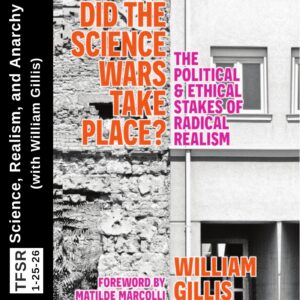
This week, we’re sharing an interview with Will Gillis, author of the recently published book Did The Science Wars Take Place: The Political and Ethical Stakes of Radical Realism, published via C4SS where Gillis holds the position as The Voltairine de Cleyre Chair in Centrifugal Studies and technical coordinator.
For the hour we talk about the so-called Science Wars of the 1990’s, debates involving scientific approaches and shared understandings of a a measurable physical reality, post-modernism, the roles leftists and anarchists played in the debates and how cults and authoritarians employ anti-realist explanations of the world to limit their subjects’ moves toward liberation.
You can read more of William’s writings at https://humaniterations.net and https://c4ss.org
A few links to further scientific education:
- Quanta Magazine: https://www.quantamagazine.org/
- Theoretical Minimum Lectures by Leonard Susskind: https://theoreticalminimum.com/
- Milo Rossi youtube on archeology; https://www.youtube.com/@miniminuteman773
- Stefan Milo youtube on archeology: www.youtube.com/@StefanMilo
- Angela Collier youtube on physics: https://www.youtube.com/@acollierastro
- self-training in physics video: https://www.youtube.com/watch?v=Cw97Tj5zxvA&pp=ygUcYW5nZWxhIGNvbGxpZXIgc2VsZi10cmFpbmluZw%3D%3D
- Sean Carrol’s Mindscape podcast covers a lot of topics, linked from his website: https://www.preposterousuniverse.com/
. … . ..
Featured track:
- beatbuster by The Willows Whisper
. … . ..
Transcription
TFSR: Would you introduce yourself with your name, pronouns, and any affiliations that make sense to share?
William Gillis: My name is William Gillis. I write for a variety of different outlets but prominently among them the Center for a Stateless Society, and I use they/them pronouns.
TFSR: Thanks so much for being willing to have this chat with me. I really appreciate it.
William Gillis: Thanks for having me, this is really great.
TFSR: First off, William, let me introduce you to the audience. William recently released their first book via C4SS (Center for a Stateless Society), entitled, Did the Science Wars Take Place? The Political and Ethical Stakes of Radical Realism. Congratulations on this William. So before we get into the book, I’d appreciate if you wouldn’t mind saying a few things about C4SS and the ideas that the project supports.
William Gillis: Yeah. So the Center for a Stateless Society is a media center and publishing project for left-market anarchists, like mutualists, or anarchists who are committed to egalitarianism and the destruction of capitalism, in the sense of bosses, classes, poverty, corporations, etc, but who make a distinction between that (capitalism) and markets. That is to say, like voluntary trade networks, markets have a long existence. They’ve been in virtually every society or culture, including relatively egalitarian ones. Think women selling vegetables in the Village Square, or traders and tinkerers wheeling their wares around. Capitalism is a recent creation whereby immense, coordinated violence was used to dispossess huge amounts of people, giving them no choice but to slave under a boss.
Capitalism depends upon constant violent intervention and a host of ways to not just keep workers dispossessed, but to stop market competition from eroding wealth, since there are dramatic economic inefficiencies that are inherent to corporations and billionaires (or even tyrannical bosses and small businesses). So left-market anarchists, like those of us at C4SS, analyze the world and the myriad of ways in which markets are constantly being suppressed in it. Think of the murders of Eric Garner or Mohamed Bouazizi, done to keep capitalism ritual afloat. So, we’ve been a part of the anarchist movement since its inception. Well, I mean specifically left-market anarchists have been. It was market anarchist Dyer Lum who smuggled Louis Lingg his dynamite in Chicago, and it was a market anarchist who saved and compiled the largest collection of anarchist materials in North America, the Labadie Collection. Unfortunately, there’s a nasty movement that formed in the 1950s called anarcho-capitalism that tries to appropriate from us while defending pretty much every hierarchy in existence. So much of what the Center for a Stateless Society does is critique those people and try to make them see the light, sometimes by turning back their own arguments on them.
This means that we attract both regular anarchists who have become convinced that some form of markets are necessary for coordination, and that hawking books at a book fair isn’t some deep sin. And we attract former right-wing libertarians who have been convinced to more consistently oppose domination. This is perhaps unfortunate in some sense, because as we’ve converted people out of right-wing libertarianism, those who remain have become much worse on average.
TFSR: But you can’t be blamed for that!
William Gillis: I blame myself.
TFSR: To move on to the book. Could you give a synopsis on the term Science Wars, what it colloquially describes, the tensions between the sciences, and the run up, and some of the provocateurs that listeners might be familiar with?
William Gillis: Yeah, so the Science Wars is remembered by many as a conflict in the 1990s between academics that spilled over into mainstream discourse and media. Mostly over a famous hoax article that a Marxist physicist named, Alan Sokal, got published in a Marxist zine called Social Text. The article denied that any physical reality existed, asserting that matter is just something that we make up, and that all that exists are social relations. And it endlessly cited things that a specific Marxist writer, Stanley Aronowitz, who was an editor at Social Text, had written. Aronowitz had been dallying with a movement called postmodernism that was kind of half academic and half sub-cultural. A handful of people in the United States, primarily around a guy named Lotringer at Columbia University in New York, had started translating and republishing some French philosophers and circulating them in zines.
This caught on in no small part thanks to the NAMBLA (North American Man Boy Love Association) theorist who collaborated with the Shah of Iran, and supposed “chaos magician,” Peter Lamborn Wilson, who also went by Hakim Bey. But like across the board, on the left at this time, there was a certain understandable hostility to the like institutional scientific world and its complicity with the military-industrial complex. And the monolithic cultural, infrastructural, mega machine the countries like the United States were turning into.
Many leaped on to a rather reductive critique of fascism as totalitarianism, that had the benefit of also applying to the US and USSR. So, there was a sense in which scientific models like that of gravity were considered totalizing, that is to say they attempted to speak universally. And there was this fear that such universality was somehow the same thing as imperialism and fascism. So there was a lot of interest, by the hippies basically, in a mysticism, faith, healing, quackery, or whatever, to push back against science. And thus Aronowitz had written a book called Science As Power that rather hilariously misrepresented a bunch of science and philosophy. But also followed a narrative that was popular in the left at the time. Aronowitz was motivated by trying to save components of Marxism like teleology. Which basically, in this context, means the notion that aggregate things have an internal, intended character or destiny that is more or less more powerful than the nature of their constituent parts. And he was trying to defend that from physics, which disproves that sort of thing.
Similarly, Lamborn Wilson was trying to legitimize chaos magic and “violating boundaries” by appealing to philosophers like the poststructuralist Lyotard who had endorsed a return to paganism in a certain sense, and Paul Feyerabend, who had defended faith healing and praised Mao enslaving and murdering scientists, saying that the same should be done in the West. And what’s important to note is that long before this intra-Marxist conflict and this big academic, you know, public media shit show, there were anarchists, feminists, and anti-fascists, and a myriad of other leftists were often quite critical of postmodernists, and the jumble of arguments or positions often found among them.
So you know, this was anarchists and feminists heckling and critiquing French post-structuralists when they came to New York in the mid 1970s. but it also included figures as diverse as, John Zerzan, and Murray Bookchin, writing lengthy critiques. And of course, there were raging conflicts in academic philosophy during this time too. But after Sokal’s hoax brought these arguments to public, mass media kind of attention, a bunch of right-wing demagogues treated Sokal like a champion, and much of the leftist humanities and academia closed ranks around postmodernism, with both sides rewriting the history ever since then and constantly appealing to it, especially like now, despite it being almost three decades on. Famously Jordan Peterson accuses anyone and everyone of being a postmodernist, while never having read a single thing from it.
TFSR: When reading this book, initially, I found myself really conflicted around what I was reading in terms of the influence on postmodernism and this totalizing idea like of the world. It’s kind of funny, like I can see Zerzan critiques postmodernism frequently, however, also pushes back on the idea of a universal existence, right? Or like, we’ll talk about the stories that are told by the mega-machine or whatever, as this totalizing imposition. Can you break down a little bit, unless we do this a little bit later in a different question, the sort of tension between the idea of this totalizing critique and some of the good natured anti-imperialist approach towards reflecting on Western Eurocentric stories of the World? My sister was talking to me about her realization that the term Middle East is kind of a screwed up term for a region, because it definitely centers experience from the UK, looking in this direction in terms of how far the Empire reached. I know that’s kind of a weird example, maybe, let me drop this and I’ll try to return to it later in a different way.
William Gillis: Yeah, that’s totally fine. I think the term totalitarian gets used in a lot of different ways. One of the things I wanted to draw out really early on in the book was the ways in which it was being thrown at anarchists in ways that are obviously unfair, and once that’s recognized being like, oh, well, there are other instances where this is being thrown at scientific models of reality that are likewise unfair. Maybe we can get in this later, but totalitarianism maybe isn’t the best understanding of fascism as a movement. It is certainly the case that there are imperialist, universalist tendencies such as settler colonialism, Christianity, what have you, that want to impose, like a single perspective upon the world. But, you know, when anarchism is totalizing in a certain sense, and our rejection of domination that got us critiqued or attacked by Marxists who were themselves pro-state and pro-Gulags. So that individuals who were particularly authoritarian would say that anarchists were the real totalitarians, because we didn’t allow for there to be any space for domination left.
I think we have to be very careful about what we’re critiquing, and what we think of as the enemy or the thing that we’re working against. I’m not unsympathetic to many of the currents within decolonial tendencies. I mean, not just not unsympathetic, but very sympathetic. But at the same time, there’s limits to certain things where an approach that one had maybe breaks down a little, and it becomes necessary to say, like, oh, what do we actually mean here when we’re using these words? This word kind of sounds like this word or this use case of it kind of rhymes with this other use case. But are they really the same thing? Are we really like poking at the same thing here? That isn’t to say that I don’t think it’s super critical that we critique existing science as a social practice or a set of institutions.
Science kind of sometimes, the phrase operates as this near mythical symbol of authority that’s constantly being appealed to by bureaucrats and reactionaries. But at the same time, it’s productive to talk of science as a way of thinking. Or as like a set of desires and motivations. Liberal critics of science will often argue that we can’t let pursuit of the world be done for its own sake. I think they’ll say that it’s like critical that we, like, enslave scientists under the signifier of democracy or social control to make sure that we only learn things that are useful for making widgets or curing diseases and whatever is voted on is most important. But there’s an explosion of inquisition or desire in a lot of children, and those that survive being subjected to the education system long enough to become scientists. I think this should be pursued as an end in itself, and that’s a very like totalizing or universalistic kind of like thinking process. The process towards trying to understand everything, trying to go further, to not be tied down to parochial, like local context or specific contexts. I think that can be cast in a certain way, as totalizing or totalitarian or universalistic or imperialistic, and it can sometimes be, and it can sometimes be utilized as a cover for immense violence, dispossession, oppression. But it doesn’t have to be and it’s critical that we think very clearly about what is actually going on and not get these things conflated.
TFSR: I mean, I’m critical of the term…totalitarianism was brandished after World War II in a lot of ways by reactionary forces that could no longer talk about themselves as being pro-fascist, but they could talk about communism as being a totalizing system, like state communism. It became in the vogue to say, look at these two systems, they’re the same. Any question of you know challenging, and therefore, you know, slippery slope, any challenge towards the idea of, like, concentration of private property and class society, and anything that we’ve got right now, this society that beat fascism and fought off communism is, is like, leaning towards totalitarianism. I wasn’t so much meaning to jab at that. I was just trying to find a way to to sort of play with that idea a little bit.
William Gillis: Yeah, it’s a recurring tendency, right? I think it’s hard to extract anything else that’s said or that one would talk about in terms of the book from that topic, because post modernism itself, I think, at least as as I start talking about it, like centered on that narrative of, “we’re resisting the totality,” right? And it became one of the core components. So everything flows around this question of ‘is this actually totalizing in a bad sense? What does that mean?’ Like, are there appropriate times when you can speak of universalities? Are there inappropriate times, etc?
TFSR: Well, maybe this would be a good time to actually introduce that question about like definitions. Would you mind talking about post modernism as an idea, or as a framework, how it developed as it’s used by various parties, because it’s used differently by different people as a term. To the point that you know, Jordan Peterson, as you mentioned, will like use it as a slur. I’ve heard other philosophers use it as a slur. But there’s other terms that you bring up in the book, like radical realism and anti-realism that figure heavily into the way that map the arguments as they proceed throughout, like in the run up to the “Science Wars” and up until today.
William Gillis: Yeah, so I mean postmodernism, is notoriously nebulous as a term, and it’s more like a cluster identification in a sense that it’s kind of like these people with some common associations and some common perspectives. I think that’s fair to do, with some terms, and with some movements and circles of people, but it means that as a consequence it’s abused a lot. Especially by the right. Jordan Peterson will say that anarchists are postmodernist because we’re egalitarian and anti-authoritarian, or that all queer and trans people are post-modernists. Then other people will accuse anyone who’s arguing irrationally of being a post modernist by virtue of having argued irrationally. So in that sense, it’s operating as a slur without a lot of depth. It’s understandable that I think many people go, “oh, okay if the term doesn’t mean actually anything, and you want to call me that, fine, whatever.” I argue quite strongly in the book that postmodernism is an actual movement or milieu that did exist, especially in the 1980s, however distributed, where people self-identified with that label. Even if many of the original poststructuralist thinkers in France didn’t identify with it as an ideological flag, it became one.
So, in my book I trace this loose milieu of people and the set of perspectives that were common among them. I highlight this ‘totalitarianism’ analysis, whereby fascism is seen as a universalizing impulse. In response, you can kind of see postmodernism as this, like, “well, okay, if Fascism is totalizing, then we have to be everything that’s not totalizing.” So it becomes this reactive embrace of values like particularity, difference, plurality, transgression, illegibility, and humility.
All those can be totally fine or good in some contexts, but when those values or those words get fetishized as core, unassailable goods, like, you know… evaluate the situation. “what creates more eligibility?” Whatever does is therefore better, right? That doesn’t work, and taken as ends to themselves, they can be taken to very reactionary conclusions. I want to say, as with any movement or ideology, there’s variation. Not every postmodernist would embrace everything there. That said, though, it’s common overlap, like it’s things that you find as, like, recurring currents. I think this is true of like any ideological or subcultural space, such as libertarianism, liberalism, anarchism. I would hope in anarchism, everyone agrees that domination is wrong, but if you go to like libertarianism or neoliberalism, it’s a cluster concept. There’s a variety of different things that people believe in, and not everyone believes in every one of those things, and not everyone associates with everyone else, but they all kind of associate with each other, and they all kind of cluster around the same things. So it’s very hazy, and that’s, you know, imperfect in some ways, but it’s just inherent to being able to describe social movements and, like, currents in society.
Anti-realism exists within this cluster of values as one of the core ones, or one of the most reemergent ones, and it was very important to the Science Wars but not every post modernist was anti-realist. So anti-realism versus realism is the central topic of my book. Also these are like very technical terms in philosophy with many slightly varying uses. They’re not like terms of abuse necessarily, although people can use them as terms of abuse. I don’t like anti-realism. But there are philosophers who quite strongly self identify as anti-realists. There are philosophers of either side who will use the term anti-realism and realism. So as a very technical sense, although those technical definitions will go in different directions. I should definitely define what they are.
Broadly, realism is the stance that there’s a single reality with some universal structure that we can figure out a model to at least some degree, and anti-realism basically says, “nuh-uh”, about varying aspects of that. There’s, as a consequence lots of versions. In the book, I laboriously go through them in part to show that different versions of anti-realism, or different arguments often opportunistically jump between one another. So someone will be making one argument in one style of anti-realism and then will slip into a different style of anti-realism in order to avoid an attack upon that one, right? And then slip back when they need to.
I also make this distinction between radical realism and fundamentalist realism, and in that case, they’re mostly my chosen terms, although there are a few individuals who have used either phrase. Radical realism is the notion that the structures of the universe are under no obligation to be easily knowable by some random primates like us, right? You know. So we have to work very hard to delve under appearances, to what simplifications are useful to us, or underneath those simplifications, to find what’s a true universal root dynamic. It may be very alien and it means sometimes discarding what turns out to just be like a sloppy rule of thumb that we imposed upon the world and that isn’t actually universal in the world.
Fundamentalist realism, on the other hand, asserts that we can know reality. I mean, all forms of realism assert that to some extent, that we already do and it’s kind of simple, that appearances and common sense are likely to be true with only some minor corrections. This is sometimes called naive realism in the populist literature, but there’s a lot of different variations of it that I wanted to kind of group together pretty implicitly in the book, to save space and show how there’s a common like impulse driving that.
TFSR: There’s an interesting point that you make and, full disclosure, I am not a scientist. I do not knowingly practice or am trained in any sciences, not because you all are witch burners, but, because it’s just not where I focus my attention. But I find it really fascinating, and I’d love to learn more or get into the practice. One thing that you return to throughout the book, in terms of the idea of reality, and I want to ask more questions about the concept of science, but just to sort of touch on a thing, simplicity with the fundamentalist realists is something that is like… the world is present. The world is actually simple to understand in that vision. But there is like a value to simplification that you express, and I think it’s from your physicist background, or maybe just from scientific background. Because I guess mathematicians talk about it a lot, but the idea of lossless reducibility in understanding the universe or how reality is constructed. I know there’s a question later on that talks about this, I’m familiar with this term from exporting audio basically on computers or graphics. There’s smaller images or smaller audio files that may, to our ears or our eyes, seem like pretty full of depth but are oftentimes a reduced version of those initial files. If you have the ability to delve in or listen with an exceptionally good set of ears or a set of headphones to those initial raw recordings, you might notice pops and cracks or like background noises from a couple streets down or whatever. In that raw, lossless version, the lossy version is something that’s easy to spread around. Can you talk about just the idea among realists of simplicity and this ideal of lossless compression or compression?
William Gillis: Yeah. So among realists, especially in formal philosophy, lossless compression and simplicity kind of has a bad name. That’s not true for all of them, and they’re significant holdouts. But among physicists, especially the people who were involved in the Science Wars…a lot of them were leftisty physicists of some kind who were critiquing the more postmodern and relativist side of things. For those folks and in the physics community lossless reduction/lossless compression is incredibly valuable. People will maybe not use exactly those words for it, but they will use very similar ones in a variety of different ways all the time to talk about, like: what is the thing that we’re pursuing and the thing that we find as proof that we’ve successfully achieved a correct model of things.
I think it was important to me to go in depth with physics examples in the book and put equations on one page. I promise they’re short equations. You don’t have to read them, and they’re simple math. But even though my editor was very unhappy with the equations, because no one wants to read those. I thought it was important to go into that in part because the experience of certain realms of core science, what I would call the radical sciences, is so different from everyday human experience and the intuitions that we build up. There is no such thing as lossless compression in everyday human life. It does not exist. If you take an audio file and you compress it you lose something. But what if you could take an audio file and compress it and then uncompress it, and you would not have lost anything? That’s what you can do, in some instances, and some radical sciences and math and in some sense all of science, especially those in the natural sciences, are striving for some degree of at least less lossy compression. And that, like an effective model of reality, is a model of reality that manages to compress, to take everything that we know and create a compression that doesn’t actually lose anything that makes it easier for us to visualize, engage with, work with, state, even if it’s not necessarily hard to work with, because it can be incredibly hard to work with. But, like, find some way to compress it that can be uncompressed into everything without loss of anything.
And of course, that’s over a domain, over a specific thing, and the difference ends up playing out on whether or not you’re evaluating a macroscopic system, like humans. I mean, we’re much, much larger than a microscopic system, right? So there’s countless particles all involved in all these countless things, like our brains. There’s all these basically infinite connections and relations and processing that’s happening. If you had a computer that could model everything, and take the actual the physics of it, and then put in the core physics, you could build out the whole system and you could watch the whole system. At least that’s the reductionist, lossless reductionist account. It is impossible to do in practice because we have limitations in computation. We have limitations in storage of things. But there are things that…like, electromagnetism. Electromagnetism plays this role. It has all these different features, all these different things around the world, all kind of share a same underlying dynamic. That dynamic is universal. When you take all those different features, all these different things that you thought were different things, you can actually unify them into one thing, and you can show and then you can take the thing at the core that you had, and you can reproduce, everything that you were originally simplifying down, and nothing is lost when you when you rebuild it. The examples they give are out of mathematics. They’re really simple examples around algebra and like polynomials or something and that kind of stuff, to show you how that is possible in math, how you can write an equation in a really messy, long, complicated way, or you could write it in a very simple, short way. In mathematics, there’s things called complexity hierarchy. That’s how cryptography, in some sense arises. There’s all sorts of different things you could start to say there more concretely, but something can be a lot more lossy and a lot less lossy.
And the more human scale, our science oftentimes looks like trying to find the less lossy compressions. But, the radical instinct in science is not does not settle for merely good enough. It wants perfect compression. It wants universality, like absolute universality. So if there’s something that is lost in a simplification, or something that is obscured, or there’s an exception, then a certain type of scientist looks at that and it’s like, “Absolutely not, something has gone wrong.” I mean sometimes they look at it with incredible excitement, like, “Oh my god, we found an exception. The symmetry that we thought existed in nature doesn’t actually exist. There’s this thing over here. How does that change everything?” But it changes everything, because that point, like, your old system doesn’t work. So maybe it works to some approximation, but you need to find the thing that is better than that approximation. You need to find the thing that works always. That pressure, that drive for lossless compression as I phrase it, drives certain chunks of science, and what I would consider to be the core of science, physics, most notably among them, but you can look at like chemistry, certain components of biology, mathematics, computer science, or some components of computer science. And like these things will kind of have intersections. And you can also see it present out in other fields of study. And fortunately, there are some fields of study that are very different from one another, so it’s hard to do, sort of, combinations or comparisons. And then there are others that basically turn into the same thing under high degrees of radical pressure. So that core distinction between the radical and the non-radical, between the lossless and the not lossless, is this very important conceptual distinction throughout the book. When it comes to fundamentalists and reactionaries, one of the things that I wanted to bring to the fore, and maybe we can get into this later, is the way in which their assumptions and their notion of realism depend really hard upon, “well, it’s good enough.” This assumption, this model that we have, “it’s good enough,” and as you were saying with simplicity, there is this impulse in reactionary politics, reactionary perspectives, to achieve the simple at any cost. That cost can be just simply ignoring the exceptions, but it can also be violently suppressing the exceptions. I think there is a natural tendency of people who are living in everyday human life and are conventional every day, to see the drive for the simple as inherently reactionary. Because the people who we are most likely to encounter who are pressing for the simple, are people who would accomplish it through violent ends, and who would suppress and ignore incredibly important exceptions.
But it is not the case that, at least I argue, well I believe, many physicists believe, whatever, that kind of lossiness that we experience in our everyday life is inherent. I think a lot of physicists would believe that, or experience and can can demonstrate instances where the drive for losslessness is productive, and doesn’t do violence, doesn’t strip away important details and important realities, that doesn’t leave an impoverished model of reality.
Of course, people will be like, “we’re not just a collection of atoms blah, blah, blah.” And of course, there’s importance to all the arrangement and the structure and the history and all of those things, but the point being that you can reproduce, you can take certain subsections of reality, notice common trace lines throughout them and pull out of it: “Oh, this is universal symmetry. This is a universal connection.” We can actually say that this is universal, without papering over some exception, without being like, “Oh, well, put this, this to the side.” That doesn’t apply at the large scale, at the at the normal human life, we just can’t do more.
TFSR: It seems like the fundamentalist approach might be one which believes that there are understood fundamentals and that the approach of science is about finding the data that will fit into the model that they fundamentally have. Whereas the radical approach, meaning, as you put it in the book a number of times, “getting to the root”… It is happy to to be like shifted and have the rug pulled underneath it, because it’s seeking perfection, even if that’s unattainable.
William Gillis: And that search radically transforms you, right? Because, if you’re looking for the roots, and you don’t assume that you’re already going to have it, or that the simple things that you have that are more or less good or sufficient, you’re going to constantly (or perhaps just for a while, depending upon the thing you’re looking into) be changing things entirely. You’ll pull a thread and realize the whole thing unravels, and you’ll look into his thing, find the exception, and have to delve deeper. As a consequence you get changed by the search. So much of reactionary politics is like a fear of change, and a fear that if you leave home and you go on a journey you’ll come back a different person. That like globalism, queerness, what have you, will change you. So the radical is kind of like unafraid of that, and even a champion of that kind of change, because they think that whatever they find you know, like you should seek the truth, regardless of whether the truth changes you.
The reactionary, in many cases, doesn’t believe that there is a true, universal truth out there. And so just sees like, if you go off beyond the horizon, you’re gonna come back a lovecraftian monster, changed by who knows what. We can’t allow that, because they have no allegiance to this distant, unknown thing, of like, whatever the actual true universal is. They have allegiance to whatever they started out with, and they will defend that pretty violently, even epistemically violently.
TFSR: So we’ve kind of wandered into the concept of just talking about science generally, which I think is great. I wonder if you could talk a little bit about science that’s discussed in the book, about the institutions, the industries and agencies engaging in it. How it is or can be differentiated from a scientific approach, and the accumulated body of knowledge? You identify as a radical realist, that it is possible for the world to be known or the universe to be known to some degree.
So in addition to that, because these are all like three part questions, I guess this is break it down. Could you talk a little bit about when people talk about science in particular, like when some of the characters in your book (I call them characters because they were characters even if real people) when they were referring to science, capital-S science. Can you talk about some of the industries, agencies, institutions, that they were critical about. Also what other people were referring to, like radical, real people that you would identify as a radical realist, how they identify science and as as an approach, maybe differentiate those two.
William Gillis: So it’s important to note that there were criticisms of science as social practice that never really were critiqued by the science warriors, or that the science warriors never really seem to have a problem with. This becomes a distraction when telling the history of the science wars, because much of the science wars was about realism versus anti-realism. Many of the folks who were drawn towards positions that touched anti-realism were anti-realist, defended anti-realists, or provided cover for them. These folks were primarily oriented towards critiquing science’s actual social practice, and the institutions that actually exist. There’s nothing wrong with that, right? I read hundreds of books, and hundreds of papers to write this book and it becomes quite slog sometimes to read through these volleys back and forth where two sides will be talking past each other. One side will be critiquing the interiorism. They’ll be really like drilling in on the “but this person said this extreme thing” about how reality is unknowable, or is a product of our thoughts, and we dream it into existence or whatever. And somebody else will be saying “so you’re saying that there should be no checks and balances against capitalism,” and it’s hard not to have sympathy for both sides of this. I think that there were definitely currents in society, especially some more reactionary conservative currents that were critiquing postmodernists on grounds that tended back to some old fights in the ‘60s and ‘70s. Where there was a current in scientists among the left, that saw science primarily in terms of industry, and saw science primarily in terms of like, “what good can it provide to individual people?” And was, of course, horrified by the fact that, you know, industrial pharmaceuticals, industrial agriculture, whatever was not actually providing benefits to people as a whole, but was actually being quite horrific, right?
They also were horrified by the hierarchies that were gelling in science at that time. The institutional hierarchies, the domination, the complicity with the military industrial complex. Their critique was a sociological critique, and institutional, and I think it’s worth noting, even though Sokal has revealed himself as quite a reactionary (at least on gender issues) that individuals on the science warrior side of things, repeatedly made statements where they’re like, “we don’t care about those critiques”, as in, “we think it’s fine and good that you make those critiques.” Sokal, many times would say like, “I think sociological critique of the actual existence in institutions of science, is incredibly necessary. I share in these critiques. I want you to publish these critiques. I hate this. You know, what I’m taking issue with is these things over here [gestures].” I think there was also some uncharitable or opportunistic degree to which many of the defenders of the postmodernist side of things made critiques, along with the anti-realist postmodernist (because there were postmodernists who were just uninvolved). There was also a separate crew called the relativist sociologists who were basically very, very tightly in coalition with the post modernists. Those folks would oftentimes, I think, very disingenuously, deflect from one critique and try to jump back on the other critique, because they knew that no leftist would disagree with that, or no radical, or person focused on egalitarianism or liberation would disagree with that.
I do think at the same time you can’t disentangle entirely the broader social discourse that was happening, and the broader continued arguments and discussions that were happening. At the same time, I don’t find myself in alignment with certain scientists in the 1960s and 1970s who saw science as more engineering and saw the issue as one of democratic control. In my book, I harp (maybe unproductively) on a distinction between scientists and engineers, because in my experience they have almost totally opposed ways of looking at and engaging with the world. You know, as we’ve discussed, like radicalism and finding dynamics beyond first appearances is very different from the kind of practical and pragmatic tinkering an investigation for instrumental reasons, to accomplish some other end.
I noticed very early on in my personal participation in political discussions within STEM (Science, Technology, Engineering, and Mathematics) spaces that things would split very hard, oftentimes, almost always with those of a more engineering or applied background being present on the wrong side of the table. There’s a ton of sociological data, it actually turns out, consistently backing up the story in every nation and throughout history or the last century, that this is a strong divide between engineering, the engineering disciplines, and the more like core theoretical scientific disciplines.
Which isn’t to say that engineers are universally bad or that scientists are magically universally anarchist with great politics. That’s definitely not true. We need engineers, and practical tinkering, squats, and radical spaces require engineering. Like some of my best friends are engineers. But this highlights the utopian and radical inclinations of pure science. Which is also why, before World War II, physicists were publicly seen as overwhelming on the far left, and much of the Manhattan Project and the post war state apparatus very intentionally tried to beat that out of pure science and transform it into something that operated and thought more like an engineering discipline.
I think that many of the leftists who had critiques of science on a sociological and institutional dynamic had many correct critiques of those dynamics. At the same time their end goal or their takeaway, was that we should make science more like an engineering discipline. We should just change who had control of the leash. We should shift things over from being scientists should do the bidding of the industrial capitalist leaders and the military-industrial complex and we should shift it over to their being controlled by the Democratic communes.
There’s no space in there for science as a goal in and of itself. There’s no space in there for inquisitiveness for its own sake. There’s no awareness of even the notion of the search for truth, or the search for universal structures and relations. It just becomes, “How can this cash out and benefit us”? Don’t get me wrong, there should be engineering and technology and applied concerns. There needs to be medicine for people in need. There need to be things like that. We can have many critiques of how that’s applied and how the infrastructure functions etc., and I have many, but what I think is evacuated from that discussion is the value of the radical approach of science. in and of itself.
I have a lot of sympathy and solidarity with those like Science For The People who were engaged in that kind of critique and focused on those issues. At the end of the day, I think that they were focused more on a technological direction, and one that I also think is like somewhat implicitly authoritarian. This notion that democracy should control science is authoritarian. I feel like people should be free to inquire and to investigate and to delve, and to look into things, and collaborate on that as a goal in and of itself, in part because understanding the world and understanding reality is deeply enmeshed with and inseparable from the act of choice, having agency, having freedom at all.
I think that there is a distinction between sociological critiques that critique the function and the actual lived experience of science and in society, and the institutions, etc, and critiques that ignore the existence of science and other forms. Like the inquiry search for roots, etcetera, and not just ignore but as a consequence, devalue that.
TFSR: Even if it’s individuals pursuing things, it doesn’t mean that they’re also not going to be getting ideas from other people, kicking back the things that they find because they’re excited about it, and that feeds back into the collective pool of knowledge. I believe that you posit that postmodernism, despite at times being championed by leftists and promoted more widely as a leftist project of social degeneracy by right-wing talking heads, actually serves reactionary world views better. Can you talk about this (if we want to call it) subterfuge, and how it plays out in things like a volkisch mindset, patchwork approaches to things like human rights and real concerns about imposed cultural hegemony from the imperial core.
William Gillis: It’s a well documented fact that many reactionary religious folks and much, if not most of the major fascist movements in the world, pulled quite heavily from postmodernism and some associated relativists in the science wars. So you have climate change deniers, creationists, folks like that, who have all been quite public about this, and their embrace was praised and supported by some major postmodernist and religious figures. The two competing financial and intellectual loci of the international fascist movement, the new right in France and Alexander Dugin in Russia, are fervent, explicit champions of post modernism. They use the word. They drape it on things. They go on postmodernist podcasts sometimes.
Meanwhile, even a number of the core chuds in the kind of like Maga-Trump world have ties. It is important to ask why, and it’s critical that we remember that Fascism is not the same thing as every imperialism. Fascism emerged, especially in its national socialism form in Germany, as a defense of national particularity and difference. It saw itself as preserving the local against the global, protecting rural culture against Hollywood. This wasn’t just like dishonest branding, it was like core motivational stuff to a lot of them. Now, naturally, the Third Reich saw an absolute state as the means to achieve these ends and this involved the suppression of difference within the state, and they definitely wanted to expand via the extermination of people like the Slavs. But the Nazis saw themselves as paternalistic liberators of many nations like France, who they were purifying of the corrupting globalist influence and allowing them to return to their national particularity.
A lot of thought in Nazi circles was grounded in and revolves around this rejection of universals. They were incredibly hostile to physics, which is part of how they failed to build a nuclear bomb. The chief philosopher of the Nazi regime, Heidegger, was all about encouraging people to embrace their ‘throneness’, as his term, that is to say the particularities of their existence, their happenstance birth. Heidegger blamed the Jews for their extermination because, in his mind, the Jews had pushed universality and thus it was only fitting that they would be slaughtered by modern technology. Although that’s a kind of a myth about the Holocaust, it was largely a very messy, chaotic, low tech, very gruesome thing, which gets obscured in the public vision by these images of IBM racks and gas chambers. But that was only one small component of it. But you can see the danger of the fervent, abrasive Heidegger by folks on the left around the 60s and 70s, and the emergent like postmodernist movement, and those who critique fascism solely as like a homogenizing force miss how critically it relies upon relativism and cutting off consideration or empathy beyond some border.
The preservation of overall difference in national identity necessitates, in their mind, slaughter to preserve borders, customs. And this isn’t to say that global homogeneity is necessarily good, either, certainly not like imperial cultural hegemony. Liberal capitalist democracy can be quite evil on its own without that being the same thing as fascism. There are, of course, many negative universals: Christianity, settler colonial missionaries did unspeakable genocide and horrors. I would say that I think anarchism and anarchy are correct and it’s just inherently universalizing, like your freedom is my freedom. Globally, our solidarity is totalistic, right, and our rejection of domination is totalistic too.
We’re infamously prickly problem creators in any leftist coalition, because we won’t compromise with the Marxists or whoever and accept just the little domination or the specific flavor of domination over there. We oppose all of it. This has led Marxists and postmodernists, like again, to constantly deride us as actually the true totalitarians, in much the same way that many people have slurred anti-fascists as being the true fascists, right?
I think that universalism isn’t an inherently bad thing. But we have to take care that it doesn’t get misappropriated and turned into something to defend bullshit. It’s just important to make those distinctions. That also isn’t to say that there aren’t forms of the right wing that aren’t universalistic, but fascist currents within the right have tended to be very particularistic and promoting a lot of the values of the words that became core flags or fetishes of the postmodernist movement and of people surrounding it. I just think we have to be very clear about what we’re actually talking about, and not just short circuit our thoughts on something because this word was applied and, yeah, it’s technically different. You’re technically defending difference. But why should we care about difference as an abstraction rather than concrete freedom, right? Like, are these people? Do people actually have more choices? Are they more repressed and oppressed in their daily life? That, to me, is far more concrete and substantive than a question of “Well, but are there customs and cultures more diverse, do they jingle their bells and dance or whatever in this section of Europe versus the section of Europe and in completely different ways?” And “Do we need to have violent borders and incredibly authoritarian regimes in order to preserve that difference?” Right? Who cares if it dissolves if people do so freely. It’s, you know, kind of more what I would say.
TFSR: I mean, it’s not like any of those cultures are like fundamental and essentially like trapped in amber, things that have never had influence from the outside. It’s not like that language group suddenly just popped up and like, people speaking Magyar since the they were born out of the rocks in Hungary or whatever.
William Gillis: Well nationalists will certainly make certain claims like that. But, I mean, like Nandita Sharma has this great book, Home Rule, where she talks about, essentially, humanity is this kind of Gordian Knot, where nationalism just inherently has to do violence to the deep complexity of human relations in order to simplify them into these distinct cultures, distinct nations, and this superficial, completely made up fucking history, that papers over all the rich complexity of human interrelation. A term that’s always stuck with me from an indigenous anarchist conference was something this individual said, “What we want are not like tradition. Tradition is something dead that lives on a shelf, something preserved in amber. What we want are life ways.” Right? And something that grows, and something that we have agency in. And for me, the great horror of colonialism and imperialism, was the futures that it denied to people. And the choice that it denied to people in making those futures for themselves. So what would have emerged? What different tweaks of culture and whatever would have emerged from these communities and the free association of individuals on their own? Making new life ways or changing their life ways, right? And adapting and growing. This fascist notion of difference becomes this incredibly simplistic, inherently, in order to create this lasting difference. In order to create these divides, they have to strip away and do this incredible amount of violence to stop the constant melding and innovation and association that humans will do on their own.
TFSR: So throughout the book you share a bit about your experience growing up in what you describe as an anti-realist cult. Correct me if I’m misrepresenting? And the personal stakes that you faced, not only during your personal development as a child, but also your survival of an abusive situation. This is counterposed to quotes throughout it by Meera Nanda on how she saw the empowering of Hindutva perspectives implemented through the BJP (Bharatiya Janata Party) to move back struggles, to push back struggles that had been moving forward against caste patriarchy and ethno-religious nationalism in India. Can you talk a bit about the dovetail between those two perspectives that are presented, the importance of building shared, measurable understandings of the world and projects of liberation?
William Gillis: Yeah, as you said, like I grew up in the cult of Christian Science, which is a cult, although it’s formally a religion. It’s hard to explain what that means because the words Christian and science have almost no relation. They believe that physical matter does not exist and is a mistaken collective dream that we’re all having. As a result, they treat things like magic as functionally real, because if you believe hard enough, you can make it real in the collective dream. They also think that believing at all in the actual patterns that science has actually uncovered in the world is responsible for creating and reinforcing our experience of matter, and thus, as a consequence, disease and suffering. This extreme, like philosophical idealism that they have is unfortunately a pretty common take across a number of religions and like philosophical currents. It leads Christian Scientists to murdering a ton of children because they refuse to bring them to the doctors, choosing instead to try to believe the cancer, diabetes or the broken bones away. I should nuance that Christian Scientists themselves will actually bristle at the charge of anti-realism, because that’s not a term that they use. They don’t know technical philosophy in that sense. They would emphasize that idealism, the existence of only minds and not matter is actually the true reality in this kind of realist way. They are kind of imperialists of this notion that matter doesn’t exist.
Functionally, in a lot of ways, they’re anti-realists. I was shocked as a young anarchist entering the leftist, anarchist radical milieu. I was trying to escape from this cult and I found almost exactly the same takes or arguments common that I had grown up suffering under. Feyerabend, who’s this important philosopher: the story is, he went to a faith healer in Berkeley when he had cancer. Statistically speaking, it’s actually really likely that he went to a faith healer in Christian Science, what they call a practitioner. If you’re in a major city of any kind you can probably go to the downtown and find a Christian Science Reading Room, staffed by one old white lady who gets no visitors. But she’s connected to a network of people who sell their ware of faith healing, right? It’s a practice, it’s widespread. Obviously, it’s fine to have critiques of the medical industrial system, but as soon as you say, “Well, you know, I may endorse this mysticism or skepticism or even philosophical anti-realism of some kind,” but I would just take my kids in the emergency room, right?
I’m gonna dabble in whatever, but at the end of the day, I’ll take the pill or something, and people will think that that’ll resolve all the problems, and be like “Oh, well, your cult is completely different. I would just take the pill.” Okay, my childhood cult tried to take anti-realism particularly seriously and to be cogent and coherent about it. But it doesn’t mean that just being an opportunist about belief will really get you out of certain things. What I try to argue in the book, at length, is that anti-realism and realism are intensely self-compounding, that they leak out and infect everything that you do in a ton of ways. There’s not really a compromised position between the two of them. Folks want to be realist about really simple everyday matters, like “there’s a ground”, “I can kick this rock”, “the sky is blue”. Then they want to be anti-realists about more involved, less intuitive, or directly experiential scientific models like, you know, the existence of electrons or the dinosaurs or something like that was in the ground once upon a time millions of years ago. They want to layer on a skepticism and ignore the web of overwhelming evidence that’s aggressively fencing in what could be possible. Directness and immediacy is not actually very good proof of anything. Our experiences and intuitions are frequently mistaken and incomplete. Evidence has to build up. It has to create a network of proof, and an infant gradually coming to believe in object permanence is making a scientific model of the world, and that scientific modeling is not categorically different in any substantive way from the way that we gradually congeal models of electromagnetism or electrons. When folks believe that belief itself makes reality, even if they’re inconsistent or pragmatic or choose to take their kid to the hospital, eventually that assumption that beliefs make reality will inevitably like leak in, in abusive ways. Even if one is just being overly skeptical or dogmatically refusing to acknowledge increasing probability of a model from the evidence that skepticism can itself be abusive even if you get a kid to overly distrust taking all pills, and thus the kid never takes ibuprofen for a headache, you’re inflicting unnecessary pain on that kid. And you’re actively denying them informed agency in their choices.
We have to have accurate models of reality in order to make substantive choices within it. If you delude someone, if you deliberately facilitate someone having a bad map of reality, you’re actually constraining their agency. This means that we want models that don’t over assert or over claim something being true. But we also want models that don’t under assert it, that don’t ignore evidence, when it’s there. I know a lot of radicals who have permanent, lifelong disabilities as a consequence of advice given to them. I’m personally highly critical of the field of medicine, there’s so many reasons to be critical of the medical institutions as they currently exist. The hierarchies, the biases, etc, in them. But, as someone with a physics background I have a certain snottiness about how they don’t have the kind of evidence that we have. They work in crude aggregates of very little data. But there is an extreme skepticism that is pushed in anti-totalitarian, anti-totalism framing, as ‘resisting the mega machine and its scientist priests.’ It was omnipresent when I was younger, and it did real harm. I think it still does real harm. I don’t mention any of my friends in the book who experience things, but I do mention some public figures. There are some formal philosophers and stuff who have said, like, “Oh, my buddy told me not to get heart surgery when I would have died without it.”
There are people who who died as the consequence of the things that were pushed. I name a few of them in the book at various points. Off the top of my head, it’s, it’s hard to remember. I mean, anyone who’s around in the 1990s, unfortunately, knows how common hostility to vaccines or belief in really absurd things was common in radical spaces. There’s a lot of folks now pretending that they never refused to get their kids vaccinated. Sure, okay, fine. Glad to have you update your views. But we all need to at least learn from the experience or the fact that all of that happened. Additionally, I think that struggle can’t just be performative for emotive. The rubber has to meet the road in applied ways in the material world, and that inevitably involves needing accurate maps of how matter works, scientific style thinking, the kind of radical inquiry into roots can assist us into better analyzing core dynamics and can thus expose ways in which rules of thumb, or basic assumptions we already had have exceptions.
If the mega-machine is built by engineering style thinking where “works good enough” in conceptual or technical structures is sufficient. The radical realist perspective can help us at least try to find ways that those assumptions break down to reveal a deeper or more universal reality. And perhaps productively as a result, how to exploit those weaknesses or those exceptions. As a matter of theme and narrative more generally, I think there’s a very real sense in scientific thinking that the pursuit of hidden root dynamics, is constitutive. As I said, it is inseparable from agency and freedom. It’s part of the process that is choice. We have to actually map the world in order to make a choice about how we’re going to interact with the world. As a consequence, comforting delusions may give us a certain amount of sense of freedom in our own head, but they’re just a prison, right? And the drive for universals is not necessarily the power fantasy of some imperial tyrant trying to map every coastline so that his military can exploit them, but something more in my mind, the view from anywhere. A view of refugees, of migrants, of the homeless, where mobility is across different contexts. It strips away our parochialism and leaves us attracted to what is actually universally stable, certain in any context. It enables us to better adapt when contexts completely change. Finding universals enable us to travel, to flee, if need be, to not be trapped to a certain domain where certain rules or assumptions apply but we’re terrified of leaving it, because once we leave that effective domain of a model, or view of the world, things will completely break down, and our choices won’t have traction on reality because we don’t know how things will work past that point. If we are trying to find more universals and we do find them, then we will have less fear of changing everything and we will be able to make more informed choice once we pass through that change, and thus be more free in that world.
TFSR: Yeah, and so to bring it back to Meera Nanda, I really appreciated the quotes that you interspersed throughout the book, and the examples that she gave as a woman who grew up in India, the arguments about how the fake ethnic sciences that were being promoted through the RSS (Rashtriya Swayamsevak Sangh) and the BJP. The framework that they build, sets up people that would adopt these for failure. They would set them up for failure without a correct or possibly liberatory approach towards mapping the world, as you talk about, and so this is where the imposition of caste comes in. This is not dissimilar from on a much larger scale (if you want to make the analogy) to abusive households or cults. Refusing to teach children how to read, and they wouldn’t be able to function outside as easily if they escaped, they wouldn’t be able to harness that information that’s in those books to be able to build a road map about how to get from here to there, or have an understanding that there’s other ways that the world can exist. Particularly in this world that you described growing up in, where to say something and believe it is to make it real. If the world does not frame to your ideation of the world, then it’s a fault of your own. This sets the individual up for failure.
I found that touched back to that radical approach towards science. It was really inspirational to read a lot of the quotes from yourself, but also from Meera Nanda. This talking about how once you’re allowed to have these tools, once you formulate these tools, then you can take next steps and make sure that this doesn’t happen to anyone else.
William Gillis: The book originally grew out of what was going to just be a book review of Meera Nanda’s book. I ended up stripping out so much of that content. I also think her book Prophets Facing Backward is really good, but there are things that I’m quite critical of in that book. She takes a very pro-, a kind of developmentalist kind of thing, of like, ‘if only we developed more industry’ and some stuff that I would have a more critical lens on. I think a lot of the critiques she has especially of Vandana Shiva, fascist collaboration and overlap are really important. I think one of the things that I tried to make present in the book, beyond just Meera Nanda, was referencing people’s science movements in India, which are like grassroots atheist science education movements among the lowest castes. They have billions of adherence and do things basically just like this vast network of autonomous free schools with participatory training programs and activists and stuff like that. It’s such a contrast to how Orientalist perspectives oftentimes portray the non-western world, and talking about the degree to which within cults like Christian Science, if you don’t heal your injury you are therefore weak and there’s something wrong with you. That dynamic plays out pretty aggressively. There’s also a religious inheritance. It’s filtered through a lot of like white bullshit, but there is a religious inheritance whereby one current of philosophy or religious practice in India actually is pretty philosophically idealist in some ways, and Christian Science pulls from it. As do theosophists and a bunch of other currents that emerged in the 1800s by a bunch of Europeans who were really interested in, like, foreign perspectives. And they took a bunch of those things, and they’ve played forward to immense negative impact in our society.
It may be distracting to talk too much about the particular cult that I grew up in, but Christian Science is just one of a great many. The book, The Secret, sold like tens of millions of copies. There’s all these other religious currents, or occultist tendencies that have the exact same kind of inheritance or the exact same kind of path, and believe kind of exactly the same things. They may be like ‘you need to desire it more, and if you didn’t desire it enough, then that’s what’s wrong with you.’ Or ‘you need to have absolute faith in God,’ etc. But a huge component of this is the tele-evangelical world, where you send money to pastors as proof that you’re seeding your belief, and then money will come back to you magically somehow. And the people who are leveraging that are pulling from the same exact, like texts and traditions, and like history that Christian Science was a part of.
This includes Trump’s favorite pastor, who he sings great praises about and seems to be the only person that he has any sort of religious connection to or experience of. The things that these people teach is that if you’re rich, you got so because you’re a better person in some way and if you’re poor, you’re oppressed, you’re beaten, what have you. Anything that you’re facing that’s wrong with you, no matter how fucking materialistic and just inherent (like a handcuff on you), that’s your fault. You did something wrong. Like you should be able to wish that handcuff open. You should be able to wish yourself out of poverty. And if you can’t, that’s your fault. It’s perennial in religious traditions, but it’s particularly stark in both certain currents of Hinduism, in this modern construction that congeals a whole bunch of different things together.
TFSR: But like caste imposing ideology, right? Like versions of it that are heavily into karmic repayment, as well as the people being born into castes as a byproduct of their carrying too much karma?
William Gillis: I specifically focus in on more one specific current. There are subcurrents. So there’s all these different branches of Indian philosophy and of things that became Hinduism. There’s one specific branch that is very idealistic and believes that basically material matter doesn’t exist, or that all is spirit, and that spirit is essentially mental. It’s kind of similar to philosophical idealism in the Berkeleyan sense. But it’s certainly the case, I’m not going to spare any strand of Hinduism, that casteism is built into almost all of them in this really fucked up way. Even if those currents that believe in karma believe in material reality in the sense of like matter, they believe in matter. They still add in the stuff whereby your lower caste, and that’s your fault, right?
In addition, in the caste system, the tiering system is all about one’s level of like disconnect from material realities, whereby the lowest castes have to do the most amount of actual engagement with matter. With shoveling the shit, or tilling the field or whatever. As you get further up in the caste hierarchy you have less and less contact with matter, because you’re supposed to be more and more intellectual, just pure mind, just pure spirit. That’s not unique to India, particularly, although the caste and karmic rebirth system is particularly unique. But those currents, the justification of power, oppression, of the distribution of wealth in the world, etc, it sure fits smoothly with a “wishing makes it real” belief. So that thing will emerge in a lot of different cultures. There’s definitely a contiguous current. People who were doing chaos magic and shit like that, or who were trying to rehabilitate some wing nuts from 1800s into occultist subcultural traditions in the 1980s were pulling from those exact same traditions. The stuff both emerges spontaneously anytime that a hierarchy needs to justify itself and also it is immensely viral, and the genealogy of that virus is pretty broad.
TFSR: Some three decades since the first shots were fired in the so called science wars, participants have had ample opportunities to make asses out of themselves. Near the end of the book, you speak about some of the expressions of what you call fundamentalist realism, by figures like Sokal, as opposed to the approach of radical realism, notably on the discussion of sex and gender. I wonder if you could talk about this a little bit: the difference in approach, and thus conclusion, on topics of sex and gender, and how they relate to ideas of simplicity and lossless compression, like we spoke about a little bit earlier.
William Gillis: When I start talking about the science wars, for a lot of younger folks, the main way they’ve heard of them is via something that unfortunately got called by right-wing media, “Sokal Squared.” Which is in 2018 three reactionary professors submitted like over 20 contrived articles to minor academic journals to mock things like fat studies, and a handful were accepted and printed. The goal of these professors was to ridicule studying the experience of those oppressed along certain lines. They only proved that peer review at minor journals is not great. Alan Sokal himself, at the time, immediately made some noise distancing himself and saying how this wasn’t at all what his original article was about. That’s true. He wasn’t attacking a peer review system. Social texts didn’t have a peer review system. He was trying to prove essentially that they would platform this, and they read it and they approved of it. Four editors approved of it.
After Alan initially distanced himself from the thing that the right wingers were calling “Sokal Squared”, he started to associate more and more with them, and then he started echoing TERF (trans-exclusive radical feminists), transphobic nonsense. It was really astonishing, because arguments were a complete and total betrayal of scientific realism as I’ve known it, which is to say radical realism. Many of the postmodernists and relativists also said bad things and collaborated with reactionaries or turned reactionary. But it was always critical in my plan for this book to spend the back half tearing into similar patterns among the science warriors. I was talking about how the book was originally started out as a review of Meera Nanda’s Prophets Facing Backwards before it like massively diverged, and I scrapped almost all of that. From inception, it began with a story about Meera Nanda signing the Harper’s Letter on free speech, published by JK Rowling, and Meera Nanda’s daughter being astonished. She was like, “My mom’s not a transphobe. What’s happening?” It was shocking and scandalous to me, because I liked Meera Nanda and found a lot in common with her right and kind of common experiences through this. You could point across the science warriors at, so many different people like Noam Chomsky, who are always saying annoying things or being liberals about whatever, with awful takes. Sokal’s collaborator on one of his books, Bricmont, even turned into an outright Holocaust denier, in some grotesque escalation of anti-Zionism.
Sokal’s line was that there was this strict biological definition of sex that cleaves into a binary, forget the exceptions, and it must be preserved from transfeminist critiques. I spend the back section of the book tearing apart his arguments over a pretty lengthy chapter. But there’s like a line that he said that really sticks in my craw, and infuriates me to no degree. I have it written down, it’s, “Saying that ‘quarks are constructed’ is wrong, but at least it’s subtle, saying that sex is socially constructed is I mean, you know, you don’t have to be a scientist to really realize that’s wrong.” He says this before this room of like young Tories at this organization that had tried to legally threaten C4SS actually, because we had exposed some racism that one of their members had said. He says it before this room, and it’s just like this complete and utter rejection of radical realism, of the scientific realism that I was enmeshed in when I was trained as a physicist and it’s just totally odd. Once upon a time, it may have been a valid scientific hypothesis to suspect that there was this binary sex thing with some concrete biological root reality. But scientists don’t take assumptions and appearances on face values. Biologists did an investigation and learned that the physical dynamics that the theory was trying to explain and encapsulate were actually massively more complex.
Our crude rule of thumb shorthand, even with things like chromosomes, turned out to be papering over a vast galaxy of complicated gene responses, hormonal regimes, etc. No physicist would ever tolerate a theory that had that kind of complications. That kind of non-universality would just immediately be recognized as not really a real thing, just an arguably useful fiction towards some specific ends. In short, something socially constructed and judgeable, like on its utility. What Sokal does in order to try to save biological sex is right off the catastrophic exceptions as small a number ascend to saying, it’s like saying that there’s only two atoms in the universe, hydrogen and helium, because everything else, carbon, iron, whatever, is vanishingly small in number by comparison. And further, he has to legitimize and appeal to the very sort of teleology that his old enemy, Aronowitz wanted to introduce. In short, he has to say that there’s like an intended order or an intended state of affairs, which we must judge as broken or dysfunctional when it fails to fit the simple like model that he has.
That’s just not how the core science works. Evolution doesn’t have intentionality. We anthropomorphize because we assign such. There is nothing objective about how we draw boundaries of organisms or species. They are messy, complex, aggregate systems of incredibly vast numbers of constituent particles. There is no such thing as an objective ontology of the universe where giraffe is like a thing. An alien from outer space could choose to look at all the particles and conceptually slice things up in a different way. It’s just so trivially and obviously the case that giraffe does a social construct that we peck out and use these particular patterns from a human vantage point, serving particularly uses and ends to us. What the objective reality underlying all the distribution of stuff, is the distribution, and the universal structures to like how that matter can flow or relate. An alien scientist would recognize quarks as a thing. They may slightly conceptualize them slightly differently, but they would definitely recognize something like quarks. They could easily not conceptually distinguish between a single giraffe and like its wider ecosystem, and just see this whole thing as one entity.
So of course, quarks are not socially constructed. Of course sex is. People grab onto certain crude patterns around hormones and chromosomes, and because there’s an existing social practice of gender that shapes our conceptual schemas. It’s just true that sex is socially constructed and that we should not try to even speak of sex and gender as separate. There are material realities that matter. Yes, they really matter, whether a girl can get on the hormonal regime that she wants, it matters. Hormones are real molecules. They exist. They exist. They have all important consequences, but this giant aggregate thing that we label with sex is not real in any deep sense.
It’s this crude, arbitrary rule of thumb shaped by particular social interests. It’s socially constructed in every sense of the term and Sokal’s realism is like the prime example of the kind of reactionary realism that I was talking about. Where at first blush, it seems to be the case, then it is the case. It’s it’s a sort of perspective that just defends common sense, naive assumptions from the common man. Because the simple must be true, unless it overwhelmingly falls apart at the perception of the common man because sex does fall apart once you look at it with any depth.
It’s an embrace of good enough and then a willful refusal to interrogate the social uses or perspective embedded in “good enough.” Good enough towards what ends. It’s just a knee jerk hostility to updating one’s model of the world. I could say so much more about Sokal’s politics, his liberal assumptions, hilariously awful arguments of transphobic reactionaries that he sees as comrades and pulls from when he’s making his arguments himself. I spend a sub chapter that almost itself is a whole chapter dogging on Kathleen Stock. She’s hilariously bad at philosophy and science and everything, and plenty of trans folks have already written critiques of these figures, etc. I felt it was necessary in the book to drag it to the front after having built up an argument for realism that I think works against certain extreme skepticist attacks, to then turn to what Sokal’s defensive realism is and it just doesn’t work.
His doesn’t work, and it’s a betrayal of anything that would be strong enough to defend the existence of matter against extreme skepticism. I find the turn that he took as offensive on a moral level, because he’s facilitating genocide against trans folks and the increased reactionary and fascist currents in the British Isles, and he’s written letters of support for certain things. He’s written letters of support for conversion therapy. That’s beyond heinous, but it’s also just philosophically infuriating, the arguments are so bad, they’re so incredibly bad, and they violate what I saw as the core fight for realism within the science wars.
You have to recognize that what he meant by realism was probably something closer to a more fundamentalist realism than a radical realism, and it just got hidden amid the giant conflict where there were two teams and everyone got grouped together in that. There’s so many other things. There were other reactionaries, I didn’t really get a chance to dog on. I actually emailed and was talking with Meera Nanda, and I asked her point blank, “What are your takes on gender and sex?” She never responded in email. She never wrote back. So, you know, it’s very disappointing and infuriating, and a huge part of why I wrote the book.
TFSR: As an anarchist and a scientist, what affinities do you see between these categories, and what do you hope they’ll take away from this book and from each other?
William Gillis: Well, I’m not a scientist in a practicing, formal academic sense. I’m not employed in physics, and I focus my work more on philosophical issues. I do have an educational background, but that’s not quite the same thing, at least in terms of how established scientists would consider it. But even before I was educated as a theoretical physicist, I always saw very strong parallels between anarchism and science. To me, they’re both deeply utopian. Science is about egalitarianism and building a common treasury for all, or at least that’s one component of it. In terms of how it operates, and it’s ideal as scientists want to operate. I’ve seen some really stunning instances of principled selflessness from scientists who really, truly believe in the utopian vision of science, even as they absolutely hate the institutional structures of science and the elitist bifurcation of science from everyone else, so that there’s only an elite few who get to know it via an education system that beats any sort of interest out of them and is structurally just completely hostile to science (even while it pretends to kind of support it just for to get more people to build technology for the state).
I see scientists and anarchists, as with radicals, and I have endlessly harped on that same phrase. And I wrote a piece 10 years ago called “Science As Radicalism,” that even though the title was dogging on Aronowitz, you know, I’ve been zeroing in on this for a long time. I see both as chafing to disprove crude aggregate extractions like nations, and both deeply concerned with universals and little hidden tricks that can change everything.
We’re both utterly uncompromising. In fact. Well, if something’s true, it’s just not up for debate. If there’s a good model, if there’s good evidence for it, and the evidence is sufficient past a certain point, or whatever. That’s not to say that you can’t re evaluate or what have but you can’t pretend as though the evidence isn’t good evidence, it’s not very likely, right? And similarly, anarchists are notoriously unwilling to violate our principles and values for some big tent. So I think that there is a common kind of unruly inclination that is not to say that I’m sanguine about like the state of science has social practice. And, you know, the conclusion of the book I write about how scientists need to return to utopian roots, and scientists need to see themselves as insurgents, in part, because the landscape is changing. And the state that once tried to buy off scientists for this very brief period after World War II, basically and to put scientists in this golden cage where they can be controlled and curtailed and directed. The state, at least the United States, clearly sees very little reason to keep them around.
The United States institution right now under Trump is incredibly hostile to science, right? In a very explicit way. Scientists had better wake up and not pine around, waiting to return to some golden era of liberalism. I really think scientists are prepared to be a bitter, hated minority, without funding, and not just that, but facing repression. And outside the United States it is obviously a horrific genocide in Gaza, but a component of that is the targeting of scientists and the destruction of universities, and the destruction of knowledge. And that’s the case in a ton of places, deliberate targeting of scientists and repression in a way that a lot of scientists have become very liberal and have totally failed to prepare for, and have no grounding for what that would look like, or how to exist in a way that isn’t like living off the tit of the state. So, I think you got to keep going and fighting for knowledge and learning. And a lot of anarchists have shown paths for how to survive and make advances in very similar positions. So I’m not saying that scientists are anarchists right now. I mean, there are anarchist scientists quite a few. But obviously not the majority of scientists, but I do think that scientists have a lot to learn from anarchists.
TFSR: And kind of flipping that around, for listeners who are anarchists and would like some resources for building their literacy in the sciences, I’d love to hear some suggestions if you have any?
William Gillis: Yeah, I mean, it depends entirely into what you’re into. A lot of really trash science, rocks! You know, sort of like pop material out there that really misleads people. The big exception in terms of accessible public news and reporting on science, is Quantum Magazine, which, across the board, is just super excellent. I’m a big fan of Lenny Suskinds’, The Theoretical Minimum lectures, which are available for free online. He’s a kind of lovable old, cantankerous working class leftist. He once ran to give me a giant thumbs up to my “Stop Snitching” T-shirt. And he gave this night course, or series of nice night courses, on subjects in physics. Intended to be targeted to working adults who have little mathematical background. It’s a very accessible way to learn a lot like black holes, general relativity, quantum mechanics, that kind of thing. And he’s just a great teacher. Literacy in science in general right now is like so much easier to achieve than ever before, with YouTube channels and science popularizers finally putting in a ton of work. It may be too little too late, but you know, it’s at least really inspiring in some ways. Off the top of my head, there’s Milo Rossi and Stephanie Milo in archeology. I could just start listing all sorts of different fields. But, Angela Collier in physics is really great, and she has a specific video that I can’t remember the name of, where she gives an appropriate list of textbooks and resources to self train in physics. And so it’s maybe beyond me to be “Here are the best people in biology” or “The best people in chemistry” or what have you. But there’s a lot of things like that out now.
TFSR: Cool, that’s great. I’ll compile some of the stuff also from prior presentations that you’ve done and what you just mentioned, and put them in the show notes as links. Yeah. What other things do you have coming up?
William Gillis: Well, I do a few things, but in terms of writing, I have a number of articles forever in the editing pipeline. So I have a retrospective on the emergence of fascism in the last 10 years. It’s a little self-indulgent, I may even title it “A Self-Indulgent Retrospective.” I have a much longer piece diving into large language learning models, and the bubble from like an anarchist lens, critical in a huge array of directions. I just have endless writing projects kicking around that are small, my desktop is completely cluttered. And in terms of books, I have two books that have been long in the pipeline, half done. One is half done, the other is less done. But I have a book, writing on markets that responds to left communists and market abolitionists, anti-civilizationists. And then I have a book on metaethics and ethical philosophy that tries to establish a certain perspective within it, that I have within anarchism on it’s a broad ethical sort of framework. I don’t know if I can get any of this done. Life is complicated. The world is constantly on fire, but those are things that hopefully will get done at some point.
TFSR: Well, yeah, now that you’ve got this one book that you read hundreds of books in order to put together, hopefully you’ll be able to find the juice to be able to go for the next one. And yeah, time will tell. But I really appreciate this conversation, and I appreciate the book. It was definitely challenging for me to read, not having a background in sciences or in philosophy, but you know, Wikipedia is your friend. Thanks again, William, for having this conversation and for the work that you do.