
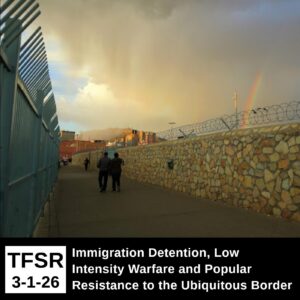
This week, you’ll hear from Juan and Fatima, two people who’ve been organizing and thinking about the southern US border for a long time to speak about the escalations in border force violence and kidnappings by ICE and CBP around the US (including Minneapolis where Fatima resides), an explosion in proposed immigration detention (including near El Paso where Juan resides), the expansion of low intensity conflict and counter-insurgency in the southwest since the mixing in of language of the War on Crime, War on Drugs and the Global War on Terror and how autonomous mutual aid provides opportunities for scaling up community defense and prefiguring the world we want to see.
Links
- https://www.immigrantsurvivors.org/statement-sw-key-sexual-abuse-case-dismissal
- https://www.theguardian.com/commentisfree/2018/jul/31/writing-from-manus-prison-a-scathing-critique-of-domination-and-oppression
- Fatima’s essay: The Insurgent Southwest
- Grey Is The Color of Hope Book
- No Friend But The Mountain Book
El Paso Groups
Related Past Interviews
- Our recent interview with Donna Mae about resistance in Minneapolis
- Interview on Life During Wartime book
- Past interviews concerning immigration, including with people held on Manus Island
Articles Of Note
- https://www.immigrantsurvivors.org/statement-sw-key-sexual-abuse-case-dismissal
- https://www.politico.com/news/2026/02/20/shutdown-stalemate-deepens-as-white-house-dems-dig-in-on-dhs-funding-00789614
- https://www.reuters.com/legal/government/courts-have-ruled-4400-times-that-ice-jailed-people-illegally-it-hasnt-stopped-2026-02-14/
- https://theintercept.com/2026/02/17/warehouses-immigration-detention-camp-prisons-immigrants/
- https://www.washingtonpost.com/business/2026/02/13/ice-detention-center-expansion/
- https://www.theguardian.com/commentisfree/2018/jul/31/writing-from-manus-prison-a-scathing-critique-of-domination-and-oppression
Announcements
Peppy Moved to Halfway House
We are happy to announce that Peppy has entered a halfway house where he will finish out his remaining incarceration. You can learn more about writing to him and what he likes to talk about at his support website. His crew is still fundraising for a post-release fund there as well found at FreePeppyAndKrystal.NoBlogs.Org
Casey Goonan Moved
Palestine solidarist Casey Goonan has been transferred from Mendota in California to what is likely to be their home for the foreseeable future, FCI Allenwood – Medium. You can learn more about getting into contact, updates on their case and how to support their commissary at FreeCaseyNow.NoBlogs.Org
Hrdindu Roychowdhrury Moved
Alleged Janes Revenge prisoner and Grand Jury Resister Hrdindu Roychowdhrury has been moved to FCI Thomson in Illinois. He just had a birthday and could use some sweet words. More on the move and how to write him at ABCF.Net
Prairieland Case Updates
The Prairieland Case was declared a mistrial and has been restructured in an audacious move by the Trump appointed judge Pitman. Restrictions applied to the case will could greatly limit the ability of the 9 defendants to make their cases where decades of their lives behind bars are at stake. You can learn more, including detailed notes from each day of trial, by visiting PrairielandDefendants.Com, find the defendants new updated Tarrant County mailing addresses and followcalls for support by finding their social media.
. … . ..
Featured Track:
- TFSR by The Willows Whisper
. … . ..
Transcription
Fatima: My name is Fatima (they/them). I’m based in Minneapolis, where I grew up. But I used to do border work on the US-Mexican border in Arizona, and I’ve been involved in No Border movements around the world for about 20 years.
Juan: Hello. My name is Juan, and I’m from the border. My pronouns are he/him. We are doing work primarily on both sides of the Mexican-American border, in El Paso, Texas, and Ciudad Juárez. We’re from a group called Casa Carmelita and La Cruz Rosa, a coalition of folks who got together to do water drops and provide aid to people trekking to the desert and the surrounding West Texas and southern New Mexico desert.
TFSR: All right, thank you both so much for taking the time to have this conversation. I was hoping that we could talk about the escalating offensive by the Department of Homeland Security in the name of immigration enforcement, and in particular, how it’s impacting folks living around that border. Juan, could you tell us a bit about yourself, your work on immigration issues, Casa Carmelita, and the communities it serves?
Juan: My name is Juan. I’m ancestrally from the border. My family’s been here through generations since before the border. We lived through every iteration of social upheaval and the histories of the border on both sides of the border, because there is an ancient pathway from Chihuahua, parts of Durango up to El Paso, so much so that the oldest neighborhoods in El Paso are Duranguito and Chihuahuita, because it’s such an ancestral pathway since indigenous times when people would trek to the desert. Hence, even in the name El Paso, it’s always been synonymous with migration, even before the border. There happens to be an imaginary line through there now. But up in Mount Cristo Rey, where we do water drops, there are dinosaur tracks because it was an ancient pathway since prehistoric times. The University of Texas at El Paso put a sign out there that shows a dinosaur crossing. And I always stop to make sure people understand that that little pathway between the Sierra Madre Occidental, which is what the mountain range is called south of the border, and the Franklin Mountains, which is what those mountains are called north of the border, that little divide between it has been a pathway for migration since prehistoric times, and that visualizes it. They put it as a joke, but it helps visualize how much El Paso is defined by migration.
We started off our organization as an occupation of the children’s detention center in Tornillo, Texas, which is an outlier of El Paso. This is when, basically, “Zero Tolerance” was instituted. “Zero Tolerance” set off a chain of events in which these emergency makeshift facilities started arising all over our community, so that they could in essence circumvent their own federal laws. Things like the Flores Act that protected children and the amount of time that they could be incarcerated. They had to work around that, and the best way to do that is to start this language of emergency so that they could erect these makeshift facilities to house children who have been separated from their parents, because you can’t house children and adults together. So, “Zero Tolerance” set a chain of events where children are being accused of a crime and being treated as criminals, and parents are being separated from their children. And the phenomenon of family separation, which had always existed, just morphed into this current form.
Out of that resistance to that occupation and the children’s detention center, a group of us from across the country, indigenous groups from Albuquerque, groups out of Tucson, autonomous groups, or social-minded groups out of the Southwest, people from the Baltimore uprising and the Ferguson uprising, and locals here in El Paso got together to basically put up whatever resistance we could and do direct actions and do whatever we could to get the facility shut down. Or, if not, to make it as disruptive as possible. We settled into the port of entry, and we took over the port of entry that’s there, in terms of where the gates and such are. When we got together, we realized that they were dumping off migrants in downtown El Paso, the Greyhound station, and other places in mass with absolutely no preparation. Now, that’s commonplace, but back then, that was a watershed moment here, when they started doing that in mass. It eventually led to thousands, but back then, it was just dozens. So our occupations both turned to a model of resistance and assistance, because we were sitting on all these resources that we were going to occupy for months. We started distributing throughout the community, sending our volunteers to help the makeshift shelters that were popping up, and out of that was born a physical space for our work called Casa Carmelita, which eventually turned into a shelter and safe space for the most marginalized we were finding on the streets through our feedings and whatnot. That was our beginning.
The work has looked very different, as there’s been different iterations of emergency crises here, but the constant need for mutual aid and a model for mutual aid, where in the rest of the city, it was falling into a very humanitarian and predominantly religious modality. We were one of the first to start doing more mutual aid and community work, and that was not beholden to those models. Our current form is water drops; we’re resisting the latest gargantuan detention center called Camp East Montana, which supposedly can hold up to 6000 people. There’s already been deaths. We were letting the community know and protesting that, since before the opening of the camp, but already knowing that just like every other camp, there would be deaths, there’d be outbreaks of tuberculosis, which there has been, measles, and other known manner of things. But this has led to the city awakening to the fact that these gargantuan detention centers are bringing not only stress to the infrastructure, but a lot of deaths and suffering on the part of migrants. We’ve been one of the groups at the forefront of the fight to stop the newest proposal for an even bigger detention center. Basically, our current form is doing water drops and resisting the detention centers that are popping up, and fighting any further expansion. Just recently, the city of El Paso County passed an ordinance to investigate stopping the detention centers and not collaborating with them. That’s been a success. That’s up to our current work and our beginnings.
TFSR: Thank you very much. That’s so much work that you all have been doing. A couple of clarification points. With the folks that were being dumped before, in growing numbers, that Casa Carmelita started as a response to and service with the community, were those folks that CBP was depositing, the ones who were requesting refugee status and who were being dumped on this side of the border by that agency, who had just crossed or were being processed through the South?
Juan: Yeah. So, with the phenomenon of dumping asylum-seekers into communities with absolutely no recourse, no self-sufficiency, and no plan on the part of the authorities or the state. That was one of the beginning episodes. This wasn’t the only one, and family separation had already been on a trial basis here in El Paso, because all manner of laws and policies are implemented in El Paso first and then implemented across the country. We’re kind of a testing ground for them. We were the first iteration on that scale here. Of course, that’s commonplace now across the country.
TFSR: I’m sure that you’ll address this, too, but the East Montana facilities are housing folks that, I assume, are people who have been kidnapped from other parts of the country and brought down towards the border. Is that right? As opposed to people that are coming across? Or is it a mix of both?
Juan: According to them, it’s people within the first two years and predominantly asylum seekers. But as everybody can clearly see, if there was ever a rule, it was surely violated long ago. In our support work, because part of the work we’re doing outside of the detention center now, which we didn’t know that’s what we would be doing, necessarily, was supporting the families. Because the detainees’ families sometimes have to come from all over the country to see their loved ones. Mind you, these are all poor folks that are coming from the most marginalized societies in the Global South, and still, to visit loved ones, they are having to pay for hotels, Ubers, and whatnot. That’s one of the things we’re trying to do to make it so they can see loved ones and get married. We’re in the process of doing that a couple of times. It’s supposedly people within certain parameters. But from what we’ve seen, it’s all manner of folks. People have been here for decades, people who have just recently arrived, people with all kinds of legal statuses, and American citizens in some cases. There’s no rhyme or reason other than who they can catch, who they can kidnap. It’s people from all over the country. Now we’re seeing people from all over the country, especially from Minnesota and places like Chicago, many of whom pass through here.
TFSR: Fatima, about a decade ago, you wrote this really good essay-zine called The Insurgent Southwest. What experience can you share about borders since you’ve worked around a few of them, and can you briefly synopsize the zine, share what motivated you to publish it, and where you feel it sits after so many years?
Fatima: Sure. I published that zine in 2013, and at the time, I’d been doing border work on the US-Mexican border for about six years. I had primarily been doing that work with the humanitarian aid organization that was shifting from a humanitarian aid model to a more mutual aid model. I wrote the zine because a friend, Christian Williams, was putting together an anthology on counterinsurgency and wanted essays on the application of counterinsurgency and low-intensity warfare in the US.
I just wanted to clarify some common misconceptions about border policy. Folks think the main purpose of border policy is to stop the flow of migration, but it really isn’t the main purpose of border policy. Specifically, counterinsurgency on the border and now in the interior is to manage mixed-status communities. We can think about the trajectory of counterinsurgency domestically on the border as an increase in internal checkpoints, deputization of the police, and a vigilant citizenry. And these controls all get justified, the same way, historically the prison boom did. The war on drugs, racism, a myriad of fears about crime, and the inward expansion of the border are really a careful balance of hard and soft controls, as are enacted by police, military, paramilitary, nonprofits, and civilians. I wanted to offer just a simple tool for folks to understand the difference between hard controls, which are things like imprisonment, deportation, torture, deprivation, assault and death, and which a relatively small number of people participate in, to a soft control, which is information gathering, reporting to state authorities, psychologicarel operatives and ideological warfare, which increasingly are woven into our daily lives.
I think counterinsurgency presents the blurring of police and military functions as an inevitability, and it focuses on managing populations within a territory, and it really wants to normalize a level of surveillance that is participatory. I wanted people to understand that border militarization, internal controls only really function well because people accept the discursive logic of those categories and what they’re policing.
We can see that the paper someone holds only has value because someone else is without it. This value is created on scarcity. It’s a manufactured worth. It’s an effective tool of control, because not everyone can obtain the right kind of documentation. We see this very specifically in the discursive shift between previous administrations and the current one. They’re literally going down a list of people who have tried to play right and to go through the asylum process, as requested by the system. They have everyone’s information because you are required to give the state information about where you live and where you work if you’re applying for asylum. Now, with the shift in enforcement priorities under Trump, people who thought that they were trying to obtain their legal recourse in the way the state was asking them have now found themselves recriminalized.
Delineations reinforce something. Citizenship gives people something to spiritually hold and rally around. It creates a false sense of community and security. It’s the process by which the state and corporations are taking on through citizenship. Essentially, it’s participatory control. I wrote the zine trying to get people to understand that the borders everywhere weren’t a metaphor, and it was a reality, and it functions because so many people accept the idea that the state should be allowed to police our communities through these arbitrary categories of citizenship. I wrote it as a warning about the ways that I saw society shifting. And by and large, the vision it painted, which was a pretty dark one, has come to fruition. And we are in that moment now.
TFSR: If anyone’s looking to find that compilation, your essay is available in the Anarchist Library, and I can link that in the show notes. But also, if you want to find it alongside a bunch of other titles, Life During Wartime from AK Press.
Fatima: Yeah. It’s a good anthology that discusses counterinsurgency also in other contexts. I really do encourage people to pick it up.
TFSR: I believe in 2012, I did an interview with Will Munger, one of the contributors to the compilation. If folks want to find that, it’s linked in the show notes also.
So, how has detention generally, and immigration detention in particular in Texas, since Trump’s first administration changed through the passing administrations, and where does it stand now in terms of conditions, oversights, and who runs them?
Fatima: The corporations that are really at the core of this privatization are groups like GEO Group, Core Civic, aviation providers like CSI Aviation, technology firms like Palantir, other major vendors, Dilatoni, MVM Inc, AT&T, and General Dynamics. And there has been a huge influx of federal funding into expanding DHS. It is one of the best-funded parts of the government currently, and it’s expanding at a rate that we have not seen previously. The groundwork for this really harkens back to Arpaio in Arizona and the tent cities that he created during the enforcement era of SB 1070, which was a law in Arizona that deputized the police to check immigration. Historically, it really should be said, immigration through the INS was a civil issue, and over the last 20 years, it’s been increasingly criminalized. This is actually a new development. Whether or not you were in the country with status or not used to be a civil issue, not a criminal issue. After the ‘90s prison boom, there were incentives to expand the prison population, and immigration is now the new cutting-edge economic opportunity for these private corporations to get millions of dollars in contracts with the federal government. I could go down the list of which companies for a much longer period of time, but all of this information is available online. These companies are transparent about it. They’re sharing these growth opportunities with their investors and putting this information on their websites because they are proud of this model.
To the specifics of detention in Texas, I will let Juan talk more about this, but I think it is not hyperbolic to discuss these detention facilities as death camps. There have been 17 measles cases in El Paso, 13 of them are in East Montana. There have been three confirmed deaths in the last three months of the nine people killed by ICE. They’re directly related to people being assaulted and killed by guards, and medical neglect. They’ve been shifting how they process deaths in custody. They’ve been shopping around for Office of Medical Examiners who will not do things like declare deaths homicides, and they have shifted over who’s processing those bodies to the military base because they don’t want to be held to account for deaths in custody. With the planned expansion of detention that the federal government has planned, we will only see an increase in deaths in custody.
It is worth saying that this is not the first era of heightened deaths in custody. There have been many people over the years who have died in custody, but just in the last three months alone, folks who are dying in custody are dying because they’re being held there and because they’re being abused. We could go down the names of the people who died and how old they were. Francisco Gaspar-Andres was a 40-year-old Guatemalan man who died in East Montana of liver and kidney failure after being hospitalized. This is a direct example of poor medical care. Lorth Sim, 59, was a Cambodian man who died in late February. His death is under investigation. Obviously, there have been deaths of citizens resisting ICE enforcement, like Renee Good and Alex Pretti. Victor Manuel Diaz was a Nicaraguan immigrant who was found unresponsive in East Montana. ICE has listed his death as a presumed suicide, but his family disputes that it was a suicide. Heber Sanchaz Domínguez was a 34-year-old Mexican national. He was found hanging in his cell in the Robert Dayton detention facility in Georgia. Parady La was a 46-year-old Cambodian immigrant who died in Philadelphia ostensibly due to organ failure. Luis Beltrán Yanez–Cruz was a 68-year-old Honduran immigrant who died in California from heat-related issues. Luis Gustavo Núñez Caceres was a 42-year-old Honduran immigrant who died in a Texas hospital after multiple medical emergencies while in custody. And then Geraldo Lunas Campos was a 55-year-old Cuban immigrant who recently died in East Montana, and his death was ruled a homicide by asphyxiation. There were witnesses who have since been deported.
I think this paints a very dark picture of impunity to assault and kill people in custody. It’s very clear that there will not be legal consequences for ICE killing people in custody, or as we’ve seen in Minneapolis, community members who are trying to resist the abductions of their neighbors.
Juan: Like I’m always saying, how many deaths before it justifies the label death camp? Fatima is so on point with so much. All of these questions are so combined, there’s so much synergy between all these different issues, it’s causal, direct correlation. I’ll speak to the context of what we experienced, but I think speaking specifically towards a question, which was in the last iteration, because I wanted to make sure people understand that there have been cycles of these dynamics over a period of time. We happen to come from indigenous people who have lived through generations of these, especially when the further questions talk about invasion and replacement. It goes hand in hand with genocide, settler colonialism, and invasion. But for us, the watershed moment that showed in the way I frame it, for people who aren’t from El Paso, is that the seminal moment for us was when zero tolerance was enacted in practice. I think on paper, there are many ways you can construe it, already saying that there was some civil offense around crossing, but for sure, that invoking criminal law made it so that children and toddlers have to have their rights read to them, being incarcerated as if it were a criminal offense. So you see these makeshift shelters coming up because family separation is leading directly to people’s arrests.
That’s why I say to people that the shift is the one that started to stress the systems in El Paso that had been around for generations to aid migrants, because all those had already existed. Changing it from mostly a civil infraction to a criminal offense stressed the Las Americas, Estrella, and other local El Paso groups that had aided in the legal defense. The need for legal defense just exploded. The having to house families separately, the charging everyone with a criminal offense, versus all these other policies like catch and release, made it so that there’s an expansion in a different way, not just the mass expansion, which I’ll talk about the mass incarceration part, which is very much on point. That stressed A House, which had provided people coming out of detention with a place to stay. So when they were filled to capacity, that’s when you started seeing migrants being left in the street with no recourse, simply because all of those systems that had been set up over time in El Paso, mind you, these were all mostly non-state actors. A great majority of them were humanitarian aid groups, most of them charitable and Catholic at the time, like A House and Estrella. But there was a network of churches and others that did the same. That stressed that part. Every part of a system that had been set up over generations became stressed, and now you have en masse people being charged with a criminal offense, not just immigration-related offenses.
Again, a lot of those iterations that happened, as Fatima was saying, since the beginning of colonization in these areas, where there were concentration camps during the Mexican Revolution, when Mexican asylum seekers back then were being housed at Fort Bliss. At one point, it was a concentration camp for Japanese internment. But this language of emergency and the language of war that you see enacted now seems commonplace. It’s good to remind folks that the edifice was built on the foundation of mass incarceration, especially in Texas, which you asked me to frame it in. It has built the biggest mass incarceration apparatus that the world has ever known. Here we are being told that they can’t house in a humane way all of these migrant asylum-seeking folks, which is really not about capacity to house. It’s about setting the draconian conditions for people to suffer. People being kept in cages, in all manner of dehumanizing ways, including in up to until these death camps, which we knew were coming, because, just during Trump’s first administration, where he was fixating on El Paso. Because I think El Paso personified so much of the politics that he’s framing his constituency against, it was a truly bicultural, binational community, statistically that defies a lot of his stereotypes, defies a lot of what he sees is wrong with the country. And in actuality, we make it work. Our community has this long storied history that represents diversity and multiculturalism, and the duality that, for Western chauvinists, for Christian nationalists, for all of these different groups, has always posed a threat.
Why El Paso has always posed such a threat to to him throughout history and our history of real revolt against those since the wars in San Eli over salt, which in essence were over capitalization and privatization of salt mines, to the bath riots that were more uprisings and riots, where it was Mexicans again over the issue of immigration, fighting for their rights and fighting the dehumanization. Our namesake, Milita Torres, is the 16-year-old who rebelled against the treatment at the immigration processing center, which was directly across from our Casa Carmelita location. There’s been a long history of resistance in our community to the treatment of people in migration. That went hand in hand with El Paso. I like to tell people El Paso as part of Texas is a game changer for us, because we exist in these three Souths. The South is very much part of the Confederacy. That’s part of this binary of black and white. So we were under Jim Crow. We’re under Texas laws. As soon as you pass the New Mexico border, you see abortion clinics, there’s gambling, there’s dispensaries, because Texas is so much more conservative than even our neighbor, New Mexico. So you see, the laws changed drastically from one side to another. But there’s that long history of resistance, and for me, that’s just a war that’s been declared against people of color in our community, particularly Mexican Americans. But we happen to be part of this other South, the Global South, because we really do exist on both sides of the border. We could go into Juarez and live an experience being Mexican American to a degree that other people can’t, an experience for their motherland that other ethnicities can’t. We’re part of the Southwest, another South, in that there’s always been indigeneity in our community, where in other parts of the country, it’s in much more of a black and white binary.
For me, these generations of war, war against drugs, war against terror, war against immigration, are now meshing into one in which you can clearly see that tactic. That to me speaks more of the language of illegalizing bodies and creating a criminal class that’s easy to label as security threat groups. Of course, we see this weaponization of labeling going back as far as we can remember as a people. Because we were some of the first people othered. Gloria Anzaldua made a powerful metaphor about the border being an open wound. But I also tell people that it’s also a womb. We were one of the first places where the othering began. We were a place of first contact between Oñate and the indigenous people of this area, which included my people. For me, it’s important to let people know this system of mass incarceration, this system of othering goes back to the foundation of this country and the way it’s always treated diversity, and I don’t think it’s a coincidence that it also goes hand in hand with the rise of this language of invasion and replacement that has always come whenever people of color become a perceived threat to the nation state.
TFSR: I totally agree with you. The language of replacement and invasion has been cyclical, pretty omnipresent in wider US culture historically. But there has been this growing fixation by conservative elements and the Republican party, maybe just again, over the last decade or so, maybe a little bit longer, talking about the southwest and talking about the border regions in terms of great replacement and invading armies. Can you talk about the normalcy of this language of genocide in the US political landscape? Do you think that this reflects some hegemonic, overall US viewpoint outside of just being in the southwest region? Is it an amplification of one side of an increasingly divided society with people talking about the slow civil war going on in the US, or do you think it’s something else?
Juan: Left off on that language, because it’s very much been part and parcel of it. You’re right. For me, the attack on immigration also coincides with the attack on anti-diversity, equity, and inclusion programs, the rise of Western chauvinism, and the language of genocide, which also includes this language of pro-colonization. For a long time, for as long as I can remember, my generation was sold, was constantly being courted by the right wing, especially here in Texas. It’s been a target for the right wing, especially under Bush, trying to court our demographic, our Mexican American community, into becoming more, if not centrist, then right-wing. We didn’t hear; it was much more covered up, the language. A lot of the language that we now see coming forth is much more overt about Western civilization. I remember that the census around 2000 where it was a very marked difference in the attitudes of people saying, “We’re going to become a majority-minority country,” and people will actually laugh about it and say that we were going to become majority, but there are a lot of us who had been lived through that ethnic violence and racialized violence knew that always comes with this perceived threat, and that people should be taking it much more seriously as a threat. That’s just something factual.
For us who under the old Southern kind of racism that had existed since the formation of the state. We recognize this anti-diversity, equity, and inclusion, this Western chauvinism, this language of genocide and pro-colonization is a form of the white supremacy and ethnic cleansing that has been enacted against our communities. People remember some of the first language, especially during the first administration. This is why I say that Trump was fixating on El Paso. He started off with Mexican Americans and expanded from there. As a matter of fact, a major part of that language was his use of groups, such as the Mexican Mafia and Mara Salvatrucha. As a person who writes about this extensively, I have to remind people that these were all born from the criminal justice apparatus of the United States that we exported abroad. The United States government was fully aware that we were exporting this social problem to countries that didn’t have the infrastructure for it. There’s a particularly disagreeable gentleman by the last name Manwaring [Max G.] who had talked about this and the potential for these groups, as they were mentioning his insurgency–not an ideological insurgency. Of course, he was using that language to scare, but very fully aware of understanding that we were exporting that social issue to a the country. And that set off cycles of young people coming up here, escaping those very gangs for something dynamic that we had created. I have to remind folks now that morphed into the language of Tren de Aragua.
But with Trump, it’s been one of those things that you can clearly see the progression from. Again, El Paso at our core disagrees with him so vehemently that it’s almost in our DNA to be pitted against one another, because he represents all of these histories of the United States that we disagree with. And we represent all of the histories that he disagrees with. But for me, this is morphing, and you could really see it at the George Floyd uprisings when a lot of our youth were downtown protesting that situation. Because El Paso has become such a military city, there was such a massive presence of what you would call law enforcement. I don’t know what you would call the entire apparatus, but there was no way you couldn’t differentiate between who was BORTAC, who was police and who was military. And for us, that was the true moment in which we understood that it had all morphed into one citizen and noncitizen alike. The Walmart shooter entered into that Walmart with absolutely no regard as to whether or not people were citizens or weren’t citizens, and used that exact language. Back then, at least, people at the beginning, at face value, would say that even Trump was hesitant just to come out and support that language of invasion that we had been hearing since the 2000 census, and especially after 9/11, where it’s now become commonplace in the right wing, not even an extreme right wing, but in the Republican party itself, as mainstream as it can get. That language had been common during these different time periods in which there was racist violence.
For me, the groundswell that we see now comes from that history. But for us, in effect, it’s just the state manifesting the different versions in which it would, like Fatima was saying, exert control over us. It starts with one community, but it winds up encompassing everyone, which is why I’m really happy to see that now people are framing it as a violation of due process. That’s when you start really seeing the attack on people’s constitutional rights and inalienable rights, regardless of who it is. For me, those moments in which we were running into this oppression by what it morphed into one singular apparatus, whether it be BORTAC, whether it be military, whether it be any of these, is where those things have truly morphed based on this idea, the language of war and the language of emergency. That’s commonplace now. And labeling everyone security threat groups and enemy aliens. This is the coming together of all these different and seemingly desperate things into what we see now. I think Trump and his underlings have purposely been creating that into a singular argument for why they can violate due process for anybody and everybody.
Fatima: I think it’s helpful for people to think about a political concept called the Overton Window, which describes the range of political ideas and policies that are considered acceptable in the public discourse over a given time. This was keyed and developed by a political scientist named Joseph Overton in the 90’s, and it really is a framework to understand how shifts in political and cultural acceptance happen. We’re in a time where the Overton Window for what is acceptable is shifting so far to the right. It’ll still be a pendulum effect, but they use the acceptability of extreme enforcement and experiences to then get the general populace to settle into and accept a less egregious but equally problematic level of enforcement. You can see that right now, in real time with people’s discussions around Operation Metro Surge in Minnesota. As long as there are not paramilitary forces extra-judicially executing citizens in the street, are people going to be okay with a new level of ICE enforcement in their communities, as long as they don’t have to directly engage with it? I think that we can see the dialogue within resistance movements about when people will effectively resist or when they will settle into accepting a certain level of carceral societal baseline is exactly what’s happening currently. I think there have been many things that have shifted people’s public perception of safety in the Midwest over the last three months in ways that folks in other parts of the country, specifically the Southwest, have been dealing with for decades. And obviously, it does come down to racialized categories within our society.
TFSR: Continuing on this trajectory, the Trump administration and their Heritage Foundation backers have been an advocate of the idea of this unitary executive, and has been using a range of precedents from the War on Drugs, the War on Crime, and War on Terror, as Juan mentioned, in the gang-jacketing and criminalization of immigrants and populations of color in order to justify extraordinary repression and rendition of people to foreign custody or unrelated third countries. Bombing civilians in the Caribbean, claiming of immunity for their foot soldiers and the Customs and Border Patrol or ICE and expanding a federal police strike force and federalized National Guard to occupy US cities, at times alongside active US military. This is in terms of the shifting away from the idea of constitutional rights and constitutional rights being applicable to anyone who is on the territory, including and excluding populations. Can you talk about what we’re seeing in this regard, how helpful concepts of low-intensity warfare and counterinsurgency can be used to explain the situation? These are two concepts that were touched on in Fatima’s essay. How can the defense of marginalized communities, prisoners, and immigrants help us to resist, roll back, and create an alternative vision to the authoritarian hellscape that we’re facing?
Fatima: Sure, I think this harkens back to our previous discussion about hard and soft controls, and it’s important for people to understand the history of the deputization of the police to enforce immigration and the criminalization over the last 20 years. Realistically, where can you expect to be picked up from and deported? It’s no longer just the border regions. It’s no longer just the 100 miles. Because of police discretion, basically any interaction with the police can lead to deportation in many communities. We’re seeing this in real time as it is being fought out. There’s going to be municipal versus state versus federal policies that people are going to need to track very closely, that will determine what the enforcement landscape in their direct communities looks like. This does have a direct correlation to low-intensity warfare and counterinsurgency, because it’s not just about the paramilitary forces in the street. It also has to do with enforcement being rolled into people’s everyday economic livelihoods.
We’re seeing an increase in enforcement for categories like social workers and hospital workers, who are not traditionally considered to be part of the management of the civilian population. We saw that with Operation Metro Surge, where they really were focusing on vulnerable spaces in our communities that have been historically sanctuaries against enforcement: hospitals, churches, shelters. There really was no space where people were safe from enforcement. They were kidnapping literal children from bus stops on their way to school. Bovino was throwing gas outside of high schools, elementary schools, and playgrounds, and there was no area in our social fabric that was safe from this level of enforcement.
It’s very disquieting when people who perceive themselves as being part of a helping profession, folks who work in social work, folks who work in hospitals, are being asked to participate in a deportation infrastructure. At this point, the idea that people get taken into custody and are actually returned to their countries of origin, that would be a middle outcome. What is actually happening with the changing judiciary and deportation infrastructure, is that people are being deported to third country holdings where they’ve literally never been and have no status, or we’re seeing increasingly proposals that being in the US without immigration status is a reason to be held indefinitely in detention. There are some very scary laws coming up for passage in certain parts of the country that are creating an effective system of bounty that encourages people to hunt others who are in this country with mixed status.
We’re at a very vulnerable place for how we will respond to this level of enforcement. I think soft and hard controls are not mutually exclusive; they should really be understood as a continuum. Part of how scary liberal democracy is in the US is that the Democrats built this infrastructure. A lot of the infrastructure for family and youth detention really came up during the Obama administration, and was codified through the management of unaccompanied minors. The implied threat and power of border enforcement in our communities means there’s no safety or no checks. The military able to be deployed to urban centers in the US should be a development that gives everybody pause and needs to be resisted in a way that people start to understand that they are a part of an active resistance. And people shield away from that and want to play respectability politics around criminalization. I really need people to start to conceptualize their resistance to the current fascist regime as something that will put them outside of a category of citizenship where they felt safe and where they felt unencumbered.
I think impunity to kill is just part of the military culture of border patrol, and it has been for a long time. We’re seeing a huge influx of new agents, untrained agents, not that the trained agents are any better, but you really saw what it meant to give hundreds of people who were joining up for ideological reasons access to less lethal weapons that are often lethal. A lot of the injuries that happened during Operation Metro Surge had to do with crazy car accidents and chases that were happening between ICE and civilians, and the impulse to flee when you saw this occupying force was the correct one, because they’ve been able to extra-judicially murder people with really no legal recourse. The complete dissolution of judicial law as we know it in the US is something that the Trump administration is succeeding at.
Imposed occupation is a participatory process; this is going to be a part of people’s everyday lives. It’s reinforced through categories of criminality, and people really need to start reflecting on and looking at what it means to conceptualize themselves as being outside of any security or respectability. The state will see you as an enemy if you are resisting what’s currently happening, and you have to decide what you’re going to do about it.
Juan: For me in particular, it’s been embodied in that sense of the resistance you mentioned. I wanted to uplift what Fatima was saying in terms of how the foundation was built. Not only by the previous administrations, but even at times when they had both houses, I remember being part of organizations that were calling out those administrations. And a large part of the establishment left was saying you can’t even critique the administration at the time because of identity politics, when there was real momentum and will to pass some policy alleviation, and that never came to fruition. A lot of us then changed from that modality of trying to mitigate through policy to just doing more resistance work. To summarize a lot of what we’ve been talking about today in an embodied form is where I saw people really shaken by the images coming out of CECOT. To me, is was part of that leftist hypocrisy in some circles where I was like “How can you empathize with that, which rightfully you should, but not with the bald-headed Mexican American kids that are living that experience, and all manner of young people of color on the border that experience that similar treatment in the Texas prison systems where I grew up?” So much of it is about respectability politics, and it’s deep in the immigration movement. And that shows the centrist inclinations of a lot of the people who have posited all of their arguments based on that rhetoric of the good immigrant, when the people that you’re seeing at the forefront of so much of the resistance today, I had the fortune of being indigenous to this land and still grew up in the system, but so many of my counterparts are at the top of the list. Even now, decades later, even after in their youth, they had some run in with the law, decades later, are now being deported. They’re the major target of this administration.
I work with a lot of formerly incarcerated artists and activists from across the country, and that’s some of the people at the forefront of the resistance. Although people are surprised by that fact, because so many of the people that I know have previous gang ties, have done time in the US criminal system, and were also naturalized citizens. And now some of them are being revisited. When we have meetings now, in all these events, we’re going to see more and more of our counterparts being deported for things that happened decades ago. For me, that embodied resistance and how we can resist as formerly incarcerated people is now extending to all these other issues, because we are some of the first people who were labeled perpetual criminals, who are living this eternal caste system in which we’re thrust, as Michelle Alexander stated. I remember reading that book and really being shaken by that phrase that she used. Not only is it thrust into this caste system, because it very much is, but that dictates how you live your life, and that applies to so many now. People are now making those connections that we were pointing out decades ago. Whether it could be a trans person in the wrong restroom, it could be a migrant on the wrong side of an imaginary line, for us, mass incarceration on the border context, which is what I write often about, is exactly the worst scenario for young people of color who had no way of participating fully as citizens in the United States, where there was this underground economy that was recruiting them en masse. That led to a lot of the mass incarceration systems and the punitive language of the carceral state that you see now being applied across the board, especially to security threat groups.
All of that wouldn’t work if it weren’t for one major point that even most of the people on the political spectrum, left and right, agree on this language on: to view people in this perpetual lens and this punitive lens of perpetual criminal. This criminal class that’s been created by this rhetoric that’s now being applied broadly. Again, that was because we as a society acquiesced to it being used on certain bodies, and now it’s being applied across the societal spectrum. For a long time, it was very tolerated to view people in this way and to view people as disposable. I’m part of a group of formerly incarcerated people who do direct actions because we know how to navigate the criminal justice system so well, and we live the consequences of not even being extended full citizenship, which you now see being applied to all manner of folks. I want to point that out in terms of an actual lived resistance, not just a theoretical one.
Fatima: I will say one last thing about strategies and tactics. I think Operation Metro Surge taught us it’s right and good and helpful to engage with people at whatever level of politicization they come to movement work at and wherever they’re willing to risk, and we saw a huge upscaling of people who didn’t normally engage with the carceral state at this way or conceive of themselves as being potentially victim to it, taking on an identity of resistance over the last three months in Minneapolis. The reason that the resistance to ICE occupation here has been so successful is because of the history of resistance movements in this geographical place, the history of the American Indian Movement here, and the history of resistance to police enforcement in brown and black communities.
There was one incident in North Minneapolis where ICE had three of their vehicles picked apart, and there was a much more valiant exchange with the community there, when they shot but did not kill one of the folks that they were pursuing. Immediately after that incident, enforcement completely changed in the neighborhoods that they were pursuing previously, and they shifted a lot of their enforcement to the suburbs, where they were not expecting that level of resistance. I think we can see in real time that a diversity of tactics that don’t accept the false dualism between violent versus nonviolent tactics is very important when resistance movements are engaging with this work. We’ll talk about it a little bit later. It’s not only about holding up these flash points of physical exchange between occupying forces, but a lot of meaningful resistance work is happening behind the scenes. There are tens of thousands of families currently sheltering in place in Minneapolis, and they have been for the last three months. Their very survival is being maintained by an entire system of organic mutual aid groups that have sprung up: every day care, every elementary school, every high school, every block, every neighborhood, every church group has now become a self-organized mutual aid group to help neighbors. I think the conceptualizing of what your commitment is to your neighbor has been one of the most beautiful things about the resistance to Operation Metro Surge in Minnesota.
TFSR: Thank you. With Operation Metro Surge being announced to be de-escalating, and ICE and Customs and Border Patrol officers being sent to other cities. Detention warehouses are being purchased, rented, and are in danger of popping up and clandestinely opening around the country. I wonder if you all had further lessons that we can take from past and ongoing resistance to this expanding fascism, that maybe people in some of these other communities that are going to face either an intense onslaught or the ramping up of the everyday criminalization of populations. Any inspirations or lessons that people could take with them and build off of in their local context would be super helpful.
Fatima: I will say one thing about numbers. There are internal plans that indicate a targeted capacity of between 92,600 and 100,000 operational detention beds by 2026. This is being funded to the tune of about $40 billion. There have been plans and strategies leaked that include converting 16 warehouses into processing centers and eight large-scale megacenters and facilities that have already been purchased in states like Georgia, Texas, and Pennsylvania. People need to understand that this is coming to their community. This is not just something that will happen to places that have historically resisted the regime, and that which Trump wants to make an example of. This infrastructure will be nationalized, and it’s going to be like playing whack-a-mole in local municipalities to try to figure out how to resist this infrastructural work. A lot of the resistance is going to shift from a very immediate resistance to enforcement or sustaining of families in hiding to community-based campaigns, like we’ve been seeing resistance to data centers that are going to need to do a lot of cross-cultural and community-based campaigns to really attack the growing infrastructure of these detention facilities. They will be built. They will eventually be built in communities that are not prepared to actively resist them.
Juan: That is so on point, and it’s happening here. And it’s not even a stretch into how you bring them into the same topic. One of the things that I really wanted to highlight before I get to some of the everyday things is that data centers here have gone hand-in-hand with these expansions. For people who don’t know and don’t follow our work, one of the things that we’ve been the first to report on is, in our part of southern New Mexico, Sunland Park, an extension of El Paso, they are already building one huge data center. In support of that data center, there are huge solar panel fields all along the border where land isn’t expensive. We’ve been reporting on this just because we’re seeing it when we do water drops, and we’ve actually had some of our water barrels destroyed by this construction. What we’ve been seeing is that the data center being built in Sunland Park, New Mexico is being built on one of the areas that has the most emergency responses in our area. We were told this, and we planted barrels there because the Santa Teresa Fire Department had told us that’s where they most respond to emergencies by migrants in migration. The data centers and the support systems for it, like the solar panel fields that are huge, are creating a secondary border wall. Because they’re all electrified fences, they clear the earth, it’s a lot more secure. They have created the secondary border wall right on the outskirts of El Paso, which is forcing people more east into these areas, now called National Defense Areas, where we’re not allowed in, whereas they are the areas where some of the most deaths have happened. There is absolutely no work on their part to address that issue. As of two years ago, we’re one of the deadliest, if not the most deadly, sectors of the border. I want people to know that these are directly correlated in our area.
Mind you, these are the two fights; ironically, they’re also stressing precious water resources in El Paso, which has always had difficulties. The colonias that I grew up in and the outskirts of El Paso, the water fight there is notorious, known around the country. We didn’t have potable water; we had to bring in potable water, living in the unpaved streets and unhygienic conditions. This aberration of these data centers that are now stressing the precious infrastructure took generations to build. It goes hand-in-hand with that experience. As people who have had to live with these state labels that deny us full citizenship and participation in society, it’s an everyday resistance to be able to survive. I think the day-to-day where you really live the privilege and oppression that the state imposes.
One of the things I really wanted to highlight, first is that the organization is alive. We’re living organisms, and community care is a part of resistance. Bravery is collective, and we’ve really seen the results of pivoting at a time when we were first defying so that model of assistance and resistance. Because we understood, even back then, that we were going to have to resist as a community in this modular way. Because we were living in such a militarized police state that we had to rely more on each other and our existing support systems than anyone could outside. We were getting support from the outside, in which we were able to form some resistance, but we were very strategic about building a local resistance, so that even after folks left during the occupation and whatnot, we would have a sustainable infrastructure. We concentrated on things like mutual aid and feeding each other, getting support systems for the folks we fed during the worst parts of Sacred Heart, when people were out in front of that church by the thousands, and the state had absolutely no response, or had really problematic responses, like opening up the civic center and whatnot to people, but only to people who had been processed by immigration.
At that time, it was mixed, and it became a humanitarian crisis that we responded to in a way that was more mutual. We started feeding folks that they couldn’t and built an infrastructure of feeding the community, feeding through programs we called Food Not Walls and others. We started taking some of the migrants into our organizational home, and it became a shelter. The same migrants that we were taking in were helping us maintain what we were doing. That model of creating systems of mutual aid versus relying on the state for our answers paid off dividends because, right now at the state level and the federal level, all of the humanitarian groups in El Paso or the aid groups in particular, that aid migrants are being targeted by Abbott and by Trump’s administration. You see them denied grants, denied funding and on top of it, being sued by the state or the fed, just an all right barrage of repression, whereas our infrastructure was much more people-oriented and popular. We don’t rely on a lot of those systems, and where they have been floundering because of the lack of support on the part of the States, we’ve been flourishing because we built in networks of support that span the country from EMA in the northwest to all of the immigrant support groups out of DC in Baltimore. We mutually supported each other because the way we support them when their loved ones are kidnapped, and we are supporting them in the detention centers here, and they also support the folks that we see leave our community and go into some of these areas.
Our network of mutually supporting one another has really paid off in terms of being able to resist in a sustainable way. It directly comes from us pivoting from a model of just resisting to one of assisting, and they both became the same. Because now assistance has become a form of resistance. Aiding migrants is becoming criminalized. For us, that’s become a real insightful moment in which we chose to change to a model that was more based on mutual aid. We’ve shown our community through actions, how counting on one another, and organizing around, how organization is life, it’s really brought our community to life, and in terms of resistance. If we don’t, what we’re seeing is we’re going to be come a testing ground for all of these things, for the Mega Detention Center, which we already have, some of the biggest in the country, data centers which coincide with all this, and also coincide with the mass surveillance that you find here. It has just become very synergistically apparent that all these things coincide, and it’s not a coincidence.
TFSR: These are great examples. I find that people have a tendency towards political inertia when the emergency doesn’t appear to be at their doorstep, and either has come and gone, and they get to go back to brunch or what have you, or it feels like it’s somewhere else, and they ratchet down their readiness. Do you have any insights into how people can incorporate political and social organizing, this life as organizing, into their daily lives, so that they’re more ready to activate and grow social resistance when the time is needed in their area? Because if these forces are shifting from place to place, if these facilities are popping up, if people that are detained in one community are getting transferred even short-term into the local jail that’s doing a hold on behalf of ICE, I wonder if you have any insights into how people can start ramping up their attentiveness and their organizing so that they have these networks and relationships in place when they’re needed.
Fatima: I can speak to that a little bit. They expect us to go back to be okay with this hidden carceral society and system that is in place. They use categories of narco-insurgency and counterinsurgency to shape our daily lives. They create self-controls that they expect people to participate in out of economic necessity. People have been doing really pragmatic coalition work, but not all of it is anti-statist. That’s a necessary part of resistance. We can’t confuse technical coalitions with passive acceptance of ideological tendencies, desire for humane border policy, as though, if BORTAC goes back to enforcing in places like El Paso, people in Minnesota should be okay with that. If we’re not careful, this statist logic can become border management instead of resistance, and people are really at risk of that. People go to these protests, and you hear these pleas for an expansion of citizenship, and people say, “Oh, we’re not criminals.” I really want people to understand the way that community organizing can be used to manage populations and control in ways that are recuperative.
It’s really important that we learn the lessons that security analysts and military theorists who write about border enforcement are trying to teach us. The major issue at hand is legitimacy, and the battle for legitimacy. And history teaches us that nation-states and boundaries can shatter. Do we believe that the Empire is beginning to crumble, and what are the tools that we can use to dismantle its legitimacy? We are being asked to accept an insane upscaling of incarceration in this country, and people would be willing fools to think that it won’t eventually expand to include someone that they love, even if they are not currently a part of a targeted population. We can see with Trump’s desire to strip certain people of citizenship, for example, the state of Kansas, just this week, has demanded that all transgender people turn in their driver’s license, and has basically stripped them of their right to vote in that moment, however you might feel about that, as a strategy, and also their right to exist within the state. We know from experiences on the border what the state is doing. And we’ve experienced it now in the Midwest, the paramilitary violence, volatile racial exchange, and mass incarceration. None of this is a pretty picture of the future, but the one silver lining is that the state is losing its mask of humane governance, and people can take a position on methods of social control. And they’re going to need to.
I think the security industry is huge because it plays on people’s feelings of dealing with an unstable world and resource scarcity. And the beautiful part of resistance to what’s currently happening in Minnesota is how people have rejected a scarcity model, and they’ve said, “No, there is enough. We can help our neighbors.” I’m part of a hyperlocal mutual aid group that makes sure the families on my immediate block have food, their kids can get to school, and their rent is paid. We are seeing people become intimately involved in the well-being of their immediate neighbors in a way that we had not historically. I think mutual aid is absolutely about political survival, and we need to really think about how we are able to resist in different ways, and also how we are going to be complicit in different ways.
I don’t want to paint a false picture of resistance where you’re able in every single moment in your life to resist enforcement at all moments, because that’s not reality. People who have historically not been comfortable with not having enough resources, or not being able in the moment, to speak out or step up to something that is happening in front of them that is questionable. People are going to have to be okay with the gray area of helping people with shared decision-making deal with fucking Choice A or fucking Choice B. What does it look like when the state infrastructure that you’re used to accessing is no longer safe? How are we going to get people medical care? How are we going to feed people when SNAP gets turned off? How are we going to ensure that people’s children are safe and aren’t taken from them?
Community organizers have stopped twelve ICE warehouse sales and prevented a total of 41,500 detention beds just in the last few months. These are really good examples. The resistance to Operation Metro Surge prevented a lot of attempted abductions, and people are continuing to care about their neighbors and care about the survival of people who are immediately at risk for deportation in their neighborhoods, in a way that I think is really beautiful. So it’s a pretty dark thing we’ve all been experiencing. But there’s also a lot of joy in learning how to survive state repression and also survive without the state.
TFSR: Another element to that is that it’s prefigurative. When we’re not only resisting the cruelty in the moment and building these worthwhile relationships that we find with our neighbors, but it needs to be anti-status resistance, recognizing the state for what it is. We’re building the alternatives and hopefully building the road while walking it, to turn a Subcommandante Marco’s phrase.
Juan: Yeah, that was really powerful to walk into because it touches on exactly what I was going to say. One of the things that we noticed is that, too often, the eye of the nation, when it comes to this debate, is that we saw, we recognized there was an opportunity to resist in ways that have national consequences, being far beyond our small community. We’re part of the national discourse. In one of them was narrative change, we really had on our hands, the opportunity, in a very matter-of-fact way, to show that it was the state that was the chaos in our community, and we could be the order. That became our mantra, because you could see it, and a total development of the state into what it has been throughout history. For many reasons that we outlined today, our community has been dehumanized by this state. It has always seen us as a foreign entity and never fully accepted us. We very matter-of-factly started seeing that, even as so-called everyday people, because most of the people that came together for us weren’t particularly ideologically bent. We just had one true north of saying, “We’re going to do it in a community way.” We weren’t part of established nonprofits. We weren’t part of the hierarchical system of nonprofits that have dominated this area. And we weren’t particularly religious, although we had a spectrum of people from all walks of life. But we saw that opportunity to create change. In a lot of these instances, it was a handful of us resisting these very powerful forces and having all manner of state repression pushed on us.
We understood that if we didn’t resist, there would be no resistance to them. But there was also an opportunity to change. Like Fatima was saying, it’s not necessarily that people are on an ideological bend. There are so many people in the barrio who come from a history of immigration or witnessing, at least witnessing immigration in our community. Even by people who are ancestrally from there, sacandos burritos and giving us $20 to keep up our work, keeping an eye out for immigration. It was every day people coming up and showing the true spirit of our people. And that resistance had been built over generations. It was in defiance of the state because we really are conscientious, oppositional consciousness. It comes in a very real and drastic way where we’re from.
One of the things that I really wanted to leave this conversation with is, for me, I remember hearing about how much the average so-called cis het male in the United States fixated on the Roman Empire and I remember telling all of our comrades. We had a house full of migrants, in which we would have all manner of conversations that were some of the most interesting we ever had. I was raised around old school Texas racists who educated me very well on that old hate that was foundational to this country, and in their view, being part of it was that diversity was an empire killer. They viewed the Balkanization of the Roman Empire as the downfall of the Roman Empire. For those people, it speaks to this idea of cultural hegemony and defying cultural hegemony. I would tell people, the best way, ironically, to be an empire killer is to be diverse. Be different. Be free to be different. Be free to be proud of who you are. It is one of the most defiant things as people of color. It is truly an act of resistance to exist and to resist those who would deny you the freedom to be different, the freedom to live your life on your terms.
That comes into contestation. I think the fight in our community that we’re having amongst ourselves in a true knockout drag out fight, it is against assimilation. You see it in Texas, where part of our demographic, and those who can pass, and those with enough privilege, are accepting and incorporating some of those grotesque ideas and turning even against their own people. I get told that time and time again, wherever I go in the country. I say that’s the face, the grotesque face of assimilation, where you will act inhumane. The agents who shot those folks in Minnesota were from southern Texas. I’m generationally from Texas, and our part of Texas is the one that’s most identified with the Chicano and Pachuco culture. We’re literally called El Chuco, and we’re a form of resistance among people. We understand that we’re at the forefront of many fights, and one of those is within ourselves. That’s a daily fight, and it’s easily won by being proud of ourselves and being who we are, reminding ourselves of who we are.
TFSR: Yeah, this is a good time to ask, are there any things that I didn’t ask about that you wanted to share while we’re having this conversation that occurred to you? Any closing thoughts?
Juan: I’ve already said too much, but we’ve said everything in between, so I’m happy to leave it there. It’s been great to talk about how these things come together. It’s one of the most fruitful ways I’ve had conversations in a very long time. Thank you both.
Fatima: The only thing that I’ll say about preparing ourselves emotionally and mentally for resistance is that many communities, much wiser than our individual selves, many indigenous communities perceive and approach resistance as an intergenerational and lifelong thing. I encourage folks to connect with folks in their communities who have already been working on these issues, and to show up with an open heart and to also think about their own profile of risk and what they’re willing to give up in order to resist the carceral state.
For me, in really dark times, I like to revisit literature that reminds me that people have dealt with and survived incarceration in the past. Two of the books that I’ve been revisiting in the last two months, as we’ve experienced pretty intense repression in the neighborhood that I live in, I’ve been rereading Grey is the Color of Hope, which is a prison memoir by Irina Ratushinskaya, and it details her imprisonment in a Soviet labor camp in the 80s. The other book that I’ve been revisiting is No Friend But the Mountain, which is a memoir by the Kurdish Iranian journalist Behrouz Boochani. It details his illegal and indefinite detention in Manus Island prison. He ended up there for seven years. The way that he got out was he wrote a book that was smuggled out of the prison, line by line, literally in text messages. And then he was able to escape because he got invited to speak at a literary conference somewhere, where he was able to apply for asylum. Those two texts are really beautiful examples of the tenacity and the persistence of the human spirit under really extreme conditions. We all need to be preparing ourselves to be considered a high priority for repression by the state. You only have to look at what the FBI recently published. I don’t wish that for our communities, but I think that people need to understand.
One thing that we didn’t touch upon in our interviews is the fear people have of being separated from their children and the endemic sexual abuse that is happening in family detention. This has been noted. This has been an issue in many legal cases brought against Southwest Key, which is the operational organization that was in charge of family detention. There have been reports for about a decade of abuse in custody. People need to really understand what is happening in these facilities, which is the wholesale torture, imprisonment, and sexual abuse of minors and adults. Anyone who watched what happened unfold in Gaza over the last period of time needs to understand that this is just foreign policy coming home in a way that it always has. Whipple is the locational site of processing and detention in Minneapolis, and it is also historically a place of a death camp against the indigenous folks in our community. There’s nothing more American than the carceral state in its current form, and this is not an exception.
Folks who wish to make metaphors around the Third Reich need to understand that the Third Reich based their detention and death camp system on the US, and this is all very homegrown. Maybe a dark note to end on, but we need to understand where we’ve come from in order to understand where we’re going in our resistance movements.
TFSR: Thank you, Juan and Fatima, for sharing your thoughts and your experiences with me and with the audience. I really appreciate it as well. I hope that folks will get a lot out of this. On that note, are there any groups that you want to shout out, anything that you think will be helpful for people moving forward, to take away from this conversation?
Juan: For me, it’s all the directly impacted people in all the ways that this data has marginalized folks. I give a shout out to all those communities that we can’t name, and we can’t list and struggles we can’t articulate because of the state that we’re in, and it speaks to the resistance we’re in. But one day, we’ll sit and talk openly.
TFSR: Okay, Fatima and Juan, thank you so much for this conversation. Again. I’m really excited to share it with folks, and I think it’ll be a super helpful contribution. Take care, and thanks for all the amazing work that you do.
Juan: Thank you.
Fatima: I appreciate you for facilitating the conversation. It’s been really nice to chat.