
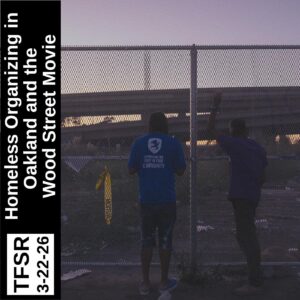
This week on The Final Straw Radio, we’re featuring an interview with three participants in the feature length documentary Wood Street, about the community that formed in a parking lot at 1707 Wood Street in Oakland. The location was a destination for people evicted from encampments around the city, who either refused or were denied the low number of shelter beds available, or didn’t fit into the city lots for camping or recreational vehicles aka RVs. Over the course of 10 years at a few spots on the street, as guest John Janosko explains, residents got to know each other and build bonds to the place and each other as neighbors. The north portion of what became known as the Wood Street Commons was evicted by the city to build transitional tiny homes managed by a services organization called BOSS and residents at the south side of the Commons ramped up organizing with outside supporters to stop the city’s eviction plan in 2023 through lobbying politicians and proposing alternative plans. The film shows this work, snippets of the lives of residents and the eventual eviction of the Wood Street Commons in 2023, with over 300 people losing their homes in the end.
Since the eviction, the tiny home camp funding ended and it was vacated, the mayor Sheng Thao was recalled and indicted for corruption and the site became a parking lot for a minor league baseball park next door, but people have taken their energy and experience to keep advocating for themselves and other Oaklanders around issues of houselessness. For the hour we speak with John Janosko, a featured face in the film, as well as our past guest Freeway and the film’s director Caron Creighton. The Wood Street Movie is touring a number of film festivals and looking to feature elsewhere, in hopes that the film can act as a support and inspiration for other homeless organizing in communities across the country.
- Our 2024 interview with Freeway: https://thefinalstrawradio.noblogs.org/post/2024/10/13/homeless-organizing-in-oakland-and-rural-relief-after-helene/
- Capital City Film Festival, April 12: https://capitalcityfilmfest.com/event/wood-street
- RiverRun Film Festival, April 18 & 20: https://riverrunfilm.com/events/woodstreet/
- Instagram: @woodstmovie & @woodstreetcommons
- Film website: www.woodstreetmovie.com
- Wood Street Commons website: www.woodstreetcommons.org
. … . ..
Featured Track:
- TFSR by The Willows Whisper
. … . ..
Transcription
TFSR: We’re joined by folks involved in the feature documentary ‘Wood Street’. I’d like to welcome Freeway back to the show, who was a prior guest. For folks listening from North Carolina, the film will be showing at the River Run International Film Festival on April 18th and 20th in Winston-Salem. I want to ask about the land and community that brought you all together. But I’d appreciate it if you could introduce yourselves a little first. Tell us about your journey that brought you to the Wood Street Commons, starting with your names and your pronouns.
John: Hi. My name is John Janosco, one of the leadership from Wood Street. I was unhoused on Wood Street for about 10 years. I always try to explain this piece, because it stumps me that Wood Street was there for about 10 years. But when we talk about Wood Street Commons, we actually refer to a specific lot on Wood Street owned by the city of Oakland, California. It was 1707 Wood Street, and that’s where Wood Street Commons got its name. It is that particular place that we lived. We were there on that particular piece of land for about 3 years before we were evicted 3 years ago. While we were on the land, our community just really started growing and developing. We started organizing and sharing all the resources that were being dropped off to our community. The overall encampment of Wood Street was about 300+ people that lived in a quarter-mile stretch, about 16 city blocks, and about 100 yards thick. Some people lived under the freeway, under Caltrans property. A lot of us lived on the front street of Wood Street. Then we had 1707 Wood Street, where we lived. We started organizing. We started distributing food, clothing, and resources. We started connecting people with more resources that were brought to our attention. It just started building as a great community, honestly, and from there, we kept growing, organizing, and advocating for better conditions in encampments and the same rights that everybody else is privy to in the city of Oakland. I’ll pass it on to Freeway. It’s my introduction.
Freeway: Okay, I am Freeway, they/them. I was one of the folks who helped found Wood Street Commons. I say, “helped found,”, I’m by no means a single actor in that. It was a group effort. I was on Wood Street on and off for about eight years, and just really, really glad to be a part of this opportunity.
Caron: My name is Caron Creighton. I made a film about Wood Street. I met them when I was working as a journalist for the San Francisco Chronicle and making podcasts. I did a couple of podcasts on Wood Street, interviewed a bunch of people, and also did video work. Eventually, when I saw this community of folks under the highway taking the state of California to court, I decided it was worth quitting my job to follow them, make a film, and see what happened, because it just seemed that powerful to me.
TFSR: Cool. Thank you all. Congratulations on the completion and the touring of the film ‘Wood Street.’ Caron, would you tell us a bit about the movie, how it’s been received so far, and the conversations that it sparked?
C: Yeah. The film is a feature-length documentary. It’s entirely verite, which just means it doesn’t have sit-down interviews with people. The real intention was to try to show as much of the Wood Street perspective as possible. I use some of John’s Instagram videos. You can follow him at Wood Street Commons on Instagram. Some of his Instagram videos and a lot of really close, intimate footage I filmed with them over about a year. It follows the community through the process of really organizing and the struggles of organizing to fight and stop the city from evicting them. We premiered at the Big Sky Documentary Film Festival in Missoula, Montana, back in February, where we won the Best Feature award.
TFSR: Back in October of 2024, as I alluded to before, Freeway was on the show to talk about homeless sweeps, a little about the Wood Street Commons, and about the work of the Oakland Homeless Union. You were, at the time, in the tiny tombs, I think, as you called the tiny sheds that had been built across the street from where the Commons were. Can you talk about what happened with the Commons site and the plan proposed by the city administration? And a bit about those tiny houses?
F: Yes, we call them the tiny tombs because they were deplorable. So much has happened after we spoke in 2024. At the end of 2024, Wood Street Commons actually collaborated with a few of our comrades, and for a magazine, it wasn’t just in the streets. And we actually took over the Greyhound station in Oakland. The point of this action was that we had been talking for years about the many vacant lots in Oakland. John can probably tell you the number at some point. I can’t remember the exact number now, but it’s a lot. It’s a ridiculous amount. A caveat to that is that it has the highest rent that exists in the nation. It’s ridiculous. Record numbers of people who can’t afford rent are ending up on the streets, and the city continues to not use these lots. They continue to sit vacant and unused, bought up by these corporate out-of-state real estate companies that are just hoarding them. It drives the property value up. There’s a whole trickle-down effect that just continues to drive this madness. So we took over the Greyhound station, and we were there for about a week and a half. We ultimately had to leave, but it was still a really monumental moment, and it was the beginning of us really catching the momentum we’ve been needing to accomplish what we’re trying to accomplish. The movement happens, and then the sweeps usually dip a bit around the holidays because people don’t like to work on holidays. That’s about the only reason.
Then you fast-forward to about May of the next year, and the tiny homes or tiny tombs had gotten so bad that people were reporting raw sewage leaking into the streets. We actually posted pictures and videos on social media every single day. This went on for the better part of a month before the city finally stepped in. They only stepped in when we got the attention of the county, and they were like, “No, this is not okay. You need to fix this. You need to take care of this.” That wasn’t the only issue. We continued to have abuse from the staff, mismanagement of funds, and basic provisions not being provided. We were bringing food down there. We were bringing clothing down there to folks because they just would not do what they were supposed to do. I don’t know if I can say the company’s name here, but it continued to deteriorate.
Then ultimately, in June, we got notice. Some more folks who were down there were now coming around, telling everybody that they were going to shut it down early. There was a scare about a month before that where they were like, “Oh, we’re going to shut down early cause city’s not paying us.” We made some noise. Went to the city council, and we called attention to it. They backed out of that. But then at the end of May they did the same thing again, only this time they actually did shut it down. It was right around the same time that Wood Street 2.0, East 12th Street, which had become a very large community, was part of a three-pronged city attempt to “clean up the streets.” By cleaning up the streets, what they really meant was to displace and destabilize several elderly, disabled, unhoused folks. They did it under the guise that they were cutting down on crime cleaning up, or cutting down on this or that. But the reality was that there was no real cleanup; East 12th Street is still in shambles. There’s still garbage everywhere. Nothing has changed. People are still displaced. They’re still unhoused. The folks who were at that time considered “lucky” to get into the extended stay have had several reports of the same stuff happening that was happening at the tiny tombs. We knew that that was an issue. We knew that the shelters systemically weren’t good. There were several gaps in services across the board. In 2024, there was also a Cal Matters article released about the shelter system statewide and how it was just not adequate at best and, at worst, corrupt. So we were seeing that in real time.
You mentioned the Homeless Union, I’ve since taken a step back and refocused my energy. But the people stepping up now in that position are those on ESA. They’re the residents that are on ESA and that are at these other shelters that are stepping up and saying, “It’s not okay that you’re not serving us enough food to nourish us. It’s not okay that you’re doing all these human rights violations. It’s not safe that we’re living in a hotel that, for a long time, may still be, wasn’t up to fire code.” There were several complaints and several grievances, and there still are, and there’s still a ton coming out, and now they’ve taken it a step further, and now they’re suing the company.
It reminds me of when we were back in 2024, and we were thinking, “What’s it gonna take? What are we gonna have to do to make a move that really matters, to make an impact in this movement?” We felt like we weren’t going anywhere. When we took over that Greyhound station, that was the pivotal point. Everything past that point just started really picking up. People really started waking up and seeing how horrible the conditions really were. They started fighting back.
So, fast-forward to today. Our mayor recently made a very public statement about wanting to cut back on the sweeps. Three years ago, five years ago, you wouldn’t have heard that. So it really speaks to when we feel we aren’t doing anything, we’re not making a difference. We’ll never know the impact of our actions. We’ll never know how our actions are impacting other people, assume they can see that, and it’s just really awesome.
TFSR: If anyone else wanted to jump in on that?
J: I’m on board with Everything Freeway said, but I want to just tighten it up a little bit. When we talk about the cabins, I’m definitely not defending the cabins at all. I just want people to understand that there were circumstances out of our control, out of the service providers’ control too. What happened with the Wood Street cabins was that, two years ago in February, we found out the city of Oakland was four months behind on a $900,000 payment to the nonprofit organization BOSS which was managing the property. That was the second time they had been behind on payment to BOSS. There was a threat that BOSS was going to walk out in March 2024. They were going to close down and walk out. Some negotiations happened that we weren’t privy to, with the city of Oakland and the BOSS nonprofit organization. They were able to negotiate BOSS staying until the end of June 2025, which was actually the date they were supposed to be closing in general. They had a two-year agreement with the landowner of that piece of property. The city of Oakland leased a piece of property so the BOSS could set up these cabins on Wood Street, so they could shut down Wood Street and have a place for people to go to justify it.
Regardless of how it looked, to be honest, the funding was over by June. It was going to end. They negotiated being able to stay until July 15. They were supposed to stay until September 1, and then they needed to exit the program so they could clean up the lot and return it to its original state. Once again, the city of Oakland didn’t pay BOSS, so BOSS finally said they’re calling it quits and shut it down on July 15. The people that were left there were back on Wood Street, and that’s really what happened with the cabins and the city. It made it a bad situation. BOSS was already horrible, but it made it even worse because the city of Oakland wasn’t keeping up with payments to BOSS. So they were coming out of their own pockets to provide whatever they were providing there: food, electricity, and so on. There were circumstances where BOSS was already a horrible service provider; the city of Oakland not being responsible; in turn, the people who suffered were those in the cabins. They suffered over the years because no one was being responsible at all, and no system was set up to hold anybody accountable.
TFSR: I dropped us into the middle of something; I should have asked more context questions, too. Because that’s good information. For listeners, as alluded to, Oakland has extremely high rents. There are a lot of people who live unhoused in various – however that looks – sometimes in RVs, sometimes in their car, sometimes on other people’s couches, maybe family, friends, whatever, short-term rental situations, or literally on the streets. Would someone want to contextualize what the scene looks like and how the story that’s told in ‘Wood Street’, the documentary, gives a snippet of an interesting moment of people taking on the city in an organized fashion? Does that prompt make sense? People are constantly challenging their conditions, trying to improve their individual or collective situation. People are constantly in various forms of community that overlap with each other. But this was a moment where you had certain residents living in this specific location coming together and working with lawyers and advocates and other community members to ascertain a more cohesive autonomy, which I think was really interesting.
J: I can speak a little to that. I want to give some content to this. People have to see how it was back then. We were able to exist, honestly, for about 10 years on Wood Street, the whole community. During those 10 years, the community got to know each other, bond, and become a real neighborhood, a community out there. Also, during the last three years that Wood Street existed, when we were on 1707 Wood Street, we were not evicted. We weren’t pushed off this plot of land. If you see what’s happening now, most communities that are out on the streets are usually swept within a month. They don’t have time to get to know each other. They don’t have time to get organized, or they don’t have time for organizations, resources, to become familiar with them, or a set place to come out and meet them.
When we started organizing at 1707 Wood Street, we were able to organize because we had three years there to organize. So we were able to set up routines. People were able to come out there and find us. It was a hub. We called it our resource hub for the greater West Oakland unhoused communities, and that really is what sets us apart from other encampments that were being swept, every month or every two months, or what have you. You can’t really organize – and people know that – if you’re continually getting swept.
C: To add to what John was saying, when I was a journalist working out at Wood Street, so many people told me – and I know other journalists heard this too – that they’d been told by the police to move to Wood Street from other encampments around the city. Wood Street was an unofficially sanctioned encampment by the city of Oakland, so they were able to stay there for years, which is pretty unique for encampments. As John said, help them have the time and space to organize.
J: Also, the organizing for us, and for me personally, wasn’t anything out of the ordinary. It was just something out of necessity. We had an abundance of food donated to us in that lot. We had an abundance of donated clothing. People came there because of that resource. So what we did was just out of necessity, but it was also, for me, because I grew up always having some gathering going on in my family. Every weekend, we were barbecuing and doing something together. I learned that’s how you live in a community. That’s how you lean on each other. That’s what you do. You celebrate each other’s lives. So, being on Wood Street, organizing wasn’t really organizing; it was just what I grew up doing. And that was normal in my life to like, “Well, we have all this food. Somebody needs to cook it. I’m gonna cook the food. We have all these clothes. Let’s hang all these clothes up. Let’s get it so it’s easy for people to navigate and find their size.”
It was a lot of life skills that I’ve learned through jobs that I’ve had and just through my family, so it wasn’t something out of the ordinary. Wood Street was very special, and Wood Street Commons was really special. But from my perspective, it wasn’t anything out of the ordinary that we don’t do in society as human beings. It was just the norm for me, and it was also a way to change the narrative of what people thought about us as being unhoused and how we live. It was a way to show people that we do the same things. We gather, we celebrate, we cry, we laugh, we barbecue. It was a way of changing this really bad, negative narrative that we were just lazy and from a different planet.
TFSR: Former Oakland mayor Sheng Thao, who features in the film, speaking about her experience with homelessness and advocacy for working-class Oaklanders, has faced some problems since the documentary was filmed. If you wanted to mention those problems. Have subsequent administrations done any better about being accessible to members of their voting public? There were a lot of scenes of folks waiting, trying to contact her through the office, coming up to the door, and being blocked at that point. Have they done better work on the issues faced around houselessness in Oakland, in your opinion?
F: It’s hard to really answer that question without sounding critical. Let me just start by saying this: the mayor that we have now, Mayor Barbara Lee, has taken great strides. She has already done, or promised to do, more than Sheng Thao, and definitely more than Libby did. I distinctly remember being at this rally in front of Libby Shaaf’s house. It was my first preview into organizing, and especially in this capacity. We were just asking her, “What are you going to do to address this growing issue?” This is back when she was mayor, so it had to have been 2019, I think. I just had this really distinctive memory. She came home during that action. I remember one of the organizers asked me to tell my story. So I was telling my story. I was telling her about how bad the sheds were. I said my piece, and I remember she looked at us with a straight face and said, “Can I go to my house now?” I just remember thinking, “How insensitive, how out of touch.”
That’s why it was so important. That’s why we all rallied around Sheng Thao when she was trying to get elected. Because she had made all these promises about how she had been homeless, and she understood the struggle, and then came to find out, she was as much of an enemy as anyone else had been. That’s important to point out, because there’s still a very deep mistrust in the unhoused community. Maybe not everyone, but by and large, the overwhelming consensus is that we have been lied to and let down in so many ways by people in positions of power and by the people who are supposed to be helping us. While our current mayor is a decided improvement over the last one and the one before that, she’s gonna have to really back up what she’s saying she’s gonna do. She’s really going to have to show up for this community for there to be some healing. Really, that speaks for the entire city, the locality, and all the local policymakers; they’re really going to have to undo a lot of damage, because at the same time, we have this step forward with Barbara Lee. She’s saying she’s gonna put a pause on the sweeps. At that same juncture, we have Ken Houston’s abatement plan. That’s just absolutely inflammatory to its core. That’s just on the local scale. I don’t even think I need to say at a federal level what we’re dealing with.
There is potential for some healing and trust rebuilding, and there are people in those positions right now who can start making that happen. But it’s going to take more than talk. It’s going to take more than promises. We’ve had promises and verbal agreements, and we’re still having this conversation. It’s time to see some action. It’s time to stop talking and either do something or let us do something.
Just to explain what Ken Houston’s encampment abatement plan is: there’s a city council member, Ken Houston, who has proposed this policy. Essentially, it makes it even more criminal to be unhoused. Part of the proposal is that it offers arrest and citations and forced treatment as an answer to individuals who are deemed either “shelter-resistant” or mentally ill, or, the proper vernacular is someone with an SUD or substance use disorder, but in his words, “drug addicts”. The thing is, I don’t think I need to tell you this, but there’s literally decades worth of research and data to support the statement that forced treatment does not work. If anything, it has adverse effects. I’m very opposed to someone saying that they’re doing something in the spirit of health and safety when health and safety have nothing to do with this. I also think it’s very telling that part of his whole get-down is that he actually runs a nonprofit that gets contracted out to clean up after a sweep. I feel like this is a little bit of a conflict of interest. But in any event, the language of the proposal, the suggestions, as far as the enforcement of it and all that, the entire thing is just wrong. It’s just straight up wrong. There’s no other word for it.
J: When you say the voting public, you’re talking about the majority of housed people. I feel like the question should be: have they become more accessible to the unhoused community and to advocates trying to advocate for the unhoused? When Sheng Thao was in office, she was a complete liar. Bottom line. She put us off so many times. When she was getting ready to get into office, or it was time for the vote. Wood Street Commons created a voting guide for the unhoused community. Our advocates, along with some unhoused community leaders, created this voting guide to hand out to unhoused people to help get Sheng Thao into office because of the platform she was running on. We wanted to get her in the office because she sounded like a candidate who was going to make change and understood what we were going through, because she said she was unhoused. That didn’t happen.
We even went as far as to go to her inaugural party, we got dressed up, hung out with her, danced with her, and danced with her chief of staff. From that day, put a bug in their ear and wanted to meet with them so we could talk more about our situation and how we could partner together with the city, to do things differently and more humanely. We were put off at every turn. We went to city council meetings. We tried to get meetings set up with her in her office. Every single time, basically, the door was closed in our face. Moving forward, as everybody knows, she was recalled because of misdoings and other stuff that happened while she was in office. She got recalled, and now Barbara Lee is in office. The accessibility for the unhoused community and unhoused advocates has gotten a lot better. We are in constant conversations with city officials, city administrators, and the different departments across the board when it comes to the city of Oakland. We have actually sat with the mayor at our office, where she’s in the room with us. The conversations we’re having today will be with her chief of staff. It’s gotten a lot better to talk to the people you need to talk to, hopefully inciting some change in Oakland’s approach to homelessness. I feel like there is going to be some change. It’s just that the problem is so enormous, the unhoused situation just across America, but in the Bay Area, in Oakland. There’s not one single thing that we’re going to be able to do that’s going to end it.
The Oakland strategic plan, put out about two weeks ago, aims to cut homelessness by 50% in five years. We’ll see how that works out. Because we have a lot of shelter beds closing down right now, we only have 1200 as we speak, and more are going to shut down. I think it’s going to bring it down to about 900. The new recount they’ve been posting says there are about 3,600 people on the street every night without shelter. There’s a big difference in the amount of shelter beds that are out there, the amount of people that are out there, and the amount of shelter beds that are actually being proposed to open up.
TFSR: Caron, did you have any response to that as well?
C: I do not. John knows more about how the new administration is doing than I do, to be honest. I’ve just been finishing the film. I haven’t been going to all these meetings.
TFSR: Throughout the documentary, downtown Oakland office buildings loom visible from the Commons, if I’m recalling, from the meeting scenes or close up when the crew goes to find the mayor or address the city council. Y’all were attending the meetings, having to wrestle with following the official steps and language of the government, having an address, interacting with officials and architects, attending public meetings, and holding press events. You were navigating courts to stay or stop an eviction and then facing off with police showing up to evict you. I wonder what lessons you took away from the organizing that you did among your neighbors and standing your ground with officials.
F: One of the biggest lessons that I’ve learned through this experience, through this process, for one, is my voice. I’ve really gone through a pretty intense transition and growth period since the beginning of all this till now. A lot of that growth was purely just baptism by fire. I was never really involved in the community because I was so isolated. I was dealing with a lot of depression, and I was dealing with a lot of other internal conflicts. One day, it was made clear that if we didn’t do something, if we didn’t defend ourselves, if we didn’t come together as a community and fight, we were all going to be displaced. Wood Street was the last stop. Wood Street was the refuge. When that refuge is being threatened, where do you go from here? That was a very real sense of necessity. In that moment of perpetual fight or flight, we all made the decision to fight, and it was pretty unanimous. When that moment came, there wasn’t time to be timid. There wasn’t time to question myself. It was like, “No, time to go.” There’s no time to second-guess myself or my community. There was a very real sense of urgency, and it really was the make-or-break for me.
One of the lessons that has also been really prevalent through this process is learning that lived experience is actually very, very valuable. I was very lucky. Somewhere along this process, I had someone who was a mentor to me tell me that my lived experience, whatever that was, whether it was being a person who uses drugs or being unhoused, or being part of this movement that was happening with Wood Street Commons, any of the things that have been challenges in my life, living through those things and navigating those obstacles is just as important as these learned academia-minded skills that people look for in the workplace. When I really thought about that for a minute and dove into that idea, it was very easy for me to look at the things that I was good at, the things that my community showed me I was good at, and to leverage those as skill sets. Just learning my own value and learning to be okay with having value again. It’s really common for us to hear and to really accept this idea that we’re subhuman, or we don’t matter, whatever that is. There’s an entire society of people that live around us all the time that would sleep better at night if we were dead. That’s the sad truth. So it’s very easy to settle into that and to accept that and to embrace that, even. It’s one of the most detrimental things we can do, because if we were really honest with ourselves, as people who have survived this huge, monumental challenge of being unhoused and the policies and all the factors, we’re pretty badass. Dude, we’ve overcome some stuff that most people would not make it five days. So just learning not to be cocky, not to overshoot our worth, or not to think we’re better than everybody else, but to find that middle ground: true humility. We’re not subhuman. So seeing that and really accepting it has been an interesting journey. It is definitely one of the bigger lessons that I’ve taken away from this.
J: Wow, lessons. Just the whole beginning to today is a big lesson on how to navigate the city, navigate politics, navigate government, and just understand how things really work. Back then, when we first started doing all this, we didn’t know what was going on. We were just showing up, had great ideas, and knew we were the experts because we were living the experience of being unhoused; they would most definitely listen to us. But that wasn’t exactly the truth. It wasn’t the way that things are, how things are done. I feel like the biggest lesson was learning the process for interacting with the government. We’re still learning it to this day. We’ve had the same conversation with the same people over the last solid two years, over and over and over. We’ve been in the same offices, talked to the same city council members, talked to the mayor’s office, all these different city officials. We’re saying the same thing. It seems like it takes a while to keep going in circles and revisiting all these offices. Each time you go in, I’ve seen that we have a little bit more to offer them. There are ways they do things, and they’re not going to tell you those ways they do things. They’re not just going to give you their hand. What you do is you listen to what they say, and then you have other people who advise you. Other people who work with you in administration who are more open to giving you a little bit more than what the last person was, and saying, “You have this now. This is what you need to do with this. This is how you present this.” That’s what we’ve been learning.
It’s just like going upstairs; you’re learning to keep your balance, how to navigate through all of this. That’s really what it’s been – learning how to navigate through all this, so that eventually, one day, people that are coming behind us, new advocates, new unhoused people with lived experience that are now wanting to be in this fight with us, we’re able to give them information that we didn’t have when we started, that hopefully is going to help them navigate a little bit smoother than we navigated, and help the process, whatever that process is that they’re working on, to move a little bit faster.
C: If I can add, even though Wood Street didn’t necessarily win the battle of ending or preventing their eviction, they made a ton of progress, and they made a ton of connections, and they’re still doing the work. For me, the goal of the film is to show other unhoused communities across the country that they, too, have power and can try to do these things. And, on the other side, to show the folks who are maybe criticizing Wood Street the real inside look and why it’s so challenging to organize this community, because there are so many different things that they’re coming up against.
TFSR: That’s really powerful. That’s what I was thinking of when I wrote the question: it gives so many opportunities for people to look at their own circumstances and say, “Hey, what can I apply from this?” even if it’s not filing this paperwork at this time, to this person or whatever, what in the approach is reproducible? Even if those administrations or offices are shifting, and different people are working in the offices at different times. The personal interfacing part is going to change. I think that having a record of “you can fight city hall”, maybe it isn’t going to be pie in the sky at the end of it, but you make steps forward. That’s one thing I really took away from this documentary and appreciated.
J: You just mentioned “fight city hall,” and that’s what we’re doing. But also, my philosophy is that it’s not actually fighting, it’s finding ways to work together. Because of the work that we’re doing, I feel like it was public and is public. It’s going to be more public once we get past these little hurdles where we can’t really talk about the conversations in depth that we’re having with these city officials, because we’re building our relationship with them. What we’re trying to do is show more of the community how we can work together instead of against each other. It shouldn’t be the city against us or us against the city. It should be all of us working together, because we’re not going to be able to accomplish anything unless we come to some mutual agreements that are best for our community, not just for the city, or not agreements just for the unhoused or just for the housed or the ones that vote. It has to be an agreement. It has to be things that we’re doing that best suit the overall community. I agree with what you’re saying, just working against it, but we’re trying to show people how to work together.
TFSR: I recognize that difference. Thanks for pointing that out. This is a good time, maybe, to talk about what folks are working on next, what you can say about the advocacy work or the organizing work that you’re doing right now. I’d love to hear about those updates and the next steps for the film.
J: Right now, there’s a coalition of couple of grassroots organizations, the Village, Wood Street Commons, are working with some bigger organizations, Just Cities, and a coalition of others, the Council of Elders and other organizations throughout Oakland. The main characters are Wood Street, The Village, Just Cities, We’re working right now with Mike Piatak architectural firm. He’s a retired architect who used to do work for the city, and he’s one who started designing the cabin communities. He saw that the cabin communities were failing, and he had a conversation with us years ago about how we felt about those cabins. We told him the truth that they’re horrible. Since then, for a good solid three years, we’ve been really working side by side with this man because he wants to right wrongs that have been done to the unhoused community and continues to upgrade these shelter programs.
What we’re working on is three different lots. We want to make sure that the city is meeting people where they’re at. We can’t always take people out of their space and take them somewhere else. That’s not healthy. We came up with three different designs. One is a tent community, one is an RV community, and one is a cabin community, and we’re calling them academies, educational campuses. Most shelter programs across America don’t really offer any engagement for residents. They’re just put in these cabins, in these rooms and left to their own devices. Nothing that they’ve dealt with in the past, or caused them to become unhoused, or the trauma that they’ve endured over a lifetime, or just being unhoused – none of that’s being addressed. Nothing’s being done to help them prepare for permanent supportive housing, or just permanent housing, and being in a situation where now you have to be a lot more responsible than you were when you were unhoused in different ways.
These educational campuses, these academies, will offer life-changing programs that help people get ready to be on their own again. Just simple things. How to balance a checkbook and pay your bills. How to navigate getting back and forth to appointments. Maybe a GED readiness class. Computer readiness class. Other things that are fun too, like art classes. People will be involved day-to-day in the overall maintenance of these sites, with the landscaping, picking up trash, cooking, and supporting one another, so that they’re not just sitting there waiting for a handout or for someone to give them an opportunity. They’re going to create their own opportunities. It’s a way for staff members who will be there and are from a different nonprofit to interact with these people more and have an opportunity to listen to them about what they see themselves doing in the future. We’re not just telling them what they’re going to do. They’re actually setting out a path and giving us a framework of what they would like. Then we are the ones bringing in the resources, making sure that what they need, we can provide for them. Hence, they have a better chance of being successful when they move into permanent, supportive housing, and successful is their definition of what they see as successful. I don’t like to say what that’s going to look like for an individual. I want them to tell us what success looks like, what a different life looks like for them. We can only find that out, and we start really engaging with them and opening up opportunities for them to open up in these spaces. It’s really based on just how communities should be and are. That’s what we’re working on. We’re working on getting this proposal hammered out in the next couple of weeks so that we can actually start presenting it to the administration of Alameda County, Board of Supervisors.
We’re going after Measure W funding. For people who don’t know, Measure W was a 0.1% (half-a-penny) sales tax created six years ago during the pandemic in Alameda County. It accrued over five years because it was in litigation. After all, the whole thing was getting sued. So it finally got released, and about a billion dollars in accrued. Now, since the government under Donald Trump has been cutting all this funding, we have this money there to help support all these programs, preventative programs, that keep people from getting unhoused, and just all those programs that weren’t cut or didn’t have funding. We have that money also; there’s a possibility with a new proposal. It’s not guaranteed that our proposal will be accepted, because we have to go through Alameda County. We also have to go through the city of Oakland because this proposal is being presented there. Measure W has the funding, but this tax will continue to accrue, and it’s going to be about $1.8 billion over the next four years.
We’re hoping that when our proposal is done and we present it, the city of Oakland is going to go for it, which we think they are. Alameda County, we’ve already been working with people within the administration of Alameda County, the Board of Supervisors. We’ve already been working with them, and they are all on board with our proposal. We just have to hammer out the details, all the political stuff, and navigation that you have to do to get the right thing done. Even though it’s the best thing and everybody knows it, it’s still no guarantee because of politics.
When it comes to Wood Street Commons, we’re doing what we’ve always done – serving our community. We go out every Sunday to a different encampment in Oakland. It’s called our outreach, and it’s more like a family barbecue, because we barbecue. If we don’t barbecue, we bring hot meals, we bring groceries. People go to the grocery shop and take food back to their community. We give away free clothes. One of our guys, Lamonte Ford, does free haircuts. We play music, we bring other resources and other organizations to interact with the people who are out there. We just really try to go out there and have a good time and not like it’s a handout. Most definitely, we do the same things that we were doing on Wood Street: to be a community that helps build other communities and identify leadership in them, so they can follow in our footsteps and join the fight against homelessness in Oakland and Alameda County.
C: The film is going to Lansing, Michigan, next on April 12th, and then we’re coming to Winston Salem, North Carolina, on April 18th and April 20th. Those are the dates the film’s playing. We’re still waiting to hear back from many other film festivals. You apply, and then you wait to see who takes you. We’re hoping to have our Bay Area screening sometime over the summer. People can follow us on Instagram @WoodStreetMovie or John @WoodStreetCommons. There’s a website, woodstreetmovie.com. And that’s pretty much it.
TFSR: All right. Is there anything that you all wanted to say in closing that I forgot to ask about, or that you want to add in that didn’t get covered?
J: Tell your viewers to follow us on our Instagram account, WoodStreetCommons Instagram account, and that gives daily updates about what’s going on in our community, meaning the Wood Street Community, what we’re doing. We have a lot of flyers that are posted. It’s just a way for more people to be interactive with us. Also, if you click the link in our bio, you can go directly to our web page. From there, you’ll find a plethora of information and photographs, and it can also take you to our donation page, where you can donate to support the work we do.
We just want more people to be educated about what’s going on. We really love to see when you support your unhoused community. Wood Street Commons is a manifestation of that. You support us, this is what you get. You give people an opportunity to live their best lives. You give them an opportunity to become the person that they want to become. You see more of the J Harpers, Lamote Fords, Jon Janoskos, Freeways, Tinas, more of those people that we’ve written off as not worth the effort, but they are really worth the effort. And with that support that the community gives us, we’re able to do what we do and support more unhoused people out there. It’s really important that people see the results of the support we have received.
TFSR: Awesome. Thank you all for being on this call and for taking the time to have this interview. I really appreciate it, and I hope folks get a chance to check out your project and get to see the film.
J: Thank you. Thank you so much.
C: Thanks so much for having us.