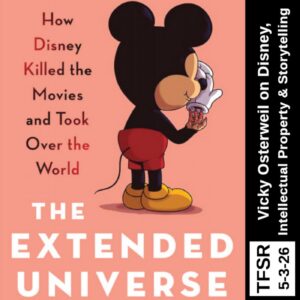
This week, we’re featuring a recent, live interview that I did at Firestorm books with Vicky Osterweil, anarchist writer and worker, author of In Defense of Looting and more recently The Extended Universe: How Disney Killed The Movies and Took Over the World (Haymarket, 2026). Vicky is a member of the Collective of Anarchist Writers (CAW), and you can also find her on Bluesky and what she’s thinking about what she’s watching at Letterboxd.
During the chat Vicky talks about intellectual property and how it overlaps between entertainment and other elements like technology and medicine, the shaping and limiting effects IP has on popular culture and imagination, the film industry and more.
To hear Vickys past appearances on our show check out:
Announcements
Support Jason Reynard Walker
Incarcerated activist and journalist Jason Reynard Walker is asking for support as he nears the end of his state sentence in Texas prisons and before starting his Federal sentence. He’s concerned about the shifting of his release dates around that may put him in a dangerous position where he’s more likely to have a hit on him placed by prison authorities. Read more at: https://jasonsprisonjournal.com/a-rogue-within-tdcjs-bureaucracy-changed-my-release-date-with-malice-aforethought-to-get-me-murdered/
. … . ..
Featured Track:
- TFSR by The Willows Whisper
. … . ..
Transcription
Firestorm: Hey y’all welcome to Firestorm. Thanks for being here tonight. We’re really excited to be here to talk about something that we talk a lot about here at Firestorm: Walt Disney.
Thank you so much to Vicky for including us on a tour of the East Coast. We really love getting a chance to have authors come through, particularly someone who we adore as much as Vicky.
So, just to kick us off here tonight, I’m going to share a little quick bio. I also want to give a big shout out and appreciation to Bursts from The Final Straw Radio for partnering up with us today for this event, and being in the mix as an interviewer/interlocutor.
Vicky, is a Philadelphia-based writer, agitator, and brick mason, whose first book in Defense of Looting, described historical struggles for liberation in the US. She’s a member of the anarchist journal CAW, and has written about the intersections of film, politics, and culture for publications such as the Paris Review, Art in America, Al-Jazeera America, the Baffler, Dissent, Lux Magazine, and The New Inquiry (TNI), where she was also a culture editor for many years.
Thanks so much for being here tonight to talk about this really unique and interesting book. It was not on my bingo card for anarchist literature in 2026 but I think it actually has an enormous amount to offer in terms of how we understand the world around us.
So thank you so much.
Vicky: I love it in Firestorm. It’s so nice to be here. Unfortunately, that bio is a little outdated. I now work in a warehouse, I’m not at the brick mason anymore, although that was much more fun.
I’m going to just start with reading from the intro. It’s from a section called on Letting People Enjoy Things and I think it’ll give an idea of what we’re doing here and it’s worth talking about in the year of everything being on fire and total fascism:
“While Disney may be one of the most cutthroat and exploitative corporations in the history of the world. It may indeed have been a core pillar of American Imperial domination. It is also at root, a movie studio, and that studio was responsible for some of the most pleasurable experiences of my childhood.
While I always preferred Bugs to Mickey, I loved my rescuers’ dolls. I identified so intensely with Flounder from The Little Mermaid that just thinking about him now spreads a warm feeling through my chest.
And saw in Ariel, Belle, and Cinderella, the first inkling that I might not actually be the boy everyone insisted I was. I treasured a Jasmine Barbie doll acquired at a local Disney on Ice production of Aladdin. I can still see the sticky, primary colored snow cone in my hand as we found our seats in the arena. And a few times I chose the Disney Princess figurines instead of the Hot Wheels cars when we got McDonald’s Happy Meals. Somehow or another, I learned that this was shameful, and eventually hid the figurines alongside, Jasmine, and Teenage Mutant Ninja Turtles’ girl reporter, April O’Neil, deep underneath my bed.
When I say that Disney is a monster, I say that as one of its spawn – almost all of us are. It is not a betrayal of our young selves, but rather an act of love and solidarity to insist we deserved better images of gender, of pleasure, of creativity, of art, and of possibility.
That we deserve to have our dreams and desires blossom through less restrictive, reactionary cultural pathways. That our minds and imaginations should never have been offered up to a corporation whose total dominance of a particular market segment marked us at our most inquisitive and joyful moments with its image.
It is not to reject the beauty and pleasure we found anyway, but to point out that those moments were in the service of molding us into proud Citizen Serfs of the Magic Kingdom. And that we need to build new ways of thinking and talking about those experiences if we want to stop the cycles of consumption, nostalgia, and ideology they support.
Similarly, unlike many books that take a critical look at the role of IP (Intellectual Property) in culture, this book does not argue that the copyright system needs to be reformed. Or that in its current form, it is somehow a deviation from the proper role of IP in society. This is an abolitionist text, and it comes from the perspective that IP, along with the mega corpse it upholds, and the broader system of property it is an increasingly central part of, must be overthrown for us to build more sustainable and liberated forms of art, creativity, and childhood.
IP is not and was never designed to protect artists and authors, even though they are brought up as moral shields by corporate and financial interests arguing that their position of monopoly is in fact to the benefit of our culture. This has been the case from the very first patent grant given to inventors in medieval Florence, to the campaigns against library photocopying in the 1960s, to the Disney-driven Sonny Bono Copyright Term Extension Act of 1998.
In the piracy wars of the early aughts, media conglomerates largely succeeded through a years long marketing and lobbying campaign costing hundreds of millions of dollars in convincing regular people that copyright protects artists above all else.
And in an internet age where imagery, words, and music are easily reproduced, many artists have had the experience of having their work ripped off on social media. It’s no surprise that they come to believe that copyright is their only protection. IP law was designed to guarantee scientific, cultural, and technological progress within a capitalist system that would otherwise tend to privatize and halt that progress. Don’t take my word for it. That’s how it’s written into the Constitution.
As a measure designed explicitly to quote, ‘promote the progress of science and useful arts.’ The law is meant to promote the progress, not the individuals carrying that progress out. And there is no question that the founding fathers were quite successful in this. The progress of technology, culture, and science in the United States has included incredible advances in medicine, the invention of the telegram and the airplane, the movie camera and the radio, the internet and the mobile phone, the creation of Gatling guns, offshore-oil rigs, the automobile and the highway, industrial agriculture, the suburbs, the atom bomb.
In 2025 the sum effects of this progress of science and letters, put to the service of capital and Empire, is not human freedom or artistic flourishing, but instead oligopoly, mass incarceration, forever war, and climate destruction.
Given that legacy, I believe we should make no excuses for the system of IP, and should instead do everything we can to support pirates, whistleblowers, and leakers in their work. Imagine if in the autumn of 2020 someone within Pfizer or Moderna, or the US Patent Office had stolen and publicly released the science behind the Covid-19 vaccine.
That hero, no doubt, would have been hunted down and prosecuted, but they might have saved millions of lives in the process. It does us no good to pretend that the IP-based games, shows, and blockbusters we love don’t contribute to and emerge from the same world of privatized medicines, agricultural methods, and academic knowledge.
As a result, this book is unflinching in its criticism of the ideological content of the movies it discusses. But I hope it also contributes to a mode of cultural criticism that goes beyond trying to draw a one-to-one connection between a film’s politics and its quality as entertainment or even art.
I like a lot of these movies and truly enjoyed watching most of them. I like them enough to spend years watching, thinking about, and writing a whole book about them, after all.
All but the worst gave me moments of genuine joy, pleasure, and admiration. As my friends can attest, I’m a big movie crier. My chin will start to quiver if I hear a certain swelling of strings. I can be set to weeping by depictions of simple gestures of love and kindness. And even though I’m being cheaply manipulated sometimes, in the moment it still feels good and real, and can give me space to experience genuine emotional release.
I cried many times watching movies that I talk about in this book, and scenes that I critique seriously in this text moved me deeply. Critiquing their function, however, is not meant to deny their power, or argue that people enjoying these films are somehow dupes, quite the opposite.
The more effective these movies are emotionally, the more effective they are ideologically, and knowing that doesn’t make you immune to their charms. If movies were someone just talking directly to the camera, saying, “money is good, go to work, be a heterosexual, buy things, be happy with your lot in life,” well, okay, that might be a kind of good piece of AGI prop, but it certainly wouldn’t have any broad popular appeal.
Analyzing movies as commodities helps us break with the ideological fantasies that elevate and idealize art and culture, where art is held separate from the tedious, material concerns of everyday life.
‘Creativity is a specialized activity, only available to people who hear its spiritual call’, the story goes. Not a basic everyday practice, a joy and pleasure that we can find in all our pursuits. As long as culture is so elevated, common sense dictates that the rewards of stardom, acclaim, and fabulous wealth should go to society’s most brilliant, skilled, creative people.
And if most culture workers are paid pennies, to turn out content, to line the IP owner’s pockets, driven by the fantasy that someday they too will join the Pantheon, well, they get to pursue their highest calling. So aren’t they lucky to be so exploited?
Such vulgar concerns as pay rates and workplace conditions are beneath the true artist/ And elevating art like this allows corporate powers to defend a media product that costs more than most cities annual operating budgets, as though it is little different from charcoal sketches made on an easel in some Parisian garret.
Still, reducing movies and culture products generally to just their commodity function, misunderstands the dynamics of resistance, struggle, and recuperation in the places culture is made and consumed. Not to mention the chaos and randomness that often marks the pressure cooker of onset conditions.
With so many hands on the wheel, many people contribute their particular perspectives, experiences, and desires into a film. An actor and screenwriter may have different interpretations of a character. A cinematographer and color editor may differ on a particular shade of blue.
On the ground from movie to movie, the way meaning is produced is contingent and chaotic. A major part of the struggle within cultural workplaces hinges on who gets to determine how particular images are made and which stories are told, and each individual movie functions within a broader cultural whole. Encompassing the marketing, branding, critical culture, current events, fan discourses, internal corporate politicking, and many, many other contexts that shape both how films are made and how they are received by the public.
At the same time that the industrial forces that create a cultural product will always pull it toward being an idealized representation of itself as a commodity (a product designed for creating the most profit with the least friction), it can only do so by selling tickets, by appealing to the mass of viewers. This is an infamously unpredictable process, and we will see how even as Walt Disney designed his animation studio around principles of control, uniformity and efficiency, he was still often stymied, and on occasion, almost ruined by the Mercurial tastes of the public.
Ultimately, mass culture must piggy back on and recuperate social energies of creativity, desire, conflict, and struggle, relying on ideas that bubble up from below. It is therefore always in danger of reflecting and releasing those energies back to the public. As literary critic Fredric Jameson puts it, “works of mass culture cannot be ideological without one in the same time, being implicitly or explicitly Utopian as well.” They cannot manipulate unless they offer some genuine shred of content as a fantasy bribe to the public about being so manipulated.
And there’s always the threat of sabotage of culture workers secretly embedding particular images and ideas. An extra pulling a funny face in the background of a serious scene, or a production designer putting a message of their own choosing on a piece of graffiti, or even just purposely breaking the illusion that the commodity attempts to produce, by making things look unrealistic, jagged, or silly.
IP, whether in the movies or in culture more broadly, has proven to be extremely useful in putting more power in the hands of the owners and leaving less space for the conflictual energies and tactics described above. Its stories are always within controlled worlds of predetermined and pre-built characters, narrative expectations, and genre constraints. But even still, as visible in the way Black Lives Matter activists made use of Black Panther in 2018, this control is never successfully absolute.
Put another way, I can enjoy a bag of potato chips without pretending that the system that made them is just, but also without berating myself that my enjoyment is somehow false consciousness.
And when in the midst of an uprising, people distribute single serving bags of chips to one another as a form of mutual aid – as I saw again and again on marches during the George Floyd uprisings in 2020 – the power and solidarity of that gesture is not extinguished by the fact that in a better, more just world, there would be more ethically produced treats to affordably share.
We should take whatever sucker we can from this crumbling system, while acknowledging that we too are products of it, that there is no outside of it, and therefore our pleasures, desires and needs have been shaped indelibly by it. That we don’t even know what our desire would look like once truly liberated from the demands of work, the nuclear family, rent, and property.”
TFSR: Vicky, thanks a lot for sharing the book and for being here to chat. So you opened the book also with this example from the Biden administration, when Disney lawyers and other Hollywood lawyers show up in front of the Biden administration and plead the case to not share the information about how the Covid vaccine was produced. Can you talk a little bit about the overlap between the investment in the protection of IP, in the form of characters like Mickey Mouse? And these sorts of life saving technologies?
Vicky: Basically, that was sort of the hook that I would use to tell people when I was explaining why I was writing a book about Disney movies. So the thing I would say is, it’s setting out to answer two questions – Why are all superhero movies the same? And why did Disney and the rest of Hollywood send lobbyists to stop the Biden administration from sharing the Corona-virus vaccine, with the Third World? And why do those questions have the same answer? Which is Intellectual Property management.
If you think about a movie company, if you know anything about movies, you instinctively understand that a global pandemic is a disaster for movies, right? The movie theaters were all closed, and even if they get back to being able to aggregate, to film and aggregate every single day on set, it is so expensive. The way filming works is so intense, and having to protect against an outbreak is really expensive. And, one star getting Covid could bankrupt an entire movie, right? So, it instinctually makes sense, why wouldn’t they be super invested in making COVID end as quickly as possible? It’s because Disney’s not a movie company. Disney is an IP protection company.
In 2018, which was the year that Disney had the largest monopolistic share of the movie industry of any year I looked at. I looked at the sort of ‘30s as well, because that was when monopolies got really intense. So in 2018 Disney made $1.1 billion on 10 movies. That was 37% of the global cinema market. That is a larger monopoly share of global market than almost any single Corporation has had on anything, it’s just massive.
I’d say 37% is wild. And that year, that was 16% of their total revenue. So, even when they had the best year any movie company had ever or will ever have in the history of movies, it was not even a fifth of their business. So movies are just really expensive and profitable advertisements for the rest of their business empire – merchandising, education, theme parks, cruise ships, etc… They have a venture capital firm, the GoPro is a Disney product. There’s less money in it now, but music and books was also a big sideline for them. There’s just this this massive, massive corporation, and across the entire corporation, characters are the lifeblood that brings money in. So when they bought Marvel for $4 billion, in around 2013 or 2012, they described Marvel as a, “character franchise company.” That’s what they were buying. They were buying characters.
So, if we think about what does Meta own? Or what do any of these software and social media companies own? They usually don’t own the servers they run on, most of them just give it to Amazon – that’s how Amazon’s in business, they hold all the other websites. So, what these companies own is the designs, the code, and the sort of the intellectual property that is held by their engineers and their designers. Theoretically, you could just highlight that code and hit copy paste on it.
Without the state backing up that right of intellectual property, there is no way a software company makes sense and exists. Similarly, anyone could theoretically make a movie about Han Solo or whatever. And lots of people do that with fan fiction. And it is the threat of state violence that keeps that valuable, and is necessary.
So when they sued, the movie industry sent five lobbyists – Pharma sent one hundred – to stop the sharing of the coronavirus vaccine, so to extend vaccine apartheid in the name of COVID, they were defending COVID against its enemies, like the vaccine.
And the reason that they they do that is because there is a probably wrong headed, but strategic, legal corporate belief that any threat to intellectual property, even going through the legal process that it was going through (that’s actually quite mild and was written into the law), any threat like that is a total snowball threat to everything. That also explains the extreme legal attacks on us and indeed our very small copyright violation.
TFSR: So, like people pirating video tapes and getting raided by the FBI?
Vicky: Exactly, especially in the 2000s there was a lot of that. And I mean folks have effectively been stopped from pirating on their computers, because there are those automated emails – which I imagine everyone in here has probably received at one point in their life – because you downloaded an episode of True Blood or whatever, and your internet provider immediately emailed you saying that they’re gonna cut off your access to the internet.
God, True Blood is an outdated reference. Why did that come to my head? I should probably rewatch it, it’s been like a decade – it’s probably awful.
Anyway, you get those warnings. If you’ve ever posted anything to YouTube – or if you know about how social media, video, and audio posting works – there are robot lawyers crawling around constantly and algorithmically nuking stuff from orbit that they just claim is a copyright infringement. The policy of the platform is to delete it, demonetize it and the channel, then it’s up to you (the user) to prove that you haven’t violated copyright through arcane processes that are totally determined by the corporate power.
There’s this massive apparatus to wipe out any pseudo threat, and to demonstrate extreme power, precisely because it’s all built ultimately on cop-with-stick, that’s the only thing that makes it valuable.
TFSR: So there’s the threat of state imposition, there’s this threat of violence if you copy things or if you reproduce things. Can you talk a little bit about how this focus on reproducible IP that’s owned by the company, that’s re-released over and over again, and how that shapes the framing of how movies are made, how culture is produced through legacy sequels and this sort of thing?
Vicky: Totally. I went to the movies this afternoon. I got here a little early and I had some free time. My hosts were working, and I had a choice, I could choose between the Michael Jackson biopic, which, obviously absolutely not, the Super Mario sequel, and The Mummy remake.
I chose The Mummy just because it felt the least offensive. I was wrong, it was awful. But the point is, if you go to the movies, almost everything is an IP or based on a true story, that is not the case. That has not been the case historically, I literally did extremely elaborate research, I made charts, I did numbers (not my strong suit), showing that you can see how much by what percentage franchise stuff like this takes over the entire industry. It starts accelerating in the 2000s.
It’s always been a part of the movie industry. There were things there called serials that go back as far as the ‘20s, with the same character coming over and over again. Obviously, like early cartoons were all movies, and those recurring characters. James Bond and Sherlock Holmes are franchises that have gone on forever. It’s not a new thing, but its concentration is the only thing that’s valuable, has really transformed our cultural landscape.
One example that I really like going back to that’s in the book is, if people remember, in 2018 or 2019 suddenly all movie trailers had these sort of “sad girl” covers of pop songs. Like it was just a sad girl with a guitar doing a terrible version of, say, a Tears for Fears song. And, I thought at the time it was just some sort of trend, like some weird trend in Hollywood trailer making, or whatever. No, actually, what happened is, with the rise of streaming and the way that copyright works on audio recordings, is that there’s a copyright for the particular recording, and there’s a copyright for the writing of the song.
The writing credits are kept by the artist and are much less valuable. The recording is kept by the studio. What had been happening in the 2010s is that a bunch of investment firms figured out that they could just give a big cash payment to, you know, Bob Dylan and he could retire with it or whatever because he would get like $50 million for his kids. And then every time a Bob Dylan song is played through Spotify or Apple Music, they get that one-tenth of a penny, or not even that, they get like one-hundredth of a penny that comes every time that song stream.
Which, if you’re a real regular artist, you cannot make money like that. By selling 1000 singles as an artist you can probably eat for a year, but having a 1000 people stream it as though they own the single means you don’t get anything, right? So it’s, it’s completely destroyed the middle and bottom of the music industry.
Anyways, so these companies buy the rights to these songs, and then anytime that song gets played, they get a little bit. Then it becomes in their interest to get that song played as many times as possible. So suddenly they want to get their old songs in the mouths of new artists, because then the new artist will sing it, they’ll get a play on that version, and then listeners will go back to the old version, and these music investment firms will get a hit every time you stream either the new one or the old one.
So it’s really valuable to them. Ultimately, what that means is that the market logic is that any piece of new music is competition. So it is in your active interest culturally, because if people are playing new music or a new genre – like a totally new genre, like hyper pop or something – and you can’t ever get any money off of it, then it is a real threat to your business model.
So it becomes in the interest of IP holders to never let new IP develop, which is to say, never let new creative things be created – just the old stuff forever. And that’s really intense and horrifying that there’s an incentive for that. But also, it has these weird effects where we end up shopping in the grocery store or driving and we’re hearing this weird, uncanny valley version of a song we used to love when we were 10, and it produces this sort of weird mood.
And these affective moments are minor, but they are happening to everyone, all the time. What is that doing to our culture? How is that producing, say, a desire to “Make America Great Again,”? How is that producing nostalgia and fear and resentment, and a belief that the past is the only place good things come from, or some other belief? It’s impossible to study, but that’s all thanks to this weird, arcane loophole some investors found in IP law around recorded music. Who knows? I don’t know! How many other things have been changed like that by things like that?
TFSR: I guess when you’re considering the innovation factor, like what you were talking about with the US Constitution and when you go through some of the history of the early days of the US and the colonies, and in particular, once the US gained its independence – there was a lot of literature being brought in from other countries with a refusal to recognize the copyright from those countries which allowed for a flourishing of productivity within the popular culture in the US. It seems like with the concentration, not only the divestment from new production and new productive forms of creativity, but probably also the active suppression of new pieces of culture that we’re getting fed the same sort of “Soylent Green” over and over again, probably does a lot to increase that uncanny mood.
Vicky: Yeah, and it shapes what people believe they can do. If you don’t feel like you can tell a story that anyone’s going to like without having legal rights to something, whether or not that’s true, that’s gonna affect your sort of impulse to create.
We still see a lot of creativity that’s not gonna go away. But what it does do is it diminishes the belief in the possible through creativity, while also sort of pushing things into certain sort of cultural streams that I think are quite tedious and often generically repetitive and visually ugly, right? Like Marvel movies are so ugly. Marvel movies are so ugly that people thought The Barbie Movie was good because they hadn’t seen a saturated color in like, 10 years. And they’re like, “Oh my god, the color pink!” And of course, the next week after its opening, Mattel announced their theme park in Arizona that they were building, because they are playing the exact same game. Mario is on the same game. That’s why it was at the top of the box office in 2024 and again, this year, it’s doing quite well. All the companies are doing this now, everyone is doing it.
I think in the last few years, it’s something like 95% of all the top 30 movies in the global box office are based on IP. It’s just everything, and it’s not just the movies, right? We see it with music and video games. With video games, it’s a little different because of sequels, but we’re seeing the video game industry is going through another crash, despite doing extremely well in the 2010s, and part of that crash is the consolidation into certain IPs, like Grand Theft Auto 5. These are games that are live forever. So, one game stays forever, and you try to draw everyone into that one game, and you make a game and it doesn’t work, so you kill it. That’s sort of how the business works now, which is different, but similar.
Anyway, all of which is to say, it severely restricts our cultural pathways, while also giving a lot of power to executives to decide what kind of stories we hear. And the kind of stories we’re going to hear are stories about how awesome it is to make money, and work, and have a family, you know? Maybe that family, if you’re lucky and it’s a Pixar movie, maybe that family has two moms, but it’s still like a nuclear family, where both people work, right? It’s all these sort of stories. The best you’re gonna get is this very mild representation, and even that representation was so intolerable to a portion of this country that we’re living through what we’re living through now.
TFSR: Especially with, as you point out, the markets that these films are being produced for is not just to be palpable to the majority of people in the US who are wanting to put money into it, but also to all of these other markets around the world too. This is nothing against universality or stories that can be heard by a lot of different people, but if you’re selling to the least common denominator of these situations, or something that’ll not only maybe make people in the US excited, but also get past the sensors of the Chinese Communist Party (CCP), it says a lot about what you’re going to be.
Vicky: Right exactly. And China has overtaken the US in 2021 as the biggest market by by dollar volume. That’s the biggest film market in the world. It has been the biggest film market by ticket since 2013 or 2012, but they were making a lot less money. And there was a rumor, that I think I do talk about in this book, about one of the members of the Chinese censorship board.
So basically, the Chinese market works, really, really quickly, is that all the US movies go through this censor board and assuming it passes the censorship board, they also just select 10, or, maybe 15 that are going to be allowed into theaters. It’s part of the planned economy. So you really want to get your movie in because it’s this huge market. And there was a rumor that one of the three people on the CCP’s board really loved molten gold. So every action blockbuster movie, for years, contrived a reason to have an image of gold melting. Sometimes it would be cut from the domestic release and it would just be in international release.
I don’t know if that sensor was really there, if he really liked that, but that really happened in those movies. If you think about these products that are being sold, “for everyone,” and it has that level of specificity, of trying to get through certain really narrow windows, or I think, more pressingly and seriously, they often will appeal to so called “Chinese anti-black racism,” which is just different from US anti-black racism, obviously.
Or, you can’t show a same sex kiss in Chinese cinema, and there’s certain levels of sex that you can’t have in a lot of the Middle East, where there are also sensors that they’re interested in. They’re smaller markets and less influential than China, but it also matters.
The desexualization of superheroes, how they get turned into these mired in grief, realist people in mill-stripped down military gear instead of these, ridiculous, horny, bodacious adolescent camp-fests. Part of that is literally just about being able to sell it everywhere, where it’s actually going to make money.
I think so often in our discussions of that politics, we talk about the particular filmmaker. ‘Oh, this filmmaker made it so straight’, which can be more or less true, but there’s this bigger structural thing going on that is dictating the levels of sex that are in movies.
Some of the most horny things that we have culturally have been desexualized by the fact that it needs to sell in markets where there’s more control over sexuality, formally. And again, as you’re pointing to, I think it’s really important. It’s not to be like, “damn, those Chinese,” you know, that’s not what I’m saying obviously, but it’s about the ways in which those Chinese predilections are also being combined with US predilections about certain forms of morality and work that they wouldn’t recognize in China.
So you’re sort of getting ideological, this sort of base stew of ideology from everywhere that’s really garbage. And you’re getting everyone’s garbage, and it’s being mixed into this one big, ugly garbage product, and sort of shoved down your throat. It’s fun.
TFSR: You bring up the increased cost of movies over the last few years and just how they’ve become an avenue for investing a huge amount of international capital, so they’re way over production cost for the actual need of what they’re producing. I wonder if you could explain how money is being legally laundered through this form, and what it does for those that can invest in it?
Vicky: Yeah, so as I understand it, and having researched it and written about it, and thought about it, there’s a sort of common thing that people say critically about CGI (computer generated imagery), which is technically correct, which is that CGI is cheaper than live action stunts. You’ve probably heard this at some point. That’s why they use so much CGI. Yes, one CGI worker is cheaper per hour than one unionized worker on set and that’s real. But movie budgets haven’t gone down. Movie budgets have gone up and up and up. They’ve ballooned. Movies are more expensive than they ever have been before. If the goal was driving down the costs on the production side, then they’re doing a very bad job of it.
In fact, I would argue that I just don’t think that’s a motivating factor. I don’t think that makes sense as a description of it. And because I was stuck with that, I was like, “well, that doesn’t make any sense,” so I looked into it, and other people have talked about this, but what CGI does allow you to do is spend almost infinite money on labor costs, labor costs which are non taxable. The person who gets paid the labor gets hit with the tax bill.
Hollywood has long been a series of tax dodges dressed up in the Oscars. And that’s famously, people making their first movies who go out to Hollywood and get this deal where they’re like, “you’re gonna get 30% on the end profits.” And are like, “this is incredible!”
And then they get like $0 right? Because there’s just all these elaborate, arcane financial instruments. And Bank of America, for example. One of the things that founded Bank of America was funding Disney and early Hollywood Studios. Financialization is extremely early to movie making because they’re so expensive to make. So anyways, you can basically just keep putting more hours into digitally manipulating an image. You can just keep doing it over and over again. You can ask for redos. You can do the thing called pre-visualization, which they do and which is where before a movie’s even been made, a digital team starts making the movie images.
Directors often now come on when a lot of the movie has already been made. When the director shows up, they’re really like a hired gun pointing a camera. There’s all this stuff that you can do which allows you to make this investment, which obviously means that your capital isn’t sitting in a bank. But with a franchise movie, like the next Star Wars movie or the next Pirates movie, or the next whatever, you are almost guaranteed to make money. Because things flop in the US, like The Lion King’s live action remake in 2018, it was still the seventh most successful movie of all time, because international markets just buoy it. It doesn’t matter, stuff can flop in the US. They prefer it didn’t. They want it to hit here too. But my point is that franchise and IP, combined with global market control, has made movies an extremely safe investment in a certain way, which they never were before.
Movies were always famously like a casino. It was a gamble, which is often why, you know, there’s stories of people, especially in the ‘60s and ‘70s, when independent production really took off in a big way, like consortiums of dentists losing their shirts, because they were all like, “we’re gonna make a movie, we’re gonna be producers.”
TFSR: I feel like that showed up in Ed Wood at one point. Like, “we’re running this, we’re gonna make this movie!”
Vicky: Exactly. So it has become yet another financial instrument. But part of the reason also that a movie is a successful financial instrument is because, even if it fails, if you can get a chunk of the back-end stuff – streaming revenue, merchandising, theme parks- then it doesn’t even matter, because as long as you’re sort of part of this corporate funding stream, you’re going to get your money back.
Because, again, the movies are advertisements for the rest of the corporation, and those corporations aren’t putting most of those upfront costs down on the movie because it’s so desirable to financial investors.
TFSR: With a lot of the book, which is very well researched, I felt like I was learning a lot about these huge corporations finding ways to change the laws in order to concentrate their wealth more and more. And I was really happy when you started talking about fan culture as a way of agency getting injected into this conversation, and for better or for worse, you gave examples of times when fan groups got together and were able to influence the way that the products that they were organizing around were made. I wonder if you could talk a bit about the positives and the negatives related to fan culture?
Vicky: Yeah, it’s really important. I think it’s the thing that probably is the most immediately relevant to most of us, the way we move in the world, the cultural world and experience it.
On the positive end, David Graber used to tell the story that happened during the first week of Occupy. At the start, we were like 30 weirdos in a park in New York. We were completely surrounded by NYPD. But, they never came in or cracked our heads, which would have taken them 15 minutes, probably, but they never did it.
There was a big question internally, like, “why did that happen? We want to know.” And one of the stories that came up was that David Graber overheard two cops talking about it, and because people were wearing Guy Fawkes masks, the cops were like, “we’re gonna get hacked. Like, we can’t, we can’t hit those guys, you know.”
You know, classic cop brain, obviously. And of course, if they had been ordered from above to do it, they still would have done it. That’s not the only thing. But what that means is that, for a moment, the Guy Fawkes mask, which, even at that point, was basically a cringe political symbol of being an online libertarian for a moment, kept the police at bay from smashing a movement that then would go on to become an international flash point and would kick off a decade of struggle in the United States.
That has nothing to do with how good that movie is. Similarly, in 2014, during the Baltimore uprising, teens were talking about it, putting up posters, and they were tweeting about it like, “We’re gonna go purge tonight for Freddie Gray.”
Now the first The Purge movie – although it has some interesting stuff in it that gets pulled out in the later sequels, which I think are quite good, some of them- the first Purge movie is an anti-crime, home invasion fantasy, where this white guy defends his house from deranged criminals, that’s that’s an extremely reactionary movie. It didn’t matter.There was an anti police uprising that partially was moved by the image of The Purge.
Another example is during the anti-monarchy protests in Thailand in 2014 you couldn’t use political slogans. So the youth activists started doing the salute from The Hunger Games, which is this three fingers together salute.
This has nothing to do with how much they felt liberated by Jennifer Lawrence, but it was this sort of universal symbol that allowed them to communicate with one another in a way that was opaque to the police. And the monarchy didn’t understand until it was too late, that they had used the symbol that was immediately understood as a symbol of resistance, whereas other symbols from Thailand’s revolutionary past would have immediately been cracked down on. And then in 2019 when Thai people came back into the streets, that symbol had become completely autonomous from it, and had nothing to do with The Hunger Games anymore. It had become its own symbol of Thai resistance. In an essay called “Notes on Deconstructing the Popular”, the critical theorist, Stuart Hall, talks about this a lot. He basically says, “today’s revolutionary anthem is tomorrow’s greatest hit.” The Weather Underground were making bombs to Jefferson Airplane songs that now sell Pontiacs. That’s how it works. And sometimes it can happen really fast. During Occupy, there was this occupation of this artist space, this thing called Artist Space in New York and someone put graffiti on a bunch of their posters. The occupation got evicted. The next day, those posters were being sold on an auction site as an authentic Occupy object for like $40,000 as art, as an ‘art object’. The art world is very good at doing that very fast. It can happen very, very quickly. But that was a genuine object of resistance for one moment and then a commodity the next.
So it’s not in the nature of the commodity. Similarly, I think we’re all familiar with the extremely important role that Gamergate and its offshoots – which included an anti-star wars harassment campaign. A lot of these folks met each other and got organized for the first time within Gamergate. Sometimes it gets over credited, you know, they’re like, “Oh, it was like Steve Bannon and Milo Yiannopoulos, sitting in a smokey room.” No, those guys are idiots. But they saw what was happening, which was a bunch of aggrieved white people getting organized to harass women. And they used those organizing spaces to move in and it was effective.
It was important, and it was part of the birth of the current fascist movement in America. Fan cultures like that are extremely, extremely effective at organizing certain kinds of rage. They’re much more likely to function through franchises because, to build a backlash to a totally new thing, that totally new thing first has to become really popular, but to build a backlash to the new Star Wars movie, I just have to hear a description of it.
And there’s already communities that are there who are ready to talk and organize about it. Similarly, there is a salutary effect for the studios. Counter-intuitively, much like COVID, it feels like they’d be really horrified by this, and sometimes individual directors and producers are horrified by the harassment campaigns. But in aggregate, it makes their workers less willing to go out and say anything political, less willing to take risks with the franchise, and less willing to not listen to the executives, because the executives have let them know and have shown over and over again, “You’re on your own. If the fans don’t like you, we’ll cut you from the series. We don’t care. We don’t need you. We need the character that you’re playing. And we don’t even necessarily need this particular character at this particular time.”
If you look at what happened to John Boyega in the three Star Wars movies (which I talk about), in the first one, he’s the most interesting character that mainstream Star Wars has come up with in a long, long time. He’s a storm trooper who sort of gets out of it and joins the resistance. And he’s also black, and fans were so angry about it because he was black, obviously. These reactionary fans, who were a tiny percentage of the Star Wars fandom, became so vocal and so organized. You can watch it happen, from the work print that got released in the first one and that produced the controversy, he’s less present in the final version. Then he’s a side character in the second version, and then he’s basically a background character in the third movie.
These campaigns are really effective at driving the content, and Disney likes them because they keep their wages down. He could be a star instead. Like Daisy Ridley, who is the star of those three franchises, got so much harassment for being a woman that she had to delete her Instagram. Now this is a low stakes thing for most of us, obviously, but if you’re a movie star in a really mercurial business, or any entertainment business, your social media following is a calling card. It is like a way you can raise your cost. So the fact that she doesn’t have any likes makes her cheaper to get and hold. Similarly, like the Marvel heroes, it represses your wages to be at the whims of angry fans.
TFSR: You also bring up the fact that IP theft, in the form of, for instance, The Punisher logo being used by right-wing groups, is something that hasn’t really been challenged, but it it also falls into the benefit of the company to allow that to happen, right?
Vicky: Exactly. I think we were talking about this beforehand, but with AI, Disney can literally win a lawsuit like God. But they haven’t taken out any AI companies, even though those AI companies have gone on the New York Times and we’re like, “we’ve stolen all of Disney’s work, and we think it’s great to steal it.” And the reason they don’t sue them is because they don’t give a shit about being copied. That’s not what matters. It doesn’t matter. What matters is the power over the image-making that the copyright allows them, so they don’t actually care about the act of stealing a reproduction. That’s not what’s at stake. What is at stake is control. And AI companies offer them more control over the image, not less. So they don’t care if they’re reproducing their back catalog. That’s not what it’s ever been about.
As we were just speaking about, in The Lion King, the famous Lion King opening is stolen from from that Japanese TV show from the ‘60s. Hollywood people steal the pitch screenplays from them all the time. And those screenwriters bring cases in the Fifth Circuit of Appeals, which is basically where all Hollywood cases happen, and they always lose, because Hollywood’s like, “Nah.”
The judges just throw it out. It’s generic. It’s too generic. They’re like, “Look at this, my dialog was stolen. I pitched to Sony, Universal, and Warner Brothers, last week. That’s clearly my story, but they rejected my pitch,” and they’re like, “No, you can’t prove that.”
It’s always to the defense of the best lawyered, and the most powerful, and it’s always going to hurt the small person – even when the small person is right, that they have, in fact, been stolen from. Always is probably too strong. There are probably instances where it goes the other way, but again, those are used and held up as exceptional. And in fact, it’s actually shocking how infrequently the intellectual property system works to the advantage of people who get robbed.
TFSR: Where do you see hope in terms of creativity and bumping up against these huge industries that have the government’s wielding these laws? Within the realm of fan culture, there’s a lot of fan fiction that’s created. There’s tons of examples you could give of those being repressed or being sued out of existence, but people find ways to reproduce.
For example, storytelling is really important for the way that we live with each other and the way that we imagine what’s possible. And for better or for worse, characters that Disney owns the IP for are formative parts of how we identify ourselves, how we feel about these things. I wonder… there’s piracy, there’s continuing to try to find creative ways to recuperate those characters back, or de-torn them, I wonder if you have any thoughts?
Vicky: Piracy, movie projection, and media sharing have never been easier, technically, than it is today. I see a lot of hope in stuff that’s sort of underground, or with friends, or even on Discord servers, like movie clubs, that people just form autonomously. They don’t even think about the fact they’re breaking copyright, it’s not interesting. It’s not really what they’re doing, necessarily – or maybe they do think about it. They’re sharing the culture they want to share and having discussions in their own spaces.
I think that’s a good start. As we are going through these many, many crises, one of the things that has happened, like in Philly (and I think everywhere there are empty movie theaters), we had a crew that projected movies for a whole summer on the side of the abandoned movie theater. We could break into them and start using them.
Similarly, when it comes to medicine, if we talk about pharmaceutical companies, 30% of research and science done by humanity is valuable, impressive, interesting, and important science, and 70% is complete bullshit.
The answer something like MAHA (Make America Healthy Again) would offer you is to throw it out or, drink some silver and put leeches on your body, or whatever the hell they’re selling right now. But it’s like, ‘no, steal the 30% right?’ Break their patent. Figure out how to compound the medicines. Figure out how to make them for each other. Because as we face more and more collapses of infrastructure and logistics and their systems, we’re increasingly going to need to be able to do that anyway. But even if we didn’t need to, even if it wasn’t a survival question on that level, that’s what makes it affordable, that’s what makes it possible. That’s what makes it possible for us to take care of each other.
On a cultural level: making stuff, just making stuff, and sharing it with your friends. One of the things that I think people are increasingly accepting is that there is no path through the mainstream without extreme luck, towards viability financially as an artist. And that sucks. Like, it’s bad.
There’s a bad situation that you can’t make money doing art and you have to do it as a side hustle. That really sucks. And the only way we’ll really have free flowing creativity and culture is when no one has to pay rent to live inside and when no one has to pay money to get medicine, right? That’s the only way we’ll really have true culture. But in the meantime, making stuff for your friends, just doing stuff in community. I think it’s such a small answer and it’s very similar to the mutual aid answer. As we saw in Minneapolis, mutual aid does scale, it will scale. It can change an entire social fabric.
In Philadelphia, where I live, there was this thing that was made, I think in 2019, which was just like a signal chat. It was just designed to share raves, because raves can’t be publicly announced, since they don’t have a venue they can’t have one publicly. And out of that chat, a ton of the organizing around 2020 emerged. Continually, mutual aid organizing comes out because you’ve just created a space where people are already hanging out and where people are already talking to each other. Culture brings people together, and that’s really powerful, and that can really be overlooked, and we can get too invested in the content of the culture rather than the content of the space that it produces.
TFSR: I feel good about those questions. Do you want to turn to the audience?
Vicky: Yeah, definitely. I’d love to.
Audience Member: I really like how you opened with the fact that enjoyment is still a very real part of this, no matter how much you know it is evil. And I think you can get a lot of morale from these things. If I’m to watch a show like Andor, which is made by the Mouse (Disney) himself, it’s still a really, really powerful show. And I’m just curious what you think about that kind of disconnect between these companies making some genuinely very great pieces of art that have great theory within them?
Vicky: In some ways, Andor is an outlier. I don’t think there’s an MCU product you can point to and say the same thing about, Black Panther, is as close you get, and that’s literally a movie about how cool it would be to gentrify San Francisco, ultimately. Anyway, on one hand, Andor is an outlier, as I said, also, it’s rad that it happened and that people enjoyed it, that was cool. I’m glad people shared it again. To go back to 2020, during the uprisings in Philly, one of the things that happened is we had two big unhoused encampments pop up and stay all summer. And we won some demands. We won some housing. But one of the things we did during that was project movies on a screen on the backstop of the baseball diamond on the field we were occupying, and I think that pleasure is still, well, there’s still utility to it, right?
We can still use it. We’d never think about this as a question with music, right? Like, certain songs become anthems of a moment, and often they’re put out by Sony or BMI. But I think with movies, or TV or visual, general televisual media, you feel less active doing it somehow – you can’t really do other things while it’s going on, because it’s in the dark.
I think we think that it’s less social. I honestly think, making them more social is cool. But in terms of that contradiction that you’re talking about, I think some movies really suck and are reactionary, and I will make really vigorous arguments about it with you, but I’m interested in having that conversation.
Most of the time, I think those conversations can be really generative again, I think what really matters is the way that we use them. Culture is ours to use, no matter what they say, no matter how many symbols they put on it, no matter how many police they send after you for reproducing it. Ultimately, it’s ours to use, and we should use it the ways we want to. And if that includes just watching it with your buds, then let’s do that, that’s great, it’s ours.
It has always been ours. It comes from us. They stole it, they put fences around it. They called that a copyright. Then that’s our’s, take it back.
Audience Member: I think Disney, in recent years, has had this sort of gloss of progressivism, and maybe in particular, as a result of the conflict in Florida with Ron DeSantis. I think a lot of people have this idea that Disney is sort of somehow on the liberal, progressive side of things, but in your book, you talk about the extremely, and kind of rabidly right-wing politics at its origin point – in terms of anti-communism and labor busting and things like that. I’m wondering if you could talk just a little bit about what the political culture of the Disney Corporation is about, maybe not just right now, but historically has been like?
Vicky: Speaking of things that are ours, part of the reason it has that reputation is because, for example, a lot of queers in Florida have historically gone to work at Disney World. Orlando is actually kind of a gay city in some ways as a result. But if you work anywhere on Disney property, you have to sign an NDA (Non-Disclosure Agreement) saying you can’t talk about anything.
So anything we know about labor practices in the Disney Corporation since like 1988 is technically hearsay, because no one is allowed to talk about it, because they would be violating their NDA.
I think that’s sort of how you can see that sort of progressive gloss. There’s all these gays there, but their literal experience is owned by Disney as Intellectual Property. In the beginning, it was much more open that they were far right. Disney himself, Walt, was right-wing. He was conservative. He’s understood to be a conservative guy across the 30s, he was anti-New Deal. But there was actually a moment where he also got glossed because of the movie The Three Little Pigs. If you all know that cartoon from 1936, it has a song about the Big Bad Wolf, that comes out of the height of the Depression. And a lot of people read it at the time as this sort of myth, of every hard working man against the sort of Big Bad capitalist, The Big Bad Wolf.
One thing we don’t know about that is that in the original version, The Big Bad Wolf has a scene where he dresses up as a Jewish peddler with a big Jewish nose and a yarmulke and a bunch of gold coins that he plays with. So you could question that progressivism.
But even without that, it’s still a myth about Protestant work ethic versus the lazy guy who makes the straw house. Then there’s a big animator strike in Disney, because Disney, for a while, always had the lowest wages in the industry, even back to its very beginning. It’s extremely low waged. It’s very similar to a startup in the ‘20s and ‘30s; This charismatic young CEO who’s on the floor with you, and everyone works in this really chaotic situation that’s like, fun and creative, but actually you’re getting exploited, like totally being destroyed, you have the worst wages in the industry, and you don’t recognize it.
So anyways, the movie industry unionizes. There’s a big, big strike at Disney, one of the most vicious strikes in the history of Hollywood. There’s physical brawls. At one point, pro-studio animators poured gasoline in a circle around the picket while they all have these baseball bats and they’re threatening to light the picketers on fire.
At one point, Walt Disney tries to throw down with Art Babbitt, who’s the head animator and artist, and has to be physically restrained by security guards to stop him from beating the shit out of this guy in the front of the studio.
It was a really nasty, violent strike. And after that, all the biographers I read, from the most friendly to Disney to the least, all of them agree that the strike is when he stopped. He lost all interest in movies. He stopped. He was already mostly a figurehead by 1941 when the strike happened. But after that, he basically loses all interest in the movie side of the business. Only a very few times does he really even participate. And he spends a lot of his time, when he’s not designing Disneyland and Disney World and Epcot, he spends a lot of his time as the head of the MPA (the Motion Picture Association), which still exists today. And in 1941, he sends a letter to the House Un- Americans Activities Committee (the HUAC Committee), which is the group that did the Red Scare and the McCarthy hearings against Hollywood. He sends a letter saying Hollywood is full of communists. And he identifies Herb Sorrell, one of his animators, and Art Babbitt, the other animator, as leading communists in Hollywood.
Babbitt was at best a SocDem. Sorrell was a member of the Communist Party at one point but was not an active member. There were a lot of those. Anyway, it’s 1941 the US State Department has other things to do, you know: Pearl Harbor. They’re not that interested. Then after World War II, as the Cold War starts to kick off, he sends the letter again, and he’s like, “You got to come here.”
Five years later, those guys are long gone from Disney. He’s like, “You got to come, Hollywood’s full of communists.” And they’re like, “you’re right.” And they show up. And arguably, Walt Disney is one of the most responsible for the most famous moment of McCarthyism that we have, which is people being forced in front of Congress to name names, or be blacklisted from Hollywood.
Walt was one of the stones that put that in motion. He campaigned for Barry Goldwater – who you may know, people didn’t really know him until recently when he’s been compared to Trump. He’s an ultra-racist presidential candidate, probably the most openly fascistic presidential candidate, until Trump, who was on the ticket.
Barry Goldwater had free use of Disney airplanes. Disney went to cultural events and wrote reports for the FBI, and was an FBI special agent, policing all of these sort of milk-toast liberal political events. At one point, he takes the stand during the anti-communist hearings and accuses the League of Women Voters of being a communist front. And it’s actually because he meant to accuse the League of Women Shoppers, an even less political organization who had organized a boycott of one of his cartoons 10 years previously.
This is a very bitter, nasty man. Another example – and then we’ll move on, because it’s all in the book- was in 1937 when Leni Riefenstahl (who you may know, the director of Triumph of the Will, or Olympia, the two most famous pieces of Nazi propaganda) was planning to come to Hollywood and meet folks as an artist from the Nazi regime. A week before, this is 1938, the Nazis unleash Kristallnacht, The Night of Broken Glass, largely seen as the beginning of the Holocaust.
So Hollywood says, do not talk to Leni Riefenstahl. Don’t bring her in. Don’t talk to her. There’s an open letter in the Hollywood Reporter and the owners of the studios who are themselves, conservative, union busting, and anti-communist, but also a lot of them are Jewish. And they’re like, “Absolutely not. Don’t talk to this person.” Part of the reason Walt Disney is so popular and is the image of America is because he’s the one Protestant. He’s the Christian. He’s the goy in Hollywood. And Leni Riefenstahl comes into his studio, and he gives her a tour of the studio, and he shows her Fantasia, which he’s working on, and she offers to send him a work print of Olympia so he can watch it. And again, this is the ‘30s, so in order to watch it, you need a projectionist. And Walt doesn’t because the projectionists were unionized, so if they were to show it, everyone would know he had been visited by the Nazi week after Kristallnacht. Months later, when he gets found out, he claims he didn’t know who she was.
TFSR: And just to throw it in too, there was the politics. You had a whole chapter on Song of the South.
Vicky: I think part of what’s so frustrating about this sort of gloss is because Pixar basically had this reputation, has this reputation, as progressive, which it also isn’t. It is nominally more so than Disney. But in the ‘90s, there was these series of controversies around Aladdin, Mulan, and Pocahontas, all of which I don’t know if you have watched recently, but are extremely racist and difficult to watch. Also, Peter Pan, which is extremely racist and difficult to watch.
But there’s the song. I have a whole chapter about Song of the South, which is a movie you’ve probably seen part of without knowing it because the song Zippity Doo Dah comes from it, and the ride Splash Mountain comes from it. But you can’t actually officially see the Song of the South anymore, because it’s a pro-slavery fantasy about how good life is on the plantation for black folks.
They claim it’s technically during Reconstruction, which is completely flimsy. It’s never mentioned the movie, and that’s just enough to let you know they knew it was wrong what they were doing, and it makes it worse, not better.
That movie is literally a narrative about how black folks’ stories get stolen and turned into a happy white family, and it was re-released most recently in 1986, so Disney didn’t even stop showing it. This movie was boycotted at the time by the NAACP (National Association for the Advancement of Colored People). There’s massive protest against it. It’s an extremely racist moment in culture. And they were still doing it as recently as 1986.
This is not a progressive institution. What has happened is that, in the interim, so many other companies look just like them. And The Right has gotten so unhinged that they’ve given up on one of their great stalwarts, Disney. This is largely because Ron DeSantis is struggling over sovereignty, because there is this thing called the Reedy Creek Improvement District that is written into the Florida Constitution as basically sovereign territory of the Disney Corporation. In order to get Disney World there, they have their own cops, they have their own medical system, and they have their own tax base.
So, central Florida has long had this weird, autonomous, capitalist state. I think in the ‘90s there was some controversy around this thing called Celebration Florida, which was this town that they built that was all Disney workers and Disney owned all the houses. But they already had the Reedy Creek District, which is literally this autonomous corporate territory in the middle of Florida.
So DeSantis’ attack on them was largely over control over that tax base, because Disney World is the most profitable tourist destination – well, up until very recently, was the most profitable destination in the world, by huge leaps. It’s a lot of money that DeSantis wasn’t getting enough of a cut in. And then he was backed up by Daily Wire, the fascist grifters who wanted to make their own children’s network called Bent Key. And if you remember, they wanted to make an anti-woke Cinderella. So they sort of started attacking Disney as woke because they wanted to sort of get in on it.
That whole group fell apart because those people are absolutely talentless, even for the Right, talentless hacks. But despite all that controversy, Disney didn’t even take a side. They didn’t even say, “we detest” or “we support saying gay.” They didn’t come out in favor of the bill. The Don’t Say Gay bill was the thing that started this controversy. Sorry, now I’m really in the weeds, but the point is, the Right is manufacturing these conflicts with Disney for their own reasons. And with the sort of nature of the way we think about politics in this country, everyone gave Disney credit, as though it was on the other side actively, when it never was.
Audience Member: So you touched on this a little bit parts of your talk, when you were talking about, the uncanniness that’s kind of built into certain kinds of IP legal eases that creates these emotional micro environments for people, just like walking through their days. The emotion that I tend to associate most – I don’t even know if it’s an emotion, but the sort of the psychological state that I tend to associate most – with Disney media is nostalgia. And with nostalgia, I’m taking that to mean this really complex kind of constellation of emotions that is pertaining to maybe nothing or has its roots in an idea, and maybe not in something that happened on an actual timeline. I’m wondering what role nostalgia plays? And I’m sort of imagining maybe that it’s somewhat tangential to the meat and potatoes of the book. But I’m wondering what role you think it has, and to what extent do you see nostalgia propping up fascist logics?
Vicky: It’s not adjacent to it. I think it is central in some ways, but the book is structured. I haven’t even said this. Every chapter is about an analysis of a different Disney movie. One of the chapters is about Peter Pan. That chapter is mostly about how I didn’t know I misremembered Peter Pan because of nostalgia.
When I was watching the movies for the book, Peter Pan was the first one where I was like, “I really have fond memories of this. I loved it as a child,” and I watched it, and I was like, “Wait, where are the songs I like?”
And I liked songs from the musical that I had remembered from the musical. And I liked the story from the musical, and the play, and the book, which has this whole story about Wendy, and Wendy’s coming of age, and whether she’s gonna decide to become a mother and stay there, in a sort of mothering role forever.
There is all this sort of interesting, weird gender stuff going on. None of that’s in the Disney movie. The Disney movie is extremely flat. It’s like 65 minutes long. The only notable musical number is the extremely racist, one called, please forgive me, What Makes The Red Man Red? There’s the song from the musical, I Won’t Grow Up, which features a lyric, “I won’t grow up. I don’t want to go to school. I don’t know want to be like something who obeys every rule,” right? Something like that, some very sort of basic anarchy stuff that I like, and loved as a kid.
I really identified with it because I hated school. Shocking. So weird. Who hates school? What a wonderful place. But yeah, so I talk about that, that’s obviously pretty low stakes. But the way that Disney controls the image of Peter Pan, because, if you remember, throughout the ‘90s and 2000s, Tinker Bell appeared in every Disney logo. She was a constant feature of Disney. You couldn’t see it without seeing Tinker Bell. I just had ascribed all that stuff to Disney. These warm feelings I had, I thought “Well, Disney did make this one cool movie that I liked,” and like they hadn’t, they had made the worst possible version in the Disney movie. The story about Wendy is that she’s sexually jealous of Tiger Lily and Tinker Bell, and there’s like a sexual triangle of control around it, it’s gross, it’s weird, it sucks.
The only good part is Nana the Dog. Like, it’s really strange. But again, I remembered it being good. I mean, does nostalgia, you know mean do we Make America Great Again? Nostalgia has been so dominant to the current fascist moment, especially because I think it is, in this really unspoken way, about the collapse of capitalism, climate collapse, it can’t name any of those things, it denies the existence of those things, so it has to really lean on nostalgia as like a political principle.
Early fascism, like Mussolini, it (nostalgia) was the Roman Empire, but it was also futurism, right? And like the Nazis, it was like the ancient, old German ways, but also this sort of future technology. And we’re seeing that sort of with AI, that is present here. And meme magic also. It is present here in the present as well. But the focus, the balance, is much less. So in the original ‘30s fascism, they were much more focused on the industrial forces and the future Right. “The future belongs to us,” is how that song from Cabaret goes. Whereas, like this movement, especially because it’s so overwhelmingly older as it’s being formed in the US, the proportions are flipped. It’s much more interested in nostalgia.
So I think it’s really important to it and I think that IP is a particularly potent nostalgic force. I think there’s an argument to be made. I don’t think I quite spelled it in the book, but IP and nostalgia is a result of increasing monopoly control. Fascism also tends to emerge from a crisis produced. Has it emerged? Often, not always, it’s not a lever. But often, when capital gets really concentrated and monopolistic, fascism becomes a solution, because those monopolistic corporations do not want competition and they’re willing to use more and more violence to repress it constantly. And to make the market less and less free, which it never obviously was, but to make the state more openly fascistic and more openly the thing it already was a little bit.
So that was very off the cuff, but I think there’s probably something there that nostalgia, monopoly, and IP all go hand in hand.
Thank you guys so much for coming out.
Firestorm: Thank you all so much.