
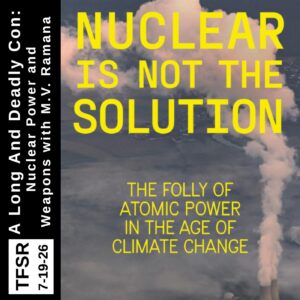
This week, we’re sharing an interview with M.V. Ramana about Nuclear energy, it’s proposal as a clean option for power generation to counter the fossil fuel industry-exacerbated climate crisis, it’s ties to weapons development and other topics.
- Nuclear is Not the Solution: The Folly of Atomic Power in the Age of Climate Change from Verso, 2024
- Faculty page with writings linked: https://sppga.ubc.ca/profile/m-v-ramana/
- AI and the Techno-Fascist Nightmare panel hosted by Counterpunch and Haymarket Books featuring Ramana
Next week, we’ll be sharing a chat with two local activists affiliated with Appalachians Against Uranium and their research on weapons production expansion underway in eastern Tennessee.
. … . ..
Featured Track:
- TFSR by The Willows Whisper
Transcription
TFSR: So we’re speaking with Professor M.V. Ramana of the University of British Columbia, author of Nuclear Is Not the Solution: The Folly of Atomic Power in the Age of Climate Change from Verso in 2024. Thank you so much for taking the time to have this chat, Ramana. Do you want to introduce yourself further with any pronouns or any other information?
M.V. Ramana: Sure. My name is M.V. Ramana. Ramana is my given name. I use he/him pronouns, and I teach in the School of Public Policy and Global Affairs at the University of British Columbia in Vancouver.
TFSR: Awesome. Could you tell us a little bit about your background in terms of nuclear technology or in terms of physics?
M.V. Ramana: Yeah, my PhD is in physics—theoretical physics. The kind of physics that does nobody any good necessarily. It was kind of a project that was trying to think about what breaks electroweak symmetry. Over the course of my PhD, I became quite politicized because of various things that were happening, including opposition to the war in Iraq. And eventually, one thing led to another, and I started working on nuclear weapons first, primarily in South Asia, followed by some work that I did on thinking about nuclear energy in India. Finally, in the last decade or more, it’s been thinking about nuclear energy globally.
TFSR: You’re talking about the second war in Iraq, the 2003 invasion, or the 1980s?
M.V. Ramana: Actually, the first one. Yeah, that kind of dates me.
TFSR: [laughs] When I was politicized during the latter invasion—not Desert Storm, the Enduring Freedom or whatever they called it—nuclear-related technologies were coming to my mind with all of the information that was coming out around the use of depleted uranium for munitions and the lasting impacts. Just, I mean, that whole…obviously, war is hell. But yeah, so I do want to bring this conversation back to the military connections with nuclear technology. Could you talk a bit about the reinvigorated conversation over the last few years concerning nuclear power as being a clean source of energy that could be a reliable way that we could step away from fossil fuels and our carbon footprint globally, and just sort of break down why that’s sort of come up in conversation?
M.V. Ramana: Yeah, that’s a great question. If you look at mainstream media and how they discuss climate change and, more generally, environmental issues…There’s a very strong focus on climate change in mainstream media and you can see two kinds of coverage. One basically saying that climate change is a very serious crisis, and all kinds of bad things are happening. So right now, for example, a lot of the coverage about the heatwaves in Europe will talk about how this is virtually impossible in the absence of climate change, and the same with forest fires or hurricanes and so on and so forth. So there is one strand of narrative that talks about how severe the climate change problem is.
But in parallel, there is almost always another narrative that’s going on which says we have solutions. We do not have to change our system fundamentally, especially in the social and political sense. We just have to replace the kind of technologies that are used to generate electricity or move us around from one place to another, and so on and so forth. That narrative is almost always combined with saying “it’s imminent, we know how to do this, if only we could get some right policies into place.” In that vein, the technologies could be renewables—it could be nuclear power, it could be hydrogen, electric cars, carbon capture and storage. A number of these technologies kind of vie for this. These days, we also occasionally see talk about geoengineering and trying to modify the climate itself. Nuclear comes in that context.
But nuclear power advocates have always promoted nuclear power, and that tradition goes back all the way to the 1940s. For them, nuclear energy used to be seen as the best way to generate electricity. In the words of Lewis Strauss, who used to be the chairman of the Atomic Energy Commission in the 1950s, the electricity that it was going to produce was “too cheap to meter.” So there was always this very wondrous narrative about nuclear power being a magical way to generate electricity. This was particularly common among scientists, especially physicists. The people who are always proposing nuclear power just look for reasons to propose it, and climate change was one of those reasons.
Since the beginning of this century, they have been talking about nuclear power being the solution to climate change. Every so often, they’ll say there is a “nuclear renaissance” happening with large numbers of nuclear power plants being built, and so on and so forth. However, if you observe the narrative carefully, you will see it shifting from time to time. So in 2017, when Donald Trump first took power as the president of the United States, the narrative quickly shifted away from nuclear power being the solution to climate change to nuclear power being a provider of jobs, and nuclear power being so important for our national security because of the connection with nuclear weapons and nuclear submarines and so on. But be that as it may, the climate discourse is the one that’s caught on most because that’s one thing where both the mainstream parties in the United States and in Canada, all of them agree that this can play a role there.
TFSR: And we can talk a little bit about what sort of advancements they claim to have made with the technology in a moment. But I wonder if you could talk about what proportion of—for instance, if you know it—the US power grid is powered by nuclear power plants, and how efficient that production is?
M.V. Ramana: Yeah. Rather than focusing entirely on the US, I’ll come to the U S in a second, but maybe we should sort of zoom out a little bit. In part because if we are discussing nuclear energy as a solution to climate change and evaluating its feasibility, then climate change is a global problem, and so we should think about nuclear power globally.
There are roughly around 400-odd nuclear reactors operating around the world, and a little under 100—maybe 96, if I remember right—of them are in the United States. These 400 nuclear reactors have been supplying, historically, under 20% of global electricity. The highest ever value of the share of electricity flowing in the world’s grids from nuclear power plants was in the mid-1990s, when it was about 17.5%. Since the 1990s, the share has been declining consistently, and in 2025 it was 8.88%—under 9%. So roughly half of what it was in the mid-1990s.
The United States is slightly different; it’s a little bit under 20%, I think 18-odd percent, and it’s been staying at roughly the same value for the last decade or so. The reason there’s been this decline globally is that the number of nuclear power plants has been more or less constant since the mid-1980s, actually, when the wave of nuclear construction stopped. Until that point, there had been a sharp increase in the number of nuclear power plants that were being connected to the grid around the world, but by the mid-1980s, that whole wave stopped. Essentially, what was being constructed at that point were the ones where construction had already started. Since the 1990s, there’s never been a large increase in the new nuclear reactors that have been added to the grid, while a number of nuclear reactors were taken off the grid—because they had either developed some problems with their operations, because some piece of equipment fails, or because it’s just become so old and utilities decided to shut them down because they are no longer profitable.
So that’s the broad outline from which we can think about nuclear power in the US. This period has also seen several talks of a “renaissance in nuclear power” and new nuclear reactors being constructed. The last time this happened in a big way was in the first decade of the century, under the George Bush administration, which favored fossil fuels and nuclear power plants. They passed something called the Energy Policy Act in 2005 that put in place lots of incentives for electricity utility companies to invest in nuclear reactors. Following that, by the turn of the decade, nuclear utilities had made plans to build about 30-odd nuclear reactors and had put in applications to the Nuclear Regulatory Commission to possibly construct these things.
That whole plan to build all these reactors came to a halt when all these utilities saw what the costs would be. They basically had sticker shock, and that whole wave had been promulgated by the assumption that the nuclear industry had learned from all its past experiences and figured out how to build nuclear plants cheaply. A leading nuclear reactor vendor called Westinghouse—that company is still in the news right now—claimed in the beginning of this century that they could build one of these nuclear reactors, their so-called AP1000 reactors, for something on the order of about $3 billion. That was the basis on which all these plans were made. But by the time actually the firm order could be placed and a good cost estimate could be developed, those numbers jumped up quite drastically.
A good example is that of the Vogtle power plant in Georgia. Those are the only two nuclear reactors that were built from that wave of construction pushed by the Bush administration. Now, when the Vogtle reactor construction started, the cost estimate had jumped from $6 billion for two reactors to $14 billion for those two reactors, and that’s when a lot of those 30-odd reactor plants were canceled.
The Vogtle project moved forward alongside one other project called VC Summer in South Carolina. Those four reactors were the only ones that emanated from the 30 reactor orders that were started around 2010. The South Carolina project was canceled after about $9 billion was spent, and the Vogtle project was the only one that was completed. But the final cost estimate of the Vogtle project was close to $37 billion. So from $6 billion or so, roughly, it went up to $14 billion, which then went up to $37 billion. That makes the Vogtle project the most expensive power plant ever built in the United States.
We have similar experiences in France, in Finland, and now in the UK, where they’ve all built the most expensive power plants—or are building, in the case of the UK—the most expensive power plants in the history of their nations. So that’s been the history of nuclear power: that it’s been a very expensive source of power.
I’ll just say one brief thing here about why this is so expensive, and this has to do with what exactly a nuclear power plant does. A nuclear power plant ultimately is just a very complicated way to boil water. Where in a coal plant you might be burning coal to produce the heat that converts water into steam, in a nuclear plant, the heat comes from nuclear fission reactions, where uranium nuclei split into two. When that fission reaction happens, it produces all these hazardous radioactive materials, which have to be contained inside the nuclear reactor because it’s hazardous to human beings. You don’t want human beings or the environment or other flora and fauna to be exposed to this. The bulk of designing a nuclear power plant is to try to make sure that these materials don’t escape out, at least not in the normal course of things. That’s why there’s a huge amount of steel and concrete and highly trained workers that are required, and all of that makes a nuclear power plant very, very expensive.
TFSR: Thank you very much. Just in terms of the cost, if you compare the cost of construction and the materials that go into it and the amount of energy that it produces, there were some figures in the book I noticed where it was comparing kilowatt-hours and prices for those from different technologies. Do you have a pretty good way of giving a quick breakdown of how it compares to other energy production?
M.V. Ramana: Yeah. The way that most energy analysts try to estimate the cost of generating electricity using different technologies is they do something called a “levelized cost estimate,” which involves trying to look at the entire lifecycle cost: the cost of construction, the cost of operations, the cost of putting fuel into the nuclear reactor or whatever other source of power that you have, and in some cases, also the cost of dealing with the wastes that are produced in those power plants. You sum up all of these things using a particular mathematical technique, and you divide it by the estimated amount of energy that it produces. The energy that it produces is usually measured in kilowatt-hours or megawatt-hours. So the way that we compare these is by looking at the dollars that you spend per megawatt-hour of electricity generated.
There is a Wall Street company called Lazard that tracks the costs of producing electricity in the United States from different technologies, and what they have been pointing out is that nuclear energy produces electricity at roughly something like $180 per megawatt-hour. And the thing to compare that with is the cost of generating electricity from wind or solar power—not solar power as might be on the rooftop of a house, but these larger utility-scale solar fields, which tend to be much cheaper because the cost of installation per unit is much lower for those. The cost of generating wind power and utility-scale solar power is roughly around $60 per megawatt-hour. Now, this varies tremendously according to the project and according to the particular location and so on, so this is an average across the United States. Just to give another point of comparison, the cost of generating a combined-cycle gas plant would be around $80 per megawatt-hour. So wind and solar are among the cheapest. Nuclear is the most expensive—roughly about three times how much it costs to generate wind and solar.
All of these things are changing every year, partly depending on the nature of the demand. When the demand goes up, the companies that are producing the technologies will jack up their costs a little bit, and so this is likely to go up in the future as well.
TFSR: We’ve been talking about the costs of the technology or the cost of the production of the electricity, and one of the things that I found most interesting in the book was the discussion of the overall cost of the technology itself. That doesn’t often get factored into the conversation of nuclear as something that will save the world from climate change by decreasing the amount of carbon that’s put into the atmosphere. It doesn’t really take into account the costs to the local communities where the materials are extracted from, the nuclear materials or the sites of refinement, and the concept of disposal or even responsibility if there is an emergency like a terrible event—such as at the Fukushima Daiichi plant, or Three Mile Island, or any number of other nuclear disasters. Who is responsible for the containment and the cleanup, or even barring one of those instances, the long-term disposal of the nuclear materials? Could you talk a little bit about the ecological and health dangers of this technology and some of the concerns around the longevity of the threat that it poses, as opposed to the corporations that take responsibility for running the power plants?
M.V. Ramana: Yeah, definitely. Nuclear power is unique in that it produces power using this hazardous process, namely nuclear fission, and the materials that it produces—the radioactive fission product materials and transuranic radioactive substances—stay radioactive for a very long period. As most people know, to be radioactive means that it’s going to decay by giving out some kind of radiation: alpha, beta, or gamma radiation. These are all hazardous to human beings in one way or another. Depending on the particular material, it could be more hazardous when it’s inside the body, or in some cases, it’s hazardous even when it’s outside the body.
In the best possible circumstances, these materials stay inside the nuclear power plant until the fuel is removed and replaced with fresh fuel in order to continue the operations of the nuclear plant. Once this fuel has been removed, it’s often called spent fuel, or sometimes its called radioactive waste, and that is stored usually in the nuclear power plant sites. In the United States, there is no place to take this spent fuel to, and I’ll come to that question in a minute.
In the normal course of things, in a normal reactor which doesn’t have an accident, the best-case scenario is that you produce these radioactive materials and they stay at the nuclear power plant site—it’s been for several decades at this point in the United States. Under certain circumstances, as you mentioned in the case of Fukushima or Chernobyl, there can be severe accidents that lead to a large amount of these materials being spewed out into the environment. In the case of Fukushima—this happened while people were watching it on TV, as it were—there were hydrogen explosions that led to radioactive materials being dispersed from the three nuclear reactors at the Fukushima Daiichi site. That material then gets spread out over space and time, as it were, by the winds. In the case of the Fukushima accident, a lot of those materials actually went into the Pacific Ocean, whereas in the case of the Chernobyl accident—because Chernobyl is in the center of the continent—much of it fell in Belarus or in Ukraine, but some of it escaped quite far, including, for example, into the United Kingdom, where it deposited itself in the higher regions, the northern parts of the country. Same with Fukushima—there were traces of radioactive materials from the Fukushima accident that could be seen on the West Coast of the United States, being transported through the Pacific Ocean.
Then there is a kind of worst-case analysis where some of these materials—and we’ll talk about this later—but in particular, the plutonium that is produced in the nuclear reactor is used in a nuclear weapon that is exploded, and in that case, you would also have a huge amount of radioactive fallout. But that’s a different contingency.
Coming back to the regular thing, in the absence of a nuclear accident, the waste that is being produced in these nuclear reactors, we would have to maintain it away from contact with human beings for as long as this material stays radioactive. Some of the fission products that are produced, as well as some of the other materials that become radioactive by absorbing neutrons inside the nuclear reactor, stay radioactive for hundreds of thousands of years. For that entire period of time, you would have to find a way to keep it away from human beings. The only way the nuclear industry has managed to do that after decades of research is to essentially dig a deep hole somewhere and bury it, and hope and pray that it doesn’t come out. They would, of course, not characterize it in that fashion. They would say, “We are building a geological repository, and we have engineered barriers that are going to prevent this material from ever coming out.”
But we really do not know how things are going to behave over tens of thousands or hundreds of thousands of years. There’s always a certain amount of uncertainty, and the longer you try to predict how this repository and all the materials that are buried inside it are going to behave over this very long period of time, the more the uncertainties. So it’s quite likely that sooner or later, some of these materials are going to come up. It may be 10,000 years from now, and the question that you have to ask is: how are we going to communicate to people who might be living 10,000 years from now that this particular site here—if a repository is ever built—should not be mined? They should not try to dig into it, because the radioactive materials that have been carefully buried in there will come out, right? We don’t have any reliable way of communicating with human beings who live so far in the future. The oldest languages and scripts that we know are probably a few thousand years old, so how do we communicate with that? That’s a question that nobody really has a good answer to.
The other thing to note about these kinds of repositories is that there have been some cases where countries have tried to set up repositories. The only operating repository in the United States is called the Waste Isolation Pilot Plant (WIPP) in New Mexico. The WIPP facility was supposed to deal with a particular class of radioactive waste that was produced by the US nuclear weapons program, not the nuclear energy program, but the principles are essentially the same. So there’s a repository there, there are the so-called engineered barriers, and this plutonium-containing radioactive waste is stored in casks there. This was supposed to keep that material safe for 10,000 years or however long—plutonium stays radioactive for a half life of 24,000 years, so you want to make sure this is going to be segregated from humanity for maybe a quarter of a million years.
Now, the problem with the WIPP facility was that in 2014, less than 20 years after it was constructed, there was an accident which involved a cask that had plutonium-stored waste exploding. The reason it exploded was somebody had made some change in the packing material that was used, and that had some unforeseen reaction with some of the gases that are being emitted by the radioactive waste, and that’s what led to the explosion. The question is, now you can try to change what the packing material is and prevent that specific type of explosion, but what happened in 2014 reminds us that it is impossible for designers of any of these repositories to envision all the possible ways in which that system can behave and the number of ways in which an accident can occur. So we should not have a lot of confidence about the claims from the nuclear industry that they know how to manage these materials safely.
The final thing I will say is that if you look at where countries have envisioned constructing these kinds of waste repositories, they tend to be in areas where the populations are largely Indigenous. Whether it is in India, or in Canada, or in the United States, or in Australia, both the uranium mining areas and the potential waste repositories all tend to be in these kinds of areas.
TFSR: Yeah, thank you for bringing that up. So when there’s tailings or extra parts that are not taken in to be refined for fuel or for weapons, that is just kind of left out in the weather, might seep into the water table in the area, or blow around in dust form and impact the health of the Indigenous people living around these extraction sites, right?
M.V. Ramana: Exactly, yeah. And also especially the miners who work in there, because they go down into the mines where they have to breathe in some of the radioactive products of uranium decay—in particular, this gas called radon—and many of them have been diagnosed with lung cancers and silicosis and things of that sort.
TFSR: Yeah. There’s another element of the way climate change intersects with how we should be thinking about nuclear that comes to mind. One being with the storage of nuclear materials: you can’t really foresee all the things that are going to happen, especially as climate change is ramping up and weather patterns become more extreme and also less easy for humans at this point to guess what they’re going to be creating, where storms are going to appear, what the storms are going to look like—that leads to an increased possibility of accidents happening in the facilities or the breakdown of those containment facilities.
Another side of the complication of climate change, in terms of nuclear being a solution for a need for quick alternative energy sources to replace the burning of fossil fuels, is the amount of time that it takes to spin up one of these projects—being a decade at the short end, and oftentimes two decades to actually build a nuclear power plant and get it outputting electricity. I wonder if you could speak about that?
M.V. Ramana: Yeah, great question. So let’s start with the challenge of climate change to nuclear safety—the safety of all kinds of facilities. Perhaps in a more dramatic sense, since we are talking now in July of 2026, the news has been around the heat dome over Europe. In Europe, the country that has the greatest reliance on nuclear power is France, and France has had to shut down quite a few of its nuclear power plants because the water that they use to cool the nuclear reactor comes from rivers and inland sources of water, and the temperature of this water has become so high that it can no longer be used to cool the nuclear reactor. Because nuclear reactors always require water to cool them, in the absence of that, the fuel can melt down, and that can result in what happened in Fukushima or something of that sort. So these reactors have had to be shut down, and we are going to be seeing this kind of pattern of reactors being shut down because of severe weather events more and more in the future. There have been similar cases when there have been severe hurricanes and reactors have had to be shut down. If they don’t do that, then we risk accidents. But if you do shut them down, then the nuclear power plants become unavailable at probably the time of the greatest demand for electricity, because the temperature is so high and everybody is trying to run their air conditioner or fan or whatever.
The other aspect which you mentioned is for radioactive waste disposal. With many of these repositories, you would also have to deal with how climate change affects what’s happening underground, and that’s something which is not necessarily known in all cases, it can only be modeled in terms of scenarios. The other important aspect of time is: what do we do about climate change? The best time to have dealt with climate change by reducing carbon emissions was 30 years ago. The second best time is today. A nuclear power plant, on the other hand, is a very slow process.
So I live in the province of British Columbia in Canada, and BC does not have any nuclear power plants. But every so often, somebody thinking that they are saying something particularly profound will come and say, “Oh, we should be considering building nuclear power plants here in BC to deal with the growing demand.” In BC’s case, during the last election, it was the candidate from one of the conservative parties. Had BC elected that person and decided to go ahead with building a nuclear power plant, to build it from the point where you start pouring concrete into the ground to the point where it generates electricity takes around 10 years. That’s the average number around the world. There are some which take longer; there are some which take a little bit shorter. But that average number is fairly typical.
Of course, BC could not start pouring concrete into the ground the day after the election, because they would have to do a number of things before such a construction process starts. The first thing they would have to do is to find a possible site. In any site where you’re going to build a new nuclear plant, the community that is living there would be expected to have some concerns about it. In the event of an accident like what happened in Fukushima or Chernobyl, the community that was most affected was the community that lived very close to the nuclear plant. So, if there is going to be some new nuclear plant near a town here in British Columbia, the people in that town ought to be concerned about this, because there is a slight possibility that one really bad day, they will be asked to leave their houses because there is a meltdown, and they can never come back to those houses.
Once they find a place, then presumably you’ll have to go through an environmental impact assessment process, some kind of safety assessments, and last but not least, British Columbia would have had to raise the tens of billions of dollars it takes to build one of these nuclear reactors. All that can take five to 10 years easily. So if you look around the world, typically the time frame between when a decision to build nuclear plants was made to the point where the nuclear reactor starts generating electricity is about 15 to 20 years. The earliest emission reductions that might materialize from British Columbia investing in nuclear power would be in the 2040s, right? That’s far too late for climate change, and this is true everywhere around the world.
Remember, the kind of timelines I’m talking about are in countries like the United States, Canada, and the UK, which have had loads of experience building nuclear power plants. But if climate change is really to be confronted by using nuclear power, nuclear power plants will have to be built mostly in the Global South, which are the areas where there’s the fastest-growing demand for energy to meet the needs of the several billion people who live in those areas. So you’d have to see nuclear reactors being built in Nigeria, Indonesia, and so on and so forth, which have had no experience building nuclear power plants. So it can take longer and we can be more concerned about the experience of the companies that are building nuclear power plants there, how up to speed they will be in terms of trying to maintain these safely and securely. So there are a large number of challenges before nuclear power can actually make even a very minimal dent in the growth of emissions in our world.
TFSR: Thank you. There is so much to talk about on this subject, and again, I can’t say enough times to the listeners that if you get the chance, you should at least go down to your library and check out Nuclear Is Not the Solution. If not, pick up a copy for yourself.
Because we have only so much time in this podcast, I’d like to pivot over to the connections between the military-industrial complex, nuclear weapons, and the nuclear power industry. Could you talk about the correlation between the two? Can you have one without the other? And what impact does the proliferation of the refinement of nuclear materials and these power plants have with the creation of nuclear weapons?
M.V. Ramana: There are five different kinds of connections between nuclear energy programs and nuclear weapons programs. Historically speaking, the first nuclear reactors around the world in many countries were built to make nuclear weapons materials. In the United States, those are the reactors that were built in Hanford, in Washington State. They produced the plutonium that was used in the first nuclear weapon test in July 1945—the one that people would have seen if they watched the movie Oppenheimer. Then it also produced the plutonium that was used in the nuclear weapon that was detonated over the city of Nagasaki. Down where you are in Tennessee, the uranium that was used in the bomb dropped over Hiroshima was enriched at the Oak Ridge facility in Tennessee.
Back to what I was saying: historically, in the United States, the first reactors were built to make weapons material, and it was only subsequently that nuclear reactors were built to produce electricity. It’s the same story in, let’s say, China and India and so on. The second overlap you can see is technical. The reason why there is a connection is because all nuclear reactors produce plutonium that can be used to make nuclear weapons. The process to try and separate out the plutonium from the other radioactive materials is a process called reprocessing. It’s been known since the 1940s because it was used to isolate the plutonium from the spent fuel from the Hanford reactors. The other technical connection is the fact that all nuclear plants in the United States use uranium not as it is found in nature. In nature, uranium comes in two varieties: one called uranium-238, the heavier version, and uranium-235, which is lighter. They both have the same chemical properties, but different physical properties because they have different numbers of neutrons. Uranium in nature is mostly uranium-238—about 99.3%— and only 0.7% of the uranium found in nature is uranium-235. But it’s the uranium-235 component that allows the fission reaction to be efficiently carried out in a nuclear power plant. So in the United States, most of the nuclear reactors use uranium where the uranium-235 fraction has been increased, or “enriched,” from 0.7% to somewhere around 4% or 5%—could be probably as low as 3%, and sometimes higher. There are some reactor designs which require much higher levels, closer to 20% of uranium-235.
Now, the process that is used to produce this enriched uranium these days uses something called centrifuges, which are sort of like washing machines where the material goes round and round and separates out the lighter from the heavier materials. And this process can be used to either produce enriched uranium that’s only enriched up to 3% to 5%, or you could continue with the process and modify it slightly in order to produce material that has up to 80% or 90% uranium-235, and that’s the kind of material that’s used in bombs.
This precisely is the reason why there is concern about Iran and its nuclear program. I don’t want to get into a whole discussion about what’s happening there, except to say that Iran has uranium enrichment facilities, we know about it, and they can enrich uranium up to around 60%. The claim Iranians make is that they are using it for peaceful purposes. The United States and several other countries, including and most importantly Israel, don’t trust them, and that’s the source of a lot of the conflict about Iran. But the technical underlying basis for that is simply the fact that the facilities that are used to produce fuel-grade enriched uranium can be repurposed to produce weapon-grade enriched uranium. That’s a connection—the technical connection between nuclear power and nuclear weapons.
There are three other things which I will very briefly say. If you look around the world at the distribution of nuclear power plants, there are roughly around 400-odd nuclear reactors around the world, and the majority of them are going to be in countries that have nuclear weapons: the United States, Russia, China, the UK, France, India, and Pakistan. There are only two countries with nuclear weapons that don’t have nuclear power plants: Israel and North Korea. So there’s enormous overlap. Then there are, of course, countries like Canada, which rely on US nuclear weapons for their defense. If you include all those kinds of countries as well, then the overlap becomes overwhelming. There’s a very strong geographical overlap between who has nuclear power plants and who has nuclear weapons, or are reliant on nuclear weapons in some ways.
Two other connections are the fact that when a new country starts developing a nuclear energy program, it will have to train a number of people in the basics of nuclear science and certain forms of engineering, much of which can also be used in a nuclear weapons program. It’s not identical—you would have to do certain other things to make nuclear weapons—but the overlap is quite strong. This is why many countries started their nuclear weapons program, including Iran. Of course, Iran claims it doesn’t have a nuclear weapons program, but the fact that they are even able to enrich uranium to this point comes from the fact that under the Shah in the 1970s, they decided to set up a large nuclear energy program. A number of Iranian students came to MIT, the government of Iran gave a bunch of money to MIT to set up a special program for them, and some of these people are the ones who are leading the atomic energy establishment in Iran.
Likewise, Pakistan is another country which didn’t have much of a technical basis to start building a nuclear power program. They sent a bunch of people to be trained in the United States as part of the Atoms for Peace program that was started under President Eisenhower. Some of those people went back and set up the Pakistani nuclear energy program, which also became the Pakistani nuclear weapons program. So there’s a personnel connection.
The last connection is that in many countries, it’s the same institution that oversees the promotion of nuclear power that oversees the materials that are used in nuclear weapons. In the United States, that’s the Department of Energy—it oversees both the nuclear energy program and also the production of nuclear weapons materials. In India, that’s the Department of Atomic Energy. So there’s also an institutional connection.
The last thing I’ll say is that for the nuclear energy program, for people who are promoting nuclear power plants, the connection to nuclear weapons is a great asset. It’s a political asset to them because they can turn to the government and say, “You need to support us if you want to have nuclear weapons. You need to have a strong nuclear energy program also, because we are the people who are going to go and operate your nuclear submarines. There’s going to be a lot of back and forth of people between the nuclear weapons program and the nuclear power program.” Many of the corporations that are involved in nuclear energy are also involved in nuclear weapons and vice versa. Some of the big ones, like Bechtel or Babcock & Wilcox, these are all involved in both these enterprises.
TFSR: The arsenals of these countries that have nuclear weapons aren’t static. In a similar way to power plants eventually breaking down because of their operation and because of the nuclear material that they’re holding, the nuclear missiles that the US holds onto also degrade over time, or the warheads degrade and need to be replenished if the country wants to continue having operational nuclear weapons, right? So it’s not like once these get built, they’re around for whenever we need them. There’s a perpetual need, to some degree, to re-up them.
M.V. Ramana: Yes, absolutely. The nuclear weapons industry is always looking for new resources, either to make new designs of nuclear weapons or to just refurbish older nuclear weapons and delivery systems. There’s a huge nuclear modernization program that was started essentially in the Obama administration as a kind of quid pro quo for signing something called the New START Treaty. This was the deal that they made with the nuclear weapons complex, and it’s going to cost in the trillions of dollars, this whole process. We can see there’s huge amounts of money to be made in these kinds of enterprises because you have essentially a system where the government is going to buy these things, and you can jack up the price to whatever it is.
TFSR: Outside of nuclear warheads, like I had mentioned earlier in the conversation, depleted uranium is coated on certain shells to be able to penetrate armor. When people think about nuclear weapons, they think of Nagasaki and Hiroshima, or ICBMs, or what have you. But could you talk a little bit about some of the other applications of nuclear materials as they are used in wartime currently?
M.V. Ramana: Yeah. Depleted uranium is a very good example of something that is used in war. Depleted uranium is basically very hard, and so it can penetrate things. There are other materials that can be used in similar ways. The great attraction for depleted uranium is that during the process of enriching uranium to fuel nuclear reactors or to use in nuclear weapons, you have to set aside the material that also is not enriched so much. The way that the enrichment happens is you put in a certain amount of natural uranium, and it produces two streams: one of which is enriched in uranium-235, and the other is depleted in uranium-235. This depleted uranium material is just lying around for free essentially, it’s waste material. So the military repurposed that into their penetrators.
What this does is two things. One is, if you happen to be inside one of these tanks that is hit with one of these penetrators, then some of this depleted uranium is going to get into the air in the form of very small particles, and people might breathe it in. It goes and lodges itself inside their lungs, giving them essentially a radioactive dose from the inside, and that can lead to certain kinds of diseases. The other option is that it might go and lodge itself inside the kidneys, and that’s another set of diseases that can come.
The other set of people who are going to be exposed to this are, of course, the people who live in the lands where these wars are being fought. Whether it is Iraq, or Iran, or Afghanistan, these are the kinds of places where you might imagine these materials are used. The children and all the people who are going to walk around the wreckages that are being left behind by these tremendously destructive wars are going to be exposed to these materials. It’s not good for anybody to be exposed to these kinds of materials.
What is important for us to remember is that the reason this is being used is not because they are looking for that radioactive impact on people, but because depleted uranium is so hard and it does the job for them at a low cost—the job being that of trying to penetrate into tanks and other kinds of materials.
TFSR: Going back to energy production and nuclear. One thing, besides the other part of this conversation that listeners will hear concerning the BWXT plant that’s proposed to be built in Jonesborough, Tennessee, near the Johnson City area, there’s been discussion in the last few years during this huge push for AI technologies, for “artificial intelligence,” to have an increased amount of computational power available, and therefore electrical power to power this or to cool the systems. A lot of the tech industry has been pushing nuclear as a way to scale up production of power, especially with the idea of these modular systems that might be quicker to set up, smaller, more autonomous from the power grid, and therefore more reliable for data centers. I wonder if you could talk a little bit about that aspect of the push for a new renaissance for nuclear energy. Are these modular systems a step forward in the technology that makes it safer or more productive, or is this sort of the same tune coming out, just recycled by a new industry?
M.V. Ramana: Yeah, so this is a great question, and we do hear a lot about these small modular reactors (SMRs). To put this in sort of historical context, the general narrative from the nuclear industry in the several decades since the height of nuclear reactor construction has been that whatever problems we are seeing with nuclear power, they are a feature of older nuclear reactors, and there’s a new generation of newer designs that’s going to fix all those problems. So the AP1000 reactors that were built in Georgia—the Vogtle project, for example—were supposed to have fixed all these problems. I bring up the AP1000 because they utilize one of the characteristics of the small modular reactors, which is the modular part of it. I’ll start with what exactly modular means, and then we can go to the small part.
In the case of modularity, the idea is that instead of building the nuclear reactor at the field site fully, the nuclear reactor would be assembled from factory-fabricated modules—just the same way as today we might see an office complex or a shopping center being built from building blocks from a factory. Nobody brings bricks and wood and carpenters to a site these days to construct buildings; it’s the same idea that is being extended to nuclear power plants. You can think of these as some kind of Lego blocks, if you like, coming together and being assembled on the site. The claim is that by moving some of the construction and manufacturing process from the field location of the nuclear power plant to the factory, you have greater control over the manufacturing process, and that is going to make things more efficient, cheaper, and the project can be built on time.
None of that came true in the case of the AP1000s built in Vogtle. All that we had was instead of having problems arising just at the site of the nuclear power plant, there were problems both at the site of the nuclear power plant and at the factory where these modules were being fabricated. So that’s the issue with modularity; it’s not going to fix the problems of nuclear power.
And what about the other term? The other term is small. “Small” really means that the level of electricity generation that these are designed for is under 300 megawatts. That’s in comparison to roughly around 1000-odd megawatts of a typical nuclear plant—the Vogtle plants were 1100 megawatts each. So “small” just means it’s under 300 megawatts; it has no implication for the physical size of the plant. The size of the nuclear reactor depends sensitively on the design that is being used, and even the smallest of these small modular reactors are not things that you can keep in your garage or in the school playground or something of that sort. These are quite big facilities.
Now, why the push towards small? It’s because the cost of these large reactors, like in the case of the Vogtle reactor, went up to, as I said, $37 billion. If a typical large utility in the United States might have a market capitalization in the tens of billions of dollars—maybe as high as $20 billion or whatever it is. When these companies decide to build a new nuclear power plant, that means that they are taking on a huge risk. Wall Street gets very nervous about it; they start increasing their interest ratings, their bond ratings are affected, and so these utility companies were looking for a different solution.
The nuclear industry came up and said, “We can build small reactors, and the small reactors are going to cost much less than $35 billion. It might cost $5 billion to build one of these things.” The problem is that $5 billion will only get you a very small amount of electricity. And as long as you have the same demand—and especially if the demand is growing very rapidly because of the construction of data centers and other AI-related facilities—then you have to build very large numbers of small modular reactors to deal with that.
How would small reactors work? There’s a well-known principle in industrial engineering which says that when you go to a larger plant, then you gain in terms of the cost per unit of production. What that means in the context of nuclear reactors is that the cost per kilowatt or cost per megawatt of generation capacity becomes smaller when you go to large plants. Conversely, if you go to smaller reactors, the cost per unit of power goes up. Why is that? Because if you want to build a nuclear reactor that generates five times as much electricity, you do not need five times as much concrete, or five times as many wells, or five times as many workers. You can gain on all of those things the same way that if you want to transport 100 people, it’s cheaper to have one large bus or two buses rather than 25 different cars.
The same idea holds here as well. These smaller reactors, you also have—to the extent that we have seen projects proposing small modular reactors—the cost per unit of these nuclear reactors is higher than the cost per unit for the Vogtle reactors, which are already very, very, very expensive. For the NuScale project that was proposed for Idaho, the cost was around 250% of what the estimate of the Vogtle reactors was at the time construction started on Vogtle.
So small modular reactors are not going to fix the cost problem for nuclear power. They are also going to suffer from all of the other challenges. They will produce radioactive waste, and there’s a risk of accidents at each of them as well. They don’t really fix the problems of nuclear power per se.
The last thing I’ll say is, yes, there’s a lot of talk about nuclear power plants, including small modular reactors, being used to power AI and data centers. There’s a basic question I think we should all be asking ourselves: whether these kinds of data centers should actually be built at all, especially at a time when climate change is becoming worse and we are already confronted with all kinds of environmental problems and water shortages. The fact that you’re going to be using valuable water and electricity to just cool a bunch of data centers that are all storing information about us, sucking up all our data, and also being used in military campaigns such as the bombing of Iran and the genocide in Gaza and so on. These are questions we should be asking whether these kinds of data centers should be built in the first place.
But the second thing to note is that the demand from these data centers is today. They want the power as soon as possible, and the timeline for building any of these nuclear power plants, as I mentioned earlier, is on the order of a decade to two decades. The earliest we are going to see any kind of new nuclear power coming on in order to provide power to these data centers, especially from these new designs like the small modular reactors, is going to be in the 2030s or 2040s. Who knows whether this demand for data centers is actually going to keep growing the way the industry envisions, because they don’t clearly have a very good business model yet, and so everybody seems to think there is a bubble here which is going to burst at some point. Should that happen, then all of the money that is being spent by utilities to try and increase their power production capacity to meet this demand will be stranded assets that ultimately consumers and taxpayers are going to be paying for.
The last thing I will say is that when you see these announcements from these big tech companies, whether it’s Google or Amazon, if you look at the announcements themselves, they don’t talk a lot about how much money they are investing. But to the extent that they do—for example, there was one consortium of companies, including Amazon, that talked about investing $500 million into one of these SMR projects, the so-called Xe-100. You take that $500 million and compare it with the cost of the proposed NuScale project, which was $9.3 billion, or if you look at the Vogtle project, which cost $36.8 billion, you can see that the amount of money that these companies are putting in is no match for how much it costs to build these nuclear power plants. So it’s not clear that any of these announcements is actually going to propel actual construction. There’s a lot of talk about it; many of these companies are producing lots of PowerPoints, going around trying to raise money from various markets and investors. But whether all of that is going to add up to even the cost of a single nuclear reactor remains to be seen.
TFSR: Thank you. I just had one more closing question. I really appreciate you bringing up the question of why we would be putting public money towards funding a data center that’s powering AI, collecting information about us, or doing stupid transactional accounts for a cryptocurrency that the president’s making money off of, or whatever. I appreciate the fact that at the end of the book, you tie a lot of this into a challenge to rethink outside of the box what these technologies are, what the purposes of them are, thinking about the capitalist drive towards increased production without thinking about the implications on a finite planet with living creatures all over it. This is not a policy show, so we’re more about ideas and trying to generate energy and thoughts among popular grassroots movements to ask challenging questions and think through alternatives. So I really appreciate the fact that this book focuses so much throughout, in all the different ways, on how the nuclear industry is a prime example of socializing the costs in construction, ecological impacts, health impacts, and finance, while privatizing the profits of it.
In closing, I wonder if you want to point to any innovations that you’ve seen around energy production? You do point out that there are problems with other sources—none of these are a perfect solution for the energy needs that we have currently. But are there any innovations you’ve seen around energy production that you think are interesting and worth exploring a little bit more, or any people that you see working in that vein, doing interesting work around climate, energy, and these sorts of things?
M.V. Ramana: Yeah, I’m going to duck that question, or at least deflect it in a different way.
TFSR: Great.
M.V. Ramana: There are definitely lots of clever people who are trying to produce solar energy, new kinds of batteries, and all kinds of other technologies. But for me, one purpose I had in writing this book was to actually use nuclear energy as a means to try and understand our political economy—the way our world is structured today, and the way that people envision dealing with problems like climate change. That basically involves this fundamentalist belief that some technology is going to come along and save us from the problems created by earlier technologies, right? If you were to rest your hopes on any kind of technology, you’re going to be misled into this.
We need to understand climate change as part of a larger set of environmental problems which are all intersecting with each other and driving each other forward, so you can’t fix one of these problems without making other problems worse. We really have to think about it holistically, and we have to get at it by changing how we structure society and politics among ourselves. This capitalist drive towards constantly increasing production and use of various materials is basically what is sucking up the Earth and its resources. The people who are running this planet are all completely oblivious to this, in part because they live lives in very secluded areas, and some of them are thinking in terms of going away to Mars or some other place of that sort to try and escape from this. The rest of us are not going to get to go there, whether they manage that or not remains to be seen.
We have to think about how we take back control of how our societies are run and not sort of go after technologies, but think about how we restructure our priorities in the first place. That’s where I would like to focus our attention.
TFSR: Great, that was wonderful. Thank you so much. Ramana, are you working on any new books at the moment, or is there anything that you want to mention for the audience—places that they can find your work or what you’re thinking about?
M.V. Ramana: Thank you for that question. I feel a little guilty in saying I’m not working on a book at the moment. In part, it’s because this onslaught of propaganda about nuclear energy continues unabated, and I’m being constantly asked to talk about this particular work in multiple settings, responding to journalists, and so on and so forth. So I frequently sort of comment in the media. I write for a bunch of publications—off the top of my head, the last few I’ve written for are CounterPunch, I’m writing something for the Bulletin of the Atomic Scientists, and here in Canada, I write for something called Canadian Dimension. A bunch of places—essentially, anybody who invites me to write, I’m often willing to consider writing for them.
I’m also thinking a lot and worrying a lot about this whole AI business, both because of the implications for energy and ecology, but also because of the implications for what I do in my day job, which is I’m a professor in a university. I think about what our students are going to have to go through. There’s one problem, which is the fact that they may be using AI in answering their assignments and so on—I’m not so concerned about that. I’m worried about the fact that they may not learn as much as they are paying money for us to teach them. But the other aspect of it is when they go out into the world, they are not finding positions—there are no entry-level jobs or positions available—so they are all in a real state of concern about it.
I think this is actually, in a way, a good organizing moment to try and explain to them how our society is structured, how capitalism drives us into these increasingly destructive ways of living, and how we need to try and change that particular pattern of operating.
TFSR: Yeah, it is literally our survival on the line.
M.V. Ramana: Absolutely.
TFSR: Thank you so much for this conversation. It’s been a real pleasure getting to meet you and chat with you. I hope that the audience will take a gander at your book, and I’ll link to your university faculty page. I think a bunch of your articles are listed and linked on there for people to check out. But thank you.
M.V. Ramana: Thank you very much. Just curious, how did you find my book in the first place?
TFSR: Our local radical bookstore has it on the shelf, but I was actually talking to my friend Xander Dunlap about it. I was asking who are some good people to talk with about nuclear power and the problems around nuclear. He had written a book, The System Is Killing Us, but he’s done a lot of research into the ecological footprint of renewables that doesn’t really get talked about—what happens to old solar panels, what’s the impact of the oil that leaks from wind turbines, what goes into the production of those, and what’s the lifespan of them. He and I correspond sometimes, and when I asked him, I think this book was one of his suggestions.
M.V. Ramana: Okay, I’m glad he did, too. Thank you, and thank him for me.
TFSR: I will for sure.
M.V. Ramana: It’s really a great conversation. Thank you so much, I very much enjoyed it.