
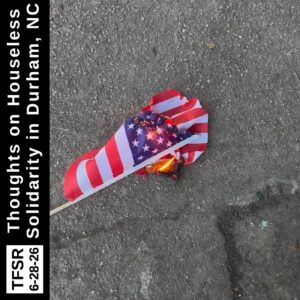
This week, you’ll hear a conversation with Bam and Row, two residents of so-called Durham, NC to talk about that city and industries and their experience of solidarity with houseless neighbors, particularly in the Oakwood Park encampment which the city has already attempted to evict once this year. The guests give a long term and detailed view of the development of the city and the role of Duke University and adjacent, co-constitutive businesses and the city’s research park play in the day to day grind of living in that triangle city.
- GoFundMe to support mutual aid with the Oakwood community
Also, after the interview the guests reached out wanting to uplift Traingle Anarchist Black Cross as one group involved in community support for the Oakwood Park encampment. They meet 4th Sunday (that’s today!!!) from 2-4pm for letter writing at The Burrow in Durham. More at linktr.ee/triangleabc
Finally, many of the people listed as inspirational by Row at the end of the interview have been either guests on this show in the past or the subject of episodes, which you can find under the tag of Black Anarchism.
Announcements
Recent Repression Updates
Federal Indictments have come down against people alleged to have taken part in anti-ICE protests (accused of being Antifa) in so-called Minneapolis. We plan to cover this in an upcoming episode, but meanwhile would direct listeners to recent episodes of It Could Happen Here, Outlaw Podcast and Live Like The World is Dying on the topic (the latter two are pending but should pop up at those links)
Also, sentencing has begun in the Prairieland “Antifa” case, with decades being handed out to make a political point (in the words of one judge). You can follow the updates at PrairielandDefendants.com (and we should be sharing an interview on the sentencing next week, once it’s complete for the Federal case).
Request for call-in to support mentally ill prisoner at the Joe Corley Detention Center in Texas
The prescribed collective action I believe will solve this issue here at the Joe Corley Detention centers RHU cellblock is:
1) A phone zap to warden Dickey’s office, the commissary office and the US Marshals office. The Marshals pay these inmates $1 a day and are responsible for their work ethics while awaiting transfer to a BOP.
Joe Corley Detention Center phone number: (936) 521-4000
US Marshals Office Southern District of Texas phone number: (713) 718-4800
2) Request that these individuals review surveillance cameras in the RHU cellblock where the incident involving a mentally ill prisoner name Brandon that live in cell 243 took place on the morning of 6-25-26 while he was forced to go to rec. This is to verify that he just purchased nearly $100 worth of commissary, a T-shirt- batteries, boxers, etc yesterday.
3) Demand that all of his items be returned to him.
4) Disciplinary for the officers involved in allowing the inmate worker to enter Brandon’s cell wholly unsupervised, take his items and refuse to investigate his valid complaint because he’s mentally ill and can’t comprehend what happened.
Background
On the morning of June 25 2026 officer Henley and a male white or Hispanic looking officer approached Brandon’s cell (243). They told him he was going to rec whether he liked it or not. Brandon complied with their order and was handcuffed and taken to the rec cage outside. I note Brandon wasn’t wearing a commissary T-shirt, nor was he carrying anything when he left the cell.Moments later a Black inmate worker with a yellow skin tone entered the cellblock with a cart used to carry cleaning materials. They say he is amongst the most despised for his interest in stealing from other inmates.
This inmate worker was ordered to clean Brandon’s cell. Not only did he clean the cell, he cleaned him out. As both guards left him to his own device, taking their eyes off of him to tend to less important things. The inmate worker took a large plastic bag full of Brandon’s commissary that he’d just bought yesterday, two bags of coffee and a few things laying around and tossed them in the cart’s trash compartment like it was trash.
Soon after Brandon was placed back into an empty cell and to his dissatisfaction, he protested that Henley had set him up to be robbed.
Henley blew his concern off to a female mailroom employee as a hallucination, but what happened was reality.
Around 10:20am the inmate worker returned to sweep and mop the cellblock wearing, what looked like, Brandons brand new T-shirt under his own jail issued prison garb.
The officer who helped Henley take Brandon to rec halfheartedly asked the inmate worker if he stole Brandon’s commissary, implying he wasn’t present while the worker was in Brandon’s cell. Of course the worker denied taking anything, merely suggesting that the only thing in the cell was trash on the floor. Though he did admit to the officer to taking Brandon’s shampoo to use as he wanted. And his other inmate co worker gritted at Brandon that that’s what gets done to psych patients.
From what transpired both officers not only knew what happened but they created the incident as they already dislike Brandon because of his mental illness, forced him to leave his cell so that an inmate that openly despised him could clean it up unsupervised and stock piled with goodies.
If such acts against the mentally ill are perceived as heroic deeds in the eyes of this inmate worker and guards who condone it. What does that say about observers on standby that cheer them on, or an administration that chooses to assist by covering it up?
. … . ..
Featured Track:
- TFSR by The Willows Whisper
. … . ..
Transcription
Row: Thank you for having us. My name is Ro. I am located in what’s called the Triangle area of North Carolina. I move through lands that have been stewarded by the Eno, Occaneechi, Tuscarora, and Lumbee, to name a few of the indigenous people of this land. That’s how I view my area. As far as affiliations go, I am affiliated with the Oakwood Park unhoused encampment and with all the people who fight for liberation.
Bam: My name is Bam. I use he/him pronouns. I am located in the Triangle area as well, but when it comes to organization, I am based out of Durham. As for affiliations, I am also affiliated with the Oakwood Park encampment for the unhoused, a few political prisoner support groups, and some other general organizing work in the area.
TFSR: Thank you both so much for taking the time to have this chat. I wonder if you could tell the audience a bit about the Triangle, but in particular about Durham, about the landscape, the economy, who lives there, and what living there is like.
Bam: More generally, Durham itself is a supposedly thriving, growing city, one of the so-called Black-run, Black finance cities, similar to Atlanta and Memphis, and other cities around the country. Durham is a place where people have a lot of pride in the history of Black prosperity, of Black success, and the historical Black Wall Street that was in the center of downtown Durham. More generally, economically, Durham is run almost entirely by Duke, that corporation and university. They control and own almost the entirety of the city. They run a lot of the healthcare that impacts everybody generally. So it is Duke City in a lot of ways, even though there is a pride in the Black ownership, Black business guidance and Black success that has been almost entirely funded by white capital and white business.
Durham itself, demographically, is proposed as this super Black city, but, like everywhere, Black people are a minority. The economic disparity amongst everybody is very, very, very large. The inequality between those that have and those who do not have is widening almost every single day. Duke, as a corporation, influences that. They pretty much have the entire city in their hands. With the assistance of politicians and the enforcement by the police and any other state militia, they are allowed to continue to own and control property, and the means of life and survival on an everyday basis. On the ground, the city itself does the bidding of those corporations and allows them to come in and plunder, destroy and take down the wildlife and the trees and plant life across the city to build these brand new, very ugly developments and housing projects that serve only those who have the ability to afford them.
Row: Thanks, man, that was really thorough. The piece that I’d like to add is a little bit of the history of Durham to give some context as to how this pattern that Bam detailed presents. As I mentioned, there are many indigenous people who steward the land that is now considered or called Durham. They actually did the work of making it a place of commerce, of community, and of a lot of trade and life. With the settling of European colonists, or you can call them colonial settlers, they take over, infiltrate, and invade that space and start to build their own settlements upon it. As we know, we get the development of plantations in the region because of how fertile and rich the land is. And it is of importance to know that Durham is the locale for Stagville Plantation, which was one of the largest plantations in the South during the early years of the settler nation. So that’s important to keep in mind.
Stagville Plantation enslaved about 900 Africans, which is what is documented or understood. After the Civil War, the majority of those Africans migrated off the plantation and settled their own communities, like Hayti and Bragtown. As far as how those people lived in the period after the Civil War, during Reconstruction, they actually continued some of the same work that they were doing on the plantations. The cash crop of North Carolina is tobacco, and the Durham area sold a lot of what was called bright leaf tobacco, which is a type of tobacco that has a particular curing process. But the enslaved Africans were procuring this tobacco and doing the labor of processing it while on the plantations. During the migration of these people off the plantation, some of them are sharecroppers still managing those lands, and then as the “city of Durham” grows, tobacco becomes the place where wealth is built. And that is actually how the Duke family garnered its wealth through tobacco and building the American Tobacco Company. You’ll see that throughout downtown Durham. You’ll see the Lucky Strike Tower because that was one of the companies that was acquired to make the American Tobacco Company. The African people who are living in the communities that now make up Durham worked in these tobacco factories, and they worked in subpar conditions. So you see the continued pattern of exploitation of people and the flow of wealth in one direction, and specifically enslaved people and the erasure of native people. That is a process that continues to this day. So I want to highlight that history because it’s really important. And also knowing that Duke is such a huge fixture of Durham, and understanding that the Duke family got their wealth from the tobacco industry.
TFSR: That’s super powerful. Thank you for laying that out. You were talking about the accumulation and extraction of capital by these white elites, and oftentimes with the same literal lineage, same family running endowments, corporations, farms, and plantations. Can you talk a little bit about the industries that Duke is involved with now? Because there’s clearly the university – it’s a very well-known university. There’s a bunch of hospitals that they run, and I imagine that they’re pretty tied into the research.
Row: The Research Triangle Park.
TFSR: Yeah. Could you talk a little bit about whether there are other elements, or how these industries impact the people who live in and around Durham, affecting housing costs or job availability?
Row: That’s a good question. Ben, do you want to answer that first?
Bam: Sure. Duke has their hands on a lot of different things, as already mentioned. When it comes to their involvement in healthcare, owning the two largest hospitals in the city that have a lot of traffic for the housed and unhoused. But also, Duke Energy is the primary energy corporation or functioner in the city, and they are constantly raising prices and jacking up costs for those who are housed. It has been a constant issue that residents who have been mobilizing people have had to fight for to challenge the constant price hikes. Generally, for health care, Duke has their hand and their hold on that in the city, and they are able to allow and disallow folks from having access to that. So a lot of the unhoused folks have dealt with physical and psychological ailments and issues that they’re still dealing with to this day, and they all have to go through Duke. So everything flows through this large, super giant corporation.
Duke Energy and the healthcare system, as well as different aspects of everyday life, are controlled by Duke. And because they have the ability to unhouse and displace people to raise prices whenever they see fit, there’s a constant process of challenging Duke and conceding to Duke that the community has to go through because of how much control they have over pretty much everything in general and every aspect of life itself in the city.
Row: What I’d like to add to Bam’s pretty complete response is understanding the Research Triangle Park, which is a huge fixture of Durham. It’s this 7000-acre lot of land that was selected and has been worked on for decades, since 1959, so the ‘60s. It was a region of development that was curated by the local government, the state government, Duke, other universities, and local businesses. And the point was to make it a place of investment and future development of various pharmaceuticals and technology, making it a hub of sorts within the United States. And in that capitalist endeavor, they were very successful because the Research Triangle Park, which, if you look at the region, is enveloped by Durham on three sides and extends into Wake County. That park is the most prominent research science park in the nation. That park also houses about 300 different companies, IBM being one of the earlier investors. But it’s important to keep that in mind, because that is a jewel of the city. So the point is always to make the city alluring to investors for those who desire to accumulate capital. One of the things that the city and those who are part of the Research Triangle Park are really proud of is that Abby V, which is a pharmaceutical company, recently announced it would be investing $1.4 billion to bring a campus to Durham.
With that massive investment and the focus on developing that research triangle, which has produced some novel drugs that are very important to day-to-day life for many people, you have the focus on building a city that feeds the work and that provides workers for that. So from there you’re going to get this great hostility towards the unhoused, but also the acknowledgment that within a capitalist economy, those who are unhoused are always required. You need that population to do free, very low-wage labor, and the “undesirable” work that will eventually flow out of a region that has so much investment for tech and pharmaceutical companies.
I wanted to end that by saying it’s important to understand the Research Triangle Park and its relationship to Durham, and also to understand that Duke University is one of the key investors in the city of Durham. This relationship is almost linear to an extent.
TFSR: How does homelessness look there? Where are folks who are houseless on the streets and in the parks of Durham from? What relationships do they have with their housed neighbors? And how do the city and university interface with houselessness in terms of services, policing, or allowable spaces?
Bam: We have understood homelessness and the unhoused community in Durham to be the community within the community. Once you are speaking with and talking to and then trying to meet the needs of folks that are living outside, you enter a community that’s dealing with all the external aspects, but having their own way of moving, functioning and focusing on things that need to be done to survive until the next day. We have been observing just the desperation of the condition. And that’s what Durham, similar to most cities, has: the desperation that is bred from those who are unhoused and always on that line of struggling financially. A lot of the unhoused folks are trying to create or find some community. A lot of it can end up being very alienated, very individual, but at the end of the day, folks are looking for a general community. We have seen that as something that has always been present.
When we talk about how the city interacts, there is a constant hostility that is present between the city and folks who are unhoused and live on the direct exterior of the encampment that we organize at. There’s a constant hostility all around them, all around those who are unhoused. And the city utilizes the enforcement of the police to control and corral the unhoused, to imprison and to displace them from their created, almost carved out homes and spaces in which they lay their heads down. There’s a constant hostility towards them for that.
Homelessness in Durham is always greatly underestimated by the city. They have these numbers they put out. Like, we have this many thousands of people who are unhoused, this many hundreds of people in this or that area. And the number can’t ever really properly be calculated because it’s a constantly fluctuating condition: people are unhoused and housed almost back and forth. There are some people who are always going to be on that line of not knowing if they’ll have somewhere to stay next month, next week, or next year. And those who have fallen out of being housed. The city tries to calculate how often to get a number to make their bullshit plans on care and community, but it’s a condition that is just ever-changing and ever-present. There’s never been, and will never be, because of the functions of the state in general, a way of addressing that condition at its root, of course. We talk about root causes. There’s always a straying away from tackling the economic condition that presents that.
A summary is that those who are unhoused or sprawled throughout the city are mainly concentrated in the downtown areas, and are in a constant battle of hostility with the city. They are just trying to find somewhere to sleep, somewhere to sit, somewhere to rest, especially now in the summertime with this hot weather being very unforgiving for those who are outside. But the city is almost hell-bent on making life more difficult than it already is. And that’s one thing that we’ve always understood: that the responses that those who are living outside have – the hostility, the lashing out, the expressions of emotion – just come from being in a constant state of hostility.
The police here target the unhoused very often. They arrest and imprison, and they abuse and target the unhoused almost on a daily basis. With that, there’s no further understanding that needs to be had or created as to why folks feel so hostile, feel so alienated while they’re living outside. Because all they deal with is that condition and the city has no intention of actually addressing that for real. There have been attempts to pretend to care, which I’m sure we’ll get into a bit later, but there is always a constant level of hostility towards the unhoused communities.
Row: You’re always giving such a great overview and understanding. The piece that I want to add is that, as Bam had stated, there’s difficulty in figuring out these actual “statistics.” But it is documented in many city and county reports that the unhoused population of Durham and Durham County is disproportionately Black. Obviously, that is not surprising when you understand the history of this anti-Black settler nation, and also specifically the history of Durham. It’s not ironic, but the city uses its history of a Black Wall Street as a way to disregard those Black people who cannot be part of the affluent “society.” And it’s funny because even Black Wall Street was first becoming what it is, specifically in the 1900s in the period of Reconstruction, we have John Merrick. He founded the North Carolina Mutual Life Insurance Company, which is the largest and oldest Black-owned life insurance company. And then you also have the creation of M&F Bank, which is a Black American-owned and managed bank, and one of the strongest in the nation. You have this Black Wall Street that’s developing at the time, but still that wealth is allowed and funded by the wealthy white elite of the city. You can look through the history, and documents will say that some of these people received some donations and endowments from white benefactors, or were even allowed to create these businesses because there were some white folk that thought, “Okay, this should be okay. This is within the purview of what we would accept.” But that still leaves the majority of Africans, of Black people in the city, dispossessed, working in those factories that I talked about, sharecropping, and really struggling in even the domestic sector to make it by day to day. Again, that history continues through the development of Durham to now. There have always been those who are unhoused – but in this current day and age, you see the population being disproportionately Black. So it is very tied to the anti-Black history of the nation and the anti-Black development of the city of Durham.
TFSR: With the Research Triangle and the university, the city has probably become harder to live in. I would imagine that the costs have been going up over the last couple of decades, as “gentrification” ramps up, as it has in so many places around the country, pretty much everywhere it feels like. And I would imagine the housing crisis, like it did everywhere in 2008, ended up being a series of events that had a terrible impact on, in particular, homeowners of color. Does the city have a business improvement district? One got passed maybe a year ago in Asheville, and that’s been another layer of anti-Black but also class-based policing of the downtown business district. Does Durham have something like that? What does that look like?
Bam: Yeah, Durham has the DDI, or Durham Downtown Incorporated. It’s officially a nonprofit organization, but they’ve had it for a while now. And for the past 20 or so years, they’ve invested a few billion dollars in building and creating a thriving downtown area, with additional businesses and creating new opportunities for jobs and things along those lines. So they have something similar to that. And the institution of that correlates with how much more aggressive or aggravating the unhoused condition or the housing crisis has been. If I remember correctly, the Business Improvement District was founded in the 90s, and since that time, there has been a continuous growth in the number of unhoused individuals. As I can understand, homelessness and that condition are a required aspect of any expansion or development. For capital to thrive and for capitalism to continue to exist, there needs to be a permanent class of people who are always struggling. And the Business Improvement District added and aggravated that condition even more by continuously expanding, destroying and deforesting land in the city, and continuously building new businesses that hardly anybody even interacts with. They are just there taking up the space and displacing people, forcing them out of homes, and continuously jacking up prices of the living conditions in general. While we are mainly organized with folks who are unhoused, we do also work with those who are housed. They can attest to the fact that the price for their conditions of living has gone up so drastically. There are also hundreds of businesses opening almost every single year in the city. That is directly correlated.
But the condition of being unhoused is a permanent requirement for that expansion. Because if there are those who are struggling, who are dispossessed completely and have nothing, they will always have a supposed desire to get back or gain something, to work and labor. And as more businesses grow they need laborers for said businesses, and that’s where the condition of being unhoused or the condition of intensified unemployment comes into play. Because then that permanent class of people who will always be struggling on the edge of being unhoused or being unhoused quite literally will also always be able to be employed to work in these businesses that are ever growing.
TFSR: A kind listener sent me a couple of articles about the eviction and refounding of an encampment at Oakwood Park, which happened in May of this year. You both have mentioned it, so I wonder if you could talk about the encampment, what reasons the city is giving for why it’s mounting these evictions, and what you think is behind it.
Bam: The project for the encampment itself comes from more of a collecting of the individual asks of those who were unhoused in Durham or in the area of the encampment. People reached out for immediate medical or healthcare support, and we provided as much assistance as possible. And then being introduced to the growing encampment at Oakwood Park was a side effect of being present to assist those individual needs. As we were working and getting used to that project, we were made aware of a sweep that was impending at the park in early April by the city workers and the police. Specifically the HART program or HART Team, which I believe we could probably end up talking about later on, were also part of that initial attempted sweep.
So, being aware of that, there was a decision to defend those that were there, and it turned into this general project that we have now. But the city has consistently made encampments a public health safety hazard, or whatever they might call it, because they say that encampments are invasive in these public spaces. They will give you a thousand reasons – there are needles on the ground, glass everywhere, people smoking, supposed public sex acts happening at the park – whatever reason they can give to not only employ the police but also employ the general surrounding housed community to the horrors of this encampment, supposedly. They have given many reasons why it needs to be evicted and cleaned out to allow for kids to come and use the playground and things like that. We can understand, being on the ground, that none of these things are true. But there is a narrative battle they are constantly engaged in at the city level to ensure that whatever they do can be properly understood by the general community, and the practice of it can be turned away from and looked away from by the majority of the city. They have not said, but the real reason is the social aspect of what encampments mean for a city that is trying to grow in the way that Durham is trying to grow. There needs to be a constant show of the city being in tip top shape to show investors that this is a place that is ready and ripe for investment, for production, for expansion. And the existence of unhoused encampments is just something that cannot stand if the city is going to be given billions of dollars to build whatever business that will supposedly benefit the community or the city.
So there’s a constant process and project to protect the image of Durham. There is a new encampment almost every month now in the city of people who are just outside, need somewhere to go and look for that community on the small level. There’s a project to remove and replace all of these encampments at some point down the line to protect that image of Durham being a thriving city that benefits everybody and whatever myths that they can come up with. That’s always been the project. For most cities, and Durham is not unique in this, the image of the city is everything when it comes down to business ventures, economic expansion, and the social understanding of a city, and attracting people to move there, live there, or whatever other aspirations the state has for these cities. The removal and clearing of encampments is a part of that process. Because if we can plunge, imprison, kill, and dispossess the undesirables, then our city can be purely for those who have by removing those who do not. The efforts that we have been able to commit to and be somewhat successful in have challenged the literal and figurative bulldozing of encampments. They have disallowed these efforts to just be cut and dry, and they drag the city out to fully show why it is they’re doing what they’re doing. Not because we’re going to confront them on their grounds, but because the project of defense is one that will just shed light on the truth of the condition. Another scenario is that we end up against the will of the state, which tries so often to hide its true intentions.
Row: I understand the encampments as necessary. People need a place to be, to rest, to live. More often than not, people want to do that among other people and not be isolated. So the encampments develop as a natural process of how people live. And as Bam detailed very astutely, the way in which those who are unhoused live is considered unsightly, but not of their own causes. This is their living in response to the conditions that have torn them away from their basic needs, and they are making do. So that is why they are there, and that is why they keep coming back. The evictions are for the development of land that they may occupy, The land is now lucrative or appealing to developers who want to build new houses, apartments, and communities for ideal workers who can work in the Research Triangle Park or in the headquarters of certain pharmaceutical and tech companies that are in downtown Durham.
So the unhoused become a nuisance in that regard, but the evictions of them are very important to the image, as Bam stated. It’s important to understand the ability of the state and its police to move, corral, incarcerate, and harm people who have been marginalized by the capitalist economy. It is important for that process to look seamless because that is a marker of how easily and how well the ruling class can accumulate their wealth, build capital, gain capital, and continue to exploit. It’s a really disgusting display of what we can do, demonstrating that we have control of our city, and we are able to create these borders firmly.
TFSR: Can you all talk a bit about the organizing that houseless folks and their allies have engaged in, in terms of mutual aid and eviction defense?
Bam: The folks that we have been supporting have asked for a multitude of different things, but more generally, a holistic project that can combine meeting their needs and, in the presence of imminent danger, the threat by the city, its police and by its reformist organizations. Through the triaging of certain needs by the people – whether it is getting comfortable things to sleep, to get clothes, to supply food, water, and drinks – the needs of everyday life became the project of defense. Because it builds a level of trust amongst the community to be able to rely on other people to get what they need, to create that need for themselves, and to create the things that can meet that need.
So, we have been tasked with ensuring that there is a way of empowering people who are unhoused to supply themselves with what they need to get through the everyday. Results from that vary from trying to build a project like that to creating some autonomy within a space. It just takes time to build up the desire to do so, but the conditions still stay the same and still are desperate. For more specific projects, there’s some things that we’ll keep as internal things that we’re trying to work through and do and commit to. But more generally speaking, the combination of mutual aid and defense of the encampments and defense against sweeps and evictions is one that relies on a lot of trust for us to come into the living spaces of people who are living outside, bring what they need, and also protect them when the time comes for that. Because while we haven’t dealt with any specific threats from the city, the time will always come back around. So we are trying to build in the meantime.
Especially in Durham, the term “mutual aid” has been appropriated and perverted by many a nonprofit organization and by many people who desire to assist but don’t have the actual political, ideological commitments to maintaining that process. So, for us, mutual aid meant not only supplying the material needs, but also trying to build an ideological support for that. It didn’t take much for us to come in and say that we don’t want the police to come in to try and evict people, and for folks to say, “We don’t either, but how do we do so?” We are trying to build up the ability for them to do that themselves. There’s a commitment to the encampment, to being there, to being present. Folks don’t just go and get up and leave; they’re committed to being there because of what’s being built. That’s just through engaging in methods of building that trust from us and also amongst each other.
The defense comes down to there being a physical presence whenever there is an attempt. The first attempted sweep was thwarted through a spontaneous gathering of people at the very last minute to defend the space. In the second one, some folks were removed and thrown out, but within an hour of it, were brought back and set back up. That was just through a constant commitment to making sure the space remains there, remains open, and remains accessible to folks that need it. It’s been that way ever since. This combination of mutual aid and meeting needs, and also defending when the time comes relies on the constant everyday process of building the trust amongst those who are housed, who are allied with the unhoused, and within the encampment itself – to rely on each other and make sure you can trust the person that you’re sleeping next to every single night, whether in the same tent or separate tents.
TFSR: One neighbor of the park is quoted in a News Observer article from April saying that the park lacks the resources appropriate for people’s needs, like running water, sanitation, etc. And it puts the onus on the city for not providing a permanent shelter as part of the city’s responsibility. This clearly is not the whole picture, because it’s still looking at homeless people or houseless folks as a problem to be dealt with, as opposed to people living in a condition and a circumstance who have agency. Though it does touch on a point that gets lost in these conflicts: cities often offer meager housing opportunities. They limit where people are allowed to exist, and they pit housed neighbors against their houseless ones, just hoping that the houseless folks will go away or disappear. And houseless folks’ views and concerns get lost in the mix, as if they’re just shuffled from place to place, or no place at all. Do you want to share anything about the tensions between neighbors, the people camping in the park, and the city?
Row: In my time with the folks at Oakwood Park and seeing the dynamics between neighbors and between the city, it’s very clear that the tensions are mounting in a very specific direction. Simply put, it is the pig class versus the poor and the unhoused. By the pig class I mean those individuals who are not the ruling class but who are affluent or what we may call middle class (or even poor), and who align themselves with aspirations of becoming ruling class or engaging in all the societal and economic structures that allow the rich to be rich only simply for the ability to maintain a level of privilege above others. In that regard, we have encountered those neighbors who make it their duty almost to surveil the encampments, to spread lies and disinformation in the avenues that the city has provided for them, meaning the city council. Folks love going up there and saying how disgusting, off-putting, and dangerous these encampments are. And that’s where the tensions build.
The dangerous part of that is that the individuals who are the pig class rely on the police to handle their discontent, which puts those who are unhoused at greater risk of the destruction of their temporary homes, incarceration, and death. But even with that tension, we still have many, many people that understand that being homeless or being unhoused is not a foreign state or condition. It is merely an inevitable progression of one’s own condition living in this very hyper capitalist environment, where in order to get to live every day, the majority of us must work very hard. So even with those neighbors who make it their job to make the day-to-day life of those who are unhoused difficult and who choose to align themselves with the ruling class, there are many of us who are engaged with the encampment and the people there who understand that this is the condition we have been dealt under capitalism. And we are committed to figuring out ways in which we can resist and strongly and firmly oppose the city and all the state structures that make it so that we are constantly housing insecure or completely dispossessed.
Bam: When it comes to the relations between the housed and unhoused, there is an ideological or social separation between these two conditions. Even though some are housed, some are not often too far off from being unhoused, just because of the unsturdiness or the insecurity of just being in these conditions – being poor or being on the brink. There’s still state-manufactured alienation and hierarchy being built between those that have and those that do not. And it might not always be materially real, but it is something that is mentally and psychologically embedded to where those that have a home, have a job, and are working or making some money can always be secure in the fact that “at least we’re not them:” those that sleep outside, those that sleep on benches, that stay in tents, and that are in encampments. There’s always that separation. And within that, it allows for people who have to do everything they can to make sure they don’t get to the condition of being unhoused. That adds to the idea that the state and that capital will always have people who are willing to work, labor, and do whatever occupation to make sure they have money. Because there are economic implications for that, but also social implications – not wanting to fall down that ladder, to be completely dispossessed and displaced. Being willing to do whatever it takes to be somewhere besides outside.
And even those that we take care of who are in the encampment also have aspirations to be somewhere else. Most people when you ask them what they want say they want a job, they want to work, they want to labor. That’s an understandable next step for the condition, but it’s something that has been put as the pinnacle of what people can do, or what people have access to. When you work, when you have something to go and make money from every day, when you’re toiling away for hours a week – that becomes the pinnacle. That condition socially creates and reifies the existence of the exploitation that people face on an everyday basis.
It’s a psychological condition that we try to struggle against almost every day at this point to challenge the psyche, understanding it is not something that is inherent, but something that is embedded in the minds of people who live outside and are housed as well. It is something that has to be challenged as not the final or last step to success or to prosperity, but something that has been proposed as the primary way to be useful, to be of use to society.
TFSR: The city has worked alongside Research Triangle Institute International (RTI) to create this project called Holistic Empathic Assistance Response Team (HART) that has participated in some of these sweeps. Bam mentioned HART before. Can you talk a little bit about what this is? There was a project called CAHOOTS in Eugene, Oregon that was meant to be a non-police emergency response and I wonder if this started off as something in that vein. They’re clearly working with police during these camp evictions. Can you talk a bit about the relationship between the university, the police, and this HART project?
Row: I really want to pass this to Bam first, because he has some really interesting and important things to say, and then I’ll go after that.
Bam: I’m not familiar with CAHOOTS, but I am familiar with the activity in Eugene when it comes down to the eco-activists, eco-defense organizers, and movers over there. But HART, and more generally, the Community Safety Department was created in direct response to the 2020 uprisings. It was something that the state had signaled to the cities around the country to create some reform or to offer some concession to people who were rightfully engaged in rage for rebellion across the country in response to the constant police killings and police activity in certain communities. So, the Community Safety Department in Durham was created in response to that and to start the process of quelling the anger of the people.
HART comes around to function as the non-police, non-lethal emergency organization or force that is the alternative to the police. They are beyond policing, from what some folks might say. They function in a way where they will tell you up front that we do not work with police, we have our own thing, we’re here for you, we care for you. But in their practical and functional activity, they do the exact opposite. It’s clear with the encampments because we see that they were active and present and telling people before the attempted sweeps that the cops were coming, that they were on the way to come and clear out the encampment. It’s showcased to a lot of people who are staying outside the true function of HART. We have been in a constant battle to delegitimize their existence, even though they’ve attempted so often to reify their place in the city and then within the unhoused population.
They’ve infested a lot of different encampments with their activities, supposed relocating and housing efforts. They tried to create a permanent place in the function of the unhoused on an everyday basis, but their true intentions were to be a part of that controlling and corralling system that the police, the city, and the general state take part in and activate. HART has expanded its programs. Now they have systems or programs like the Involuntary Commitment Program, where they can just take someone off the street, kidnap them, and place them in Duke Hospital, with which they have a partnership for that program specifically. Because they decide through whatever process that the folks who stay outside cannot make decisions independently. They must be made for them. And they’ve expanded out to these projects as a direct combination and collaboration with the police, because they understand that there is such anger and discomfort with the police coming and doing certain things that HART becomes the replacement for that.
That is a direct reform response from the 2020 uprisings. HART has tried its best to distance itself, but when you can clearly see that they are engaging with the police chief, talking to them during sweeps that are currently happening to discuss what needs to be done, and getting messages from the police back and forth, the collaboration is clear. And then when you engage in that involuntary commitment program that takes folks off the street, and we have a very specific example of that from one of the folks that stayed in the encampment, you can see that the carcerality never leaves these programs when they come from the state’s formatted reforms. It’s always there: the capturing, the control, the ways in which they can just be kidnapped off the street are permanent in any law enforcement force, and HART exemplifies that as well. They continue to do so, but now, with the more community-based defense projects and assistance projects for the unhoused, they have been rendered obsolete. But that project, at least for me personally, is still ongoing.
Row: Thank you for that, Bam. The analysis that you have been building, as it relates to HART, is really important. I want to add that they irritate me so goddamn much. I cannot stand the way in which they move, which is so cowardly and so deceiving. They have this reputation that they’re trying to build regarding making announcements to certain people in the community who are considered activists to say, “Hey, we’re aware of the police planning a sweep on this day.” And they feel very proud about that, because they are doing what the city told them to do. They present themselves as a separate entity from the police in doing this kind of like “Hey, just want to let you know, violence is coming your way, please, duck and cover. If you need help ducking, we’ll help you duck.” It’s not their purpose, but they don’t make any effort to stop the police, to counter the process, or counter whatever decision-makers are saying that encampments need to be swept. They don’t actually intervene to say, “Hey, we have all this ‘affordable housing’ that we’re building. But this is unrealistic. It’s not affordable. People just need to be housed. We have all of these empty apartments, all these empty buildings. What can we do with them?” But no, their job is to make people complacent and comfortable with the violence that will be coming to them. That is why I really despise them, and they irritate the hell out of me. That’s it.
Bam: I just wanted to add, lastly, that HART does come from the idea of an alternative to policing. In Durham, it comes from a community demand that was created around the time of the uprisings and the creation of the Community Safety Department. People in the community who were organizing then did advocate for a program that was different from the police. But what many of them and we have understood is that when a demand is given to a city or to a state, there is always a possibility for it to be co-opted and become something that benefits the state but hardly ever benefits the people who made the demand. And that’s what HART became for a lot of people. With the institution of HART into almost the everyday programs of emergency response, it became at least formatted to what people wanted – an alternative. But when the idea is taken by the state, it becomes something that will always, always reify their existence. And that is something that the community didn’t really want, but that’s what it was given. That’s why the making of demands in that way always ends up back in the same place – as a concession being given and co-optation – which infests all demands that people make.
TFSR: The state is never going to give up power, and so every demand to it needs to be taken with the expectation that you’re going to get handed a snake and not a handshake.
Well, I’ve had you both on for a long time, and I really appreciate this conversation and all you had to share. I just wanted to close out with a question. What are some lessons that you take from the organizing that you’ve been engaged in and seeing going around homeless communities in Durham? And also, if there are any groups that you want to uplift for support or further information from listeners in the audience.
Row: I’ll start off here. As someone newer to this type of community organizing, the lesson I’ve gained so far is that organizing is not simply just lectures, webinars, and reading all the books and knowing how to quote so-and-so in a debate. It is really the process of reading texts that are impactful. For me, I’ve been reading George Jackson, Kuwasi Balagoon, Safiya Bukhari, Russell Maroon Shoatz – reading the theory, the experiences, and then implementing that as I go into these communities. Because I see these people as my people, as my family. I share what I’m learning with them, and we work together to determine what practice works for us and how we will move as a unit. How do we deal with conflict? How are we honest with each other and what can we and cannot do? I see what Lorenzo and JoNina Ervin were saying, when it comes to meeting the daily needs of the people. That is the organizing that will build relationships and community and that builds the movement that is outside and inside, meaning behind the walls and outside of the walls. Making that connection is really figuring out every day how we are going to build a new world within what we’re doing right now, how we actually share and spread what we are learning and the understanding of our condition, and how we are going to determine how we deal with that. That’s one of the greatest lessons, and within that, there’s the recognition that it takes time. It requires patience. It requires listening that respects what people are saying, the histories they may give you of themselves, and of the place that they’re in – of the city, the city officials, and politicians that you may not have even known. Just being honest overall. Hopefully that made sense, but that’s what I’ve been learning.
It’s been a beautiful process. Very, very difficult. Nothing has been easy, and nothing has been too beautiful, in a sense of “one plus one equals two.” The simplest one plus one equals two is like, “I need some water,” and you’re like, “Great, I have some water for you.” But it’s been very rewarding. One thing I’d like to leave off with is that Michael Kimble, who is a Black gay anarchist political prisoner, has said in the struggle for building a movement towards liberation, he’s received a lot of joy. In that it’s been hard, so hard, but it’s the building of those relationships that makes it worth it, and the change that happens that makes it worth it. And so I’m definitely seeing that.
TFSR: That’s awesome. Thank you so much for sharing.
Bam: I can say what I learned, but it’s not much more of a conclusion than that, for real. I’ll try to sum up. One of the main lessons that I’ve learned is that a lot of organizations or projects in our area, and more generally, tend to be very singular, individual. This project has taught me and those with whom we work how necessary holistic organization is. How necessary it is to build holistic projects to meet all the requirements for communities. And we don’t learn what these things are until we actually engage and discuss and decide. Working with the folks in the encampment at the park, we have been able to discuss certain histories, certain theories, as Row explained, study with them, and read things. And we have studied and talked about the concept of what it means to resist, what a constant state of rebellion is, and how that happens when you are unhoused and you continue to live every day and survive. You are in that state of rebellion. Just being conscious of that is the next step.
A lot of folks aspire to a lot of different things. They aspire to be liberated, they aspire to have somewhere to stay, and they aspire to take what they need. That is a very important aspect that has taught me to be more understanding, more open, and more observant of what the aspirations are—and also to learn that nothing is inaccessible to those who are unhoused. None of the reading, none of the studying, and none of the organizing tactics – nothing is inaccessible. It all just has to be shared, and we are in a struggle, in a project that is a walking and breathing and ever-changing archive for our work. It needs to be shared, it needs to be disseminated, and it needs to be opened up, so that we don’t have projects that are stagnated. So that we have projects that can develop and grow. And this project has needed and will continue to need constant development and growth. I’m excited to continue on and to push past where we are now to get to something even greater than this.
Row: I did neglect to say that I would encourage folks to please consider donating to the Oakwood Park Fund. We collectively use that money to get folks what they need every day: tents, water, food, fans. If people could donate, that would be greatly appreciated.
Bam: No specific groups exactly that I can name. I would tell folks to just tap into the park if they’re in the area. Even if you are a few hours away, there is work that is continuing and growing every day in our city. And if there’s interest in being involved, come find where people are at, come find what a movement is, and then try to join, try to be a part of it in some capacity.
TFSR: That’s awesome. People can’t have too many comrades, so that’s a good suggestion. Row and Bam, thank you so much for this conversation. I really appreciate it. I’ll put a link to the fundraiser in the show notes, so folks should look at the post for this. Thank you so much for taking the time to share your experience and your wisdom.
Row: Thank you.