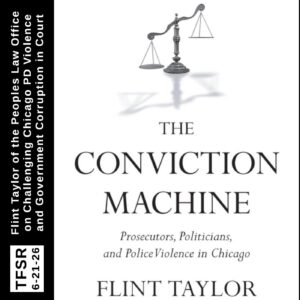
This week, Ian spoke with G. Flint Taylor of People’s Law Office in Chicago and his new book, The Conviction Machine: Prosecutors, Politicians, and Police Violence in Chicago, out now from Haymarket Books.
The conversation vacillates between the past and the present as Taylor talks about the misconduct and cover-up by the FBI and Chicago PD in the assassination of Chicago Black Panther’s Leader Fred Hampton, the forty year effort to free Jackie Wilson, the tradition of movement lawyering, and the legacy of the People’s Law Office.
. … . ..
Featured Track:
- TFSR by The Willows Whisper
Transcription
TFSR: Good afternoon. We are joined today by Flint Taylor, author of the recently released The Conviction Machine on Haymarket Books, and, prior to that, The Torture Machine, which was published a few years back. Mr. Taylor, can you introduce yourself to listeners and offer an overview of your career as a lawyer and, subsequently, as an author?
Flint Taylor: I am an attorney with the People’s Law Office here in Chicago for over 55 years, since we founded the office in 1969. I’ve been involved in several very important cases, both here in Chicago and nationally. First and foremost, perhaps, is the assassination of Black Panther leaders: Fred Hampton and Mark Clark in 1969. I was involved in 13 years of litigation in that case, which ultimately established that it was an assassination that was masterminded by the FBI with the local police and the state’s attorney, the chief prosecutor of Cook County. I have also been involved more recently in helping to uncover and litigate against a pattern and practice of systemic police torture here in Chicago that lasted for about 20 years, from 1972 to 1991 and was masterminded by a police commander by the name of Jon Burge. The office here continues to represent many movement folks who get caught up in the throes of the fascist state, for the lack of a better word, prosecuted or brutalized, and sometimes murdered and assassinated.
TFSR: Thank you so much. Going back to the beginning, can you talk about the origins of the People’s Law Office? What influenced its inception? What, if anything, was it modeled upon? What impact did it have from a local, national, and professional perspective?
Flint Taylor: The office started, as I said, in August of 1969. It started because several young lawyers, and I was a young law student working with these young lawyers, were working in legal aid offices in the city, and they were representing the Black Panthers, the Young Lords Organization, SDS (Students for a Democratic Society), and other radical and revolutionary organizations, their members, and leaders. And of course, Legal Aid did not count on such representation out of their offices, so they basically gave an ultimatum and said either you stop representing these folks or you’re no longer working with us. So the lawyers took the initiative to go out on their own and found an old sausage shop near the west and north sides of Chicago and we made it into an office.
Previously, we’d been representing various organizations, most prominently the Black Panther Party, and its young, very charismatic leader, Chairman Fred Hampton. We moved into the office. The lawyers were Dennis Cunningham, Don Stang, Francis Skip Andrew, and Jeff Haas, and several of us law students as well. We took the name People’s Law Office. There’s several explanations for why, but the one I like the best is that the Panthers, of course, had the people’s breakfast program and the people’s medical clinic, and we were their lawyers. So we were the people’s lawyers in the sense, so we were the people’s law office, and so that’s how we were named, and we take that name very seriously.
Within months of the founding of the People’s Law Office on December 4th of 1969, Fred Hampton, the chairman that I mentioned of the Black Panther Party, who was perhaps the foremost upcoming Black Panther leader in the entire country at that point, and Mark Clark, a leader from Peoria, Illinois, who was visiting Chicago, were assassinated in the early morning hours by a group of 14 Chicago police officers who formed their own little unit under the chief prosecutor of Cook County, Edward. V. Hanrahan. That raid left both Hampton and Clark dead, and five of the other young Panthers in the apartment wounded. All the seven survivors were charged with attempted murder, certainly a frame job, and that led to 13 years of litigation in the criminal courts and in the federal courts of Cook County, having to do with exposing the truth about the assassination of Fred Hampton.
TFSR: Jumping ahead just a little bit, Edward Hanrahan, at least in the first part of the book, is something of an antagonist. He figures prominently in The Conviction Machine, and he seems to embody many of the political and social currents with which the Black Panthers were in conflict, or swimming against. Can you talk a little bit about who he was and where he figured in the Chicago political machine?
Flint Taylor: To say that he was a bit of an antagonist is quite an understatement. In the book, I focused particularly on prosecutors. As you know, the title of the book is The Conviction Machine, which is kind of an extension of The Torture Machine, my first book. The Conviction Machine is prosecutors, politicians, and police violence in Chicago, and so I looked at Hanrahan and all of the state’s attorneys, the assistant prosecutors who worked for him during that era. The era we’re talking about is 1968 through 1972 specifically. Hanrahan was elected in 1968. He was part of the Democratic machine. He was perhaps, or was the second most powerful politician in the city of Chicago. Richard J. Daley, the father of Richard M. Daley, who had been the mayor of the city of Chicago for over 15 years at that point, was headed towards either retirement or passing the torch, and the person who was expected to have the torch passed to was none other than Edward V. Hanrahan.
Hanrahan was a person larger than life who was very much an advocate of “law and order,” which was a thinly veiled attack here in that time on the black community in general, on the youth in the black community in particular, and even more particularly on what he called and what he unveiled, along with the mayor, “the war on gangs.” The war on gangs again was an euphemism for a war on black organizations. There were many strong street organizations in the city of Chicago, as well as several revolutionary groups, and the most prominent of those Black groups, of course, was the Black Panthers. So that war on gangs was in reality a war not only on gangs in the city of Chicago, but particularly against the Black Panther Party. From there within a year of his election in late 1968, Hanrahan, had taken the war on gangs all the way to 2337 West Monroe Street, which was the apartment that his little group of fourteen Chicago police officers, who were assigned to him, attacked and raided and murdered the morning of December 4th.
TFSR: Maybe slightly off the topic, but I wonder at what point in your opinion the Black Panthers became such a threat to the authorities?
Flint Taylor: I think it started almost as soon as the Panthers were born in Oakland in 1966 with Huey Newton and Bobby Seale, because the Panthers had a 10-point program. The 10-point program covered many what we call now socialist programs, the breakfast program, for example, or the health program. It was serving the people. They had a newspaper, but they were also very much in opposition to the war in Vietnam that was happening at that time. That program called for resisting going to fight. The program also called for the abolition of prisons, in essence, the release of political prisoners. It also quite prominently called for self-defense. Self-defense against the rampant police brutality and police violence that we found in various communities, particularly the black and poor communities across the country. And certainly, Chicago was one of those communities.
Local authorities, local police, very early on came into conflict with and focused on the Black Panther Party for attack, for ultimate neutralization and destruction. J. Edgar Hoover, who was the head of the FBI for decades at that point, got totally involved in going after the Black Panther Party with his, among other things, secret COINTELPRO or counterintelligence program. At some point Hoover told Congress that the Panthers were the biggest threat to the internal security of the country, and so the focus shifted from the mid 60s, which was an attack on the Black liberation movement, Malcolm X, for example, Martin Luther King, Stokely Carmichael of the Students Nonviolent Coordinating Committee.
As the Panthers blossomed in the north, particularly starting in California, and then moving east to New York and Chicago, and all over the country, they became the focus of COINTELPRO, and were targeted for “neutralization” (that term was used and popular with the FBI) and ultimately for destruction. They attempted to destroy their leadership, who were marked as those whom I named, and also in the FBI’s own words, “to prevent the rise of a messiah who would unify and electrify the Black nationalist movement.” They were looking to not only neutralize the leadership from Dr. King all the way to Malcolm X and Fred Hampton, but they were concerned with disrupting and preventing the unification and the coalitions between Black, Latino, and radical white organizations in the late ’60s.
TFSR: Thank you very much for that. Moving a little bit into the process of constructing these narratives, in my understanding, both of your books have been placed into narrative form based on your notes and your records. What are the challenges of piecing together a story in this way? Can you also talk a little bit about the process of writing these books?
Flint Taylor: For many years, as I mentioned earlier, I had been fortunate enough to be involved in highly significant political cases that involved the police, prosecutors, and politicians. And from time to time, people would say, “Hey, you ought to write a book about that.” As I near 50 years in my career, back in my late teens, I said, “Well, maybe I will do that.” So I started to think about writing, and actually did start to write. I was able to do that, because I was in the unique position of having lived through and been one of the persons who fought against the powers that be in these cases. I not only had a memory of them, but also I pretty religiously had kept records. I had transcripts from the infamous or famous Panther trials. I had transcripts from all of the torture cases. I had briefs and other things that we all had written from time to time. I had all sorts of articles that I had collected, so I was able to put together on paper a history that not only had in it the detailed factual data that I had collected, but because I had lived through it, I had my perspective and my own understanding and memories.
That was how it came together. It was no easy feat to do it. The Torture Machine ended up being around 550 pages long. So I took two or three years to write that piece by piece, chapter by chapter, sometimes in the evenings, because I was still an active lawyer at that time. But I was fortunate with regard to The Torture Machine, and again with The Conviction Machine, to have a very, very skilled, sympathetic, and understanding editor at Hay Market, woman by the name of Carolyn Luft. She took what was a lawyer writing and helped to make it more understandable in terms of what a layperson would read rather than what a lawyer might write.
TFSR: Can you speak to that a little bit? Because I think that that’s an important distinction to make, and I would like to know what permutations need to take place in your written language to achieve that layperson voice that you mentioned.
Flint Taylor: Well, lawyers, as anyone who’s picked up a legal brief or a court decision can certainly attest to, have a kind of a stiltified language. It’s codified in a way that you’re talking about legal cases, you’re talking about legal theories, you’re using legal lingo, all of that. I was fortunate, and we at the People’s Law Office were fortunate enough from the beginning to learn under the mentorship of Dennis Cunningham to write, what would be considered now outside of the legal box. In other words, from the beginning, we would write briefs that were more focused on the facts, more focused on bringing out the contradictions in the cases, bringing out the outrageousness of what had happened, and making an attempt to put that in less legal terms.
I’ll give you an example. In the Hampton case, we went through an 18-month trial. We had one of the worst judges that could be imagined. It’s in the book, it’s in both books, actually. People can read about that process. He threw the case out after 18 months of trial. To synthesize all of this outrageous decision, we then had to go through a 37,000-page transcript, pull out the facts to convince an appeals court that he had wronged us, that he had wrongfully made this decision. So we wrote a 250 page brief, which would be unheard of in this day and age, that synthesized all those facts. Going back and reading it now, it still stands the test of time in terms of how we told the story of the conspiracy to assassinate Hampton and Clark, and to cover it up, and of all the people from Hanrahan to the FBI to the police in that conspiracy. We already wrote in a different way than most lawyers. Let’s put it that way.
In our brief, as you open the cover, we had the pictures of Fred Hampton and Mark Clark. That’s not something that you’d see in a normal brief. And when we got to the end of the brief, usually lawyers will sign it respectfully submitted, and then they’ll sign their names. Many of us worked on the brief, but three of us, who were kind of in charge of the final production, debated whether to change the “respectfully submitted” to “all power to the people” and sign the brief “all power to the people.” We debated that for a while, and we came to a lawyer’s compromise, in which we signed it “respectfully submitted” on the right side of the bottom of the page, but on the left side of the bottom of the page, we put “all power to the people.” So in some ways, we and I were a step or two ahead of or removed from your normal lawyer writing.
Nonetheless, I would get edits back from Caroline. I would send her, let’s say, a draft of a chapter, and she’d come back, and redline it, and I would learn from that how to write a little less like a lawyer and more like just a writer. That was a process that went on for several years. It took us several years to finish The Torture Machine, and I learned quite a bit from her on that. I’d also been writing a lot of articles for different publications, some of which would be legal publications, and I’d focus on the law, but other times I’d be writing for something like Truth Out, or occasionally The Nation, or whatever. So I would be writing in different forums, and therefore I would be learning and changing the focus of how I wrote depending on where and whom I was writing for.
But I’ll say one final thing on the way we wrote that brief in the Hampton case. From the three appellate judges you get, we were fortunate enough to draw two very good out of the three judges on appeal. If you read that opinion, any young lawyers or law students who are in the audience listening, if you go to the citation of 600 F.2d, which is the law book citation, you read a 70-page decision which lays out the conspiracies. I would challenge anybody to find another case in the law books that is quite that remarkable in how it lays out the facts of the conspiracy to overturn the decision of the judge who threw out our case.
TFSR: Thank you very much. With all of your experience, from then until now, can you speak at all to the shifting terrain of “movement lawyering”? Is that okay phrase to use? Does that seem like an accurate description?
Flint Taylor: Yes, I think, like being a people’s lawyer. It’s, how should I say it? It’s a term that in my mind has a very positive meaning.
TFSR: Can you then speak to the shifting terrain between then and now? I would imagine that it’s something that is affected and ebbs and flows over the years, depending on external factors. Maybe in broad strokes, and then maybe we’ll try to get a little bit more specific with that, if that makes sense. I would imagine that the factors that influence the efficacy at any given moment are political and social factors that people might expect. Can you maybe draw what those factors are? Draw those factors out for listeners, and maybe point to the obstacles and advantages at any given point that are static and those that are dynamic?
Flint Taylor: Well, being a movement lawyer can mean many things to many people. Some lawyers will call it being a public interest lawyer; that’s a little bit more of a sanitized version. Movement lawyers, people’s lawyers, and public interest lawyers we’re all part of a big family of lawyers who deal with issues rather than money. In other words, lawyers who are committed in some form or another to the struggle. And the struggle obviously was and is multifaceted. It covers a wide range of topics, issues and confrontatioss, and different fights that, as you say, ebb and flow to some degree.
But there’s a current there, there is a constant flow through all of it. The system, government, the people who enforce the rules and regulations of the government and of capitalism, continue to be there. And they continue to do some version of the same kinds of things, same kinds of oppression and repression, the same kind of, in various forms, racism, white supremacy. You see all those factors running through the history. And I can speak from when I first became a law student involved with the People’s Law Office to the present, which is about 57 years. You can see those similarities.
In other words, when you look at what appears to be fascist government acting in a very fascist way in the various communities, we had it here in Chicago with ICE for several months, you tend to think it’s the worst and the only time it happened. Unless you think back to what happened in the 60s and 70s, for example, and what government forces did at that time, whether it be in the Fred Hampton case, or whether it be what the National Guard did in Kent State and other places around the country. Then you think about Charlottesville, and you go back to the 80s, and what happened in Greensboro, for example, when the Klan came in and the police allowed them to come into Greensboro and murder five anti-Klan demonstrators and get away with it. Then you look at what happened in Charlottesville just six or seven years ago, and so you see these similarities. And each time you see movements and movement lawyers, people and activists resist those specific situations to bring truth to power in all those situations. In that sense, you said static versus dynamic, right? I guess that I’m not exactly sure how I’m pressing those terms.
TFSR: I think that you certainly answered my question. As an aside, what did you make of the response to the ICE siege in Chicago, and what are you seeing in terms of repercussions of that, either in Chicago or nationally?
Flint Taylor: Well, it was very heartening to see what happened, specifically in Chicago. It was tremendous how the communities across the city came together and resisted ICE in so many different ways, organized neighborhood to neighborhood, and resisted when they came to kidnap people. It was such a broad-based resistance that all of the federal judges in Chicago issued orders and decisions in support of the people who were demonstrating and against the actions of the ICE and the Border Patrol. This spread or spanned all the way from tear gassing, pepper spraying, and other forms of “non-lethal” attacks against demonstrators at the Broadview facility, where they were taking many of the detainees that they were ripping off the streets, to the murder of two people. Similar to what happened later in Minneapolis and what had happened previously in Los Angeles. People who at most were in their cars trying to impede in some manner or to support in some manner those who were protesting in the communities. They were just shot down. One person survived, one person was killed here in Chicago, but in all those cases the judges stepped up and found the actions of Bovino, who was the front man for all of it, and his shark troops to be in violation of the constitution and of the constitutional rights of the demonstrators as well as those persons who were resisting. Also they were violating wholesale constitutional rights of those who were allegedly undocumented and who they were just mass rounding up.
TFSR: As part of the legal community there, coming down the pike, you see ICE is coming to my city. Is it a matter of seeing what they do before you determine how you will respond, or do you have a vague idea of what is going to be under attack and how you respond?
Flint Taylor: Well, as a lawyer, a lot of what we do is represent people who are on the front lines. Some of our lawyers were legal observers at some of the demonstrations, and some of our lawyers represented those who were arrested at demonstrations. There were immigration lawyers who were very much mobilized to represent those who were seized in the raids, and there were civil rights lawyers who went to federal court to get injunctions to stop the kind of illegal activity that the government and its agents were engaging in.
People on the ground had a bit of a blueprint, because they did a similar thing in Los Angeles. Los Angeles was the first place where they really did a full-fledged attack. Trump promised that he was going to come to Chicago, so people had the experience of Los Angeles to get their mobilization in order to the degree you could do that. I think Minneapolis people had the blueprint of not only how it was resisted in LA, and resisted in Chicago, but the blueprint of how ICE and border patrol would act when they got to Minneapolis.
TFSR: The way that you wrote your book in the granular detail, it sort of disavowed me of the notion that these events in the past unfolded in a slower way than they do now. I think with social media, you can see things minute by minute. Perhaps the ease of communication currently allows social movements to be maybe more nimble or more responsive, but that doesn’t take away the speed at which these things unfold. Would you agree with that?
Flint Taylor: Yes, I think that when you look back at it, you can call a demonstration in 30 minutes now, is my understanding on Facebook, or Instagram, or whatever the most current iteration of social media is to do so. And you can also publicize what happened with videos, which you couldn’t do in the past, primarily bystander videos. People who pull out their phone with the drop of a hat and are able to video what’s happening in real time, and post it within minutes of the time that it happened. That kind of instant activity didn’t happen back in the day. It was newspapers and TV, and that kind of thing, where you publicized what happened. In that sense, it wasn’t developing as fast, but as you say, it certainly wasn’t slow and measured all the time as well. The resistance that you had to mount was as instantaneous as what the government would do.
TFSR: Do you find that the positions of larger, more visible groups, like the ACLU or the National Lawyers Guild or CLDC, tend to set the tone for movement lawyering in whatever sense it is similar to the work of the People’s Law Office, in terms of public perception, in terms of strategies of those smaller groups? And do you think that the choices made by these larger groups have a limiting effect, trickling down to these smaller groups?
Flint Taylor: Well, you’ve put together several different organizations. ACLU is quite different from the National Lawyers Guild, for example. And the Law for Black Lives is quite different than the NCBL, for example. We, as members of the Lawyers Guild and being in the forefront of certain aspects of movement lawyering, we’re going to make our determinations of what cases we think are important to be involved in to the extent and limitations of our office, because it’s a small office. It’s not the ACLU, it’s not funded the way the ACLU is. The ACLU, for example, has been in the forefront of many important struggles. But you’re right that they set the terms of it. If you don’t agree with those terms or you think they’re limiting, that is a frontier that you have to push beyond.
I remember back in the day because the ACLU is very committed to First Amendment rights, when the American Nazis were raising hell in Chicago, the local ACLU represented them. We totally disagreed with that, because of the hate speech that they were spewing, and we would never represent someone from the right like that. We’re always in opposition to them, like we were in the South when we were some of the lawyers who fought against the Klan and the Nazis in the Greensboro massacre case. But the ACLU also does a lot of good, and they are the focus of a lot of the right’s attacks as well. They take a lot of the heat because they do take stands and they represent people whom straight lawyers would never represent. Now, the guild, for example, will take positions that are much more consistent with our politics and with what we believe in, and the kinds of cases that we would be involved in. So I think that there’s a multi- layered answer to your question.
TFSR: Sure. I appreciate that. As we segue into questions about current struggles, your new book, The Conviction Machine, explores both the killing of Fred Hampton by Chicago police and the torture and wrongful incarceration of Jackie Wilson 13 years later. Listeners are likely familiar with the Fred Hampton case, perhaps less so with the Jackie Wilson case. Can you talk about the Jackie Wilson case, and what were the similarities and differences in the cases themselves, and in your approaches to them?
Flint Taylor: The Wilson brothers’ case happened in 1982, as you say, it was 12 or 13 years after the assassination of Fred Hampton, and the Wilson brothers were involved in the killing of two white Chicago police officers. Because they were not initially apprehended, there was “the largest manhunt” in the history of the city of Chicago to find them. What that meant was it was an unbelievably violent attack on the Black communities, particularly the North, South, and West sides of Chicago. The police terrorized people. They grabbed people, they tortured people, they beat people, and they kicked down doors looking for the Wilson brothers. And when they found them, the mastermind of police torture in Chicago took them to a South Side detective station, and they tortured them unmercifully to get confessions from them, but also to punish them for killing the two police officers.
They used the kind of tactics that you would expect to be used in South Africa under apartheid and some of the fascist regimes in South and Central America, but they used them here in Chicago. They had imported it from Vietnam, where Burge had a military sergeant in a POW prisoner war camp, where they used electrical shocks among their tactics. He used electrical shock, burning on a hot radiator, and other kinds of torture techniques on these two men. They were, of course, convicted. Andrew got the death penalty, and Jackie got two life sentences. This led to our getting involved in representing Andrew, the brother who was alleged to have fired the fatal bullets into the two Chicago police officers in a civil rights case. His criminal conviction had been overturned, and he was retried and ultimately convicted, but did not get the death penalty the second time. We were not involved with this, but in the civil rights case that dealt with his torture. That case went on for over 10 years, and ultimately, we were successful in establishing that he was tortured, and it led to the firing of this police commander, Jon Burge. This then set forth a series of cases that have continued to today, which exposed the realities of the systemic torture and the cover-up.
To talk about the similarities, while Jackie and Andrew were not political leaders by any stretch of the imagination, like Fred Hampton and Mark Clark were. They were victims of the kind of police violence, systemic police violence, organized police violence that in the annals of history of city of Chicago could be called outside of the norm. Even more outrageous than your day-to-day brutality and violence. The narratives that were put forward by the powers that be in the Hampton case by Hanrahan, the prosecutor, and in the torture cases by Richard M. Daley, the chief prosecutor who was the Hanrahan of the 80s in terms of his role and his political power, was a narrative that was false. In both instances, these prosecutors were involved: Hanrahan in the planning, Daley in the cover-up, so there were those similarities.
The similarities in the police violence were as I described, but also had the overt racism that was involved in it. In the Hampton case, that was obvious. In the torture cases, there were black men who were being tortured almost exclusively by Burge and his men. So there were those similarities, and the fact that an entire prosecutor’s office under the leadership of their chief prosecutor, Hanrahan in the Hampton case, Daley and his prosecutors in the Wilson brothers case, closed ranks and were part of the cover-up. Without these prosecutors in each instance, the police violence would not have occurred, and certainly would not have been covered up.
Another thing that is similar in the two cases, as I said, was a popular false narrative Hanrahan put out, that it was a shootout, the Panthers, the vicious Panthers. And in fact, over the decade as we and Panthers and other activists were able to show it was not a shootout, it was a shoot-in, that shoot-in being 90 shots fired by the police and only one shot by the Panthers. There was not only a shoot-in, but it was the murder of Fred Hampton and Mark Clark. They specifically went there to kill Hampton and Clark, and it was not only a murder, but it was a political assassination because the FBI had specifically targeted the Panthers and Fred Hampton for neutralization, destruction, and murder.
Moving to the Wilson brothers case, the narrative started with this decorated Vietnam War veteran commander of the Chicago police had allegedly been involved in some “police brutality” that was alleged by convicted cop killers Andrew and Jackie Wilson. Over the 40 year period, we and others were able to change that narrative to that of a police torture that was part of a systemic program of racism within the police department that was countenanced, encouraged and covered up by the highest levels in the police department and in the prosecutor’s office. In each case the chief prosecutor, Hanrahan, on the one hand, Daley on the other hand, were involved and implicated in it. That’s how I brought it. It’s definitely two parts. The facts are distinct, but the similarities, as I’ve tried to lay out to you just now, is what makes it The Conviction Machine.
TFSR: You just described a 40-year process. When you were going through it, I guess you have to be attuned to very subtle trends in terms of when to bring something new to the case. Is it like that? You see a possible precedent, a possible similarity, and then you try something new with the case. Is that how it works?
Flint Taylor: Well, that’s an interesting question. We cut our teeth in the Hampton trial, as I mentioned. That was an 18-month trial, the judge was totally set against us. He had his roots in Alabama, came north and was part of a democratic machine, and he was totally devoted to beating us. As young lawyers, Jeff Haas and I primarily, we just fought tooth and nail, that’s all we knew how to do. We knew that we weren’t going to win this case in front of this judge with the jury that he gave us, but we also knew that we were right there in the wake of Watergate. That we were dealing with some remarkable evidence and that the government is covering this evidence up from us. We had to go as hard as we could to uncover that evidence. And then when we got that evidence to take whatever risks were necessary to publicize that evidence in the teeth of the government and the judge, not only not wanting us to get the evidence, but when we were able to disgorge the government of some of that evidence that they would try to keep it secret. So we had to devise ways of fighting the case in and outside of court. That is what we as young lawyers, knew and what we were able to do over those 18 months, which I discuss in both books to some degree.
Now we’re in the torture situation; like it was at the beginning of the Hampton case, the projection of success in the sense of winning the case was almost nil. As I set it up, the convicted cop killer with a first-grade education versus the commander of the police. We got another terrible judge in federal court, so here we are again, and we are again fighting to try to uncover and expose. In that case, we caught this incredible break of an anonymous police source contacting us during the first trial. We dubbed him or her, we never found out who it was, as Deep Badge, kind of Deep Throat in Watergate, and he or she gave us the information that helped us to make the connections. To show that it wasn’t just a one-off torture of two alleged cop killers, but it was part of the systemic program that led us over the decades to uncover over 125 or 130 known victims of police torture under the command of this Jon Burge. It was piece by piece, but the overview of it all was our understanding of what we thought we were dealing with, and then step by step, actually uncovering and exposing the realities of what we firmly believe to be the case from the beginning.
Along the way, we were able to accomplish some quite remarkable legal and political victories and to change the narrative in both cases. Jackie Wilson spent 36 years in the penitentiary, and his “crime” was driving the car when his brother hopped out and killed these two cops. Jackie stood by in shock, but he nonetheless spent 36 years in the penitentiary until we and lawyers like Elliot Slosar and people from the Loevy firm were able to get him a new hearing about 10 or 11 years ago. Ultimately we were able to get a judge. You know, sometimes you think all judges are the same and part of the system, and of course they are part of the system, but in terms of these political cases, a tremendous amount is determined by who that judge is, as I just mentioned, with the Hampton case and with the Andrew Wilson case. Ultimately, in Jackie’s case, when it got returned to the criminal courts, initially, we drew the worst criminal court judge possible. One who had been implicated in a torture case, but he refused to take himself off the case. Because we were able to get an editorial that exposed his position, we were then transferred to the most independent Black judge in the courts. And that had a tremendous difference, and ultimately we were able to get Jackie exonerated, to get his confession thrown out of court, and to have him declared innocent and to get a huge settlement for his 36 years in the penitentiary.
So you take it step by step, I guess you could say, to use a kind of shopworn term, you keep your eyes on the prize, politically and legally. It doesn’t always work out the way you want it to, but that’s what you’re driving at. You’re thinking not only of what you’re accomplishing in court, but what you can accomplish in terms of establishing the narrative and people’s history.
TFSR: A couple more broad questions as we wrap up here. What do you make of the increasing entanglement between public police forces, private security concerns, and surveillance firms? We talk frequently on the show about the increasing ubiquity of Flock cameras, for example. What challenges do these trends present? I wonder if you go so far as a lawyer on these topics to imagine the possibilities that they might invite in terms of seeking justice down the line?
Flint Taylor: Well, they’re very dangerous and pernicious, and as you say, they’re growing in terms of the connections. I think about the Anti-Defamation League and its long history of informing and working with the FBI. At this point, at least until recently, they have been informing and giving information on the Palestinian movement in particular. But once again, this isn’t something that just popped up anew in the last few years. When we look back to the 60s and 70s, there were right-wing organizations here in Chicago that were working with military intelligence, that were working with the FBI, and so there’s this historical precedent for it. All of what’s happening here, for lack of a better word, is what the government has done on steroids. Trump’s approach, and all of his people’s approach, is just right out. They’re not hiding it. They’re proud of all of this, and it’s part of their political agenda that they’re publicly trumpeting. Whereas in the past, there was at least some attempt by government officials to cover up what they were doing and to deny it in a way that you don’t see that even happening today as much. They feel that their forces are so encouraged by what they’re doing that they want them to know what they’re doing. And that I see as a difference, even with some of these techniques, including the ones you mentioned, of using private security.
In Standing Rock against indigenous folks, I’m forgetting the name right now of the private agency that worked hand in glove with the law enforcement forces out there to repress the Native folks and others who were demonstrating against the pipeline at Standing Rock. You see that again and again in these various cooperations, and so here we are again. But what’s even more scary is we’re in an age where we have artificial intelligence, and all of that, which allows them to do the surveillance in a much broader and in some ways more efficient way than you could ever imagine that they were doing when it was a wiretap here or there or informant infiltrating.
TFSR: Last question, as organizers mobilize or seek to mobilize and protest against police actions, ICE actions on the streets and in the courtroom, with the caveat that you are nobody’s lawyer until they make it so, can you offer any broad or practical information for their consideration? And finally, what do you wish more people knew about the law?
Flint Taylor: Those are a couple of really closing questions, aren’t they? Well, I think that the people in the movement today know what they’re doing. I find them to be very educated in the sense of their tactics and understanding the law, understanding what they want to do and what they want to accomplish. I have a tremendous amount of respect for the young folks who are fighting the battles that we all were involved in many years ago. In that sense, I think that the best advice I can give is that they need to relate to the leadership that they find within their organizations, and when they need legal help, the Lawyers’ Guild is always there with observers, and to represent them if they get arrested. So, on the ground, that’s some of the things.
I don’t pretend to want to give them the kind of advice, in terms of what targets they’re picking, for example, what kind of tactics they’re using in terms of civil disobedience, or whatever it may be demonstrating. I think all of that is good, and I support all of it as resistance and moving forward the movements. So in that sense, I don’t sit here trying to be some kind of big Pooh Bear in telling people what they should do. But they should know that the guild and lawyers and offices like ours are there to help and to represent them to a degree we’re able to. And the second part of your question.
TFSR: What do you wish people knew more about the law?
Flint Taylor: Well, I think by writing these books and hopefully getting them out to as many people as possible, talking to people like you and other folks who want to know about these mixed legal and political battles, I want more people to understand the law in that context. To understand the law not as some standalone piece, but as part of a system. A system that attempts to and does oppress people of color, poor people, not only here but around the world.
If in some small way writing about the police torture scandal here, writing about the court proceedings in the Jackie Wilson case, for example, all the different judges, courts and grand juries, and everyone who was involved in the Hampton case, federal and state, you can hopefully get, a feel for the law. You get a feel for the law, and the political context of the law, which you’re certainly not going to learn from the corporate media, or by some kind of sterile type of courses that you might take in either college or at law school.
In that sense, hopefully these books open people’s minds, people who are interested in political struggle, the context, and the relationship of law, courts, politicians, prosecutors and cops to the law, to the criminal legal system. That these books will maybe open some eyes in terms of what the realities are with regard to the law in these contexts.
TFSR: Taylor, your book, The Conviction Machine: Prosecutors, Politicians, and Police Violence in Chicago, is available now from Haymarket Books.