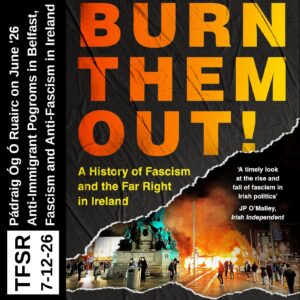
This week, an interview with Pádraig Óg Ó Ruairc about the June 2026 anti-immigrant pogroms in Belfast, a bit about the sectarian legacy they operated in, anti-immigrant riots in the north and south of Ireland, overlaps with fascist organizing locally and abroad as well as antifascism and how it relates to Irish Republicanism. We invite you to check out other books by Pádraig and recent interviews he’s conducted, linked below.
Books (some may not be available new in the US at this time from the link)
- Burn Them Out: A History of Fascism and the Far Right in Ireland
- The Disappeared: Forced Disappearances in Ireland 1798-1998
- Blood On the Banner: The Republican Struggle in Clare, 1913-1923
- Truce: Murder Myth and the last days of the Irish War of Independence
- The Men Will Talk to Me: Clare Interviews (editor)
- The Men Will Talk to Me: West Cork Interviews (editor)
- The Battle for Limerick City (Mercier’s History of the Irish Civil War)
- Revolution A photographic History of Revolutionary Ireland
Other interviews mentioned
- The State Between Us episode 4: The British Fascisti
- Behind The Bastards on Lord Haw-Haw (audio pt 1, pt 2 / youtube pt 1, pt 2)
- The Empire Never Ended episode 243: Fascism in Ireland and the Dublin Riot
Announcement
Support Flora Anarchist Space in Valparaiso, ¢hile
The Flora Anarchist Space is requesting help staying open. The space for meeting, organizing, and struggle in Valparaíso, a territory dominated by the Chilean State began as an initiative of the 2019 uprising and plays an important role in ongoing community rebelliousness: https://www.firefund.net/espacioflora
. … . ..
Featured Track:
- TFSR by The Willows Whisper
. … . ..
Transcription
TFSR: We’re speaking with Pádraig Óg Ó Ruairc, author of multiple books relating to Irish history, most recently Burn Them Out! A History of Fascism and the Far Right in Ireland. Thank you so much for talking with me, Pádraig.
Pádraig: No problem, Bursts.
TFSR: This conversation follows in the aftermath of the June 2026 anti-immigrant pogroms following an alleged knife attack by a Sudanese immigrant on his neighbor Stephen Ogilvie in Belfast. I was hoping we could speak a bit about some of the anger, the motivations, and the actors at the center of these activities, the pogroms, and the connections and influences they have across borders and identities. First up, would you describe the events that happened in June?
Pádraig: About three weeks ago, a 44-year-old man, Stephen Ogilvie, who is a native of North Belfast. I understand he has some learning difficulties. He was attacked near his home in Kinnaird Avenue in North Belfast by a man called Hadi Alodid, who is a 30-year-old Sudanese immigrant. Alodid stabbed Ogilvie, knocked him to the ground, and then straddled his torso, sat on his chest as he repeatedly continued stabbing him in a very frenzied attack. It’s understood that the two men knew each other and possibly lived in the same building or in the same area. It was a brutal attack. Ogilvie lost his left eye, and he suffered stab wounds to his head, face, and back. Ogilvie was rescued by a local man, Maitiu Mág Tighearnán, who beat Alodid with a hurley. To explain, for those who are not familiar with Gaelic Irish sports, it’s like a field hockey stick. It’s this ancient Irish game we play. Anyway, the attacker was beaten by an oncomer with this stick. He was arrested after police arrived at the scene, and he’s currently in prison, awaiting trial on the charge of attempted murder. Mr. Ogilvie survived the attack; he was rushed to hospital, and he was initially in intensive care. Glad to say that he’s now in recovery, in a regular ward, and is in a stable condition.
Now, what has brought this to international attention is that the attack was filmed by onlookers and posted online. The first thing I’d have to say about that is, I question anyone who stands around filming an attack instead of trying to either phone the police or intervene themselves. But anyway, the imagery of a black man kneeling over his white victim and striking his head and face repeatedly with a knife was obviously very graphic. This went online and was almost instantly picked up on social media. There were a lot of sensationalist reports in the beginning, specifically claiming that the man had been beheaded, and that this was a terrorist attack related to Islamic extremism. It was also said that Alodid was Somalian, or that he was an illegal immigrant. In fact, Ogilvie is still alive, so clearly he wasn’t beheaded, despite the fact that certain right-wing media groups in Ireland have reported a man was beheaded in Belfast. The PSNI, the Police Service of Northern Ireland, have said that this is not terror-related. Alodid was not Somali; he was Sudanese. He had been given refugee status by the British government in 2023, so he was not an illegal immigrant.
Following the attack, inflammatory rhetoric was put out by far-right actors and British politicians, in particular. The North of Ireland, Northern Ireland, depending on your politics, is obviously constitutionally still part of the UK, the United Kingdom, and activists, including Tommy Ten Names, Tommy Robinson, Stephen Yaxley Lennon, whatever he calls himself this week. Rupert Lowe, who was the leader of Restore Britain, who would be even more right-wing or far-right than Nigel Farage, put out a lot of statements talking about this on Elon Musk’s X network. For reference, Elon Musk’s X, formerly Twitter, has its European HQ in Dublin, but the Irish government doesn’t seem to do much about controlling misinformation or disinformation they spread. In fairness, Mr. Ogilvie’s family were very dignified. They appealed for calm and stated, “We do not want this terrible tragedy to be used to divide people or fuel hostility. Do not do this in the name of our loved one, as we do not share the same values as those rioting.”
There was a similar case, the murder of Henry Nowak in England the previous week. He was a white man who was stabbed by a Sikh. Mr. Nowak’s family in England also appealed for calm, but it was ignored. Rioting involving far-right agitators broke out in Britain, but also in Belfast. That’s the background to what happened, and how it’s hit international attention.
TFSR: Thank you for that. A side note: I remember back in the 90s the US advertising the Celtic Tiger as an economy where a lot of tech companies that were based in the US could build headquarters in Ireland. My understanding is that over the years there’s been a lot of complaints from within Ireland about the tax status of these large international tech corporations that have connections to the US, getting a free ride. Is X riding on that same bubble?
Pádraig: Absolutely. I think somebody previously described it as leprechaun economics. You have the likes of Apple, X, Meta, or Facebook; they all have their European headquarters here. They’re doing it because they have to pay very low amounts of tax, about a 2% corporate tax rate. Normally, when I’m on podcasts talking to people from across the Atlantic in America, you’re lucky to have the First Amendment, and you can be very liberal in what you say. I have the 2009 Defamation Act. Our libel laws are pretty similar to British ones. If anyone’s seen that movie about the Irving trial denial, we have to be very careful about what we say about ongoing court cases and stuff. But amazingly, stuff is put out on X, the most harmful incitement to violent stuff, misinformation, disinformation, and the Irish government repeatedly fails to hold them to account for it. If I wrote such things in one of my books or published them in a newspaper, I would probably be sued for it; I’d end up in the High Court, and I’d be bankrupt in the morning. But we somehow turn a blind eye to what’s going on with big tech here. The argument that Twitter, X, Facebook say is, “We’re just a platform, we can’t be responsible for what people post on it.”
In some cases, the rioting, the pogroms, the violence we’re going to talk about is actually being coordinated. You can see it live on Facebook groups in Northern Ireland, where they’re saying, “Burn out the people in number 7. They’re immigrants, they’re Romanians, they’re Filipinos.” Or “Don’t burn out people in number 12 and number 10, they’re they’re good Protestant loyalists.”
TFSR: Can you talk a bit about the neighborhoods that the violence did take place in in Belfast, and who was behind it? Who ran the roadblocks in the interface areas? In the Wikipedia article about this, I was seeing that the NICCY was claiming that loyalist organizations were blackmailing youth into rioting in exchange for removing whatever debts they owed to their neighborhood loyalist gangs.
Pádraig: The interesting thing about the attack on Mr. Ogilvie is that it took place in the republican area of North Belfast. It’s described as an interface area. An interface is where those who consider themselves Irish and those who consider themselves British in the North meet. But the fact that the guy who came to his rescue was wielding a hurley, which is very much a Gaelic Irish sport, as far as my knowledge of Belfast goes, and I lived quite close to Belfast for a while up in County Antrim, I have a fair knowledge of Belfast geography. It’s pretty much a republican area where the attack occurred, but the racist pogroms which followed only took place in loyalist areas of East Belfast. Just some context on terminology for your listeners. When the Troubles were going on in the North, it was often presented in American and global newspapers as Catholic versus Protestant. And the terms Catholic, Irish, republican, and nationalist are often used interchangeably. When we talk about republicans here, Irish republicans are people who want a completely independent Irish republic. The term “republican” here does not have the same meaning as “Republican” does in the US. When we talk about nationalists and Irish nationalists, it’s people who want independence from Britain. It doesn’t have the same racial connotations or Christian nationalist connotations that you will get with American British nationalists. For example, the British National Party will be very much a racist, closet neo-Nazi organization, whereas something like the Scottish National Party is trying to get independence from Britain. Their former leader was, I think, Humza Yousaf, who was obviously a man of color from a Muslim background. That tells you the difference in Irish and Scottish nationalism and British or English nationalism.
Also, the terms Protestant – British are often interchangeable: loyalist, unionist. Of course, you don’t have to be Protestant to be British. There are plenty of Catholics who are loyal to the King of England, both in the North and in England or Britain itself. But when I talk about republican areas, it’s people who consider themselves Irish and want independence. When I talk about loyalist or unionist areas, I’m talking about those who consider themselves British and want to maintain being part of the UK. At its core, the conflict in Ireland is not about religion. It began 800 years ago, long before Catholics and Protestants separated from each other in Christendom. So, at its basis, it’s a colonial thing, and it’s a question of identity rather than religion.
But that said, the areas where the rioting happened- you’re talking about places like Newtownards Road, Mackey Street, the Tiger’s Bay estate, Lagan Street- and there was also violence outside Belfast in Portadown. These would all be areas that, if you visited them today, would have British Union flags flying all over them, would have murals of British imperial heroes, the King of England, and so on. A bus was set on fire in the Newtownards Road. A Police Service of Northern Ireland car was set on fire in Portadown. A cop car being burnt out anywhere is a serious incident, but when you consider that the Police Service of Northern Ireland will be even more heavily armed than your cops in the States. They’re a paramilitary police force. To get control of one of their cars and burn it out is no mean feat. Dozens of private vehicles were set on fire in these areas, dozens of homes were attacked, windows smashed, fireworks thrown into them, a number of cases set on fire, or attempts to set them on fire.
As we discussed, social media was being used to coordinate the attacks, and specifically to attack people of color, immigrant families. You can go online and watch the footage: you had immigrant families evacuated in police armored vehicles, armored cars being used to evacuate crying children. Several homes were completely destroyed in arson attacks, and as a result, 27 people have been left homeless.
So, this isn’t just racist rioting; this is a pogrom. The North has a long history of pogroms, particularly in the 20s and in the 60s, 70s. Traditionally, these pogroms were by the loyalist community targeting Catholics whom they didn’t want, or Irish people, republicans, nationalists, whom they didn’t want, living in their area. But it’s not surprising that the violence was limited to loyalist areas, because a Belfast Telegraph poll – the Belfast Telegraph would be a liberal unionist newspaper; it’s the closest thing you get to a centrist newspaper in the North- did a poll in August 2024. It found that 82% of loyalists, i.e. those who see themselves as British, felt immigration was too high, compared to 13% of nationalists or republicans.
There’s no doubt that the Ulster Volunteer Force, the UVF, a pro-British loyalist paramilitary, was involved in coordinating the rioting. Journalists who were there on the ground looked at figures who they knew to be in the UVF or associated with them, standing on the sidelines watching things happen. We also had actors come in from far-right groups, both in Britain and the North.
For example, Restore Britain spokesperson Orla Minihane was present in the North, reporting on these. Now, I’m not saying that she was encouraging rioting. The same follows for the rest of the people. Still, her presence there is interesting, showing how the most conservative and right-wing elements of British politics were coming over to witness this. Daniel Thomas, aka Danny Tommo, would be a very close friend and associate of Tommy Robinson. Tommy Robinson was, of course, live-tweeting about all of this from Moscow, where he was on holiday with Elon Musk’s dad.
Another person who was seen to be active or certainly present – again, as per libel laws here, I’m not accusing him of any criminal wrongdoing, but someone who was there, live streaming from the event, was a guy called Mark Sinclair, who goes by the name Freedom Dad online. Mark Sinclair is a member of the UVF. I can say that without fear of being prosecuted. He admitted that in court. He also said that he was previously an intelligence agent for MI5, and he’s a convicted bank robber. There you have a loyalist paramilitary, potentially associated with British intelligence, who’s there.
Tony Martin, who is the leader of a British neo-Nazi party called the National Front. He lives in Northern Ireland, even though he’s an Englishman. He was present, and I think at one stage he was removed from one of the protesting crowds by the police service.
You also had Glen Kane. Glen Kane is a former member of the British National Party. He is a neo-Nazi. He’s also a convicted murderer. In 1992, he pled guilty to the murder of a Catholic man, Kieran Abram, whom Glen Kane and a number of others beat to death with wooden planks studded with nails. So he was present at the rioting and the protests as well and is present at most anti-immigrant protests and demonstrations in the North.
I also heard reports that Richard Inman was present. He’s a former British Army soldier living in the North. I can’t confirm whether he was present. I heard he was. I’m not accusing him of any criminal wrongdoing, but, interestingly, he was reporting on his social media that “the working classes of Belfast are uniting and there is nothing the political elites can do to stop it.” This idea that Catholics, Protestants, Irish, British, republicans, and unionists were all uniting against people of color, or people of a Muslim background, or whatever, is complete nonsense. There was no rioting in West Belfast. There was no support from republican areas, because Irish republicans, people who identify as Irish, will not align with UVF unionist paramilitaries and people who’ve been convicted of sectarian murder or elements from the British far-right and the most conservative aspects of British politics.
There was one small protest in solidarity in Dublin, in O’Connell Street, a few days later. I think the rioting in Belfast continued for two or three nights. On day two or three, there was a protest in Dublin, organized by an anti-immigrant group or groups. That had about 50 to 100 people on it, and they marched up the main street in Dublin, waving their Irish flags, giving out about foreigners and immigrants, and then went away again. 50 to 100 people is a dismally small protest in Dublin.
TFSR: Thank you for that. Because I did see in the reports I was reading, or in some articles, that there was a claim, at least, that it was cross-sectarian, but it sounds like that was mostly propaganda, and maybe some AI-generated images.
Pádraig: Yeah, you have had incidents in the past. There’s one group in Dublin who were opposed to a refugee center being set up in their area. Coolock Says No. We can talk maybe later when we talk about previous racist rioting in the North. They did famously travel up and stand side by side with their Irish tricolors at an anti-immigrant rally beside members of the British far right and loyalist paramilitaries who were there with British flags. That was one incident, and it became so embarrassing to the Irish far right in Dublin that that group, Coolock Says No, actually changed its name as a result.
Maybe one or two cases in the city center. We do have very small anti-immigrant neo-Nazi groups, like Clann Éireann, for example, that have a presence in Belfast, but you’re talking a handful of members literally. They have been subject to beatings, and there is a police investigation into improvised explosive devices or bombs being placed near the homes of those in republican areas who engage in neo-Nazi politics. So those who would seek to make common cause with the loyalist far right are certainly not very welcome in republican areas, and will suffer physical attacks for it.
TFSR: That’s not because there is a structural one organization that is deciding who has the right political perspectives and who has the wrong political perspectives, are the ones that will get beaten up for; it’s because of a cultural hegemony of a perspective that this is the wrong thing to do and these are the wrong allies to have?
Pádraig: Yes, even though the Provisional IRA has folded its tent and gone away, you would still have a lot of republican paramilitarism, and as we might get to later, there is a very long and strong history of republican anti-fascism in Ireland as well, both North and South.
TFSR: To swivel back to the other side of things, and this is clearly a very limited conversation for us to have to talk about very complex things, and I appreciate you being willing to entertain this. Can you talk about Ulster Loyalists, as opposed to the wider unionist umbrella, and a bit about their shared ideas and how they’ve related further to groups that identify as fascist or neo-Nazis, as you spelled out in your book, Burn Them Out!?
Pádraig: Okay. Loyalists means somebody loyal to the British monarchy or to Britain, and unionist is somebody who wants to maintain the political union with Britain. These terms will generally be contested. I’m not from a Northern loyalist background, and I’m sure people who are might give a different interpretation. As I understand it, when the terms are used in the press, unionist generally refers to more middle-class, more mainstream political parties, like the Ulster Unionists, the Democratic Unionist Party, so on. Not that the DUP are mainstream; we can talk about them in a minute, but it’s more a middle-class thing, and maybe in some cases slightly more moderate. Loyalist is generally considered a working-class thing very much, and often exists outside of politics. It will be involved in things like what are called Blood and Thunder bands, or in parading or paramilitarism.
If we talk about loyalism and unionism together, the people from an Orange background or a pro-British background in the North have been accused of having the settler mentality. They considered the native Gaelic Irish inferior. Often that was presented as being racially inferior, and they would present things like craniology as examples of that. They were also given to conspiratorial thinking and would claim that there were papist plots behind everything, and Catholics had a secret agenda working for the Pope to control and overthrow all kinds of governments. Traditionally, you had a lot of discrimination against Catholics in the North of Ireland. Similar to how in the South under Jim Crow, you would have had people of color- Black people- who couldn’t get jobs, were passed over for housing, there was gerrymandering, all these things. I will compare the loyalist community in the North and their mentality to Afrikaners in South Africa today. During the conflict in the North, the Troubles, loyalists would have imported guns from Afrikaners in South Africa. Maybe neo-Confederates, Southerners who long for the Confederacy in America, or maybe the most hardcore religious fundamentalist Jewish Zionists taking land in the West Bank. The claim I’m trying to make here is that loyalists very much feel under siege; they’re separated physically, geographically from Britain, and they’re worried about the indigenous natives on the land. That’s the point I’m trying to get to.
I mentioned the DUP, the Democratic Unionist Party, founded by the late Ian Paisley. He had his honorary doctorate. He was known as Dr. Ian Paisley, or Dr. No; he was often called here after the James Bond films. He said no to any political progress. His political party, the Democratic Unionist Party, was largely based on what was called the Free Presbyterian Church. It will be against gay marriage; it will be against abortion; things like creationism are very popular within the Democratic Unionist Party. Creationism, I know as a thing in the States; I’ve been to the Art Park, the Creation Museum in Ohio. Even in the States it’s extreme, but in British and Irish politics, the idea of creationism is really extreme. Ideas like British Israelism also feature in loyalism. The idea that the actual Jewish people aren’t really Jews, and that God’s true chosen people are white Anglo-Saxon Protestants. That, of course, is a racist idea. Enoch Powell, who, after Oswald Mosley, would be the biggest political figure in British far-right history, when he lost his position with the English Conservative Party for being too racist for them in the 1970s, which was an achievement in itself, he came over. He stood as a member of parliament for the Ulster Unionist Party in Northern Ireland.
Coming up to the 70s-90s, you had the National Front, which, again, as I said, is a neo-Nazi party. The BNP, which is a split-off of that, and Britain First, all would have had political offices and connections to loyalism or unionism in Northern Ireland. There would have been, in terms of paramilitarism, a crossover between loyalist paramilitaries and neo-Nazi terrorists; particularly, there would have been a crossover between the UVF, the Ulster Volunteer Force, and Combat 18 in the late 80s, early 2000s. And mainly this involved Combat 18 neo-Nazi terrorists procuring guns and explosives in Britain, and shipping them over to the North for the UVF campaign against the IRA and their sectarian murder campaign against Catholics.
TFSR: To note, as this is going to get aired and people are going to be able to hear it, we’re around the beginning of what would be considered the marching season in the North. If you have a second, you could talk about a thumbnail of what happens with that, by whom, and to whom. I’m sure people peripherally have seen that this very warm part of the year, suddenly there’s historically a lot of sectarian violence that occurs during it.
Pádraig: So the marching seasons. Traditionally, there’s a number of what are called loyal institutions. There’s the Apprentice Boys and Derry, there’s the Royal Black Preceptory, and so on. The main one people would have heard of is the Orange Order. The Orange Order was founded in 1795. It is a Protestant supremacist organization. It is only open to people of the Protestant faith. It’s called the Orange Order after William of Orange, or William the Third, who was king of England in the 1690s and took the throne from his, I think, uncle and father-in-law, King James the Second, who happened to be a Catholic king. People will base it on religion, but it’s quite complex. There was a big thing going on in the 1690s European politics called the League of Augsburg, and the Catholic Pope of the time was actually on William of Orange’s side, the so-called Protestant side.
It’s complex, but it’s an organization that’s only open to straight Protestant men; women aren’t allowed, and Catholics aren’t allowed. They wouldn’t have a big immigrant community involvement. Every year, they celebrate William of Orange’s victory at the Battle of the Boyne over James II. So, on the 11th night of July, they light these huge bonfires. Now, when I say huge, these things are like small skyscrapers; they can be several stories high. They will involve hundreds of wooden construction pallets. And they light these in imitation of when William of Orange landed in the North on his way to the battle. Coming over from England, there were these loyalist beacons that were lit in celebration. The bonfires themselves are huge, and they’re often decked in racist, sectarian, and homophobic symbols. It’s what I would compare to a hate fest, a KKK cross burning, or a Nazi book burning.
That might sound extreme, but I can give you some examples. Glasgow Celtic is a Scottish soccer team, which traditionally will be supported by a lot of people from an Irish/Catholic background in the North. And Scott Sinclair was one of their players, who was a man of color, I think a Scottish man, a British man of color. They made the typical racist monkey effigies of him. They burnt them on their bonfires, along with signs saying “Scott Sinclair loves bananas.” A lot of misogyny as well on display on these occasions. You had Naomi Long and Anna Lo, leaders of the Alliance Party, a mainstream middle-class party in the North that seeks to bring people together on both sides and not have British and Irish politics, but “let’s work on social issues and things.” In Anna Lo’s case, I think it was her election posters, which were put on a bonfire and burnt. In Naomi Long’s case, they made a mannequin or a dummy of her and hanged it in effigy.
We’ve just come out of June and into July, so things like Pride flags. Again, generally loyalism is very homophobic. Pride flags, trans flags, things like that will be burnt on bonfires. Catholic statues will be stolen from grottos and churches would be put on bonfires, alongside Irish flags, Palestinian flags. Anything that isn’t white, Anglo-Saxon, Protestant, straight, British, any other cultural symbol they can find, they will burn.
I was speaking to Jake Hanrahan, who’s a reporter and podcaster, and he was at an Orange bonfire a few years ago. He’s from an Irish background; his people moved to England years ago, and he has an English accent. He was attending one of these bonfires, and he noticed they were burning a picture of a loyalist or unionist politician. He said, “Why are you burning her picture? She’s a loyalist.” And they went, “Oh yeah, mate, but she’s Chinese.” Because her skin color or ethnicity was different, it didn’t matter that she agreed with them politically.
And the worst example of this occurred in Moygashel, which is a village in County Tyrone. If anyone googles “Moygashel bonfire,” you’ll see an image of they built this huge bonfire and putting a life-size boat on top of it, an actual boat, and filling it with mannequins of people wearing life preservers, but dressed in hijabs. The mannequins had fake Islamic dress, and the male mannequins had beards on them, and so on. And it was burning immigrants in effigy, and there was a big sign beneath it saying, “Stop the boats,” as in “No immigration to Britain.” Atop of this boat, of course, was an Irish tricolor. If it happened in Britain, it would be treated as a hate crime. The police service of Northern Ireland, most of whom are from a Northern unionist background, still would turn a blind eye to this.
And I’ll give you an example. If you can remember, about maybe 10 years ago, Grenfell Tower was this huge tragedy in Britain, where many people from immigrant backgrounds and people of color were burnt alive in a tower block that caught fire. On Guy Fawkes Night in Britain, November 5, people would light bonfires. Somebody made a papier-mache effigy of Grenfell Tower, including little images of people dressed in Muslim garb being burnt alive and jumping out the windows, and so on. People who did that at a bonfire in Britain were prosecuted and imprisoned for hate crimes, but when it happens in the North, the law doesn’t apply. So, this hate fest goes on every year, and sectarian attacks, neo-Nazi graffiti, you will sometimes see Southern Confederate flags. You will see neo-Nazi flags and swastikas flying at these bonfires, or going up around July 12.
TFSR: That’s incredible. Thank you for sharing that. So nationalism is a core component of much far-right ideology and fascism; however, it is also often an element of more egalitarian, anti-colonial struggles and movements. In the Irish context, can you talk about the nationalism embraced by republicanism and how this differs from that of fascists on the far right?
Pádraig: Well, Irish nationalism or republicanism has always been more a civic type of nationalism. Irish republicanism was founded here in the 1790s mainly not by Catholic indigenous Irish people, but by people of Protestant British or French stock. These were people inspired by both the French Revolution and the American Revolution. I’m thinking of Theobald Wolfe Tone as our George Washington figure. He said that it was his political motto to break the connection with England and to replace the terms “Catholic, Protestant, and dissenter” (that’s Catholic, Protestant, and Presbyterian) with the common name of Irishman. Wolfe Tone will be revered, as I said, the founding father of Irish nationalism, or Irish republicanism. Wolfe Tone didn’t have a single drop of Irish blood and was a Protestant of French extraction.
So Irish nationalism has always been based not on racial ideas, but on Enlightenment thought and French republicanism: liberty, equality, fraternity. If we look at the 20th century, when Irish republicanism was at its most successful in the Irish War of Independence (early 1920s), Irish republicans made common cause with Indian nationalists and Egyptian fighters for independence, who were at war with the British Empire at the same time. And also, surprisingly, given that most Irish republicans tended, though not all, to be Catholic, from 1917 to the mid-1920s, the IRA and Irish republicanism were very supportive of the USSR, the early Soviet Union, and the Russian Revolution. Figures around the globe, like Marcus Garvey in America, had a very strong interest in Irish politics. In fact, if you go to the halls that he set up, both in the United States and in places like Jamaica, they’re called Liberty Hall, and that’s named after a very famous center of radicalism in Dublin, set up by James Connolly.
Ho Chi Minh, for example, was very inspired by the death of Terence MacSwiney, an IRA member and Sinn Féin member of parliament, who died on hunger strike in Britain. MacSwiney’s hunger strike also inspired Gandhi. In the 1930s and the Spanish Civil War, a lot of Irish republicans went to fight for the Spanish Republic, and Irish republicans still have an interest in Basque and Catalan separatism from Spain. In the 60s, the civil rights movement was very inspiring to the Catholic nationalist community in the North. People went on protests in Derry in the 60s, sat down on blocked roads, held signs saying “One man, one vote,” and sang songs like “We Shall Overcome.” That comes straight from America.
The more militant end of things, let’s say Bernadette Devlin would have been a civil rights leader in the North. She went to Chicago, was given the freedom of the city, and given the symbolic key. She went straight away and gave it to the local chapter of the Black Panthers, which did not go down well with very conservative Irish Americans. But it’s interesting, if you look up Bernadette Devlin’s speech, she says, “Look, we are all the one cause, we’re all fighting for the rights of the people.”
More recently, in the ’80s and ’90s, I can remember going into Sinn Féin bookshops. You would see posters up supporting the ANC in South Africa, posters of Nelson Mandela, posters of the PLS, PLO, and Palestine. Again, Irish republicans, Irish nationalists see this as not a racial struggle, but an anti-colonial struggle. In the modern day, you’ll see Irish soccer fans, you’ll see Irish republican activists waving Palestinian flags, Kurdish flags. And Irish republicans have always had an opposition to US wars in Iraq and Afghanistan, partially because of the politics of the wars themselves, but also, of course, obviously the involvement of the British Army in those campaigns. Republicans, if you take the most mainstream Irish republican party, Sinn Féin, will be very progressive today in terms of things like abortion rights and marriage equality. The majority of the people, though not all in these parties, would be Catholic, and they are willing to defy their priests and the Catholic Church on social issues.
TFSR: So these are vast majorities of these social movements and these political philosophies, and there are, of course, outliers as there are with anything, which you talk about in and Burn Them Out! at times, where people who participate in the republican movement, or even in the IRA, or the IRB, or other republican movements have rather conservative, Catholic hierarchy, even reactionary politics, who are within these wider communities. I don’t know how much of that is because the cultural nationalism of the late 19th century influenced civic nationalism, and because there were racial ties to that. But just for the audience, you’re not painting that everyone who considers himself republican is egalitarian, anti-racist, anti-fascist, and all these things, right?
Pádraig: No, you do have people who are Irish and who would emphasize more the Catholic side of things and will be quite conservative. We talked about the Orange Men. There is a green equivalent called the Ancient Order of Hibernians. Ironically, they’re much bigger in Irish America than they would be in Ireland. They’re very small in number here. They’re not really a political presence. But you do have those small, as mentioned, groups like Clan Aaron. You do have a neo-Nazi fringe, but you’re talking about probably less than 50 members in all of Ireland, and they’re really a clown show. Traditionally, if you felt very patriotic and if you felt inclined to street activism or potentially paramilitarism, or engaging in direct action, or violence in support of a nationalist or republican cause, you were being channeled into groups like the Provisional IRA, which were teaching about anti-colonialism and making common cause with the ANC. So, traditionally, up to this point, Irish republicanism has actually served as a break on that more extreme form of conservative Irish nationalism, which will be more common, funnily enough, in Irish America than it would be here.
TFSR: There’s something to be said about the settler identity with that, but that was actually a really interesting part of the book for me. I think Scranton was maybe one of the headquarters for the Ancient Order of Hibernians. Thank you for bringing that up. Could you talk a bit about the weirdness introduced by Brexit and the political positions taken around the border between the occupied portions of the North and the South, which has an ongoing relationship with the EU, and about the Common Travel Area?
Pádraig: The Common Travel Area has been around in its current form since the 1920s, and it means that I don’t need a passport to travel to Britain. People from Britain don’t need a passport to travel here. A driver’s license or any other form of ID will do. So there’s free movement between the two islands. Now, when the war, when the conflict was going on in the North, that was quite a different story. If you were crossing the border, you could expect to – and I had this experience myself – be stopped in your car by an armed member of what was then called the Royal Ulster Constabulary, the predecessor to the modern police service of Northern Ireland, who would not be slow if they saw your southern car reg, Irish car reg, or heard your accent and taking you out of the car forcibly, searching you, having you under assault rifle or machine gun, while they were doing so.
Obviously, that border infrastructure from the British side of things was meant to prevent IRA attacks on the British army or British infrastructure or British police, but what it meant was there were huge fortifications along the border between the North of Ireland or Northern Ireland, depending on your politics, and the Republic of Ireland. And the fact that you had so much border infrastructure, and so many British police and soldiers on the border, meant that these then became targets for Irish republican paramilitarism. So, most of that security infrastructure was dismantled in the late 1990s-early 2000s as part of the peace process and Good Friday Agreement, which ended the modern conflict in the North. All parties signed up to the Good Friday Agreement, saying that they would abandon paramilitarism and try to use peaceful means to solve their differences or bring about constitutional change.
That was working fairly well until Brexit came along in 2016. Brexit also coincided with Donald Trump’s first term in office. And the British people voted on Brexit with the intent of stopping immigrants from the EU from coming and working and living in Britain. It was very xenophobic. Most of those immigrants would have been white Polish people, Slovaks, and so on. So xenophobic, but also a racist element to Brexit in Britain. And the ordinary British and English person voting on it had never been to the North. A lot of them wouldn’t even know that Northern Ireland is part of the UK, or would think that the South of Ireland is still part of the United Kingdom, even though it hasn’t been for 100 years. In the North of Ireland itself, the unionist parties all supported Brexit, and the Irish nationalist or republican parties all opposed it. The result was that there was this whole mess about the British were talking about reintroducing the border, Boris Johnson’s government. And it was pointed out to them, “Do you want to restart a war? How many British soldiers do you want killed there?”
What happened was that between the island of Ireland and the island of Britain, the border now realistically is in the sea. I took my kids on holiday up to Antrim, where I used to live last year. We just drove across the border; there were no police, no soldiers, not like in the old days, and people moved from one side of the border to the other side for work, for social reasons, for holidays every day, and there is no big issue. But as part of that free travel between the North and the South, when the British government started threatening to send failed asylum seekers to Rwanda, you had a lot of people who had initially sought asylum in Britain traveling from London to Belfast on a plane, and then coming south of the border and applying for refugee status in Dublin. People applying for refugee status in Dublin suddenly weren’t arriving at Dublin port or Dublin airport; they were arriving at a government office in the middle of Dublin City. This brought up that Mr. Alodid, the guy who is on trial for attempted murder at the moment, or his trial is coming up, was Sudanese. He originally had sought asylum in Paris. From Paris he moved to Dublin, and then from Dublin he moved across the border up to Belfast, where he made his final application. There he was granted refugee status in 2023 for five years to remain in the North, until 2028. That’s where Brexit and the border and all that comes into this.
TFSR: How are the loyalists feeling about the idea of the border being a sea border or reinserting the land border and restarting the war?
Pádraig: Well, nobody who’s not involved in paramilitarism wants to restart the war, but loyalists have been very unhappy about it for the last decade. And they’re claiming that the majority of refugees, asylum seekers, and immigrants who are in the North are coming from the South up. Traditional Unionist Voice, which would be the most hardcore loyalist party, even more extreme than the DUP, put out this meme of all these buses coming from Dublin up, packed with Muslims and people of color. The reality is that most of the traffic is actually the other way; it’s from the North down to the South. But it’s just a whole big mess and byproduct of Brexit, but that’s the situation we’re in.
TFSR: Do you get the impression that people in the North, outside of those extreme loyalists, are looking more towards the South and their relationship with the EU through Ireland? Or, among the wider part of the population, do you have much of a sense of the sentiment towards remaining in Britain or rejoining the EU?
Pádraig: The most moderate and centrist elements of liberal unionism, if we take a group like the Alliance Party, who I mentioned there, Naomi Long and Anna Lo, these people, who’s would generally have traditionally been broadly in support of maintaining the current status of North as part of the UK, but obviously they’re not involved in the hateful aspects of loyalism, and in fact, they’re the people being derided and mocked and burnt in effigy in these bonfires. Once Brexit happened, it was a shock to a lot of more centrist liberal middle-class thinking in the North. And you’ve seen a growth in both the Green Party in Northern Ireland, which obviously is more concerned with environmental issues than constitutional, and the Alliance Party, with the result that you’re starting to have people who traditionally would have seen themselves as British, who were going, “God, there’s going to be a huge queue if I go through on a British passport on holidays. I’m going to be waiting two hours at the airport in the queue, or whatever, in the non-EU line, but if I get an Irish passport, I walk through that gate straight away, because it’s put into the Schengen zone.” So, getting people who identify as British suddenly taking out Irish passports to skip airport queues. You also get people who might be pro-British in politics in the North, but who don’t like the extreme conservatism of the likes of the British Tory party under people like Liz Truss, Boris Johnson. They don’t like the prospect of Nigel Farage becoming Prime Minister. And they’re going, “Maybe we should reconsider our future and economics and everything with the South.”
If you’re a member of the LGBT community or you’re a member of an immigrant community. You see that British politics is increasingly becoming more conservative, more right-wing, you might be saying that, “Look, we’re not being welcomed with open arms by the loyalist community, or the likes of Reform, or whoever. Maybe things are more tolerant and liberal in the South, in the Republic.” So you’re starting to get that element as well. But these changes could take quite a long time.
TFSR: So, Ireland has seen some intense instances of anti-immigrant sentiment in the last decade. Sometimes this seems to me to take the form of people blaming capitalist austerity on others taking their jobs or their comfort, their housing, changing their ways of life. During the housing of refugees during this greater period of immigrants coming from the SWANA, for instance, evading war and climate change. There have been protests against asylum seekers’ shelters and accommodations that we saw in the North and the west of the Republic in 2018 or across the South of Ireland in late 2022. At other times, this anger flares up into riots and pogroms that travel at the speed of the tweet, such as those in 2023 in Dublin, after the terrible stabbing of three children and the caretaker in the North, which has the added sectarian element. In 2024, the UK-wide riots were beginning in Southport and Stirling, though the attack in Stirling was by a white Briton. It turned out that wasn’t what was advertised. Then in 2025 there were riots after a sexual assault of a Ballymena girl by two Roma teens from Romania. When you see these events, there’s a terrible act that happens, or the accusation of a terrible act happening, and then you see spreading outrage. Can you talk about, in your view, the motivations in Ireland of the anti-immigrant organizing, and how it’s taken shape in recent years?
Pádraig: Okay, so there’s a lot there. Again, I shouldn’t be giving the impression that the far right is- and I hope I don’t in the book. We’ve mainly been talking about the North, but in the South we have anti-immigrant parties like the National Party. We have groups like the Irish Freedom Party, and various other anti-immigrant groups. There is an accommodation crisis, as you said, the problems of capitalism. There is a housing shortage in the South that is not the fault of Ukrainian refugees who came here four years ago, or people who’ve come here from Syria, or somewhere seeking asylum. That’s the failure of mainstream Irish political parties to provide housing. You have had 40+ attacks on refugee centers. Now, normally these would be, let’s say, a hotel that has been closed when word gets out that it is being repurposed as refugee accommodation. There will be an arson attack in the middle of the night. Only in one case, in Drogheda, on Halloween night, there was an attempt to set fire to a building deliberately. All these areas I’m talking about are very much the South of Ireland, and the so-called patriots who would be doing this would very much consider themselves Irish and wrap themselves in the Irish flag.
There’s one instance where a migrant hostel or refugee hostel was set on fire while women and children were upstairs, and a number of them had to be rescued. The worry is that eventually the people who are going around committing these racist arson attacks are going to end up like what happened to Turkish immigrants in Germany in the 1980s. If you’re setting fire to buildings with people in them, sooner or later you end up murdering people by burning women and kids alive.
So, you’ve had that violence, you’ve had large anti-immigrant demonstrations in the South, but they have failed politically to get anyone elected. Some members of parliament are conservative, very populist groups, like Independent Ireland. They’re anti-immigrant, but they’re not spouting conspiracy theories or espousing violence and stuff. Independent Ireland, they’d be a very populist conservative group; one of their Tds, Ken O’Flynn, is an openly gay man. It’s not your typical far-right stuff.
That’s the situation in the South, and they’ve never succeeded in getting more than I think maybe six councilors whose politics I would consider far right elected out of almost 1000 local councilors in the South. You have had the Dublin riots, which were sparked, obviously. That trial is actually ongoing at the moment, when a man who’s originally a native of Algeria, but had lived in Ireland for 20+ years and become an Irish citizen, stabbed and attempted to kill a number of school children. He’s been tried at present. I understand that he tried to appeal on the grounds of insanity, but that was denied after psychological checks. I know he has a history of head trauma and stuff. We’ll see what comes out of that. Thankfully, no children were killed in that attack, but that resulted in a lot of rioting in Dublin city center, and the center of the city, the main shopping area, being burnt out in a night of rioting.
So we had this sporadic violence in the South as well, but not to the extent that it happens in the North. If we go back, this recent pogrom in the North is not new. And I’m not talking about the history of loyalist pogroms against the Catholic or Irish or nationalist or republican community. I’m talking about the last two years. So if we take 2024, you said there were UK-wide riots; I’d correct you in that – there weren’t. Because this is in response to Southport, when the Taylor Swift dance class was attacked, and I think there were three or four girls murdered by a man who had grown up in Britain, but of parents from an immigrant background. He was a Christian; he wasn’t an Islamic fundamentalist or anything, or at least he’d been raised a Christian. So, in response to the Southport murder of those girls by a man of color, you had rioting in England. There was no rioting in Scotland. There was no rioting in Wales, because, again, Scottish and Welsh nationalism and politics there are very different to English nationalism. The only place there was rioting outside of England was in the North of Ireland, in Northern Ireland, in Belfast, in Portadown, in these same areas we’ve just been talking about. And the rioting in England lasted for two or three days. The rioting in the North lasted for a whole week.
That was the summer of 2024. In the summer of 2025, there was, you said, an alleged sexual assault on a girl by two boys, who I don’t think it was ever established if they were Roma, but certainly they asked for a Romanian interpreter. Interesting that the charges against those boys were dropped for lack of evidence. So it’s unclear what exactly had happened there, but that sparked rioting in response to the alleged sexual assault. In the town of Ballymena, large sections of the housing estates were controlled not by the Ulster Volunteer Force, but by a rival loyalist organization, the Ulster Defense Association. And during the rioting that followed there, you could see grown men handing out from boxes surgical masks and surgical gloves to disguise and prevent forensics of those teenagers who were engaging in the rioting. And again we saw the same thing there, that the houses of Filipino immigrants, Romanian immigrants, and Polish immigrants in particular were attacked. Social media was being used online to pick out what houses should and should not be burned. Interestingly, despite the claims of it being a cross-community thing, I found one group chat I was in online, where people were pulling up questions like “Are any Fenians getting burnt out tonight?” Fenian is a term for Irish republican politics, and it can also be used as shorthand for Catholics. So there’s a sectarian element to that.
And it’s interesting that the former leader of the Democratic Unionist Party, someone from a loyalist background who was a member of the Orange Order, Jeffrey Donaldson, has just been convicted of one count of rape and 17 other counts of sexual assault against two young girls. And he is currently in prison awaiting sentencing. There was no rioting in response to his conviction. When it is somebody from a white Protestant Orange loyalist background who commits a sexual assault, there is no rioting, there is no violence. But the sections of the far right, both North and South, are just looking for any incident where a person of color is involved or a person from an immigrant background, so that they can use it as an excuse for rioting.
In the South, the equivalent to this will be the murder of Ashling Murphy. Ashling Murphy was a school teacher who was out for a run, just out jogging along the canal in her local town, when she was attacked and dragged into the bushes. I think strangled or stabbed to death by a guy, Jozef Puška, who was an immigrant from Slovakia. He fled the scene, but was caught, and Puška’s family were involved in trying to cover up his involvement in the crime, and they’re all currently in prison. I have no idea what the woman’s politics were herself, but Ashling Murphy was used then as a poster girl for the Irish far right, saying, “Look at this Irish woman who was beautifully photogenic and everything, who was a very talented musician and a very popular teacher with her pupils, who was murdered by this immigrant who was living here on social welfare.” And the misery being inflicted on her family by her loss is being exploited by the far right. They use this as a trope that “Look, all immigrants are involved in violence against women, all immigrant men are rapists.” This is an age-old trope. They never mentioned cases like Ana Kriégel. Ana Kriégel was, I think, a Russian or a Belarusian girl who had been adopted, who was living here, and who was murdered by two Irish teenage boys; no mention of that. Then you had Manuela Riedo, who was here as a German [correction, Swiss – Ed] exchange student, and she was raped and murdered in Galway by an Irish man. And again, that’s never mentioned.
And there are other cases. There was a Filipino woman who was murdered by a white Irish guy off his head on cocaine. There was a Mongolian woman who was working as a cleaner in Dublin, just going around, doing her job, cleaning offices, and she was stabbed and killed by a white Irish teenager. So the way that the far right presents it is that it’s always like Ashling Murphy, and women in Ireland who are murdered are always murdered by immigrants, but when it’s a woman from an immigrant community murdered by a white Irish person, that’s never mentioned.
That’s the lay of the land, or how these things are happening. There is a grassroots far-right movement, North and South, green and orange, that is looking for any excuse to stir up hatred. And social media and the internet are very important to them, and what we’re looking at is really a post-organizational far-right. When we see people being convicted for being involved in these riots and stuff, they’re not necessarily a member of a neo-Nazi group or a far-right or anti-immigrant party, or whatever. Social media is often being used to spread propaganda and misinformation, disinformation, and that is radicalizing people and encouraging them to get involved in racist violence.
TFSR: Thank you for those corrections. You bring up some really good points, and that networking and generalization of violence and violence sentiment and reaction is right from a wider far-right playbook that extends past the Atlantic archipelago. Do people actually use that term? I was trying to find a term that didn’t say the British Isles.
Pádraig: Not really, but there you go; just Britain and Ireland does fine. If you were talking to a British person or a Northern Irelander, I’m sure they’d have no problem with the term British Isles. I’m not going to go down your throat over it.
TFSR: Okay. As you mentioned, there’s unnecessary cross-communication happening among these reactionary, entitled sentiments that are looking for the same reasons for rising up and causing violence. And those extend past those borders; there’s a lot of influence between platforms and individuals, and even messaging that happens across the English-speaking majority world, as you pointed out when you were talking about connections between loyalist groups and South Afrikaner nationalists, and what have you. I wonder if you could talk about some of the influences and connections beyond Tommy Robinson, to Elon Musk, that feed into what you’re seeing on the Irish Island.
Pádraig: One figure who was popular here for a while with the far right was Conor McGregor. I have to be careful what I say legally; McGregor has criminal convictions for physical assault and other things, but McGregor recently lost a civil case in which he was accused of assaulting a woman by raping her, and he claimed it was consensual. She claimed it was not, and the jury believed her and not him. So McGregor’s name and reputation here is dirt, but that didn’t stop people like Elon Musk and President Trump, Conor McGregor. You will see that he was recently, a year or two back for Patrick’s Day, invited to the White House, which was an insult to our Prime Minister, who wasn’t there on Patrick’s Day, but a few days before. Musk has a particular interest in Ireland. I think he’s compared us quite condescendingly to being like hobbits whose shire was being invaded by immigrants or orcs.
Before, you’ve had some really bizarre connections as well. English neo-Nazi types have taken an interest here, so I’d be thinking of figures like Mark Collett and Patriotic Alternative, Nick Griffin, former head of the British National Party. You actually had a convicted neo-Nazi bank robber who was a member of the Order. His name escapes me, a former wizard or goblin, or whatever they call themselves, of the Ku Klux Klan, who was found to be advising members of an anti-immigrant group in Waterford, in the South of Ireland, on how to organize their protests and do their PR. So, the fact that you have former neo-Nazi terrorists from the Order, and guys who were involved in the KKK, advising Irish people what to do and how to react to things, is interesting.
Figures like Steve Bannon have talked about that he is going to fund an anti-immigrant Irish party and have a Make Ireland Great Again movement, and he’s going to find an Irish version of Trump. A lot of these guys thought that would be Conor McGregor before he disgraced himself. Again, people like Elon Musk, Steve Bannon, and other figures on the international far right have a very twee, outdated Darby-O’Gill-and-the-Little-People idea of Ireland. Those who are seeking a case study, or an example to show the rest of the world, will often pick Ireland to promote their anti-immigrant far-right politics.
TFSR: This is a great time to talk about anti-fascist ventures, as you’re seeing in Ireland. How have state structures, in both parts of the island, interacted with anti-fascist defensive immigrants and other marginalized communities? What anti-fascist organizing are you seeing? In your mind, are there any positive programs taking place to not only oppose but replace cultural influence to reactions that you see as being especially positive?
Pádraig: We have a very long history of anti-fascism in Ireland, just as we have, sadly, a long history of fascism in Ireland. Just after Mussolini has his march on Rome, in the aftermath of the Irish War of Independence, during the Irish Civil War, a group of British loyalists, mainly actually in the South, in Dublin, most of them would have been ex-British soldiers or ex-members of Britain’s paramilitary police who had fought against the original IRA in the War of Independence, they formed a group called the British Fascisti. In the 1920s their big day out was Armistice Day to commemorate the British soldiers killed in the First World War. This obviously didn’t go down very well in 1920s Dublin, and they were regularly attacked by members of the IRA in the 1920s. IRA members were brought to court for shooting at them, for stabbing them, for brawling with them on the streets. And I think they burnt down the headquarters with the British Fascisti. Their most famous member, actually, was a guy you might have heard of, William Joyce, better known as Lord Haw-Haw, who had been a spy for the British during the Irish War of Independence. He was very much against the IRA, and he later was deputy leader to Oswald Mosley’s British Union of Fascists. And then during World War Two, he broadcast propaganda in English from Nazi Germany back to Britain and Ireland. He was hanged by the British in 1946.
You had a large Catholic fascist nationalist group, the largest non-governing fascist movement in the world, the Blue Shirts; they were the main opposition party, Fine Gael, here in the South of Ireland during the 1930s. I think four of them were killed by the IRA. One IRA volunteer was killed by them. The IRA were quite brutal in fighting and suppressing the Blue Shirts. In one case, one of the Blue Shirts that they abducted was beaten to death with a sledgehammer. Another one was beaten to death with fists and boots, and a third was taken out of his house and shot. I mentioned Oswald Mosley there when the British Union of Fascists organized a group called the Ulster Fascists in Belfast. They were attacked and opposed by trade unionists from Belfast, who would have been socialists, I think, mainly from a Protestant loyalist background, but also possibly Catholic labor activists.
During the Spanish Civil War, of course, I think about 300 or 400 Irish republican socialists, communists, anti-fascists went over to fight for Republican Spain. More recently, post-World War II, when neo-Nazism started to crop up here in the 80s and 90s, a group formed in 1991 called Anti-Fascist Action Ireland. They were very successful in keeping the far right off the streets and in infiltrating and breaking up and attacking neo-Nazi and far-right groups that sprang up here.
In 2015, Tommy Robinson attempted to organize an Irish branch of his anti-Islamic PEGIDA movement here. He picked the GPO, which is like our Alamo if you were Texan, but it’s one of the central points in Irish political history, where the 1916 rebellion against the British was launched. So Tommy Robinson picks this sacred spot in Irish republican politics to try and launch his anti-Islamic movement. And he never gets to have the launch, because a handful of far-right anti-immigrant activists turn up. They are outnumbered by, I think, 10,000 or 15,000 anti-fascists, who would have been people from immigrant communities, who would have been Irish republicans, socialists, trade unionists, members of anti-fascist action, members of Irish language groups like Misneach, and so on.
It’s only from 2016, with the rise of Trump and Brexit, and then with COVID, that the fascist genie has come out of the bottle, and fascists have been more active in taking to the streets. You have groups in the South like Anti-Fascist Action Ireland. In the North, you have groups like the Republican Socialist Front, who will physically attack and combat and engage in street brawling with Clan Aaron and other fascist neo-Nazi groups when they turn up.
If we move away from direct action and anti-fascist opposition on the streets, if we talk about something like the Gaelic Athletic Association, so I started off talking about how a hurley, which is the implement used in the ancient Gaelic Irish sport of hurling. Hurling was used to defend the guy who was being attacked in the initial Belfast attack we discussed. Gaelic games are very popular in Ireland, and it’s all voluntary. These guys can fill an 80,000-seater stadium on All-Ireland Hurling Final day. None of the guys on the pitch are professionals; they’re all going back to their teaching jobs or jobs as policemen or bank clerks or whatever, shop assistants the next day. Everything in the organization is volunteer. It has a very strong community spirit all across Ireland, North and South, and the slogan of the GAA, the Gaelic Athletic Association, is “The GAA. Where we belong.” They’ve been very progressive in saying that it doesn’t matter if you are a person of color, if you’re from an immigrant background, if you’re Muslim, if you’re gay; the sport is here, the sport is available for everyone, and we’re all part of it.
It’s also been very interesting to see people from immigrant backgrounds, people of color, getting involved in things like the revival of the Irish language, in sports like the GAA, and in Irish culture and the arts. That’s a very useful tool in combating racism, when you can point to these people of color that are here embracing Irish culture and saying, “Look, these immigrants aren’t coming here harming us, they’re becoming one of us.” This is what has happened traditionally with immigrant groups that came into Ireland: they did intersect and integrate quite well into Irish society.
TFSR: Does this also extend to traveling people, too?
Pádraig: It’s funny, because you will get people in Ireland who have the most socially acceptable form of prejudice in Ireland – against the traveling community. Traveling community, for those not familiar, in England, and this would be a derogatory term, they will be referred to sometimes as travelers, or sometimes people might say they’re gypsies. These are people in Ireland, and I know they would reject the term gypsy and say we’re not like Roma or Sinti. The traveling community in Ireland would be a nomadic people who are white Irish Catholic but have their own nomadic lifestyle and some cultural differences from the rest of the Irish, in terms of how they live, how they practice religion, arrange marriages, and so on.
Prejudice against the traveling community, sadly, is more socially acceptable than prejudice against people of color, or misogyny, or homophobia. Politicians who know their political career would end if they spoke about gay people or women or Black people in a derogatory fashion will often have no problem making political hay out of opposing housing or accommodation for the traveling community. It’s actually sad that we have seen some members of the traveling community actually engaging with far-right politics. It’s the people who are on the lowest rung of society complaining that “Look at these immigrants coming in, and they’re getting housing and whatever, and we as travelers aren’t being treated well.” And to that I might be saying, “Look, if these far-right guys ever got into power, they’re not going to stop with Jews and Black people and gay people. Travelers will be on their list of people they want to round up.”
TFSR: Thank you for responding to that. Last-minute thought on my part. Throughout this conversation, a lot of the information that you’ve given is stuff that one can read about also and Burn Them Out!, including the more recent from back, the Irish Fascisti up through more recent groups like Tommy Ten-Names – I hadn’t heard that before, that’s really funny – and their influence. I do suggest that people read Burn Them Out!; find a copy. You’ve also given a lot of other really good interviews about characters like Lord Haw-Haw and some of the historical moments in fascism and anti-fascism in Irish history. For listeners who’d like to find more of your work, can you speak about the books that you’ve put out and some of the keen insights that you’ve given into Irish history? I’ve got a copy of The Disappeared on my shelf that I still haven’t cracked open, but I’m looking forward to it.
Pádraig: If anyone googles my name, if you put my Gaelic name, which will seem strange to most people, into the show notes, and people can Google it. I’ve written a number of books on the Irish War of Independence, on Irish republican history. Obviously, Burn Them Out! is my most recent book, and it’s a history of fascism and the far right in Ireland that’s published by Bloomsbury, Head of Zeus. So, you’ll find that online, obviously. If you can order it through your local small independent bookshop, don’t be going to a Barnes and Noble, and for Christ’s sake, don’t give Jeff Bezos any more money. He has enough if you can avoid buying it on Amazon.
My previous book was about forced disappearances, which was the abduction of people during political conflict in Ireland and the concealment or hiding of their bodies in bogs or in bodies of water. This was something that was done both by the British military forces and by the provisional IRA and previous incarnations of the IRA. If anybody has seen the Netflix series Say Nothing, or read Patrick Radden Keefe, The New Yorker’s writer’s book of the same name, Say Nothing, and if you enjoyed that, have a look at my book, The Disappeared, because Patrick Radden Keefe only examines two or three cases of disappearances, whereas I have the full gambit of more than 100 that have happened in 20th century Ireland detailed in my book.
TFSR: Thank you very much. Are there any places that you suggest that people find your work moving forward? Are there any books that you’re working on right now that you want to mention for people to keep?
Pádraig: I’m not on X, I’m not on Blue Sky, I don’t have a Substack, so that’s it. Check out my book, Burn Them Out!. Check out The Disappeared, as I said. I’ve been on a few podcasts recently. I was on with Robert Evans on Behind the Bastards. We did a two-part episode where I guest-hosted on Lord Haw-Haw. I’ve been on with Fritz McAlinden on his podcast, The Space Between Us. So, if you want to check that out. Or Google me and see what comes up.
TFSR: Sounds good. Pádraig, thank you so much for taking the time to have this conversation and all the work that you’re doing. I really appreciate it.
Pádraig: No problem.