
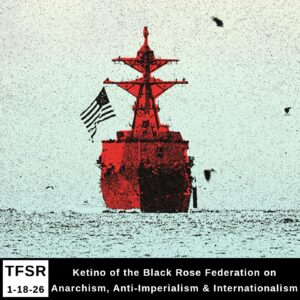
This week on The Final Straw Radio, we’re featuring a conversation with our guest, Ketino, to speak about Especifist anarchism and anarchist approaches at anti-Imperialism. Ketino is a member in Florida of the Black Rose / Rosa Negra Anarchist Federation and they grew up in Cuba. You can learn more about Black Rosa, or BRRN, at BlackRoseFed.Org
Other links:
- Black Rose’s introduction to Anarchism
- Denunciation of Venezuela Coup by CALA (member groups listed) and sibling, BRRN
- ICOA — International Coordination of Organized Anarchism wikipedia page
- Anarkismo Network
- Solidarity with Sudanese Anarchists (including ICOA-related signatories)
- Zabalaza Anarchist Communist Front – South Africa
- CES (a project offering education in Especifismo): https://especifismostudies.org/
First up, here are a few prisoner struggle updates
Announcements
Prisoners For Palestine
It was announced on January 14th that members fo the Prisoners For Palestine hunger strike, from the Palestine Action case in the so-called UK, ended their strike after 73 days without food after a key demand was met with Elbit Systems being denied an important government contract. You can read their statements at PrisonersForPalestine.org and check out our November 30, 2025 episode for some background on the cases.
Xinachtli
From Xinachtli’s support crew (Instagram at @FreeXinachtliNow):
On January 1, Xinachtli (state name Alvaro Luna Hernandez) was transferred to the Carol Young Medical Facility. In the moment, this was a major victory getting him moved from McConnell, and Xinachtli shared that he felt the power of the people!
However this victory was short-lived. The transfer was carried out without any notice to his attorney, and made Xinachtli unable to communicate with them before his latest court hearing on January 6, effectively blocking his right to counsel.
Within days of the transfer, we also learned that Xinachtli had been placed in a cell with no running water, and a broken sink and toilet.
In Xinachtli’s words: “They bring me a bowl of water. I first use it to drink, and then I use the rest for hygiene for the remainder of the day. I also have not been able to flush the toilet in days.
Prison conditions in the U.S. are deeply dehumanizing. For Xinachtli, who is attempting to recover after months of medical neglect, these conditions risk further delaying his recovery and compounding the harm he has already endured.
We know that applying pressure works. A director of TDCJ called organizers earlier this month begging for an end to the “hundreds of calls.” Contrary to their request, we will not stop until Xinachtli is FREE.
Xinachtli’s current demands are:
- That he be moved to a cell with running water and functioning plumbing.
- That he receive his ID card so he can purchase needed items and receive his commissary order from January 2.
- That he receive all of his personal property from the McConnell Unit.
Contacts:
• Carol Young Medical Facility TDC): (409) 948-0001
◦ WARDEN: (**129)
• Region III Director Jerry Sanchez: (281) 369-3736
• TDC) Executive Director: (936) 437-2101
You can sign up for slots and find tips for making calls, including scripts, at https://bit.ly/xphoneblast
Repression in Alabama Prisons
In the last few days, according to supporters of the Free Alabama Movement as we approach the February 8th call for a statewide work stoppage Kinetic Justice, Hannibal Ra Sun and Raoul Poole have been transferred to another prison and prisoners across the ADOC have had food rations cut. To learn how to advocate for these three FAM leaders now at Kilby CI and read the press release announcing the upcoming strike actions, check our shownotes :
following their announcement of an upcoming labor strike, Melvin Ray, Robert Earl Council (Kinetik Justice), and Raoul Poole — three prominent voices in the film “The Alabama Solution” — were taken to Kilby Prison.
In anticipation of the strike, the AL Dept. of Corrections has also reduced access to food in its prisons. This is a dangerous violation of [prisoners] constitutional rights.
Call Kilby: (534) 215-6600
Demand they keep these men — and all those in state custody — safe.
The Press Release announcing the strike is here:
FOR IMMEDIATE RELEASE
December 2, 2025
FREE ALABAMA MOVEMENT (FAM)
ANNOUNCES STATEWIDE SHUTDOWN ADOC 2026
Effective February 8, 2026
Alabama — The Free Alabama Movement (FAM) announces a coordinated, statewide shutdown of Alabama Department of Corrections (ADOC) facilities beginning February 8, 2026. This nonviolent action comes in response to decades of unconstitutional sentencing practices, forced prison labor, and the ongoing humanitarian crisis throughout Alabama’s prison system.
With the release of the documentary The Alabama Solution, state officials can no longer deny or ignore the overwhelming evidence that Alabama’s prison system is in catastrophic failure and requires immediate, sweeping reform. The documentary exposes systemic corruption, violence, and deliberate neglect that incarcerated people have endured for generations. The truth is no longer hidden behind prison walls — it is publicly available, undeniable, and morally urgent.
Despite federal investigations, DOJ findings, and repeated warnings, the State of Alabama has failed to enact meaningful change. Therefore, incarcerated people across the state are exercising their lawful right to peaceful protest through a statewide shutdown and work stoppage.
LIST OF DEMANDS
- Repeal Alabama’s Habitual Felony Offender Act (HFOA)
Abolish the outdated and excessively punitive enhancement statute that has produced life and virtual-life sentences far beyond any rehabilitative purpose and out of step with modern standards of justice.- Make the Presumptive Sentencing Guidelines Retroactive
Apply current presumptive sentencing standards to all eligible prior convictions so that people sentenced under older, harsher laws can receive the same fair and consistent treatment as those sentenced today.- Make HJR 575 Retroactive (Drive-By Shooting Statute Reform)
Apply the legislative clarification of Alabama’s drive-by shooting statute retroactively so that individuals who were improperly charged or enhanced under the statute can receive review and relief.- First-Time Offender / Capital Murder Reform Bill
Create revised sentencing options for first-time offenders and end Juvenile Life Without Parole by providing parole eligibility after 20 years, recognizing the capacity for growth, change, and rehabilitation.- Parole Board Reform and Clear, Objective Criteria
Mandate transparent written standards, meaningful hearings, and review procedures that ensure fair, non-arbitrary parole decisions for every eligible incarcerated person.- Medical Furlough & Compassionate Release Expansion Expand and enforce mechanisms for the release of elderly, terminally ill, severely disabled, and medically fragile individuals so they can receive appropriate care in the community instead of dying in prison.
- Establish a Statewide Conviction Review Unit
Create an independent conviction review body with the authority and resources to investigate wrongful convictions, excessive sentences, and cases involving prosecutorial or judicial misconduct.- Abolish Forced Prison Labor
End uncompensated and coerced prison labor by guaranteeing fair wages, voluntary participation, safe working conditions, and basic labor protections for incarcerated workers.- Strengthening Families Act (Including Conjugal Visits)
Implement policies that protect and strengthen family bonds, including conjugal and overnight family visits, expanded contact visitation, increased access to phone and video communication, and parenting and family-support programs.STATEMENT FROM FAM
“For decades, incarcerated men and women in Alabama have lived in conditions that violate human rights, constitutional protections, and basic dignity. With the undeniable evidence now in the open, we are left with no alternative but to demand justice through collective, peaceful action. This shutdown is not an act of hostility — it is an act of survival, truth, and human rights.”
Bennu Hannibal Ra-Sun
Kinetic Justice Amun
CALL TO ACTION
We call upon:
- Civil rights and justice organizations
- Faith-based institutions
- National human rights observers
- State and federal officials
Families, supporters, and the public to stand in solidarity and demand immediate reform of Alabama’s prison system.
PRESS CONTACT
- Free Alabama Movement (FAM)
- Email: freealabamamovement@gmail.com
#StatewideShutdownADOC2026
. … . ..
Featured Track:
- Al Nather by Ma3azef from Nisf Madeena
- TFSR 1 v2 by The Willows Whisper
. … . ..
Transcription
Ketino: Hello, I go by the name Ketino. My pronouns are they/them. I’m not too big on that, but that’s fine. I’m currently based out of Tampa, Florida, and I’ve been around here for maybe the last 10 years, and I’ve been moving between two different locations. I’m kind of new to Tampa. As for my affiliation, current and former, I’ve been a member of Black Rose for maybe nine years now, and I’ve been part of a couple of unions. I’m currently part of the Teacher Association in Hillsborough County, in Tampa, Florida. I was with a migrant union before that. I was also part of Florida Prisoner Solidarity back in Gainesville. I’ve also organized before that in Miami with some mutual aid efforts. That’s pretty much my background. Is that good enough? [laughs]
Maybe it’s worth mentioning that I’m a Cuban, and before moving to the States three years ago, I was also part of the Taller Libertario Alfredo López, also known as TLAL, which is a Cuban anarchist collective. They did a lot of work in Cuba. In that sense, I can say my path in anarchism started actually in Cuba, and then continued in the States when I moved down here.
TFSR: Can you tell us a bit about the Black Rose / Rosa Negra, how it’s structured, and its shared conceptual frameworks among the membership?
K: Black Rose / Rosa Negra Anarchist Federation, as you can guess from the name, is a federation of locals across the United States. We have numerous locals across the territory of the so-called United States. It’s based on the idea, the principle of a federation, which means that all locals come together and do the labor of coordinating what they are doing, at a local level and at a national level. Just to put it very easily, that means our locals have their own voice. Usually, you have a delegate that will be the voice for the local, and the local will do their work at the location they are based, and at the same level, there are going to be committees that are organized, or not organized, but at least are looking into what we in Black Rose call “sectors”.
It’s important to understand that Black Rose is based on the ideas of especificismo, which is a way to address what is otherwise known as either organized anarchism or class-based anarchism. Especifismo is a group of ideas, an understanding that came out of this specific experience of South American anarchism with organizations like FAU (Federación Anarquista Uruguaya) around the 1950s, the 20th century, and had a significant development in places like Brazil and South Africa, just to name a few. Right now, it’s been expanding across different places on the planet.
Going back to the concrete, specific way in which Black Rose works: it’s a local-based federation that tries to work within the idea of a revolutionary organization, meaning that we are all for revolution, anarchist revolution, also known as libertarian socialism. And you can definitely find all this information on the Black Rose website, where our mission statement and all the articles have been published — that website and social media.
I was talking about sectors. Black Rose has been trying to work specifically in sectors like labor and territorial/region. We consider labor and territories to be very important places of struggle, or sectors, as we call them. Labor is definitely everything related to the working class aspect of the class struggle. What I mean by that is the focus specifically on workers’ unions, on the workers’ side. And then territorial is everything that’s related to the struggle that takes place within the context of what we call “territory,” or space overall. The concrete way to organize is through tenant unions and issues around land, around extractivism, and all the uses of territory and land and housing.
Also, Black Rose does a lot of revolutionary propaganda, and it’s another important aspect of Black Rose to take into account. We try to put out there as much revolutionary propaganda coming from, of course, the understanding of anarchism, organized especifismo, organized class-based anarchism, and do all that with as much revolutionary propaganda as we can. That’s why the website has all this information that you can look into for yourself.
Our ongoing effort for the past three to four years has been to build an international solidarity relationship with what we call “seedling organizations”. As I mentioned earlier, there is an increasing number of “Organized Anarchists” across the whole world, in different places — different continents, countries, etc. And this is definitely not a Black Rose initiative, this is something that happened before and we have been invited to be a part of that. We’ve actually tried to do our work in that direction as well. This is nothing new to Black Rose in the sense that it always had very strong ties to organizations like FAU or class-based organizations as well. Because things are changing across the whole world in many ways, we’ve also been able to try to find ways to address these many new situations that are part of the actual class struggle across the whole world.
TFSR: At some point, I remember Black Rose using the language of “platformism” to define itself. And I know that I’ve seen that Black Rose correlates with the Anarchismo Network, which includes other collectives that I haven’t seen use the term especifismo. Maybe because they’re not as influenced by proximity and common membership with organizations in Latin America and the Uruguayan model. But would that be considered an umbrella, and especifismo is a flavor of platformism, or is it a distinctive development in that trajectory of having a highly coordinated, specifically class-based federation like you’ve got?
K: It’s an interesting question and a very useful one, because it’s going to clarify a couple of things. Especifismo and platformism have a lot of overlaps. However, in terms of pure history, they have no relationship whatsoever, as platformism was a development of anarchism within the concept of the Eurasian territory, specifically related to a region in Ukraine.
TFSR: Like the Makhnovshchina?
K: Yes, and then Delo Truda, which was the space where the ideas of platformism were mainly developed. Especifismo was developed in, like I mentioned, Uruguay, specifically. Especifismo, from what I know, and I’m definitely not a historian, and definitely not a historian of the development of anarchist ideas… So my knowledge can be challenged. There might be some shortfalls here. But if I have to say something, I would say that especifismo was probably mainly developed as a revolutionary practice within the context of Uruguay in the ‘50s, originally, and later on, probably around the late ‘70s, early ‘80s, you see more theory coming around the idea. That’s my understanding. There are probably one or two pitfalls there, maybe I’m not being accurate.
Just to recap, they are very similar. These two sets of ideas definitely agree that you need to focus on organizing, coming from an understanding of what’s called traditionally class struggle and class-based, and then you have to have a strong organizing principle. And they also overlap in the idea that a federation model is the most suitable. Platformism might have a slightly different approach to these thoughts, maybe more centralized, I don’t know. I don’t want to get into the weeds of debating platformist ideas, because I know less about platformism than I know about especifismo, and I don’t know where the debate is right now, and all the nuances around that debate. However, I do want to mention that it’s important to note that we do come together. And we work together, and we consider platformism to be a really close organizational model to not only Black Rose, but to an organization that is based out of especifismo itself. We do believe we share a lot, and we’re really close in that sense.
TFSR: One thing — and maybe I’m just super imposing this in an ahistorical manner — but some of the discussions that I’ve heard come up around the development of platformism were that “we need an organized model that can counter the rise of the Bolsheviks. Because the anarchists were crushed in Russia, in Ukraine, in neighboring areas by Bolsheviks, and crushed between the Cheka security forces and the Red Army, and undermined in a lot of ways.” I don’t know so much about the Uruguayan circumstance, but my understanding is that in the 1950s and 1960s, in that country — that was where the Tupamaro uprisings were also happening — there was a very strong national liberation and Leninist-driven, probably Stalinist as well, movement that was around at that time. And I would imagine that organizing and competing in that time with those groups probably influenced the shaping of especifismo to be able to counter some of what the Leninist organizations were doing. Was that a fair assumption?
K: Yes. This is what we call, in Spanish, curiosita historica, which translates to historical curiosity. At some point, even the Cuban revolutionary government was in conversation with groups like FAU. And then there was definitely a will to distinguish and to separate themselves from that type of understanding of what is revolutionary praxis, or revolutionary practice. It’s also important to understand that FAU developed this specific set of ideas that we call especifismo today within the context of fighting back against high state repression, and sometimes being underground. It was a battleground. This is the same as platformism coming out of that specific experience of what happened with anarchism within the context of the Russian Revolution, and then everything that happens in Ukraine afterwards, and all of those historic events. Especifismo also comes out of that very specific history of active, real context of class struggle against state repression and reactionary forces — against police, the army, and so on — in the context of Uruguay and South America, overall. Yes, absolutely. The ‘50s and the ‘60s in South America, Uruguay, and Brazil — I am gonna put it this way — is a golden moment for military dictatorships in South America. You can imagine what type of situation was happening. Killing and torture were just your everyday situations.
TFSR: We’re having this conversation in the shadow of escalated and escalating violence by the US state under the Trump administration against the state and the population of Venezuela under the banner of a renewed Monroe Doctrine, as well as claims of terrorism and narcotics trafficking against the Venezuelan administration. These are all things that Trump and company are saying to legitimize the coup that they just engaged in, the bombings that they conducted in Venezuela of boats, as well as places on land, and the threats against the administration currently to extract more oil.
I wonder if you could talk a bit about the US role historically in Latin America, and how this policing claim that’s being made around illegality or narco-terrorism of the Venezuelan regime matches up with other legitimizations by the US administration’s past for its incursions into Latin America, direct or indirect.
K: Let me put it this way, when I woke up on January 4, and I read this news, my feeling was that we went back in history 150 years. That was my gut feeling about that. We went back, we jumped back in that day, like NASA had invented a miraculous time machine, put everything in it, and sent us 150 years back in history. This is obviously something that comes from — and I was just reflecting about why I’m feeling this way, that I shouldn’t be feeling this way, because I know better — but in a way, collectively, we’ve been led to believe that that’s over. That it was over a long time ago, the Monroe Doctrine was over. What they call “diplomacy with a stick” and the “gunboat diplomacy.” All of those things that were such an essential part of building and structuring continental and regional relations, geopolitical relationships in the late 19th and early 20th century, were over. All of a sudden, “No, it’s not!”
There is a lot of conversation about that. There’s a lot of discussion. I really don’t want to saturate this moment with half-fake ideas coming from my part, or pointing out complicated and complex theoretical discussions. I really don’t think this is the right place for that. I don’t want to bore people with that. I’m going to come from the idea that it’s a major structural change in terms of how capitalism works worldwide, and the role of the United States within that change as being the one that’s spearheading it. When I say the United States, I mean the state of the United States and the current government of the United States. They’ve been taking over the role of spearheading this structural change, so to speak. I believe there is a consensus around this. I don’t think I’m saying anything new.
The thing is — perhaps, and you can take this however — is that I do believe the Trump administration has the right lever, or the right tools to do this, and it is not an accident that the Republican Party and the Trump administration are doing all of this: I think this is more a need of capitalism as a world system, rather than just the will of a particular group of people. What I mean by that is that, while we have to hold the complexity of understanding why this concrete group of people is doing this, this political class, at the same time, we need to understand that this is a systemic need. This is a systemic need. It’s not just because two guys one day in the morning, sipping coffee somewhere, decided, “Oh, this is what we’re gonna do.” This is a very systemic need, and it’s related to the current state of capitalism as a whole, how it’s been in a constant crisis since 1970. And this is pretty much also established — all the economic indices are really, really bad. Consumerism is not working anymore. The last model, which was neoliberal globalization, didn’t work — I suspect — either, and this is the response. It also has to be understood that every time there is a structural adjustment, every time capitalism adjusts itself structurally, the first outcome is going to be political violence. That’s what this is always going to be. It means increased state repression at every level. Violence is just going to ramp up. It’s the way it happens. This is the core of the nature of capitalism.
Going back to the United States specifically and its historical role in what we call the Americas, and specifically South and Central America, the Caribbean areas: yes, this is what it is. If you go back to 1994, to the Zapatista uprising in January 1, 1994, you realize that NAFTA — which was this idea that we all going to be at the same level of free market — was definitely, at the time, making social changes. I mean the Zapatista is not only a response to NAFTA, but definitely NAFTA played a big role in triggering the Zapatista uprising. What I’m trying to say here is that every move — even those moves that they try to portray as based on international law, all the narrative about democracy — all of that has always been coming from the United States, and looking at South and Central America and the Caribbean, as violent military interventionism. It can just violate the whole territory of Venezuela and kidnap the president, or it can just support Augusto Pinochet and all the killing in 1973 in Chile. It can be Nicaragua and the thousands of Nicaraguans killed across, I don’t know how many years of intervention in Nicaragua. It can be Cuba. It can be Haiti, a place where they’ve been paying the price of a revolution for centuries now. It keeps going and going. That’s what a historic relationship with the United States looks like in all of these places. You just have to go and look at the record. It’s the very same nature of imperialism.
And, I do want to say something. It is true that it’s America. It’s true that it’s the United States, but we need to understand that this is how capitalism plays out. The United States is not actually the first nation-based model of capitalism. Britain was before that. It was actually as violent as the US. You go to World War II and everything that was happening before that, just as an example. This is the very nature of the system. I am going to leave it at that.
TFSR: One thing that’s been shocking people in a lot of this has been the fact that it seems like a ramping up, an escalation of violence. And you can point to different military interventions, invasions, coup d’etat, that have occurred over the last 150 years that the US has been involved with, has funded, has trained, has armed, what have you, or supplied active military for. And maybe the turn that you’re referring to, and maybe you could say some things about this, in the way that capitalism, through the US state, imposes itself on its neighboring territories has shifted fully away from the soft power approach, by actively defunding USAID programs, health, education and a number of other things. Programs that were funded in part by the US as a way of stabilizing a certain model of international stability that one wing of US-based, in a lot of cases, capitalism, could find easy purchase and be able to operate and make good profits because stability is a good thing for business. You can send investors, you can extract with less conflict, less expense, and less moral outrage by populations in the imperial core. But I wonder if you could speak about that shift, and how that’s a continuation, just by its politics, by other means, of what was already happening in the region.
K: Absolutely. For example, not so long ago, [the US] did a similar thing with Manuel Zelaya in 2009 [in Hondorus]. I’m bringing that one in this particular case, because it was very similar. It was a coup d’etat. This did imply a regime change. The whole conversation now around the kidnapping of Maduro is calling for a regime change, how they’re talking to the VP, all that, purposely confusing the situation that’s going on. This was not the same. This was not the most violent case, but it happened in 2009. I believe Obama was the president at the time. Then you have the whole situation with Haiti and how Haiti is now policed by Kenyan police. But this is definitely the way they found, a workaround they found, to keep up this ongoing violent intervention of Haiti, that sparked a lot of deep social, political, and economic issues in Haiti, and they are not even talking about that. This is what is happening right now. It’s very recent. It’s not too far in time. Sometimes we just don’t have the best understanding that we live in that concept. Then you have the Panama invasion of 1989, and then you have everything that was happening before that. You have the situation in Nicaragua and the Contras that is definitely associated with the United States, and the Reagan administration actually funneled all that money.
Let me tell you something, this is a very personal story. When I was a kid in Havana, I was on vacation with my family, and I was probably eight or nine years old. We were camping next to this medical facility that hosted victims of minefields in Honduras. I never forgot about that, kids missing limbs. And all of that was linked, one way or another, to the United States fueling interventionist policies and fueling political violence across South, Central America, and the Caribbean. The country I was born in, Cuba, is definitely a stellar example of that. The Independence Wars in 1890s, the last one that started in 1895 was definitely intervened by the United States in 1897, 1896. They intervened, and they took over. The understanding is that the Spanish army was pretty much already defeated, and they stepped in. Then they claimed they were crucial to the victory, which is never true. Then they pushed aside the Cuban Independence Army, and they rigged the whole thing. They occupied the island and fed us a fake constitution that included the Platt Amendment, which granted the United States occupation rights, but also part of the sovereign Cuban territory. So they rip the Cuban independence effort — which actually lasted for 30 years. It started in 1868, 30 years of struggle against Spain, the colonizing power — they ripped the Cuban effort out of the right to independence.
So everywhere you look — in Guatemala…Chile is a pretty well-known case of how the [Operation] Condor was just sponsored by the CIA. The CIA is the main actor here and across the 20th century, and in so many instances. Is this a good number of examples? Or you want me to go a little bit more?
TFSR: If you have more to say, go for it. But if you want to switch to the next question, we can do that, too.
K: Also, Grenada, for example. Everywhere you look, you’re gonna find the history of US interventionist politics. It has gone by different names. The Monroe Doctrine was just the beginning of that. They wanted to just protect the Western empires from European colonial powers and, of course, the subtext was that they wanted to keep it to ourselves. That became clear throughout the years, specifically the administrations that started in the early 20th century. I believe it was Wilson and definitely Roosevelt. Roosevelt, for example, was someone who was involved in this takeover, the intervention of the US Army in the Cuban Independence War. He was there in the flesh, by the way.
TFSR: Let’s talk about a framework for understanding imperialism, how has the term developed, and how is it used today, more generally? I’m specifically hoping we can talk about how might we as anarchists who have a critical relationship with the concept of national liberation – because we’re not nationalists, different from how authoritarian Marxists engage with national liberation struggles – how we can approach situations of interstate, and thus intercapitalist, aggressions that have real consequences for working-classes everywhere in a way that fits with our view of the world?
K: This is a big question that we have to update or rethink every single time. If you don’t want to see it as the Leninist idea of the “late stage of capitalism,” it can definitely be understood as a set of relationships that capitalism will always find its way into. But as you mentioned — and I totally agree with what you bring into this conversation — it’s all the things that factor in, and it is complex, and it can also become complicated sometimes. I totally agree that we, as anarchists, have a critical relationship with national liberation movements. We have always had that critical relationship. There is literature that Black Rose has produced about that — it’s a very interesting one. And there’s real experience about that. Anarchists have always been involved in that type of effort, and were always trying to make sense of an understanding of what revolution means within the context of sometimes national liberation.
So imperialism… I think what matters is what we do, how we move towards revolution. That’s the most important thing, and the complexity of the theoretical discussions, definitely, we need those, but sometimes we just have to be realistic about that. We can go and make the whole genealogy of what imperialism is as an idea and what the critique of imperialism means. Actually, it sounds pretty much like it was a literal concept through J.A. Hobson, and then it was taken over by Lenin and was developed in his classic book Imperialism, the Highest Stage of Capitalism. There’s a very strong idea within the tradition of Marxist thinking. You have key Marxist thinkers, not only Lenin, but also Bukharin, Rosa Luxemburg, you have Kautsky, Rudolf Hilferding and then all the way up to the current moment. You have authors like Samir Amin, who was really discussing the understanding more, at least the time he was around, it was a more contemporary understanding of capitalism — everything that turns into that, and that it has different branches. Like, within even Marxism, some of it goes into ideas like Campism, like there’s imperialist countries and not imperialist countries, which contradicts the core of the Marxist-Leninist understanding of imperialism.
It’s important to point out that Marx never discussed imperialism in the way we discuss it nowadays. The use of that term within massive research, or written by Marx, specifically in the Eighteenth Brumaire when he was debating the revolutions in Europe around 1848, and then the Commune in 1870. The term is there, but there isn’t any relationship to the way we take it nowadays, like it discusses “empire” like the French Empire. And then we have the reality of the current imperialism. I have the feeling that anti-imperialism became a very big thing after World War II, because it turned into the national liberation movement, national liberation struggle, and anti-colonial struggles across the world, specifically in Asia and Africa.
It is important to understand that the revolutionary socialist movements and organizations were really key to the development of these struggles, and it was pretty much a critique of the Left worldwide. And because the Left has this in front of Marxism, which is undeniable, and many other things, anti-imperialism became a very strong ideology that was definitely very useful. There is a lot of discussion about this. To what extent, who was the winner of the thing, if anti-imperialism won or nationalist ideologies won. I don’t want to dig into that, because that’s a whole can of worms. I don’t think we need to unpack that right now. This is not the right place for that.
I will lead in with neoliberalism. Neoliberalism can be understood to some extent as a number of defeats of revolutionary movements across the world. This was a pretty big offensive against the labor movement, against revolutionary organizations across the world on many levels. And that pushed imperialism, in my opinion, at least from the ‘90s and the early 2000s, out of the frame. Although there have been people who have discussed imperialism, it’s not a concept that you see much around, like it used to be, but right after World War II. And I believe it’s making a comeback. It’s a very important comeback, because I do believe imperialism is definitely a form and shape of the development of capitalism that’s always present. It’s not only about forced military intervention, but it is a way to structure the world around capitalism at the transnational level.
I do not agree fully with the Leninists. We’re coming from an anarchist perspective. It can sound weird, but it doesn’t sound weird to me. I don’t fully agree with Lenin’s take, at least I don’t think it applies to our current moment. These five or six points that Lenin put out there are what imperialism is about. But financialization is an important one. We’re living in a world with financialization. If we look at the critique of economic policy currently coming from the left, you know that financialization, for a long time now, has been the way that’s actually shaping the world. There is a lot that has been in the very long term “downturn,” just to put it in the language of Robert Brenner, who’s been developing this set of ideas. I don’t necessarily agree with everything that Brenner is saying, but it’s a fact that productivity has been shifting, and financialization has taken a bigger role. That’s there. There are banks and monopolies. The role of monopolies is pretty obvious across the capitalist economy at every level, from Walmart to Google to whoever you want. The monopoly is a very much a part of the current structure of political economy and the economy overall.
TFSR: Just for clarification or for simplification of the term financialization, could you talk about what the impact of that is? Is that like another stage of capital approaching a commodity to create liquidity for it, to extract more value by making things like housing less based in the physical territory that exists, but allowing speculation and the abstraction? Instead of it just being an apartment building that a bunch of people live in and they pay rent to, it’s now a banking facility that’s running multiple of these in multiple cities in multiple countries around the world, and trading on the future profitability of those in a way that, when it comes to affecting the people on the ground, they no longer have a clear line of complaint, for instance, or any agency in affecting the cost of the rent in the place that they live in, or the development that it makes, because suddenly it’s 15 steps above them and maybe owned by a company in Europe or in China or something like that. That’s my understanding of it, and I’m right very ignorant around economics.
K: That’s absolutely right. I would add debt to that debt. Financialization is debt. Even you can see the trend of the exponential… I believe that word isn’t even useful anymore in giving an idea of amount of debt that everybody is in, and that is financialization. What I mean by that, just to build on what you’ve been saying, is that the basic idea of credit is you owe cash today on a future commodity. However, capitalism has been failing to keep up with that future commodity because production cannot catch up to that level for a number of reasons. This is very abstract, but I am going to try to bring it back to Earth. It just cannot do it, has not been able to do it for a long time now. So what you do is you create debt, meaning that you give people credit for something that’s not going to happen, right?
Housing, for example. There is a company in, let’s say, Belgium, that owns something down here. The way you have to pay this company is by going into debt. Because there are sometimes ties within this company and the other company, that’s creating debt and all of that, there is this idea that the capitalist class is a socialist class within themselves, while being capitalist to everybody else. They distribute the wealth among themselves while being a predatory capitalist beast to everybody in the working class. They increase the price so you can’t pay. You have to go into debt. That creates an idea that you’re going to produce this money in the future. You’re going to fail doing that. So your interest is going to increase. That creates more debt, and that debt is traded at high financial levels. That’s how it works. I’m sorry if this expression is not that clear. That’s my understanding of what financialization is about: creating debt, creating the idea of credit, and pushing the idea that you can pay for it, while the very same system is not productive at that level. The system is never going to produce that level of commodity to actually match up that level of debt. We are caught in that situation. This is not a personal failure when you go into debt, it’s rigged. It’s working like that. And it’s not even a conspiracy theory, master plan, or anything. Capitalism doesn’t work at that level of conspiracy theories. It doesn’t work that way. They’re trying to profit and trying to push for everything, for every mechanism.
TFSR: As you say, it’s not about conspiracy theory. It is still complex, and so for a lot of people, it can feel this obscured thing — and it is obscured in a lot of cases, too — the relationship between state application of violence and the financial institutions that are behind them in a lot of cases, because maybe the motivations might be illegal. There might be a grift going on or bribes being paid. But I think that what you’re saying about financialization seems to point — and the neoliberal turn that began in the 1960s and 1970s, mostly points — to a vision of imperialism that’s more complex than this Campist idea of “there are imperialist countries and there are colonial countries.” If it’s understood that the capitalist class is transnational, and while most of the violence flows in one direction towards populations that are in the former colonies, if you can still say that the violence that occurs through financialization is impacting working-class populations in imperial core where there’s less of the immediate violence than you see — like the bombings going on in Venezuela or in Nigeria or wherever this happens to be directed — there’s ground right there for a relationship. A transnational working-class relationship, understanding that while the impacts may look different on the ground, we’re all over the barrel by these same international institutions, same nation-states, as well as the national bourgeoisie, in the various circumstances. We’re interacting with each other, but therefore, there’s a possibility for solidarity across those national borders.
K: Yes, absolutely. The US is one of the most violent countries in the whole world. The violence in this country is rampant-
TFSR: Like internal to the country.
K: Internal, internal. We have to understand that this violence is a product of class struggle. What I mean by that is number one, you have the police, which is state repression. Statistically, it is, or at least it used to be, the fifth most violent police force across the whole world. Brazil used to be number one, but the United States ranked fifth. Then you have all the violence that’s incubated in society. Whatever the reason might be, we’re not discussing that right here. This is a whole different subject that is very complex. But I’ve been in instances where people are talking about the violence that’s exported, happening in this place or that place, and I’m like, “Well, you live in a very violent society; everyday violence is so big.” And it’s not just because. There is a reason behind that. Exploitation, oppression, and domination in capitalism, which is what produces the system, are the reasons behind that. Violence in the United States is a mechanism. What I’m trying to point out here is that the working classes in the United States… This goes back to the whole idea that this working class in the first world benefits from Imperialism, but let’s just pass that. But it’s not as privileged as you might think.
One of the things that was running through my head at the height of the late iteration of the Palestinian Solidarity Movement was how to actually understand the conflicts in terms of class struggle. There are many answers to that. But for me, it was something that was in my head running all the time: how to clarify that relationship, how to show that the interest of the working class here is the same interest of the anti-imperialist struggle in Palestine, in Gaza, and in the genocide that was taking place at the moment. How to present that outwardly, how to present that it’s systemic, clearly make that evident — for my own sake, probably. I don’t think many people need me to qualify any of that. The people have their own reasoning. And at that moment, one of the great victories of that movement, I believe, was the actualization of many of these responses: all the solidarity networks that popped up, all the experience, all the thinking, all the praxis across the world. They grew how this relationship, this understanding of the linking became something that was the regrowth of that capacity of the internationalist scope.
I would say there is a major difference between what used to be the anti-war movement in the early 2000s, around the attacks on Afghanistan and Iraq, and what has become the beginning of an Internationalist movement. It’s not coming out of the blue. We have Rojava, we have Myanmar, we have all of these instances there, and people who have been doing that. But it is the moment. It is a moment where that seems to be coming front stage more and more. And people are understanding, and the working class and the oppressed dominated class, to put in proper especifismo language, that the dominated class is growing more conscious that it is a class issue, it is a class struggle issue. And that understanding is becoming more central, and they are building around that understanding. And that’s happening, in my opinion.
At some point, we were looking into pension funds because there was a lot of conversation about unions, pension funds, Israel, and the pension bonds. All of that conversation. So, we were trying to look into that, trying to make sense of that in terms of a reading of class. There is, of course, the history that goes back to those pension funds, and how in the United States, the unions don’t have much control over the pension funds, but still have a little bit of voice about that. Very minimal, besides the fact that since the ‘70s or the late ‘60s, the unions were stripped of the capacity to control that money. That’s a very important reality to take into account when we discuss the idea that unions are protecting the pension funds, because sometimes that plays out as an anti-union feeling. It’s not that, they don’t have the control. There might be some instances of this guy, who’s Trump-affiliated, but I don’t remember his name or a specific union. That’s an exception. Overall, the unions will not go in that direction, like give up the control that easily, but they just don’t have that control in a number of ways. That was done throughout the ’60s and the ‘70s, and you can see it right now.
Nevertheless, with this idea, how to understand where the unions are putting money, like into an imperialist oppression, an imperialist endeavor. The way that this genocide, the occupation of Palestine and the genocide in Gaza, impacts the working class of the United States is because it makes capitalism stronger. If capitalism becomes stronger, it will push you down, no matter where you are; it’s going to go against you. So if you move your eyes away from how imperialism is playing out somewhere, you need to understand that the next way is going to be you losing your rights. Or a privilege that you’re never going to be able to attain. Everything that’s been going through the sink, all the healthcare, all of that, because that’s the capitalist class accumulating power. Imperialism makes the capitalist class stronger. When the capitalist class is stronger, they lash out on guess who? – the working class, no matter where they’re located, because they need to exploit the working class, and if they have the power, they will exploit the working class in a better way for themselves. For their own gains. That’s the connection. I’m sorry, this is messy, but…
TFSR: No, that makes sense.
We’ve talked about finding the commonality among struggles and internationalism being a response to imperialism. You could even just, without the economics, say, “Well, there’s a common cause of humanity and I could see myself being born in a different place and being subject to these terrible crimes.” So, for whatever reason, we’re motivated to push back against imperialism from wherever we’re living.
What approach and response can we as anarchists have or promote, and how does that correspond or differentiate from, say, a Leninist or a Stalinist approach towards internationalism?
K: We, at least as especifists, need to acknowledge that every attack on the population is an attack on the working class. It’s the working class that takes the blow. The ruling class, the capitalist class, or the state. They find ways to put themselves in a safe spot. People who are left behind are the working class. For example, when the genocide was at its worst moment, there was an accounting in the media that became gender-based or age-based, and so on. But nobody ever says, “Well, it’s the working class.” And guess what – it is the working class, the people that are getting killed. It is the working class that’s being massacred; the ones that have the most bodies there. That’s who’s been massacred basically. Not only the working class, but mainly the working class. What I mean by that is every solidarity effort to alleviate the situation needs to be distinct from what can be seen as a non-critical nationalist approach to the idea of national liberation. In that sense, every support that can help the working class, which always takes the blow in any type of violent conflict, is part of the class struggle. And it needs to be understood that, in my opinion. And this is something that’s shared at least across Black Rose Federation. Every effort is necessary in that sense, be it Gaza or Sudan, which is going through a really genocidal moment as well.
At the same time, in my opinion, we should make a distinction and not support or critically support the reconstitution of the capitalist class and national bourgeoisie within those spaces. Sometimes those things overlap. They might overlap in a given moment. Our priority has to be the resistance and the solidarity work with the working class, and if that means that sometimes we have to work together, we should work together. Always making the distinction, always putting upfront the reasons why we’re doing it, but we must not shy away from supporting, helping and being in solidarity with the working class in a genocide type of situation like in Gaza, because we might feel that will bring a very specific type of support probably based on a different set of ideas. That, in terms of the working class, is totally counter-revolutionary. It’s petty thinking that we definitely do not subscribe to.
So clarity of ideas, being upfront about the way we think, but definitely being on the ground and creating material support for the working class whenever the working class is under attack. And the working class is always under attack in these circumstances. Again, to put it in proper especifismo language, the dominated class is always under attack. The model of “no war but the class war,” most of the time, what we see is the class war. The class war is active. Class struggle always has two ways. One is the response of the dominated class against the class in power. The other one is that the class in power is against the dominating class. Class struggle has always been bidirectional. It’s not one-directional. It’s not the response, it is always happening. So solidarity funds, or the takeover of ports, even boycotting, the encampments that happen — supporting all effort is crucial. You have to keep yourself, as an anarchist, and your mindset as an anarchist, and not give in to any ideas like we mentioned before, like “there is imperialist countries and non-imperialist countries,” and “imperialism and capitalism are not exactly the same.” They are always related, because, as you mentioned, the capitalist class is transnational, so it always finds its way, its workaround, on a transnational level. We should not identify with the myth of nationalism — of a country-based, dominated working class. We should be aware of that, and of internationalism in solidarity. What is also key is to have clear communication with what’s happening “over there,” and listening to the people who are over there. We need to listen to what they’re saying, because they’re going to be the ones who are going to help us understand the situation, and they’re going to be the ones who are going to help us better understand the solidarity that needs to be put in place.
One last thing about this. When I mention solidarity — and this is something we’ve been gaining lately — solidarity, sometimes, is a word that’s thrown around there, just like helping someone to survive, which is a very important thing to do. However, as anarchists, we need to understand that solidarity is something that has a political goal behind it. Solidarity is a way to build, to organize. It’s a way of building class struggle, the dominated class’s power. That’s the way we have to see it, and that’s an important distinction to have in mind when we work together, when we do internationalism and solidarity. We need to always find a way towards the political meaning of solidarity. That’s the real difference between what we used to have, that model that goes around, “solidarity is not charity.” That’s the real meaning behind that. We’re not just spending the two dimes that we’re able to put together for the sake of some moral high ground, not only because of that, but also because we find political revolutionary purpose behind that. We have to focus on that every single time, and that has to be our priority every single time.
TFSR: Yeah, and I think that’s a very good point that opportunities for solidarity are also opportunities not just for redistributing wealth between needy parties, but also as a way of building relationships and a way of building power in ways that, in the future, we can continue to. So if we’re finding a project that’s in Venezuela or Cuba or Palestine, somewhere on the ground, where maybe we’re seeing the spear point of imperialism especially affecting people, if we have the opportunity to support projects that are actively building power on the ground, they will have a better ability to defend themselves against further incursions. And we can learn from that building also, in addition to the positivity of having more information coming our way about how whatever technologies, for instance, are being applied in Palestine… What they are before they get applied to the US border, or whatever. Those technologies are transnational, too.
In closing, if you could talk a little bit about how, in your experience, Black Rose local chapters engage with internationalism, or through the wider federation, and how they interact against imperialism… What power-building relationships do they have with some of the past iterations or current versions of Internationales that they participate in? For instance, I know that there was a Caribbean and Central America, one that was around for a few years, but seemed to go by the wayside because of repression, I’m sure. Could talk about the networks that Black Rose participates in, communicates with, offers solidarity through, learns from, and maybe ways that people can get involved?
K: Sure. Let me do the easy part, which is how people can get involved with Black Rose. Just go to the website, you’re gonna find an email address there, and you just message. You will start a conversation with someone who will definitely respond to you, and you will have a conversation about the possibilities of joining Black Rose. I have to say these two things, though. Black Rose is a political organization, and it’s not an entry-level political organization, so you’re going to need a little bit of experience, and you have to be already politically aligned with what Black Rose is into. You’re gonna have to have some experience as an organizer, and be actually actively involved. That’s the type of membership Black Rose is looking for. It has always been like that. That’s the easy part.
The other part, yes, there is an ongoing effort, for example, in this specific case, Gaza and Palestine. Black Rose membership, through unions, has been doing a lot of work into bringing that political content within unions. And that’s a whole different conversation about unions and politics, unions between the right and the left, where unions go, where unions don’t go in the United States. It’s been a constant effort that’s definitely central to the politics of the labor committee within Black Rose to always bring political content in there first, in the sense of rank-and-file organizing, and on top of that, always press issues like Gaza, Sudan. That’s one thing that has been ongoing for a long time now. If you’re part of a union, a Black Rose local, then you will try to direct that work first, definitely, using the base of this idea of rank-and-file, because it’s the anarchist model of dismantling hierarchies. At least not working through the hierarchies of the contract unions and the bureaucracy might sometimes be there. Just trying to build autonomy, and we need the power of the union and the rank-and-file autonomy in the union, and then pushing for solidarity efforts all the time. Through workshops, meetings, and fundraising. That’s one thing.
Black Rose was also in support of anarchists in Sudan. I’m proud of that. We were able to help, and for me, being a working-class person and immigrant, it was a significant amount of money we were putting together. We’ve been in conversation with Sudanese anarchists for a while, I can attest to that, within ICOA, the International Coordination of Organized Anarchism, we’re able to support that effort, and have been in that conversation for several years now. It didn’t happen yesterday, and the result of that was just a long process of work. The reason why I am in Black Rose is that the Miami local, which is at an impass right now, but back in the day it was a very active local, was a funding local of Black Rose, and it has a number of Cuban or Cuban descent people involved with that. So they were really pushing for keeping an eye on what was happening in places like Cuba in the Caribbean overall. And we had a very active relationship with TLAL, Taller Libertario Alfredo López and Black Rose through the Miami local at the time. I met people there, and it was very easy for me when I came here to actually just put myself in it, and that was great. That was a lifesaver. Being a Cuban on the Left in the United States, people who know that can relate to it; it is not an easy thing. I’m not making this about myself. Anyway, this is just an anecdote that can help to understand the work that’s been done by Black Rose.
Then also, of course, supporting the effort that you just mentioned. There was a congress in the Dominican Republic around 2014 or 2015, trying to put together an Anarchist Federation of Central America and the Caribbean. Black Rose was invited there as observers. They sent people over there. I, myself, was sent last year to ELAOPA. ELAOPA is the gathering of autonomous popular organizations that takes place in South America. It goes to different places every year, and it’s been happening for a number of years now. It is supported mainly by the number of anarchist organizations. Black Rose would be funding and sending people over there, so I went there. We built a lot of relationships, friendships, and camaraderie. It’s definitely very close. We do the same anytime we can. We’re just trying to build this relationship actively. Right now, we are working very closely with CALA, Coordinación Anarquista Latino Americana, which is a South American-based organization. You have FAU, FAS, FAR, and CAB. CAB is in Brazil, FAS is in Santiago, Chile, and FAR is in Rosario, Argentina. This is mainly Argentina, Brazil, Uruguay, and Chile working together and putting up statements and having conversations, discussions, and finding ways to support each other. There’s always a little bit of details I just cannot discuss, but it gives you an idea. It addresses your question.
TFSR: If you wouldn’t mind, after the conversation, typing up links to some of those acronyms that you said, and that way I can put them in the show notes, so that listeners can be like “Oh, well, I’m interested in learning more about this work, or about these groups,” or “maybe I’m in one of these countries and hadn’t heard of this organization or this network — might be cool.”
Are there any topics that we didn’t touch on that occur to you that you feel are really pertinent to this conversation, or do you feel good about where we’re at? Anything we missed?
K: I would like to say this: at the current moment, with everything that’s happening with ICE and the state’s attempt to reshape the immigrant labor force, which is how I see what’s happening… It’s definitely constituted, as it has been said before, through race and nationality lines, but overall, I would say, this is still an attack on the migrant working class. It’s important, in my belief, to understand that this is another key feature of capitalism. Migration is a push on the working class to move around to places where capitalists need them. Capitalists need the working class. People do not migrate because they want to take a trip to a better beach. That’s not the reason why. It’s because economic pressure is there, in a very apparent way, but then the real push is where capitalism wants to have that workforce available. And that’s why, historically, undocumented labor has been a key part of the economy in the United States. What’s happening now is a crackdown on that layer of the population of the working class, because it has been incremental in the gaining of rights through working-class struggle. This is just a bashing against this class.
It’s key to be involved in this. This is not only immigration and racism, but on top of everything, it is a working-class struggle at its highest point. At this point, it’s a very political level, but our belief as revolutionaries is that we need to push for it to be a deep social issue, a very organized social issue. And it will take time, but we have to participate in this. And I’m just preaching to the choir here, because I believe anarchists have been at the front line of this all over the country. For me, this is a way to say that I’m very proud of anarchists taking that step in all the ways and shapes they’ve been able to do it, but also saying that this is the meaning I see behind that. This is solidarity within this class. This phenomenon has a domestic framework, but it’s still about that. And I hope for this to have a positive development in terms of class struggle, in terms of revolutionary class struggle, not in terms of the oppressive class organizing, but of revolutionary class struggle.
I also want to finish by saying that I feel hopeful. What I mean is that there is a number of events, crises, and so on happening, and the toll is very high, but at the same time, the increment in organizing is very obvious. And there have been setbacks. At some point, we were very hopeful with how unions were growing at that time; they were a very low percentage of what union organizing is today, and at some point, that was growing a little bit. Also, there were a lot of union-busting regulations put in place across a number of states just to push against union organizing, which means an increment of the labor movement. But that movement is still growing. And this is a natural response. To resist is the natural response. I agree with that statement, but we are also aware that organizing, and not only resistance, is growing. And the idea of a revolutionary horizon is becoming something that’s being discussed more and more. I believe that this new generation is playing a key role in bringing all the things back home. I’m very proud of these new generations. I’m very hopeful, and they’re doing what they’re supposed to, but they’re actually taking over their role in history. And in that way, while aware of the high cost in all of this, I’m also proud and happy that we get to be part of this process, of this struggle in this time in history.
Also, I just want to say thank you so much for this opportunity.
TFSR: Ketino, thank you so much for this conversation. I’ve really enjoyed it, and I’m excited to share it, and I hope we get to speak again sometime.
K: I hope as well that you have a wonderful rest of your day. Thank you so much.
TFSR: You too. Bye.