
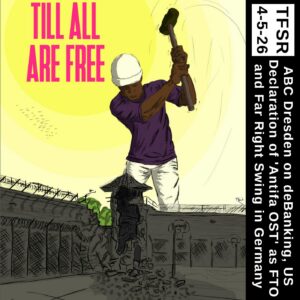
This week, we’re sharing a conversation with Nina at Anarchist Black Cross Dresden to speak about the political landscape in Germany, the Antifa Ost and Budapest Komplex cases and the impacts on anti-repression work in Germany since the Trump administration’s declaration that a group they’re calling Antifa Ost be added to the list of Foreign Terrorist Organizations that is kept by the US State Department.
This sits alongside the US government prosecuting the Prairieland case in Texas that was the subject of our prior episode, and could be one step further toward an official declaration of war on Antifa in the US, whatever that means exactly. We really feel that these cases are important to keep up on as the administration telegraphs it’s bizarre but frightening counterinsurgency strategies.
Some German Context:
- ABC Dresden articles on deBanking:
- Past episodes on Antifa Ost and the Budapest Komplex including support links: https://thefinalstrawradio.noblogs.org/post/category/antifa-ost/
- A past episode mentioning Lina E: https://thefinalstrawradio.noblogs.org/post/2022/07/03/stop-cop-city-intl-day-of-solidarity-with-antifascist-prisoners/
US Implications:
- https://en.wikipedia.org/wiki/NSPM-7
- Trump Admin calls for Anti-Antifa (…. ) summit in June / July this year: https://www.reuters.com/world/us/us-counterterror-officials-plan-antifa-summit-sources-say-2026-03-31/
- Prairieland Case episodes: https://thefinalstrawradio.noblogs.org/post/category/prairieland-case/
- NLG lawyer Mo Meltzer-Cohen on NSPM-7: https://thefinalstrawradio.noblogs.org/post/2025/09/28/the-implications-of-trumps-war-on-antifa-with-moira-meltzer-cohen/
- WSJ on Trump weaponizing IRS against the US left: https://www.wsj.com/politics/policy/trump-irs-investigations-left-leaning-groups-democratic-donors-612a095e
. … . ..
Featured Track:
- TFSR by The Willows Whisper
. … . ..
Transcription
TFSR: Would you please introduce yourself for the audience, with any name, pronouns and affiliations that you care to share for us?
ABC Dresden: My name is Nina, and my pronouns are she/her, and I’m part of the Anarchist Black Cross Dresden.
TFSR: Would you tell us a bit about ABC Dresden:, its story, and what the group does?
ABC Dresden: The group has actually existed already for more than 10 years, and with saying that, it feels really long actually. [laughs] Our main project is supporting prisoners and doing solidarity work. Our focus from the very beginning was actually to support comrades in Eastern Europe, such as in Belarus, Russia or Ukraine, but also we’re in touch with people in Poland. That was kind of the main focus. For a really long time, we didn’t have so many prisoners in Germany when we started, but this has changed through the years.
I think with this initial focus in Eastern Europe, we try to share the wealth we have in Western Europe (Germany). We want to kind of redistribute the wealth we can find here in the West, because this kind of relation between “East vs. West” is shaped a lot by historical exploitation and the Second World War.
This is really important for us. And in general, we try to live in practice and explain and work on this topic of solidarity. Such as, how practical solidarity works and what it means. And since the beginning of the full scale invasion of Russia in Ukraine, we are supporting a lot comrades in Ukraine.
TFSR: So that would include groups like the Solidarity Collectives, I would imagine?
ABC Dresden: Yeah.
TFSR: We’ll get into some of the changes that you’ve experienced in terms of where prisoners are that you’re supporting at some point, but for the most part, I was hoping to speak to you about deBanking that you and other anti-repression groups in Germany have faced. What is deBanking? Why is it happening? And how does this impact your work?
ABC Dresden: DeBanking in general means that basically the bank is cancelling your account or not even opening one for you. I mean, the latter you wouldn’t call deBanking, but this is also a problem.
So with cancelling your account (deBanking), this can happen over time, but also without notice, like in our case. Companies, associations, and also private individuals can be deBanked because they can be considered a risk for the bank.
The bank’s decisions behind deBanking are not necessarily always political, but the way they determine a risk can be highly political. The banks try to avoid fines or exclusion from international finance markets, or also having problems with their reputation. So this is why the banks proactively minimize their risks, and deBanking is kind of “de-risking”. You could say that there are a lot of funny words actually in this context. So maybe as a result of some suspicious movements, they’ll basically cancel the account, or even exclude different sectors from even providing bank accounts.
In general, deBanking actually can result from different reasons. Usual reasons can be, for example, money laundering or organized crime and for sure, terrorism. They kind of implement regulations and laws which are supposed to “prevent” such things. But, for example, the “terrorism” topic started basically since the 9/11 attacks in the USA, and then these kind of regulations were increased with the 2008 banking crisis. So, it already has a long history.
In recent years in Europe, a lot of new regulations were introduced, especially in 2023, 2024, and 2025. They even opened a new anti-money-laundering authority. So now, here in our region, you have the federal and state level, where both have an an independent authority, and then you also have the European level, and an international level.
So, for example, the banks want to be part of payment systems like SWIFT, which is maybe something people know. And this kind of SWIFT payment system allows the bank to transfer money to countries where they don’t actually have a physical presence. But to be part of these kind of payment systems, they have to follow certain rules. And these this kind of sanctions lists are connected to these rules, and banks have to obey these rules.
And, for example, when certain countries, associations, or people are on these sanctions lists, then their not supposed to transfer money to them. And, historically, we have some kind of famous deBanking cases, like, for example, WikiLeaks, after they published the US government’s documents in 2010. But quite often the targets are marginalized groups or nonprofit organizations who work in countries which are considered to be high risk.
So for example, we often had this experience in the last years where we would transfer money, even within the European Union, just to another account, but with a subject like “Belarus” or “Russia” or something like that, and then these kind of transfers would be blocked because of sanctions, and they wouldn’t even check what the transfer was about. But it’s blocked because there are certain kinds of words which triggered these kind of algorithms. And when it comes to these kind of marginalized groups, you have examples like sex workers being deBanked. Sex workers, for example, are considered as part of a high-risk sector. So they are in this kind of sphere where you have a lot of deBanking. And also after 9/11 for example, you had a lot of Muslim activists or NGOs being targeted with deBanking.
And with the recent situation we had here with the anti-repression group Rote Hilfe being targeted, it was because of Antifa Ost. And I’ll explain more.
“Antifa Ost” was put on an international terrorist list by Trump, and is also a construct of the police that they think exists. And so they were put on a terrorist list, and are now also on this kind of sanctions list, and that’s what affected the control of the banks.
So we have from one side this proclaimed goal in general by the banks to supervise money flow or fight terrorism and organized crime, but actually a lot of people are targeted by these regulations who are not supporting terrorism or money laundering, but rather they are kind of unwelcome organizations or marginalized groups.
And often this, as I just shared in some of the examples, follows quite a racist, sexist, or fascist interest at the end of the day. And not having a bank account these days is very problematic and makes things very impractical. So if you, for example, as an individual, get your bank account deBanked, you just have suddenly have no bank account, which means you will not receive your salary and you cannot pay your rent.
And for us as an association, we managed a large amount of money through our social media and in our bank account. And this doesn’t work anymore. So it actually has quite a big impact on the way we are able to collect donations. And this is actually a huge problem.
The thing is that from one hand, you have these kind of bigger regulations, but from the other hand, the bank has a certain ability to actually decide whether or not to block or close a bank account. But for them, it’s this kind of, what I said earlier, a kind of de-risking. So, to not get in trouble. they just proactively cancel the bank account, and then they are on the safe side. But for you, there is the additional problem that they often don’t even tell their reasons for deBanking you. This is kind of a common practice, that they actually don’t offer the reason for deBanking you, and that means you cannot really fight back, because you don’t even know what you’re fighting against.
Actually, often if they would check, it wouldn’t be a real legal problem. Like, this transfer you made you could explain what it is, but they don’t actually take the effort at all. So for them, it’s easier to just get rid of some of these kind of complicated initiatives, and then continue their business without any threat of trouble or something like that.
TFSR: Yeah, as you say, deBanking isn’t even necessarily because of a public safety threat or terrorism, but that the government might come after a group or marginalized person. So, for example, if a group is talking about support for resistance to the Russian invasion in Ukraine, or what have you, then they could just decide this is a risk, and close your accounts without any recourse.
ABC Dresden: Yes, and especially, for example, in Germany, political groups can be considered extremist by the German secret police (Verfassungsschutz), and then the bank could decide just based on that, that they wouldn’t give you a bank account, or close a bank account solely based on this. And then there are not any proofs for that. For example, the state apparatus just decides whom to criminalize, and then that can go further into “okay, this means you cannot have a bank account.”
But our bank is claiming this is not a political decision, saying “We are kind of bound to these regulations on money laundering. And actually we do not have another option.” You could see that, for example, there was a big campaign in December, when the deBanking of the anti-repression groups happened, and there were 1000s of people who got involved in organizing around this topic of deBanking.
Because this bank, also the bank account of our association we were working together with, was a bank that considers themselves ecologically and socially conscious. So a lot of projects, for example, housing projects from the housing syndicate in Germany and also a lot of agricultural syndicates have their bank accounts there. So a huge part of liberal and left-wing organizations and individuals have their bank accounts at this specific bank. And that’s why people were really like, “Okay what the fuck, this is our bank, which claims to be politically correct, and now they’re deBanking us?”
So there was a huge campaign where 1000s of people joined and through that they actually created a lot of pressure on the bank. But still, you could see that smaller initiatives, like our association, didn’t get their bank accounts back. So we were like, “This is clear, we’re deBanked, and there’s no way back.”
But for example, bigger associations, like Rote Hilfe (Red Help, ), where they have 1000s of members and are quite a big organization, it was eventually possible to negotiate.
So they had before, like, I’m not sure, but roughly 60 or 70 bank accounts that were all closed. But they have a handful or a couple of bank accounts they could still keep, I’m not sure exactly how many. And this was the outcome of extensive discussions.
So what the bank eventually did to try and keep its reputation, was to actually not deBank this organization completely, but completely centralize it in the way that the whole organization right now has a handful of bank accounts instead of over 60, because then the bank can say, “Yeah, this is easier to actually kind of control.” So they kind of minimize the risk.
And now you can see that the organization is publishing really clear ways on how to transfer money. And it really needs to have a clear organization, and a specific subject. And then, for example, you wouldn’t want to write Antifa Ost, because Antifa Ost is obviously on the terrorist list. So you need to change the subject to something less problematic.
This is kind of agreement or negotiation they bank made to acknowledge that there’s this protest we have to kind of acknowledge, and maybe we also actually want to still be this socially and ecologically conscious bank, because this our audience we actually serve.
So the bank is kind of making a step towards the movement, but also limiting it in a certain way. In the way it kind of decided on who can now keep a bank account, and what kind of bank account or how many bank accounts they can have, and so on.
Now, there are a lot of workshops on how to keep your bank account. So you have to really take care that you make these kind of transfers correctly, using the proper association name and stuff like that, because there are really a lot of small details which they can use as a reason to deBank you. Like you could just have the wrong subject or the wrong name, and then they would say, “Ah, yeah, this is money laundering. You’re putting money on for the third person, which we cannot control.” Which they did with our bank account, for example. Like the bank account with this association, we work together on.
This is a really specific case with GLS Bank, this kind of “socially and ecologically conscious bank,” because a lot of bank accounts from other banks just get deBanked without any way to negotiate with the bank afterwards or even hold discussions. It’s like they say “DeBanked, is deBanked, and we won’t talk about that.” So having any negotiations with this this type of bank at all, is a kind of lucky situation.
However, this organizing of so many people against the bank’s deBanking efforts actually worked out to put pressure on the bank. I think this is something extraordinary. And I think not many people before actually organized around the bank and within the bank, because the bank is a cooperative bank. So you have members who have a share, and then there are these kind of general meetings where all the members who have a share actually can participate. So there is actually a certain way of putting pressure towards the bank, and this is what people are also using right now. That’s it’s a bit interesting to me.
TFSR: So where does that leave ABC Dresden? At this point are you still kind of without a banking institution you can use? Because you’ve mentioned that it seemed to work out for Rote Hilfe somewhat, but, but maybe not with you?
ABC Dresden: Yes, it didn’t work out for us, for sure. The head of the association we were cooperating with had a talk with the board of the bank, and they were really not cooperative. I think they’ve tried to make some damage control and offered these kind of talks for these small initiatives, but it was clear that there is no way that they would give back the bank account.
So they even tried to say, “Yeah, we couldn’t reach you. You didn’t pick up the phone, you didn’t read your emails, and you didn’t check your mail,” which is not true. Because, I mean, the deBanking letter where they said they cancelled the bank account, actually arrived in the post, and all the typical advertisements that usually come through the mail, also were arriving.
Basically they just wanted to kind of say, “Yeah, it was your fault. We couldn’t reach you immediately, and because we had these suspicious moments, we had to kind of react, because there’s a lot of pressure on the bank and la, la, la.” So no, there was no way that this bank account was going to continue to be provided, we even asked for temporary prolonging of the account, so that we can actually figure out for ourselves how do the accounting before we close it. They were not open to that.
But I mean, they are trying some damage control right now, in the sense of some reaching out to some specific target groups, and inviting them to talk. But they really didn’t wan to have this risk of having us there anymore, or the initiative we have. So, we don’t have a bank account anymore right now that we can use publicly.
TFSR: We’re speaking in the midst of a long running, far-right wing turn of the German government, as AFD (Alternative for Germany political party) continues to gain political traction nationally, as well as in the EU. I wonder if you want to talk about how this may relate to the repression of anti-repression [groups], or how it’s also impacted movements for liberation? Does this reflect a wider tendency in the German populace towards the right?
ABC Dresden: Yeah, unfortunately yeah. Where to start? I think in general, it is not a new tendency, right? It feels like it’s going on for a really long time, but now it’s getting intense.
So you have on one hand a shift to the right. Sometimes people here also use this term, like “Rechtsruck,” which means like this kind of shift to the right. But I think it’s already kind of diminishing how serious the impact is. In general, for a really long time, you see how the discourse has shifted. How the liberal parties or these kind of conservatives are changing the language and changing the discourse. I think this is something that’s been happening for a really long time, that the right tries to push. And then the language and the discourse already moves to the right before any right-wing movements are actually empowered.
And this is happening on every level: on a social level, on the migration question, and also you see this push back against feminist rights, and how all that is really increasing. So I wouldn’t say it’s just a shift to the right, but I would say it’s already a “fascisticization” of the populace, and the building of authoritarian structures.
You really have increased surveillance. You have increased predictive policing, for example, and there’s another round of harshening the police laws in all the federal states. For example, regarding the migration question on whom to deport and to where, the discourse is really horrible, actually. And repression is increasing a lot. This is affecting all kinds of movements. So for several years now, this Antifa Ost case was one of the more famous ones, but now you would say that you have these kind of bigger investigations into different parts of the movement.
Just today, actually, there were 18 raids this morning, all around Germany, with 15 raids located in Berlin and three others somewhere else, which is related to the “sabotage of critical infrastructure” they claimed. There were a lot of attacks on critical infrastructure in the last year. For example, there were long blackouts of electricity in parts of Berlin allegedly due to the attacks, and this is something they really don’t like. So they make this construction of a criminal organization, and with this, kind of started investigations into the Anti-Fascist movement, in the animal liberation movement, or into struggles for social justice or ecology, like the last generation, which also had several of these kind of investigations.
And now, what I just said about these morning raids on “anarchists,” well I’m not sure which political box to put to them in, but these raids in response to these alleged attacks on infrastructure. And this specific Paragraph [Section 129] is something which is there for really long, but they actually harshened the paragraph in 2017 and the character of this paragraph is that the cops are making this construct of the criminal organization.
And from the other hand, it is actually to investigate in the field. So it’s not only investigation against certain people they consider part of the group, but the whole kind of movement. So everybody who is connected with these people will be also under the threat of investigation. So you only need to have contact, it is not that you have to be part of this kind of movement in general, or that you kind of actually support the actions or the ideas of people, but rather that it’s enough that the person was in touch with somebody else, and then this person also will be surveilled.
So the cops have a lot of possibilities with surveillance measures and means, and they are using them intensively.
TFSR: So when you say “the Paragraph” in this repressive apparatus, can you be a little more specific, so people can learn more?
ABC Dresden: So there is this 129 paragraph, and this means criminal organization. There’s even A and B, so it’s kind of criminal organization who could support a foreign organization. So for example, something like what the Kurdish activists here in Germany often are facing when they are targeted with this paragraph. But Paragraph 129 A is just the simple criminal group. And this paragraph is used to surveil the movement in general. It’s not just the criminal group, but it’s targeting a whole movement.
And actually, how they use the paragraph changed, because before it was more like spying on the whole movement, because you had a lot of possibilities to do that with surveillance but the impact of this paragraph changed a lot in the way that before it was always just investigating people. Or that the security police or the cops, could gain a lot of information, but there were really often not any prosecutions because of this paragraph. But this changed actually now, and this became really kind of famous with the Antifa Ost, because there, people got several years of prison sentences.
This is something new in the way that they’re using it to actually charge people with really high sentences, well high for the German context. And also what’s happening here is that they don’t have to prove you are specifically part of some specific action, but they can just prove that you are part of this organization, and then you can be charged for allegedly being part of the organization or supporting the organization, but not necessarily that you were actually part of something that happened. And this makes this a really political paragraph, because it is one thing for spying and gathering as much information as possible, and another thing to be charging people with things they can’t even prove.
TFSR: Yeah, I could see spying for the purpose of undermining further actions, right?
ABC Dresden: Yeah, and gathering as much information as possible. So I would say that the threat or the pressure from repression right now on political movements is really intense, but that I think it also depends on the different regions, how conservative the cops and the government are etc.
From one hand, the secret police are considering certain groups extremist. And then, for example, what they would do. is, if some NGO works together with this group, then they would cut the funding. So you have, I think, a lot of pressure points actually right now, which [gets initiative from] right wing and conservatives, actually more from conservatives and also liberals right now are doing this work.
On one hand about this repression I can go deeper into that, like how and where else this happens, and from the other hand, I can discuss the populace.
You can see how people and things change, and do it to different reasons, and it’s really complex, and this is most probably how it’s all around the world right now. Like, from what are people affected? From populism, from the way the internet is working or not working anymore, from the crisis situations, which is putting pressure on people. And then people are looking for easy solutions. And then people here prefer to see easy solutions in being racist and fighting migrants, even is not solving any other social problems.
But of course, with this kind of populist politics, I would say the people are moving into this direction [in a] really strong [way]. And you could see this specifically on the example of Ukraine, at the beginning of the full scale invasions, people were really supportive. People went to the borders. They really just normal people took their car, went to the border, helped bring people in to safe places, or supported them here with kind of language courses and all kinds of things that like a civil society can offer as support.
And now, after four years of war, you really can already see this tendency or shift in the way that people would now be more racist towards Ukrainians, because “they have so many benefits” and they just create all kinds of racist mythologies about Ukrainians. Like they would say, “Ukrainians would get money from the state and then go back to their place,” or “they have big cars,” or just anything you can imagine.
So this solidarity, which was there four years ago has kind of almost vanished, and this also gets at the support from the state. For example, all the language courses for Ukrainians are now cut. So it’s not possible anymore to have easy access to language courses. And I think this always goes a bit hand in hand. I think this huge lack of solidarity and empathy, is appearing worse and worse as the world is getting worse. The economic crisis is increasing, and this puts a lot of pressure on daily life, but for a big part of the society this does not lead to thinking, “actually, okay, we have to get together and figure it out.” Rather it is more about individual comfort. And I think here in the West, and specifically in Germany, as one of the most privileged places in the world right now, is really strong. I would say that people push back with this perspective. Instead of being in solidarity and helping each other and something like that, it is more like, “Okay, we have to protect our comfort, because everybody sees how dumb it is in the rest of the world.”
So people voice that that they kind of protect their comfort. And also you have a lot people being more ignorant. People don’t check the news anymore because it’s so overwhelming. And, of course, it’s overwhelming if you check the news, but you don’t do anything about it, right? You don’t get active, and you’re just stuck in your daily life. People are getting more ignorant towards what actually happens to other people in the world.
And what was really horrible, actually to read, was a survey just the other day about Gen Z and how their political views are shaped right now, and how they’re getting quite more conservative. This was really scary, because usually you have the young generation which is open, and these are the ones you consider progressive, because they want to have their freedom. But it seems like now we have a generation which is rather conservative, and I think this is also related to protecting personal wealth, but also the kind of allegedly safe construct of family and relationship and things like that.
So I think it’s is really complex and I’m stopping here.
TFSR: As has been expressed about Gen Z, even less than the millennials and prior age groups, the potentials that are forecasted for them, economically, the potentials that are forecasted for them ecologically, like all of these things, look very negative.
And we have systems around us that are, whether it be the technology that we’re using for everything in our lives (for socializing, for dating, for gaming, for all these things) whatever it is, I think that they promote us not reaching out, not exploring the world, not making new connections, not putting ourselves out there. They just promote us kind of turning inward and I guess blaming others becomes an easy thing, or fearing others becomes an easy thing when we don’t go outside.
That makes me sound like an old man. I understand, but I mean [laughs]
ABC Dresden: I mean, I think it is a problem. It’s sometimes also hard to understand, because I think I’m also not part of this generation that grow up like that. And I think sometimes it’s also hard, because we have really different realities in which we are living in, and this is also something we often forget. That we have a society which is really living in different realities. And I think this is something we didn’t bridge yet. We didn’t find ways to bridge that actually. And this is, I think, something we should remind each other.
What also came to my mind, I didn’t mention yet, is something highly affected by the right wing, and which may also lead to this conservatism, is that there is a kind of culture war. In Germany, there’s the word called Kulturkampf. So something actually going on for quite a while is that you have right wing conservatives attacking liberal structures. Liberal and left structure for sure, I mean left for sure, but also attacking liberal and democratic, or so-called “democratic structures.” And this is something which is really showing that the Liberals can not even able to protect their democracy that they are so proud of. And it really actually has affects on different levels.
For example, you had an attack on a book publisher because there’s these book fairs, this really big book fair, not like anarchist one, but like the federal book fair. Then you have different kind of prices for the best publishing house, or the best book shop, or something like that. And these are the sort of things where there’s kind of right-wing politicians would going in and saying, “Ah, okay, so this publishing houses actually were nominated for something. But hey, look, there’s this publishing house, and this is left wing, and they have this book, and in this book there’s this group, and this group right now is actually considered extremist. How can it be that this publishing house actually gets money for being the best publishing house?”, or something like that.
So this kind of culture war is on this kind of level, and it becomes this big media thing, and was even debated in the parliament. So eventually people would fight back with this kind of “Okay, we have freedom of speech.” But you could see how bad actually these liberals are in fighting back in these kind of situations.
Last year, 2025, you have in Germany, this federal court, which is the highest court in Germany, it is the Federal Constitutional Court. And people are on the court for their life I think, or something like that, I’m not sure. So they get elected, and then they’re there forever, I think. But some of them, last year, there were three to be replaced, because they obviously got old and had to change, (or, I don’t know the reasons why they stopped working). And this was really an example of how crazy this culture war can be. Because there was a candidate who was supposed to get elected, but even before they would vote for them in the parliament, the right-wing conservatives were attacking and through this election, they were finally not going to elect her anymore.
The thing is, what they made the problem out of was the question of abortion, and all these conservatives and right wingers, of course, are against abortions, and this was a liberal person who would have a different stand on this question, which actually doesn’t really play a role in this situation, because she’s well known and kind of a recommended jurist, but they kind of started a campaign to discredit this person on this question of abortion and her position towards that. And eventually the whole kind of election was cancelled, and she was not elected. And then they tried to figure out new candidates, and you could see how these conservatives were really attacking all these democratic structures, because there were no reason to kind of discredit her at all, like she was a reasonable person for this kind of position. And eventually they managed, and they won’t have judges anymore in this constitutional court who have liberal values. I think this was quite of a confusing situation, specifically for the liberal parties and I think they didn’t do a good job to actually defend their political values.
This is what is happening a lot on different levels in the same way on a local level or regional parliaments, you have them (the right) already in power, this kind of fascist party, and this already leads to a lot of power and influence they have, and this leads to local decisions where certain initiatives don’t get funding, where theater plays get censored, and situations like that. So it is this kind of classic, “slow march through the institutions” and through the different levels of politics, where they gain more and more influence.
And then you also have this situation, and this is also happening for a really long time and this is kind of a bit repetitive of the ‘20s and ‘30s, where, back then, the Nazi Party also had a huge influence in the rural areas. Whenever I remember that there was like an election on the local level, you would go outside, right? And you drive through the villages, and then it is really obvious that the only parties which have their posters there is like conservatives and maybe Social Democrats, and sometimes left, but really rare. Most often it was really right-wing, Nazis, conservatives, and social democrats.
So you already have in this rural area, a strong influence of right-wing parties, of right-wing individuals, and through that, this kind of influence would spread. It was interesting to see, because in the ‘20s and ‘30s, this was already a strategy to take over, first, the rural areas and then move to the cities. And this is something which is actually working again, that in the rural areas it is really more conservative, not everywhere, but you really have conservative regions, and you feel the individual how much influence they have. Because often it’s like the person from this from the village everybody knows, and this person eventually is part of the AFD party, and then, of course, all the neighbors are voting for this person because he’s a “solid character,” or “he was always supporting the community or whatever,” so with this kind of strategy, they kind of expand the influence as well, on this kind of level.
TFSR: A lot of what you’ve said so far, makes me think that this conversation for listeners should be sitting next to a conversation about how the “Prairieland Antifa Case” in the US has gone. And there’s a lot of resonance, I think, between how you’re describing political shifts, to some degree, the creation of criminal conspiracy, like the naming of Antifa Ost as a foreign terrorist organization by the US. But so it seems the German government and the US government are working off of a lot of the same playbook. And my understanding is (and maybe I’m incorrect about this but) that a lot of the German legal system was also restructured after World War II to match a lot of the like US structures. So the way you’re describing the Federal Constitutional Court, would be the Supreme Court in the states.
Anyway, you’ve talked a bit about the expanding repression against left-wing movements. I wonder if you could speak about specifically the cases of Antifa Ost and the Budapest complex, maybe just a really brief explainer on what those cases are, if those are groups, or if those are constructs, and how you see the cooperation among right-wing regimes to that end?
ABC Dresden: I think what was interesting to see at the beginning, like when “Antifa” became a criminal organization or a terrorist organization in the US, everybody was like, “Okay, this sounds like the Right creating a situation they wish were real. We cannot imagine what that actually means in the future, specifically. But we know something bad, really bad will happen.”
And then I was a bit surprised that in the US, people didn’t consider to be a big deal so much. And I thought like, “Yeah, okay.” And then, eventually it felt that putting Antifa and Antifa Ost on a terrorist list had actually first impacted us here in Europe, and then later also in the US. At least that’s how it felt to me, because the Hungarian government was very happy when Antifa as an “organization” was put on a terrorist-watch list, or however they considered Antifa a terrorist organization.
And then the deBanking case happened, because of Antifa Ost being put on the sanctions list and so on. So the impact was felt really fast, and people were, I think, a bit caught by surprise So it was clear that something will happen.
And eventually, without even the German government contributing to that effort, rather other countries were applying and pushing this kind of criminalization of Antifa and that created an impact (not specifically the German repression organs being first).
But now they can be closer to look into this Antifa Ost thing as a “criminal organization.” Which is now in the second round. Since last November, here in Dresden, actually, there is this court where they have this whole case right now. And in the first round, the accused were charged with varying prison sentences from two to four and a half years.
And now we have the second round. This is different people and have different situations then the first round. They had some specific situations where Nazis were attacked, and now they’re like different ones. So it’s different people. And parallel to this Antifa Ost, we have this Budapest Komplex. It’s two different things.
One thing [Antifa Ost case] is a group of people, which are more located here in the Dresden region, and who were accused of attacking Nazis in Thuringia, which is the neighboring region, which had a quite huge and developed Nazi movement, with different locations to meet and were quite violent. So while they could organize, nobody was doing anything to stop the Nazis. So people decided, “Okay, we have to act, to show these Nazis there are some [limits].” And then we have this Budapest Komplex, which is another story, but why its kind of connected to this, is that some people are present in both cases.
The Budapest Komplex; every 11th of February in Budapest there is a huge neo-Nazi March [“The Day of Honor”]. It’s not even a march, it’s like a hike. And it is a reenactment of the situation in the Second World War, where the Red Army was encircling Budapest, and then the German army, the Wehrmacht, and the collaborators from Hungaria [the ruling Arrow Cross Party], tried to escape and break through this encircling Red Army. And this didn’t really work well, and I think most of them died. So Nazis are really sad about this incident, and that’s why they do this re-enactment.
TFSR: It’s not a very good re-enactment, though, if most of the marchers survive, right?
ABC Dresden: Yeah, it’s not real. That’s true. We should send them…. [laughs]
TFSR: Give them notes…. [laughs]
ABC Dresden: So this is one of the most important Nazi meetings within Europe, where all the militant and neo-Nazi organizations, groups, or individuals meet. And it’s especially exciting for Nazis from Germany, they like to go there because in Hungary you can just like show a swastika. I mean, actually, you technically “can not”, but you know, you can show symbols from Nazi organizations, and I don’t know, meet your Nazi comrades, and have weapons and all this bullshit. It’s a really important gathering for them.
It’s really crazy too. Because, on a society level, this hike (re-enactment) is an event which is funded by the tourist administration, and they give a prize too. And there’s lot of families joining. So you have these kind of Nazis with uniforms and Nazi symbols, next to their families in the in the pink hiking outfits. And then they would all go do this hike.
And a counter-protest started some years ago before. And while it’s not something usual in Hungary that you would have street violence or something like that between Nazis and anti-fascists. But people started organizing against this march, and there was a demonstration, like a counter-demonstration, where people were protesting against this kind of ideological framing and this kind of presentation of national socialism. There was always kind of a counter-protest growing which always had wider international support. Like people would come from different cities and countries in Europe. And in 2023 there were a group of people who decided to attack some of these Nazi cadres.
But the problem is, is that Budapest is one of the most surveilled cities in Europe. And the cops were quite fast. And were able to detain some people the very same day, and then later on, through all the video material, they could really track down a lot of individuals, and started some kind of campaign to hunt for the “anti-fascists,” which was supported in Hungary by the Hungarian media, and Nazis there. And then Nazis took the case over to Germany. And then a lot of information was revealed about people, which actually was really a problem. A lot of internal information was made public. And then the Hungarian state charged all these people, and a lot of them went underground for some time.
Like the first people arrested were a person from Germany, another person from Germany, which later got released, and a person from Italy. And this person from Italy got a bit famous, Ilaria Salis, because she was publishing a lot about the conditions of the prisons in Hungary, and that their really fucked up. And eventually she also managed to become a member of some leftist party from Italy, and was elected to the European Parliament. And because she was elected to the European Parliament, she was eventually released from the prison.
This was kind of a move they made to get her out of prison. So the whole case was quite public, and there was a lot of European politicians who would address the Hungarian prison situation. But, I’m not going into this whole election thing and why she was so public, because this is a whole other topic.
So one other person, one German person, spent the whole sentence already in prison, and is now back in Germany, again in prison. And because of the bad situation in Hungary, people were quite afraid that if they will be arrested here in Germany, and then extradited to Hungary, that they will face a fucked up prison system and a politically motivated trial. That’s why people went underground. I think at some point there were more than 10 people underground. And eventually, Maja was detained in Berlin. Somehow the cops figured out where Maja was, and arrested Maja. Maja was half a year here in Dresden in the prison. Basically, Maja was the first person from these people underground, who was caught by the cops in Germany and it’s kind of the precedents decison that Maja was eventually deported to Hungary. And despite the Constitutional Court deciding that it’s not okay to extradite Maja. Yet the Criminal Police decided to do extradite them. And Maja was brought with a helicopter, actually, to the Austrian border, and then brought to the Hungarian police and then imprisoned.
And Maja is a queer person, and it was clear that they want to make an example of that, and kind of scare everybody. So Maja is until today, in prison. Last year, they had a hunger strike to protest against the situation. And in January, Maja was sentenced to eight years in prison. And from one hand, it was a surprise, because the state prosecutor wanted to give them 24 years. And on the other hand, it still is really too much. 8 years is just really a lot, especially when taking into account that they couldn’t prove any of the accusations they actually made against Maja. Maja is still in Hungary, and there is an appeal waiting.
Also two other people were actually sentenced to lesser sentences, but are not in Hungary, and are in different countries. So there were a lot of people who were underground, like I said, and at some point there was actually the request of those underground people to say, “Hey, we will come out.” Like, “we will show ourselves and go to the cops, but we want to have the promise that we are not getting deported to Hungary, but we will face the court here in Germany.” And while nobody gave this promise, eventually a lot of these people still went to the cops and were then distributed all around Germany in different prisons.
Right now, a trial is ongoing on in Dusseldorf, against this bigger group who actually kind of left the underground and showed themselves to the police. And they will now be sentenced in Germany for the same situation. So it’s interesting to see how this will actually go, and if they can prove anything, and how these sentences will actually end up.
TFSR: Thank you. Well, I would like listeners to know where they can follow the work of ABC Dresden:, and how, if any way, they can support the work that you’re doing?
ABC Dresden: Yeah. So we have a website: abcdd.org . We also have Instagram and Mastodon, so people can follow us there.
If you want to know more about this Budapest case, because I don’t have all the details in mind right now, you should check out: basc.news . They are reporting about the Budapest situation. And @free.maja, is an instagram account which offers updates on Maja’s case in Hungary in general.
How can you support? I mean, we still actually need a lot of money for different things and for different people in different places. You can check out our website (abcdd.org), we still have PayPal, in case you want to donate via PayPal.
But what is most important is actually spreading the word about political prisoners and repression. I think this is most important thing. So share information with your communities. I think what is also important is how you can support all the anti-repression work right now, to actually prepare for repression, so then people have less work with the anti-repression work, when it’s already too late. So it’s really important to take the situation seriously.
Right now, we are witnessing a clear and strong attack on any kind of structures, ideas, or values which are liberating, or have progressive [values]. And for that, we really have to organize and prepare better, and well. We have to take into account security. That means, like technical security, like encrypting your computer and your smartphone, and being serious with passing on information to whom and when. And don’t think, “Oh no, this is all these nerd crap that I’m not interested in,” but we really should.
It’s like, right now, this is what gets a lot of people into prison. Because people are careless with personal information and other people’s information. So, I think this is something really important, and we should strategize more towards the future, considering the increase of authoritarian regimes we live in, or are on the way to being live in. So we have to make all that work. I think in general, it is important to support the work of anti-repression and anti-prison groups.
TFSR: Thank you very much for this and for the work that you do.
ABC Dresden: Yeah, thanks for the interview.