
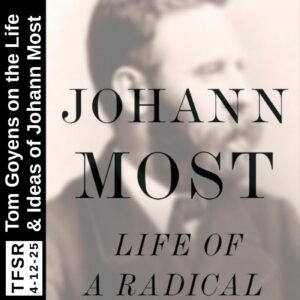
An interview with Tom Goyens, professor of history at Salisbury University and author of Johann Most: Life of a Radical, out last year from University of Illinois Press speaking about the life and times of the atheist and propagandist (notably through his journal, Freiheit) and his development from social democrat parliamentarian to socialist revolutionary to anarchist. For the chat we talk about Mosts’s life, development and legacy, from the mid-1800’s in Bavaria up to his death in 1906.
Other links:
- Tom’s prior book on radical German immigrants in the US, Beer and Revolution: The German Anarchist Movement in New York City, 1880-1914
- Tom’s compilation of the memoir of Helene Minkin, Storm in My Heart: Memories from the Widow of Johann Most
- Tom’s wixsite: https://txgoyens.wixsite.com/tomgoyens
- Tom on facebook, instagram and bluesky
. … . ..
Featured Track:
- TFSR by The Willows Whisper
. … . ..
Transcription
Tom Goyens: My name is Tom Goyens, I am a history professor at Salisbury University in Salisbury, Maryland. I teach American history, and my research is in the immigrant and transnational anarchist movement. That’s where I teach and where I work right now.
TFSR: Thanks a lot for being here. I really appreciate it.
TG: Thanks for having me.
TFSR: My pleasure. We’re here to speak about your recently published book, Johann Most: Life of a Radical from University of Illinois Press. But looking through your past books, I’m seeing more of what you’re talking about with transnational and immigrant anarchist communities. You have written before about German and Yiddish speaking anarchist immigrants from Central Europe who made their way to organizing in New York in the latter part of the 19th and 20th centuries — that’s a theme in some of your other books. I wonder if you could talk a bit more about this focus, what brought you to it, and some of the larger patterns that you see of who these communities were and what brought them to the US?
TG: I’ve always been interested in radical immigrants since my undergrad studies, which I did in Belgium. I’m from Belgium originally. I worked on Belgian immigrants in undergrad, and I could also read German and French. I cannot read Yiddish, but Yiddish is often quite close to German. So I had that interest already and then later on, I discovered some books by historians like Paul Avrich, Bruce Nelson, Ronald Creagh, who wrote on American anarchism specifically, and I was hooked on that. Then I discovered a gap in our knowledge, especially on German anarchists in urban America, around the 1870s to 1910 or so, specifically in New York. So I wanted to do something there, but I wasn’t sure what at the time. I met Paul Avrich briefly, and he strongly encouraged I should do this, and that was all it took.
I knew there was a long history of migration of German radicals to the United States since 1848 and maybe even earlier. This was not a large migration, but they were people very much infused with republicanism (with a small “r”) and free thought, and that really was attractive to me. The German socialists and anarchists who came a bit later are part of that history of German radicals who had first looked up to the American republic and then became very critical of it.
There was literature on German socialists, but very little on German anarchists. I discovered the role of Freiheit, which is one of the longest lasting anarchist publications, which was not only printed in German, but also had the Gothic letters. Sometimes I wonder if that’s impeded people from really looking into it. That’s how I basically got started, and this is where I discovered Johann Most who was a central figure there. I published this in the book Beer and Revolution, which is a whole social history of this movement in New York, especially. The communities were quite insular, but in some ways very internationalist at the same time.
The Yiddish speaking movement — like I said, I cannot read Yiddish — they are an adjacent community or movement. They may have a little different history. They certainly are alternative communities. But once they arrive in the US, the Yiddish and German live very close together geographically, especially in New York and Philadelphia, and build this community of its own language, literature, proletarian culture. There’s a lot of affinity —I think that is a good word to use — between these movements once they are a self-proclaimed anarchist community. Many Yiddish Jewish anarchists could understand German, and to bring it back to Johann Most, he really influenced the Yiddish Jewish community in a major way, and even helped inspire Jewish anarchism, Jewish radicalism, which of course, outlasted the German community. Maybe one difference is the German anarchists tended to come from artisan professions, they were skilled workers, while the Yiddish radicals – as they came in larger numbers to the United States – were more industrial workers, usually in the garment industry. When I did work on German anarchists in America, it was inevitable that the Jewish movement enters into it.
TFSR: For folks who do know the name Johann Most, what images are likely to come to mind and how did this image come about? What is your book looking to shift in this?
TG: This was a major aspect for me about Johann Most’s legacy, and a major reason to write a scholarly biography. Most people will be able to conjure up a cartoon caricature of an anarchist — usually disheveled, mad bomb thrower, depicted in cartoon form in the American press with wild eyed or holding a bomb or having a knife between the teeth and things like that. This became a trope well into the 20th century. In some ways, I argue the origin of that figure was actually Johann Most, and there’s several reasons for it, because Most had physical attributes that you could well imagine some cartoonist exploiting. He was of a slight stature, had disheveled hair, and his face was deformed, which is an aspect of his childhood. We can go into that a bit later, but obviously to no fault of his own. The other reason is the moment he arrives in the United States in 1882 and for a few years to come, his public speaking, his activism was really focused on a type of propaganda by the deed. He did talk about dynamite and even revolutionary terrorism. To many Americans, or to the reading public, this congealed into this stereotype. It’s not an unusual feature, this happened to a lot of people. Most infamously for African Americans or Irish immigrants, who were often summed up in the press as this very unflattering cartoon image. The same was true for anarchists. In a way, one could say that Most was partly to blame for the genesis of this cartoon. You could add to this his speaking style. He had a high pitched voice. He was a fabulous orator, and he had a gesticulating style. This probably was inspiration enough for the media, which was then very much newspapers, for this cartoon to stick.
So the book, in one way, is an attempt to uncover who the real Most is behind this facade, behind this cartoon. And it’s a cartoon he himself helped create in some ways. He almost always spoke in German, and very rarely — as we today would call it — pushed back against media distortions, and so this image basically stuck. I start the book that way. The very first anecdote is the genesis of this cartoon image, and the role of especially the daily newspapers, who seem to be in the business of distorting all kinds of things.
TFSR: On that point, I hadn’t really thought about the lack of push-back. There are examples in the book where, absolutely, there are fictions published about the circumstances under which he was arrested, for instance, that were just replicated and amplified in various daily newspapers. He could have written a letter to them and said, “That’s actually not true.” You express that the papers sometimes, when allowed to actually talk to Most or to be present for some of his court hearings where he defended himself, even some of the more reactionary bourgeois papers, very pro-business papers, nativist papers, to some degree, had to give it to him and say, “Oh, well, that’s a reasonable point. That doesn’t really reflect what the court is trying to do here in these circumstances.”
TG: Yes, I think an important event is Haymarket, which really changed so much in terms of the perception, and understandably so. For example, when Most was living in London, just before he arrived in the United States, he was also involved in a well-publicized court case about publishing an op ed, essentially. And many papers in the United States covered this with a slight almost defense of not Most’s ideas, but his right to express them. So he does come to the US as an eccentric person, or he’s seen as an eccentric person, definitely a curiosity. He goes on two lecture tours, and this is really where he lets loose his theories of revolutionary warfare. He starts to mention some American figures, not royalty but robber barons. And the press becomes a little more concerned. The tone becomes from slight interest or mocking to “Well, this guy is crazy and could potentially be a threat.”
And again, it’s true Most could have certainly defended himself better. It’s one of those aspects of his life. He could speak in English, but not very well, and his style of speaking involved a lot of puns and new words that he invented, that were very funny, but only to Germans. He felt very comfortable in his abilities to communicate in German, but that was a disadvantage, I think, once he came to the United States. I realize that is an interpretation I put on it, but he is constantly writing about the American press as being unscrupulous and worse than European press.
TFSR: Not to go too far down this. But there’s also something too for someone who has aspirations towards theater and monologues and public speaking in that way, and also someone who edits newspapers. There’s the monologue element to that of, “Oh, if I just make the argument, it should influence you enough. You’re talking back to me? You don’t talk back to the actor on the stage.” Maybe that’s a postmortem interpretation, too, but it’s a comfort level.
TG: Yeah, there is definitely a theatrical element. Undoubtedly, he makes those links himself. In fact, as an activist later on in the 1890s he starts a theater company with overtly political goals in conveying a revolutionary message by other means. It’s not so much that Most didn’t enjoy polemics. He writes thousands and thousands of op eds and often repeats some things in other writings. It’s just that it doesn’t land with the right people when he keeps writing in German, and especially using some of the rhetorical devices that really only work in German. There’s people around him who keep telling him, “You should have an English version of this.” He does, here and there, speak sometimes in English and contributes to some writing in English, but it’s a tiny amount given his entire work.
TFSR: So we’ve given some little snippets of his life. But I wonder if you could give a thumbnail of Johann. Could you tell us a bit about his life path, the jobs, places and relationships to the church, and German unification during his earlier period while he was still living on the continent?
TG: Yeah, this was a fun part to do in the biography: his upbringing and childhood, his adolescent years. I did a research trip to Germany and visited his hometown. It’s always nice to be able to have a geographic situation or connection there. The house he lived in by the way, in Augsburg in Bavaria, is no longer there because that entire section of that town was destroyed in World War Two. But the layout of the streets are still there.
To summarize, it’s important to highlight two traumas in his childhood. One is a cholera outbreak that happened when he was a very young child. This is, in itself, not that unusual, but it kills his grandparents, a two-year-old sister, and then later the next year, his mother dies of complications from cholera. It’s somewhat of a curious event because he hardly mentions it anywhere in his memoirs. Most writes memoirs, but he only finishes the parts where he lives in Europe, and he barely mentions the death of his mother. In fact, he misremembers the exact year of it. He certainly doesn’t talk that much about his mother, but I’m not sure exactly why that is. His father remarries, and he does talk quite a bit about his stepmother, who ends up being a rather authoritarian figure.
The other trauma is his facial disfigurement. This is caused by an infection when he’s 13 years old, an infection in the jaw. It’s life-threatening, and it takes years before a proper physician is able to assess the seriousness of his condition. He undergoes an operation in which they remove parts of his jaw bone, and in order to reattach the jaw, his face is essentially moved all the way to the left. Emma Goldman once called it the “deepest tragedy” of his life. Emma Goldman and Johann Most for a brief period were very close. Most does talk quite a bit about it in his memoirs, because before he could grow full beard, the trauma just was a constant reminder of how he could never make it in the theater. We just talked about the theater — this was his great love of his childhood. He wanted to become an actor, and instead he was trained as a book binder, and several years of basically wandering about not knowing what to do followed. I think this disfigurement really was a serious psychological trauma. There’s even one bit in his memoirs where he entertained suicide. This was a period when people weren’t as sensitive to any number of disabilities. He really did feel an outcast, and I think this is really formative.
Another element of his childhood is his early hostility to the church and then later to religion in general. It’s very, very important in his life. Most became an atheist well before he became a socialist. If we keep going into his life, into his adolescence — I mentioned he’s trained as a bookbinder. This was a formal training. He was an apprentice and then a journeyman. Because of that, he had to travel around Central Europe to gain experience. But in Most’s case, he did several jobs, but he also traveled to see the world. It’s in those travels that he discovered socialism — in 1867, in Switzerland. It completely changes his life, certainly his intellectual life. He’s barely 20 or so, and he travels to Austria, which is really the beginning of Most’s involvement in the socialist movement, as opposed to just an intellectual change.
You asked about the German unification, which comes a little bit later. Most is actually in Austria when the Franco-Prussian war occurs, which is the start of German unification. When he is expelled from Austria, he arrives in Germany, into this new unified Germany. The socialist movement in Germany was very early, as it was in Austria. To many socialists, any national identity was a normal thing. German national identity was perfectly fine within a socialist worldview, except that in the case of Germany, unification was very much pushed and defined by the Prussian militarism — Prussian monarchy, basically. That is really what became a defining moment for the socialist movement, which was very small. It became a very anti-Prussian movement. Most was no different. Most was originally from Bavaria, and there was a very strong regionalism in Germany, so he had a natural aversion of anything Prussian. This is also true with his father, who became a Catholic conservative. He and his father didn’t see eye-to-eye at all, but except for that one thing, that anti-Prussian sentiment. Most was and would always remain someone who was hostile to any overt nationalism or patriotism.
TFSR: One thing I got is that the socialism that he adopted was tied to a republicanism, and he had preexisting distrust of the church and theism generally, but the church had loomed very heavily in his childhood life, as it did throughout a lot of different parts of the world, defining who gets to be married to who, how property transfers, who has legitimate access to public recognition in a society, baptismal records, marriage records — these things are all in the wheelhouse of the church. So that proceeds to socialism, as you said. But also questioning this move…I think a lot of the nationalism of that period, it made sense for people to, in some ways, push towards a devolution of power in the hopes of having a republican form of government that at least would be representative of working people’s peasants, industrial proletariat and such. But this seems a move towards a different autocracy from the Hapsburg Empire, and so moving from one hot pan into another.
I wonder if you could say a little bit about the socialist and labor movements that he was involved with in Austria at the time. Because I know what he learned in the relationships that he made in Switzerland were very important generally. That country was very influential in what would become the anarchist movement later. But if you could talk about his involvement and exile from Austria, that’d be pretty cool. That was really fascinating.
TG: Yeah, the early organized socialist movement, coming out of the International in the mid and late 1860s, is a fascinating period because it’s an overtly internationalist movement. There’s a cross border solidarity. At this period, the influence of the usual, large figures like Marx and Engels was fairly minimal. In the International itself, Marx had certainly an intellectual influence, but the movements had a lot of local flavor. There were certain principles but in Austria, for example, it was a monarchy. But the liberals — and with that phrase, I mean, this is in the European context, these would be people who were not necessarily anti-monarchy, but they were certainly anti-autocracy — the liberals in Europe were people who were often critical of the church and critical of authoritarianism. They tended to be free market, pro civil liberties, and they were really asserting themselves throughout the 19th century.
It’s an important context in Austria, because the moment Most arrived in Austria, the actual government was basically full of liberals, in the sense these were upper middle class bourgeois people, educated usually, who could be persuaded to enact reforms for civil liberties, but stopped short of enacting outright democracy. This is an important force in European politics, where property is still a benchmark, we shouldn’t give everyone the right to vote. They certainly weren’t in favor of trade unions, which would imply that workers had a place at the table and so forth.
Most’s involvement in this socialist movement in Austria was actually somewhat focused on a political activism to get more civil liberties such as freedom of speech, freedom of assembly, and also workers’ rights and organizing factory workers. But the large demonstrations that was often a daring thing to do, because the government and certainly the monarchy could suppress them using the army, for example. So, the actual activism that Most was involved with, a large movement, was a demand for civil liberties, so that the labor movement could freely organize. And he gets really involved in this.
If we look at Most as a political figure, Austria is absolutely formative. He already had socialist ideas, but it’s in Austria that he becomes part of a movement. And this is really thrilling for him, because he learns how to speak, for example, to hold an audience, and no one is judging him for his physical appearance. He starts growing a beard. He just completely transforms. It’s a new lease on life, almost. He also suffers the consequences. He’s arrested. He is accused and tried and convicted of treason, which was a very serious thing. This was one of those highly publicized court cases, and he’s convicted for a prison term. Just after that, the government falls and changes. There is an amnesty, releasing Most earlier, but he’s eventually expelled from Austria. There’s a funny anecdote where he is transported on a train to the border of Austria and Bavaria at the time, or Germany, and the guards tell him you, “Just to be clear, you are expelled from Austria, from the crown, from Hapsburg, forever, you can’t ever come back.” And Most says, “Well, forever? That’s funny, because I don’t think your monarchy will last forever.” Of course, he was right. The Hapsburg monarchy disappears in the wake of World War One. But anyway, it’s an absolutely formative year.
It’s formative in another way, because when he arrives in Germany, he is somewhat famous. I wouldn’t say famous in all of Germany, but among the socialists and the grassroots activists, Most is known because the Germans have read about his treason trial. He makes a speech in the courtroom, and everywhere he goes in Germany, he introduces himself, “I’m the treasonous person from Austria.” And he gets a big round of applause. The Hapsburgs basically hand Most over as a famous, notorious person to Germany, if I can put it like that. I wrote a separate article about Most’s years in Austria which are not very long, maybe a year or two or three.
He also always remembers — there’s a several places where he writes in his memoirs, and later on, when he’s already in the United States — he remembers Austria with a certain fondness, when the movement was youthful and adventurous and it wasn’t yet a party or a top-down organization. Austria figures pretty large in his life and in his remembrance of it.
TFSR: I wonder if we could talk a bit about how Johann became involved in the beginnings of labor struggles, who he was organizing with and alongside, what political movements he was engaged with into his exile in London. You had mentioned that there was a local flavor to a bunch of the different thinkers and writers and styles of socialism that were expressed throughout different parts of Europe at that time. In the book, you talk about him having interactions with Marx and Engels. I wonder if you could just talk about that milieu and the early connections between socialism and labor, which weren’t necessarily the same thing at at the start.
TG: Like I said, it’s important to keep in mind that in the 1870s — Most is back in Germany, from 1871 to 1878 — in that period, many aspects of socialist doctrine or ideology is fairly fluid. If you read later accounts of the socialist movement, especially in Germany, you almost get a sense of like, “Oh, it was all very without controversy at all, and Marx was always important.” That’s not entirely accurate. Most arrives in a unified Germany, in a socialist movement, that was fairly weak but had a few strong points, where a lot of economic policy — maybe policy is not the right word — ideas about the economy or even about unification, like “What should we think of German nationalism?” was all very much in flux, and Most enters into this not as an intellectual. He never claimed to be a thinker or a theorist, but as a communicator — a brilliant communicator — as a writer, and as a speaker. He’s really what today we would call “a media guy,” perhaps even an influencer, but without any pretensions. He just likes that grassroots traveling about and doing speeches. In some ways, he’s a bit of a sponge. He takes in a lot of ideas. He looks up to certain people like Wilhelm Liebknecht and August Babel. Liebknecht becomes bit of a father figure, even though they don’t get along. There probably are personal animosities there. He knows all the names that become large names later.
For example, he settles down in Chemnitz, which is maybe not a familiar place for many people now. During the communist period of East Germany, it was called Karl Marx Stadt, or city. It’s in Saxony. But at the time, Saxony was the Pittsburgh area of Germany — very heavy industry, textile, machine works. That’s where Most settled down and started as an editor. But he ends up leading one of the largest industrial strikes of that decade in Germany, the machine worker strike in Chemnitz. He is always very close to the working families, the working class. You see this in his editorials, where he writes in a very popular style. As the years go on into the 1870s, he’s probably getting some push-back from more established figures in the socialist movement, who think he’s probably a little too popular or maybe even a little too effective with the workers.
His popularity lands him in the Reichstag, which is the German lower house of the parliament. He’s actually an MP twice, representing the district of Chemnitz, all the while doing speeches and editing newspapers and getting involved in other movements that sometimes is not to the liking of people who want to streamline the socialist movement or want to be more cautious. One thing I do want to stress here is, throughout the 1870s, Most is a card-carrying social democrat. He is not really a social revolutionary at all, not an anarchist. In fact, there’s very little literature in Germany about anarchism. Yes, he’s a republican with a small “r”. He’s certainly an atheist. He believes in organizing the working class gradually to a level where they can exert political power. He believes in parliament, although he gets somewhat disillusioned by it, and he believes in what the Germans socialists call the “people’s state” —Volksstaat — which was actually the name of one of their official newspapers. It’s somewhat vague of what they mean by this, probably somewhat of a republic. So, Most was not an anarchist at this time, and in some ways, was very much a loyal member. He believed in the organization. Organizational power was important. He carries this over into the period where he is an anarchist. That’s some of the labor struggles there. But yes, you’re right. He certainly has an appreciation for organization, for solidarity, for anti-clericalism, which is as strong as his political beliefs.
One other episode that’s maybe relevant here is…I mentioned, he’s like a sponge. He like to learn. He’s an autodidact, which sometimes he’s made fun of for that. But, at one point he gets really influenced by this strange academic who comes on the scene. His name is Eugen Dühring, rather important in the social intellectual history of German socialism. Dühring was a professor. He was not really a member of the Socialist Party, but had these ideas about a decentralized political and economic model. There’s much more to it, and Most grabs on to this, and not just Most, many others. You see here a conflict emerging between Marx and Engels — who are, by the way, not in Germany, they are in London and they’re trying to influence the German socialist movement in Germany, but have a hard time with it. Dühring was also an anti-Semite. Most acknowledges this at some point, Most was not anti-semitic. And so, it sort of went away. Engels was very active in putting down this influence of Dühring, but Most moves on. It’s like, “I just read a few things, and he had some interesting things to say.” He’s this eclectic mind at a time when certainly Marx wanted to exert more uniformity of thinking.
TFSR: It just sparked to me a memory like, “Oh, where have I heard Dühring before? Oh, Anti-Dühring being a pamphlet published by Engels, right?
TG: Yes. I think Engels wrote this because it was precisely people like Most, who everyone realized, even critics, was very effective. He could influence the rank and file. I think there was this sense, “Wow, if Most — who is a bit of a loose cannon in our mind — if he is into it, we should probably intervene.” You see this often within the German socialist movement, they all appreciated Most’s talents. But stay within the certain intellectual guard rails.
TFSR: Kind of had to shepherd him around a little bit, point him in whatever direction.
TG: Yes. Then the whole repression happens in Germany. From then on, the German socialist movement and its historians essentially ostracized Most.
TFSR: There’s one piece of a lasting legacy of Most, though, in the German-speaking socialist world that you touch on a couple times in the book. I wonder if a little bit more about here. His contributions to popular socialist songs that maybe you might still recognize if you’re in that world. I wonder if you might say a few things about that.
TG: Yeah, I’m glad you asked that because it’s very much neglected. I try to contextualize it a little bit, the importance of songs and this sense, this really emotion of a collectivity, not in a negative sense.
TFSR: Togetherness.
TG: Yeah, singing is a very powerful way of expressing communion, solidarity, and I would argue, power. I had known about Most’s affinity for poetry and song, which were very closely related. In assembling a bibliography, I found several of his published song books, and then I came across a few notices in newspapers. You have to read closely. I would find these announcements of meetings or lectures, and at the very bottom, usually in smaller font, it would say, “Don’t forget to bring your song books.” I would see this a few times. There’s some literature on it, so I went to look for scholars who wrote about songs in other contexts, and I use some of that in the book. I’m concluding here that yes, not only did Most compose songs, he collected them from other authors, assembled them, and edited these volumes and made a case for publishing them in large numbers. The idea here is Most recognized the propaganda value of them. I use the word “propaganda”…this is also something I often want to address. This is a bit of an aside here, but the word “propaganda” since the 20th century has had a bad name. Today, when we use this, it’s usually associated with with authoritarian regimes trying to trick or influence or curb certain ways of thinking.
TFSR: And it has the connotation of being a lie also, this is like, it’s not only that I’m trying to influence you, it’s that I’m telling you something that’s not true. It’s just propaganda.
TG: Yeah, exactly. It’s spin doctors doing something nefarious, and it has nothing to do with the true values and so forth. In the 19th century, and even probably in some of the 18th century, the word propaganda does not have that connotation at all. It’s simply a word that derives from “propagate” meaning spread certain ideas. Yes, there is a connotation that some of these ideas may be dissident ideas or unpopular. It’s almost propaganda is the activism, almost the science of spreading certain ideas. It doesn’t have the connotation of “Well, okay, you’re trying to hoodwink me” or something like that. I think it’s really important to state this because the word…propaganda by the word, by the deed — you put this all together, and modern readers already are filtering this, unjustly, through something like, “Well, I can’t take this guy seriously because he’s engaged in propaganda.” So I just wanted to put a flag there.
So Most, and most of the activists, I would say, anyone in activism could be on the right-wing side of the political space. If your movement is small and has maybe interesting but unusual, unconventional ideas, you want to engage in propagating these ideas. In that sense, Most was brilliant in understanding what would work. This is where theater ties in. Theater is a non-written form of propaganda, and so poetry and song was written, but it had sound and it had a power to it. Absolutely, this is an important aspect of his life, and I would argue, of his way of thinking.
Just to be clear, the song books are not all his songs. There are a few of them that are his, but he just collected them. So you had your meetings, and then at the end or at the beginning, it’s “Let’s take out your song books and we’re going to sing on page 15, the International “ or often, something about German authors. And people were on the same page, literally, to do this. Again, I want to resist, I wonder if some listeners are thinking, “Oh, this is like the Red Books by Mao.” Maybe there is a similarity here with having everyone on the same page, but minus the whole authoritarian piece.
TFSR: It sounds a little more like the social function of church.
TG: Yeah, absolutely. It’s what James Scott called the Weapons of the Weak. You want to feel community within your own group, but you want to signal to the outside “We are more powerful than you think, than you give us credit for.” I think song and demonstrations are this. This is all well known, but Most is in the middle of this phase of the early organized socialist movement in Europe.
TFSR: Could you maybe survey some of the movements and moments that Johann Most was involved in in the US and talk about the paper Freiheit that he brought with him?
TG: One thing to keep in mind is that his life is somewhat bifurcated, or that’s usually how it’s been portrayed. He has this life in Europe, in different countries, including England, and then in 1882 comes to the United States and never returns to Europe. He lives in the United States until his death in 1906, almost exclusively in New York City. That is a long period, and it’s often been portrayed in previous biographies or writings as a uniform period in America, where he is basically the advocate for propaganda by the deed. That is not really accurate. Freiheit — and it’s just Freiheit, not Die Freiheit, sometimes you see that, but it’s Freiheit — was founded, not necessarily exclusively by Most. The idea of starting a socialist or social democratic newspaper in exile started with other people in London. This is in the wake of the national repression of socialism in Germany, when many people had to flee into exile, including Most. When he arrives in London, there are other people there who know him as an editor, and they broach this idea. Nothing’s permitted in Germany. All the newspapers are shut down. Do you want to be an editor of a new newspaper? And this is how this comes about. Freiheit starts as a social democratic paper, by the way, with the approval of Marx and Engels. I say this because several of the leading socialists in Germany immediately take issue with the founding of Freiheit. They say “You can’t just found a movement paper without our approval.” This is its own history in where Most gets more and more frustrated with the leadership. Most thinks, “Why not? We should continue our movement. We should resist the repression.” And to the leadership in Germany, this is again an episode where Most is reckless or doing his own thing, not thinking things through. Most goes ahead and Freiheit lives on as one of the longest lasting papers. Freiheit becomes an anarchist paper when he moves to the United States, and so does Most.
London is a very transitional period. He’s there for almost exactly four years. Removed from Germany, not allowed to go back to Germany, removed from his constituency — because, remember, Most was an MP — and he now is in this metropolitan, cosmopolitan city. Again, his mind is a sponge. He takes in all these other ideas, from Russian revolutionaries, from French Communards. These are refugees from the Commune. They stress in him the revolutionary part of the left movement in Europe. Rather than social democrat, Most becomes a social revolutionary, not quite an anarchist yet. He opens up Freiheit for anarchist writers. He published a few writings by Bakunin, who was a famous Russian anarchist. Bakunin is dead by by now. But this enrages the more traditional socialists in Germany even more.
So Freiheit becomes its own thing. When he moves to New York, he takes Freiheit with him and becomes the sole editor and proprietor of the paper, which itself starts to irritate several activists, including anarchists. Maybe that’s a separate little story, but Most arrives in the United States, calling himself for the first time an anarchist. However, he knows quite little about anarchism. His real main focus is propaganda, especially bringing down the two most autocratic regimes in Europe, which is Germany and Russia. That is his focus. He now is living in New York but he’s not that interested in America. His focus is across the Atlantic.
TFSR: And he planned to move back too, right?
TG: Yes, in London, through all kinds of circumstances, he makes the decision to go to New York so that Freiheit could survive. But he goes to the US to do a lecture tour, and he is like, “Don’t worry, I’ll come back.” Freiheit in London was actually run by a collective. Most was simply employed as the editor and had to answer to this “publishing commission,” I think it was called. He went to the US to do a lecture tour, and “I’ll be back, and we’ll deal with how to support Freiheit then.” But then he doesn’t, and he gives some reasons for it, and he’s now this lone revolutionary orator and editor in New York. There are many, many communities of social revolutionaries in the United States. French and German, who are happy that Most, this famous guy, is in their midst.
For those early years, 1882, 1883, all the way up to 1887, his whole focus is something of a blend between Bakuninist revolutionary anarchism infused with all kinds of ideas about propaganda by the deed. It is the idea that if you perform a deed, either as an individual or as a movement — like burning records, or including a violent deed — that could have a propaganda value equal to, or maybe even more than if you just wrote an essay or a pamphlet. Most is inspired by the Russian revolutionaries, a group called Narodnaya Volya, which means the People’s Will, who were doing assassinations and bomb attacks against the Tsarist regime with some success. The French Communards, who were martyred because they dared to build an alternative republic. This is what Most is thinking. He’s now in New York and tours the country and makes speeches where he’s reminding American immigrant radicals that propaganda by the deed is also a good tactic to use. This is how the press then caricatures him.
I think it’s really after Haymarket, and especially after the execution of the Haymarket defendants, that Most really changes his mind on that aspect.
TFSR: He was specifically hounded as someone promoting anarchist ideas, even while living in New York and publishing in the German language, and anytime there was a case where anarchism was put into the spotlight for the violence of people adhering to it, he became a lightning rod and an easy place for the American press to look for, “Where’s that little guy with the big hair? The little German guy, let’s talk to him.” Even after he did publish a serialized version, then a physical version, of instructions on the science of revolutionary warfare, which included poisoning and making explosives and things like that.
I want to pull back a little bit too — if he’s coming out of a European context where the majority of people in the Social Democratic German-speaking world are using the term “anarchist” as an insult for people who refuse to take the long road and maybe have a screw loose, it makes sense that he would say, “Well, those tactics seem to be working, so I’m whatever that is.” I wonder if you could talk about his turn away from that and his resumption towards the idea of slow social change and the building and organizing towards anarchism, particularly as he saw it in the US context.
TG: I think it’s important to go back a little bit to propaganda by the deed. There’s quite a bit of literature on this, which did not always necessarily mean indiscriminate violence or even individual deeds. But it veered that way and was quite influential with a minority of social revolutionaries. Most definitely advocated propaganda by the deed, even revolutionary terrorism. He uses that word, and some of his writings are quite explicit. It’s quite hair-raising, even today, and we can certainly have some judgment on this looking back. I think it really was a mistake, but it’s quite explicit and violent. He has several editorials where he talks about warfare and the formation of companies and arming the working class and how to do street warfare. It’s clear that he had a lot of inspiration from his London years, where he would meet many French Communards and Russian revolutionaries. London also had — I don’t want to call it an underworld, but — an alternative community of several bars and hangout places and restaurants where he would hear all these things.
Of course, we haven’t mentioned this, but while he was in London, the Russian revolutionaries actually assassinated the tsar. He writes about this in glowing terms, and this is what gets him in trouble with the British courts. If we try to time travel there and get into his mind — yes, there is room for a gradual philosophy of revolution, but there is also an alternative where we can have immediate results. Most was definitely an advocate of propaganda by the deed, but only maybe for five years out of his 40-year political career, and that’s important to keep in mind.
In some ways, the press was correct. Yes, Most did talk about dynamite, which had been invented not that long ago. There’s some evidence that he sent information and funds to Germany to sponsor certain deeds, certain bomb attacks and things like that. At one point he does recommend similar treatment to American captains of industry. We should not ignore that. In that sense, as I said earlier, he is in some ways contributing to this stereotype. I think it is a valid criticism that he really did, unwillingly, propagate that stereotype of the anarchist, and he later tries to undo some of that. He has many essays where he complains about the fact that the press is always talking about anarchists as bomb throwers, without really acknowledging his own role in this.
I wanted to be really clear about this: Most did some damage to the anarchist movement, but that wasn’t his entire career, and neither was propaganda by the deed and terrorism the mainstay philosophy of a majority of the anarchist movement. That is not true. It was certainly part of it for a minority, but not the majority.
Another thing you mentioned is the word “anarchist,” which was not widely used, certainly not in the 1870s and even in the 1880s, it’s not very common, although in the mid-1880s, you see a mature, self-assured anarchist movement emerge in the United States. Most definitely appropriates the name. The very first meeting where he’s introduced — he’s literally just off the boat — he is introduced as, “Here is our anarchist, Johann Most,” and he appropriates that.
TFSR: It’s also the same guy who went back to Germany saying, “I’m the Austrian traitor.” He’s a theatrical guy who likes to take on big titles.
TG: Yes, he definitely knew how to work a crowd — and I don’t mean that in a devious way. I certainly could talk for hours about his masterful command of language and humor. That also needs to be said. Most’s power — and I’m not saying he wasn’t a serious person — but he always used humor, which I think is what made him a popular speaker, even to people who didn’t necessarily agree with everything he said.
TFSR: Now that we’ve talked about Most’s insurrectional period and writing about his change of mind afterwards in the following decades before his passing in 1906, I wonder if you could talk a little bit about his maturation into what would become his anarchism as he grew older — maybe what differences it had from his prior political positions.
TG: Yes, his maturation, his change, is really a theme in the book. I really wanted to track his change over time in political attitudes and views as his material and geographic circumstances changed. That’s a big theme. In the United States, Most evolves from insurrectionary anarchism to, I would almost say, a little bit more of a gradual, revolutionary position. He embraces anarchist communism, which is really associated with Kropotkin, as opposed to Bakunin. There are somewhat specific philosophical differences, but in some ways Most arrives at anarchist communism a bit later than others. This evolution tracks his becoming more mature as an American resident. He never naturalizes, but the longer he lives, for the most part on his own, during the 1880s in the United States — in New York, the largest city, the metropolis, the center of commerce and capitalism and media — I think Most matures in the sense that he starts writing a lot about the differences between the American republic and Europe. That’s a whole other segment that I find fascinating: the amount of times Most actually writes, almost in an anthropological sense, about Americans.
But to return to the political evolution — Haymarket is absolutely central here. This is a famous case. It starts with a bomb attack during a meeting called by anarchists in Chicago, and ends with a Red Scare and a repression in which, ultimately, four anarchists are executed. This is a huge moment. Most is not directly involved — he’s in New York and he’d already been arrested for other things — but it clearly shook him, as it did many people. He starts to move away from insurrection, terrorist actions, individual deeds, assassinations. It doesn’t really work in America, and in fact it’s not a good thing for the movement. That’s the tactical part. At the same time, he’s adopting a richer anarchist communist philosophy. He does retain the idea of armed resistance. In terms of anarchist violence — and I’m simplifying somewhat — he ditches the offensive aspects of anarchist revolutionary violence but retains the defensive part. We have a right to defend ourselves. He explicitly references the fact that we are in the United States, which has a Second Amendment, like “While I don’t think we should engage in terrorism, insurrection, and assassinations, I thinks we should arm the proletariat, have gun clubs, have shooting practice — but with a defensive posture.”
Throughout the late 1880s and 1890s and further on, Most is really a strong anarchist communist. He writes several good essays. Again, he’s not a theoretician, but he makes the case for how anarchist individualism and communism — with a small “c” — go together, they blend together; in fact they need each other, they’re part of the same coin. Later on he seems sympathetic to anarcho-syndicalism, although he’s much older and withdrawn from the movement by then.
That’s really, in a nutshell, his political evolution.
TFSR: An interesting part of the history of German anarchists in the US. for me is that theme of working-class self-defense. There was Lehr und Wehr in the Illinois area as a workers’ militia that would train, and it had connections with, I think, August Spies, of the Haymarket tragedy. It’s interesting to see these little points in history connecting together.
TG: Most himself was a member of a self-defense group, specifically an anarchist one. That feature actually goes back to the 1870s, going back to the Great Railroad Strike — but that takes us too far afield.
TFSR: Well, it’s all a continuum, right?
Also, in 2015 you released a trade translation of a memoir by Helene Minkin, Most’s longtime collaborator and partner. What insights does her story give into Most’s views on gender, and how well did his ideas and actions align? Not to make it just about Most, but I’d love to hear a little about her too.
TG: I’m glad you asked that. Helene Minkin wrote her memoirs later in her life as a response to Goldman’s memoirs, Living My Life, which came out in 1931, at least the first volume, in which Goldman makes certain statements about Most and Minkin. They knew each other; they had a little almost-commune together. Minkin, Goldman, and Berkman were much younger. They were the pupils, the disciples of Most. Later on, Minkin wrote these memoirs, which were serialized in a Yiddish newspaper. I had known about it but hadn’t thought too much about it, because I couldn’t really read or even access it. But when I embarked on this biography, I realized I could not not look at it, because she was his longtime collaborator and partner. I gathered the text — it was wonderfully translated by Alisa Braun, and I edited the whole thing. It was fascinating to read.
I want to say first: Helene Minkin was an incredibly talented and committed anarchist in her own right. There was a big age difference, which played into some aspects of their relationship. But they stuck together and had two children together. Minkin was a Jewish anarchist. She had two sisters. They became a couple, which not all German anarchists in Most’s circle appreciated, because they feared Most would become too domesticated. There was a lot of gendered language around this.
I think Minkin is absolutely crucial in this story, because she was one of those people — there are thousands of activists like this — who are not in the forefront, not loud. She was not necessarily a speaker, she could write, but she was doing all the yeoman’s work in the background. She ran Freiheit, basically. I think I can say she managed it, and given how attached Most was to Freiheit — he called it his daughter — they were a power team.
As for the memoir itself, it’s a very personal document and includes a lot of criticism of Goldman and Berkman, of how they operated, how they dismissed other people. I don’t think it takes anything away from Goldman’s immensely inspiring career, not at all, but it humanizes everyone involved. I was very interested in how it humanizes Most, given the caricature, the media image, even the image held by some of his colleagues. Most had many friends and many foes. Reading her memoir — which I would recommend to anyone interested in early American anarchism — it gives Most a much more human side: as a father, as a partner, as a cranky old man. If one thing sticks out to me as a personal quality of Most, it is his endurance, his integrity. Whatever you think of his viewpoints, the guy just never gave up, even after years of incarceration and humiliation. He was always back at it. It’s really inspiring, but because of it, he was probably a man walking around with a lot of trauma and frustrations, and sometimes it came out in certain ways. But the two of them stuck it out. They were people of their time. There was an age difference, and there were certain gender roles, as we would say today, and Minkin was probably on the short end of the stick. She was much younger, so her prime years were not aligned with his. But it was a great, really important document. I’m glad I did the Minkin memoir project before releasing the biography.
TFSR: From what you learned from her perspective — as you said, there was a lot of the ire in it. A lot of the critique was aimed, I think, because it was published in 1932, the year after Living My Life Volume 1, and it was serialized in the Forward magazine. I don’t know if she took the space to say anything explicitly about his stated beliefs — that he believed in the abolition of the family structure as a byproduct of Christian capitalist civilization, or that women should have a leading role — I don’t know if that book gives an impression of how his ideas matched him as a man of his times.
TG: I think Most, to generalize a little bit, was essentially a romantic. There were aspects of him that were socially somewhat conservative. His disfigurement carried a trauma that translated into frustrations in terms of relationships with women. He makes allusions to that in a few places — it’s not just my interpretation. His views of women were sometimes of the time, in the sense that women are not as suited for a strong, potentially violent revolutionary movement. Although it’s hard to pin down, because I know of some editorials from the 1870s — when he was a Social Democrat — where he’s actually accosting some of his colleagues for being too conservative about women, and especially the domestic roles that many socialist men still adhered to, calling them out for having these residues of bourgeois morality.
I don’t think Most every really was a radical feminist. I think Emma Goldman makes some correct statements, not just about Most, but about a lot of German anarchist men who were really focused on political and economic issues in their revolutionary philosophy and couldn’t really entertain that revolution, or change, or reform, or anti-authoritarian principles should — or even could — be relevant in all domains of life, including personal relationships.
There are important exceptions, especially among the younger generations — Abe Isaak Jr., a few others like Robert Reitzel who could be a little more enlightened about this. In that sense, Most was a little old school. It’s probably one of the reasons why Emma Goldman and Most broke up. They had a brief, intense relationship, and Goldman is very explicit in her memoirs that she thought Most wanted her as a traditional wife. Minkin, I think, accepted this part of Most more readily and went after Goldman for being too judgmental or unkind to Most. Minkin could play that role more than Goldman could — and I’m not saying that’s a good role — but they certainly had, if we look at some interviews with their children, a relationship that worked, even if they had fights. They were connected by a deep commitment to anarchism.
I would not say Most was among the radical feminists — not really. But it is certainly the case that people who didn’t always agree with everything Most said were thoroughly inspired by the way he could communicate ideas, and I think that is an important aspect.
TFSR: Thank you very much, Tom, for writing this book and for having this conversation. Is there anything you’re working on that you’d like to shout out?
TG: Yes. I made allusions a few times to Most’s editorials and pamphlets. I am editing an anthology of Most that will come out probably at the end of this year, 2026, with AK Press. It’s called To the Impatient: Selected Writings on Anarchism and America. These are mostly short writings by Most about not just anarchism, but the United States, which is really fascinating. It will come out as a compendium to the biography, if you will.
TFSR: Are you online in a way that people can follow you?
TG: Yes, I write a Substack called Anarchistories, in which I write short pieces about anarchist history and historians. They’re not super academic writings, but I think informative. There are all these materials that I want to share. I also have a website for my academic site through Wix — txgoyens.wixsite.com/tomgoyens. Other than that, I’m on Facebook, Instagram, and Bluesky.
TFSR: Thanks a lot for the conversation. I really appreciate you taking this much time, and thanks for all the work — it’s really fascinating.
TG: Thank you so much for having me. This was fun, and I enjoyed talking about some of these less-known aspects. Thank you.