
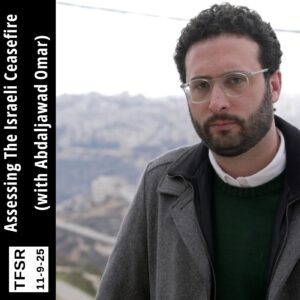
This week, we’re sharing two segments: a chat with Palestinian writer and assistant professor Abdaljawad Omar and a segment of the October 2025 B(A)D News with network participants discussing thinking-through resisting the rise of fascism.
Assessing The Israeli Ceasefire
First up, an interview with Abdaljawad Omar, a writer, analyst and an Assistant Professor at Birzeit University in Bethlehem in the West Bank in Palestine. For the hour we speak about the status of the ceasefire, the continued killing by the Israeli state and the lack of significant humanitarian supplies of food and medicine in Gaza, ongoing violence in the West Bank and settlement expansion and settler impunity, representation of Palestinian resistance in Western media and meaningful solidarity from abroad.
Mr Omar’s writing is frequently featured on Mondoweiss and the newly launched Equator Journal and other journals listed in our show notes. He can be found on X and Bluesky and has a couple of books due out in the near future.
- Bluesky: @Hamayel
- X / Twitter: @HHamayel2
Appearances in:
- Mondoweiss
- Communis Magazine
- Ebb Magazine
- Electronic Intifada
- Al-Shabaka
- Millennails Are Killing Capitalism
- Truthout
- Equator
- other texts, thanks to Analu Lopez
- an essay by the title of one of his upcoming books on RustedRadishes
Playing Out Resistance
The next segment was recorded at the annual A-Radio Network gathering that happened in Freiberg, Germany, by participants in the network in attendance. For this segment, you’ll hear people discuss a workshop they participated in about thinking through preparation for rising authoritarianism, keeping safe while preparing for social revolution. Feel free to reach out to projects on the participants page for the A-Radio Network website (we suggest you first try A-Radio Berlin as they’re quite good at answering their email) if you would like the materials used in the workshop to host one with your community.
. … . ..
Featured Track:
- Mapa by Murcof from Utopia
. … . ..
Transcription
Abdaljawad: My name Abdaljawad Omar, I am an assistant professor at Birzeit University in the Philosophy and Cultural Studies Department, and also a writer and analyst that has written quite a lot of pieces since the outset of the war in Mondoweiss and other platforms. I’m glad to be with you today.
TFSR: I really appreciate you being here and taking the time. Currently, there’s a ceasefire that was declared by Donald Trump between Hamas and the IOF in Gaza, and yet, there is only a trickle of medical and food aid being allowed into the devastated occupied territory, and Israel is continuing to murder Palestinians. Could you talk about the ceasefire, the hope that you see in it, and the role that this declaration of ceasefire appears to play in Israeli plans?
Abdaljawad: First of all, it’s important to note from the outset that the idea of ceasefire because in the Palestinian context, war is an unfolding event that never really ends. This has been more than a century of war on the Palestinian people in the Palestinian land, it included the expansion of settlement at the expense of the indigenous population. Therefore, when we talk about this context there’s no real end of the war. The war continues in a different form, specifically in Gaza, where the ceasefire perhaps has ended this intense form of massacres and destruction that we have seen unfold for the past two years. But siege is also still intact. Israel still controls more than 50% of the Gaza Strip. It still trickles in food. And the prices of food are still quite extraordinary in the Gaza Strip, impoverishing people and creating the conditions even for the continuation of hunger and conditions of famine, and the continuation of the killing machine, but in a lesser intensity than we’ve seen in the past two years.
So in many instances, this is a cease fire that actually does not end with a total end to the firing on people, or the massacres, or even the trickling of aid in quantities that are not actually appropriate for the Gaza Strip itself. So these are the conditions now on the ground, and it’s quite problematic to think of it as this as the end of the war. I don’t think most Palestinians in Palestine, whether in the West Bank or in Gaza have a hopeful sense of the future. There’s a very bad taste of uncertainty hovering in the environment. People are still scared. People are still in mourning and the future still looks bleak.
One of the reasons for that is that despite the current war and the attempted genocide and total annihilation of the Palestinian people which, in relative terms, has failed (since Israel had to agree to some sort of accommodation with the Palestinians, even in the Gaza Strip). Despite the dire consequences that we speak of we still see a Israeli state and government and leadership that is not willing to really speak of a political grammar that actually recognizes Palestinian rights or undoes the systematic injustices, including the apartheid system it’s set up. The state still seeks, in many ways, to find opportunities for the continuation of the annihilation if not now then somewhere in the future. So we’re still caught in this loop, a loop of death, a loop of attempted annihilation of the Palestinian people. This is why I think, also the future does not really, for us in Palestine, look anything hopeful, at least at the moment.
TFSR: I know that a talking point for decades now has been the idea of a two-state solution, and it seems like pretty clear that the Israeli state isn’t actually open to any of that. They might mention such a thing and recognize that “Oh, maybe a Palestinian authority could rule over certain parts of the territory”, but they’re foreclosing the possibility of any such thing with their policies as they stand, right? So what could be a solution for them, other than a final solution of fully evicting the indigenous populations?
Abdaljawad: Well, I think it has become clear that what we need is actually the de-Zionification of Israel. What is needed is to end of the apartheid regime. And what we need is a total reconfiguration of relations between the peoples between the river and the sea in a way that actually provisions a different future for both peoples. Not in the sense of only thinking of one state or two state or recognition, but in the sense of actually ending the condition where violence is a permanent necessity, even in terms of Palestinian resistance or Israel still coalescing around the politics of attempted annihilation of the Palestinian people through this racialized regime that we exist under. I think this is the core issue. This is what needs to be worked on by all peoples in the world: how to end the system of racialization, how to end the system of war on the indigenous population of Palestine, and create a new form of relationality between those who live between the river and the sea, in a way that can actually bring about a different form of future, perhaps outside even notions of state.
You mentioned the two-state solution. I think the two-state solution has been proposed by international powers in the past as one way forward where two peoples can have two nations dividing the land among them. But as we all know by now, and for all those hearing us, Israel has continued to build large blocks of illegal settlements within the occupied West Bank specifically, but also continued to enact its siege on Gaza for the past 30 years, basically slowly but assuredly creating facts on the ground that would actually make it very difficult to conceive of a contiguous autonomous, or at least a contiguous sovereign Palestinian state that actually live side by side with another state on the same land.
So there has been a deliberate architectural, political, diplomatic attempt by Israel to actually destroy the premise of that possibility of a Palestinian state to emerge. Now, this does not mean it could not emerge now, because if there is a will on the part of the international community, then there is also a way to actually force a two-state solution on Israel. I think this is one of the issues that have come out also in the current genocide, is that Israel has had total impunity on its actions and policies, and ending that impunity is actually a precondition to conceive either de-Zionification of Israel itself and the configuration of new relations between the peoples, between the river and the sea and beyond, or at least, a two-state solution, or any other form of solution that can actually be brought about that actually guarantees Palestinian right, including the Palestinian right of return and self-determination, and the right for freedom and dignity for the Palestinian people on the land of Palestine.
TFSR: I wonder if you’d care to share any assessments of resistance to the overwhelming and genocidal violence of the Zionist entity from within the occupied Gaza and the way that this resistance has been covered in international media.
Abdaljawad: It’s not surprising that international media views Palestinian resistance in a way that is actually highly skeptical, but also tries to render it as a profane, diabolical, highly irrational, mad, even a form of politics of suicide on the part of the Palestinian people. However, in Palestine, we view resistance differently. We view resistance as a necessity because of the various conditions we live under, including this regime of terror that actually chooses who to arrest and who not to arrest, who to kill and not to kill. As we’ve seen in the past two years, it’s a system that is willing to actually go all genocidal on the Palestinian people. As villages in the West Bank are choked by settlements, as settlers roam around olive groves and burn them or attack people, as we see these fascist militias also killing Palestinians on the road to work, or in the Gaza Strip, where, 90% of the built infrastructure was destroyed. And daily massacres, averaging around a hundred murders a day, was enacted, including the use of hunger as a weapon of war.
So when we take the system under which we live in, when we take the ideology that is prevalent in Israeli society, when we view the form of racialized hierarchy that Israel wants to sustain, this form of Jewish supremacy on the land of Palestine, then resistance for the Palestinians is a necessity.
Now, what is echoed in Western mainstream reception of resistance is that this is a form of terror. It’s only meant as a form of revenge, and again, it registers differently for Palestinians. Resistance is a form of hope. It provisions people a way to actually open political possibilities. It’s meant to deform the existing regime and attempt to actually create the conditions, not only for peoples across the world to interact with the Palestinian cause, but also to enforce a material shift in the structure of power in a way that would meet Palestinian requirements for freedom and self-determination and any other demand that Palestinians might have. However, this doesn’t mean that we shouldn’t assess the resistance tactically or strategically, the force that it has, the way it actually calculated its decisions to engage in this offensive maneuver on October 7, or whether it was successful or not successful. There’s a lot of discussion, even among Palestinians, around that, whether this was the right move or the wrong move.
But one thing that we can say in this current war is that what happened is that Israel revealed its true face, and in revealing its true face in this obscene manner, it conducted its genocide. It has also lost some of its ability to sustain itself in the future. That is contingent on the value of people who now have seen what has been unfolding in Palestine for the past 130 years and more, and in the past two years, specifically, it’s incumbent on them to also take Palestine as a cause that not only liberates the Palestinians, but also touches the very foundations of political structures in their own societies, including the US.
One of the things that comes across here is that how, for instance, the US supports Israel unconditionally with impunity, provisions it with weapons, and creates this complex dependency where the settler colony is dependent on the Empire, but also the settler colony shakes and moves the empire in ways that is favorable to itself. I think this is why Palestine is always more than itself. Palestinian Liberation also means more than itself in this sense.
This is the task for the future. I hope, at least from my part, that the end of this, the intense massacres does not stop the organization, mobilization and movement around Palestine, even if it is met with other forms of struggles that are also occurring and unfolding in places like the United States or elsewhere.
TFSR: Thank you for the very thoughtful answers that you’ve given so far. While this inhuman violence has been visited upon the inhabitants of Gaza, it has been met with an uptick of settler violence in the West Bank, where you live. Could you speak about this and about what accountability settlers face for their attacks?
Abdaljawad: To be honest, there’s no accountability. When most analysts think of the settlers and Israelis, say they think of them as these two separate entities, but actually they complement each other. In many ways, the Israeli army is just settlers in uniform. The settlers that are civilian, perhaps have a much more extreme ideology. But at the same time that extreme ideology is actually a spearhead of this expansionist form that Zionism has shaped up since its inception of the land of Palestine. So in this historical conjecture, what we see is that these religious messianic fanatics are the ones spearheading the expansion and attempt to replace the Palestinians by the buildup of settlements, and the use of violence as a means to instill or induce mass immigration or mass force expulsion of Palestinians from the West Bank.
Since 30 years ago, what we’ve seen is that Israeli state planning, financial incentives and the settlers complement each other. One conducts violence on the Palestinian people and communities and olive groves, the other provisions all the necessary means through which the settlements are expanded and infrastructure is built. The Palestinians are being choked slowly, cut, checkpoints are placed on each exit and entryway to major cities and villages, and life is slow and strangled, and induced with daily humiliation for the Palestinians.
Since October 7, that daily humiliation took a more intense form, with checkpoints popping up across the West Bank, with soldiers enacting arbitrary forms of arrest, beatings of people in checkpoints, sometimes even sexual harassment, and creating these conditions where people wait for hours, or, for instance, simply are made to feel the sting of humiliation as they do their daily routines, going from one place to another, from their village to work or otherwise. So the West Bank has faced that. To add more, the Israeli army has entered major cities like Jenin and Tulkarm. Have destroyed camps like the Nur Shams camp and Tulkarm camp, and the Jenin camp, efface the infrastructure of these camps. It has displaced around 40,000 people in the West Bank, and has engaged in military activity and has killed more than 700 Palestinians since October 7 in the West Bank as well.
What we have is the continuation of the killing machine and of the arrest machine. We’ve seen the arrest of many Palestinians in the past two years in horrible conditions of imprisonment where food is denied and they’re beaten daily, and humiliation is a constant form of attempting to break the Palestinian spirit in prison. Now we have 10,000 Palestinian prisoners in Israeli jails. Most of them are from the West Bank as well. So this tells you that the West Bank is not really removed from the genocide. It is within the genocide and outside of the genocide, but at the same time it’s still a place that is suffering from a state that is that has implanted the terror regime here for the past 50 years and continues to actually experiment with new modes of humiliation and domination and control and surveillance and killing. This is our reality in the West Bank as well. It continues to this day. And again, it just tells us that there’s no real ceasefire in Palestine. The war continues. It just takes a different form.
TFSR: I remember this year with a reading group that I’m a part of we read an essay by Walid Daqqa, writing from a number of years ago about the attempts by the Israeli occupation, with the walled roads and with declaration of different zoning rules for different areas, and even just the distinction made between Gaza and West Bank, the attempt to corrode the idea of unified identity among Palestinians and for a common Palestinian resistance, right? And for the idea of nationhood. I don’t know if you want to comment on that, the attempting to break down Palestinian identity into neighborhoods or into regions, and if you’ve seen any impact of the escalation this year in common identity as resisting the genocide and the expulsion.
Abdaljawad: Walid Daqqa is making his take in this contemporary moment on this divide and rule strategy. What does division and rule mean in the context of Palestine in the current century, in this form of late modernity. Technology has become different, so there’s forms of surveillance that we have not seen in the past that now can be enacted and where Palestinians can be divided through an architectural apparatus that includes walls and checkpoints, a bureaucratic apparatus that includes various form of identity cards. For instance, in the West Bank, we have a green identity card, for Palestinians in Jerusalem, they have a blue identity card, for Palestinian with Israel citizenship, they have a citizenship, for Palestinians in Gaza, they have a green identity card. But also they have different forms of inclusion-exclusion within this sphere of Israeli control and domination between the river and the sea.
What Israel seeks through that is to actually fragment the Palestinian community in different forms of exclusions and inclusions, giving privileges to some while denying to other and denying the Palestinians the ability to have a coherent political and national movement through which they can struggle together. One of the actual manifestations of October 7 is that we saw an organized self-defense form of resistance within a specific territory administered by the resistance itself through its political arm, taking the struggle into Israel through this offensive maneuver, and at the same time fighting for almost two years through guerrilla tactics, through the manufacturing of their own weapons without strategic depth, and building on whatever the land can give, including this complex architecture underneath the ground in attempt to sustain the resistance and its capacity through time.
So you had, for instance, Gaza fighting, but at the same time in the West Bank and in places like Palestinians with Israeli citizenship, or Palestinians in Jerusalem. What we didn’t see is actually the Palestinians also engage in a much more forceful, active form of resistance in a way that would meet the demands of this historical movement. This is for a lot of reasons. One of them is the lack of organizational capacity outside of Gaza, for a lot of historic reasons, the different forms of systems that the Palestinians live under. While Israel basically removed its physical presence from within the Gaza Strip and engaging these repetition of war, in other places it did not actually, in the West Bank and in Jerusalem, it continued to arrest activists, it killed the networks of the resistance. It neutralized any attempt to actually create any form of organization. So therefore you have this discrepancy, and this discrepancy creates problems among the Palestinians, in which one part of Palestine, for example, Gaza, feels the brunt of the sacrifice that has been made in the past two years, while other parts, while sacrificing and still suffering through a lot of different forms of humiliation and forms of punishment, feel that they have not participated fully or enough in backing their brothers and sisters in the Gaza Strip. This discrepancy creates a lot of fissures within Palestinian society. On the one hand, intensifying an already fragmented Palestinian community, and at the same time, in many ways also provisioning a question among all the Palestinian people: whether we’re actually one nation after all. This is part of the symptoms of this moment, if we want to take it on that level.
But at the same time the fact that the settler colony eventually wants to get rid of all Palestinians also forces the Palestinians to reckon with the fact that they are Palestinians and that they have something shared, which is this common threat, despite the current system of inclusions and exclusions, privileges to some and less privilege to others that exist between the river and the sea.
TFSR: Thank you. Throughout this period, the more virulently reactionary members of the Israeli state have declared openly their plans of annexation, while US, and I’m sure other collaborator states and capitalists, have made overtures towards building on the shattered ruins of Gaza and making deals to operate businesses to the exclusion of the Palestinian people. Can you describe some of this for the mostly US-based audience?
Abdaljawad: There have been a lot of proposals for plans for this “the day after” of Gaza, and most of them were actually conceived from these planners and designers, or futuristic designs coming from the metropole, and coming specifically from this billionaire high-tech and at the same time, political managerial class of the empire. What we saw, for instance, in the Trump version, is this idea for riviera real estate, where this business inflection comes from Trump’s involvement in real estate in New York and it takes it into Gaza. In the first vision it completely excluded the Palestinians from Gaza and envisioned the Palestinians of Gaza being ethnically cleansed and removed from their land.
Currently talks about what form of life will shape up in Gaza is still provisioned by these different competing ones that actually include Gazans staying in, ones that include the buildup of Israeli settlements while Palestinians in Gaza remain, and ones that still hope that actually Palestinians will be removed. They all share something in common, is that they’re not really expressions of what the Palestinians in Gaza really want. And nor the Palestinians want not only the rebuilding of Gaza, not only the provision of forms of economic life, but one of the important facts of why we actually have this war, which is a solution, a political solution that will actually see the Palestinians live a dignified life with their rights intact and ensured. A political solution that ends this Jewish supremacist regime between the river and the sea and creates the possibility for deZionification and for some other arrangement to actually arise in this area.
So at this point, what we’re speaking about is these designs that want to neutralize Gaza from its resistance and create or replace it with a system that is amenable to a colonial form of administration that would see little resistance among the indigenous population. This is the conception of most of the plans. Some of them go extreme into the ethnic cleansing mode and still hope that the Palestinians in Gaza would be removed completely from those lands.
TFSR: Netanyahu has been at the center of a number of corruption trials preceding October 7, but since October 7 has clearly been hoping that the blood in the land of Palestinians would distract from or pay for his crimes. In your opinion, what has the war done to the internal cohesion of the settler state and Likud party, for instance, in ‘48 and its international support?
Abdaljawad: I think one of the clear things that comes out of this two-year massacre of the Palestinians and attempted genocide of the Palestinian people and ethnic cleansing is that the world now is…specifically in places like the United States, where there was, for a long time, a Zionist ideological apparatus that actually hegemonized the imagination of the American population, we can see this fracture. We just had, for example, somebody like Zohran Mamdani winning elections in New York. But partially out of this change in attitudes towards Israel, I think for us Palestinians, we see that the world now at least sees us and see the daily humiliation that we have lived under in this long daily struggle that we’ve gone through, we see the fractures in the narrative the Zionists have advanced for the past 70 years around their own state, effacing their own crimes as they’ve conducted and attempted to replace the indigenous population with settlers coming from Europe.
At the same time, I think that will have consequences in the future on the ability of Zionism to sustain itself, at least as a coherent movement with the backing of the imperial metropole. I’m not saying it will not, because there is still a lot of support, specifically among specific classes in the United States for the continuation of the support for Israel itself. At least now this support is under increased scrutiny, more dissenters, and Palestine has also come become one of these moral issues where people test the morality of their own politicians and their ethical consistency and the way they relate to the world, and how they can trust them. These are things that actually will definitely have some political impact in the future. But one of the provisions for the continuation of this form of racialized regime, one of the conditions for its continuation, is impunity. It is the fact that Israel can get away with committing a genocide live streamed on our phones without the mainstream media, without institutions that speak of liberal values and without politicians that speak of Russian invasion of Ukraine as an occupation and an immoral rot, at the same time, turn towards Israel and back it with all the bombs and with all the financial means to commit a genocide out in the open.
I think this is something that the world will have to reckon with. But one of the results of at least the past two years is that the Palestinians feel a bit more seen, that attitudes are changing, that the world has looked at the corruption and rot in Israeli society, at its support for genocide, at its mass participation in the conduct of the crime. This is why it’s important also to not reduce what happened to the figure of Netanyahu himself. Because this is a much more systematic ideological and political program shared by the vast majority of Israelis and their political formations – left, left of center and right wing as well – in all their manifestations.
Having said that, I think the fractures in Israeli society have already been out in the open for a long time, between the different tribes of Israel, between this center liberal left that is still insistent on a Jewish supremacist state between the river and the sea, and the Messianic Jewish right wing which is attempting a retake of the state, an attack on the various institutions of the state and the reconfiguration of the state in a way that actually meets its own ideological demands. We’ve had that fight going on for a long time, I think at least in the past two years the fact that Israel attempted a genocide, the ethnic cleansing of the Palestinians, but have not succeeded will only come back to haunt and intensify these fractures within Israeli society. Not only because there has been a lot of economic loss on the part of Israel, not only because we’ve seen many problems come to the fore, but because at the same time Israel cannot seem to produce actual alternate leaders to somebody like Netanyahu, who is keeping the system intact. Once Netanyahu is out of the picture I think that that type of fight will actually just intensify and increase even if there’s still strong institutions that are trying to maintain some safeguards against, for instance some dictatorial system, even within Jewish society itself coming to the fore or against the implementation of Halakha, or Jewish religious laws within the state itself.
I think the losers will be the center liberal elites who sustain the economic vitality of Israel, but at the same time will be faced with increasing pressure as the state is remade in the figures of the like of people like Itamar Ben-Gvir and Bezalel Smotrich, who are now on the forefront of Israeli politics, and the spearhead of the settler movement and its expansion in the West Ban, Gaza and other places.
TFSR: We’ve also seen – and this is nothing new, because there have been movements in the past of refuseniks – but you have seen a number of young people publicly refusing to participate in the military or in the civil system and going to prison for short periods of time for it, probably losing the opportunity for employment in the system, probably getting bullied, I’m sure, lots of other things. And then we’ve also seen these massive demonstrations with the horizon of their demands being things like an end to corruption and bring the hostages home, or bring the bodies home. And that’s not very helpful for reimagining what society would look like without a supremacist value within it, although I could see the people refusing military service as being a good step in that direction. But do you see, from where you’re at, any possibilities, or any passive light for people within Israeli society that are seeing what’s happening, short of just leaving and settling somewhere else, for how to put pressure within Israeli society, to bring it to the table, to actually discuss what a solution that doesn’t rely on military, economic and political supremacy, and actually learning to live with their neighbors?
Abdaljawad: To be honest, I don’t see that. There’s always dissent in Israeli society, various forms of descent. Some of it remains within the Zionist fold. Some of it actually exceeds it. And it comes from both Zionists or anti-Zionist. But what surprised me, actually, in the past two years is that the dissent was very late to come, and it was still very marginal. Even the protests that erupted in terms of returning Israeli captives was actually very centered on Israeli captives, rather than the end of the genocide itself, or reckoning with the idea that Israel committed and is committing a genocide against the Palestinian people in the Gaza Strip.
It was a very Israeli-centric form of discourse. If you talk to the Israelis there, they’ll tell you this is a necessity, because this is the only way to pressure the government without being accused of being a traitor, for instance, if they’re pragmatic enough, but also because it touches upon the sensibility of Israel’s society, where the Palestinians are not really seen, they’re not really thought of. They’re not really seen as figures that deserve life, dignity, political rights, economic, social and civic rights. They are only props to be effaced so Israel can feel more secure, more dominant, and more at ease with itself.
In many ways, I don’t think that we’ve seen signs that we can build upon politically that have arisen from within Israeli society that speak to that political grammar, where change can come from within. However, I would say that lot of these Israelis who are dissenting what they’re calling for, specifically, if they’re honest with themselves, is that they’re calling for actual pressure on the Israeli government from the outside, an end of impunity from the outside. Boycott, Divestment and Sanctions from the outside. Because I think that that is the register to which Israel losing the world having a new economic and political calculus in terms of its relationship, specifically to its imperial backers, whether it’s the United States, United Kingdom, France historically, or whether it’s the collective West that has supported it with weapons and finances and means and diplomatic cover for the past 70 years or so. If that comes to an end, or if we see sanctions actually being enacted, if we see forms of dissent, then this is something that actually will strengthen the voices within Israel itself that speaks of the need for a new political grammar to arise between the river and the sea.
I think even there, this is the one area missing, and we should think of that as the central primary goal for any political mobilization and movement outside of historical Palestine meant to actually bring about forms of justice and dignity to this land.
TFSR: So what do you think that the recognition by Western powers of Palestinian statehood means in reality for Palestinians, when the infrastructure and even continuity of territory continues to be subdivided by settlements and walled roads?
Abdaljawad: I think the recognition came at a point where dissent, moral inconsistency and corruption among the political classes that rule various Western countries was boiling. I think much of the populations in the UK, Spain, Italy, other places where we’ve seen the recognition of the State of Palestine was also becoming a point of political pressure on many of the governments and the political elites in these societies. So the symbolic recognition of the State of Palestine was meant to basically bring about some empty symbolic gesture in which this dissent can be a bit managed and reduced, and show that these governments are doing something to advance Palestinian rights while still sustaining the relationship with Israel, materially, politically and in terms of the provision of arms in a way that is uninterrupted. For us, it’s good to have recognition, but at the same time, I think it was too little, too late for us. What is needed, actually, is not to repeat myself but an end to Israeli impunity because that actually could possibly have actual consequences and change the political dynamics on the ground.
TFSR: So there have been actions in solidarity from abroad, from boycotts to direct actions against weapons manufacturers, from media savvy flotillas to break the Gaza blockade, to interventions against Israeli commerce in the region. Can you talk about effective forms of support for the Palestinian struggle for survival and self-determination and initiatives to keep an eye on, and that you take inspiration from? And please feel free to repeat yourself, because I think it’s still helpful for people to hear that.
Abdaljawad: I think one of the things that Palestine offers the world is – and I think this is more than Palestine, I mentioned that a couple of times – for instance, think about what happened in the past two years in the US, how Palestine forced people to actually inhabit the truth of the corruption of their mainstream media in ways that they haven’t seen before. Maybe they realize that on a theoretical level, but you’ve seen it. You see on your phone how people are killed on a daily basis, how they are lured into these traps where they’re supposed to get aid and then killed. How you have these dystopic scenes of massacres taking shape in the Gaza Strip, hunger, and at the same time, you see the mainstream media still remaining loyal to the idea of an Israeli state that is democratic and liberal and all-loving and doing the best, still the Israeli army is a moral army, despite the army lying to their faces, despite doing all of these things.
What we see is not only that Palestine reveals something about the institutions in which people live and interact with, whether it’s media, Congress, universities, civic or civil society, and can therefore assess how a lot of contradictions can blow up and not only implode in Israeli politics, but create implosions within American politics, British politics and other places.
This is one facet of the Palestinian struggle where it’s more than itself. And this is why it’s a universal struggle, not only contained about Palestinians or Palestinian rights, it’s something that actually touches us all. And you can see the impact viscerally if you have been watching at least what’s happening for the past two years.
The second thing, what is important is the idea of resistance itself. The idea of resistance is charismatic. I don’t mean necessarily armed resistance, but the idea of actually mobilizing, building movements and creating the conditions for a sustained fight against the rise, for example, of forms of technofascism, or forms of whatever we want to call it. I don’t want to name it now. I don’t want to give it this diagnostic sensibility. Resistance itself is something that people can actually mobilize around, and in the past few years we have seen many inspiring moments from the encampments that happen across American universities to the various protests. This includes hundreds of thousands and millions of people galvanized and protesting across various capitals, cities and universities, and in different public spaces including the outpouring of love and support, even financial support, to the people of Gaza. This also includes all the various means with which people have been attempting to organize and engage in tactical fights within institutions, or forcing positions here and there, or working within their associations on adoption of position. This includes all the fights that have happened, these micro struggles that were occurring across the globe, even in editorial boards and media platforms and all the various places.
This is something that Palestine forces on the world. But at the same time, I think there is something charismatic, something that circulates with the idea of resistance, that makes it more flattable and opens a revolutionary horizon. Because one of the conditions of any revolutionary horizon is for people to lose faith in the current institutional and economic and political arrangements that exist and stabilize the capitalist system that is built on exploitation. Palestine has managed to do that as well.
This is where the problem also lies, because what we’ve seen in the West is that this is a moment that intensified the right-wing agenda, one where the loss of faith in various institutions, including universities, was picked up by the right wing as a means to even attack them further. Unfortunately, some on the left saw that their position should be to protect these institutions and to protect their durability instead of actually bringing out an agenda of change and rule that actually makes sense, at least in this historical conjecture.
I do see that Palestine has opened something, maybe it’s not big enough to create a complete revolutionary horizon, but it opened something that can actually be built upon politically and create the conditions for radical change if there is a much more organized political left that adopts also forms of resistance against the rising tide of right-wing fascism, as we have seen in the past two years.
TFSR: Another element in there that I’d like to touch on is just that, obviously, the lack of faith in existing institutions and the paths that they offer towards measurable change. Seeing that what you have right now is not what you want is one important step. But then there’s the path of desire that has to be part of that as well: What do you want? What can we build? What would it look like, and how would it be different from what we’ve got now? How do we get there? I wonder if you could speak a little bit about – just to be Amerocentric, because this is what we do, and also because this is where most of our audience is – what do you see, as far as from where you’re at, developments towards positive programs that would not just stop the arms shipments, but building towards a future that would actually stop something like this from happening again.
Abdaljawad: For me, I don’t have a prescription here. I’m very aware of prescribing things on people, because I think that there’s room for coalitions, there’s room for a direct action, but I’ve always seen that the most important element is an organizational ecosystem. I say ecosystem because, it’s built upon the ability, for instance, to have a show like yours, to have awareness-raising activities, to have things like mobilization and the ability to enact direct action in ways that is meaningful, to pressure the system more. There’s a lot of great efforts that happened in the past two years, but one of the missing paradigms is we haven’t seen enough direct action that is actually disruptive and interrupts the flow of logistics and arms in a way that is actually meaningful, or puts more pressure along those lines. But having said that, the most important element, generally speaking, when I was speaking of the West Bank and its ability to actually act, it’s also because of the inability to actually create political and social organization that can meet that demand in the West Bank and Jerusalem and other places.
It’s always about the ability of people that share at least an ethical orientation and a political hope for some change that moves at least in the right direction to bring about an organizational infrastructure that makes sense to put whatever pressure is needed, to take power at least eventually, but at the same time to be able to at least disrupt the systems that may be in a meaningful way, so that something like Gaza becomes much harder to enact and much more pricey for those who are willing to engage in such forms of violence in the future.
TFSR: It seems like not to be prescriptive, but that this period in which the bombs have stopped falling and the bullets are flying less frequently, would be a good opportunity to be able to continue, to not drop the dialog and the demands around the safety, protection and dignity of Palestinians and their future. Just because the genocide has slowed, has pulled back a little bit, doesn’t mean that it’s not being enacted and that it’s not going to ramp back up again in the near future, right?
Abdaljawad: I agree. We can have the war come back in its intense form anytime. There’s nothing really done and said. Israel is still retrieving the bodies of some of its captives. We’re not sure what will happen once these captives return and it gets all of them back. There might be a return to war at any moment, and at the same time again, as I said before, the war continues. It continues in terms of attempt to neutralize Gaza. It continues in denying the Palestinians in Gaza an actual sustainable form of life. It continues in the West Bank in the various attacks from settlers and the Israeli army. Again, the war never ended. It might not be as bloody as before, although we still had a lot of bloody incidents and massacres happening since the announcement of the ceasefire. But the war continues. Locking ourselves to the task ahead politically is important, because I think again, there is something that Palestine demands from the world, which is not only attention, but also mobilization and the ability to work on ending this racialized system of control between the river and the sea. But at the same time, Palestine offers the world something, and this is where it’s also important. It offers the possibility of seeing the development of some sort of revolutionary organization for those interested in some sort of radical change in their own societies.
TFSR: You’ve written articles and opinion pieces for a number of outlets, including Montoweiss, and are a part of the recently launched platform Equator found at equator.org I wonder if you could tell listeners a little bit about where they can follow you, any projects you’ve got on the horizon, how we can keep up with your words.
Abdaljawad: I write a regular monthly analysis pieces for Mondoweiss. I also write more literary, lyrical essays in Communis, which is a new publication. And also I engage in podcasts here and there, and in media appearances. As you mentioned, I have an essay coming out in Equator, which is a new magazine that wants to connect various writers, specifically from the global south, but also those who exist in the global north and the metropole, to gather and write critiques and political takes and other forms of cultural expression. And I think it’s a promising project. And at the same time, I have two books forthcoming. One is a called Can the Palestinian Mourn, and it’s going to be published by Seagull in 2026 and the other is a book published by Pluto, which is The History and the Meaning of the Tufan. Tufan is the October 7, which tries to explicate this moment and its repercussions and consequences. And hopefully also will be published in 2026.
TFSR: Can you define in English tufan?
Abdaljawad: Tufan is the flood.
TFSR: Okay Thank you so much, Mr. Abdaljawad Omar, for having this conversation and for all the work that you’re doing. And I’m really excited to share this with the audience.
Abdaljawad: Thank you. Thank you for having me.