
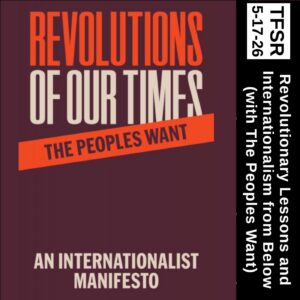
Here’s our recent chat with two members of The Peoples Want Network, an attempt to build an Internationalist movement from below and to the left. For this chat, Rindala and Doxie speak about sharing lessons from movements and uprisings of the recent past from around the world among participants and those hoping to create movements in their own lives, organizing in exile, the enriching practice of building solidarity and the recently published English booklet of The Peoples Want manifesto, Revolutions Of Our Times (Haymarket 2026). At the end of the chat, Rindala announces the upcoming, June 2026 project Mujawara for networking local movement sites with those around the world to further increase intercommunication and solidarity and support such spaces in conflict sites in the SWANA.
We’ve covered a number of the uprisings, migrant struggles, and internationalist organizing topics and movements discussed in the episode since we started in 2010, so feel free to pick through our website if you want to dig a little deeper and hear some views from the times.
. … . ..
Featured Track:
- TFSR by The Willows Whisper
. … . ..
Transcription
Rindala: Hello, everyone. Thank you for hosting us. My name is Rindala. I am Syrian. I’m a member of The Peoples Want network. I was in exile in France for the past ten years or so, and after the fall of the regime in Syria, I am trying to restart a life here in my hometown, in Damascus. So if I have internet problems, it would be probably because of that. Happy to be with you.
Doxie: Hi, thank you for having me. My name is Doxie. I’m Egyptian, living in Berlin since 2014, and I am a member of a leftist Egyptian diaspora organization in Germany, focused on addressing sociopolitical challenges in Egypt, and also advocating for solidarity with interconnected struggles in Palestine, Sudan, in the region and the broader Global South. I’m also a member of The Peoples Want.
TFSR: Thank you both very much for taking the time, and for the work that you’re doing. I’m really glad to be here chatting with you both.
We’re here to speak about The Peoples Want network. Listeners may recall us talking about this a bit with Leila Al-Shami at the end of our most recent conversation about the last year in Syria since the overthrow of Bashar Al-Assad. Would someone refresh the listeners about the nature of The Peoples Want network and how you came to find yourselves personally involved with it?
Rindala: The Peoples Want network has had an official formal existence for a year or so, but actually the story of the network goes back to 2019. If you remember, there was another wave of uprisings in 2019 in many different places around the world: in Lebanon, in Iran, in Iraq, in Algeria, in Hong Kong, Chile, Sudan. At that time, I was involved in a small collective that was called the Syrian Cantina. It was made up of Syrian exiles and internationalist activists, I would say, mostly from the French autonomous movement in the Parisian suburbs. And this small collective basically was a popular kitchen, a mutual aid space, and at the same time a place of encounter and exchange between diaspora communities exiled, especially from uprisings of the last two cycles of struggles: 2011, 2019.
Basically, in 2019, we just started to organize a solidarity event for our Lebanese comrades who were participating in a revolt at the time. Uprisings started popping up in different places, and we were like, “Okay, we need to do something that speaks to all of those geographies.” And this is how it came about. That was the first gathering that we called The Peoples Want. We put the famous slogan of the Arab Spring in plural, because we felt that there was something that goes beyond the specific national context of each uprising.
And basically we did that over and over. Over the years, we had five editions. At the beginning, it was a one day gathering, and then it developed into a ten-days festival with three public days, with concerts, exhibitions, film screenings, debates, etc. Then we had more or less one week where we would meet without the public, just among activists, and people, organizations, collectives, people who participated in those uprisings. We’d exchange experience, strategize, meet each other, speak about what it meant to us to partake in those uprisings, what are the learnings, and how to move forward. So these were the starting blocks of this informal, organically developing network, with people from over thirty countries who would participate over the years in those exchanges and gatherings and festivals.
In the last edition we decided to take a step further, if we can call it like that, and have some sort of a formal organization, organize ourselves in a more intentional way as a network, and with a text that could act as a political compass. The text is called Revolutions of Our Time: An Internationalist Manifesto, it just got published by Haymarket in the US and the UK. I was part of that small Syrian collective; this is how I got involved with The Peoples Want, the Syrian Cantina.
Doxie: For me, I’m more of a fresh member. I just joined the network after its official establishment. So we were invited as a group to the gathering in France, and after the gathering was the opportunity to join the network. That was two years ago, if I’m not mistaken.
TFSR: Great, thank you both. So listeners know, to reference Revolutions of Our Time: An Internationalist Manifesto that you mentioned, this text is also available in PDF form right on The Peoples Want website, correct?
Rindala: Yes, in four languages: in English, French, Spanish, and Arabic.
TFSR: Would you talk a little bit about the contents of the manifesto, and some of the experiences that are rolled into it?
Rindala: Basically, the manifesto is really the sum of our discussions and exchanges and debates that we had during those festivals, those gatherings that I’ve just been talking about. At some point we were like, “Okay, so actually we have a lot of materials.” Because when we were organizing the gatherings, and there were some threads, thematics that would come back every edition.
Regarding certain questions, we started having quite a lot of materials, and we felt that some of this material is getting matured. We’re starting to become ready to share it, and to put it in a form that we can share with the rest of the world. First of all was an invitation to continue, or intensify, maybe, a strategic debate about revolution, about the question of uprisings and the limits that they faced. But also, as our Syrian comrades like to say, to have some sort exercise in memory. So that we don’t forget how intense and powerful some of those experiences were for us, individually, but also collectively, and how can we learn from them for the future, for the struggles that are ongoing, but also for a horizon that could actually make us dream of surpassing the limits that we faced.
I think the book has six or seven chapters, and each chapter is focused on a theme. At the beginning, we start by giving an account of uprisings, the ways they were organized from the base and the kind of protagonists that were involved in them. Then we move on to speak about the counterrevolution, the multifaceted forms of the counterrevolution that we think was a direct result of the different uprisings and of their intensity.
We move on to speak about exile. There’s a whole chapter on exile because the question of exile and exiled communities and diasporic collectives was quite important in the formation of the network since the beginning. For example, where I was in France and with the collective that I was in, we really worked on weaving this experience not only with the local French community, but also with a lot of diasporic communities that we would start connecting with from Lebanon, Palestine, Egypt, Sudan, etc. So the question of exile is quite an important aspect, dimension in the formation of the network, but also in our analysis for what happened and for what we hope to come.
Then we start speaking about internationalism from below: what we understand by internationalism from below, our need for it, how did we get to this question of internationalism that could be adapted for the twenty-first century. Then we have a whole chapter on empire, trying to think of the question of anti-imperialism in a way that is suited to the coordinates and parameters of the twenty-first century, and the developments that happened in leftist currents and the leftist tradition.
And then we move on to try to speak about the question of revolution, which was one of the hardest chapters to write. Like, okat, so what do we do? How do we do this? So yeah, that’s a very short overview of how the book came to be and the content of the text.
TFSR: It’s a very small book, it’s about a hundred pages, but it is super rich in the space and time that it covers. Not only jumping back into past experiments or revolutionary ruptures in various countries, on page seven, I think, almost the whole page is just a list of different locations with sometimes repeated years of uprisings. And I think putting these moments and places in conversation with each other, reflecting in a lot the gatherings that you’re talking about, and the coordination and collaboration at the gatherings that you’ve been hosting, the IRL version of it, there is so many opportunities for the reader to do a little more research and look into the contexts and lessons and stuff.
I started reading this with a group of people here, and found it really gratifying and challenging in some really positive ways. So I’m glad that you all published this, I’m glad that Haymarket put it out.
Rindala: That’s great to hear! The reading group I mean. That’s perfect.
TFSR: So, could you speak a bit about your personal experiences of the revolutions and reactions that have shaken your countries of origin since the early 2010s at least, during the so-called Arab Spring? I don’t know if you have a contestation to that phrase being turned on. I know a lot of people, like listeners in the US, use that as a shorthand to talk about the revolutions that spread across the SWANA, and then a lot of the repression that followed.
Doxie: I was part of the Egyptian revolution in 2011. I definitely started with very high hopes in the beginning. The popular demand was to take down the Minister of Interior, and then I believe that people found out that they could really take down the president, which happened very quickly, in eighteen days. Building up to this moment took quite some time. It was a lot of workers’ strikes, a lot of organization that was taking place. The biggest was in 2008, then it happened so quickly that Mubarak was ousted. And then started the real issues, showing how also divided the movement is.
After the eighteen days, when Mubarak was ousted by the military, it was the military council in power, and it was definitely a continuation of protest, a lot of discussions. The public sphere was open. I can say that we had two years of relative freedom, while also at the same time, it was a lot of repression by the military council. A lot of people have been arrested, killed also in the streets and the protests. Then we had the first elected president, who, as Mohamed Morsi was part of the Muslim Brotherhood, didn’t last for for a long time. After one year, there was a military coup, and I would say that was the end of this wave of the revolution.
Afterwards the amount of repression was not seen before. In comparison of Mubarak, we still had relative political organization. It was like, there’s journalists that would talk–with some definite red lines–but after 2013 everything was closed completely. Then it was what we called the exodus and exile of the people who were part of the revolution. A lot of people left the country, either willingly or they had to. Others were arrested. Up to this moment, in Egypt there is around sixty thousand political prisoners, and this is the most conservative estimate. It was definitely part of the Arab Spring, and in the beginning we were also in contact with other activists from Syria, from Tunis, from Libya. But for Egypt, 2013 or 2014 was the end of the of the revolutionary wave.
Rindala: To me, my first contact with the Syrian revolution was through the repression: friends in Damascus. I personally did not partake in protests that were happening. I was seventeen at the time. It was highly secretive and I think I was too young to understand what it actually took to enter into discussions and circles to get the information to go and protest. Also, we didn’t know. there was the TV, but actually things would happen in your city, sometimes blocks away from you and you wouldn’t know it. In the early days, information was not circulating very fast. It was just the beginning of Facebook and stuff, but in Syria not everyone had a cell phone or a smartphone or whatever. That came fast, but that came later on. So I did not take part in protests, but the first contact was quite harsh repression and detention of friends who did take part in protest. In 2012, because of political repression relating to family members, we had to leave the country, so most of my involvement in the Syrian revolution was actually in exile in France.
In one way, my participation on the ground in the cycle of struggle was actually more in the Yellow Vest movement in 2019 in France. I remember the early days of the Yellow Vests, we had some comrades who were like, “No, but this is right-wing protests, the protests are being infiltrated by fascists, we shouldn’t, it is not legitimate! Why are we going down to the streets to protest against a tax related to fuel?” A big part of the left, at the beginning, was not ready to participate in the Yellow Vest movement.
And I remember with Syrian comrades at the time, we were already organizin. It’s been years that we were organizing in France for the Syrian revolution. I remember we were telling our French comrades, like, “What do you expect revolution to look like? What do you expect a popular uprising to look like? Do you think everyone is going to be on the street with red flags and singing the Internationale? It does not work that way!” I think participating in the Syrian revolution or following it from exile, trying to be involved in different supports to the revolution on the ground in Syria gave us some understanding, or a readiness to read the situation in France regarding the Yellow Vests in a way that allowed us a much faster participation than some of our French comrades. Also a kind of knowledge of the kinds of contradictions and divisions and internal battles that needed to be fought within the uprisings.
Doxie: When it was the beginning of the revolution, and then when the movement also started in Syria, we were really shocked about the amount of violence there—although you can argue that oppression from the Egyptian regime against the revolution was quite big. In Syria it was so violent that we were in a state of shock. We definitely knew how the Assad regime was: what they have done in the eighties under Assad, and then the uprising in Hama, they killed like forty thousand people. Even knowing that, we were like, “This regime is really violent!”
In the beginning, in the eighteen days, we couldn’t believe that this was really happening. There were a llot of small organizations, how people organized the protest. There are a lot of people that weren’t very well known, but it took lot of work to make it happen. For me personally, 28th of January, 2011 was, I would say, the day of the revolution. It started on the 25th. In the streets, the people were just joining from everywhere. And the ground is almost shaking underneath you. That was the moment that we felt unity, that we felt we could do something.
Afterwards, after the fall of Mubarak, it was the beginning of the divisions, starting to face the reality of not actually having a project or something like how this transitional period would be run, how to deal with the military council, and so on. There were a lot of questions they did not have the answers to.
TFSR: My next question was going to be about the category of “the people” as an identity. This feels like a good place to ask it. Between the reflection on the Yellow Vest movement and the diversity of positions within it, and the question that some comrades were bringing up of, “Do we participate in this thing where not everyone agrees? We don’t have the same positive project, goal, as an outcome. Do we sully ourselves, or do we potentially lose ourselves to a larger rightwing populist influence within the movement?” Or with those first elections after the overthrow of Mubarak and the Muslim Brotherhood coming into power, which is far from a progressive organization. The question is like, who are we looking to speak with, and to?
In the US context, during the Occupy movement, the organizing was meant to be by and among the 99%. That was the framing that it started out with, and that really grasped a lot of people, with that dividing line according to wealth and the interests associated with that. There were tons of discussions of, “Well, cops are technically working class people, so the police must be a part of the 99%! We can pull them over to our side!” Or, “What about people that have much more interest in racial politics and preserving white control in the country? They’re technically in our grouping; they have a common understanding that there’s a systematic problem, that they’re being excluded from power and their interests aren’t being voiced. They have this common project with us about wanting to oppose the current order, but there’s definitely a lot of differences about what they want to see together.”
So I wonder, who is the intended audience for this manifesto? And who is the subject, “the people,” that is envisioned within The Peoples Want network?
Rindala: Thank you for this question. It’s a question that keeps coming back, actually. Some people continue to raise some sort of dissatisfaction with this category of “the people.” I will get into that in a bit, but just to answer the question of who is the public, who are we addressing with this manifesto: I think simply people who partook in those uprisings, and, to quote someone, who have some sort of fidelity to that event that they have experienced. That is to say, not just those who partook in the uprisings, but those that the uprisings are still something that is working within them. It’s still something that is moving them in one way or another. It could be as a memory–as a nice memory, a harsh memory, a difficult memory–but it’s something that they still cannot let go of. It’s something that acted as a fundamental experience in their lives. That’s the “public,” if we can use that term.
Those are the people who we’d like to address with the text. But of course not only, because it’s also organized folks: partisans, activists, militants. Even if they didn’t partake in those uprisings, they at least saw in those explosions, in those revolts, in those uprisings, in those revolutionary processes, a sign of hope. Regardless of the repression, the defeats, and the counterrevolution, they saw something that we need to hang on to and start from in order to think what to do now after those cycles. I mean, “after those cycles” is a bit complicated, because it seems that those cycles are just not ending. There was the Gen Z uprisings that happened last year. Basically it’s people who, even if they have not necessarily participated in uprisings, still see in those different cycles of uprisings as a site to think about the revolutionary question for today, for our times.
Now to go to this question of the people. As I was saying, we had a lot of discussions and feedback on drafts of the text before it came out, and this is something that came out sometimes: this dissatisfaction with the category of “the people.” That it’s so wide, it’s so loose, more or less for the same reasons that you were mentioning with the 99%. It can have anyone. It could be instrumentalized in a very populist fashion, etc. I hear those dissatisfactions or remarks, but I think for us what was important was to take something that was there, on the ground. To take a term that was used by those who participated in these revolutions and movements. We didn’t want to invent something to propose as this new revolutionary subject, or this new term that needs to guide the masses or whatever. The term “people” was obviously, in the famous slogan “The people want the fall of the regime,” but also as this thing that was mobilized by those who were on the ground in order to reclaim something. It was present in a lot of contexts. It was one way to self-identify, to self-recognize, but also to start to have some sort of awareness of oneself and have some sort of antagonism with the state, with the government, with the police, with the system. Sometimes this self-consciousness, or self-awareness, would include the economic structures, corruption, etc. For us, it was a site where there was an antagonism towards the state, towards the system at large. Sometimes it wasn’t as clear if it wasn’t anarchist, anti-capitalist slogans and words and discourse. But we think it was a site of an antagonism.
Two, when we say “the people,” and this is how we use it in the text, we’re not speaking about the population. We’re not speaking about those who live in a certain country. We’re really speaking about the people who are on the street. There is this idea that the uprising, the revolutionary struggle, produces its own “people.” For us, when you are in the movement, in this relationship of antagonism with the state, in one way or another you are working on a redefinition of what is “the people” and what is not “the people,” what you want to exclude. It seemed to us that this term, is a site that could be operational to introduce antagonism without bringing something from outside and just projecting it on a popular uprising or on the revolts on the ground. When we say “the people,” we really mean the people of the uprising, the revolutionary people, the people of the struggle. We don’t mean the population. When we’re speaking about Syria, or France, or Egypt, we’re not speaking about the whole Egyptian population. I think regardless of all that, we still have some folks who would still not be satisfied with that choice, but we’re happy to continue this conversation.
Doxie: For me, it’s also very important to understand how Rindala said it, that this is what the people were shouting in the streets. When you look at the slogan of the Egyptian revolution, part of it was “Bread, freedom, and social justice.” So we’re talking about all the repressed people. I remember one day at one of the protests someone was talking to a soldier and saying, “We are on your side, you shouldn’t be against us, we want you to be with us, we are defending your rights.” And I think this is how we should somehow get out of this identity politics. Because I mean, now with some reflections of the Egyptian revolution, which started perhaps around the beginning of last year: the revolutionaries started to say, “Okay, what went wrong? What were our mistakes?” Definitely a part of all the things is out of your hands, but what could the people have done differently?
This is inspiring the people that you also disagree with. And now after the most repressive regime that we’re living under in Egypt is a point that even some people would say, “We wish to go back to Mubarak times.” Because the people had more freedom, it was less harsh, life was kind of affordable for many. And I think this is a very good question, and it has to be re-examined as well.
TFSR: That all makes sense. I hope it didn’t come across that I was trying to be antagonistic per se, but it sits comfortably with me that the idea is something that needs reassessment perpetually. Any relationship is a living thing, and so you need to be assessing, “How is this working with them? Do I trust these people that are next to me? Do I need to reassess where I’m at? Could my ideas use some challenging?” What do we have in common? We have in common the fact that we recognize that there’s a problem. This is a good first-step place to move from, in order to build solidarity and to build a movement.
Doxie: Yeah, an example is the Muslim Brotherhood. At the beginning, no one can deny that the Muslim Brotherhood were in the streets. Officially, they did not want to join on the 25th of January, but in the the youth of the Muslim Brotherhood were there in the streets. They were part of the revolution as well. And it’s definitely an organization that we disagree with: it’s quite repressive, we disagree with their project, their ideas, and so on. But they were also part of the revolution. And in my opinion, when the people have supported the military against the Brotherhood, it took us way back, and took us to the state that we have now. So it’s definitely complicated. I think it requires a lot of thinking and reflections.
TFSR: The manifesto discusses the stigma associated with the label of refugee, as a subject that is set adrift from their home, obscuring the fact that even in exile one relates to and acts and organizes and communicates and carries a bit of that revolution or that movement with them. Would you talk about this? About how the revolution continues through exile, and also the innovation and new combinations of community that are formed through encounters of exile?
Doxie: In my own experience, after leaving Egypt and going to Germany, it was very difficult for me, and also for a lot of comrades, to restart a life, to have this individualistic way of life, that you care about yourself, you find a job, blah blah blah. That was differently difficult, of course, in comparison with the Syrian comrades; their journeys were way more difficult. But by the end, the revolution was part of us, and I know through other friends that they also wanted to take a step back, that the feeling of the failure of the revolution, and the feeling of being in exile took a little bit of time till the people started back to organizing, and realizing that we cannot leave that.
You don’t have the choice to live your own life, and forget about the revolution that you took part in. That was the way that people started back to organiznig. Some people definitely were doing activism individually, but I think in the last four to five years, I would say it was a lot of organizing in exile, and also working with other diasporic groups. There was momentum after the start of the genocide; that was the moment that gathered a lot of different diaspora groups together, to work together.
TFSR: And that’s the genocide in Palestine that you’re referring to, specifically?
Doxie: Yes.
Rindala: For me it was important to speak about this status, this figure of the refugee. I don’t know how much it was present in the States, but 2014-2015 there was this thing in Europe that they were calling the “refugee crisis.” Basically there was one million or more Syrian people leaving Syria, trying to go towards Europe whether it is by sea or by land or whatever. A large section of the left,whether liberal or not, was very concerned and involved in movements of solidarity, hospitality, support with the refugees, not only Syrians, coming to Europe.
But there was a certain way in which this solidarity was completely depoliticized and disconnected from the roots of exile, from the reasons that led people to leave their country. In the Syrian case, there were those who left the country not necessarily because they participated in the revolution or were involved in the organizing or whatever, but just because of war, because of destruction and deteriorating economic conditions. Also a lot of people left because they were actors of the revolution and they had to leave because their houses were getting shelled. They organized demos in their neighborhoods, and the regime was just shelling entire neighborhoods, and when there were no more neighborhoods and houses to be in, obviously you need to leave.
The thing is: that politicized aspect, tat part about political agency and participation, or the political reason of exile, was kind of masked. It was mostly this charity, humanitarian treatment of the subject. This is even among some sectors of the radical left, or the anti-racist movement or whatever where the solidarity towards the refugee also sometimes circles back to speak about local politics, like policies of the European Union, German politics, French politics, etc. It is very important to denounce the racist laws, xenophobic politics, policies, etc., but I think that what was missing in many contexts was a connection to the site of struggle that led many of those people to leave their homes and seek refuge elsewhere.
I think here what we try to remind is that in a refugee there is also a history of political struggle, mobilization, and knowledge that needs to be re-centered, that we really need to re-think about not only to be able to have healthy relationships of solidarity that can be bidirectional, unilateral, like white people helping brown and black and Arabs just surviving in Europe, or whatever. The same thing could be applied to the States with what the right wing also calls the “refugee crisis” on the Mexican border.
We needed to leave behind that figure of a refugee that just needs help, and that leftist or progressive or liberal organization that just gives solidarity and feels good about themselves. But to it as a way to combat the local politics, the local racist xenophobic context. All that is good and necessary, I don’t want to downplay that, or degrade the utility and the usefulness. In a lot of cases it’s vital to be able to provide support with administrative work, shelter, food, etc. But we feel that there sometimes could be a missed opportunity where this kind of relationship of solidarity or support can become something that we call mutual aid, in which the exile could also be a revolutionary figure. In history it was the case: a lot of the revolutionary figures were exiled, had to leave their places, and this is how revolutionary ideas have circulated around the globe. It was a huge part of the communist movement. So we need to bring back this figure of exile as a revolutionary figure, as a revolutionary subject in one way or another in order to make sense and practice mutual aid. The example that I was talking about in the Yellow Vest movement: our experience in the Syrian revolution gave us some sort of heads up. We didn’t lose time, we intervened right away, because of that. So this is knowledge, experience, that could help the local context.
This is what we wanted to insist on in the manifesto, to treat some of the things that my comrade was talking about at the beginning, with the sense of despair and depression. You participated in revolution, it got defeated, you had to leave your home, your home country, your friends, your comrades, etc. and just start over. So reconnecting to the revolutionary struggle in the local context is also a way not to be cornered into this individualized “Let me just find a job and a house. I’m just gonna be a person who’s just seeking citizenship, and that’s it” existence, with no sense of community, no sense of actual relationship to the local context that you exist in.
This is what we tried to speak about in this chapter on exile—but also to practice. With Egyptian Diaspora Resists, with us at the Syrian Cantina, with a lot of other groups that are in the network whether from Sudan or from Iran. This is a huge part of the work that we are trying to do to bridge gaps between different contexts through exile, because otherwise we wouldn’t have met. Like, I don’t know a lot of people, we wouldn’t have been able to meet a lot of the folks and the comrades that we’ve met from all over the world if we weren’t in exile. And we wouldn’t have been able to bring support to the Syrian revolution if it wasn’t for exile. It is in that way that we try to speak about turning exile into a position of attack, and leave this victimhood narrative and all that.
Doxie: I totally agree with Rindala, and I want to note the importance of intersectionality of the struggles. This is something that, in my experience, we touched on when we were organizing with other groups that have been in revolutionary contexts and with local organizations in exile. I think one of the most important things that we have learned is that our struggle is kind of the same, and we met each other, and we are trying now to find other solutions. Like, what can we offer being in exile and being far away from the homeland? What is our role? How we can move forward?
TFSR: This is just an audio call so you’re not seeing that I’m just nodding fervently. Yes, yes to what both of you have just said. This is very powerful, very important. Looking back at the history of radical struggles in the US, they have been deeply, fundamentally informed by the experiences and the ideals and horizons that people have brought with them here. And ideally building positive, mutualistic bridges back to people returning from exile–if they can, and they want to–to be able to build these transcontinental bridges that not only inform and undergird and sustain movements at one end of the bridge, but have the possibility of reigniting fires on the other.
In the current state of the world, it seems like the fascists around the world are in state power. Capitalism is hurtling the world towards many climate catastrophes, and revolutionary movements for liberation and self-administration feel failed, despite our best intentions and the blood that people have given. A natural reaction for many might be to focus on the local fight and to gather resources and lick our wounds. But the manifesto proposes building international solidarity from below. How does the concept of internationalism multiply our resources? How can it add to our defenses against repression at home? And why do you argue that people should look beyond and include their struggle where they’re at, beyond the local context, in order to get help from the people?
Rindala: Maybe to win!
TFSR: But I mean, when you’re under attack, it’s natural to feel that you have close ranks and defend the resources that you’ve got. The socialist perspective feels in some ways like an unnatural one, that maybe in some ways we need to be strategically open and we need to reach out and not just close in to defend ourselves and armor ourselves.
Rindala: Yeah, of course. Sorry, I was kidding—well, half kidding.
It is counterintuitive and I think we have this one section of the text where we try to say like, “Okay, let’s not be dispersed! We can’t run from one struggle to the other, because we lose strategic vision, and we just exhaust ourselves!” And then we’re like, “Oh, but actually, internationalism!” Already we have a lot on our plates where we live, whether it is locally or nationally, but let’s add international struggle to the mix. So it does seem counterintuitive. But we’re trying to put forward as an idea that our struggles are interconnected in the same way as those who oppress us are. Capitalism is transnational networks of exploitation, domination, and repression. If we’re talking about states, they help each other regardless of their ideological differences when it comes to defeating popular power, when it comes to defeating revolutionary processes. Structurally speaking, he context which we’re operating in, whether it is very local as in area where we live, or whether it is national, cannot be isolated or disconnected from the transnational flow of capital and violence.
So that’s one, then two: when we’re arguing for internationalism, we’re not necessarily arguing for someone to follow every single struggle that is happening on the other side of the world, and like go to every single demo that is happening in support of every single struggle that is happening around. That’s not our idea of internationalism. For us, internationalism, as we say is a practice and a method. First of all it’s a method for analysis to allow us to navigate the contradictions of our times, and the confusion. The understanding of internationalism and of anti-imperialism that was dominant in the twentieth century seems to work less today, because it was an internationalism focused on big labor unions and worker movements and large organizations, etc. And did its job to a certain extent, but when we think of the uprisings today, those sectors of the traditional left weren’t necessarily part of them, nor a very important engine or fuel of those uprisings. Not only that, but some of these traditional leftist currents and organizations were either indifferent or hostile to some of those popular uprisings, because they left the doxa or were leaving some of the Marxist-Leninist canons of leftist organizing and discourse, etc. So internationalism for us intervenes here to first look at other contexts and try to understand what is happening, how to take a position, not only to have a good position about, like, Ukraine or Palestine, but also to think about your own context. How do you navigate the contradictions, the difficult questions, the limits, the obstacles, in your own context?
For example, comrades in Sudan looked a lot at the question of the armed resistance in the Syrian revolution, and they learned a lot from it, and from all the negative externalities that it brought to the revolutionary struggle. What we mean by internationalism is actually a method, a practice of trying to look at other people’s struggles, to engage in debates and to have a better understanding of the situation, how to avoid some of the mistakes that other people have fell into, but also how to come up with a strategy together. I will stop at that. Or rather, that’s the first element.
The second element is really part of the question about resources and about self defense, so here I speak again about the context of the Syrian revolution. The Syrian revolution was an unpopular revolution to the traditional left, if I may say. Getting support, just moral support, for the Syrian revolution was quite difficult even when it was in the harshest times like during siege and famine, like when the regime would besiege whole cities or countrysides and basically starve people. Even then it was difficult for some of us to get moral, but also concrete support to revolutionaries on the ground.
When I’m speaking about concrete support, it’s not like military support. Sometimes it’s just getting seeds to places who are in siege for years, in order to survive. We have comrades in the network who were active in those very concrete material supports to revolutionaries. But in order for them to do that, they needed to understand what is actually happening. They needed to understand that it was a just cause, that it was a revolutionary struggle, and that there are people like us, who think like us, who share the same questions, and maybe projects for the future, that we can support. This is one way in which internationalism can help us survive at least certain situations. And in the Syrian case, if support was larger, if an international movement or a transnational movement in support of the Syrian revolution was larger, I wonder if it could not have reduced the bloodbath, or delayed it in a way that would have left people on the ground some time to self-organize and come up with more efficient ways for self-defense.
This is a huge question that we need to think about in order to make internationalism a legitimate, concrete, and efficient tool for everyone. It is true that it is much easier to just look at your context and be like, “Okay, we don’t have time to think about other stuff, let’s just focus on what we have now.” But what we see is when we need to build those connections, those relationships of trust, of mutual understanding with comrades in another context, while we are getting bombed, we don’t have the time. We actaully need to do this in a continuous fashion, so when we need this kind of support, it is much easier to do it. It’s much more natural, it’s much more efficient. But again, it’s counterintuitive. It’s not necessarily an evident thing to do, but we think this is one way to ask and to engage with the revolutionary question for the twenty-first century.
Doxie: I think it’s also what we have learned from the Arab Spring, if we can call it this. It mainly has failed in every country; it was common, the failure was collective. It wasn’t one country. There is not a single one that it went well. Tunisia was more the country that we were looking at, and we thought, “Okay, it changed the vibe, actually, but it did not happen, because it’s also part of the region.” It’s about their neighbors as well. Their neighbor is Algeria, is Morocco, is Egypt, is Libya. In this regard, I believe internationalism is not a luxury. It’s the method, it’s how to go. Imagine that you have, let’s say, Bernie Sanders ruling in the US. The military coup in Egypt wouldn’t have happened in this way without this support that came from the US and Western powers, the Arab Gulf countries, and so on. So the way out is that people have to work together.I don’t see another way a country can survive by itself. If we’re talking about the region, for instance, it’s really hard. It cannot work. Lebanon would affect Syria. What’s happening in Palestine would affect Syria as well. What’s happening in Syria would affect both countries. So, it has to be an actual solidarity movement. The question is how to make it work.
TFSR: That’s something that I appreciate about the book, or the manifesto. There are a lot of spots in it where the writers pose questions, and they say, “We don’t have the answer.This is what movement is for, to find answers that make sense and that feel right, and that we can work with, out of it.”
There’s a lot of complicated questions like, who’s the neighboring countries, and what impact is happening, what is the experience in those neighboring countries, and what impact does that have on the country that we’re speaking of? But also you’ve got calls for no-fly zones or for strategic interventions from some countries to stop bombing from other countries, which is a very complicated thing. A lot of people outside of the region sit there with their hands on their head, and they’re like, “I don’t know what the right answer is! Like, do I advocate for the US government that I know has terrible intentions, and depending on who’s in power, is going to direct the Pentagon to just bomb random sites around the country?” Or is their intervention going to just take the oil fields, but maybe stop barrel bombs from falling on Aleppo? The “from-below” portion of The Peoples Want network makes a lot of sense to me, but it’s also complicated with questions like, how do we deal with the material circumstances? And, who has the ability to enforce, for instance, a no fly zone?
Rindala: It’s a very complicated question. Obviously from an ideological perspective, we can’t support external military intervention like NATO or US intervention or whatever in Syria, although people in Syria did. We see it today in Iran. Some people in Iran are happy, or not that sad, about the insane American-Israeli war that it led. There is this idea that, like, “Okay, that would help us let go of the regime.” We know ideologically, but also just from history, from experience, that that just never works well. The consequences of that, at least in the mid-term, is not something that is in the interest of the people in the uprisings.
But we can have disucssion on an ideological political level, but I think it is something else when you’re actually on the battlefield, when you’re actually involved, whether in an armed resistance struggle or a revolutionary struggle where the stakes are survival. I think when it comes there, that’s another discussion to have. I think what we try to say in the book is that we know our political strategic compass: it’s refusing external intervention because we know that it is always conditional, and it’s never in our favor. And when we say “our favor,” in the favor normal people, popular power, people on the ground, not some sort of national bourgeois elite or a section of them.
We know that, but what we realize is that just saying that is not enough. In certain circumstances you are faced with very difficult tactical questions and decisions. What we say is, if and when people need to make some of those very hard tactical decisions to seek support from an external power, be it Western or another, sometimes they have their reasons. And sometimes materially speaking, it could be a necessity, knowing that ideologically it is something that they’re not in favor of, or it’s not the ideological line or vision that they would defend.
Here, we can think of the Kurdish liberation movement. They have this capability of thinking about alliances, and thinking about how to deal in different moments with different external powers. For example, the US in Syria, in the northeast territories that were controlled by the Kurdish liberation movement, you would have alliances with the US and Russia at some point at the same time. So if they’re doing this, they’re doing this for a certain reason. This gap between our political refusal to engage in those alliances/tactical support in certain moments, and our inability to not depend on them, is the question that we need to solve. To think of the autonomy of the political struggle, the autonomy of the revolutionary process.
Doxie: All the recent examples of military intervention, external military intervention, went really bad. Look at Syria, look at Libya, look at Iraq. I agree with Rindala. At some point, tactical decisions have to be made, and this is very complicated. But at the end of the day, it has never brought any good because the military intervention is also coming for their own interests. They are not coming to liberate the people. This is the work of the people. Sometimes if we had not intervened, things could have went a completely different direction, and it cannot be imposed by external powers. It’s a political situation that is not negotiable.
TFSR: But also in Ukraine, there have been a lot of people calling for external military support to stop the invasion and to shore up the Ukrainian state. If you look back to the Maidan, there were revolutionary horizons to what was going on, but with the war starting around that point, and then escalating in 2022, calls for external military aid, funding, weapons, and support kept people from experiencing some of the terrible traumas that some of the occupied regions have experienced. But then it starts getting into geopolitics, as opposed to people’s movements and what we’re discussing here. So I understand it gets a little bit off topic with a lot of what The Peoples Want organizes around. It’s complicated.
Rindala: But these are the questions that we need to ask ourselves. We need to think about where we are right now, and what horizon we want. The horizon that we want, in line with what my comrade was saying, is to be in a position, at some point, not to have to depend or rely on any form of external intervention—unless partisan, obviously, and revolutionary—in order to oust the regime or to kick away a colonizer.
Saying that today, in the midst of the genocide that has been ongoing in Palestine, the ethnic cleansing that is happening in southern Lebanon, the war on Iran–that does sound kind of naive and idealistic. But I think if we don’t keep that horizon open, and not only open, but seriously engage in trying to make it a reality, the possibility of our independence from external superpowers, or external powers—colonial, imperialist, capitalist reactionary powers who try to instrumentalize our struggle—we’ll just keep repeating the same mistakes. If we don’t take seriously this question of autonomy– not only political autonomy, but also material, technical, logistical autonomy–we will keep falling into the same loop.
Okay, you oust a regime on one hand, but then you have imperial fragmentation in the country, that’s just what happened in Syria. Okay, you manage to gain national liberation, but then you have this new authoritarian regime that is emerging to replace the occupation. It is not about what is better or worse. People in the same context have very different opinions on what is better or worse. But for us revolutionaries who want not only to learn something from this cycle of struggle but also try to envision a different way in which future uprisings can go, and reduce some of the bloodshed and the dependency and the instrumentalization and the losses that we had depending on some of those external powers, then we need to take seriously this horizon of the autonomy of the struggle. Not only in words, but also materially. It is very, very difficult. I hear it, but I really don’t see another way. There’s no shortcut but to take this question very seriously. And I think this is one of the most thorny tasks for the revolutionary struggle to come. But yeah, there are no shortcuts. We can keep on doing the same things, and we will still face the same limits and the same difficulties, etc. But I think it is a horizon that we need to hold on to.
TFSR: Very well put. Keeping on the geopolitical side of this discussion, the manifesto describes a situation where Empire reigns across the world and geopolitical divisions are often framed as struggles between imperialist and anti-imperialist states. Can you talk about what is campism? What does it assume about the possibility of popular power, the operation and motivations of states in the global order, and the horizons of possibility?
Doxie: I hope I’ll say it right: campism is mainly the people that would support armed resistance across the region. So for instance, Hezbollah are supporting the Iranian regime because the Iranian regime is being “anti-imperialist” and fighting against US hegemony and Israel in the region. So campism is like being into this camp, defending their actions, because they are “anti-imperialist. Did I put it correctly, Rindala, or you want to add something?
Rindala: I mean, yeah. God, I’m starting to really hate this term. The trauma…just make it disappear! It’s this binary vision of the world that looks at the world like as a chess game, a very geopolitical analysis where there are more or less two camps: the Western camp, and those who resist them, and we’re going to call those who resist them anti-imperialist. Basically, regardless of the nature of the regimes who pretend to be anti-imperialist, regardless of the repression that they exercise on their people or towards other people, we’re still going to support them as the bulwark against US hegemony and Western imperialism.
But actually it could be the other way around: campism could also be understood as those who side with the Western camp as the incarnation of good, and the camp of freedom and liberty, and see any attempts of armed resistance/struggle against the status quo, against the hegemonic order, as something that is barbaric and regressive and reactionary, and is not worth supporting or existing. So it’s really this binary way of seeing the world as divided between two camps, and it’s very much centered on state powers, or superpowers, or military organizations as the sole agents of change in the world, disregarding what popular movements could have, or do.
Doxie: Yeah, I think a good example would be the former Syrian regime. This is why a lot of the left did not support the Syrian revolution. In their perspective, they assume that the former Syrian regime is in this camp against the Western hegemony, which is really quite a problem! In the beginning, talking to a leftist, they would say, “No, but Assad is fighting against Israel,” and so on, and was disregarding all that they are doing in Syria: crimes and bombing people and so on. I think that would be a good example of why the Syrians were left alone, because the traditional left was thinking in this binary way of thinking.
Rindala: Now a lot of very heated debates are around this question. Like, “Do you support the Iranian regime or not, today, in the current context?” Same thing with the armed resistance in Lebanon, same thing with Ukraine. Those are some of the debates and questions that divided a lot of the leftist scene, not only in the West, but in quite a lot of places, like in Latin America and the Arab world, on the African continent.
TFSR: So the liberal framework of human rights and terms like democracy have failed to live up to the lofty ideals that they claim to stand for, and have instead been used to mask existing power relations. What could alternatives to this framework look like? And how do we hold the best elements of these ideas, while still rejecting their wielding by authoritarian structures of inequality?
Doxie: I think I would say that there is something fundamentally wrong with liberalism in general and how this was practiced through institutions like the UN and other NGOs, and so on, for a very long time, and didn’t live up to that. I think it’s fundamental: they are part of the system that is in place. They are not really solving the roots of the problems. They are part of the system that would give aid, military aid, to Egypt, but at the same time they would also be spending some money on USAID, organizations hearing about human rights and so on. Of course, it’s contradictory. They are basically supporting the regime that is oppressing the people and imprisoning them, but at the same time putting some effort, like, “Can you please get some political prisoners out?”
I think in it’s core it’s contradictory, and I think the way out traditionally is the role of the left. In my opinion, the left has failed for many years now, and we need to re-imagine the left and the role of the left, and I think that’s the main issue: that the left is really failing at this, and left that to the liberals. We have seen now the results of that.
Rindala: I think it is a tragedy somehow to leave some signifiers, terms, categories like democracy, to the liberals, just because it was instrumentalized to invade countries and kill millions of people. It is devastating. The term “democracy” we understand as people’s power. When I’m speaking of democracy, I’m not thinking of liberal democracy with parliaments and voting and whatever. I think people have understood it’s not really our cup of tea. It’s not something that we’re very much a fan of, or are asking to figure in to the political horizon that we desire. Nonetheless, we can’t leave this notion of people’s power, or democracy for that matter, to the liberals.
Same thing with human right. A lot of the legality and the institutionalization of that, and the codification of that just forgets about the idea of the power struggle. It doesn’t matter if it’s written in a text or if it’s constitutional, or if it’s the UN Charter or whatever. That’s not what is ruling the world today. It’s not those charters, and it’s not those rules and laws, it’s the rule of the powerful, and it is the rule of force. I would say that on a superficial level that’s really the main problem with notions like human rights and democracy and the liberal framework. I think to completely disregard some of the content could be a bit dangerous and problematic. First of all, current struggles, whether Indigenous, decolonial and anti-colonial, whether it is in places like Syria, or where there is intense repression, people will speak in this language of human rights and international law, and try to use those as tools, to have a part of their battle, on this transnational institutional framework, because it’s what exists, that’s what’s there.
But if we disregard the framework, the structural context in which those debates on international law happen, we can’t completely disregard some of the content. I think we can’t just disregard the notion of equality, the notion of the right to self-determination, especially for colonized people, the right to self-defense in an occupied territory. Those are vital rights, we can’t completely just disregard them. Anyway when it comes to self-determination and self-defense, if we think of Palestine and Palestinian resistance, the liberals definitely don’t apply this framework or these logics.
So we can’t completely disregard them. In certain contexts it is just about claiming life. When you live in a totalitarian authoritarian regime with intense politics of repression, of forced disappearance, of torture, then you know those very loose signifiers actually at least state something that needs to be obvious. Like the right to life. Unfortunately they have been completely emptied out from their context by this liberal, legal, transnational, institutional framework that is just fake, and it’s just really masking the rule of the more powerful.
TFSR: As we’re speaking right now, there’s this ongoing US and Israeli war that is continuing to bomb populations across SWANA, and in particular in Iran, following their suppressed uprisings. You’ve got Israel claiming more territory and depopulating and destroying villages in parts of Lebanon, and re-escalating the genocide against people in Gaza. I wonder if you could talk a little bit about some of the analysis that you’ve been able to hear from activists on the ground, and how this violence has impacted their organizing and the struggles against the regimes that they live under.
Doxie: You can say that definitely the Iranian people, like all the people in the region, are entitled to their freedom and sovereignty, and also to their self-detemination. From activists that I know, Iranian activists, I know they don’t like what Trump was going around and saying, “We are supporting, we are calling for the protests,” and so on. It really harmed them. It really harmed the people on the ground. Also what was mentioned before: I think that when you hear Iranians in the diaspora, we are uploading what’s going on. It’s actually not really reflected of the activists on the ground that they were part of the uprising. For them it’s actually more harmful.
In my opinion, the main question here is more why this current war is taking place. It’s not to free the Iranian people, it’s simply to dominate. It’s a display of power that conveys this message: “Comply or we will crush you.” In this regard, comrades and I would claim that the people of Iran know for sure that the US or Israel wouldn’t really care about their freedom. Actualy, if they leave them alone, perhaps they could gain things on the ground, but this is not the case. And that’s the main issue that also applies in Lebanon and elsewhere.
When Tom Barrack was in Lebanon and then was talking to the journalists, they were speaking loudly, and he said, like, “Either you will be quiet, or we’ll get out, or we will leave.” And compared the people to animals, in a very colonialist way that was a bit difficult to see in 2025. And it was like, that’s the main point! We actually want you to leave! That’s the main issue, and that’s the main problem: they are there; there are military bases, American military bases all over the region, and they are actually the issue itself. When he was like, “We want to leave,” I was like, “Yeah, please! ” Leave the region alone, and the people will figure it out. In a case like in Syria, if it wasn’t that much of an intervention—from Iran, from Russia, from the US, from Turkey—perhaps it wouldn’t have been that bloody. In Egypt, if they did not support the military coup, perhaps it would have went a different way.
Rindala: Right before the war, I was with some of our Lebanese comrades, members of the network, like a week before the beginning of the war. We were speaking about all those amazing things that they’ve been doing since the so-called ceasefire from the last war. In Lebanon, the bombing of the southern part of the country has not stopped since 2024. Now we’re really at the level of ethnic cleansing of a whole community from its homeland, it’s being deracinated. Nonetheless, there was some sort of de-escalation at some moment, and our comrades have started finding tools and ways to deal with this new situation, in which they were really few, because repeated economic crisis, invasions, war led a lot of people to leave, to go into exile. And so despite the war, despite a lot of people leaving into exile, finding tactics and ways in order to continue, people were starting to continue the part of the revolutionary organizing that they were involved in from the 2019 uprising.
And we had so much hope in what we were doing! We were like, “Okay, we’re going to organize between comrades in Lebanon, in Palestine, in Iraq and Syria, and finally we can make this happen,” again after the de-escalation in Palestine, Lebanon, Syria, and all that. Then the war came, and obviously all those plans and all those ideas and initiatives that were ongoing had to stop, because you just can’t, daily survival is what is at stake. A lot of our comrades in Lebanon are involved now in mutual aid initiatives, solidarity campaigns to host, nourish, help all the displaced people. There’s more than one million displaced persons in Lebanon. Providing shelter, providing seeds, providing food, you name it. This is what imperialist wars do. We can’t organize for better horizons.
Doxie: You’re in a constant state of urgency. You cannot strategize, you cannot think about the future, because you are very busy to deal with the catastrophes that are being put upon the people.
Rindala: And unfortunately it’s not only this urgency and daily survival that you just have to do and leave the other questions aside for the moment, but it’s also a lot of divisions. Whether it is in Iran, whether it is in Lebanon, we also see a lot of debates in the left. Some people would be in a position of unconditional support for the Iranian regime since it is undergoing an imperialist aggression, and some just cannot accept that and deal with that position, because of not just the long history of repression of that regime in Iran, but just the last uprising in January and the crazy, insane scale that the repression happened at that point.
So of course you’re against the American intervention, but do you support the Iranian regime unconditionally? Okay, you don’t support the Iranian regime, but do you have the right to criticize it publicly or not at a time like that? So, there’s a lot of divisions and debates happening. I mean, it’s more than division: it’s really long-term comrades just no longer speaking to each other, collectives being broken. It is something that is not to be underestimated.
In Lebanon it’s the same. T what extent do you criticize or not Hezbollah as an organization and as the sole force that is doing the work of military resistance against the Israeli occupation? Do you support it unconditionally? Do you support it in a tactical way? Do you support it in a strategic way, without saying anything? So these debates about positioning and the kind of support that we give to these powers resisting or standing at least in the face of imperialist wars and attacks are creating so many divisions in the activist and comrade scene. It is really sad. You have the daily survival, and on top of that, you have links and friendships and comradeships and collectives that are being broken. It’s the kind of echoes that we are having, that I have from comrades undergoing those two terrible attacks.
TFSR: Heading towards the end of the conversation, I had one small, kind of personal question. The small city that I live in will be hosting a few smaller G20 meetings at the end of August, before the larger G20 summit that’s happening in December in Miami. Are there any words that you want to share with folks planning to protest this organization and its impacts around the world?
Rindala: Protect yourself in the demo. I guess folks know how to do that.
Doxie: I remember the big protest that was in Hamburg, the G20. I don’t know if you remember that, in 2017. This is the moment that I learned how brutal the German police are. It was really big, and I think it had an impact, but definitely take care.
But the other thing, generally it has been a discussion between the community and the people organizing demos in Germany and elsewhere, the idea of using the demonstration as a tool. What is the point, what do you want to make with this protest? And this question has to be answered. We have definitely seen a lot of big demos. Before the invasion of Iraq, in the UK it was the biggest, I think one demo was more than a million people. But the invasion took place anyway, even with how much we criticized the UN. I mean, the UN didn’t agree to the invasion, but it happened anyway. So it’s more of really how to use protest to gain actual political gains. This is what the people have been thinking about for a long time. It’s very important to be there. It’s very important to show that the people are against this, and understanding how those people really determine catastrophe that the people have to live with. But at the same time, it’s not only a political message, but can this protest be part of something bigger? That would be worth thinking about.
TFSR: Yeah, this is a very small city. I don’t think that there are going to be massive demonstrations, that is just my impression, and I think what is happening here is going to be the much smaller in scale than the summit itself that’s happening in Miami a few months later. But I hope that it can be taken as an opportunity for people who are organizing around social issues to be able to contextualize their struggle within a broader international struggle, and take some points of solidarity from that. The organizations like in the G20 are made up of powerful economic and military powers, that try to determine the shape of the world. While the scale and the scope of these things are going to be felt differently in different parts of the world, they are felt in these ways across the world and among populations that have a lot more in common with us than we have in common with the people sitting at those tables during those meetings. It may be an opportunity to think, even in our small ways, about ways that we can stand in solidarity and build those bridges to create a more powerful internationalist movement.
Doxie: Yeah.
TFSR: If listeners want to engage with The Peoples Want, how can they learn more and get involved?
Rindala: So we have a website that we’re trying to rebrand, that’s going to soon have more information and resources. We’re on Bluesky and Instagram, if you want to follow us.
But also we are organizing a transnational campaign in June around one of the projects that we have in the network that is called Mujawara. Mujawara is a word in Arabic that means the act of neighboring, and it’s really one of the most concrete ways that we have of practicing and embodying internationalism from below. Basically, Mujawara is the attempt to connect and link physical spaces around the world, whether it is social centers, farms, libraries, coffee shops, self-organized co-ops, or whatever, in order to strengthen the mutual aid, like, practical material solidarity among members of the network, but also from outside.
This transnational action is also open for folks anywhere around the world. A lot of people who are not officially members of the network are taking part, from Mexico to South Africa to Syria to Germany. So if you want to engage, get in touch, start linking up with the with the network, this might be a good opportunity. There is a contact email on our website, that you can find on our socials, if you feel like organizing an event—it could be a march, it could be a demo, it could be a fundraiser, it could be a barbecue, it could be painting a mural, it could be whatever you want it to be.
It’s really about coming together, starting to practice and test our strength and our mutual aid. Whatever money is going to be raised from this will go into supporting the creation or the support of existing self-organized places, one in Syria and another one either in Sudan or Uganda, we don’t know. Basically the financial support would go into the Syrian and the Sudanese diaspora in the network, to contribute to the creation or the maintenance of physical spaces that would eventually be part of the Mujawara network.
So yeah, that could be a moment to link up with us.