
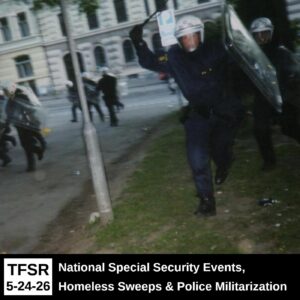
This year has felt like there’ve been a series of large sports mega events and summits planned and taking place in cities across the USA. For instance, starting in June the FIFA World Cup will be hosted in cities across the country (as well as a few in Mexico and Canada). Also a few cities are hosting meetings and an eventual summit related to the G20, or group of 20 economies, a gathering between large capitalist industries, banks, para-governmental neoliberal international institutions, government ministries and heads of state that share policy decisions effecting immigration, wars, trade policy and the climate. In 2028 Los Angeles will host the Olympics.
This episode will feature two discussions about some of the security impacts of hosting large sports or political events and the ways that the state and capital work to change the landscape and norms of the locations they take place. First up, Kristian Williams speaks about National Special Security Events like the G20 or World Cup, how they change local police and surveillance landscapes and work to turbocharge gentrification and displace working and poor people, making our cities more hostile to anything but commerce and control. Then, you’ll hear from Sam Schmidt at Our Streets Collective to speak about homeless sweeps in Pittsburgh, PA in the run-up to and aftermath of the 2026 NFL Draft taking place in that city.
- Kristian Williams past interviews on TFSR
- new book, Policing The Progressive City
- Our Streets Collective: https://www.ourstreetscollective.org/
- Article showing complaints to police in Pittsburgh about homelessness
- info-page for PopEd around G20 in Asheville this year: g20avl.noblogs.org
- past episodes relating to G20 protests and repression on TFSR
- Prosfigyka video by Sub.Media: https://sub.media/prosfygika-resist/
- Prosfigyka coverage by Pyrias of Athens appears on this episode of B(A)D News podcast
Announcement
Marius Mason
Longtime listeners to The Final Straw Radio will be familiar with the yearly June 11th Day of Solidarity with Marius Mason and other Longterm Anarchist Prisoners. Well, stay tuned for an announcement from the June 11 crew in coming weeks with a recording of this year’s call. We are happy to announce here that Marius Mason, a long standing ecological, animal rights and trans prisoner rights activist will is on his way out of prison, currently in a halfway house having served out his sentence,
- Past interviews on Marius’ case, other prisoners supported on the day and June 11th yearly event
- https://supportmariusmason.org/ for how to donate to his post-release and updates.
. … . ..
Featured Track:
- TFSR by The Willows Whisper
. … . ..
Transcription
TFSR: We’re speaking with Kristian Williams, anarchist and author, most recently of Policing the Progressive City: Portland, Oregon, from Settlement to Uprising. Out this year from AK Press. Kristian, thank you so much for joining us.
Kristian Williams: Thank you for inviting me.
TFSR: I asked you on here to speak about the role and techniques of police in the US during large international events. I recall when your first book came out, Our Enemies in Blue published by Soft Skull, the discussion of the massive police presence at the 1999 WTO ministerial protests in Seattle loomed very large in recent memory. It was only the third of these events to be designated a National Special Security Event (NSSE) following the Clinton administration’s creation of that procedure in 1998. Can you talk a bit about NSSEs? What prompted that formation, and what it rolled out for large-scale events like this?
Kristian: Sure. As you mentioned, it was one of several gifts from the Clinton administration to the police state, and it came at a time when militant demonstrations around globalization were happening around the world. There hadn’t really been a large one in the US until the WTO in 1999. I think it is not coincidental that in that context, with that organizing happening, and with the US really trying to take a leading role in the globalizing economy. This particular way of organizing and deploying police and really federalizing law enforcement for a designated area in a specific period of time I think was was a part of that same process. That accompanying globalization, there is always an increase in repression of various kinds, and I see the emergence of the National Special Security Event in those terms.
In terms of what these things are, they’re events that are designated by Homeland Security; the designation lies with them. Once they make that designation, the Secret Service — which is part of Homeland Security — becomes the lead agency for security at that event, as it’s been defined. The FBI takes responsibility for intelligence and investigations, and FEMA begins preparations in the event of a terrorist attack or another disaster or some sort of mass casualty incident. FEMA also takes responsibility for distributing funds. Now, what these things tend to look like…their main quality is interagency coordination — as is apparent from the number of agencies we’ve already mentioned being involved in this — and, really, it federalizes policing. It puts the local police under the control of the national government for the time and place where it’s happening. Generally, the local cops will have their days off cancelled for the duration of the event and their shifts will often be extended. There’ll generally be a National Guard presence, but how overt or not that is varies. There will usually be deployment of police dogs to detect explosives and snipers, presumably to protect against other snipers. All of that gives it a very militarized feel, which I think is somewhat deliberate. The areas surrounding the event will be subject to road closures, river patrols, and airspace restrictions, and part of enforcing these involves a certain amount of infrastructure, such as chain-link fencing, roadblocks, and checkpoints. That stuff will generally be removed when the event is over, but the more lasting effect is the federal training for the local law enforcement, which moves them in a more militarized direction. And that has been shown to affect the culture, strategy, and tactics of local police for the indefinite future. That element of militarization tends to be very much permanent.
TFSR: I guess this designation comes after the creation of these Joint Terrorism Task Forces (JTTFs) that are meant to be ongoing and specific to investigations. So this is the cross-agency work that follows in those footsteps. Do you want to say anything about JTTFs?
Kristian: That’s a good observation. Part of the challenge for the National Security apparatus is that the US doesn’t really have a national police force in the way that other countries do. Instead, we have this patchwork of local jurisdictions, some of them overlapping, some of them with sheriff’s departments, which have different responsibilities than police departments. There isn’t a single agency that is responsible. There has been a long-standing push at the federal level to try to introduce uniformity. Some of that is in terms of standards of professionalism and civil rights and that sort of thing, but a lot of it is also just the desire of people in charge on the national level to be able to have some influence on the control of policing as it’s done locally. Rather than create a single national force — which I think would be politically unacceptable for a lot of different types of Americans — instead, they’ve found these more subtle backdoor ways of influencing the way local policing is done. Some of that is through training, some of that is through funding, some of that is through giving them equipment, and some of that is by creating model policies. So that the police chief in, let’s say, Duluth doesn’t have to spend a year trying to figure out what the correct procedure should be if there’s a dead body in the police parking lot. They can refer to the standard policy that was put together by some federal advisors.
So, in terms of the growing influence of the federal government on how local policing is done, the National Special Security Event designation is one part, and as you mentioned, the JTTFs are another part of that. The first JTTF was created actually in the early 1980s in New York to target the Black Liberation Army, and then over the course of the next 20 years or so, major cities started to have them. Then, after September 11th, they just went gang-busters. It went from 15 or 20 of them nationwide to more than 90. I think they may be up to above 100 at this point. What these are, are intelligence units that are led by the FBI, but include participation from all law enforcement agencies active in the area, so that will include local police, state police, and sheriff’s departments. It often includes agencies that we don’t usually think of, like Fish and Wildlife or the Coast Guard. The idea is that it makes some of the resources and the authority of all of those agencies available to the FBI to pursue investigations. Nominally, these are supposed to be just investigations about terrorism, but often they’re more broadly political investigations where no terrorism is even suspected. They become these sort of federalized Red Squads or anti-subversive units, and one of the challenges with this is that it means that there are local police basically working under federal guidance and get pulled outside of the usual mechanisms of accountability, because the JTTF work is generally secret, and that means that police commanders, police chiefs, city mayors aren’t made aware of what their own officers are doing. So there’s a short circuiting of accountability that happens at the local level as well.
TFSR: That’s really interesting. These are all processes that get initiated at one time and then develop and evolve as power and the science of policing — or whatever fashions are around of what policing looks like — ebb and flow and change over time. I wonder, with the last year and a half of the Trump 2.0 regime, with the deputization of local law enforcement operating, or the push from the federal level for local law enforcement to work more hand in glove with, for instance, immigration policing, how has this shifted. Or is it just more of the same, and a sort of smoothing of the process?
Kristian: Well, there are a couple of things happening simultaneously. On the one hand, as you mentioned, there is much more pressure for local law enforcement to participate in immigration enforcement, and whenever Trump starts ranting about sanctuary cities, this is the thing he’s mad about. The “sanctuary city” designation is a misnomer because it’s not a place where you are actually protected from immigration enforcement, as you would be if you actually had sanctuary. It’s just a place where the local cops don’t assist the federal police in immigration enforcement. There’s this big push from the federal government, basically to make local cops do federal work. Interestingly, most police chiefs are against this, because what they know is that if people are afraid that calling the police will get them deported, they won’t call the police. That means that the cops don’t have access to information about what’s happening in the community. People don’t report crimes, crime victims don’t come forward, the witnesses will be afraid to testify, and informant networks will dry up. It means that to the degree that they have managed to build any trust, especially in communities of color, which they’ve spent decades trying to cultivate, all of that will just immediately collapse as soon as they’re seen as an arm of immigration enforcement.
The other thing that’s happened in the last year, and this is more novel, is that Trump realized that the thing I said earlier about how we don’t have a federal police force, is not exactly true. We do have Immigration and Customs Enforcement, and we do have the Border Patrol, and that’s thousands of officers, which he realized can be deployed pretty much as he wants. The Border Patrol is only supposed to operate within 100 yards of a border, but when you consider that the coastline is also considered a border, that is an area where 90% of Americans live. So he realized that he does have this small army that he can send wherever he wants and have them do whatever he wants. That’s why we’ve seen the massive incursions in places like Los Angeles and Minneapolis. That is a new development and not a hopeful trend.
TFSR: Getting back to one thing you said in response to defining some of the impacts on the local law enforcement agencies that get put under the coordination of the Secret Service and the FBI at some of these National Special Security Events. Just for clarification, when you’re using the term militarization, what sort of things are you talking about?
Kristian: I’m talking about several different things that are related. One of the most apparent things, the thing that people immediately think of, is in terms of military weaponry and equipment. This is partly because that’s very visible to the public. You see police with ballistic vests and helmets and assault rifles, and Armoured Personnel Carriers, and helicopters. Some of the stuff is literally equipment that the US military is retiring and has just given to police departments over the last 25 years. Related to all of that, there’s militarization in terms of tactics and how officers are deployed, and the way that they interact with suspects and especially with crowds. There’s on the one hand a more disciplined, but on the other hand, a more bellicose approach to things like crowd control. Maybe the most important aspect of militarization is something that implies, which is that the organization will change toward a more military model. That there’s a renewed emphasis on command and control and coordination within and between units. Sometimes, police will be organized into platoons, for example. There is a shift in the structure and culture of the organization to make it more like an army and less like the kind of police department that you might see in a small town with relatively low staff and lots of individual discretion. It becomes more rigid, more disciplined, and also more lethal as a result.
TFSR: This year is going to be a big year for National Special Security Events. For one thing, the city of Asheville will be hosting two gatherings of government officials related to the G20 in late August / early September of 2026, while Miami will be hosting the G20 proper in December. Can you talk a bit about what’s known about the agencies that would run security for these events, how far in advance they’ve been preparing, and, based on past examples, what that preparation looks like?
Kristian: Well, I’m sure they begin preparing as soon as the designation is official. Probably, they have some contingency plans even ahead of that, but the actual committee meetings and whatnot, I’m sure begin as soon as they know that they’re going to have this responsibility. As mentioned before, the Secret Service would be the lead agency, and the FBI would handle intelligence and investigations. In addition to that, there are, of course, the local police, who are always there, as well as the local sheriff’s office. In Miami, I would also expect a Coast Guard presence. The state police may likewise be involved. Sometimes, the National Guard will be deployed. For very large events, they will also bring in local cops from surrounding jurisdictions, especially those that already have mutual aid agreements with the city in question. For very large events, they will bring in local cops even from several states away, and some of that is so that those cops get some training in how this is done. Sometimes, they’ll send the commander in charge of crowd control in another jurisdiction just to observe how the organizing has happened. Sometimes they’ll send line officers because they just need bodies on the street to staff checkpoints and stuff.
Having that many cops in one place is a bad idea, no matter what. But it’s especially a bad idea when they are spread across numerous jurisdictions, and they’re used to different policies, and they have different standards. Sometimes there are problems with interoperability with radios and such. It also poses some radical problems with accountability, in that it is not always apparent, when the police have arrested or hurt somebody, who it is and what agency is doing that, what agency is responsible and what policies or rules of engagement are applicable. That’s often not even clear to other cops, and it’s certainly even less clear to people who are being affected by it. So the amassing of that many armed men who are not used to working together creates its own dangers.
TFSR: Cities elect to host summits or large sports events for many reasons, including that they may make money and gain prestige, some of which filters down to local contractors and local businesses. I’m planning to have conversations about some of the economic impacts of these styles of events in the future on the show, as well. This year, the FIFA World Cup is going to be hosted in a bunch of different cities around the country. In a couple of years, we’re going to have the Olympics in Los Angeles. I think there’s a lot of conversation to be had about these large events and the impacts that they have on the host cities and the communities that are there.
Another outcome of hosting large security events like these is that they bring infrastructure expansion. You have mentioned one aspect of it in terms of maybe new toys for the police locally that they get to hang on to after the play dates done through the militarization topic. But what can you say about the legacy of large security events in terms of surveillance systems and other equipment, other aspects of training, and personnel?
Kristian: I mentioned the temporary structures, like fencing and checkpoints, and that sort of thing, but most of that will come down after the event is over. Things that might not come down, though, are security cameras, and often an event like this will see an increase in surveillance cameras, especially in the area of the events, but sometimes throughout the city, and those will generally be left behind. Often, the cops also get new communications equipment in connection to events like this, and sometimes they get military-style weaponry, and that stuff will stay when the event is over. There’s also the new training in some things like staffing checkpoints, event-specific kinds of security work, and a lot of it in terms of crowd control and crowd management. That, of course, will also later have implications for how policing is done, especially at demonstrations or similar events going forward. In terms of the economic aspect, one thing that it’s important to understand is that, in addition to the positive side of the ledger of construction jobs and renewed infrastructure and that sort of thing, these events will generally be accompanied by the displacement of the homeless population, which immediately will be forced out of the area where the event is being held into surrounding neighborhoods. That tends to precipitate part of the process of gentrification of the areas where the events are held.
Similarly, there will generally be restrictions on the movements of housed residents. If you close off part of the city and have checkpoints, you know the roads will be closed, and people will sometimes need to show ID to even enter their own neighborhoods, which then limits their ability to have guests, limits their ability to move around the city freely, makes it harder for people to get to and from work, etc. There’s also often an increase in both target hardening and hostile architecture. The places where these meetings occur may see concrete pylons installed in front of them to keep cars from parking within a car bomb’s distance of the venue. They’ll often install the thick metal doors that come down over the normal doors in case there are demonstrations or some sort of attack. You’ll see that kind of target hardening. You’ll also see things like park benches being removed, mailboxes being removed, the installation of spike strips on horizontal surfaces, where someone might be tempted to sit or stand, or the placing of boulders under overpasses, so that people can’t camp there. All of that is really making that part of the city less available for the use of the people who live in the city. It is also really concretizing the displacement of the homeless population, making it unattractive for them to come back. That’s part of a process that then later on often leads to a wave of gentrification.
TFSR: Since 2020, the Asheville police have been having a problem — they have had a major loss of officers, and they weren’t able to train up enough officers who would stay on the force. I’m not sure where the numbers are at right now, but a part of it was the pay scale that they were offering versus the cost of living in the city. Some former cops had expressed that it was because people didn’t like them here, and people were saying that they didn’t like the cops, which I think is great. So there’s been a pretty sharp public media promotion by a PR company that was employed by the local police department, talking about how 2020 got these liberal politicians to defund the police in Asheville, and this is why the streets are dirty. There have been stories in the New York Post and in other like papers that aren’t even in this area about how dangerous the city has become, how crime is on the rise, and there’s a need for more police, despite the fact that the police department has been getting more funding each year. Some of that money they’ve been spending on drones — they were one of the first departments in the country to get approval from the FAA as a local department to be able to do flights past the horizon with their drones, ostensibly for search and rescue, since we’re right next to the Appalachian Trail, and sometimes people go missing on it. But alongside that media push that’s been happening on and off since 2020 about Asheville being a lawless place without enough cops who need more funding or whatever, they have announced that they’ve started sweeps of homeless folks. I don’t know if that’s in relation to this event, which is only a few months away, or if that’s separate, but it’s a really scary situation to have happen in your hometown.
Kristian: I would assume that these are probably the first wave of sweeps, and the approach would be to push people out, make some arrests, do that in a few iterations before the event, in hopes that when it’s time to actually put up the chain link fence, that it’s become unwelcome enough in that area for people and that there aren’t that many people they need to remove at that point. That would be my assumption.
In terms of the media narrative. I live in Portland, Oregon, and we’re seeing the same thing. Every now and then, there’ll be a national story that says, “Portland’s on fire”, with the footage from 2020, and in the meantime, the city has more or less returned to its normal level of unrest. I think there’s a reason that is being pushed, and some of it is to try to build a perception that the police are needed, and also a perception that criticism of the police makes society dangerous. I don’t think either of those are true, and it’s especially disingenuous when that’s tied to a narrative about needing to increase police funds, because places where police budgets were cut at all in 2020 and 2021 were relatively few and far between, and the cuts were relatively modest, and for the most part, they just took the police budget back down to the level that it had been in the mid-teens. So it wasn’t like there was no money for the police; it returned them to the already very high amount of funding that they had a few years earlier.
There’s also a fallacy in the thought that they need more police and therefore they need more money, whereas the staffing crisis is also happening in cities across the country. I think that the main reason is that people don’t want to be cops; the main reason for that is that their legitimacy has been permanently damaged by the George Floyd uprising and the events of 2020. Also, the morale completely cratered. So a lot of people quit the police forces during those couple of year, a lot of people took early retirement, and they’re not able to recruit at the level that they have even budgeted for. Which means if you have a budget of 8000 officers and you’re not able to hire more than 800, increasing the funding is not going to help, because you’re just going to add more positions that you then can’t fill. That money will be used once it’s there; it will be used for other things that the police department may want to be doing, besides hiring new staff. It’s a sneaky way to increase their resources and make a plea for legitimacy, but it is fundamentally dishonest at every level.
TFSR: Sorry to keep just popping things at you, but I was just thinking about how last year the city finally got past a business improvement district, which is a semi-privatization of the services within a certain part of the town. There are different schemes about how it gets funded, whether it’s mostly attacks from within that area that has this new public-private policing structure. It’s very much influenced by the property owners’ association model. They have armed guards that go around some of the parks who will interact with folks, who will shoo homeless folks or people that are spanging or busking or what have you, and probably interact if someone’s having a protest to evict folks. I wonder if there are funding shortages to get people to staff police departments? I wonder how much they’re going for the more militarized model of private contractors for some of these, even if probably at a much lower pay scale?
Kristian: Yeah, there’s always been some private police — security guards, mall cops, those sorts of things. There’s been an increase, I would say since the 90s, of the kind of privately employed, let’s call them “guards,” that are doing essentially low-level order maintenance police work in public, which is different than doing it at the bank or in a mall. I can tell you specifically how it’s unfolded here in Portland, which is that the Portland Business Alliance was unhappy with the cops’ priorities because what they wanted was a lot more of moving along homeless people, and less focus on auto theft or whatever. So they created a business improvement district and therefore, they got the right to tax inside that district, and then taxed businesses in that district, and then used some of that money to hire private guards, who would go and move along homeless people, and who, by the way, look almost indistinguishable from the local police. They sometimes would lease officers from the city itself and just have them patrol the business improvement district for that sort of low-level order maintenance — loitering and racial profiling type stuff. Then, they also use some of that money — which again they collected by a tax under the city’s authority — to lobby the city council to create stricter laws about things like drinking in public or sleeping in doorways, or whatever it may be.
So there was this privatization of state power, which is extremely troubling, if you think through the implications of that, and also consider what that looks like when it isn’t just a neighborhood that is being organized that way, but instead, what if we generalize that to the rest of society? The thing that was mobilizing that was that the business interests wanted the police to be doing specific things in specific places, which would not be defensible as public policy in terms of what the priorities of the police should be. And, as a bonus, by privatizing that part of policing they also managed to move the interactions between their armed guards and the homeless population completely outside of any public oversight. Whatever measures of accountability, or control had been imposed on the police over the last 30 years, these guards were not subjected to it.
TFSR: So it becomes not that an officer who’s paid by the city, whom I pay taxes to, is doing this thing. It’s this private organization that has hired this off-duty officer to do this violence. Because they’re being paid at the time, then if you want to challenge it, you have to challenge the fact that this company is able to exact physical repercussions on citizens within a certain sphere of the city. It seems like a harder target to hit.
Kristian: It means you could try suing the company, but you cannot just file a complaint, which means that only the most serious harms are going to have any kind of accountability at all, and then even only when there’s really solid evidence. You’re not going to sue the Portland Business Alliance’s Clean and Safe program, because a cop was rude to you, that would be just pointless. You might file a complaint, except there’s no one to file a complaint with. They’re outside of the accountability mechanism. There isn’t a review board. At no point does their behaviour become reviewable by anyone who, in turn, has to at least give a principal answer to a constituency.
TFSR: So, in terms of other impacts that these National Special Security Events can have…In 2010, there was a G20 in Toronto, which was a rather large deal. In terms of within the so-called USA, I recall events like the Minneapolis RNC in 2008 or the 2012 NATO gathering that happened in Chicago being accompanied by police and informant / provocateur infiltration of activist movements, sowing discord and bringing conspiracy cases to undermine organizing. They sapped resources, and they overturned people’s lives. With the ongoing case of the Turtle Island Liberation Front — which appears to be, from basic info that I’ve found, very well infiltrated and moved along by the FBI and its assets — and the Trump 2.0 DOJ focus on building this Antifa boogeyman, I wonder what your thoughts are on what might be some of the movements presenting opposition to events like the G20, the FIFA World Cup, and the 2028 Olympics? What kind of movements do you see likely to be coming from the state? Are we still in that period of time where these manipulations are being practiced?
Kristian: I think we have to assume that infiltration and entrapment will continue as they have. The journalist Trevor Aronson has done a good job for years documenting the use of informants and agent provocateurs in FBI terrorism investigations, and what he’s found is that in nearly every case that makes it to court, there was an informant. Usually, the group that finds itself charged would not have been capable of carrying out any sort of attack were it not for the participation of the person in the pay of the FBI. I think that that is a well-established pattern at this point, and a live danger. Of course, much more common is the more typical infiltration, which doesn’t result in a phony bomb plot, but may nevertheless give our adversaries information that we wish they didn’t have. Also, infiltrators often prove to be very disruptive presences in organizations, sometimes engaging in actual active sabotage of the group’s work, sometimes playing up political drama, sometimes just getting themselves into a position of responsibility and then botching it in some way. Those are all legitimate concerns that activists might have.
There will also be widespread surveillance of electronic communications and telephone calls for people and activists local to the events, sometimes in-person surveillance, and all of that will start way earlier than seems reasonable in terms of the event itself — months, sometimes even years in advance. All of that is pretty well familiar from earlier events. Given what we’ve seen of federal policing over the last year, we also need to expect that there will be an aggressive and arbitrary approach to crowd control, that it will be much more on the coercive and violent side of the scale, and often the use of force will seem completely unprovoked, just out of nowhere. We may also need to expect that there will be targeted arrests, which may occur far from the demonstrations, and that people will get nabbed, just going about their daily business. Also, given what we’ve seen from federal policing in the last year, I think we need to expect that all this will be matched with some immigration enforcement, probably at a startling and large scale, which may also include things like revoking the legal status of people who are in fact here legally.
Other recent trends to keep in mind is that people identified as being activists, or just in some other way enemies of the administration, might be subject to firing or blacklisting, especially if they are federal employees or work for companies with federal contracts, and that information about them may be released in the press, including just outright lies, and that, of course, leads to harassment and threats and violence from the far right. Another uncomfortable element of how repression has been progressing recently is that those sorts of measures — the firing, the harassment, the immigration enforcement, especially — may not only be targeted toward the people that the government is actively looking to repress. They may also be targeting the family members. There’s nothing about the Trump administration that suggests that they won’t fire a low-level official in the Department of the Interior because his sister went to a demonstration. So, I think we need to expect to see the sorts of repression that we have seen over the last 20 years or so, and then layer on top of that both the types of political repression and the types of just extraordinary policing that we’ve seen over the last year. I would expect all of that to be coming to your town. I wish I had better news.
TFSR: Yeah, I feel that you are often put in a position of telling people bad news, so I feel for you, and I appreciate you being there to do the research and tell people how bad it is.
Kristian: You’re welcome? [laughs]
TFSR: Yeah, that’s fine. [laughs]
Kristian, thank you so much for having this conversation and for all the research that you do. I look forward to checking out your new book, Policing the Progressive City: Portland, Oregon, from Settlement to Uprising. I’m hoping to check it out at some point. Is it out now from AK?
Kristian: It is. Yeah.
TFSR: Cool.
Kristian: And you can also find it at my website, which is kristianwilliams.com
TFSR: Awesome. And I know in the past that you’ve published blog posts. Are you still putting some of your articles up on that site, or are you working on anything else that’s upcoming that you want to mention?
Kristian: Yeah, if you want to see what I’m working on in terms of articles and such as they come out, that website is the place to do it. Having just finished the book, presently I’m working on some reviews and a few short pieces, but I am trying to catch my breath before I jump into another major project.
TFSR: Yeah, that makes sense. You deserve it. Thank you again for having this conversation and for all the work you do, Kristian.
Kristian: Thank you for hosting.
TFSR: Yeah, my pleasure.
. … . ..
Our Streets Collective
Sam Schmidt: My name is Sam Schmidt. I use any pronouns. I am a community organizer and activist in Pittsburgh, and I’m the co-founder of Our Streets Collective.
TFSR: Thank you for being here. Could you tell us a bit about Our Streets Collective? Where it’s based, even what part of the city, and what you all do?
Sam: Yeah, Our Streets is based in the Pittsburgh Metro area. We started out really focused on downtown, but we pretty much cover all of the Metro area now, and occasionally regions outside of it. Typically wherever people are experiencing homelessness, we’re trying to get out there. What we do…we are a mutual aid collective that formed with members from four different social justice-type organizations. Two of those are now defunct, the other two were our local chapter of Food Not Bombs and the local chapter of the Pittsburgh DSA. What we do predominantly is outreach and advocacy work for people experiencing homelessness, and material social and emotional support for poor folks while they’re experiencing homelessness and as they’re coming into and coming out of homelessness and still experiencing poverty. What that looks like in practice is a lot of different things.
Firstly, we table outside of Allegheny County Jail two days per week, every week, that’s Tuesdays and Fridays. We serve a hot meal there. We serve more than 200 free meals per week, sometimes close to 300. We support other harm reduction distros with food support, material support, and otherwise. We supply free clothes, shoes, and survival gear — things like tents, sleeping bags, and camping stoves. We support people who are in the shelter system, people who tent camp, and people who are forced to squat in the Pittsburgh area. We also support houseless travellers as they come through Pittsburgh, and we welcome them into the community. We maintain a presence in multiple other outreach organizations throughout the city and county, so we’re well connected to the outreach infrastructure there, so we have information access, and so we get taken seriously as an entity, because we’re not a non-profit or anything, just a community group. We interact with local government and NGOs when necessary. We act as a liaison for the community bail fund, so when folks who are experiencing homelessness get arrested or are experiencing incarceration, the other outreach workers throughout the city and county will reach out to us to connect them with the community bail fund and get them out of jail. We keep people connected to the community while they’re incarcerated, and we act as a radical arm of advocacy for our outreach peers who are restricted by their jobs in doing that. We facilitate the local chapter of the National Union of the Homeless, and we don’t replace the voice of people experiencing homelessness or act as their voice, but we platform their real needs. We are as radical about that as we need to be, because we’re unrestricted by structure.
TFSR: That’s really cool. When you mentioned serving hot meals in front of the jail, that made me think of a bunch of different kinds of abolitionist groups I’ve heard of doing that, as part of a bail fund. It’s also cool that your collective is integrating all of these different struggles that are facing poor people. Not simply just Food Not Bombs, which it does what it says for the most part, though some collectives do more than that. It’s cool that you’re interfacing with folks at various levels and trying to get them support. It’s a little plus, I guess, on the work that you do.
Sam: Yeah. The motivation for forming the collective is that a couple of us were very involved with Food Not Bombs, who do excellent food justice work. There is a huge network of mutual aid organizations here who are doing similar work to that, but we are abolitionists and wanted to bring that component in, and make sure that people who are forced into this constant cycle of homelessness to incarceration back to homelessness have some support through those periods of their lives.
TFSR: I didn’t ask about this, but I will now, because you use the term “travellers” in this context. I know that when a lot of city leaders or business people in different places around the country talk about homelessness in the cities that they live in, they refer to homeless folks or houseless communities in a lot of cases as “not belonging,” or that they came in from another city. I remember in Asheville — where I live and where this first broadcasts — back in 2020 there was a lot of discussion about the people being bused in from Charlotte, or whatever other conspiracy theories. I think it’s cool that you all provide these services and this mutual aid to folks who just need it, without the context of looking at people’s IDs to see if they’re the worthy people that are from an area or whatever. Can you say a thing in your experience about the majority of people that you’re working with and who work with you? Are these folks who have lived in the city for a while, or are these folks who are coming through? And if they’re from there, why are so many people becoming homeless in your community?
Sam: Totally, yeah. We do support travellers as they come through Pittsburgh, but they are, for the most part, pretty self-sufficient, and just looking for access to food while they’re in town. They’re usually here for brief periods, and they definitely make up less than 5% of the community that we support and interact with.
First of all, I will say that the idea that most people experiencing homelessness are travellers is an antiquated trope about homelessness that is untrue. It’s similar to the idea that a lot of older folks tend to have, that people who end up on the street are alcoholics or drug addicts. These are just antiquated ideas of homelessness that the media and local governments use to demonize that population that they cannot, or refuse to, meet the needs of. The reality is, at the end of the day, that the city and county governments will always try to avoid accountability for taking care of these groups of folks, and so they will pit them against each other through means of testing the supply of scarce resources. They will perpetuate these types of tropes.
Generally speaking, there are not enough resources given through our local governments to support homelessness in Pittsburgh, but the fact of the matter is that homelessness is rising, not just in Pittsburgh, but all over the United States as wealth inequality does, and so these numbers are always going up. The city and local governments do not have the efficacy or willingness to actually approach and address the root causes of homelessness and meet the needs of these folks means that their plan for these folks is death or incarceration, and that’s something that they’re satisfied with. So, it does nothing but help them to demonize the folks that they’re failing to take care of.
TFSR: So, that leads me to the topic of why I was hoping to talk to you. In April 2026, Pittsburgh hosted the NFL draft that brought an estimated 800,000 sports fans into the city to participate and party. This year, cities around the US are slated to host World Cup games, and Los Angeles is slated to host the 2028 Olympics. These large sports events take a lot of public coordination and bring money into selected pockets for contractors and hosts. They also turbocharge gentrification with the greatest effects hitting over policed and marginalized communities the hardest as police and security flood into the neighbourhoods. I wonder if you could talk a bit about what you saw as the effects of the 2026 NFL draft in Pittsburgh, Pennsylvania, and how it impacted communities throughout the city?
Sam: Yeah. Definitely, the effects of the draft began long before the draft was here. The city and county have swept at least a dozen encampments over the last two to three years in preparation for the draft. They use this horrible language to talk about the forced displacement of poor people, like “cleaning” or “clearing” the city. The city was “beautified” in preparation for the draft, which meant thousands of taxpayer dollars spent on different small pieces of architecture and installations catering to the draft audience, but also spending a lot of time removing graffiti that was sympathetic towards or brought awareness towards the people experiencing homelessness or squatting in the city. Let’s see….The city had hundreds of public toilets available for the draft goers, and it basically made a huge attempt to make the city as pleasant and palatable as possible for tourists and future gentrifiers. The intent was to create a city that would appeal to them. The result of that was that folks who were experiencing poverty were removed from the landscape in order to facilitate that goal, to create this facade of what Pittsburgh would look like without poverty. That was the forced displacement of folks leading up to that, and in a lot of those situations, folks were either offered shelter or housing options that were inadequate — I can talk more about that later — or they were not offered anything and just threatened with jail or violence, and were otherwise displaced from specifically the downtown region, where a lot of the draft stuff happened.
TFSR: It seems like the NIMBY anti-poor sentiment and cleansing motivations by the bourgeoisie created the space for events like the NFL draft, rather than the event being the motivation for it just in and of itself. Before we chatted, you shared with me this article by Jordana Rosenfeld, entitled “Homelessness is not just a problem for those without homes”, and I wonder if you could talk about some of the insights that were brought to light by the author’s research into the ways that police and private security were used to assault poor and houseless folks? What motivations were expressed by some of those who were behind the sweeps and the harassment?
Sam: The article was really comprehensive, as we talked about it briefly. Jordana covered a lot of different aspects of these issues and has been researching these issues for a few years now, actually, beginning with a time where there was an encampment sweep, and that campsite was immediately replaced with more than $100,000 worth of boulders — anti-homeless landscaping or anti-homeless architecture. We learned a lot through that article and Jordana’s research. Some of the things that we also learned were that the ultimate drivers of displacement were the director of DHS, Aaron Dalton, who has since gotten a job with the Department of Social Services in New York City under Zohran Mamdani’s leadership. Together with our former progressive mayor Ed Gainey, along with the county executive, who were the main decision makers of when and how sweeps happened in preparation for this and other events, in preparation to accommodate those tourists and gentrifiers. That is their main audience. On the political side of things, those politicians are really looking to appease developers and bring development to the city. It’s just this disgusting site of proposed never-ending economic growth that’s meant to cure all of our ills.
Many of the businesses downtown have blamed homelessness for their failing revenues, and they were the drivers of a lot of these projects, failing to understand the continued economic impacts of COVID-19 and the decline of consumers with expendable incomes in general. So these businesses formed the “business-boosting” non-profit that Jordana wrote about, which is called the Pittsburgh Downtown Partnership, and they actually have their own “outreach program,” called Block by Block. They basically pretend to be an outreach organization, but they don’t offer any services, and they discourage their outreach workers from meeting the material, emotional, and social needs of folks experiencing homelessness. Their whole goal is to shuffle people away from downtown and funnel them into carceral structures and things that mimic carceral structures, like big city shelters that violate people’s rights and lose their material possessions repeatedly.
The Pittsburgh Downtown Partnership was responsible for a lot of the detailed surveillance that was happening around anyone that they perceived as impoverished or potentially experiencing homelessness — anyone sitting on a bench longer than 20 minutes or doing anything outdoors that it would typically be okay for housed people to do, they became heavily surveilled. Not just through the Pittsburgh Downtown Partnership, but what Jordana uncovered is that there is basically nowhere you can go in downtown Pittsburgh without being recorded and surveilled. Those downtown businesses and that Partnership have worked together through private surveillance to communicate about and prevent the relative comfort and safety of those unlucky enough to experience this degree of poverty. They paid over $100,000 to install that hostile architecture when that could have obviously gone toward housing or other means to address the root causes of homelessness. So the businesses were a huge driver, developers were a huge motivator for the politicians, but ultimately the politicians were the ones who made those final decisions about how and when those clearings were going to happen, or how they were going to remove poor people from downtown.
TFSR: Yeah. Just to pinpoint that “hostile architecture,” that terminology for things like moving boulders into underpass areas where people might be able to shelter from the weather, set up camps, and have a little bit of privacy, be out of the way. The article also makes the point that this exists on a spectrum, and to understand that it’s most messed up when this is happening to people who are already living and being forced to the margins of survival within society, to have to deal with these situations. To not be able to have a safe, dry, and secure place to be able to sleep throughout the night. Sleep is incredibly important for mental health, for your sociality, for your ability to carry out long-term plans, and for just the happiness that people deserve.
Our downtown just passed a business improvement district last year, which sounds frighteningly like what you’re talking about with this business association that’s sending out “ambassadors” and surveilling and shooing people along. Besides the basic human rights issues that we’re talking about, and the classist attacks on poor people, it’s important for people in the audience to consider that, in terms of the spectrum that I mentioned, what is happening to homeless people who are viewed as not belonging in these places? The question becomes, who is determining who belongs in a place? What right do people have to the city that they live in? Who gets to make the decisions? Who gets to enforce it? If you hold a sign outside because you’re against ICE raids, or if you just don’t dress in a way that is perceived as doing good for the businesses in this neighborhood, for whatever reason — maybe you’ve got dreadlocks, maybe you’re black, what, have you. They get to make the decision of who belongs and who doesn’t belong in this space, and these corporate para-state organizations are just a freaky development. Sorry, that was more of a rant than a question. I just want folks to consider that this is not just an issue of homelessness — which any of us could become — and it’s not just an issue of being a bleeding heart. There’s an issue of what communities we live in, what determination we as community members have towards that, and the possibility of building a better community goes away when we just hand over sovereignty or allow it to be just taken by the rich and the people that they get into office in these cities.
Sam: Yeah, totally. You can kind of see some of those parallels with ICE now. They can pick up whoever they assume is a migrant person based on any number of markers of identity, and so you’re applying the same thing to poverty. You may get harassed because you’re sitting on the sidewalk, or for any number of reasons, because you appear like you’re not to conform to the social, cultural context that these businesses, and these kinds of business entities, force us to adhere to. One part of that makes me crazy is the lack of availability of public facilities for people downtown. You cannot use a bathroom downtown unless you are patronizing a business. You’re actually forcing people to not be able to exist in these spaces by limiting the accommodations in that way, and then criminalizing them for having to use the bathroom outside. There are just so many examples of that here.
TFSR: Yeah, and sleeping is another example. These are two basic human functions, and if you make it so that people can’t do these in a safe and secure way in one place, they’re either going to do it and then get rousted and criminalized based on that, or forced out.
The article talks about pressure in the media for more police and policing of homeless people, spreading rumors of crime and danger, and the framing of political campaigns around fear of the poor rather than a systemic approach towards people’s actual quality of life. Have you seen this pattern yourself through the work that you all do, and how has it played out with even supposedly progressive politicians there?
Sam: I love that you use the term “supposedly progressive,” because Pittsburgh, like many major cities, is a Democratic city, but I wouldn’t call any of the Democrats in office here progressive. I’ve definitely seen examples of this, especially in the talking points that public safety officials use on the news. There was a public safety representative — Camila Alarcon — in the last mayoral administration who frequently spoke about our houseless neighbours to the media and would use vague terminology like “open air drug den” or “human trafficking happens at this place”, while failing to mention that the victims of trafficking in those instances were people experiencing homelessness, where the perpetrators of these alleged crimes were people who were housed. So, with a careful manipulation of language or leaving out pieces of information to try to spin a specific perspective of homelessness. They’ve failed to disclose the numerous incidences of sexual assault and harassment against houseless folks, or police violence against them, which happens frequently, and we report to them frequently. It never makes the news when police officers repeatedly harass and violate people on the ground, or when corrections officers do the same to them once they eventually land in jail.
Ed Gainey, our previous mayor, was a really good example of one of those “progressive politicians” who are really good at using a lot of words to say and do nothing on the issue of homelessness. He appeared to me to have zero sympathy for the poor and for the unhoused, despite being exposed to it in his upbringing. We have this other issue that the mayoral candidates and other politicians will show up for photo ops with our community during hot meal distributions and just be really predatory about that when it serves them and their interests during campaign season, including photography and videography without consent, when they’re not in these spaces the other 50 weeks of the year. Any compassion you think your politicians have toward the poor is a farce. They really are content with the solution to homelessness being death or incarceration.
TFSR: I think there’s a systemic element to it. If you’re gonna get far enough to wield political power, you’re gonna have to be able to bend to the desires of the other powerful interests.
Do you have any lessons to share, or inspirational work that you’ve heard of in opposition to the pushing out of poor and homeless folks from the places that they call home, and where can people learn more about Our Streets Collective?
Sam: We’ve learned a lot, obviously. I think the lessons that I’ve taken away from the last couple of years in trying to negotiate with our leaders to recognize the humanity of our neighbours is that it’s maybe not the way. Negotiating with politicians and those with political aspirations is a waste of precious time. The real work actually happens by networking with and organizing at the neighborhood and worker level, where most Americans are on the edge of poverty as it is and struggling to survive. I think that is one big takeaway.
What’s been inspiring me is the huge proliferation of neighborhood groups in Pittsburgh. We are getting hyper-locally organized and learning to show up specifically for our neighbors. We’ve begun doing some work canvassing neighborhoods to normalize squatting and help people understand the way police who displace our poor neighbors are so similar and connected to ICE, who disappear and imprison our migrant neighbors. Folks in neighborhoods have been really receptive to that information, especially when they learn the ways that people who are forced to squat really preserve the longevity of homes and neighborhoods instead of letting houses rot. In Pittsburgh, there are 24 vacant and abandoned homes for every person experiencing homelessness, so there are a lot of lessons to be learned there.
I’m inspired by their grit and compassion for one another as we build out more robust and supportive communities together. I’m constantly inspired by the generosity of houseless folks and poor folks in general, and the ways that they’re willing to show up for each other, and just their incredible resilience. I did recently go to a film screening to learn about a squat community in Athens, Greece, called Prosfygika, and I would really encourage people to look that up for further inspiration about autonomous communities and the ways that we can organize among the poor and among refugees and support each other, and how we can integrate into the community and supersede those political and carceral structures that really restrict our lives in the ways that they do now.
If you’re in Pittsburgh, you can find Our Streets Collective outside of the Allegheny County Jail every Tuesday and Friday evening, serving a hot meal and welcoming our neighbours back into the community from periods of forced incarceration. If you’re not in Pittsburgh, you can connect with us on Instagram @OurStreetsCollective, or on our website, which is ourstreetscollective.org
TFSR: Great, thank you. And yeah, for Prosfygika, I’ll be sure to put links to the subMedia short documentary that came out about it, and there’s also some reporting some comrades in Athens have been doing about it, that’ll be linked in the show notes, if people want to learn more. Sam, thank you very much for having this conversation. I really appreciate it.
Sam: Yeah, thanks so much for having me. It was great talking with you.
TFSR: You too.