
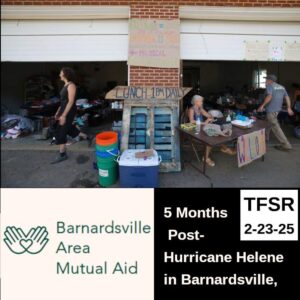
This week we’re sharing recent chat with Jazz and Badger, two residents of Barnardsville, a small village just outside of Asheville, NC. We spoke about the community, the impact of Hurricane Helene, some lessons learned from coordinating among the neighbors and how people are faring now, nearly 5 months out from the storm. You can find their website at MutualAidBarnardsville.com
To hear similar stories from after the storm you can find links to past interviews here. Also mentioned were interviews recorded by Blue Ridge Public Radio: Voices of Helene.
Articles on recovery referenced:
- https://www.bpr.org/bpr-news/2025-01-13/are-fema-rules-to-blame-for-slow-wnc-housing-recovery-heres-what-we-learned
- https://www.newsweek.com/fema-kicking-hurricane-survivors-housing-administrator-responds-2013660
- https://www.bpr.org/bpr-news/2025-02-03/gov-stein-calls-for-1-07-billion-in-state-funding-for-helene-recovery
If you’d like to help out after recent flooding in Eastern Kentucky, there are a few links in our show notes to Hillbillies Helping Hillbillies aka EKY Mutual Aid
Recent Storm Support for EKY, ETN, SWVA + WV
Recent floods in middle Appalachia in the middle of an intense winter cold snap have left many without potable water or other basic needs. ATV donation / loan / operation request to help check on people in hollers, help clear roads, drive supplies: reach out to theferalraccoon (a t) proton (d ot) me OR MutualAidDisasterRelief ( at) gmail (do t) com.
EKY
One place you can look for where to send resources is Eastern KY Mutual Aid, found on Instagram or Facebook under the name Hillbillies Helping Hillbillies. And you can find out more by visiting the website or checking social media for Mutual Aid Disaster Relief. Some of the useful links are here for those unable to use the platforms:
- EKY Mutual Aid Patreon
- Volunteer form if in the region
- EKY Mutual Aid Cashapp: $SoupBeansFriedTaters
- EKY Mutual Aid Paypal: @EKYMutualAid
In Pikeville, KY, there’s a request for food grade 5 gallon for water filtration where municipal water isn’t running or wells are contaminated there’s a request for restaurants to save buckets for water filtration. People interested can contact Cara at 859_533_0349
DROP OFF LOCATION:
Pike Central HS
100 Winners Circle Drive Pikeville, KY 41501
Other EKY sites:
- Appalachian Crisis Aid Fund
- The Y’all Squad TheYallSquad.org/donate
SWVA
- SAMS Lonesome Pine Mutual Aid Paypal: @SAMSVA
- The Care Collective of SW VA Venmo: @carecollectiveofswva
- Cumberland Mountain Mutual Aid
- Paypal: cumberlandmountainmutualaid (a t) gmail (d o t) com
- Venmo: @CMMAID
- CashApp: $CMMUTUALAID
WV
- WVUMC Disaster Response Ministries WVUMC.org/donate
- Bluejay Rising BluejayRising.org/donate
- Spark of Love Foundation
- CashApp: $sparkoflove4thekids
- PayPal: The Spark of Love Foundation
ETN
- Disaster Relief at Work https://www.drawbuckets.org/donate
Continue reading 5 Months After Hurricane Helene in Barnardsville, NC
 First up, Dulce, a member of Companeros Inmigrantes en las Montanas en Accion, or CIMA, a local organizing and advocacy group by and for immigrants in western NC about her experience working for dignity and solidarity in light of the current and past administrations. More on CIMA can be found at