This week, we’re sharing an interview with M.V. Ramana about Nuclear energy, it’s proposal as a clean option for power generation to counter the fossil fuel industry-exacerbated climate crisis, it’s ties to weapons development and other topics.
Next week, we’ll be sharing a chat with two local activists affiliated with Appalachians Against Uranium and their research on weapons production expansion underway in eastern Tennessee.
I’m sure that many people coming out of this holiday season, returning from visiting relatives will wonder: “couldn’t we abolish the capitalist family structure?” We’ve got great news! We’re happy to present this conversation between Scott and Sophie Lewis, author of “Abolish The Family: A Manifesto of Care and Liberation”.
In this episode, Sophie speaks about the book, the ideas and inspirations she’s pulling from, the critique that the family form not only passes property and generationally allows concentrations of it, but simultaneously limits our horizons of care to these small, private and often abusive relationships. Here we also find ideas of Child Liberation, a challenge to the state form and capitalism, and an invitation to imagine beyond what we’ve been taught is the natural nucleus of human relationships in what turns out to be a long lineage of ideas cast back through Black feminisms of the 70’s and beyond.
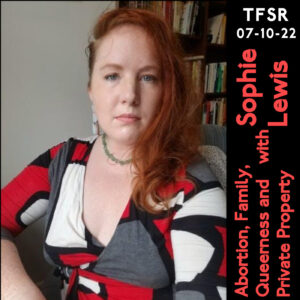
Anyway, there was a lot here and we hope you enjoy. For a related chat, check out Scott’s July 10, 2022 interview with Sophie on the show, and you can find more recordings and essays at her site, LaSophieLle.org and support her freelance writing on her patreon.
This week, Scott and William talk to Sophie Lewis, author of Full Surrogacy Now: Feminism Against Family and the soon-to-be-released Abolish The Family A Manifest for Care and Liberation (out in October, 2022) about the current political moment that is characterized by attacks on trans people and peoples reproductive abilities. They also talk through what creates this moment, where trans people come into the target of State power being weaponized by the far right, as well as the connections among these attacks against LGBT education, access to transition, access to abortion and critical race theory. Also discussed are some limitations of a legalization framework around abortion, as opposed to a decriminalization, the limits of liberalism (particularly liberal feminism), and also the ways that certain strains of feminism contribute to an anti-trans discourse. Finally, there is chat about how to approach people needing support people who need access to healthcare, whether it be transition or abortion, outside of the hands of the state.
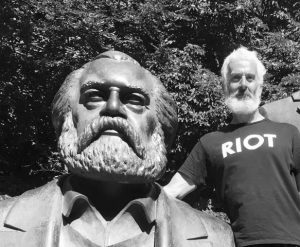
Joshua Clover is the author of seven books including Riot.Strike.Riot (Verso, 2016), which has been translated into six languages. Scott and Joshua talk about proletarian resistance to the capitalist economy through struggles against circulation of commodities and to fix their prices (riots) and struggles against exploitation and to set the price of wages in the workplace (strikes), how these methods are not as indistinguishable as we are told and the future of struggle against capitalism and extraction, for a new communist world.
Joshua also has the forthcoming book Roadrunner coming from Duke University Press. It’s about exactly what you think it’s about (but, if you’re not familiar with or from Boston, or haven’t ever seen a Stop&Shop at midnight from the beltway, it’s about placing one particular song from one particular band within a wide and fascinating context. This’ll be out in September!)
I am always trying to get people to read the poetry of Wendy Trevino and Juliana Spahr, both of whom take riots and insurrections as a main topic. Both of the books linked too are free.
Speaking of riots, people should always read Gwendolyn Brooks, RIOT.
I am always trying to get people to read Red Skin, White Masks by Glen Coulthard, which is a theoretical consideration on Indigenous struggle that eventually arrives at the fact and the logic of land blockades; it was written before Standing Rock.
I mentioned the work of Charmaine Chua on logistics, circulation, and decolonial struggle; here’s one useful essay.
Here is a link to the book I have coming out soon. Here is a link to the Introduction if anyone wants a sample.”