Category Archives: General

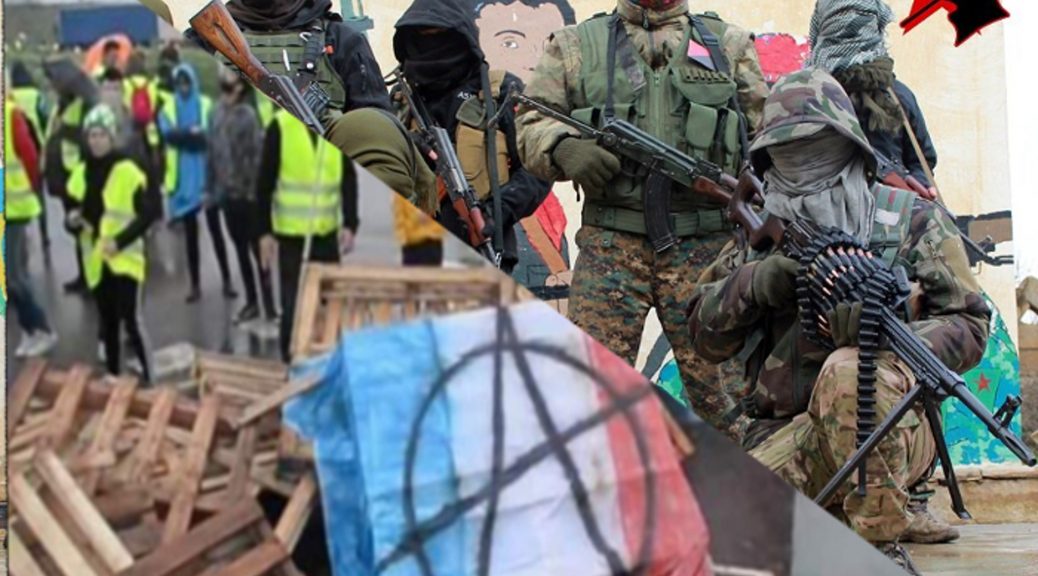
Anarchists In Conflict: Rojava + Yellow Vests

Anarchists In Conflict: Rojava + Yellow Vest Movement

(Sean Swain at [00:06:28], interviews begin at [00:14:05])

Download This Episode

This week on The Final Straw, the episode’s theme is anarchist interventions in struggles around the world. We’ll be sharing audios from comrades in the A-Radio Network, which just had it’s 5th Annual Gathering in Zurich, Switzerland. The A-Radio Network is made up of stations around Europe, plus a smattering in South + North America. We have been a member of the ARN for 4 years now, which over the last year and a half produces the monthly B(A)DNews: Angry Voices From Around The World news podcast in English, made up of contributions by A-Radio member-projects. You can find past episodes at our website.

In lieu of this month’s BADNews, the gathering produced an 8 hour radio show last week and elements of this broadcast. We’ll present here two interviews from that broadcast concerning the struggle for autonomy in the social revolutionary region of Rojava, in northern Syria. The first is with a fighter with the Tekosina Anarsist (Anarchist Struggle, starts at 42:49) and the second with Zaher Baher, a member of the Kurdish Anarchist Forum in London (starts at 57:04). well as one from another an interview conducted a week ago with an anarchist in Paris, France, involved with the Yellow Vest (Gilets jaunes) social movement in France for some updates and perspectives.

But first, we’ll be airing audio from another member of the A-Radio as well as Channel Zero Network projects, Dissident Island Radio from London in the U.K., with an interview about the geopolitics of Rojava and leadership within the Kurdish struggle with a comrade participating in the annual ‘Long March‘ in solidarity with Abdullah Öcalan (starts at 14:05). We apologize for the audio quality. We invite you to note the differences of opinion between the anarchists who’ve witnessed, lived in, or fought for the Rojava Revolution, as somewhere within and between their perspectives I believe lies some of the truth of the complex situation there.

Announcements

Happy Birthday Yona Unega (Oso Blanco)

From occupied Cherokee territory in so-called western North Carolina, we’d like to wish a happy birthday on February 26th to wolf clan Cherokee/Choctaw political prisoner, Oso Blanco or, in Cherokee, Yona Unega. Oso is in for armed robberies, where he expropriated from U.S. banks and sent funds to Zapatistas communities in the Yucatan in Mexico. You can write to Oso to write him a happy birthday by addressing letters to his state name:

Byron Chubbuck
#07909051
USP Victorville
PO BOX 3900
Adelanto, CA 92301

And more info on Yona Unega’s case and efforts can be found at https://freeosoblanco.blogspot.com

If you’re listening to the radio version, please check out our online/podcast version up at our website for another 20 minutes of interviews plus the Sean Swain segment for this week.

Blue Ridge ABC events

Smash Bro's TournamentFriday, March 1st is the first Friday of the month and therefore the Trouble Showing at Firestorm Books and Coffee in Asheville, NC. Episode 18, entitled ACAB (for All Cops Are Bastards) airs at 6:30pm and will be followed by a little over an hour of discussion.

Then, on Sunday March 3rd, as the 1st Sunday of the month, BRABC will hold it’s Political Prisoner letter writing event, again at Firestorm. The event begins at 5pm, letter writing materials including stamps, prisoners names and stories, addresses and help in writing. If you’ve never written someone a letter or someone in prison in particular, no worries. It’s a nice social time. The event runs from 5pm to 7:30pm.

Finally, on Saturday, March 16th, Blue Ridge ABC is holding a double-header at Static Age Records in downtown Asheville. First up, from 3-5pm, a Super Smash Brothers benefit tournament, with vegan cheese-steaks and fries available. Double elimination, best 2 out of 3 rounds. For more info, check out https://www.smashprisonssmashbros.eventbrite.com. Then, from 9pm til late at Static Age, get ready for a lineup Anti-Fascist Metal Benefitof anti-fascist metal including Rat Broth, Arid, and Margaret Killjoy’s project Feminazgul, plus more to be announced.

More on all of these events can be found at brabc.blackblogs.org


. … . ..

Playlist

 . … . ..

Transcription:

TFSR: This week on the final straw radio, this episode’s theme is anarchist interventions in struggles around the world. We’ll be sharing content from the A-Radio network, which just had its fifth annual gathering in Zurich, Switzerland. The A-Radio network is made up of stations and podcasts from around Europe, plus a smattering in South and North America. We’ve been a member of the A radio network for four years now, which over the last year and a half produces the monthly ‘Bad News: Angry Voices From Around the World’ news podcast in english, made up of contributions from A-Radio member projects. You can find past episodes at thefinalstrawradio.noblogs.org searching for the term A-Radio Network.

In lieu of this months Bad News, the gathering produced an eight hour radio show last week and elements end up in this broadcast. We’ll be presenting here two episodes from that broadcast, concerning the struggle for autonomy in the social revolutionary region of Rojava in northern Syria, as well as an interview conducted two weeks ago with an anarchist in Paris, France involved in the yellow vest social movement, for some updates and perspectives on that.

But first, we’ll be airing audio from another member of the A-Radio as well as Channel Zero Network projects, Dissident Island from London and the UK, with a review about the geopolitics of Rojava and leadership with the Kurdish struggle with a comrade participating in the annual ‘Long March’ in solidarity with Abdullah Öcalan. We apologize for the audio quality, and we invite you to notice the differences in opinion between the anarchists who have witnessed, lived or fought for the Rojava Revolution, as somewhere within and between their perspectives, I believe, lies some of the truth of this complex situation there.

Dissident Island Radio: Now in our final piece tonight we discuss the ongoing Kurdish struggle and the campaign to free Abdullah Öcalan.

Hi Kawa, thanks for joining us here on the show tonight, do you want to introduce yourself a bit?

Kawa: Yes well I can say that I’m now in a bus in the direction to Strassbourg for the demonstration that will happen tomorrow in solidarity with the Kurdish movement and that I’m taking part of the international Long March and that several people from more than ten countries from different places around Europe are with me right now in this bus going to, uh,  Strassbourg.

D*I: Cool and the march stated in Luxembourg, there was a kickoff event in Luxembourg last Sunday?

Kawa: Right, exactly. We start in Luxembourg and have been walking since there. And we have been crossing different villages and places around france and meeting the different Kurdish community and different political groups in different places we go.

D*I: How many people on the march, how many people doing the full kind of distance?

Kawa: Yeah in this march from Luxembourg to Strassbourg we start like around maybe 60-70 people but now we are much more because there was a several marches, there was one started in Germany but German police stopped them and like attacked them and forbid them to continue the demonstration after two days that they were walking. So they decide to stop their march in Germany and join the international march so now we have this, like the international march with like 60-70 people with also this also this other youth march with I dunno, you call it more like atypical that are together. There are  also another march that are coming from Switzerland there is also a lot of people that have come to buses for demonstration tomorrow in Stassbourg.

D*I: And this kind of response from local people on the route of the march, what kind of response have you received?

Kawa: Well, uh, especially the Kurdish people is welcoming us, like really happy, really motivated to see so many people in solidarity with the Kurdish people, with the Kurdish struggle because we are also demanding the freedom for Abdullah Öcalan because in fact today 15 of February is 20 years since he was arrested and put in jail, in isolation, and that’s why we are asking us for the freedom of Abdullah Öcalan.

D*I: Part of the demand of the march is petitioning the EU to put pressure on Turkey to release Öcalan.

Kawa: Yes, exactly. Um, that’s one of the points and somehow that’s why we’re going to Strassbourg. The European Council is there and also the building of the committee for prevention of torture. Because this is, Öcalan is in complete isolation, they are not allowing him to the lawyers and there are several questions about how is his health situation. The committee for prevention of torture make a short visit one year ago, something like this and they just release a note saying he was alive and he was okay. They never said anything if he was under torture or not, and we don’t know anything about his health situation and we are asking at least if his lawyers can see him, because we don’t know anything about him, he’s in complete isolation for now, today, 20 years.

D*I: And what is the European Union’s position on that, because in the mainstream news we hear a lot about the US, and Turkey, and Russia and Iran, and the roles they are playing in what’s going on in Syria in the moment.  But there’s a lot less information about the EU’s position, and what you just said about how the German police stopped the German part of the march from marching altogether, that’s not really a good sign.

Kawa: No, it’s not really a good sign. And we can see how somehow for the European Union, we can see how they [?] with Turkey because somehow Turkey is a NATO country and Europe and the NATO and the US of course and all the countries of NATO keep Turkey close to them because they like being able to do the things that the western countries cannot do in the middle east, that Europe cannot do – Turkey it’s there, and being member of NATO it’s alliance with western powers in middle east. But we can see in the last years [?] Turkey’s turning more close to Russia and to Iran and Europe is trying to also keep Turkey together.

We have also the deal for refugees when Turkey receives at the beginning three thousand millions of Euros and the material of supporting refugees but at the end there is no keeping track of this money and we can see how this money it’s ending in building military bases or like the wall that Turkey build in 2016, a wall that it’s more than 600 km between the border of Turkey and Syria for control the Kurdish people to not cross from Turkey to Syria. And we can see how in Europe the ban on PKK it’s only forcing Kurdish people to have more difficulties to work in solidarity since we can see how Abdullah Öcalan has been the president of the PKK, the Kurdish Workers Party, and this ban accusing the PKK of terrorist organization is making the things much more difficult. But at the same time, in fact a few months ago there was an initiative in the European Parliament to remove the ban on PKK and at the end at the last sentence on the European Parliament that yes, it’s true, that PKK is never making any kind of terrorist attack or any kind of terrorist actually in Europe. So it’s right that actually we have no reasons for keep them on the terrorist list. But anyway, even saying that, the PKK is still on the terrorist list of the European Union.

D*I: And the whole situation is very confusing for someone on the outside to fully understand because the PKK is not actually in Syria or in Turkey but Öcalan is arrested in Turkey and the US were supporting the YPG/YPJ, the Syrian defense forces, to defeat ISIL in Syria. And they recently announced less than two months ago that they were eventually going to remove their backing and withdraw from Syria and this had caused quite a lot of concern about Turkey is going to do in that northwestern region of Rojava, so do you want to say a bit about what people’s response there has been?

Kawa: Yeah, it’s true there can be a bit complicated because we have a lot of different actors in the same conflict. First for clarify the situation it’s important to understand that when we talk that when we talk about Kurdistan and the Kurdish people, we are talking about, uh, at one time about Turkey but at the same time about Syria, about Iran, about Iraq, and of course over one million of Kurdish people that are in Germany and in other countries all around the world. It’s a lot of actors at the same time, so when we see the situation in Rojava right now we can see that since 2012 there is this social revolution that is happened there where there Kurdish people in the north of Syria start to manage society outside the frame of nation-state.

So it’s interesting to see how the Kurdish liberation movement was born with a frame of national liberation movement in the frame of building a Kurdish state but the beginning of the 2000s they reformulate the political project and they make this step, uh, this step that they call Democratic Confederalist pushing for a society that is based on values of the women’s liberation, ecology, and direct democracy without a state. So we can see how since the autonomy of Rojava in 2012 they are building this society based on these ideas, we can see how in Turkey the Kurdish people in the southeast of Turkey they were also building this autonomy, a system based on Democratic Confederalist, but the Turkish state completely attacked them and in 2015 they start a lot of military operations destroying a lot of cities. Cities like Nusaybin were completely destroyed by the Turkish army. It’s important to see that now the army wants to enter the north of Syria but it’s not something new, like the war from the Turkish state against the Kurdish people have been for a lot of years. In the 90’s there was a huge war.

Now Turkey wants to attack the Kurds in Syria but of course Syria means to cross a border so it means that still Turkey is a county that’s part of NATO. And of course like Russia that’s a country that has been supporting more the government of Bashar al-Assad in Syria and can put objections if Turkey wants to enter Syria, so that’s why there have been so many objections and diplomatic interactions with so many different actors and Turkey’s getting closer and closer to Russia in order to have green light from Russia in order to allow them to attack the Kurds in northern Syria and Rojava. So we can see since how the announcement of Donald Trump in December 15th that they withdraw from Syria they start to withdraw the diplomatic body of US in Syria, some soldiers are still remainin there. And these has been presented for Erdogan as an example of how Donald Trump is ready to withdraw from Syria for allowing Turkey to enter there. After that there was some contradiction messages, it’s not clear, if the US will allow Turkey to fully enter the north of Syria with bombs and airplanes and drones like they did in Afrin one year ago. Or if they will stop Turkey to use planes, though it’s a discussion ongoing you can see how Turkey is now also talking with Iran, Russia in these international meetings that they are having after the process of Astana. And it’s a really complicated situation  with a lot of different actors that it’s sometimes different to follow maybe.

D*I: And how does it feel to be a part of that actually? Because it’s one thing to attempt to build an alternative community structure that’s really quite large – the region that it’s covering is not insignificant, there’s many many small communes that make up this region of north Syria – so how does it feel to be a part of that, to try and build that, and at the same time be so incredibly vulnerable to all of these international geopolitical movements over which you have absolutely no influence, no control, no ability, you’re just completely vulnerable in that situation?

Kawa: Yeah, and this vulnerability, it’s really interesting point though because we can see the hegemony of the model of the nation-state succeed in taking over the world. And since the Kurdish movement is northeast Syria they are developing a society outside the frame of nation-states, the threat of nation-states is always there. And we can especially how Daesh, the ISIS, the Islamic State start try to create their own system also outside the frame and in opposition to that, and of course the Kurdish people were in the need to defend themselves. And that’s what allow them to also allow them to take so much territory because the threat of the Islamic State and the terror society that they were implementing on to all the people were a direct war and somehow the Kurds were saying “We’re defending ourselves and we are fighting also, not fighting Daesh because we want to fight them. It’s just because this is a threat for humanity, this is a pure fascist system. So it’s an antifascist struggle and we need to defeat them.”

And since all this war against the islamic state, a lot of different territories that have been liberated from the caliphate have been joining to the Autonomous Administration that the Kurds started in the north. When I went to Rojava and I had the opportunity to view for one year how this society’s working for one year interesting to see how they are succeeding in developing a system outside the frame of the nation-state with the women’s liberation as a main point of this social transformation but uh, of course, all the states that are surrounding this territory don’t recognize Rojava as something that they can fear[?}. There is a problem that when the situation of war came, it’s really difficult to defend yourself from an army like Turkey, that it’s a member of NATO with warplanes, drones, like full technology of NATO. And of course, no one will ever sell of give anti-aircraft weapons to Rojava because they are not an actor that can be recognized as a state and they don’t want to be so, uh, somehow it’s a really complicated situation and we can see how all these structure of capitalism and the connection of capitalism with, uh, the weapon industry it’s creating a system which is not allowing other projects outside the frame of nation-state to exist because there is this military frontier that you can’t go and we saw it in Afrin one year ago when was the division of Afrin and it was really clear that the military technology was creating a border that you can’t overcome.

D*I: And I think that something that Rojava has shown us over the past year is just how difficult the creation of an alternative way of structuring society really is. I mean we had some of this experience with seeing what was going on in Latin America some years ago but I guess Rojava is the most recent example of this, and it’s been really impressive to see people actually putting their own lives on the line and going out and fighting the powers that are trying to stop them from existing. Has that the willingness to fight and the demands that fighting has made on that society, like has it had an impact on the communes and the way that they’re organized or has it has any effect in that way?

Kawa: Of course it have effect but I think it’s important to understand the Kurdish people they are used to live outside the frame of nation-state. We can see how in a lot of the structures in the system of communes that they are developing, it may sound like something new for us but for them it’s nothing that it’s completely new. They have been living in this system from, like, forever. So it’s important to see that this process that they are doing it’s without states because they have the knowledge of how the state and it’s important to see how at some point the communes are able to exist now because Daesh has been defeated so a lot of places before the communes was the war. And the war was the thing that was more necessary, so we can see how not only the Kurdish people from Rojava but the Kurdish people from all around Kurdistan came to the northern Syria to fight against the Islamic state because they know that the Kurds are their brothers and their sisters and every step and every city that was liberated, the Kurdish people was able to go back to their cities and then they realized that they were able to win the war so they were able to bring this system of Democratic Confederalist to the maximum example. So before they were already somehow living in a communal way, building up communes, but the point is that now the Syrian state left because they were not able to fight the Islamic State and now they are self-managing all the parts of society. They succeed in creating a self-managed system of justice, a self-managed system of economy based on cooperatives. So they are in a full way of managing all the aspects of life, all the aspects of society outside the frame of nation-state. And of course for the communes it has a huge impact, this war, as they know they can exist and they have the life that they have today because the war that they did and they always remember all the people that has been fighting and all the people that has died.

D*I: And what was it like to be an international there, what does it feel like to go there as an international person?

Kawa: Well, it’s a really interesting experience. We can see how a lot of people already went there as internationalists, especially since 2014-15 a lot of people started to join more in the military side, in the fight against the Islamic State. But since the war against Islamic State was able to take more land and to liberate more territories this society system that they are building is attracting more and more the attention of internationals. So I was one of these internationals that went there in the civilian side, I was traveling there for see the society, for see what means to build the revolution, what means to build a society without a state, what means to build this system of Democratic Confederalism that they are building. And for me I can say that I was really impressed for see a lot of things that seems impossible to be, but at the same time it’s a really hard situation so we’re just fighting a war that means a lot of people and a lot of resources needs to focus on this war and it’s really important to see how this situation there it’s really hard. But what they are building it’s something that can bring a lot of inspiration in order to develop new ways of thinking and understanding the society that can allow the humanity to think beyond the nation-state, beyond capitalism, beyond patriarchy and try to bring new ideas and new hopes to the revolutionary movements all around the world. Like, we saw in the ‘90s with the Zapatistas movement that was giving inspiration to a lot of movements, a lot of revolutionary organizations. We can see how this is happening in Rojava and to be able to be there and to see not only the nice parts and all the beautiful things that you can see but also the difficulties, the sacrifices, and all the problems that they are facing. It’s giving perspective for how we can also start to develop a revolutionary movements all around the world in our countries because somehow if we go there as internationalists it’s not just for going there to see the situation in Rojava, we are also going there for learn, for understand their movement, how they succeed on doing this revolution and then bringing these ideas back home and being able to develop an internationalist movement. We can develop a revolution all around the world.

For me also I’m from Catalonia, so the impact of the international brigades that came in Spain in 1936 at least more than 50,000 peoples from different countries fighting fascism together, um, it had a huge impact. So now we can see how fascism is affecting Rojava, is attacking the people in northern Syria. So it’s important also to have this in mind and to see that internationalist is not something that is in the books of history, it’s something that is it’s happening right now. So we can see internationalists from all around the world are going there to learn, to support and for fight to defend this revolution.

D*I: You said that the march that you’re doing right now is calling for the EU to put pressure on Turkey to release Öcalan. So I have a slightly perhaps controversial question. How important is Öcalan to the movement, is it necessary that there is a leader in the movement or is it more of a kind of solidarity support for an arrested comrade? What’s the dynamic there?

Kawa: It’s a good question, and especially for anarchist people who have been interested in the stateless society that they are building it’s sometimes a bit contradictory, no? This focus on the leader. But it’s important to understand when Abdullah Öcalan started this movement he was always trying to give perspectives on developing revolutionary line in this movement and of course he has been respected for all the perspective and all the ideological background. He’s a person that was writing a lot of books and was giving a lot of political perspectives because he had been studying a lot of different revolutions, different movements. And the point is that he did not it alone, so he was always pushing for education, for studying, for learning together. So the threat of catching him and putting him in jail when Turkey was making the trial they condemn him to seven death penalties but somehow Europe and the western powers was putting pressure for make the Turkey cannot execute him and they have been keeping him in complete isolation in this jail so it’s important to see also how he’s in jail and he’s not able to push for the revolutionary struggle in a practical way, he has been using this time to read a lot and to develop this frame of Democratic Confederalism. So it’s important to see Öcalan not only as the political or military leader but also as one that brings the ideological perspectives, all the ideas of Democratic Confederalism that are summarized in this Manifesto for a Democratic Civilization that is this five books that he wrote from prison, are the books that are presenting this model of Democratic Confederalist that somehow we can see that is a synthesis of all the things that he was reading and all the things also that he was experiencing when he was in the guerrilla movement, in this revolutionary movements. So when read these ideas of Democratic Confederalist we can see influence from all this Marxist background that this movement have, but of course also we can see a lot of influences from different authors. He’s even quoting Bakunin in some books, Sylvia Federici so a lot of different thinkers that are giving perspectives so he’s the one who made the synthesis and for this the Kurdish people it’s really know how he put a lot of effort on giving a perspective for a solution not only for Kurdistan but for middle east and all the world, making this synthesis of other revolutionary movements.

And for this it’s also important to understand the reality in Middle East. Like, middle east has been a place where the oppression and all the attacks of the colonialism has been really strong and we can see how one hundred years ago after the first world war the western powers went there and started to build the nation-states and the dynamics on middle east are not fitting with this system of nation-state, and they are keeping with the system of tribes and different clans so for them this point of the leadership is something that’s really rooted in the society. That of course, from a western view can be difficult to understand and to give meaning. And I think that even for me, before to go there, it was sometimes difficult to understand. But there you can see how this kind of leadership is bringing unity in order to face the enemy so somehow also the point that he’s in isolation as a political prisoner it’s also increasing the solidarity for all the people but it’s not only him, there are thousands of Kurdish peoples in jails, especially in Turkey, that they are also developing a huge movement of resistance in jails, an anti-jail movement. But of course he as the leader of these revolutionary movement have a special importance for the Kurdish people.

D*I: So there was a very interesting and really quite brutal critique a few years ago released by the anarchist federation, of Öcalan, comparing him to Gadaffi and Gadaffi’s pre-dictatorship politics, and then what actually transpired. And I wondered if recognizing kind of the brutality of the geopolitical dynamics that are going on with all of these nation-states fighting for different reasons over this territory, and then also within the wider region of Kurdistan, how many different smaller groups exist that are all toeing not exactly the same line, which is positive in some way and also the ability of a leader to unite these people. Having been there, do you feel that there is structural resilience within what you’ve seen, within the structure of the communes against a kind of re-hash of a kind of Gadaffi situation, of a leader coming in and then eventually capitulating under these geopolitical dynamics and having to force a dictatorship through, like is there a resilience to that happening.

Kawa: Yes, for sure, the implementation of Democratic Confederalism it’s really interesting to see how they are pushing a lot for the development of the communes, how they are really creating systems for avoid any kind of centralization of powers. For example they are building different committees for take care of different things, and for example in Rojava there is one big city, Qamişlo, somehow it’s the biggest city in Rojava and they are putting a lot of effort toward these committees, like for culture or economy and to avoid to put the central place of these kind of institutions in Qamişlo and to decentralize completely them. Somehow they have a huge analysis on the society and the nation-state and what they are understanding is that nation-state it’s the main power of centralization, of homogenization, of control. So in order to avoid a dictatorship, in order to avoid a fascism to happen, the most important thing is to decentralize the power, to decentralize the society for allow anyone to be autonomous and in the commune system it’s exactly this, they are trying to give power to every commune that they can solve their problems but they understand that the situation it’s complicated, so that somehow it’s important that still keeping some structures, and some institutions where these communes can go if they face problems. So the idea is that the commune is able to solve all their problems and all their needs in the life, but in case they are facing problems that they cannot, they are making coordinations in a district level, in a province level, in order to be able to support all these communes.

So we can see how is this system of power is bottom up and it’s important to see that some kind of central institutions have this mentality of like, serving the people, you know like the Zapatistas were saying, a place where the people rule and the government obeys. So they are creating central institutions because of the needs of some dealing with some things, especially with the military situation, with the war. But they are trying to reinforce these experiences of the direct democracy the communes are giving to the people. But of course you cannot change from one system to another in one night, it needs time, it means that the people needs what means direct democracy, what means to manage their own life in all the levels. So for this they are seeing the history also as a process, so they want to push for this society, for direct democracy but they know that managing a society of like four million people, five million people that are living now in Rojava it’s not something easy. So they are trying to develop different institutions that ensure that this revolution is able to defend itself because this is one of the main points of this movement, self defense. They understand how all the living beings need to be able to defend themself in order to survive. So they are trying to push also for all the communities to have their own self-defense system. And I think this is the main structure you can have in order to avoid fascism, when you have a centralization of power to control the others, if you decentralize the ability of self defense, this cannot happen because any kind of commune can see that ‘hey, this is not going in the line that we want with the society so we cannot allow this to control other things.’ So this point of develop self defense in any commune, I think it’s one of the best ways to ensure that dictatorship will not be ever possible there.

D*I: Thank you very much Kawa for taking the time to discuss with us these crazy complexities of an actual real-world attempt to live without a state. So if people want to support the struggle in general, how can they get in touch, where should they go what’s the points of contact and information?

Kawa: There is a website, freedomforÖcalan.longmarch.com.

D*I: Cool, thank you very much and I hope it’s successful

Kawa: It has been a pleasure, thank you a lot for this time and I’ve been happy to talk with you.

TFSR: You’re listening the Final Straw Radio and I’m Bursts O’Goodness.

And I’m William Goodenough.

You just heard Dissident Island Radio’s interview about Kurdish solidarity and the struggle in Rojava. Next up is an interview by comrades from Črna Luknja on Radio Student in Ljubljana, Slovenia with an anarchist fighter in the militia Anarchist Stuggle, a signatory to the International Freedom Battalion.

A-Radio Network Announcers: We’re back in the studio in Turic, so it’s been quite a start, this fifth radio live anarchist broadcast from the gathering of different anarchist and antiauthoritarian radios. We know that in capitalist society class struggle is never far away so battlefields are opening up everywhere, so we will have also on today’s show some reports from France about Gilet Jaunes movement, we will hear from London by our correspondents from Dissident Island and we begin this section of the show with that other ever important struggle that has lightened up all sort of revolutionary imagination of many around the world and of course, Rojava. Territory in Syria that wasn’t widely known a couple of years ago but due to the actions of different political and even military forces and due to the revolutionary efforts of movements there, Rojava somehow became for us in Europe something, a recognizable entity for some fantasy, for others unfulfilled expectation, etc etc. So we will try to also add some more information, some analysis, some reflection to the understanding of ongoing struggles in and around Rojava so for today we will hear two pieces, two interviews.

So first one is an interview conducted by Črna Luknja with a fighter directly from Rojava. So the interview is a couple of weeks old, it deals with the latest geopolitical changes on the terrain that are connected with the recent announcement of the US president that USA would withdraw its military forces and then the other interview that will follow the first is also lets say, tries to critically engage with the common narratives around Rojava Revolution. So it will be an interview with a comrade from Kurdish Anarchist Forum and we should also add a technical remark that the interview was originally conducted in a language other than english, but for this purpose it was translated and then re-enacted. So, yeah. The content of the interview is true to the original even if the voices that you will hear do not belong to the people that were interviewed. So this Rojava slot will take maybe the next 25 minutes of the broadcast, so stay tuned, and inform yourself about the struggles and get ready to open up some battlefields also closer to home.

Črna Luknja: Rojava from Tekoşina Anarşişt, Anarchist Struggle collective that was established in autumn 2017 and just recently announced its military presence in Rojava. They are also participating in the International Freedom Battalion. For the beginning can you present yourself, anarchist collective and International Freedom Battalion.

Tekoşina Anarşişt Member: We’ve been in Rojava – I mean a lot of us have been in Rojava for a longer duration, a long period of time – but our collective was established in autumn of 2017 and we didn’t really want to become like a public, propaganda oriented collective. That was never our interest, we were more focused on doing, you know, material work in terms of going to the front and also engaging with the movement here. We decided to go public simply because of the impending Turkish threat, so everyone right now is kind of, you know, attempting to rally their base and our base is obviously anarchists. So we decided to go public because of that, as well as to some extent we were forced to go public because of the IBF formation, because we are a signing member of the IFB. And I don’t want to speak very much about IFB because they have not made their announcement yet and we prematurely mentioned their formation and we’ve received criticism for this. I don’t want to speak about the IFB very much until the formation has made itself public.

ČL: So it would be very interesting to get some news from within Rojava, what is current political situation there.

TA: I guess I’ll touch a little bit on the Turkey situation. Information here is difficult to come by, to some extent, so a lot of the stuff that we are made aware of actually comes from the internet as well, just following Syria Livemap and stuff like that. Obviously, we are, there has been two particular situations where based upon Erdogan’s threats that we believe that there was gonna be some sort of massive invasion of Rojava, so we’re obviously getting prepared for that, if that is a reality, if that’s going to happen. Things have a little bit seemed to kind of have calmed down but obviously that is a very tangible reality and something that could happen at any given moment so that we need to be prepared for.

ČL: Maybe you can predict some possible scenarios for the future.

TA: Yeah, I mean obviously Rojava and the PYD have been in negotiations with the regime for quite some time now, so hopefully they’re able to come to some sort of agreement. And I say ‘hopefully’ – obviously as anarchists we are not supportive of the Assad regime, we’re not supportive of any regime or any state, etc. – but in terms of survival it’s kind of the only way, as far as I see it, or we see it,  in terms of being able to maintain some element of the revolution here. And in terms of scenarios of outcomes, if there is no deal with the regime I think it’ll be a very difficult situation for them to be in simply because not only will they then have to deal with Turkey but they’ll have to deal with attacks from the regime. So it’s a kind of indefensible position to be in if they don’t cut some sort of deal. I don’t want to say any sort of my predictions about the future of Rojava or anything like that. After Trump decided that he’s just gonna pull out of Syria, just, you know, I’ve kind of given up on making predictions because we’re dealing with irrational actors here. You know Erdogan is not necessarily a rational actor and Trump is definitely not a rational actor so it’s very difficult to make accurate predictions, what’s going to transpire here.

ČL: I don’t know how much you are able to be in contact with the society, how is in general the situation, how is living for the population there?

TA: The good thing is that we are able to have contact with people from like the general population, in fact we have a good friend of ours who is Assyrian, he speaks perfect English and he learned it primarily through American hip-hip which is a kind of interesting thing. And he’s given us a little but of light into more of the civilian population here. I mean, a lot of people are obviously incredibly supportive of like the YPG, the QSD [SDF], YPJ, etc. But a lot of people, especially people who are not Kurdish, are not aware of exactly what’s happening, you know, because it’s a very complicated situation. They’ve had al-Nusra come through, they’ve had ISIS come through, they’ve had different groups and a lot of people aren’t actually incredibly familiar with what you know, YPG, YPJ, the revolution, etc. is but they view it very favorably for sure. I mean, when you have something like ISIS, like al-Nusra or TFSA or something like that, you know obviously people are going to prefer the alternatives. Personally I think that there is a lot of education and communication that needs to happen with the population here simply because they don’t know what is going on, or why internationals are here. They kind of want to go back to their normal life, they don’t want this war to be happening. They really just want security.

ČL: How can people support your struggle and where can they find more information?

TA: So in terms of supporting the struggle at some point we’ll figure out how to properly how to get donations and figure that all out online. So that will be posted. We also very much need medical supplies, that’s one of the projects that we’re trying to work on right now is having competent combat medics. It’s something that’s very very needed here and the medical supplies are quite lacking so, you know, if people can donate things like chest seals, tourniquets, hemistatic dressing, a lot of these kinds of things are very much needed. In terms of finding more information, we’re really kind of starting to be public as I had said previously. So things are kind of going to come out over time, so I guess if you want to follow our twitter that’s the primary place that we will be posting everything. We’ve posted our involvement in Der ez-Zour, today we’ll post about the anniversary of Afrin and the actions that our people took in that. So, yeah, I guess follow our twitter for more information.

ČL: Okay, do you want to add something maybe?

TA: Obviously in Afrin there is consistently examples of people being kidnapped, people being sexually assaulted, people being murdered by the TFSA. There is ethnic cleansing happening in Afrin and if this continues, if the Turkish army is allowed to come in to Rojava the exact same thing is going to be happening. We have to dispel this narrative that, like, Turkey is fighting ISIS. Turkey has never fought ISIS, they never considered ISIS to be a threat when they were on their border. So with the Americans pulling out, with the defeat of ISIS, etc, is the trying time for Rojava. As I stated earlier, we cannot let what happened in Afrin happen to the rest of Rojava. The people in Rojava are living a decent life, a good life, and a safe life, comparatively. So I guess in summation what I want to say is that we need to be supporting Rojava right now, we need to be supporting the people of Rojava. We cannot let this just drift out of the 24-hour news cycle as some tragedy that’s happening somewhere else in the world that doesn’t effect us. This is an incredibly important thing and the Rojava project has provided people with a good life, with a safe life, within the Syrian civil war. So we cannot let them be betrayed, we cannot turn our backs on the Kurds, we cannot turn our backs on the Arabs here, we cannot turn our backs on the Assyrians, the Armenians, etc. We need to stand up for Rojava now.

TFSR: You’re listening the Final Straw Radio and I’m Bursts O’Goodness.

And I’m William Goodenuff.

You just heard Črna Luknja’s interview with an anarchist fighter with the militia Anarchist Struggle, which is a signatory to the International Freedom Battalion, just back from Rojava. Next up we’ll hear from the Kurdistan Anarchist Forum with Zahir Bahir, an Iraqi Kurd living in London.

ARN: Dear [?] thank you for your time, would you shortly introduce yourself. Where are your from, where do you live and what is your connection to the Rojava revolution?

Zahir Bahir: I am Zahir Bahir, originally from Iraq. I am part of Kurdistan Anarchist Forum and part different anarchist groups in London, among others Rebel City. I am also engaged in writing and translation, and as I am retired I am now a full-time activist.

ARN: Let us talk about Rojava. When have you last been there and what was your general impression?

ZB: Well, in respect to Rojava, basically I am part of the Kurdistan Anarchist Forum. We believe in building local groups and changing the society from the bottom and not from the top. At the time I was really excited, I had a close friend who worked at the PKK media and he interviewed me in 2013 for one and a half hours about the local groups. Then they interviewed me again in Brussels and we arranged a journey afterwards to Rojava. I went in May 2014 with a friend of mine. As I was the first one, they were very concerned that the news were spread. I had all the freedom to speak and see whomever I wanted. I was allowed to do whatever I wanted. I went to all the meetings, to the communes, etc. I met the top of the people of the PYD and the movement for a democratic society and also from the bottom. I also went to events then. When I came back I wrote a big report in English and Kurdish. However, when I came back the anarchist book fair took place and the comrades organized a meeting at the anarchist and socialist movement. In 2016, I wanted to go back to Rojava to feel the difference between 2014 and 2016 with a French comrade. We tried to organize the border crossing but there was a blockade by the KDP of Barzani. In the end we had to come back. Last year I went back to Kurdistan for one and a half months but I refused to go to Rojava, as then I was supposed to follow the plan of the authorities, and to be honest at the moment it is very difficult to write news about Rojava. Many people went and came back, but they usually went as academics or as a delegation and they usually stay a week or a bit more, and whatever they see was organized for them. They don’t really see or talk to the ordinary people. There are exceptions, but only a few.

ARN: What can you tell us about the political situation now?

ZB: It is very complex and it can change week by week. There are so many forces there, which makes it difficult to have a proper analysis. But one thing is very clear: when I was there, the situation is completely different from now. At the time, there were three powers: the movement for a democratic society, the self-administration, and the PYD. There was a balance between them. Today, the PYD is the dominant actor. At the time, the YPJ was a voluntary force. It is very difficult to properly analyze the development, because I wasn’t there all the time. What I saw so far is that many people don’t realize what would be there to criticize. However, a few things are clear. At least we can say some things about how Rojava is changing. There was a change in voluntary forces or forces that belong to the community. Now, they are a PYD force and are not any more a defender but became an attacker. All this actually happened because of the fight against ISIS. When they attacked Kobani, there was a good moment for the US to get involved in order to control the movement. The best way was to get involved in Kobani side by side with the PYD and YPG. By the strategic change from a defense to an offensive force, they, the PYD and the YPG, needed more weapons, more tanks and more hospitals, more food, more clothes, a lot of things. That’s why a guerrilla force or any movement which has an army cannot do much until they are supported by an original or international power if they are acting offensively. YPG completely became dependent on the US, which tried to increase its influence.

ARN: You have published many articles about the developments in Rojava. What are your most important points about the situation on the ground?

ZB: The situation is continuously changing. What I thought last year was that there was time to resolve the Kurdish issue in the region. There was no guarantee if Assad is winning the battle and if he’ll negotiate or or if he’ll attack. I said if Assad is defeated in Idlib, then the Turkish state will overrun the Kurdish people. However, US and Trump don’t want their power and forces staying there and of course it is important to talk about the interests of the Turkish state and Erdogan. There is no way for any state to support the Kurdish people in expense of their relationship to Turkey. This is one thing. The second thing is one with which a vast majority of Kurdish intellectuals disagree with me, but I can always say that Erdogan is a very clever political that knows how to play. He plays with Russia, with ISIS and with the KRG. He even managed to involve the PKK in a peace process, but now the situation in Rojava and Bakur is getting worse. At the moment there is heavy fighting between the last ISIS groups and the Syrian Democratic forces in Dier ez-Zor. For me it was important that PYD would not get involved so much in the fight against ISIS. This wasn’t a Kurdish war due to many reasons. One of them is that Turkey was exporting his own interior crisis into Northern Syria. This was one reason. Another important thing to talk about is the embargo. Democratic Confederalism is a big task for many, many people. Not only for cadre or PYD or a small minority. In order to achieve that we need an enormous revolution, in education, economic, ecological and other spheres. So ignoring the cultural and political revolution was and is a threat to successful societal change. This is also connected with the embargo. As soon as the money starts to flow and if the sanctions were lifted, this will influence the situation and is a threat to solidarity. If there wouldn’t have been sanctions, Rojava could have been defeated a long time ago.

ARN: One of your main arguments is the gap between the theory of Democratic Confederalism and it’s practical outcome in northern Syria. Could you say a few words about that?

ZB: In my article ‘Confederalism,’ I argue that Bookchin and Öcalan don’t have many differences in their definition of Confederalism. They’re only minor differences. Basically, Bookchin extends his idea to feminism, but Öcalan goes beyond that and extends it to a feminist movement. In addition, Bookchin never believed that a political party can achieve Democratic Confederallism by itself, but in Rojava at the moment it is mainly the PYD that is trying to install and achieve Democratic Confederalism. Bookchin believed in decentralization, and according to what I know, and according to people who went to Rojava it is not exactly Democratic Confederalism that is happening there, as it is mainly executed and organized by political parties. If you give power to political parties to the PYD, you give it to an organization with hierarchy. None of their decisions like cooperating with the US or negotiations with the Kurdish opposition were based on debate with people, but based on decisions made by a tiny minority within the PYD and probably in accordance with PKK cadres. This kind of things, if you look at the connection to the US and the hierarchical organization and the focus on fighting, this is done on the expenses of the commune and the communal organization. This is the opposite direction of Democratic Confederalism. I think PYD and PKK, both of them are somehow counteracting Öcalan’s ideas. His ideas are very clear when it comes to Democratic Confederalism. As many people attack us, we will defend ourselves but we will not attack.

ARN:Nonetheless, there is some sort of emancipation happening. Where do you see the most emancipatory elements within the current development?

ZB: Before I come to the positive point, I’d to point out that if they get defeated it will take a long time to emerge again. In my opinion, this will leave a very bad picture for the people. In the end this will cause a lot of problems and the idea of Democratic Confederalism and the movement as such will be damaged. Regardless of what happened, the movement in general is good. They are supporting the building and emergence of local groups. This is what we are trying to do in Başur, and what is at the core of anarchist ideas. That is one thing. Another thing is the empowerment of individuals. The third thing is the emergence of the women’s movement. The women’s issues were, and are promoted. It took quite a lot in order to develop and support the women’s role. If you are comparing KRG and Rojava, in the KRG women’s issues have women in the past 27 years rather than decreased. Men are in power. When it comes to Rojava, there is a fourth positive point: the ecological issue. It’s important and a direct reference to Öcalan. They have done very little work to ecology, but in fact even if there is only information spread, it’s important. We cannot work towards an ecological society if we are in war. But they still did it and that’s impressive. The fifth positive point is that they make the people live together. Muslims, Christians, Yezidis, etc. That was a big step because still many people at many places are fighting each other based on ethnics, religion and other identitarian reasons. In Rojava, they seperated religion from the power. They made religion a religion s personal issue, and separated from the political area. They don’t force people not to have a religion, but created another way of decision making in this regard.

ARN: What’s your point of view about Democratic Confederalism from an anarchist perspective?

ZB: It’s a big issue, basically. I don’t think that anybody’s definition’s as good as Bookchin’s. I completely agree with Bookchin. I think there are many important things within his concept. One of them is the argument against the nation-state. It’s not only for the working class, but it’s for all the people. Everyone is building up the confederal society. In Bookchin’s eyes, we have to democratize the municipality and regard the municipality as the alternative to the nation-state. He calls this alternative ‘libertarian municipalism’ and regards it as the possibility to achieve a socialist society. In this regard, Öcalan and Bookchin agree with one difference. Bookchin called it ‘libertarian municipals’ and Öcalan called the units ‘people’s houses’. People’s houses are an assembly of the people, these assemblies contain representatives of the groups. In practice, people’s houses are representing local groups. But in the case of Rojava, it seems that people that are on top of the People’s Houses are always the same ones. Bookchin wants everyone to get involved, and everyone to be entitled to get involved, even though he did not believe in consensus within big groups. But he never believed in a leader. He constructed a concept where people can be replaced at any time. For Bookchin, everything has to rotate and people have to change in order to prevent hierarchy and power structures. And I just want to add something, I think that in Rojava it seems to me now that putting decisions into practice is made by the same body that is taken the decision. But it should never be one body, the decision maker and the decision implementor. A decision should always be made by the vast majority of people. In this regard, Bookchin was very clear about Confederalism. What he said was that Confederalism was only administrative. The members of assemblies need to be empowered to participate in direct action and direct democracy. Members of higher bodies should be strictly mandated to be in an assembly or in a group, they should only be chosen to administrate and coordinate the politics that have been shaped by the assembly itself. It’s never ever thought to be a fixed system of representation.

ARN: You called for critical solidarity. What do you mean exactly by that, especially regarding the current threats for the people and the federation?

ZB: Well, in my opinion anarchists do not believe that anything is perfect. That is the beauty of anarchism; even any idea from an anarchist movement should be regarded critically. Even anarchist ideas should be regarded with critical solidarity. I wrote an article about why we anarchists are divided about Rojava, and in fact anarchists are divided. Some regard Rojava as the project of PKK. They reject it as they believe PKK and Öcalan didn’t change. On the other side there are people just supporting it without criticizing, and this is wrong. There is movement, no group that should not be criticized. Criticism is at the core of anarchist actions and ideas. If you isolate criticism from anarchism, you isolate anarchism from a core characteristic. The third part are people like me, supporting Rojava critically. If we support it we can see what’s going on and wrong with the movement and how we can or want to tackle the problem. It cannot be good to only criticize Rojava. I believe that every movement has good and bad things. We need to promote the good, and reject the bad. Referring to the positive points I mentioned, we need to promote these points. At the same time there are negative points we should not support. What’s important for anarchist comrades is not to just support the movement, but also to criticize it on the basis of our ideas. It is not right to align with the US or the UK, it’s wrong to line up with them, it’s wrong how the town meetings are shaped and how influential cadres are. This is why we need to offer both criticism and solidarity.

TFSR: You’re listening the Final Straw Radio and I’m Bursts O’Goodness.

And I’m William Goodenuff. You’ve just heard a translated interview with Zahir Bahir of the Kurdistan Anarchist Forum in London about Rojava and changes she’s seen there, and what might be termed a shift from a social revolution to a political revolution. Finally, we’re about to hear an interview with an anarchist living in Paris, France about engagement with the Yellow Vest movement. This was recorded and broadcast as part of the 2019 A-Radio gathering live broadcast in mid-February.

ARN: Yeah, so you’re still listening to the fifth international radio broadcast from the anarchist and anti-authoritarian radios. Now, this morning we made a short telephone interview with somebody from Paris about the Yellow Vest movement and you’re going to hear it now.

Rebel Girl: Can you introduce yourself and give us a little background on the Yellow Vest movement?

Anarchist In Paris: I’m an anarchist living in Paris, France and since the beginning of the Yellow Vest movement have been taking part of several actions throughout different cities of France as well as writing articles about what is going on here for US comrades. Um, so the Yellow Vest movement started exactly three months ago on November 17th. It started as a grassroots response to the government’s proposal of increasing taxes on fuels for supposedly ecological purposes. Um, then, people realized that this increase of taxes will worsen their living situation. Therefor they decided to oppose the government’s decision. It is important to remember that the same government before wanted to increase taxes on fuels, this idea at the beginning of 2016 to clearly stop taxing the ultra rich. And so by these two kind of decisions, one of like reducing taxes for the ultra rich and increasing taxes on fuels for people who are constantly dependent on their cars, this created the spark that put people out in the streets. And so since November 17th every single week people decided to get organized wherever they were living, that is to say some people decided to gather during major demonstration in major cities in France. Or simply blocking traffic circles. The Yellow Vest movement was supposedly apolitical, leaderless and decentralized at first. And I think that it’s important to notice that instead of talking about the Yellow Vest movement as whole unit, it’s important to approach it as several movements with their own characteristic strategies and specificities depending on the geographical area we are studying. So yeah, for like the little background of the Yellow Vest movement that’s what I have right now. Of course, the movement had like different stages. For example the beginning of it led to a major riot, like in Paris at the Champs-Eleysess there have been like huge riots in the three first weeks of the movement. Then by mid-December it seems like the movement was reaching some kind of plateau with the Christmas holidays approaching, but a lot of us were afraid that it would end up dying after the Christmas holidays. But surprisingly in 2019 it started all over again and until today there are still people in the streets.

RG: Yeah, so I didn’t know if you would want to to talk a little more about what’s going on now and how it has changed or where you think it’s going to go.

AIP: Okay, so like about what is going on now, um, it’s a bit difficult to know. Yesterday there were major national day of action and in Paris there have been some clashed with police forces as usual and about 5,000 people took the streets, which is kind of like massive compared to the previous week. So clearly there are still people willing to be in the streets fighting for their living situations against the government. And this didn’t also just happen in Paris but there was also demonstration in Rouen, Toulouse, Leon, so it was really like a national call again. But what is going on now, it’s difficult. In the sense that people are still gathering in the streets, people are still upset but there’s feeling we are clearly reaching another kind of plateau, according to me.

RG: Yeah, if you want to talk about maybe a little bit all the different forces that have been at play, what’s been inspiring or problematic.

AIP: Uh, so, I think what is important to remember what is inspiring first to the movement is that it’s been lasting for three months and this is something that is quite rare and we should acknowledge it because the government tried on several occasions to pacify the situations by making concessions, by trying open dialogue with some forces among the movement. But besides all this attempts of pacifying the situation and turning the pages of the Yellow Vest movement, the movement is still in the streets, people are still angry, upset, and part of the die-hard participants refuse complete dialogue with the government and have lost all trust in politicians and the system itself. So I think that’s something first really inspiring because it’s quite rare that among our circles or even among social movements there is like, this capacity of lasting so long and refusing any form of dialogue. Another inspiring fact is that the movement started as a grassroots response without any traditional political framework in the sense that usually France, when there is like a social movement, there is always like a call made by trade unions or traditional leftist parties to start a social movement or a demonstration, and for the first time it’s just like people in the streets that gathered and were brought together because of shared frustrations and that refuse any form of like political parties or political trade unions became part of it. So they really started from just common people deciding to gather by their own means and organize by their own means, so there’s like a really interesting aspect in this.

Because we can clearly see some links between our ways of organizing as anarchists and the way the movement started in a sense, with the ideas of being leaderless, decentralized and a horizontal platform. So that’s the things that are inspiring but there’s also a lot of problems within the movement. First, of course, it’s the apolitical stance that the movement decided to embrace from the beginning. And this apolitical stance allowed a lot of like, reactionary tendencies to use the movement as a platform for their own ideas and actions. Since the beginning of the movement there have been a lot of issues with fascist groups taking part in the movement and fighting alongside anarchists and other demonstrators. There have been a lot of problem with conspiracy like discourse, misogynist discourse, racist discourse, anti-Semitic discourse, nationalistic discourse too. So that’s a major problem and it still remain a problem nowadays. That is to say just yesterday in the Parisian demonstration fascists were there too, but luckily, which is inspiring the group of 20 fascists or so got kicked out by yellow vesters and radials. So even if they are still taking part in demonstration there is at least an answer from part of the demonstration to clearly chase them out of the actions. So that’s also something that we need to keep working on, to continue making the movement somehow unwelcoming for those groups of individuals which is extremely difficult. Because only three weeks ago fascists were super organized in Paris and attacked two weeks in a row an anti-racist block that was within the Yellow Vest movement. So right now we have a second front within the movement that leads to a lot of street flights between anti-racists and facsists. So that’s still problematic.

Something that is also really problematic among the movement is that because the movement is really unpredictable, the Yellow Vests are still trying to find a way to increase their structure and to get more efficient. So in January, for example, for the first time since the beginning of the yellow vest movement the so-called leaders of the movement in Paris decided to make a legal demonstration instead of the wildcat demos that they used to do before. Let me explain: when I said a legal demonstration, they decided to discuss with authorities so the authorities will allow a specific march with the people organizing the demonstration. So for the first time they agreed with the authorities to work hand-in-hand on organizing the demonstration with clearly was a big step back in the process of trying to be some kind of grassroots power against authorities and the government. While doing this, the Yellow Vest movement also decided to create their own security group to protect the Yellow Vest participants, and from this specific security groups they hired a lot of ex-paramilitary that are well known far right figures, and for example some of these ex-paramilitary fought in the Donbass during the Ukrainian upraising along side pro-Russians. It’s really problematic to see that for their own security the Yellow Vest movement decide to hire well known fascists and ex-paramilitary to do the job. That’s a major issue also that we’ve been facing. So far we don’t know if this will keep happening or not so that’s clearly something we need to try to fight against and making this ex-paramilitary also unwelcome.

RG: Is there anything else you’d like to add?

AIP: Yeah, there’s several things. First, at the time we are talking right now there is another demonstration happening. The demonstration’s to celebrate the three month anniversary of the Yellow Vest movement, so it should begin in less than ten minutes. We don’t know what’s gonna happen, there’s going to be a lot of people joining this demonstration because the national call was to gather to Paris. So we will see what’s coming out of this major demonstration, if there is like an increase of people in the street or if it still seems to be stagnating or slowly declining. The major problem, or asset, depending on where you situate yourself, is that it’s still remains really unpredictable so it’s really hard to tell where the movement is going, even among us radicals we are constantly discussing about where do we think this is going now and we clearly have no clue.

It seems that it’s losing some strength little by little because there are less people in the streets than during December, for example, but there is lot a like of new elements that could bring a new momentum to the Yellow Vest movement. For example right now there are students from high school and university that are deciding to go on strike every Friday to fight against climate change, to force the government to make some efforts to fight against climate change. So if these student strikes is gaining momentum and decide to join their forces to the Yellow Vest movement it could bring some kind of like fresh air within the movement and maybe lead to like a new momentum. It’s also important to know that like a week or so ago trade unions decided to make a major stride and demonstration in Paris. So if trade unions also decide to continue their fight and join the forces to the Yellow Vest it could bring more people in the street and maybe like bring more, like, claims within the movement. But what’s important to remember with the Yellow Vest movement and this has been something extremely difficult among radical circles because we had a lot of fights on this issue is that the movement is by itself impure and some radicals consider this impurity as a good reason for not taking part in it instead of understanding that the world we live in by itself impure and so the movement is just an image of the world we live in, and by taking part of it we can try to bring more analysis and structural systemic answers to the structural problem we are all facing right now. So I think it is important that we stop our purity stance and decide to join what is going on right now and to fight from within to like bring the fresh air to the movement with our own criticisms to it.

RG: Well, thanks so much for speaking with us and good luck out there today.

AIP: Oh, thanks a lot.

Who Is Leonard Peltier?: Paulette D’auteuil of the ILPDC

A Story of Leonard Peltier

Download This Episode

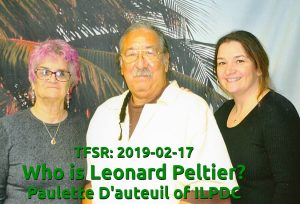
This week, Paulette D’auteuil speaks about the life and case of Leonard Peltier. Peltier is one of the best known political prisoners currently held in the U.S. Paulette is the Director of the International Leonard Peltier Defense Committee, based near Coleman, FL, where Leonard is incarcerated and also is an advisor to the National Jericho Movement.

For the hour, Paulette tells about Leonard’s life, his case, his health, the resistance that Leonard was and continues to be a part of, COINTELPRO, and Leonard’s art. You can learn more about Leonard Peltier by visiting the ILPDC’s website, http://whoisleonardpeltier.info, where you’ll find lots more info, Leonard’s artwork, ways to plug in and do events to raise awareness of Leonard’s case and keep up on updates. You can also find the ILPDC on twitter and fedbook.

Interview begins at 9 min, 14 sec

. … . ..

playlist

Eric King Hunger Strike + Mapuche Solidarity with A-Radio Berlin

Support Anarchist Prisoner Eric King

Download Episode Here

This week Bursts spoke with the wife of vegan, antifascist and anarchist political prisoner, Eric King. Eric was was convicted of attempting the September 11, 2014 firebombing of the Kansas City office of a Missouri Democratic Congressman in solidarity with the Ferguson Uprising that kicked off after the killing of Mike Brown in Ferguson, MO. The office was attacked at roughly 3am when it was empty. Eric took a non-cooperating plea agreement for 10 years in Federal prison with no chance of parole. Recently, prison administrators at Florence and later Leavenworth Federal prisons have been abusing, isolating and moving Eric around and his support crew have initiated a call-in campaign, which we mentioned last week. Visit SupportEricKing.org for more details and to keep up on what’s happening.

For a radio clean version of this podcast that is 59 minutes in length, you can visit our collection on archive.org! Follow the link below or under the photo for the podcast version.

Here are a few articles on subjects spoken of in the episode including Daniel McGowan’s recent story published by the ACLU entitled “What the Government Shutdown Really Means for Federal Prisoners”.

Here is a link to the situation unfolding at Florence CI.

And this is a link to Eric’s call in campaign, including all relevant phone numbers and a script!

To write Eric King, you can address letters to:

Eric King # 27090045
USP LEAVENWORTH
U.S. PENITENTIARY
P.O. BOX 1000
LEAVENWORTHKS  66048

An Update with A-Radio Berlin on B(A)D News about the Mapuche Caravan in so-called Chile

Before the main interview tho, we are pleased to present audio from the recent episode of B(A)DNews: Angry Voices From Around The World, the monthly podcast of the A-Radio Network. This time, Crna Luknja from Ljubljana, Slovenia spoke with a member of A-Radio Berlin who is traveling with a media caravan through Mapuche Territory to cover news there, and to offer media equipment and trainings to communities in Wallmapu, in so-called Chile and so-called Argentina. You can find the full episode of B(A)DNews at a-radio-network.org and click the menu option to the upper left of the screen. There you can also learn more about A-Radio Network, the participating projects and how to get involved.

A Few Upcoming Events Around Asheville

Tranzmission Prison Project would love for you to join them on January 24nd, the 4th Annual International Day of Solidarity with Trans* Prisoners, to send letters and drawings of support, love, cheer, and solidarity to incarcerated trans* folks and incarcerated folks with trans* experiences and identities. Cards will be provided, as will envelopes, stamps, and snacks — just bring yr undying desire to end the Prison-Industrial Complex.

. … . ..

On Friday February 1st at 6pm sharp, Blue Ridge ABC will be viewing “Long Distance Revolutionary: A Journey With Mumia Abu Jamal.” This is a 2 hour long documentary from 2013 about former Black Panther, journalist, author and activist who many believe was framed up on charges of killing a cop by the Philadelphia PD in 1981. Mumia has always held his innocence. In any instance, the case betrays biases in the court and policing system of that “great” city that held a man on death row for nearly 3 decades, a man who has fought from within to document America’s excesses and for the rights of the oppressed inside and outside of prison.

. … . ..

After the movie, starting at 8pm at the Mothlight, VVITCHGANGCOVEN presents a showcase of local hip hop and beats including Vvitchboy x Akuma, Scarlaween, Cool World Order, Herb Da Wizard & Xor. The show is a benefit for Blue Ridge ABC and more details can be found on pricing and such at brabc.blackblogs.org. This show is a must see for lovers of dreamy, alien, fierce, witchy hiphop so come out!

. … . ..

Playlist here.

F.L.O.W.E.R. on Opposing “Rock Stone Mountain” 2019 + Black Flags Over Brooklyn with Kim Kelly

Download Episode Here

Firstly we’re presenting a conversation that William had with an organizer with F.L.O.W.E.R., which stands for Front Line Organization Working to End Racism, about opposition to a neo confederate rally scheduled to take place on February 2nd at Stone Mountain Park about half an hour’s drive outside of Atlanta, Georgia. We talk about the longstanding history of this rally, which originally was a KKK event, its resurgence alongside the rise of far right activity, and some of what’s been done to oppose it in recent years. We also talk about what to keep in mind when standing against this event and how to learn more and plug in, plus much more.

This group is @flowerunited on Twitter, and that’s a great way to get rapid updates as February 2nd draws nearer. Also a great way to keep updated and read more about the history of this event, plus to see a long list of endorsing groups, you can go to https://flowerunited.org/

. … . ..

Next up, Bursts spoke with journalist, metalhead, anarchist, and antifascist Kim Kelly. Kim is an editor at Noisey, the VICE music site and has contributed radical content to Teen Vogue and many other platforms online and in print. For the rest of the hour we spoke about the upcoming “Black Flags Over Brooklyn” antifascist and antiracist heavy metal festival that Kim and others are organizing January 25 and 26 in New York City alongside a day-long anti-authoritarian leftist gathering. We also talk about the culture wars in metal, taking radical space in mainstream publications and more. You can find much of Kims work at noisey.vice.com, more about Black Flags Over Brooklyn and how to get merch or participate by just searching it on the web or finding its kickstarter or eventbrite. If you want to hear our interview with one of the headlining bands, Dawn Ray’d about politics and extreme music check the link in our shownotes.

Oh, and we mentioned Red + Anarchist Black Metal blog

Suggestions of good things by Kim ala metal with not terrible (even good) politics!

Labels: Alerta Antifascista, Halo of Flies, Sentient Ruin, Tankcrimes, Gilead Media, Tridroid Records, An Out Recordings, Eternal Warfare, Blackened Death Records, Get Better Records, Yehonala Tapes, 20 Buck Spin

Sites doing good work: Toilet Ov Hell, Astral Noize, Metalsucks, No Clean Singing, Invisible Oranges

Update from Unist’ot’en Camp

Here’s an official update from the Unist’ot’en Camp about the raid on the Gidimt’en Access Point we talked about on last week’s episode of The Final Straw.

Eric King Comms Blocks, Possible Hungerstrike

A post up at SupportEricKing.org that we read from in the episode starts with an announcement that Eric has been denied his monthly call with his wife who is recovering from surgery, was assaulted by staff at FCI Florence and transfered to FCI Leavenworth (though still under Florence’s jurisdiction) and away from his daughters and wife, is coming up on 5 months in solitary and may have begun a hunger strike.  There is a request for call-ins. Here is a sample script:

Hi I am calling about Eric King, #27090045 to demand that his phone restriction be lifted. It is unacceptable to take away a prisoner’s calls to his wife and family without any notice and without him being brought up on any charges.

Supporters are asked to call and email:

FCI Florence
Call: 719-784-9100
Ask for: The warden/assistant warden, the legal department, Counselor Quintana, Counselor Rivera. If denied demand the person answering the phone take down a message.

Email: FLF/ExecAssistant@bop.gov

BOP North Central Regional Office
Call: 913-621-3939
Ask for: Director Jeffrey Krueger. If denied ask to speak with his assistant. If denied again, demand the person answering the phone take down a message.

Email: NCRO/ExecAssistant@bop.gov

Yiddish Anarchism Conference

Also coming up in NYC, on Sunday January 20th there’ll be a free conference entitled “Yiddish Anarchism: New Scholarship On A Forgotten Tradition”. The conference will be conducted in English, will be free, run from 10am to 8pm at the YIVO Institute for Jewish Research at 15 West 16th St. More info can be found at yivo.org/Anarchism

The latest Error451

This week we released a new Error451 episode into our podcast stream, this time an interview with Kali Kaneko about Leap Encryption Access Project, about VPNs and psuedonymity online. If you haven’t, visit our website and take a listen. Or, better yet, subscribe to our podcast by visiting “podcasting” link and following the instructions there!

Support Our Work

If you appreciate the work that we put into making this show happen, week after week, sometimes more than once a week and if you can afford to help us out, please consider donating to The Final Straw. If you visit our website, you can click the Donate/Merch button and there you’ll find a few options. We can take one-time donations via paypal or venmo, we can take ongoing donations via liberapay, you can buy t-shirts, stickers, buttons and more via our bigcartel store or become a sustainer via patreon and make monthly donations. The patreon option has a lot of options for thank you gifts including what’s already been mentioned, plus homemade mixtapes and an option to get a zine made of any interview we’ve conducted, getting those words into the hands of translators and folks who have hearing impairments!

If you can’t afford a monetary donation, no worries, tell your friends about the podcast, share an episode on social media, write us an email or a letter to suggest content. You could also contact your local community radio station and say that you want us on your airwaves. We have a weekly, 59 minute and FCC-friendly episode out every Sunday afternoon up for radio stations to download and use. More info on that can be found at our website by clicking the radio link at the top of the site.

As an aside, we’ve just started sharing Political Prisoner button mixpacks for Blue Ridge Anarchist Black Cross. The buttons feature the faces of 54 (and more to come) political prisoners held by the U.S. government. The sales go to benefit the activities of BRABC. Prisoner support sites and distributors should contact blueridgeabc@riseup.net for deals on the buttons. If you want to make your own and have a button maker, the pdf’s of the button images are up at https://brabc.blackblogs.org/pp-ppow-buttons/ for download for free.

. … . ..

Playlist here.

November 2018 B(A)DNews: Angry Voices From Around The World

Download This Episode

This is episode number 17 (11/2018) of “B(A)D NEWS – Angry voices from around the world”, a news program from the international network of anarchist and anti-authoritarian radios, consisting of short news segments from different parts of the world.

Content:
* Radiozones of Subversive Expression (Athens, Greece): Local news
* 105fm (Lesbos, Greece): Local news
* Črna Luknja (Ljubljana, Slovenia): Situation in Palestine
* A-Radio Berlin (Germany): Interview on the struggle in the Hambach Forest
* The Final Straw Radio (North Carolina, USA): Interview on the Nationwide Prison Strike in the US

You can play the audio directly or download it from Archive.Org here

Please send feedback and comments to: a-radio-network/at/riseup(.)net

And more content is available at https://www.a-radio-network.org

A Jailhouse Lawyer Speaks About #PrisonStrike 2018

A Jailhouse Lawyer Speaks About #PrisonStrike 2018

Download This Episode

This week, we feature three segments. First, we’ll feature a statement about recent doxing of a number of anti-racists in the Asheville area by far-right keyboard warriors.

After that, we feature an interview with Dee, an anonymous incarcerated organizer affiliated with Jailhouse Lawyers Speak. In this conversation we ask about the effectiveness of the #August21 2018 Nationwide Prisoner Strike, the push to move prisoners under storm threat as these increase under climate change, repression and changes in response to the strike, mail limitations in PA prisons, standardization of increased security in Ohio, outside support and organizing, critiques of the methods of NPS2018, and more. Check our show notes for links to more info concerning the strike.

If prisoners want to communicate with and/or join JLS, Dee suggests in some words near the end of the show that they reach out to:

Jailhouse Lawyers Speak
P.O. Box 1076
Knightdale, NC 27545

And you can find JLS on fedbook or twitter to keep up with their organizing

Hambach Forest Updates

In our final section of the show, you’ll hear a report by audio comrades in Germany about the recent resistance to the destruction of the Hambach Forest by authorities. The clearing of the ancient forest is to create the largest open-pit lignite coal mine in Europe on behalf of the corporation RWE, which sells to Netherlands, Germany & the UK. Lignite has a carbon content of around 60-70%, has a low energy yield, and is responsible for 1/3 of CO2 emissions in Germany. This segment shows up in the November 2018 episode of B(A)DNews, Angry Voices from Around The World from the A-Radio Network, of which we’re a proud member. Keep an eye on our podcast stream and website for a link to this episode coming out in the next couple of days.

Local Doxxings

Within the last week, over 15 people were doxxed by white supremacists in our community. Here is most of a collective statement released a day or two after the fact by some of those folks:

They’ve targeted more than twenty people they believe are involved in anti-racist organizing in North Carolina. They’ve posted information such as our home addresses, places of work, family members, license plates, social media profiles–whatever information they could find. They seem to be fixating on trans and nonbinary people in particular, and delight in trying to deadname and misgender us whenever possible. Some of us, and some of our family members, have received harassing messages.

They wrote about us like it’s some big secret that we oppose fascism, that we oppose racism, that we oppose all forms of bigotry and oppression. It’s not a secret. We weren’t hiding. We are not ashamed.

This isn’t a plea for sympathy. Our friends and immediate community have been amazing. Rather, this is a message to let you know that if you ever find yourself targeted by neo-Nazis and the far right, you are not alone. None of us need to face this rising tide of fascist scum alone. We have each other.

Robert Bowers, the Pittsburgh Synagogue shooter, actively and publicly chatted with alt-right trolls who had doxxed anti-racist activists. He even discussed violence against anti-racists in our region. This is probably a good time to think seriously about your online security and that of your family members and friends. But staying safe isn’t just a matter of changing your Facebook settings or making your Instagram private. It’s a matter of us showing up for each other. Of us not letting them intimidate us, not letting them isolate us. Not letting them stop us from our work. Especially when the work is stopping fascism.

To read the full statement, you can visit https://ashevillesolidarity.tumblr.com/ , where you can also see a list of bands and businesses which have been included in the current harassment. And of course, there are ways to donate and send support!

For an article about this (released just as our radio show was airing), including a statement by Firestorm Books contextualizing the specific harassment they’ve received, you can visit The Asheville Blade, which you can donate to here! To support Firestorm Books, our local anarchist community space and bookstore, you can join their Community Sustainer’s Program or leave them a positive review on Facebook, Yelp, wherever you can.

Additionally, for a really excellent walk through of how to help prevent this kind of thing happening to you or your crew, you can visit the Smiling Face Collective guide to preventing doxxing. This site can be easily adapted into an interactive workshop, because let’s face it, wiping your presence off the internet is a tedious, upsetting, and grueling process which is designed to wear you down. It’s always better to do this in groups! You can write to us about your experiences with internet hygiene, good, bad, or whatever, at tfsradioshow@protonmail.com

Rural Organizing Against Racism Benefit

For those in the Western NC area, there will be a Fall Fundraiser to benefit rural organizing and resilience on Friday November 30th at 6pm at the Marshall Container Co. which is located at 10 South Main Street, Marshall, NC. The event will center around a cornbread and chili dinner and will include several surprise musical guests!

Support Anti-Fascist Protestors in Philly

And finally, if you are in the position to donate to those injured yesterday fighting the Proud Boys in Philly and elsewhere, you can go to this rally.org page. Remember that if you donate to do so anonymously!

. … . ..

Playlist here.

Former Political Prisoner Zolo Azania

Zolo Agona Azania

Download This Episode

This week on The Final Straw radio we are sharing a chat that Bursts had with New Afrikan, former Black Panther and political prisoner, Zolo Agona Azania. Zolo is  from Gary, Indiana where he lives now, working a job and also doing re-entry work with the formerly incarcerated and community service to break cycles of trauma. After 7 and a half years in prison from ages 18-25 where Zolo engaged in political education with members of the Black Panther Party from Indianapolis, he was released. In 1981 he was re-arrested, picked up by the Gary police while walking around the city after a bank robbery took place, resulting in the death of a Gary police lieutenant. Because of his political views and circumstantially being on the street at that time, Zolo was convicted by an all white jury and sentenced to death.

Zolo beat that death penalty from within prison twice and blocked a third attempt by the state to impose it. For the hour, Zolo talks about his life, his parents, his art, his education, his time behind bars, his political development, the Republic of New Africa, and his legal struggle.

To get in touch with Zolo you can email him at azaniazolo5( at)gmail(dot )com or you can write

Jumpstart Paralegal and Publishing
PO Box 64854
Gary, Indiana 46401

To see more of Zolo’s art you can visit this support page!

Continue reading Former Political Prisoner Zolo Azania

Conflict Resolution with the Callisto Collective

Download Episode Here

This week we are presenting audio from the Callisto Collective, which is a local collective “addressing conflict, abuse, assault and everything in between” by utilizing autonomous models of resolution, especially in closer knit communities of affinity. This workshop is called Conflict Resolution for folks who do Anti State Organizing.

In this workshop, they talk about many things, including anarchist critiques of Non-Violent Communication, which is a developed process in use mostly by leftist organizers, possible tools for dealing with conflict, and also some discussions on yogurt (stay tuned…). This workshop was originally presented at the 2018 Asheville Anarchist Bookfair at Firestorm Books.

If you would like to write with the Callisto Collective, you can email them at callistocollective@protonmail.com!

This was an extremely interactive workshop, and to protect the anonymity of participants I had to cut a bunch of material out. This sometimes makes the audio a bit disjointed to listen to, but I hope you’ll enjoy it all the same.

Before the workshop tho, we want to plug certain hurricane relief efforts going on in town. As you are probably aware, the coasts of North/South Carolina and Georgia as well as many regions off the coasts are being hit right now with a quite sizeable hurricane. Appalachian Medical Solidarity is helping coordinate disaster relief efforts, running supplies inland to the coast and supporting those who are doing on the ground relief efforts. Donations of supplies can be sent to Firestorm Books at 610 Haywood Road in West Asheville.

Things which are needed include:

  1. Pop top canned foods which are high in calories that people can eat cold and without utensils
  2. Wool socks
  3. Anti-fungal spray
  4. First aid supplies
  5. Any and all baby supplies
  6. Adult diapers
  7. Toilet paper
  8. Flashlights and batteries
  9. Travel size personal toiletries
  10. Hand soap
  11. Charged battery packs for cell phones and cell phone chargers
  12. Gasoline

If you would like to help but cannot send supplies, you can donate to relief efforts in Asheville by going to:

https://www.gofundme.com/mutual-aid-relief-supplies-nc

If you are going into affected areas as a relief worker, it’s very important to be networked with local efforts and to foreground the work of locals and directly affected populations. If people are interested in reading further about cultural competency in disaster work, we would suggest further reading by the Mutual Aid Disaster Network, which is available on any social media platform. You can contact Appalachian Medical Solidarity through their Facebook page, and they are coordinating efforts on behalf of those affected by hurricane flooding both on the coast and in Asheville.

. … . ..

Finally, we would also like to plug a phone zap on behalf of Jason Renard Walker, a Texas inmate associated with the 2016 prison strike and who contributed to the Fire Inside zine. He has been subject to an increasingly intense campaign of harassment from staff at the Telford Unit, who first issued him with a fake case for threatening a member of staff, and then sent him to lockup, preventing him from even being able to attend his own hearing for the so called case. The prison strike timeline has officially ended, but repression related to the strike is only just ramping up. For a full article on this case you can visit the full article here.

. … . ..

The music which we used in the intro is the instrumental version of the track “7” by Frank Waln, who is a Sicagnu Lakota rapper and hip hop artist. His work is very searchable on any streaming media platform.

. … . ..

Playlist here.

Asheville threatening Harm Reduction; SFBay View with Mary Ratcliff

Steady Collective + SF Bay View Newspaper

Download This Episode

This week on the show we feature two interviews. The first is with a volunteer at the Steady Collective, a group that self-describes as “ dedicated to promoting the wellness of people who use drugs through empowerment and respectful collaboration. Our goal is to improve overall community health by reducing the rate of drug overdose and the spread of infectious disease with education, advocacy, and direct services. “ Their ability to operate a harm reduction program around needle exchange and narcan distribution to stop overdoses in the midst of the #opiodCrisis in Appalachia is being threatened by the city of Asheville. Here’s the website for 12 Baskets, the food distribution program out of Kairos West.

Then I spoke with Mary Ratcliff, the editor of 27 years of the San Francisco Bay View National Black Newspaper, with a print distribution of 20,000 copies around the U.S., including thousands behind bars. For the hour, Mary talks about the history of the paper, it’s relationship with prisoners and prison struggles and the difficulties faced by the poor and populations of color in white supremacist capitalism in the so-called U.S.

Announcements

A12 in D.C., Cville & Boston

Last weekend witnessed far right, nazi-affiliated, sexist, homophobe rallies in Portland and Berkeley, which I’m sure folks are aware of. Patriot Prayer and Proud Boy goons schlepped their way out from under rocks in their goofy-ass larping costumes to spit their deranged and hateful screeds and threaten and attack counter-demonstrators where they could. And the police helped by holding back and assaulting the anti-racists at both events with pepper spray, batons, tear gas and rubber bullets, as well as legal charges. Big ups to the brave folks who came out to stem the tide of hate on the West coast, and also a big a thanks to the comrades who came out in Providence, R.I. where they were able to shut that crap down real fast.

This weekend the year anniversary of the August 11th Torch Rally and August 12th Unite The Right Rally in Charlottesville approaches. On Sunday, August 12th in Cville there’s a day of events of remembrance and mourning starting at 9am in Washington Park. The police presence has been shown to be huge in the runup to this weekend with Martial Law and States of Emergency declared by local and state officials, leave for police being suspended, and swaths of the city shut down and blockaded. Follow #AllOutCville for updates. In Washington, D.C., haters are trying to put on a second UTR to draw their morons in swastika and Pinochet shirts and confederate bafoons into the streets. Information about what’s happening and how to congregate against it can be found at https://shutitdowndc.org/ . And check out the ItsGoingDown’s “This Is America #24” for voices from the ground in DC & Cville.

On August 15th in Boston there is planned a Town Hall Meeting at the Arlington St Church in preparation for the counter-demonstration on August 18th at the MA State House to shut down the far-right hate front group, “Resist Marxism”. More info at http://bit.ly/fight-right-boston

Be safe out there, cops and klan go hand in hand. Bring water, watch out for your friends, don’t leave alone.

Worker’s Assembly Asheville

On Monday, August 20th at 6pm and every 3rd Monday of the month, the Asheville IWW is hosting a service industry workers assembly at Kairos West. If you work in food serice, retail, hospitality, breweries, or other service industries and don’t have the right to hire or fire, come by and join the discussion on issues facing your ilk including wages and hours, but also issues such as racism and gendered violence that workers face in and outside of their workplaces. The discussions are aimed at creating direct action solutions and creating class solidarity. To hear about their first Assembly, check out our interview on the topic.

Reminder on upcoming #August21

A few CZN member projects have been producing content specific to supporting and understanding the Nationwide Prison Strike. You can find great, related content to enjoy and share by ItsGoingDown podcast, Kiteline Radio & Rustbelt Abolition Radio. Links are in our notes to those recent episodes. Also, visit incarceratedworkers.org for the new and very shareable video breaking down IWOC’s role in the strike and reasons to support #August21.

If you appreciate this podcast and the voices that we bring to you each and every week (at least once), please consider a one-time or recurring donation via paypal or liberapay. You can also subscribe to recurring donations to us at patreon.com/tfsr and get some pretty sweet swag. If you want one of the shirts or mixtapes or sticker and button packs we offer to patreon supporters but can’t afford a monthly donation, drop us an email and we’ll work something out.

Shane Burley on Fascism Today + Asheville’s Service Worker Assembely

Download This Episode

This week on The Final Straw, we’ll be airing two interviews. In the first, Bursts spoke with author and activist Shane Burley about the state of street level fascism and anti-fascism in the U.S. Then about 45 minutes into the episode, you’ll hear Bursts speaking with two members of the Asheville branch of the Industrial Workers of the World, or IWW.

Shane Burley on Fascism today

Shane is the author of numerous articles on the subject as well as a the 2017 book from AK Press, “Fascism Today: What It Is And How To End It.” The conversation ranges from talking about specific groups like Atomwaffen, The Proud Boys, Patriot Prayer and the Traditionalist Workers Party (TWP), to the Unite The Right 2 (UTR2) having been announced by Jason Kessler for either D.C. or Charlottesville, VA.

Shane also talks about essentialism in fascism and the creeping relationship between “identitarian” patriarchs and the trans-misogyny of TERFs (Trans Exclusionary Radical Feminists) in Deep Green Resistance, such as Lierre Kieth and Derrick Jensen. The book mentioned by Bursts about essentialism, fascism and anarchism can be found in audio format on R.A.D., another member of the CZN.  The original text can also be found on their tumblr.

Shane Burley is touring on the east coast, currently, and can be seen tonight (June 17th) at The Wooden Shoe in Philadelphia and on Tuesday the 19th at Potter’s House in Washington, D.C.

Asheville IWW on Service Work

The wobblies talk about the upcoming Service Workers Assembly they have planned for Tuesday, June 26th from 6-9pm at Kairos West, under Firestorm in West Asheville.  Here’s a link to their fedbook.

If you are a service worker in the Asheville area and want to chat with other folks from the industries about how your conditions could improve, come on by. No bosses, snitches or scabs, please.

There’s no Sean Swain again this week, hopefully we’ll get the crossed wires fixed soon.

Announcements

Debbie Africa of MOVE9 released!

Debbie Sims Africa was paroled this week from prison after about 40 years inside for crossing the Philly PD and the Frank Rizzo administration!  We hope that a push can happen to get the remaining 6 members inside.  Welcome to the outside, Debbie! #FreeEmAll

Local Announces

In this run-up week to the Another Carolina Anarchist Bookfair (ACAB2018), there’ll be a game of punk jeopardy on Thursday the 21st at the Lazy Diamond starting at 9pm. The venue is a bar, so it’s 21 and up only. On Friday, feel free to stop by the welcome table at Firestorm for an intro to the range of events over the weekend. Check out the calendar of events, including the schedule for the workshops and more!

Playlist