. … . ..
Transcription
TFSR: Thank you for joining us, Dr Khan. Would you please introduce yourself to the audience with any name, location, or affiliations that make sense for this interview?
Tariq Khan: My name is Tariq Khan. I’m a lecturer in the Department of Ethnicity, Race, and Migration at Yale University in New Haven, Connecticut.
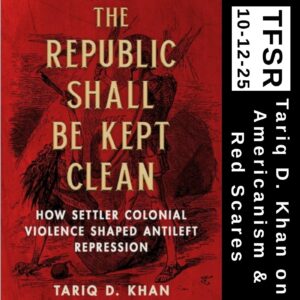
TFSR: Awesome. Thank you so much for being here. I really appreciate it, and I really appreciate your book. We’re here to talk about the current state of the USA, where we stand politically, and with the current crisis. This is backed by a lot of the history that you document in The Republic Shall Be Kept Clean: How Settler Colonial Violence Shaped Antileft Repression, out in 2023 from University of Illinois Press. I wonder if you could tell us a bit about the book and the story that you tell in it.
Tariq Khan: Sure. This book was a long time in the making. I actually started thinking along these lines way back when George W Bush was president. I was involved in the anti-war movement, and a lot of organizing around issues of racism, war, anti-imperialism, and all that sort of thing.
I was living in the Washington, DC area, and there were many hate crimes, especially targeting Muslims or people who were perceived as Muslims. For example, there were a lot of Hindus and Sikhs, Jews, and other people who weren’t Muslim, but by what they looked like, people thought they were Muslim and targeted them for hate crimes as well. As a result of the invasion and occupation of Iraq, there was a lot of language around at that time of “civilization versus savagery.”
There were advertisements in the Washington, DC, subway system, also in New York, and also on some buses in California that I heard a Zionist group had paid to put up that said: “In the war of the civilized man versus the savage, support the civilized man.” Groups like the Council on American Islamic Relations were pointing out to the transportation authorities that this is hate speech. It’s going to contribute to a climate that’s conducive to hate crimes. And sure enough, in the New York City subways, in the same place where those kinds of ads were running, a woman shoved a man in front of an oncoming train and killed him. And when she immediately got caught by the police, she just said, “I’ve been beating them up ever since they attacked us on 9.11.”
All those incidents made me think about the language of civilization versus savagery. It started as an exploration of that language. Then it grew into a bigger project, because it led into a longer story of US settler colonialism, and the relationship between US outward imperialism and outward war to inward repression.
The book examines that relationship. It’s arguing that these are not separate stories. In the history of labor and the working class, many historians use euphemisms, like westward expansion. They treat the story of westward expansion as one thing, and stuff going on in US industrial centers as a different story. I’m saying that it’s actually the same story. So that’s what I’m doing in this book.
TFSR: I think that’s really interesting, when you’re talking about the outward war and the inward repression… The title of the book talks about anti-left repression, but it also focuses on the topic of settler colonial violence. When you’re talking about westward expansion, and that period of time, a lot of the political discourse and a lot of the debate at a higher level was about where are we going to allow chattel slavery to exist? Maybe there are treaties with the neighboring peoples, and there’s the tension and the conflict for the white settler to be able to expand and take more land. A huge amount of the “founding fathers” and the early presidents of the country made their riches off of enclosing, stealing, and emptying, to some degree, indigenous lands, and then, with the support of surveyors, they became real estate moguls.
I really appreciate the fact that the book doesn’t just focus on how leftists have had a hard time, but is looking at “Why? Why have anarchists and communists been focused on? What elements of the American psyche, or the US psyche, are being activated through this? What are the grievances or the dangers that are being pointed to with these ‘alien subjects’, and what’s the perspective that’s doing the alienating? Who’s the central character in this?” If that makes sense. I’m really hoping to pursue some of that.
I wanted to speak a bit about the use of the term ‘clean’ in the title of the book. What and who were considered clean from the perspective of the book, or from the historical read, and who was applying the term?
Tariq Khan: That language of peoples who are clean and peoples who are dirty is a staple of white supremacy, but it’s a weird way of talking about entire groups of people. When you see groups of people described as dirty, something is going on on a psychological level with the people who are using that kind of language. Anthropologists have written about that kind of language of purity and most of the anthropologists actually were citing what we call the father of American psychology, William James. He looked at what dirt is. Dirt is matter out of place. If hair is on your head, nobody is like, “Ooh, gross. There’s a hair on your head.” But take out one of those hairs and put it on a dinner plate, and it’s like, “Ooh, there’s a hair on my plate. Now your plate is dirty.” It’s out of place, that’s what makes it dirty.
When we’re looking at peoples, essentially the notion of dirt implies a kind of system in existence, and then dirt is a contravention of that system. That’s how William James talked about it. And when they’re calling peoples dirty, they’re talking about them as out of place, peoples who don’t belong here. So a lot of these migrant groups coming to the United States who are dirty peoples who we need to send back. Or even indigenous peoples who actually belonged here more than anyone else, and yet they were being called dirty, but they were being described as out of place in time, as belonging to the past, or evolutionarily out of place.
When you see the language of clean and dirty, then it almost always accompanies genocidal policies, policies of expulsion, containment, extermination, and removal. The title of the book, The Republic Shall Be Kept Clean, is a quote from US Congressman William Vail, from the time of the deportation of some 250 anarchists, many of them Jewish and all of them born within the borders of what was then the Russian Empire. As they were being deported on the SS Buford, he said, “The cancer is being removed, the Republic shall be kept clean, and in its cleanliness shall endure.” This is before the Nazis and all of that. This is the US American language that’s rooted in US settler colonial history.
TFSR: That’s interesting. I don’t want to focus on the Nazis because of the centrality of the story that you’re telling. But I think a lot of people don’t realize how central the actions, the ideology, and the mythos of the US settling and the conquest of the West were to Germany at the beginning of the 20th century, and also to Hitler personally. Would you like to say a few words about the modeling of what happened during the Holocaust, during the Shoah, and the relationship to the eugenicist approach that the US had already embarked on?
Tariq Khan: Hitler and some of his higher-ranking guys were very open about the fact that they were learning from the United States. They pointed to the US genocide against indigenous groups as a great example of how countries should be dealing with the undesirables. In the United States, they have this language of the white man taming the Wild West. Hitler even used that language. Drawing on that, he talked about how the Nazis are taming the Wild East. Looking at the undesirable peoples, the Jews, the Roma, and all the different kinds of groups that the Nazis were going after.
They were quite open about the fact that they were learning from US history, but also from US scholars, United States eugenicists. I’m at Yale University, which had one of the major eugenics research institutes in the world, the Institute for Human Relations, and the American Eugenics Society was right here in Yale. All these Yale guys were the leaders, leading intellectuals of the eugenics movement. And they were in contact with Nazi officials. These guys in the American Eugenics Society and at the Institute for Human Relations were writing letters back and forth with Nazis. They were being praised by Nazi officials for the great work that they were doing. It’s very well documented that the Nazis were absolutely drawing on US settler colonialism, US racism, and US Jim Crow. European fascists were drawing on all of these unique versions of oppression that existed in the United States and were trying to craft policies along the same lines.
TFSR: The western expansion, fundamentally, was reflected in the Lebensraum idea that a Nazi Empire had of clearing space for the living room for the people that belonged there. Reflecting again the expansion of settler colonies, the pushing of indigenous people into non-existence, or across borders, or into these reservations, these concentration camps, in a way.
Tariq Khan: Absolutely. Concentration camps long predate the Holocaust. The Spanish colonizers were using concentration camps in the Americas, and later, when the United States was formed, they were also using concentration camps for indigenous groups. They were using concentration camps in their invasion of Cuba. Even the Germans had been using concentration camps in Southwest Africa in the 1880s, 1890s.
In the book, I talk a little bit about Aimé Césaire and his notion of the boomerang effect of imperialism and how Césaire saw fascism. When the colonizing states start doing inwardly, within their own countries those same things they are doing outwardly to colonized populations, to racialized populations, then we call it fascism. But for the colonized, this is what it’s always been, he says.
TFSR: To the other side of that question, if the determination that something is unclean, something is dirt, is because it’s matter out of place, or it’s people who don’t belong in a place, can you talk about the voice who is speaking the word “clean”, of what is in opposition, who is considered to belong in this place, and by what right?
Tariq Khan: Everyone, all the way from the President of the United States, down to your lowest ranking police officers, to your Indian Agents, they’re all using this language of cleansing. You still see it today with police. They say, “We’re going to clean up the streets.” That’s where that idea of cleaning up the streets comes from. We’re getting all the undesirables out of here.
When we look at the history of the police and see how police were rooted and evolved out of slave patrols, frontier lynch mobs, vigilante gangs and things like that, who literally were involved in genocidal campaigns. [When we see them] using the language of, “We’re cleansing the frontier”, or “We’re getting rid of all of these dirty peoples.” That’s where that language that the modern-day police use comes from. It’s all rooted in that history. Even the whole idea of the police as the thin blue line between civilization and savagery, is the settler colonial rhetoric.
TFSR: Can you talk a little more explicitly about what the civilization is that they’re imagining? I know that there are certain esoteric and fringy visions that believe that white people are the lost tribes of Israel, and this is the promised land that goes back to the Bible. The language that the Puritans spoke in some of the earlier colonies talked about “We are building a city on a hill. We are fulfilling God’s dream by being here, and therefore we are written into creation as belonging here and beyond that.” Obviously, there are the Papal bulls that say that these lands are determined to fall under Christendom, to be in the control of civilization and righteous, upright values, I guess.
Tariq Khan: That’s all part of the ideological structure of capitalism and settler colonialism. Some people use the term “colonial racial capitalism”. My story starts around the 1840s. It’s largely [talking about] people who are heavily invested in industrial capitalism, who are the people in power. I talk about people like John Hay. I use as an example this person who had a lot of influential positions for his entire adult life. Starting as one of Abraham Lincoln’s right-hand men, and then years later, serving as Secretary of State. And in between, having really influential positions in US media, being an editor at the New York Tribune, which was the highest-circulation newspaper in the United States at the time. That was the epitome of what the mass media was back then. It was print culture.
He talked about civilization in very clear terms, simply meaning private property. And they used racialized terms for that. So they would use terms like “the white man’s system of private property.” They would use these racist terms like “the red man’s system of communism versus the white man’s system of private property.” They were racializing economic systems. Capitalism was seen as white private property, was seen as a white system. The “white man’s system of agriculture” was one of the terms you see. You would see a lot of language like “the white man’s system of agriculture, the white man’s system of industry.” And that basically meant capitalism. So that’s what civilization was.
Even when we look at some of the attempts to supposedly civilize indigenous groups, you’ve got things like the Dawes Act. The whole notion of the Dawes Act was that we’re going to take land that is held in common by indigenous groups, and we’re going to break it up into private lots, and we’re going to civilize them by assimilating them into the system of private property. They were very clear in the way they talked about what civilization meant. It meant private property, it meant capitalism. And savagery was pretty much anything that threatened the system of private property.
TFSR: Listeners are likely familiar with the term “Red Scare” relating to the period around the early 1950s, also known for the prominence of McCarthyism and the House Un-American Activities Committee. They may even be familiar as good anarchists many of us are with what’s usually referred to as ‘the First Red Scare’ around the period of the Palmer Raids.
I wonder if you could talk about what you point to as an earlier Red Scare, and talk about the interesting overlaps and precedents it provides to the later examples. Just to point out again, if listeners missed when you were talking about the “communism of the red man”, you found an early application of the term “communism” that wasn’t in the popularized or in the Marxist or anarchist usage of it, right?
Tariq Khan: Yeah. This is one of the things I’m arguing in the book. Many indigenous studies scholars have talked about how settler colonialism cuts to the core of what the United States is. And when we take that idea seriously, and we see settler colonialism as this major category of analysis, the periodization changes.
As historians, we have certain ways that we periodize US history, and we break up textbooks in these certain ways. There are some good works on anti-communism; I’m not criticizing these works. I found a lot of these works very useful, but most of them start around post-World War Two period with the Cold War. Some of the better ones will go back to what you called the First Red Scare, the Palmer Raids, and all of that sort of thing. But the time they call the First Red Scare is the time period that’s the end of my story. Because when we’re taking settler colonialism more seriously than anti-communism looks different.
I looked at the Congressional Record, and I was looking for the earliest instances of modern anti-communist rhetoric that we know of. When does that start? And it goes back into the 1840s. As soon as the word ‘communism’ enters the lexicon, “anti-communism” also enters the lexicon. The word “socialism” had been around for a while, at least since the 1820s, maybe a little earlier than that, with a lot of utopian experiments and different kinds of religious versions of socialism. And it was a pretty big umbrella; it meant a lot of different things. In the 1840s, it was the German socialists who started using the word “communism”. Even before Marx, there were a few folks who were [using it]. I think I mentioned August Becker’s book ‘What did the communists want’ that came out in 1844, I think. And, of course, the ‘Communist Manifesto’ hits the streets in 1848, and Marx is giving talks in 1847 using the word ‘communism’.
This stuff is being reported on in US newspapers. So the literate public in the United States would have been familiar with these terms. The labor newspapers covered the activities of socialists and communists in Europe. Even though the labor movement in the US at the time wasn’t really that radical, they were sympathetic to some of the European radicals and reported on them. And so the word ‘communism’ enters the public consciousness in the United States in the late 1840s. And immediately, congressmen, especially the pro-slavery congressmen, are starting to use anti-communist rhetoric to make pro-slavery arguments.
In 1848, the United States stole over 500,000 square miles of land from indigenous groups. We say it was from Mexico, but it was actually not even Mexican land. Nominally, it was Mexican land, but in reality, those were indigenous territories that did not belong to the United States or Mexico. The United States takes all of that land, and now they have all of this land that is populated by different indigenous groups who are not citizens of the United States. And all of these questions about what they call “the Indian problem” arise. But also problems about what to do with all this new territory? Is this going to be free states or slave states?
The pro-slavery people were really pushing the fear of communism. I mentioned in the book one example from the Congressional Record where this congressman is using what almost sounds like Marxist language, but he’s twisting Marxist language to make a pro-slavery argument. Marx was giving talks as early as 1847 using language like…
TFSR: Wage slavery…
Tariq Khan: Right, wage slavery, but also that the interests of the proletariat and the bourgeoisie are diametrically opposed, the interests of capital and labor are diametrically opposed. And this southern congressman, who would later become one of the leaders in the Confederacy, says, “Look at these northern cities where they have the wage system. You have all of this conflict between capital and labor.” And he says, “that’s because they have the wage system, and so then that’s going to become fertile ground for communism to grow.” And he says, “Here in the South, we don’t have conflicts between capital and labor, because enslavers own both. And so we have harmony between capital and labor. So the best way to protect the United States from communism spreading is to let these new territories be slave states.” You’re getting arguments using communism as the thing that slavery will protect us from.
That’s 1848, and then you also have US Indian agents who are using this kind of anti-communist rhetoric in the North. You can also find it in the Congressional Record, in their reports to Congress. They were supposed to be getting the Dakota Sioux people under control, and they’re having a really hard time doing that; they’re not able to. So they’re reporting back to Congress saying, “It’s impossible to civilize them because of their system of communism.” That is the first instance I see of the term “system of communism” in the Congressional Record. And they’re talking about the Dakota Sioux. They’re not talking about European Socialists or anything like that. Essentially, the argument is that they have too much freedom, too much democracy. They share resources, and they share power. And these Indian agents translated that as a system of communism.
There is a tactic that they would often use, that colonizers have used all over the world as long as colonialism has existed. You try to hand pick someone from the colonized population who you think is a leader, you manipulate them and maybe shower favors on them, give them privilege in certain ways, and then you use that leader to control the rest of the group. They were complaining that they’re trying to do that with the chiefs, and it’s impossible, because the chiefs don’t have power. Many white settlers had this false idea that Indian chiefs were like dictators, had absolute power, and whatever they said went. And they were finding that the system was actually far more democratic. They would say, “We call the chiefs to meetings, and they bring all of these Braves with them, who make sure that the chief doesn’t make any agreement that goes against the wishes of the people.” It’s basically an argument of “they have too much democracy, our tactics aren’t working, and it’s because they’re communists.” Essentially, they’re saying they can never be civilized because of their system of communism.
If you can’t be civilized, then what’s the solution? The solution for settlers, for colonizers, is extermination. Which is exactly what they do. Another thing I talk about in the book is that anti-communist language almost always accompanies violence. It’s not just rhetoric. And so you had a genocidal campaign against the Dakota Sioux conducted by the formal forces of the state, but also by just regular white farmers. Little Crow was murdered by a farmer and his son, who found him when he was gardening, and they just straight murdered him and scalped him. And then the father got paid $500 from the state, and his son got paid $50 for the scalp, which was a lot of money back then. That kind of language of civilization versus savagery and anti-communism accompanies exterminationist policies in the real world.
TFSR: I thought it was interesting also how you had pointed to the way that the anti-indigenous rhetoric swung back in public imagination towards anti-communism. Like the portrayals following the Haymarket Affair in Chicago. The stories that were being told, the books that were being written, and historical reviews by the historians of the Chicago police departments, historians of what policing around the era of these massive strikes was like, were referring to it constantly as the Wild West. Not only calling communists, anarchists, or socialists “red” by the color of their flag, but also basically calling them “indigenous and red” in that racialized way. To say this war for Civilization includes the extermination or the control, or the civilizing of these dangerous proletarians, often foreign-born, who are undermining our possibility of civilization. Here, we’re basically the same as those fighting in the western territories to help settler expansion.
Tariq Khan: Absolutely. It’s pervasive in the police literature. We have to remember that at this time in history, in the 1870s, 1880s, 1890s, the police were a relatively new institution. A lot of the population didn’t respect the police, and they didn’t see them as legitimate. They saw them in many ways the way that many people nowadays see ICE. ICE is a pretty new agency, and when they’re sending ICE thugs into cities, they are facing all kinds of resistance. People don’t see these ICE guys as legitimate authority. That’s how these first police departments were in the 19th century. They were constantly fighting the battle for legitimacy and fighting this public relations battle.
Because settler colonialism is so core to US culture and politics, the police in the United States very explicitly liked to cast themselves as the Hardy white men of the dime novels. The Hardy white men taming the Wild West. The police put themselves into that same narrative as a way of making them seem more legitimate. History of the Chicago Police, a book written in the late 1880s and put out by the Chicago Police Department itself straight up uses that language. It says, “The first police in Chicago were the men of Fort Dearborn, who were fighting the Indians. Now we’re fighting the anarchists. Nowadays, the anarchists are our Indians.” They use that kind of language. They quite correctly, actually, pointed out that the origins of the Chicago Police were genocidal frontier Indian killers.
Fort Dearborn was established in 1802 or 1803 for the express purpose of exterminating – that’s the language they used – exterminating indigenous groups from the region to make it safe for white settler colonization. That’s the origins of Chicago. And the police point to that as the origin of the police. Captain Shack, in his very influential book on anarchists, was also very explicit. He would say, “Like a drunken Comanche about to attack the home of a helpless settler, the anarchists surrounded the police station.” He used that kind of language. And then he would say, “the Chicago reds.” He would use this term ‘reds’ and at certain points it wasn’t clear which “reds” he was talking about, because he was going back and forth between indigenous references and anarchist references, using the term “reds” for both. At some points, you don’t know which “reds” he’s talking about.
TFSR: Throughout the book, you repeat the point that the anti-black and anti-indigenous violence that has been wielded by the state and powerful classes since the foundation of the British colonies, and depending on where you are, I guess also the Spanish or the French, has in many cases different motivations and limits than the violence imposed on political radicals. Though sometimes it’s overlapping motivations and language. Can you talk about the importance of distinguishing differences between class hatred and race hatred and race construction in US History?
Tariq Khan: The line between these categories, race and class, is not a hard line. Certainly not in US history, because class has often been a racialized category. I mentioned Walter Rodney in the book. Walter Rodney talked about this in the case of Guyana. Talking about “how do we construct race?” He’s making a Marxist argument that the mode of production of a society conditions how a society constructs race. So race and class are always sort of co-constitutive and connected. Fanon also talks about race and class as co-constitutive categories.
Walter Rodney gave one example of the racial system in Guyana, where you had black landowners who exploited Black workers. You had Indian landowners who exploited Indian workers. You had white land owners who exploited many different racialized groups of workers. But when the British brought in Portuguese from the Azores, landless peasants, who came into the society as bonded laborers, Walter Rodney talks about how the Portuguese were considered a separate race from whites. And he says they were considered a separate race from white because they came into society in the position of subordinated labor. This marked them off as a separate race, because whites were the landowners, and these were not landowners, so they couldn’t be white in that case.
In the United States, we had a similar phenomenon with different groups. There was a point at which Irish people were considered something other than white. There was a process, Noel Ignatiev, in his classic book How the Irish Became White, saw a similar thing with Italians, who came into the society as subordinated labor and were considered something other than whites. The process of becoming white was also a process of upward class mobility. I don’t really conceptualize a very hard line between class and race. We always have to talk about these things as co-constitutive categories that condition, produce, and reproduce each other.
But I do say this at a few points in the book, because I don’t want to be misunderstood. I’m definitely not arguing that anarchists became the new Indians or something like that: anti-indigeneity never ceased, even in the present day. Settler colonialism still exists. Anti-indigenous policies and attitudes still persist. It wasn’t like anti-communism or anti-anarchism replaced anti-indigeneity. But what I’m saying is that because anti-indigeneity and settler colonialism are so foundational to US culture and politics, that then conditioned the form that anti-communism would take.
How did the state learn how to do things like crowd control or how to suppress an uprising? They learned that through their anti-indigenous violence. So the anti-indigenous violence became the template for how you can deal with these multiracial crowds of what the police called “whooping anarchists” in cities like Chicago.
TFSR: Also, the lineage of the police coming out of slave patrols, or the control of Black enslaved populations in many parts of the country.
Tariq Khan: Even in terms of who you are allowed to use the types of violence that they used against labor strikes were the same tactics and even the same weapons? And in some cases, the very same units, military units that they were using in the so-called Indian Wars.
I have a chapter on the 1877 railroad uprisings because I see 1877 as a really significant year for a few reasons. They’re pulling units who are involved in indigenous extermination away from what they call the frontier, back into cities like Chicago and Pittsburgh and other places where the railroad uprising is going on. Those same units that had just been attacking indigenous groups are now using their same weapons, their same artillery rounds, their same rifles, their gatling guns (I write a lot about the gatling gun), they’re using the weapons of colonial control within US cities to put down the railroad uprising.
The property owners, the railroad guys, and the people who are allied with them, the big industrialists, are talking about the railroad war the same way they’re talking about what they call the Indian Wars, using the same language. You open the page in the New York Tribune, there’s one article, one column that says “The Indian Wars”, and right next to it is a column that says “The Railroad Wars”. They’re right side by side, and they’re talking about these things as if they’re part of the same thing.
TFSR: Considering the current political climate under the second Trump administration, which has declared war on what they call the radical left, we’re in an interesting position to examine some of the history that you cover in this book and its echoes and emulations today. I’m not a fan of tight historical comparisons, which tend to flatten and shove square pegs into round holes to make a point. But the current administration has telegraphed some of their visions, and I was hoping that maybe we could speak about the current administration’s declaration of war on the radical left and Antifa as internal enemy, and lessons that we can take from history to apply to this current day.
Tariq Khan: I was writing this book during Trump’s first term in office, and I felt that so much of the history that I was writing about was playing out in real time, with a lot of the stuff that was going on. I actually included a lot of that stuff in earlier drafts of the book, and I had to cut most of it out just for length. They [the publishers] didn’t want the book to seem too dated to that one period of time, but I definitely see this book as extremely relevant to a lot of the stuff we’re seeing the Trump administration do. And relevant even to a lot of stuff that was going on under Biden as well. This isn’t just a Republicans versus Democrats thing.
Trump absolutely draws on these myths, the settler colonial mythology. He’s put up the picture of Andrew Jackson in the White House. I remember him standing in front of the picture of Andrew Jackson, announcing his crackdowns on immigration, the children in cages, family separation policies, and things like that. He’s giving those speeches with a picture of Andrew Jackson right behind him, definitely seeing himself as a kind of Andrew Jackson’s reincarnation, as many white supremacists in the United States. Andrew Jackson is a hero to them, as one of the architects of the Trail of Tears, a violent slaver and racist.
When Trump talks about the left, he uses a lot of the same language that the people I talk about in my book use, that language of pathologization, of civilization and savagery. You find the Trump administration using a lot of that exact same kind of language that Theodore Roosevelt was using. Trump is talking in those same kinds of terms and pushing similar kinds of exterminationist policies.
TFSR: Also, with the example of troops being called into Portland, Oregon currently, because it’s “a dirty and war-torn city.” While we’re having this conversation in numerous cities around the country, like Memphis, notably in Chicago, there’s been a lot of coverage of military raids onto apartment buildings and the detention, arrest, killing in a few cases of folks who are suspected of not having documentation or being immigrants or overstaying visas or just applying for citizenship. That language is still being employed in a very similar way to what you document in the book, in terms of justifying the sort of violence that was being brought against indigenous communities throughout the majority of US history.
Tariq Khan: Sure. Essentially, what we’re seeing is a straight-up military invasion of US cities ordered by the President of the United States. Many people think that this is a new thing, but it’s not a new thing. In the time period I’m writing about in my book, they were doing similar things, sending troops into cities to “restore order”, and essentially carrying out campaigns of ethnic cleansing. And that’s what I see ICE is doing now.
ICE is a force of ethnic cleansing. They’re grabbing people who have green cards, people who are here legally, just based on what they look like. We’ve had people who are documented put into immigration detention. They’re not even going after just undocumented people. They’re going after people who look a certain way. People who have citizenship, and people who are military veterans have been scooped up by ICE. ICE is doing this ham-fisted repression, very similar to what we saw troops doing in cities in 1877 and in the 1880s and in the early 20th century. You see similar things to what we’re seeing now in many cases that I write about.
It is crucial to recognize how important it is for people who are trying to fight this kind of repression to be in solidarity with the anti-colonial struggle. When we’re not in solidarity with anti-colonial struggle and don’t recognize the connections of what we’re seeing to the larger picture of empire and settler colonialism, we end up in a weaker position. A really solid example of this is Trump’s attacks on universities. Those attacks started while Biden was president of the United States, and it was the attacks on the pro-Palestine student movement. The good and liberal centrists were calling on the state to crack down on these universities, Democrats were part of that crackdown on universities. So when Trump came in, he was so much better positioned to attack universities, because the Democrats who were not in solidarity with Palestine’s anti-colonial struggle had already put the universities into a weakened position. And everyone was in a much weaker position to fight back.
I think that’s one of the lessons of the book: we have to look at the bigger picture of colonialism and imperialism, and whatever our movements are, whether we’re talking about the labor movement, or something else, we have to be in solidarity with anti-colonial struggle and anti-racist struggle.
TFSR: Absolutely and very well said. This is pivoting a little bit, but much of the violence that you describe in the book, often in brutal detail, is presented as having a few levels of meaning and purpose, including the eradication [of] or harm against the target. But also the reassertion of identity among the perpetrators, an internal disciplining. Can you talk a bit about this role in lynching, and additionally, the relationship between vigilantism and the legal application of force in the implementation of so-called US civilization?
Tariq Khan: One of the arguments of the book I’m making is that the right-wing mob, or the vigilante mob, whatever you want to call it, is the cutting edge of official US policy. I have a lot of examples. What the state eventually institutionalizes is actually what the white supremacist mobs are doing on an extralegal level. So much of the genocide against indigenous groups was not carried out by the official forces of the state. It was carried out by armed settlers. And the leaders back then understood that.
Theodore Roosevelt absolutely understood that. Back in the 1880s, before he was president, Theodore Roosevelt wrote volumes of books on US history. He was somewhat of a historian himself, though his books are saturated with racism. He was a hyper-racial thinker, obsessed with racial difference and racial categories. Theodore Roosevelt talks about the colonization of the US South, and he talks about how “it’s the armed settler who announces the permanent dominion of the white man.” That’s the term he used –‘the permanent dominion of the white man.” Because, he argues, you can send the army in, and they can win some battles, but then they leave. How do you actually hold the land and say this is the United States? You have to have armed settlers who live on that land, and that’s when you have the permanent dominion of the white man.
Roxanne Dunbar Ortiz, in her book Loaded: A Disarming History of the Second Amendment, has written about how the Second Amendment was actually based on a lot of already existing policies and practices, some official, some unofficial, of white settlers who needed to be armed vis-à-vis indigenous resistance to colonialism and black resistance to slavery. That’s actually the basis for what would later become institutionalized as the Second Amendment. White mobs play a big role in this book, in a lot of the violence that I’m writing about. They play a big role in antiBlack violence and the maintenance of the system of slavery, anti-indigenous violence, settler colonialism, and all that. But later, white mobs are also going to play a major role in industrial control and keeping these migrants, working-class people in line: to keep them producing, keep them making profits for the capitalist class. They’re the ones who oftentimes go in to break up strikes. It’s oftentimes not the formal police, but the mobs of white men.
I write about groups like the American Legion, which are basically lynch mobs. A lot of what these white mobs do then gets institutionalized by what the police do, or actually the formation of the FBI and things like that. A lot of what the FBI took on was what white mobs were already doing. These things get written into law. I talk about the Congressional Record and how they’re reading off all of these white men’s fraternal organizations who want the state to make laws to crack down harder on the anarchists. But those groups that they’re reading off were the members of the lynch mobs. I say that the lynch mob is the cutting edge of US policy. If you want to see the direction US policy is going, look at what the white mobs are doing.
A modern-day example is the January 6 attack on the Capitol. That mob that broke the law and tried to overthrow an election, they are getting everything they wanted now through the state. They’ve all been pardoned, and now they’re getting all the policies they want through the state. What that mob was trying to do extralegally is now being institutionalized by the Trump administration. I have examples of that throughout the book: the white mob does it, and then the state institutionalizes it. But there’s a very blurry line between vigilante violence and state violence. I actually argue that the vigilante violence is state violence.
That’s not an original argument. A lot of scholars in the Black Radical Tradition have argued that since the 19th century, in the early 20th century. One of the people I cite is the great Black radical sociologist, Oliver Cromwell Cox, who studied lynching and racial violence. When he talked about the lynch mob, he used the phrase, “the whip hand of the ruling class.” Some of the early studies on lynchings found that it wasn’t the so-called alienated backwoods rednecks that were doing the lynching. The most enfranchised members of society were the leaders of these lynch mobs. They were property owners, the real estate men, bank owners. Sometimes, you’d have the sheriff and members of law enforcement as members of these mobs. The most enfranchised people in society were forming these lynch mobs. They weren’t seen as criminals. A lot of the conservative newspapers praised the lynch mobs as the heroic white men who are saving civilization because the state’s too weak to do it right now, so they have to stand up and do it themselves, kind of a thing.
TFSR: That actually started getting to the respectable mob portion of it. There’s the way that mob violence does the work of Power already, because it’s constituted of elements of the powerful classes. But one element that I think you touched on, and I found pretty interesting as someone who, as a white person, is very fascinated by the construction of whiteness and the reconstruction of whiteness – this was not exactly the point of the book – but the reconstruction of the boundaries of who is in the in crowd, who’s in the out crowd…
Tariq Khan: You’re talking about how the mob isn’t simply about enforcing the group that the mob is going after, but it’s also about enforcing a kind of conformity to white supremacy amongst the white or amongst the dominant population. Yeah, you definitely see that. What some of the early lynching studies showed was that lynchings happened most in places where there was what the sociologist Kai Erickson called “a boundary crisis.” The boundary crisis essentially was where white racial solidarity, which was whiteness as a cross-class alliance, started to break down, because workers were creating greater class solidarity from below. That was the boundary crisis. Those are the places where you started to see the most lynching.
Lynchings were about keeping Black people in a position of subordination. But they were also about getting all of those white people who were replacing their white racial solidarity with class solidarity to see themselves, first and foremost, as white men and as white people and to reestablish that alliance. This is one of the reasons why lynchings were these big public spectacles. They would sell postcards after lynchings; people would bring picnics and watch. But it was a festival of white solidarity. There really was a carnivalesque atmosphere at these lynchings. And that’s what it was about.
I showed some examples. I have a chapter on one example from San Diego in 1912. Hundreds of Wobblies [IWW members] were subjected to the lynch mobs. Some of them were disappeared. Lots of them were tortured sexually, sexually assaulted, men sexually assaulting other men. Talking about sexual assault as a tactic of colonial control and of end of capitalist control. But in the mob, there were some people who were supporters, and the mob would beat those people down. Emma Goldman came to speak at one point, and the mob showed up to stop her. There were people who were there to cheer her on, and the mob basically whipped them into shape. Those were white people, and you were not supposed to be acting like that as a white person.
Sometimes it was as much as just enforcing the patriotism. Someone didn’t have the American flag pinned on their lapel or something, and members of the mob would beat them up, enforcing that patriotism on the mob itself. The lynch mob is as much about enforcing conformity of the white population or the dominant population as it is about keeping subordinated groups down.
TFSR: In chapter four, you discuss the examples of class-based paramilitarism through the life of John Hay of the Black Horse Troop, and also talk about the likes of Lehr und Wehr Verein workers’ militia in Illinois during the period that’s referred to as The Nadir. Can you talk about this phenomenon of class-based paramilitarism in that period, and what lessons could be gleaned from their successes or failures or repression?
Tariq Khan: The workers in places like Chicago were subject to so much violence. Sometimes it’s hard to exaggerate how violent US history is. When workers would get together, go on strike, form a union; they would always be met with just brutal violence. Sometimes by the police, sometimes from private agencies like the Pinkertons or strike-busting agencies, sometimes just by vigilante gangs. They were under constant threat. There absolutely were instances in which workers were lynched, were murdered, and so in self-defense, they started to form their own militias.
We think of the militia movement nowadays as a right-wing phenomenon, but there was a time when the militia movement was a radical left thing. It was a lot of the socialists, the anarchists, the labor union guys. Chicago had a few different socialist and anarchist militias, the Haymarket martyrs were involved with these militias. They would go out on their one day off from work, on Sunday or whatever, practice drill, and learn how to use different weapons and things like this. And the idea was, “we are training for when we go on strike, we have to be able to defend ourselves, because they’re going to attack us. And they’re going to attack us with lethal force, as they have been doing, so we need to be able to respond with lethal force. Otherwise, we’re not going to be able to make any gains.”
And that’s when you actually got some of the first gun control laws. The conservatives were crafting the gun control laws because they wanted to disarm all these armed leftists. You saw a similar thing later on with the Black Panther Party when people like [Governor] Ronald Reagan in California were pushing gun control laws because they wanted to disarm the Black Panther Party. The Second Amendment has never been for people like that. The Second Amendment has been a thing for the dominant group that is aligned with the US settler colonial state. That’s who it’s for: white conservative men. And when other groups have started to arm themselves, you find conservatives, these strong NRA-loving conservatives, pushing for gun control. I don’t know if it was the first, but definitely one of the first marches for the Second Amendment was the anarchists and socialist workers in Chicago, who organized this armed march in response to a law that was outlawing their guns. The leader got arrested, but I mean, it was about self-defense: they were facing very real violence.
I talk about 1877 as a turning point for both the ruling class and the working class. One of the turning points for the working class was that they saw the state was willing to just come in and mow down workers with gatling guns. Those were the kinds of things that they were doing, firing artillery rounds at groups of workers, indiscriminately firing into crowds of people. After 1877 lot of people in the labor movement who had been moderate voices [got radicalized], including Albert Parsons.
Albert Parsons, the Haymarket martyr, had been involved in Republican politics prior to that, and then he joined the Working Men’s Party. During the 1877 strike, he was even giving speeches to workers, telling them not to strike, but to vote for the Working Men’s Party, so they can get into office, and ‘can make good laws that’ll give us a better deal.’ That was the kind of language he was using, innate. But witnessing the absolute brutality and cruelty of the state changed him, and he started going down a more radical path. A lot of working-class people actually started to turn more towards socialism and anarchism, because they saw the lengths that the state was willing to go to keep the workers in the position that they were in.
TFSR: Near the end of the book, you nail home a criticism of the study of European fascism to understand US reactionary movements. As stated by the National Commander of the American Legion, Alvin Owsley “The Fascisti is to Italy as the Legion is to America.” This militarist group advocated and continues to advocate an ideology that they call “Americanism,” one espoused by Teddy Roosevelt, who was the father of one of the founders of the Legion and a hero of the current president. Can you talk about this concept of Americanism and its variations during the period that you cover in The Republic Shall Be Kept Clean and how studying this may give a clearer view than Italian-style fascism or Nazism in Germany, in the framing of past and current authoritarianism in this country?
Tariq Khan: One of my problems with constant references to the European fascists is that it’s a way of denying US history. When we look at what ICE is doing in an alarm, and say “This is like the Gestapo”, essentially, we’re saying this is not American. This is something that they do overseas. People will even use these phrases; a lot of very well-meaning liberals, even people whom I respect, will say, “This isn’t normal. This isn’t what America is about.” And I want to say: “No, this is exactly what the United States has been about. This is rooted in US traditions. It’s not rooted in German Nazi traditions. It’s rooted in US American traditions that grew out of the systems of slavery, settler colonialism, and capitalism. And if we really want to fight this, we have to understand what its roots actually are.” If we’re trying to foreignize it, then we’re denying the reality. And then the solution becomes, “let’s just get back to normal.” Well, “back to normal” is intolerable oppression for a lot of people.
TFSR: In many ways, it’s falling into the same use of language as “this is unclean.” This is not natural to be here. It’s like the implementation of how the term “Antifa” is being used. It’s referencing this foreign-born ideology that is pronounced differently from everything else here. It’s not the natural, healthy way to do things, right?
Tariq Khan: Yeah. We had fascist parties; we had a Nazi Party in the United States before World War Two. We had Nazi rallies, we had a major Nazi rally in Chicago, and one that you could probably find on YouTube, a huge Nazi rally at Madison Square Garden in New York City. But those Nazis, even those people who called themselves Nazis, were very much drawing on US American traditions. They didn’t call it a Nazi rally. They called it a “Pro-America rally”. They had big pictures of George Washington and a US flag. And they were very clear that they were drawing on the US’s own colonial history, even in how they envisioned their own Nazism.
In one of my classes that I teach, the other day, I was playing some of Woody Guthrie’s antifascist songs. If you listen to the lyrics of some of his antifascist songs, “All You Fascists Bound To Lose.” He talks about Jim Crow and the poll tax as fascism. He’s not just talking about what’s going on in Europe. He’s looking at US Jim Crow racism as fascism, quite correctly. In his other song, ‘”Tear The Fascist Down”, he uses Civil War language when he’s talking about the fight against fascism. He says, “Our union is going to break them slavery chains.” He was putting it in the American context, the Union versus the Confederacy. Somebody like Woody Guthrie looked at the fascists in Europe and said, “These guys are a lot like these American Jim Crow southerners whom we run into.”
But it’s important to remember that this stuff grows out of US American traditions, so what does it mean to get at the root of that? It’s going to require something different than just voting for Democrats and getting back to normal. It’s going to require much more radical, fundamental kinds of changes. It’s going to require us to take seriously indigenous calls for things like repatriation and Land Back and decolonization and all of those reparations. All those words that many social movement folks think are over the top, and are just going to sidetrack us. That’s actually central to the kind of change that we need.
TFSR: I see the story motivating much of the settler state and vigilante violence through the period that you describe, until today, as shifting back and forth between a tale of the white man’s burden to a fear of great replacement. The prime mover against order, shifting between masses of vicious barbarians with agency, like some sort of natural force that needs to be beaten back, and shifting over to a cabal of outside agitators with ill intent. Could you talk about this story of the dangerous Other? What does it say about those who feel it, and what lessons can be taken and struggle against the motivation?
Tariq Khan: A lot of those things happen right at the same time with white supremacy and the intertwined systems of capitalism, white supremacy, settler colonialism, and empire. All of this stuff is riddled with contradictions. If you’re looking for a logic to it, the only logic is the power of the dominant group. And they’re going to use any arguments that are there; they’ll even use contradictory arguments in the same breath. And so they’ll say “We’re civilizing these savages” and “These savages are going to replace us. We have to eliminate them.” They’ll talk about both things together without even giving it a second thought. They’ll grab at whatever justifications they think are going to be useful in the moment that they’re in. That’s something that’s central to whether you’re looking at European fascism or the US versions of that in terms of the US’s own forms of oppression. You’re gonna find it just riddled with all these kinds of contradictions.
TFSR: I guess I was trying to get at this vision that you described throughout a lot of the book. It almost has the mass, the mob as the threat that is weaponized by white supremacy. It’s about conquest. You talk about some of the ideas of the outside agitator coming in, and then throughout the 20th century, see more and more of this through the Civil Rights Movement and reactions to it, or during reactions to Reconstruction. You’ve got this idea that, “Well, the masses aren’t actually smart enough to organize themselves.” So it takes a communist, and usually that’s Jew-coded. It’s usually an antisemitic trope. But in either case, there’s this fear of Great Replacement. There’s this reflective fear of what our culture has been doing, the subject that has this fear is afraid of happening back to them. All those fears of Black folks. But at the same time, sexual violence has been imposed through chattel slavery and then onwards on the Black community… You see what I’m saying, right?
Tariq Khan: I mean, this is classic projection, like in psychology, where they are basically projecting their own evil on whatever group that they’re calling the enemy. You saw a lot of this during the Haitian Revolution. Enslavers in the United States were terrified of uprisings, and the fear was, “they’re going to do to us what we’ve done to them.” Fears of indigenous groups that we’ve been exterminating, that they’re going to exterminate us. Because they can’t imagine that anybody exists outside of their own logics. And so they project their ways of thinking onto people who don’t think that way. It’s very irrational fears, but it’s powerful and sort of mobilizing white violence, because many people believe that kind of stuff. They believe all these immigrants are gonna take us over, and then they’re gonna treat us the way that we’ve been treating them.
TFSR: The antisemitism doesn’t seem to play really strongly into it until the early 20th century, and that’s after the Protocols [of the Learned Elders of Zion] were published by the Russian Tsarist police. And it seemed like the focus on who the target was, who was the active agent that needed to be undermined, the story came about, “Well, black folks would be fine on their own, if not for being all stirred up by this communist stuff that’s happening.”
Tariq Khan: Absolutely, there’s that outside agitator narrative, and that goes back to slavery. If everybody you’re enslaving is rising up in rebellion, how do you explain it? If you’re trying to say that slavery is this harmonious and good system, it’s good for black people, it’s the natural order. You even had scientific explanations of how the white man is designed, scientifically evolved to lead, and then Black people are scientifically evolved to be servants and all that sort of thing. And yet, they’re rising up in rebellion. You can’t admit the obvious explanation that something is wrong with your system and that you’re mistreating people. So you have to come up with something else. The outside agitator narrative became very useful as an explanation for slave rebellions and things like that. I even saw that sometimes used for indigenous rebellion. At one point, they were saying that Mormons were stirring up indigenous groups to rise up against the United States. Obviously [it was] not true, but that was one of the narratives that was coming out in the 19th century.
And then with industrial capitalism, you have these huge workforces of wage laborers, migrant laborers, and people like this, and they want to form unions; it’s a similar thing. If your business is so good for people and your system is so good for everyone, then why do they want to rebel against it all? It’s these outside agitators. John Hay talked about it: “All these anarchists came in and filled their heads with ideas.” And it oftentimes was racialized. I talked about one congressman who says, “We don’t have any anarchists. We only have good Anglo-Saxons in my state,” where they’re posing Anglo-Saxon as a racial category against anarchists.
The antisemitism was absolutely pervasive. When you look at some of these mass deportations, how many of the people who were deported were Jewish anarchists, Jewish socialists? And there really were a lot of working-class Jewish radicals who were at some points in time the backbone of the labor movement in certain cities. Stirring up antisemitism was a way for bosses to stir people up against those unions. William Vale, author of the quote that I used for the book title The Republic Shall Be Kept Clean, was talking about all of these Jewish radicals who he was deporting, who were being shipped off to Russia, and calling them a cancer that’s being cut out of the body politic and how we’re cleaning the Republic by getting rid of all these Jewish radicals. They used terms like “Christian civilization” as much as they used terms like “the white man’s civilization”. “Christian” was another term that they used interchangeably with. The radicals also railed against Christian civilization. Lucy Parsons or Emma Goldman often used the term “Christian civilization” in a very derisive kind of way.
But that outside agitator narrative is pervasive, and we still see it today. We saw it in the uprisings in Minneapolis in 2020, they would say, “These aren’t people from Minneapolis. These are outside anarchists coming in.” And then you look, and actually a lot of those people are from the very neighborhood that the uprisings are going on in. And yeah, there are other people who come in in solidarity. But it’s an old trick that goes back to slavery, that whole outside agitator thing.
TFSR: Closing up, the right has been attacking re-envisioning of history for a very long time. In the book, you quote Woodrow Wilson saying that Reconstruction Era teachers who were offering newly legalized educational opportunities to the formerly enslaved had some pretty negative things to say about them, about undermining the natural order of things. Obviously, more recently you’ve got the Critical Race Theory terminology being thrown around, the right-wing presence at local school boards over the last five years. I wonder if you could talk about the importance of education, the role of it in change that you see and that you’re happy to participate in, and why you think that the right finds it so despicable and wants to attack it so virulently?
Tariq Khan: The right-wing ideology requires a certain version of history to be true. But that version of history is NOT true. Those of us who are educators are saying, “Let’s look at what the historical record actually says. Not just something that makes you feel warm and fuzzy and patriotic.” They hate it, and this isn’t a new thing. You mentioned the Woodrow Wilson example. Woodrow Wilson, a notorious white supremacist from the South, was a historian. He actually was a history professor at Princeton before he was in politics, and he wrote volumes of books on US history, similar to Theodore Roosevelt. His books are just dripping in unexamined white supremacist premises.
[He wrote a] book where he’s talking about Reconstruction, and by the way, this is the same book that the Ku Klux Klan film, “Birth of a Nation” [takes its inner title from]. Wilson had a screening of that movie in the White House. It is the first motion picture in history that glorifies the Ku Klux Klan and pushes these notions of the hyper-sexual, violent black man who wants to destroy pure white womanhood, and so the white man has to rise up and basically become a lynch mob to save pure white womanhood and save civilization. The Ku Klux Klan is the protagonist of this film, and Woodrow Wilson loves this film, but the inner titles of the film in the beginning are a quote from Wilson, from the same book that he wrote, where, essentially, he’s defending white supremacist vigilantes.
The white supremacists formed all of these terrorist groups as a reaction to the progress of Reconstruction. That’s literally what they were, they were terrorist groups, like the Klan. There was a bunch of other ones, the Knights of the White Camelia, the Pale Faces. They had a bunch of different names, and essentially, they just carried out campaigns of terror to reestablish white supremacy against the progress of Reconstruction. Woodrow Wilson is defending these terrorists, describing them as misunderstood white men who are the real saviors of the South.
These groups didn’t just attack Black people; they also attacked white people who were seen as in league with Black people. They attacked teachers, especially. They hated all of these teachers who were teaching about racial equality and history that made these racist white people’s ancestors not look good. They interpreted this as, “teaching students to hate white people,” because, they were teaching people to hate Black people, and so they couldn’t fathom that other people don’t exist within that logic. They saw everyone as having the same motivations they did. They would specifically target teachers, in some cases, they straight-up lynched teachers. And Woodrow Wilson was defending this as necessary.
These are basically atrocities committed against teachers, and this modern-day stuff that we’re seeing, [attacks] against Critical Race Theory and DEI [Diversity, Equity, and Inclusion], all of that stuff, that’s [done by] the people who are the ideological descendants of those white supremacist vigilantes who attacked teachers. They have the same worldview. They’re motivated by the same kinds of ideological commitments. It’s important that educational institutions really need to stand up to this. If they tell us, “Hey, you need to cut everything that has to do with race or gender.” Institutions should say, “You know what? We’re going to bolster everything. We’re going to have more classes on race and gender. We’re going to fund those departments more than we fund them now. We’re going to strengthen them.” That’s the way to react. When the administration comes in and says, “Hey, you’ve got to cut all this stuff, or we’re coming after you,” say, “You know what, we’re going to increase all this stuff. And anytime you come at us, we’re going to increase it more.”
We need to have a backbone and stand up to these thugs. They’re really just trying to stomp all over education because they know that they are losing the youth. At Yale we had a poll of incoming Yale students, and the vast majority considered themselves politically on the left, a huge chunk considered themselves radical left, and only a very small minority considered themselves conservatives. They know they’re losing the youth, and that’s part of this crackdown. They want universities and high schools to be right-wing indoctrination centers, and in some cases, they are turning them into just that. A lot of schools are folding under the pressure, including Yale, in some ways. But we really need to just have a backbone and be like, “No, you know what? We’re gonna teach more of this. If you’re coming at this this hard, it must be pretty important. Let’s talk about race and class and gender and empire and colonialism, even more than we do now.”
TFSR: I appreciate you saying that. Dr Khan, is there anything that I didn’t ask about that you want to mention while we’re on this call?
Tariq Khan: Nothing really comes to mind.
TFSR: Do you have any new works coming out?
Tariq Khan: I’m working on something now, dealing with psychology and counter-insurgency, but it’s way off.
TFSR: That’s exciting, though, and I’m excited to check it out at some point. Thank you so much for this conversation. I really appreciate the book, and I appreciate you taking the time for this and the work that you’re doing.
Tariq Khan: Thanks so much for having me on.