This week, Scott and William talk to Sophie Lewis, author of Full Surrogacy Now: Feminism Against Family and the soon-to-be-released Abolish The Family A Manifest for Care and Liberation (out in October, 2022) about the current political moment that is characterized by attacks on trans people and peoples reproductive abilities. They also talk through what creates this moment, where trans people come into the target of State power being weaponized by the far right, as well as the connections among these attacks against LGBT education, access to transition, access to abortion and critical race theory. Also discussed are some limitations of a legalization framework around abortion, as opposed to a decriminalization, the limits of liberalism (particularly liberal feminism), and also the ways that certain strains of feminism contribute to an anti-trans discourse. Finally, there is chat about how to approach people needing support people who need access to healthcare, whether it be transition or abortion, outside of the hands of the state.
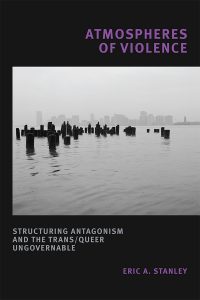
In this chat, they talk about racialized violence against trans/queer people as a foundational part of the modern US state; trace this in the formation of the US settler state and how it persists today. They also discuss the improvised ways trans and queer people learn and share survival tactics and thrive under these condition in order to envision a new world.
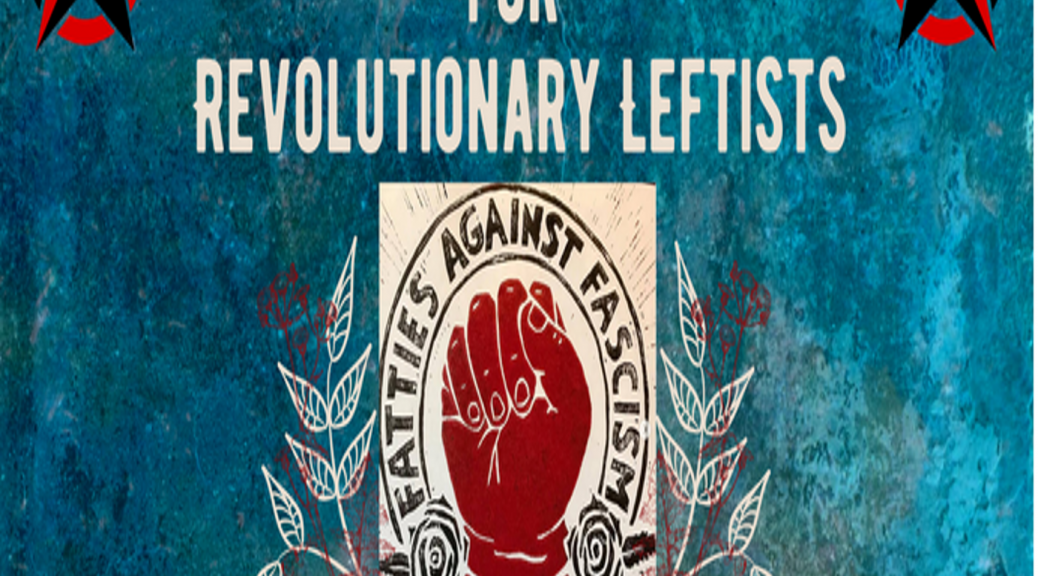
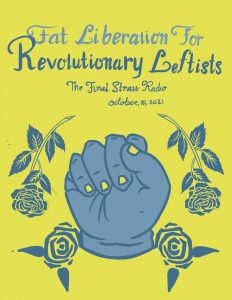
This week I am very excited to present an interview with Autumn (she/her/hers), who is an anarchist and scholar-activist, on Fat Liberation in all its many nuances, the pervasive, classist, racist, and colonial nature of fatphobia both in mainstream society and in far left spaces and thought, and the roots of Fat Liberation as a structure which originates and lives with Black, Indigenous, and brown, trans and disabled people. We also speak about Autumn’s syllabus entitled “Fat Liberation Syllabus for Revolutionary Leftists: Confronting Fatphobia on the Left AND Liberalism within the Fat Liberation Movement”. In this document, she compiles writings on the many aspects of fatphobia and gives her own analysis in bulleted form. This document is available for public use, and you can find it at https://tinyurl.com/FatLiberation!
– Hunter A. Shackleford “Hunter Ashleigh Shackelford (they/she) is a Black fat cultural producer, multidisciplinary artist, nonbinary shapeshifter, and data futurist based in Atlanta, Georgia … They are the creator and director of a Southern body liberation organization, Free Figure Revolution, which focuses on decolonizing antiblack body violence … Hunter illustrates the relationship between Blackness, fatness, desire, queerness, and popular culture.” (Instagram: @huntythelion)
– Dr. Dorothy Roberts’ work on CPS and how anti-Black racism and fatphobia infect this institution.
– Health At Every Size, evidence based medical paradigm that heavily critiques the social constructions of “obesity” and diet culture, and aims to present folks with a compassionate and inclusive framework for taking care of themselves.
– Caleb Luna (Instagram: @chairbreaker Twitter: @chairbreaker_) “Caleb Luna (they/them) is a fat queer (of color) critical theorist, performer, poet, essayist, cultural critic, and performance scholar. As a Ph.D. candidate in Performance Studies at UC Berkeley, their research focuses on performances of eating, and historicizing cultural representations of fat embodiment within the ongoing settler colonization of Turtle Island.
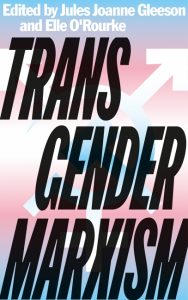
This week we’re sharing a chat that Scott Branson had about Transgender Marxism (2021, Pluto Press) with Jules Gleeson (co-Editor, Contributor) and M.E. O’Brien (contributor). Transgender Marxism brings together Transgender Studies and Marxist theory, exploring Transgender lives and movements and surviving as Trans under Capitalism. In the end, the claim of the book is that for Trans Liberation, Capitalism must be abolished. In this interview we talk about the: collective, material process of transition; trans visibility, assimilation and liberation; the history of Gay Liberation and Trans movements; being Trans in the workplace; care work and family abolition; and Trans solidarities against Capitalism and the State.
Jules Joanne Gleeson is a writer, comedian and historian. She has published essays in outlets including Viewpoint Magazine, Invert Journal and VICE, and performed internationally at a wide range of communist and queer cultural events. She can be found on Twitter at @SocialRepro and Patreon (QueerCom). Check out her awesome interview with Judith Butler that the GuardianUK censored due to critiques of TERFs, found in full at IllWill.Com.
M.E. O’Brien writes at the intersection of communist theory, trans liberation, LGBTQ social movement studies and feminism. Michelle is a co-editor of Pinko, and her writing has appeared in Social Movement Studies, Work, Employment & Society, Commune, Homintern, Endnotes and Invert. Found on Twitter at @GenderHorizon & on Patreon (MEOBrien).
This week on the show, we’re airing a portion of our 2018 interview with filmmaker and activist Yousef Natsha about his film about his hometown, Hebron, and the Israeli occupation of Palestine. We invite you to check out our full interview with him from March 25, 2018, linked in our show notes and we’re choosing to air this right now because of the flare up in violent evictions, home destruction and the assassination of around 100 Palestinian residents of Gaza by the “Israeli Defense Forces”. [00:10:24]
Then, we’ll be sharing a panel from the 2021 UNC Queer Studies Conference called “No Blank Slates: A Discussion of Utopia, Queer Identity, and Settler Colonialism” featuring occasional Final Straw host, Scott Bransen alongside E. Ornelas and Kai Rajala. This audio first aired on Queercorps, on CKUT radio in Montreal. If you’d like to engage in this project, reach out to noblankslates@riseup.net [00:24:05]
No Blank Slates: A Discussion of Utopia, Queer Identity, and Settler Colonialism
Presenter(s)
Scott Branson, E Ornelas, Kai Rajala
Abstract
Under the neoliberal regime of multiculturalism, the settler colonial project has relied on the assimilation of certain subaltern communities into its project for the effective dispossession and control of indigenous lands. This discussion will present ideas from a book project we are collaborating on in order to invite conversation around the intersection and tension around ideas of liberation and forms of appropriation and oppression. Our main challenge for radical queers is to rethink the kinds of futures we try to include ourselves in, and how our liberatory work can subtly replay exclusion and erasure. How do neoliberal utopian gay politics perpetuate settler colonial erasure and genocide? How do politics that seek inclusion and representation–in other words assimilation–disavow the work by indigenous self-determination movements, which are also poised on the frontlines of planetary self-defense? The workshop will be divided up into short presentations by each writer, followed by a structured discussion facilitated by the presenters.
Description:
The utopian project that underwrote the Canadian/American settler colonial states that still exist today was eventually transmuted into a neoliberal utopian sense of identity. The entire concept of space and self that we inherit is imbued with utopian longing for a time and place that we can fully be ourselves. This kind of rhetoric is largely at play in mainstream identity-based movements, like gay rights. But this longing often works in favor of the regime of violence and dominance perpetrated by the modern nation state. We can see how the attempt at inclusive representation of queer cultures leads to assimilation and appropriation. What gets included in regimes of representation ends up mimicking the norms of straight/cisgender heteronormativity, in terms of class aspirations, behaviors, and family structures. This therefore contributes to systematic erasure of Black and Brown queer folks, who are still the most targeted “identities” for state violence and its civilian deputies. With images of diversity that appeal to bourgeois urban gays, businesses and governments can pinkwash their violence.
A radical queer politics that relies on unquestioned utopian and dystopian visions risks aligning itself with a settler colonial imaginary of terra nullius or “blank slate” space. On the one hand, dystopian and apocalyptic visions perpetuate the unquestioned assumption that a societal collapse is impending, as if the continual degradation of human and more-than-human communities has not already arrived. Particularly dangerous in this assumption is the kind of crisis rhetoric that fosters opportunities for settler colonial sentiments of insecurity and, in the face of this insecurity, assertions of belonging and sovereignty in land and lifeways. Furthermore, visions of radical utopias as-yet-to-be-realized (or, as-yet-to-be-colonized) discount the ongoing presence of Indigenous alternatives to the current settler colonial dystopian reality, and instead preserves a view of geographic and social space as blank and ready to be “improved” with a “new” model.
Here we have a problem of erasure of the oppressions and resistances that have been ongoing in different iterations, in favor of the blank space of the utopian frontier. We argue against these linear progression narratives of societal and environmental collapse which promise to bring about a future idealized world of rainbow-diverse identities. Instead, we propose ways for radical politics, particularly those espoused by non-Indigenous people, to disavow such settler colonial mindsets. There are a few ways to offer a glimpse into the lived realities—what we might still call utopian moments—that make up the non-alienated, revolutionary life: queer and indigenous histories of resistance, rituals and moment of community care and mutual aid, and science fiction revisions of the world. We argue that this other world does in fact exist—has existed and has not stopped existing—if only in the interstices or true moments of communing and inhabiting the land alongside friends and family.
This is not an argument in favor of utopia, but one that seeks to bypass the utopian/dystopian divide. The world we inhabit is clearly dystopian for most, and utopian for some, and in many estimations, constantly on the verge of ending. The disaster scenarios, repeating the puritanical eschatology that helped settle the colonies in America, perpetuates the history of erasure of ways of life that aren’t in fact gunning for that disaster. We still argue that the purpose of dreaming, of envisioning alternatives, is to make action possible today, through recognition of the power we do already hold. Our discussion will interrogate the settler-utopian impulses that get hidden within apparently liberatory movements, such as radical queers and strands of environmentalism, as well as the way these identities and politics are represented in narratives of liberation that rely on the same logic they claim to oppose.
Bios
E Ornelas (no pronouns or they/them) is a Feminist Studies PhD candidate in the Department of Gender, Women, & Sexuality Studies. As the descendant of a survivor of the Sherman Institute, a Native boarding school in Riverside, California—and therefore robbed of cultural, linguistic, and tribal identity—E’s research interests focus on the continued survivance and futurity of BIPOC communities, particularly through the use of literature. E’s dissertation illuminates community-based, abolitionist-informed, alternative models of redress for gendered, racialized, and colonial violence by analyzing Black and Indigenous speculative fiction. When not on campus, E can be found reading feminist sci-fi, making music, baking vegan sweets, and walking their dog. [00:45:06]
Kai Rajala (pronounced RYE-ah-la) is a queer, nonbinary, white-settler of Finnish and mixed European descent. They are a writer, and an anarchist anti-academic working and living on the unceded territories of the Kanien’kehá:ka peoples on the island colonially referred to as Montréal, and known otherwise as Tiohtià:ke. They are currently pursuing studies as an independent researcher and are interested in sites outside of the university where knowledge production occurs. You can find Kai on twitter at @anarcho_thembo or on instagram at @they4pay. [00:57:28]
Scott Branson is queer trans Jewish anarchist who teaches, writes, translates, and does other things in Western so-called North Carolina. Their translation of Jacques Lesage De la Haye’s The Abolition of Prison is coming out with AK Press this summer. Their translation of Guy Hocquenghem’s second book, Gay Liberation After May 68, is due out next year with Duke University Press. They edited a volume of abolitionist queer writings based on two iterations of the UNC Asheville queer studies conference, due out with PM Press next year. They are currently working on a book on daily anarchism for Pluto Press and researching a book on the institutionalization of queerness in the academy. They also make books of poems and artwork. You can find Scott on Instagram @scottbransonblurredwords or check out sjbranson.com for more of their work or on twitter at @sjbranson1. [00:30:41]
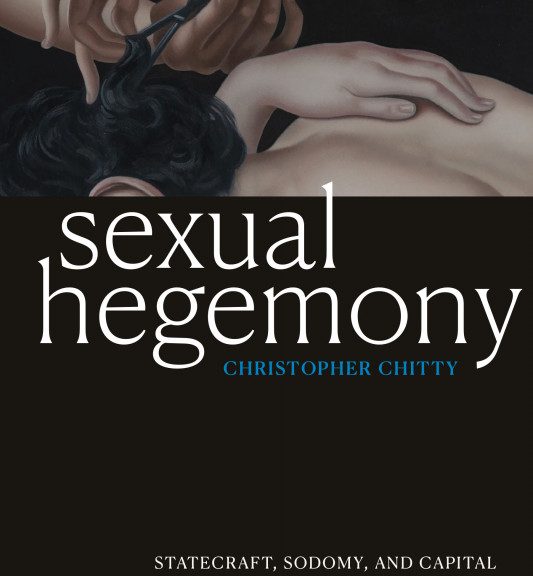
This week, you’ll hear Scott’s chat with Max Fox, editor of the late Christopher Chitty’s book, “Sexual Hegemony: Statecraft, Sodomy and Capital in the Rise of the World System”, published by Duke University Press in 2020. Max Fox is an editor of Pinko Magazine, a former editor of New Inquiry Magazine and translator of Guy Hocquinguem’s novel “The Ampitheatre of the Dead”. You can find Max on twitter at @mxwfx. Christopher Chitty was a phd candidate in the History of Consciousness at the University of Califronia, Santa Cruz.
Fox also notes that workers at the publisher, Duke University Press, are currently struggling to unionize. You can find out more about that struggle at DUPWorkersUnion.org
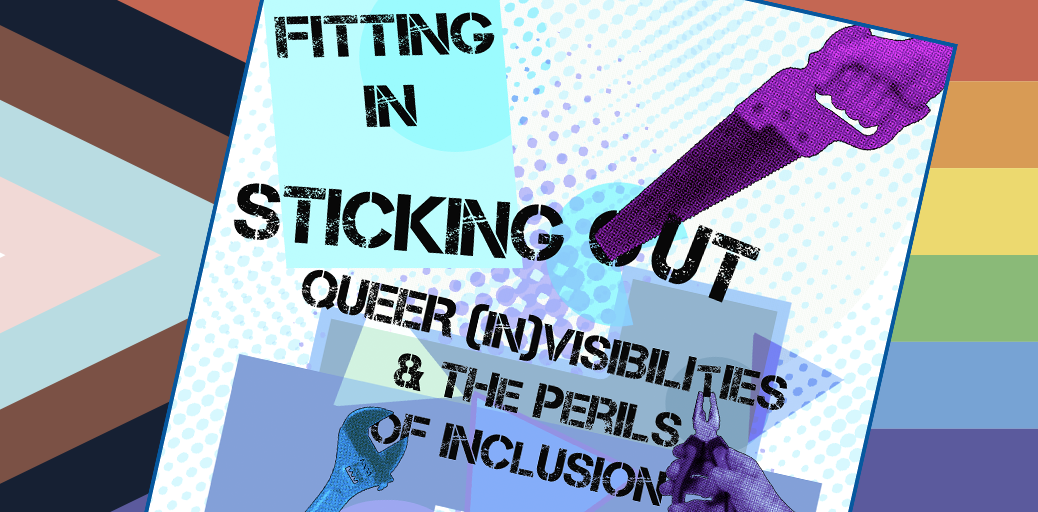
This week on the show, we bring you the audio of an activist panel from the recent Queer Conference held online by University of North Carolina, Asheville, in March of 2021.
The conference was titled Fitting In and Sticking Out – Queer [In]Visibilities and the Perils of Inclusion. From the panel’s description for the conference:
This panel brings together 4 local (Asheville, NC) and regional groups working at different intersections of queer community support. We will learn about the work these groups do, the particular issues that affect southern queers, the changes in visibility and inclusion for queer community, and the building of larger coalitions of liberation. Representatives from four organizations will be part of the panel:
Youth OUTright (YO) is the only nonprofit whose mission is to support LGBTQIA+ youth from ages 11-20 in western North Carolina. Learn more about their work on their website, and support them financially here.
Southerners on New Ground (SONG) is a nonprofit aimed at working towards LGBTQ liberation in the south. Find out more about their work on their website, and support them financially here.
Tranzmission Prison Project (TPP) is a prison abolition grassroots organization that provides literature and resources to incarcerated members of the LGBTQ community. Learn more about their work on their website and donate here.
Pansy Collective is a decentralized, DIY, queer, music and arts collective that created Pansy Fest, an annual queer music festival showcasing LGBTQ musicians from the south and rural areas, prioritizing reparations for QTBIPOC artists and community members, and community education and organizing around the principles of autonomy, mutual aid, antifascism, love, and liberation for all. Learn more about their work on their website, or donate here.
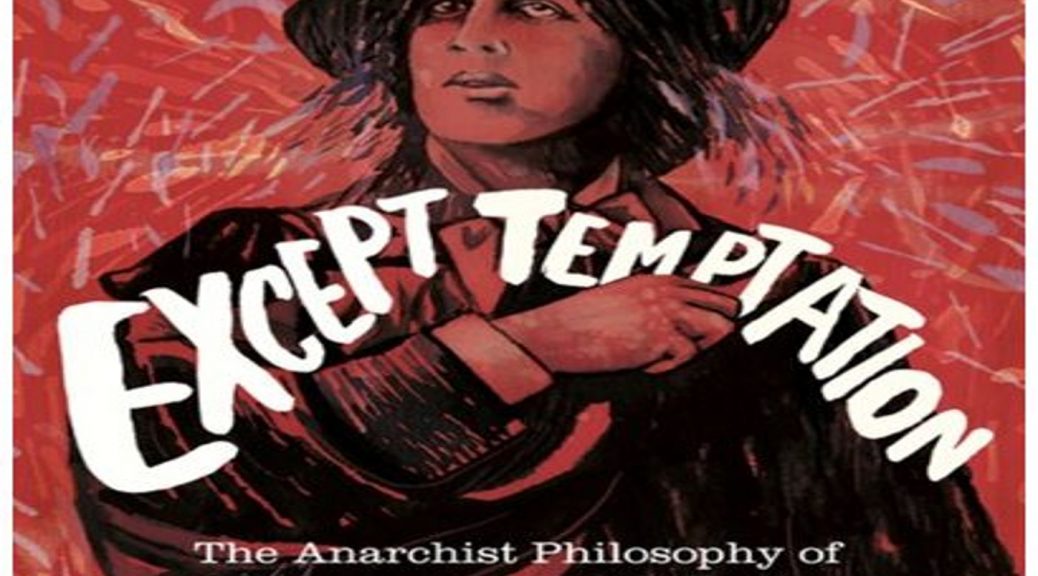
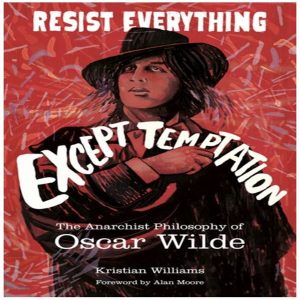
I found this interview extremely illuminating, perhaps like many other people who might not have strong ties to either academia or popular education models of learning, I had sort of written Oscar Wilde off as this kind of white dead rich guy who carried little to no relevance apart from a model of queerness that we could look back on. This interview very much proved that this isn’t the case, and that he and the circumstances around him very much influence how we as queers and as anarchists can sense historical threads that pull on our lives very tangibly today. Thanks a million to Scott for researching and conducting this interview!
You can learn more about the author, Kristian Williams, who is most known for his book Our Enemies in Blue, which is a critical history of American policing and police, at his website kristianwilliams.com.
Help Charlotte Jail Support Rebuild!
One announcement before we begin from our comrades at the Charlotte Uprising, Charlotte Jail Support has been getting extremely targeted harassment for some months from CMPD and the sheriff’s department. In times of rebellion or revolt, it is the support infrastructures that are often the most vulnerable to repression and violence. All of their supplies have either been seized or destroyed by the police, if you would like to support them re upping their much needed materials, you can Venmoing them @Ashwilliamsclt or Cash App $houseofkanautica.
This week Cypress spoke with Io Ascarium. The conversation covered their work as a member of ABO Comix Collective and their work in comics and print.
Io is “a maurading pillar of salt just doing their best to make what
could, in a sense, be described as ‘art'” (I love them dearly but could not bring myself to write this into the actual script).
ABO Comix Collective is a group of buds and comrades working to help LGBTQ and HIV + prisoners publish their art and stay connected to the outside world. They also provide direct material aid to those inside and spread the good word of prison abolition. Their 3rd volume was released for presale earlier this month. All proceeds go back to the contributors.
This week we are super pleased to present an interview done with Sima Lee, who is a queer Afro-Indigenous hip hop artist and community organizer of long standing, about a recent raid that occurred at Maroon House in DC this March. We speak about Maroon House, its story and what it is in the process of becoming, the ask for support in helping this movement build and heal from the brutal police repression, her newest album Trap Liberation Army, and many more topics.
Sima Lee has given some interviews recently about her political trajectory, her life, and relationship to anarchism in detail. Rather than having a repeat of those words, we are going to link her past interviews below!
Link to Bandcamp where there was an ask for monetary donation to help support the Maroon Movement and the Food, Clothing & Resistance Collective.