Category Archives: Race

Tariq D. Khan on Americanism and Red Scares

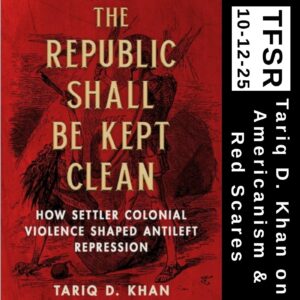
book cover of "The Republic Shall Be Kept Clean" featuring the text "TFSR 10-12-25 | Tariq D. Khan on Americanism & Red Scares" over a political comic of a greek soldier labeled civilization attacking a woman with serpentine qualities labeled Anarchy
Download This Episode

A conversation with Tariq D. Khan, author of The Republic Shall Be Kept Clean: How Settler Colonial Violence Shaped Antileft Repression, out from University of Illinois Press in 2023. In this conversation we talk about the connections between the anti-Indigenous motivations of the genocidal frontier wars in the US and the inward turn to heretical movements pushing for freedom for the laboring classes through the great upheavals of the period known as the Nadir, between the end of post-Civil War Reconstruction and the 1920’s. We talk about the roots of anti-Leftist violence of the various Red Scares and intersections with the institutions and psychology of white supremacy settler colonialism as well as the importance of resistance and education.

  • Transcript
  • PDF (Unimposed) – pending
  • Zine (Imposed PDF) – pending

We hope you enjoy, and thank you for supporting this project!

A couple of podcasts we like (that have patreons where you get extra goodies) that have with related episodes:

. … . ..

Featured Track:

Written In Red by UNWOMAN (written by Voltairine DeCleyre)

. … . ..

Transcription

TFSR: Thank you for joining us, Dr Khan. Would you please introduce yourself to the audience with any name, location, or affiliations that make sense for this interview?
Tariq Khan: My name is Tariq Khan. I’m a lecturer in the Department of Ethnicity, Race, and Migration at Yale University in New Haven, Connecticut.
TFSR: Awesome. Thank you so much for being here. I really appreciate it, and I really appreciate your book. We’re here to talk about the current state of the USA, where we stand politically, and with the current crisis. This is backed by a lot of the history that you document in The Republic Shall Be Kept Clean: How Settler Colonial Violence Shaped Antileft Repression, out in 2023 from University of Illinois Press. I wonder if you could tell us a bit about the book and the story that you tell in it.
Tariq Khan: Sure. This book was a long time in the making. I actually started thinking along these lines way back when George W Bush was president. I was involved in the anti-war movement, and a lot of organizing around issues of racism, war, anti-imperialism, and all that sort of thing.
I was living in the Washington, DC area, and there were many hate crimes, especially targeting Muslims or people who were perceived as Muslims. For example, there were a lot of Hindus and Sikhs, Jews, and other people who weren’t Muslim, but by what they looked like, people thought they were Muslim and targeted them for hate crimes as well. As a result of the invasion and occupation of Iraq, there was a lot of language around at that time of “civilization versus savagery.”
There were advertisements in the Washington, DC, subway system, also in New York, and also on some buses in California that I heard a Zionist group had paid to put up that said: “In the war of the civilized man versus the savage, support the civilized man.” Groups like the Council on American Islamic Relations were pointing out to the transportation authorities that this is hate speech. It’s going to contribute to a climate that’s conducive to hate crimes. And sure enough, in the New York City subways, in the same place where those kinds of ads were running, a woman shoved a man in front of an oncoming train and killed him. And when she immediately got caught by the police, she just said, “I’ve been beating them up ever since they attacked us on 9.11.”
All those incidents made me think about the language of civilization versus savagery. It started as an exploration of that language. Then it grew into a bigger project, because it led into a longer story of US settler colonialism, and the relationship between US outward imperialism and outward war to inward repression.
The book examines that relationship. It’s arguing that these are not separate stories. In the history of labor and the working class, many historians use euphemisms, like westward expansion. They treat the story of westward expansion as one thing, and stuff going on in US industrial centers as a different story. I’m saying that it’s actually the same story. So that’s what I’m doing in this book.
TFSR: I think that’s really interesting, when you’re talking about the outward war and the inward repression… The title of the book talks about anti-left repression, but it also focuses on the topic of settler colonial violence. When you’re talking about westward expansion, and that period of time, a lot of the political discourse and a lot of the debate at a higher level was about where are we going to allow chattel slavery to exist? Maybe there are treaties with the neighboring peoples, and there’s the tension and the conflict for the white settler to be able to expand and take more land. A huge amount of the “founding fathers” and the early presidents of the country made their riches off of enclosing, stealing, and emptying, to some degree, indigenous lands, and then, with the support of surveyors, they became real estate moguls.
I really appreciate the fact that the book doesn’t just focus on how leftists have had a hard time, but is looking at “Why? Why have anarchists and communists been focused on? What elements of the American psyche, or the US psyche, are being activated through this? What are the grievances or the dangers that are being pointed to with these ‘alien subjects’, and what’s the perspective that’s doing the alienating? Who’s the central character in this?” If that makes sense. I’m really hoping to pursue some of that.
I wanted to speak a bit about the use of the term ‘clean’ in the title of the book. What and who were considered clean from the perspective of the book, or from the historical read, and who was applying the term?
Tariq Khan: That language of peoples who are clean and peoples who are dirty is a staple of white supremacy, but it’s a weird way of talking about entire groups of people. When you see groups of people described as dirty, something is going on on a psychological level with the people who are using that kind of language. Anthropologists have written about that kind of language of purity and most of the anthropologists actually were citing what we call the father of American psychology, William James. He looked at what dirt is. Dirt is matter out of place. If hair is on your head, nobody is like, “Ooh, gross. There’s a hair on your head.” But take out one of those hairs and put it on a dinner plate, and it’s like, “Ooh, there’s a hair on my plate. Now your plate is dirty.” It’s out of place, that’s what makes it dirty.
When we’re looking at peoples, essentially the notion of dirt implies a kind of system in existence, and then dirt is a contravention of that system. That’s how William James talked about it. And when they’re calling peoples dirty, they’re talking about them as out of place, peoples who don’t belong here. So a lot of these migrant groups coming to the United States who are dirty peoples who we need to send back. Or even indigenous peoples who actually belonged here more than anyone else, and yet they were being called dirty, but they were being described as out of place in time, as belonging to the past, or evolutionarily out of place.
When you see the language of clean and dirty, then it almost always accompanies genocidal policies, policies of expulsion, containment, extermination, and removal. The title of the book, The Republic Shall Be Kept Clean, is a quote from US Congressman William Vail, from the time of the deportation of some 250 anarchists, many of them Jewish and all of them born within the borders of what was then the Russian Empire. As they were being deported on the SS Buford, he said, “The cancer is being removed, the Republic shall be kept clean, and in its cleanliness shall endure.” This is before the Nazis and all of that. This is the US American language that’s rooted in US settler colonial history.
TFSR: That’s interesting. I don’t want to focus on the Nazis because of the centrality of the story that you’re telling. But I think a lot of people don’t realize how central the actions, the ideology, and the mythos of the US settling and the conquest of the West were to Germany at the beginning of the 20th century, and also to Hitler personally. Would you like to say a few words about the modeling of what happened during the Holocaust, during the Shoah, and the relationship to the eugenicist approach that the US had already embarked on?
Tariq Khan: Hitler and some of his higher-ranking guys were very open about the fact that they were learning from the United States. They pointed to the US genocide against indigenous groups as a great example of how countries should be dealing with the undesirables. In the United States, they have this language of the white man taming the Wild West. Hitler even used that language. Drawing on that, he talked about how the Nazis are taming the Wild East. Looking at the undesirable peoples, the Jews, the Roma, and all the different kinds of groups that the Nazis were going after.
They were quite open about the fact that they were learning from US history, but also from US scholars, United States eugenicists. I’m at Yale University, which had one of the major eugenics research institutes in the world, the Institute for Human Relations, and the American Eugenics Society was right here in Yale. All these Yale guys were the leaders, leading intellectuals of the eugenics movement. And they were in contact with Nazi officials. These guys in the American Eugenics Society and at the Institute for Human Relations were writing letters back and forth with Nazis. They were being praised by Nazi officials for the great work that they were doing. It’s very well documented that the Nazis were absolutely drawing on US settler colonialism, US racism, and US Jim Crow. European fascists were drawing on all of these unique versions of oppression that existed in the United States and were trying to craft policies along the same lines.
TFSR: The western expansion, fundamentally, was reflected in the Lebensraum idea that a Nazi Empire had of clearing space for the living room for the people that belonged there. Reflecting again the expansion of settler colonies, the pushing of indigenous people into non-existence, or across borders, or into these reservations, these concentration camps, in a way.
Tariq Khan: Absolutely. Concentration camps long predate the Holocaust. The Spanish colonizers were using concentration camps in the Americas, and later, when the United States was formed, they were also using concentration camps for indigenous groups. They were using concentration camps in their invasion of Cuba. Even the Germans had been using concentration camps in Southwest Africa in the 1880s, 1890s.
In the book, I talk a little bit about Aimé Césaire and his notion of the boomerang effect of imperialism and how Césaire saw fascism. When the colonizing states start doing inwardly, within their own countries those same things they are doing outwardly to colonized populations, to racialized populations, then we call it fascism. But for the colonized, this is what it’s always been, he says.
TFSR: To the other side of that question, if the determination that something is unclean, something is dirt, is because it’s matter out of place, or it’s people who don’t belong in a place, can you talk about the voice who is speaking the word “clean”, of what is in opposition, who is considered to belong in this place, and by what right?
Tariq Khan: Everyone, all the way from the President of the United States, down to your lowest ranking police officers, to your Indian Agents, they’re all using this language of cleansing. You still see it today with police. They say, “We’re going to clean up the streets.” That’s where that idea of cleaning up the streets comes from. We’re getting all the undesirables out of here.
When we look at the history of the police and see how police were rooted and evolved out of slave patrols, frontier lynch mobs, vigilante gangs and things like that, who literally were involved in genocidal campaigns. [When we see them] using the language of, “We’re cleansing the frontier”, or “We’re getting rid of all of these dirty peoples.” That’s where that language that the modern-day police use comes from. It’s all rooted in that history. Even the whole idea of the police as the thin blue line between civilization and savagery, is the settler colonial rhetoric.
TFSR: Can you talk a little more explicitly about what the civilization is that they’re imagining? I know that there are certain esoteric and fringy visions that believe that white people are the lost tribes of Israel, and this is the promised land that goes back to the Bible. The language that the Puritans spoke in some of the earlier colonies talked about “We are building a city on a hill. We are fulfilling God’s dream by being here, and therefore we are written into creation as belonging here and beyond that.” Obviously, there are the Papal bulls that say that these lands are determined to fall under Christendom, to be in the control of civilization and righteous, upright values, I guess.
Tariq Khan: That’s all part of the ideological structure of capitalism and settler colonialism. Some people use the term “colonial racial capitalism”. My story starts around the 1840s. It’s largely [talking about] people who are heavily invested in industrial capitalism, who are the people in power. I talk about people like John Hay. I use as an example this person who had a lot of influential positions for his entire adult life. Starting as one of Abraham Lincoln’s right-hand men, and then years later, serving as Secretary of State. And in between, having really influential positions in US media, being an editor at the New York Tribune, which was the highest-circulation newspaper in the United States at the time. That was the epitome of what the mass media was back then. It was print culture.
He talked about civilization in very clear terms, simply meaning private property. And they used racialized terms for that. So they would use terms like “the white man’s system of private property.” They would use these racist terms like “the red man’s system of communism versus the white man’s system of private property.” They were racializing economic systems. Capitalism was seen as white private property, was seen as a white system. The “white man’s system of agriculture” was one of the terms you see. You would see a lot of language like “the white man’s system of agriculture, the white man’s system of industry.” And that basically meant capitalism. So that’s what civilization was.
Even when we look at some of the attempts to supposedly civilize indigenous groups, you’ve got things like the Dawes Act. The whole notion of the Dawes Act was that we’re going to take land that is held in common by indigenous groups, and we’re going to break it up into private lots, and we’re going to civilize them by assimilating them into the system of private property. They were very clear in the way they talked about what civilization meant. It meant private property, it meant capitalism. And savagery was pretty much anything that threatened the system of private property.
TFSR: Listeners are likely familiar with the term “Red Scare” relating to the period around the early 1950s, also known for the prominence of McCarthyism and the House Un-American Activities Committee. They may even be familiar as good anarchists many of us are with what’s usually referred to as ‘the First Red Scare’ around the period of the Palmer Raids.
I wonder if you could talk about what you point to as an earlier Red Scare, and talk about the interesting overlaps and precedents it provides to the later examples. Just to point out again, if listeners missed when you were talking about the “communism of the red man”, you found an early application of the term “communism” that wasn’t in the popularized or in the Marxist or anarchist usage of it, right?
Tariq Khan: Yeah. This is one of the things I’m arguing in the book. Many indigenous studies scholars have talked about how settler colonialism cuts to the core of what the United States is. And when we take that idea seriously, and we see settler colonialism as this major category of analysis, the periodization changes.
As historians, we have certain ways that we periodize US history, and we break up textbooks in these certain ways. There are some good works on anti-communism; I’m not criticizing these works. I found a lot of these works very useful, but most of them start around post-World War Two period with the Cold War. Some of the better ones will go back to what you called the First Red Scare, the Palmer Raids, and all of that sort of thing. But the time they call the First Red Scare is the time period that’s the end of my story. Because when we’re taking settler colonialism more seriously than anti-communism looks different.
I looked at the Congressional Record, and I was looking for the earliest instances of modern anti-communist rhetoric that we know of. When does that start? And it goes back into the 1840s. As soon as the word ‘communism’ enters the lexicon, “anti-communism” also enters the lexicon. The word “socialism” had been around for a while, at least since the 1820s, maybe a little earlier than that, with a lot of utopian experiments and different kinds of religious versions of socialism. And it was a pretty big umbrella; it meant a lot of different things. In the 1840s, it was the German socialists who started using the word “communism”. Even before Marx, there were a few folks who were [using it]. I think I mentioned August Becker’s book ‘What did the communists want’ that came out in 1844, I think. And, of course, the ‘Communist Manifesto’ hits the streets in 1848, and Marx is giving talks in 1847 using the word ‘communism’.
This stuff is being reported on in US newspapers. So the literate public in the United States would have been familiar with these terms. The labor newspapers covered the activities of socialists and communists in Europe. Even though the labor movement in the US at the time wasn’t really that radical, they were sympathetic to some of the European radicals and reported on them. And so the word ‘communism’ enters the public consciousness in the United States in the late 1840s. And immediately, congressmen, especially the pro-slavery congressmen, are starting to use anti-communist rhetoric to make pro-slavery arguments.
In 1848, the United States stole over 500,000 square miles of land from indigenous groups. We say it was from Mexico, but it was actually not even Mexican land. Nominally, it was Mexican land, but in reality, those were indigenous territories that did not belong to the United States or Mexico. The United States takes all of that land, and now they have all of this land that is populated by different indigenous groups who are not citizens of the United States. And all of these questions about what they call “the Indian problem” arise. But also problems about what to do with all this new territory? Is this going to be free states or slave states?
The pro-slavery people were really pushing the fear of communism. I mentioned in the book one example from the Congressional Record where this congressman is using what almost sounds like Marxist language, but he’s twisting Marxist language to make a pro-slavery argument. Marx was giving talks as early as 1847 using language like…
TFSR: Wage slavery…
Tariq Khan: Right, wage slavery, but also that the interests of the proletariat and the bourgeoisie are diametrically opposed, the interests of capital and labor are diametrically opposed. And this southern congressman, who would later become one of the leaders in the Confederacy, says, “Look at these northern cities where they have the wage system. You have all of this conflict between capital and labor.” And he says, “that’s because they have the wage system, and so then that’s going to become fertile ground for communism to grow.” And he says, “Here in the South, we don’t have conflicts between capital and labor, because enslavers own both. And so we have harmony between capital and labor. So the best way to protect the United States from communism spreading is to let these new territories be slave states.” You’re getting arguments using communism as the thing that slavery will protect us from.
That’s 1848, and then you also have US Indian agents who are using this kind of anti-communist rhetoric in the North. You can also find it in the Congressional Record, in their reports to Congress. They were supposed to be getting the Dakota Sioux people under control, and they’re having a really hard time doing that; they’re not able to. So they’re reporting back to Congress saying, “It’s impossible to civilize them because of their system of communism.” That is the first instance I see of the term “system of communism” in the Congressional Record. And they’re talking about the Dakota Sioux. They’re not talking about European Socialists or anything like that. Essentially, the argument is that they have too much freedom, too much democracy. They share resources, and they share power. And these Indian agents translated that as a system of communism.
There is a tactic that they would often use, that colonizers have used all over the world as long as colonialism has existed. You try to hand pick someone from the colonized population who you think is a leader, you manipulate them and maybe shower favors on them, give them privilege in certain ways, and then you use that leader to control the rest of the group. They were complaining that they’re trying to do that with the chiefs, and it’s impossible, because the chiefs don’t have power. Many white settlers had this false idea that Indian chiefs were like dictators, had absolute power, and whatever they said went. And they were finding that the system was actually far more democratic. They would say, “We call the chiefs to meetings, and they bring all of these Braves with them, who make sure that the chief doesn’t make any agreement that goes against the wishes of the people.” It’s basically an argument of “they have too much democracy, our tactics aren’t working, and it’s because they’re communists.” Essentially, they’re saying they can never be civilized because of their system of communism.
If you can’t be civilized, then what’s the solution? The solution for settlers, for colonizers, is extermination. Which is exactly what they do. Another thing I talk about in the book is that anti-communist language almost always accompanies violence. It’s not just rhetoric. And so you had a genocidal campaign against the Dakota Sioux conducted by the formal forces of the state, but also by just regular white farmers. Little Crow was murdered by a farmer and his son, who found him when he was gardening, and they just straight murdered him and scalped him. And then the father got paid $500 from the state, and his son got paid $50 for the scalp, which was a lot of money back then. That kind of language of civilization versus savagery and anti-communism accompanies exterminationist policies in the real world.
TFSR: I thought it was interesting also how you had pointed to the way that the anti-indigenous rhetoric swung back in public imagination towards anti-communism. Like the portrayals following the Haymarket Affair in Chicago. The stories that were being told, the books that were being written, and historical reviews by the historians of the Chicago police departments, historians of what policing around the era of these massive strikes was like, were referring to it constantly as the Wild West. Not only calling communists, anarchists, or socialists “red” by the color of their flag, but also basically calling them “indigenous and red” in that racialized way. To say this war for Civilization includes the extermination or the control, or the civilizing of these dangerous proletarians, often foreign-born, who are undermining our possibility of civilization. Here, we’re basically the same as those fighting in the western territories to help settler expansion.
Tariq Khan: Absolutely. It’s pervasive in the police literature. We have to remember that at this time in history, in the 1870s, 1880s, 1890s, the police were a relatively new institution. A lot of the population didn’t respect the police, and they didn’t see them as legitimate. They saw them in many ways the way that many people nowadays see ICE. ICE is a pretty new agency, and when they’re sending ICE thugs into cities, they are facing all kinds of resistance. People don’t see these ICE guys as legitimate authority. That’s how these first police departments were in the 19th century. They were constantly fighting the battle for legitimacy and fighting this public relations battle.
Because settler colonialism is so core to US culture and politics, the police in the United States very explicitly liked to cast themselves as the Hardy white men of the dime novels. The Hardy white men taming the Wild West. The police put themselves into that same narrative as a way of making them seem more legitimate. History of the Chicago Police, a book written in the late 1880s and put out by the Chicago Police Department itself straight up uses that language. It says, “The first police in Chicago were the men of Fort Dearborn, who were fighting the Indians. Now we’re fighting the anarchists. Nowadays, the anarchists are our Indians.” They use that kind of language. They quite correctly, actually, pointed out that the origins of the Chicago Police were genocidal frontier Indian killers.
Fort Dearborn was established in 1802 or 1803 for the express purpose of exterminating – that’s the language they used – exterminating indigenous groups from the region to make it safe for white settler colonization. That’s the origins of Chicago. And the police point to that as the origin of the police. Captain Shack, in his very influential book on anarchists, was also very explicit. He would say, “Like a drunken Comanche about to attack the home of a helpless settler, the anarchists surrounded the police station.” He used that kind of language. And then he would say, “the Chicago reds.” He would use this term ‘reds’ and at certain points it wasn’t clear which “reds” he was talking about, because he was going back and forth between indigenous references and anarchist references, using the term “reds” for both. At some points, you don’t know which “reds” he’s talking about.
TFSR: Throughout the book, you repeat the point that the anti-black and anti-indigenous violence that has been wielded by the state and powerful classes since the foundation of the British colonies, and depending on where you are, I guess also the Spanish or the French, has in many cases different motivations and limits than the violence imposed on political radicals. Though sometimes it’s overlapping motivations and language. Can you talk about the importance of distinguishing differences between class hatred and race hatred and race construction in US History?
Tariq Khan: The line between these categories, race and class, is not a hard line. Certainly not in US history, because class has often been a racialized category. I mentioned Walter Rodney in the book. Walter Rodney talked about this in the case of Guyana. Talking about “how do we construct race?” He’s making a Marxist argument that the mode of production of a society conditions how a society constructs race. So race and class are always sort of co-constitutive and connected. Fanon also talks about race and class as co-constitutive categories.
Walter Rodney gave one example of the racial system in Guyana, where you had black landowners who exploited Black workers. You had Indian landowners who exploited Indian workers. You had white land owners who exploited many different racialized groups of workers. But when the British brought in Portuguese from the Azores, landless peasants, who came into the society as bonded laborers, Walter Rodney talks about how the Portuguese were considered a separate race from whites. And he says they were considered a separate race from white because they came into society in the position of subordinated labor. This marked them off as a separate race, because whites were the landowners, and these were not landowners, so they couldn’t be white in that case.
In the United States, we had a similar phenomenon with different groups. There was a point at which Irish people were considered something other than white. There was a process, Noel Ignatiev, in his classic book How the Irish Became White, saw a similar thing with Italians, who came into the society as subordinated labor and were considered something other than whites. The process of becoming white was also a process of upward class mobility. I don’t really conceptualize a very hard line between class and race. We always have to talk about these things as co-constitutive categories that condition, produce, and reproduce each other.
But I do say this at a few points in the book, because I don’t want to be misunderstood. I’m definitely not arguing that anarchists became the new Indians or something like that: anti-indigeneity never ceased, even in the present day. Settler colonialism still exists. Anti-indigenous policies and attitudes still persist. It wasn’t like anti-communism or anti-anarchism replaced anti-indigeneity. But what I’m saying is that because anti-indigeneity and settler colonialism are so foundational to US culture and politics, that then conditioned the form that anti-communism would take.
How did the state learn how to do things like crowd control or how to suppress an uprising? They learned that through their anti-indigenous violence. So the anti-indigenous violence became the template for how you can deal with these multiracial crowds of what the police called “whooping anarchists” in cities like Chicago.
TFSR: Also, the lineage of the police coming out of slave patrols, or the control of Black enslaved populations in many parts of the country.
Tariq Khan: Even in terms of who you are allowed to use the types of violence that they used against labor strikes were the same tactics and even the same weapons? And in some cases, the very same units, military units that they were using in the so-called Indian Wars.
I have a chapter on the 1877 railroad uprisings because I see 1877 as a really significant year for a few reasons. They’re pulling units who are involved in indigenous extermination away from what they call the frontier, back into cities like Chicago and Pittsburgh and other places where the railroad uprising is going on. Those same units that had just been attacking indigenous groups are now using their same weapons, their same artillery rounds, their same rifles, their gatling guns (I write a lot about the gatling gun), they’re using the weapons of colonial control within US cities to put down the railroad uprising.
The property owners, the railroad guys, and the people who are allied with them, the big industrialists, are talking about the railroad war the same way they’re talking about what they call the Indian Wars, using the same language. You open the page in the New York Tribune, there’s one article, one column that says “The Indian Wars”, and right next to it is a column that says “The Railroad Wars”. They’re right side by side, and they’re talking about these things as if they’re part of the same thing.
TFSR: Considering the current political climate under the second Trump administration, which has declared war on what they call the radical left, we’re in an interesting position to examine some of the history that you cover in this book and its echoes and emulations today. I’m not a fan of tight historical comparisons, which tend to flatten and shove square pegs into round holes to make a point. But the current administration has telegraphed some of their visions, and I was hoping that maybe we could speak about the current administration’s declaration of war on the radical left and Antifa as internal enemy, and lessons that we can take from history to apply to this current day.
Tariq Khan: I was writing this book during Trump’s first term in office, and I felt that so much of the history that I was writing about was playing out in real time, with a lot of the stuff that was going on. I actually included a lot of that stuff in earlier drafts of the book, and I had to cut most of it out just for length. They [the publishers] didn’t want the book to seem too dated to that one period of time, but I definitely see this book as extremely relevant to a lot of the stuff we’re seeing the Trump administration do. And relevant even to a lot of stuff that was going on under Biden as well. This isn’t just a Republicans versus Democrats thing.
Trump absolutely draws on these myths, the settler colonial mythology. He’s put up the picture of Andrew Jackson in the White House. I remember him standing in front of the picture of Andrew Jackson, announcing his crackdowns on immigration, the children in cages, family separation policies, and things like that. He’s giving those speeches with a picture of Andrew Jackson right behind him, definitely seeing himself as a kind of Andrew Jackson’s reincarnation, as many white supremacists in the United States. Andrew Jackson is a hero to them, as one of the architects of the Trail of Tears, a violent slaver and racist.
When Trump talks about the left, he uses a lot of the same language that the people I talk about in my book use, that language of pathologization, of civilization and savagery. You find the Trump administration using a lot of that exact same kind of language that Theodore Roosevelt was using. Trump is talking in those same kinds of terms and pushing similar kinds of exterminationist policies.
TFSR: Also, with the example of troops being called into Portland, Oregon currently, because it’s “a dirty and war-torn city.” While we’re having this conversation in numerous cities around the country, like Memphis, notably in Chicago, there’s been a lot of coverage of military raids onto apartment buildings and the detention, arrest, killing in a few cases of folks who are suspected of not having documentation or being immigrants or overstaying visas or just applying for citizenship. That language is still being employed in a very similar way to what you document in the book, in terms of justifying the sort of violence that was being brought against indigenous communities throughout the majority of US history.
Tariq Khan: Sure. Essentially, what we’re seeing is a straight-up military invasion of US cities ordered by the President of the United States. Many people think that this is a new thing, but it’s not a new thing. In the time period I’m writing about in my book, they were doing similar things, sending troops into cities to “restore order”, and essentially carrying out campaigns of ethnic cleansing. And that’s what I see ICE is doing now.
ICE is a force of ethnic cleansing. They’re grabbing people who have green cards, people who are here legally, just based on what they look like. We’ve had people who are documented put into immigration detention. They’re not even going after just undocumented people. They’re going after people who look a certain way. People who have citizenship, and people who are military veterans have been scooped up by ICE. ICE is doing this ham-fisted repression, very similar to what we saw troops doing in cities in 1877 and in the 1880s and in the early 20th century. You see similar things to what we’re seeing now in many cases that I write about.
It is crucial to recognize how important it is for people who are trying to fight this kind of repression to be in solidarity with the anti-colonial struggle. When we’re not in solidarity with anti-colonial struggle and don’t recognize the connections of what we’re seeing to the larger picture of empire and settler colonialism, we end up in a weaker position. A really solid example of this is Trump’s attacks on universities. Those attacks started while Biden was president of the United States, and it was the attacks on the pro-Palestine student movement. The good and liberal centrists were calling on the state to crack down on these universities, Democrats were part of that crackdown on universities. So when Trump came in, he was so much better positioned to attack universities, because the Democrats who were not in solidarity with Palestine’s anti-colonial struggle had already put the universities into a weakened position. And everyone was in a much weaker position to fight back.
I think that’s one of the lessons of the book: we have to look at the bigger picture of colonialism and imperialism, and whatever our movements are, whether we’re talking about the labor movement, or something else, we have to be in solidarity with anti-colonial struggle and anti-racist struggle.
TFSR: Absolutely and very well said. This is pivoting a little bit, but much of the violence that you describe in the book, often in brutal detail, is presented as having a few levels of meaning and purpose, including the eradication [of] or harm against the target. But also the reassertion of identity among the perpetrators, an internal disciplining. Can you talk a bit about this role in lynching, and additionally, the relationship between vigilantism and the legal application of force in the implementation of so-called US civilization?
Tariq Khan: One of the arguments of the book I’m making is that the right-wing mob, or the vigilante mob, whatever you want to call it, is the cutting edge of official US policy. I have a lot of examples. What the state eventually institutionalizes is actually what the white supremacist mobs are doing on an extralegal level. So much of the genocide against indigenous groups was not carried out by the official forces of the state. It was carried out by armed settlers. And the leaders back then understood that.
Theodore Roosevelt absolutely understood that. Back in the 1880s, before he was president, Theodore Roosevelt wrote volumes of books on US history. He was somewhat of a historian himself, though his books are saturated with racism. He was a hyper-racial thinker, obsessed with racial difference and racial categories. Theodore Roosevelt talks about the colonization of the US South, and he talks about how “it’s the armed settler who announces the permanent dominion of the white man.” That’s the term he used –‘the permanent dominion of the white man.” Because, he argues, you can send the army in, and they can win some battles, but then they leave. How do you actually hold the land and say this is the United States? You have to have armed settlers who live on that land, and that’s when you have the permanent dominion of the white man.
Roxanne Dunbar Ortiz, in her book Loaded: A Disarming History of the Second Amendment, has written about how the Second Amendment was actually based on a lot of already existing policies and practices, some official, some unofficial, of white settlers who needed to be armed vis-à-vis indigenous resistance to colonialism and black resistance to slavery. That’s actually the basis for what would later become institutionalized as the Second Amendment. White mobs play a big role in this book, in a lot of the violence that I’m writing about. They play a big role in antiBlack violence and the maintenance of the system of slavery, anti-indigenous violence, settler colonialism, and all that. But later, white mobs are also going to play a major role in industrial control and keeping these migrants, working-class people in line: to keep them producing, keep them making profits for the capitalist class. They’re the ones who oftentimes go in to break up strikes. It’s oftentimes not the formal police, but the mobs of white men.
I write about groups like the American Legion, which are basically lynch mobs. A lot of what these white mobs do then gets institutionalized by what the police do, or actually the formation of the FBI and things like that. A lot of what the FBI took on was what white mobs were already doing. These things get written into law. I talk about the Congressional Record and how they’re reading off all of these white men’s fraternal organizations who want the state to make laws to crack down harder on the anarchists. But those groups that they’re reading off were the members of the lynch mobs. I say that the lynch mob is the cutting edge of US policy. If you want to see the direction US policy is going, look at what the white mobs are doing.
A modern-day example is the January 6 attack on the Capitol. That mob that broke the law and tried to overthrow an election, they are getting everything they wanted now through the state. They’ve all been pardoned, and now they’re getting all the policies they want through the state. What that mob was trying to do extralegally is now being institutionalized by the Trump administration. I have examples of that throughout the book: the white mob does it, and then the state institutionalizes it. But there’s a very blurry line between vigilante violence and state violence. I actually argue that the vigilante violence is state violence.
That’s not an original argument. A lot of scholars in the Black Radical Tradition have argued that since the 19th century, in the early 20th century. One of the people I cite is the great Black radical sociologist, Oliver Cromwell Cox, who studied lynching and racial violence. When he talked about the lynch mob, he used the phrase, “the whip hand of the ruling class.” Some of the early studies on lynchings found that it wasn’t the so-called alienated backwoods rednecks that were doing the lynching. The most enfranchised members of society were the leaders of these lynch mobs. They were property owners, the real estate men, bank owners. Sometimes, you’d have the sheriff and members of law enforcement as members of these mobs. The most enfranchised people in society were forming these lynch mobs. They weren’t seen as criminals. A lot of the conservative newspapers praised the lynch mobs as the heroic white men who are saving civilization because the state’s too weak to do it right now, so they have to stand up and do it themselves, kind of a thing.
TFSR: That actually started getting to the respectable mob portion of it. There’s the way that mob violence does the work of Power already, because it’s constituted of elements of the powerful classes. But one element that I think you touched on, and I found pretty interesting as someone who, as a white person, is very fascinated by the construction of whiteness and the reconstruction of whiteness – this was not exactly the point of the book – but the reconstruction of the boundaries of who is in the in crowd, who’s in the out crowd…
Tariq Khan: You’re talking about how the mob isn’t simply about enforcing the group that the mob is going after, but it’s also about enforcing a kind of conformity to white supremacy amongst the white or amongst the dominant population. Yeah, you definitely see that. What some of the early lynching studies showed was that lynchings happened most in places where there was what the sociologist Kai Erickson called “a boundary crisis.” The boundary crisis essentially was where white racial solidarity, which was whiteness as a cross-class alliance, started to break down, because workers were creating greater class solidarity from below. That was the boundary crisis. Those are the places where you started to see the most lynching.
Lynchings were about keeping Black people in a position of subordination. But they were also about getting all of those white people who were replacing their white racial solidarity with class solidarity to see themselves, first and foremost, as white men and as white people and to reestablish that alliance. This is one of the reasons why lynchings were these big public spectacles. They would sell postcards after lynchings; people would bring picnics and watch. But it was a festival of white solidarity. There really was a carnivalesque atmosphere at these lynchings. And that’s what it was about.
I showed some examples. I have a chapter on one example from San Diego in 1912. Hundreds of Wobblies [IWW members] were subjected to the lynch mobs. Some of them were disappeared. Lots of them were tortured sexually, sexually assaulted, men sexually assaulting other men. Talking about sexual assault as a tactic of colonial control and of end of capitalist control. But in the mob, there were some people who were supporters, and the mob would beat those people down. Emma Goldman came to speak at one point, and the mob showed up to stop her. There were people who were there to cheer her on, and the mob basically whipped them into shape. Those were white people, and you were not supposed to be acting like that as a white person.
Sometimes it was as much as just enforcing the patriotism. Someone didn’t have the American flag pinned on their lapel or something, and members of the mob would beat them up, enforcing that patriotism on the mob itself. The lynch mob is as much about enforcing conformity of the white population or the dominant population as it is about keeping subordinated groups down.
TFSR: In chapter four, you discuss the examples of class-based paramilitarism through the life of John Hay of the Black Horse Troop, and also talk about the likes of Lehr und Wehr Verein workers’ militia in Illinois during the period that’s referred to as The Nadir. Can you talk about this phenomenon of class-based paramilitarism in that period, and what lessons could be gleaned from their successes or failures or repression?
Tariq Khan: The workers in places like Chicago were subject to so much violence. Sometimes it’s hard to exaggerate how violent US history is. When workers would get together, go on strike, form a union; they would always be met with just brutal violence. Sometimes by the police, sometimes from private agencies like the Pinkertons or strike-busting agencies, sometimes just by vigilante gangs. They were under constant threat. There absolutely were instances in which workers were lynched, were murdered, and so in self-defense, they started to form their own militias.
We think of the militia movement nowadays as a right-wing phenomenon, but there was a time when the militia movement was a radical left thing. It was a lot of the socialists, the anarchists, the labor union guys. Chicago had a few different socialist and anarchist militias, the Haymarket martyrs were involved with these militias. They would go out on their one day off from work, on Sunday or whatever, practice drill, and learn how to use different weapons and things like this. And the idea was, “we are training for when we go on strike, we have to be able to defend ourselves, because they’re going to attack us. And they’re going to attack us with lethal force, as they have been doing, so we need to be able to respond with lethal force. Otherwise, we’re not going to be able to make any gains.”
And that’s when you actually got some of the first gun control laws. The conservatives were crafting the gun control laws because they wanted to disarm all these armed leftists. You saw a similar thing later on with the Black Panther Party when people like [Governor] Ronald Reagan in California were pushing gun control laws because they wanted to disarm the Black Panther Party. The Second Amendment has never been for people like that. The Second Amendment has been a thing for the dominant group that is aligned with the US settler colonial state. That’s who it’s for: white conservative men. And when other groups have started to arm themselves, you find conservatives, these strong NRA-loving conservatives, pushing for gun control. I don’t know if it was the first, but definitely one of the first marches for the Second Amendment was the anarchists and socialist workers in Chicago, who organized this armed march in response to a law that was outlawing their guns. The leader got arrested, but I mean, it was about self-defense: they were facing very real violence.
I talk about 1877 as a turning point for both the ruling class and the working class. One of the turning points for the working class was that they saw the state was willing to just come in and mow down workers with gatling guns. Those were the kinds of things that they were doing, firing artillery rounds at groups of workers, indiscriminately firing into crowds of people. After 1877 lot of people in the labor movement who had been moderate voices [got radicalized], including Albert Parsons.
Albert Parsons, the Haymarket martyr, had been involved in Republican politics prior to that, and then he joined the Working Men’s Party. During the 1877 strike, he was even giving speeches to workers, telling them not to strike, but to vote for the Working Men’s Party, so they can get into office, and ‘can make good laws that’ll give us a better deal.’ That was the kind of language he was using, innate. But witnessing the absolute brutality and cruelty of the state changed him, and he started going down a more radical path. A lot of working-class people actually started to turn more towards socialism and anarchism, because they saw the lengths that the state was willing to go to keep the workers in the position that they were in.
TFSR: Near the end of the book, you nail home a criticism of the study of European fascism to understand US reactionary movements. As stated by the National Commander of the American Legion, Alvin Owsley “The Fascisti is to Italy as the Legion is to America.” This militarist group advocated and continues to advocate an ideology that they call “Americanism,” one espoused by Teddy Roosevelt, who was the father of one of the founders of the Legion and a hero of the current president. Can you talk about this concept of Americanism and its variations during the period that you cover in The Republic Shall Be Kept Clean and how studying this may give a clearer view than Italian-style fascism or Nazism in Germany, in the framing of past and current authoritarianism in this country?
Tariq Khan: One of my problems with constant references to the European fascists is that it’s a way of denying US history. When we look at what ICE is doing in an alarm, and say “This is like the Gestapo”, essentially, we’re saying this is not American. This is something that they do overseas. People will even use these phrases; a lot of very well-meaning liberals, even people whom I respect, will say, “This isn’t normal. This isn’t what America is about.” And I want to say: “No, this is exactly what the United States has been about. This is rooted in US traditions. It’s not rooted in German Nazi traditions. It’s rooted in US American traditions that grew out of the systems of slavery, settler colonialism, and capitalism. And if we really want to fight this, we have to understand what its roots actually are.” If we’re trying to foreignize it, then we’re denying the reality. And then the solution becomes, “let’s just get back to normal.” Well, “back to normal” is intolerable oppression for a lot of people.
TFSR: In many ways, it’s falling into the same use of language as “this is unclean.” This is not natural to be here. It’s like the implementation of how the term “Antifa” is being used. It’s referencing this foreign-born ideology that is pronounced differently from everything else here. It’s not the natural, healthy way to do things, right?
Tariq Khan: Yeah. We had fascist parties; we had a Nazi Party in the United States before World War Two. We had Nazi rallies, we had a major Nazi rally in Chicago, and one that you could probably find on YouTube, a huge Nazi rally at Madison Square Garden in New York City. But those Nazis, even those people who called themselves Nazis, were very much drawing on US American traditions. They didn’t call it a Nazi rally. They called it a “Pro-America rally”. They had big pictures of George Washington and a US flag. And they were very clear that they were drawing on the US’s own colonial history, even in how they envisioned their own Nazism.
In one of my classes that I teach, the other day, I was playing some of Woody Guthrie’s antifascist songs. If you listen to the lyrics of some of his antifascist songs, “All You Fascists Bound To Lose.” He talks about Jim Crow and the poll tax as fascism. He’s not just talking about what’s going on in Europe. He’s looking at US Jim Crow racism as fascism, quite correctly. In his other song, ‘”Tear The Fascist Down”, he uses Civil War language when he’s talking about the fight against fascism. He says, “Our union is going to break them slavery chains.” He was putting it in the American context, the Union versus the Confederacy. Somebody like Woody Guthrie looked at the fascists in Europe and said, “These guys are a lot like these American Jim Crow southerners whom we run into.”
But it’s important to remember that this stuff grows out of US American traditions, so what does it mean to get at the root of that? It’s going to require something different than just voting for Democrats and getting back to normal. It’s going to require much more radical, fundamental kinds of changes. It’s going to require us to take seriously indigenous calls for things like repatriation and Land Back and decolonization and all of those reparations. All those words that many social movement folks think are over the top, and are just going to sidetrack us. That’s actually central to the kind of change that we need.
TFSR: I see the story motivating much of the settler state and vigilante violence through the period that you describe, until today, as shifting back and forth between a tale of the white man’s burden to a fear of great replacement. The prime mover against order, shifting between masses of vicious barbarians with agency, like some sort of natural force that needs to be beaten back, and shifting over to a cabal of outside agitators with ill intent. Could you talk about this story of the dangerous Other? What does it say about those who feel it, and what lessons can be taken and struggle against the motivation?
Tariq Khan: A lot of those things happen right at the same time with white supremacy and the intertwined systems of capitalism, white supremacy, settler colonialism, and empire. All of this stuff is riddled with contradictions. If you’re looking for a logic to it, the only logic is the power of the dominant group. And they’re going to use any arguments that are there; they’ll even use contradictory arguments in the same breath. And so they’ll say “We’re civilizing these savages” and “These savages are going to replace us. We have to eliminate them.” They’ll talk about both things together without even giving it a second thought. They’ll grab at whatever justifications they think are going to be useful in the moment that they’re in. That’s something that’s central to whether you’re looking at European fascism or the US versions of that in terms of the US’s own forms of oppression. You’re gonna find it just riddled with all these kinds of contradictions.
TFSR: I guess I was trying to get at this vision that you described throughout a lot of the book. It almost has the mass, the mob as the threat that is weaponized by white supremacy. It’s about conquest. You talk about some of the ideas of the outside agitator coming in, and then throughout the 20th century, see more and more of this through the Civil Rights Movement and reactions to it, or during reactions to Reconstruction. You’ve got this idea that, “Well, the masses aren’t actually smart enough to organize themselves.” So it takes a communist, and usually that’s Jew-coded. It’s usually an antisemitic trope. But in either case, there’s this fear of Great Replacement. There’s this reflective fear of what our culture has been doing, the subject that has this fear is afraid of happening back to them. All those fears of Black folks. But at the same time, sexual violence has been imposed through chattel slavery and then onwards on the Black community… You see what I’m saying, right?
Tariq Khan: I mean, this is classic projection, like in psychology, where they are basically projecting their own evil on whatever group that they’re calling the enemy. You saw a lot of this during the Haitian Revolution. Enslavers in the United States were terrified of uprisings, and the fear was, “they’re going to do to us what we’ve done to them.” Fears of indigenous groups that we’ve been exterminating, that they’re going to exterminate us. Because they can’t imagine that anybody exists outside of their own logics. And so they project their ways of thinking onto people who don’t think that way. It’s very irrational fears, but it’s powerful and sort of mobilizing white violence, because many people believe that kind of stuff. They believe all these immigrants are gonna take us over, and then they’re gonna treat us the way that we’ve been treating them.
TFSR: The antisemitism doesn’t seem to play really strongly into it until the early 20th century, and that’s after the Protocols [of the Learned Elders of Zion] were published by the Russian Tsarist police. And it seemed like the focus on who the target was, who was the active agent that needed to be undermined, the story came about, “Well, black folks would be fine on their own, if not for being all stirred up by this communist stuff that’s happening.”
Tariq Khan: Absolutely, there’s that outside agitator narrative, and that goes back to slavery. If everybody you’re enslaving is rising up in rebellion, how do you explain it? If you’re trying to say that slavery is this harmonious and good system, it’s good for black people, it’s the natural order. You even had scientific explanations of how the white man is designed, scientifically evolved to lead, and then Black people are scientifically evolved to be servants and all that sort of thing. And yet, they’re rising up in rebellion. You can’t admit the obvious explanation that something is wrong with your system and that you’re mistreating people. So you have to come up with something else. The outside agitator narrative became very useful as an explanation for slave rebellions and things like that. I even saw that sometimes used for indigenous rebellion. At one point, they were saying that Mormons were stirring up indigenous groups to rise up against the United States. Obviously [it was] not true, but that was one of the narratives that was coming out in the 19th century.
And then with industrial capitalism, you have these huge workforces of wage laborers, migrant laborers, and people like this, and they want to form unions; it’s a similar thing. If your business is so good for people and your system is so good for everyone, then why do they want to rebel against it all? It’s these outside agitators. John Hay talked about it: “All these anarchists came in and filled their heads with ideas.” And it oftentimes was racialized. I talked about one congressman who says, “We don’t have any anarchists. We only have good Anglo-Saxons in my state,” where they’re posing Anglo-Saxon as a racial category against anarchists.
The antisemitism was absolutely pervasive. When you look at some of these mass deportations, how many of the people who were deported were Jewish anarchists, Jewish socialists? And there really were a lot of working-class Jewish radicals who were at some points in time the backbone of the labor movement in certain cities. Stirring up antisemitism was a way for bosses to stir people up against those unions. William Vale, author of the quote that I used for the book title The Republic Shall Be Kept Clean, was talking about all of these Jewish radicals who he was deporting, who were being shipped off to Russia, and calling them a cancer that’s being cut out of the body politic and how we’re cleaning the Republic by getting rid of all these Jewish radicals. They used terms like “Christian civilization” as much as they used terms like “the white man’s civilization”. “Christian” was another term that they used interchangeably with. The radicals also railed against Christian civilization. Lucy Parsons or Emma Goldman often used the term “Christian civilization” in a very derisive kind of way.
But that outside agitator narrative is pervasive, and we still see it today. We saw it in the uprisings in Minneapolis in 2020, they would say, “These aren’t people from Minneapolis. These are outside anarchists coming in.” And then you look, and actually a lot of those people are from the very neighborhood that the uprisings are going on in. And yeah, there are other people who come in in solidarity. But it’s an old trick that goes back to slavery, that whole outside agitator thing.
TFSR: Closing up, the right has been attacking re-envisioning of history for a very long time. In the book, you quote Woodrow Wilson saying that Reconstruction Era teachers who were offering newly legalized educational opportunities to the formerly enslaved had some pretty negative things to say about them, about undermining the natural order of things. Obviously, more recently you’ve got the Critical Race Theory terminology being thrown around, the right-wing presence at local school boards over the last five years. I wonder if you could talk about the importance of education, the role of it in change that you see and that you’re happy to participate in, and why you think that the right finds it so despicable and wants to attack it so virulently?
Tariq Khan: The right-wing ideology requires a certain version of history to be true. But that version of history is NOT true. Those of us who are educators are saying, “Let’s look at what the historical record actually says. Not just something that makes you feel warm and fuzzy and patriotic.” They hate it, and this isn’t a new thing. You mentioned the Woodrow Wilson example. Woodrow Wilson, a notorious white supremacist from the South, was a historian. He actually was a history professor at Princeton before he was in politics, and he wrote volumes of books on US history, similar to Theodore Roosevelt. His books are just dripping in unexamined white supremacist premises.
[He wrote a] book where he’s talking about Reconstruction, and by the way, this is the same book that the Ku Klux Klan film, “Birth of a Nation” [takes its inner title from]. Wilson had a screening of that movie in the White House. It is the first motion picture in history that glorifies the Ku Klux Klan and pushes these notions of the hyper-sexual, violent black man who wants to destroy pure white womanhood, and so the white man has to rise up and basically become a lynch mob to save pure white womanhood and save civilization. The Ku Klux Klan is the protagonist of this film, and Woodrow Wilson loves this film, but the inner titles of the film in the beginning are a quote from Wilson, from the same book that he wrote, where, essentially, he’s defending white supremacist vigilantes.
The white supremacists formed all of these terrorist groups as a reaction to the progress of Reconstruction. That’s literally what they were, they were terrorist groups, like the Klan. There was a bunch of other ones, the Knights of the White Camelia, the Pale Faces. They had a bunch of different names, and essentially, they just carried out campaigns of terror to reestablish white supremacy against the progress of Reconstruction. Woodrow Wilson is defending these terrorists, describing them as misunderstood white men who are the real saviors of the South.
These groups didn’t just attack Black people; they also attacked white people who were seen as in league with Black people. They attacked teachers, especially. They hated all of these teachers who were teaching about racial equality and history that made these racist white people’s ancestors not look good. They interpreted this as, “teaching students to hate white people,” because, they were teaching people to hate Black people, and so they couldn’t fathom that other people don’t exist within that logic. They saw everyone as having the same motivations they did. They would specifically target teachers, in some cases, they straight-up lynched teachers. And Woodrow Wilson was defending this as necessary.
These are basically atrocities committed against teachers, and this modern-day stuff that we’re seeing, [attacks] against Critical Race Theory and DEI [Diversity, Equity, and Inclusion], all of that stuff, that’s [done by] the people who are the ideological descendants of those white supremacist vigilantes who attacked teachers. They have the same worldview. They’re motivated by the same kinds of ideological commitments. It’s important that educational institutions really need to stand up to this. If they tell us, “Hey, you need to cut everything that has to do with race or gender.” Institutions should say, “You know what? We’re going to bolster everything. We’re going to have more classes on race and gender. We’re going to fund those departments more than we fund them now. We’re going to strengthen them.” That’s the way to react. When the administration comes in and says, “Hey, you’ve got to cut all this stuff, or we’re coming after you,” say, “You know what, we’re going to increase all this stuff. And anytime you come at us, we’re going to increase it more.”
We need to have a backbone and stand up to these thugs. They’re really just trying to stomp all over education because they know that they are losing the youth. At Yale we had a poll of incoming Yale students, and the vast majority considered themselves politically on the left, a huge chunk considered themselves radical left, and only a very small minority considered themselves conservatives. They know they’re losing the youth, and that’s part of this crackdown. They want universities and high schools to be right-wing indoctrination centers, and in some cases, they are turning them into just that. A lot of schools are folding under the pressure, including Yale, in some ways. But we really need to just have a backbone and be like, “No, you know what? We’re gonna teach more of this. If you’re coming at this this hard, it must be pretty important. Let’s talk about race and class and gender and empire and colonialism, even more than we do now.”
TFSR: I appreciate you saying that. Dr Khan, is there anything that I didn’t ask about that you want to mention while we’re on this call?
Tariq Khan: Nothing really comes to mind.
TFSR: Do you have any new works coming out?
Tariq Khan: I’m working on something now, dealing with psychology and counter-insurgency, but it’s way off.
TFSR: That’s exciting, though, and I’m excited to check it out at some point. Thank you so much for this conversation. I really appreciate the book, and I appreciate you taking the time for this and the work that you’re doing.
Tariq Khan: Thanks so much for having me on.

Sophie Lewis on Abolishing the Family

Sophie Lewis on Abolishing the Family

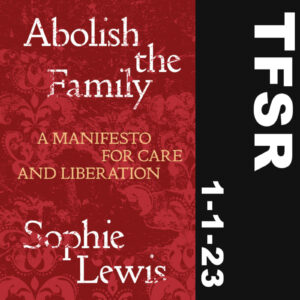
"TFSR 1-1-23" + red book cover of "Abolish The Family by Sophie Lewis"
Download this Episode

I’m sure that many people coming out of this holiday season, returning from visiting relatives will wonder: “couldn’t we abolish the capitalist family structure?” We’ve got great news! We’re happy to present this conversation between Scott and Sophie Lewis, author of “Abolish The Family: A Manifesto of Care and Liberation”.

In this episode, Sophie speaks about the book, the ideas and inspirations she’s pulling from, the critique that the family form not only passes property and generationally allows concentrations of it, but simultaneously limits our horizons of care to these small, private and often abusive relationships. Here we also find ideas of Child Liberation, a challenge to the state form and capitalism, and an invitation to imagine beyond what we’ve been taught is the natural nucleus of human relationships in what turns out to be a long lineage of ideas cast back through Black feminisms of the 70’s and beyond.

Anyway, there was a lot here and we hope you enjoy. For a related chat, check out Scott’s July 10, 2022 interview with Sophie on the show, and you can find more recordings and essays at her site, LaSophieLle.org and support her freelance writing on her patreon.

Continue reading Sophie Lewis on Abolishing the Family

Abortion, Family, Queerness and Private Property with Sophie Lewis

Abortion, Family, Queerness and Private Property with Sophie Lewis

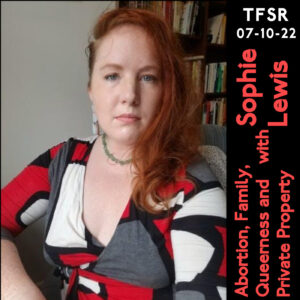
Sophie Lewis and text "Abortion, Family, Queerness and Private Property with Sophie Lewis | TFSR 07-10-22"
Download This Episode

This week, Scott and William talk to Sophie Lewis, author of Full Surrogacy Now: Feminism Against Family and the soon-to-be-released Abolish The Family A Manifest for Care and Liberation (out in October, 2022) about the current political moment that is characterized by attacks on trans people and peoples reproductive abilities. They also talk through what creates this moment, where trans people come into the target of State power being weaponized by the far right, as well as the connections among these attacks against LGBT education, access to transition, access to abortion and critical race theory. Also discussed are some limitations of a legalization framework around abortion, as opposed to a decriminalization, the limits of liberalism (particularly liberal feminism), and also the ways that certain strains of feminism contribute to an anti-trans discourse. Finally, there is chat about how to approach people needing support people who need access to healthcare, whether it be transition or abortion, outside of the hands of the state.

You can find Sophie on twitter at @ReproUtopoia and support her on Patreon at Patreon.com/ReproUtopia. You can find a children’s book Sophie co-translated called Communism For Kids or a compilation she contributed to on the ecological crisis called Hope Against Hope.

Opposing Torture

[01:11:19 – 01:17:44]

In Sean’s segment, he mentions his new book, Opposing Torture, available from LittleBlackCart.Com

Continue reading Abortion, Family, Queerness and Private Property with Sophie Lewis

William C. Anderson on The Nation on No Map (new book)

William C. Anderson on The Nation on No Map

Download Episode Here

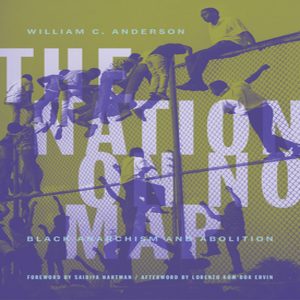
This week we are really pleased to feature Scott conducting an interview with author and activist William C. Anderson about his new book The Nation on No Map: Black Anarchism and Abolition which is out now from AK Press. In this interview they speak on the book and its many facets, and Black anarchism more broadly, some of the failures of euro-centric and white anarchism, and many many more topics.

If you would like to see more of Anderson’s work you can visit https://williamcanderson.info

To see his books The Nation on No Map and As Black As Resistance, you can visit akpress.org and search his name, or visit firestorm.coop and do the same to support a queer and trans run anarchist book store in Asheville <3

Some works and people mentioned by our guest, in order of appearance:

Continue reading William C. Anderson on The Nation on No Map (new book)

Eric Stanley on “Structuring Antagonism and the Trans/Queer Ungovernable”

Eric Stanley on “Structuring Antagonism and the Trans/Queer Ungovernable”

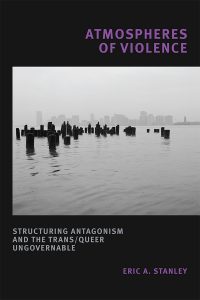
Book cover of "Atmospheres of Violence" by Eric Stanley featuring a photo of pier-tops sticking out of water with a hazy city in the distance
Download This Episode

This week, Scott spoke with Eric A Stanley about their new book, Atmospheres of Violence: Structuring Antagonism and the Trans/Queer Ungovernable, which was just published by Duke University Press. Eric A. Stanley is an associate professor in the Department of Gender and Women’s Studies at the University of California, Berkeley. In collaboration with Chris Vargas, they directed the films Homotopia (2006) and Criminal Queers (2019). Eric is also an editor, along with Tourmaline and Johanna Burton, of Trap Door: Trans Cultural Production and the Politics of Visibility (MIT Press 2017) and with Nat Smith, Captive Genders: Trans Embodiment and the Prison Industrial Complex (AK Press, 2015/11).

In this chat, they talk about racialized violence against trans/queer people as a foundational part of the modern US state; trace this in the formation of the US settler state and how it persists today. They also discuss the improvised ways trans and queer people learn and share survival tactics and thrive under these condition in order to envision a new world.

Continue reading Eric Stanley on “Structuring Antagonism and the Trans/Queer Ungovernable”

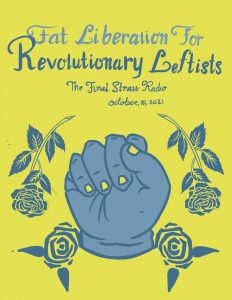
Fat Liberation for Revolutionary Leftists with Autumn

Fat Liberation for Revolutionary Leftists with Autumn

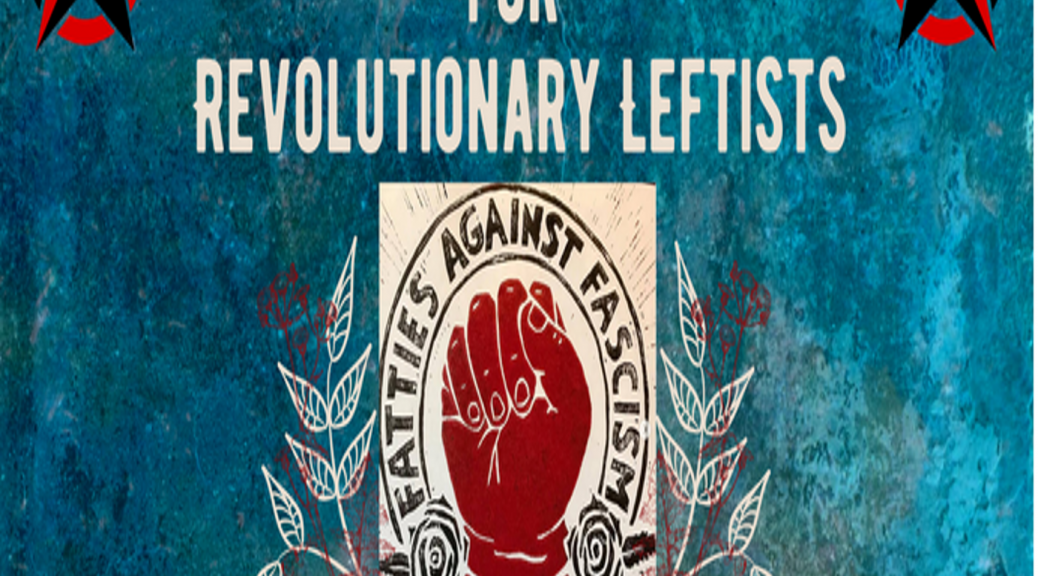
Fat Liberation cover with fist & roses by Tali
Download Episode Here

This week I am very excited to present an interview with Autumn (she/her/hers), who is an anarchist and scholar-activist, on Fat Liberation in all its many nuances, the pervasive, classist, racist, and colonial nature of fatphobia both in mainstream society and in far left spaces and thought, and the roots of Fat Liberation as a structure which originates and lives with Black, Indigenous, and brown, trans and disabled people. We also speak about Autumn’s syllabus entitled “Fat Liberation Syllabus for Revolutionary Leftists: Confronting Fatphobia on the Left AND Liberalism within the Fat Liberation Movement”. In this document, she compiles writings on the many aspects of fatphobia and gives her own analysis in bulleted form. This document is available for public use, and you can find it at https://tinyurl.com/FatLiberation!

People, works, and resources named by our guest in this episode:

Da’Shaun L. Harrison book “Belly of the Beast: The Politics of Anti-Fatness as Anti-Blackness”

Dr. Sabrina Strings book “Fearing the Black Body: The Racial Origins of Fat Phobia”

Hunter A. Shackleford “Hunter Ashleigh Shackelford (they/she) is a Black fat cultural producer, multidisciplinary artist, nonbinary shapeshifter, and data futurist based in Atlanta, Georgia … They are the creator and director of a Southern body liberation organization, Free Figure Revolution, which focuses on decolonizing antiblack body violence … Hunter illustrates the relationship between Blackness, fatness, desire, queerness, and popular culture.” (Instagram: @huntythelion)

Jervae (Instagram: @jervae)

Dr. Dorothy Roberts’ work on CPS and how anti-Black racism and fatphobia infect this institution.

Health At Every Size, evidence based medical paradigm that heavily critiques the social constructions of “obesity” and diet culture, and aims to present folks with a compassionate and inclusive framework for taking care of themselves.

Books by Dr. Lindo Bacon (founder of Health At Every Size)

– podcast Food Psych with Christy Harrison

Marquisele Mercedes article “How to Recenter Equity and Decenter Thinness in the Fight for Food Justice”

Caleb Luna (Instagram: @chairbreaker Twitter: @chairbreaker_) “Caleb Luna (they/them) is a fat queer (of color) critical theorist, performer, poet, essayist, cultural critic, and performance scholar. As a Ph.D. candidate in Performance Studies at UC Berkeley, their research focuses on performances of eating, and historicizing cultural representations of fat embodiment within the ongoing settler colonization of Turtle Island.

Sonalee Rashatwar (Instagram: @thefatsextherapist)

– podcast Maintenance Phase with Aubrey Gordon (Instagram: @yrfatfriend Twitter: @yrfatfriend)

Fat Rose Collective (Instagram: @fatlibink)

Continue reading Fat Liberation for Revolutionary Leftists with Autumn

Aishah Shahidah Simmons on Love WITH Accountability (Rebroadcast)

Aishah Shahidah Simmons on Love WITH Accountability (Rebroadcast)

Book cover of "love WITH accountability", purple color, a tree with leaves appearing as blue, pink and purple flowers
Download This Episode

This week we re-air an interview done with Aishah Shahidah Simmons, who is a writer, community organizer, prison abolitionist, and cultural worker who has done just an immense amount of work over the years to help disrupt and end the patterns of sexual abuse and assault within marginalized communities. In this interview we talk about a lot of things, her background and how she came to be doing the work shes doing right now, how better to think about concepts like accountability, what doing this work has been like for her as an out lesbian woman, and about her book Love WITH Accountability, Digging Up the Roots of Childhood Sexual Abuse which was published in 2019 from AK Press.

This interview feels very important right now, because we are in a time of overturn, tumult, stress, and uncertainty, and I think that in order for us to really be able to knuckle down and go in this for the long haul itll be imperative for our radical communities to take solid care of ourselves and of each other. I hope you get as much out of hearing Aishah’s words as I did conducting and editing this interview.

Before we get started, as a content notice: we will be talking about some difficult topics in this interview. I will do my best to repeat this notice at regular intervals, but please do take care and treat yourself kindly (however that looks).

To keep up with Aishah, for updates on future projects and more:

To support our guest, in a time where much if not all of her income is in peril:

Some more ways you can see our guest’s past work:

And so many more links on her website!

Continue reading Aishah Shahidah Simmons on Love WITH Accountability (Rebroadcast)

An Indian Anarchist on Anti Caste Organizing and More!

An Indian Anarchist on Anti Caste Organizing and More!

Download Episode Here

This week we are very happy to present an interview with Pranav Jeevan P, who is a student, a writer, an anti-caste activist, and an Indian anarchist living in the state of Kerala. You are listening to the full extended audio from this conversation, where you’ll hear Pranav explaining how he got into anarchism, how anarchistic praxis unfolds in India, some about the origins of and worldwide implications of the caste system, anti-caste organizing and how anarchism feeds it, and about how the BJP and Hindutva have real influence on people’s lives and destinies.

He further touches on the struggle of Dalit and Other Backwards Caste folks and how this tendency has always had solidarity with Black liberation here on Turtle Island, much more information about the anti CAA protest and the Farmer’s Protest, a little bit about the ongoing military occupation of the state of Kashmir, and many more topics. There is already a lot of really good anti-caste hip hop out there, mostly performed by those in oppressed castes, and I’ll be including a bunch of those tracks which have been recommended by our guest, plus providing links in the show notes.

There are a lot of terms in this episode which may be unfamiliar to all listeners, and we warmly invite folks to take a look at our show notes for this episode to see links for further reading and research. Please also look forward in the coming week to this show being transcribed in full, if you would like a copy to send to a friend or to read along while listening.

Send Solidarity while India fights the pandemic!

Also you may have heard that covid is spreading out of control in India right now, in no small part due to government mismanagement. Please also take a look at this ongoing list of donations compiled by the group Students Against Hidutva Ideology. You can follow this group on Twitter @Students_A_H to see their updates and events. You can also follow India Solidarity Network on Instagram for updates on COVID in India.

We will link to a form for mental healthcare workers to donate their time and services to Indian frontline healthcare workers, who are really struggling right now.

Pranav’s social media links:

Links to articles by Pranav Jeevan P:

Incomplete list of people and topics mentioned by our guest, for further reading:

You Are the Resistance

Please be aware that in this segment, sean speaks about the Derek Chauvin trial and the murder of people at the hands of police. If you would prefer to skip this subject matter, you can skip forward about 8 and a half minutes. This segment occurs at the end of the episode, [02:02:27-02:10:58]

Continue reading An Indian Anarchist on Anti Caste Organizing and More!

The Struggle for Likhtsamisyu Liberation Continues, Updates from Delee Nikal

Download Episode Here

This week we had the opportunity to connect with Delee Nikal, who is a Wet’su’weten community member, about updates from the Gidimt’en Camp that was created to block the TransCanada Coastal GasLink pipeline (or CGL) that Canada is trying to push through their un-ceded territory. In this interview Bursts and Delee speak about ways folks can get involved, both in so called BC and elsewhere, how the covid pandemic is affecting their work, and many other topics.

The Struggle for Likhtsamisyu Liberation Continues, Updates from Delee Nikal

Click here to hear a past interview with Delee!

Follow @gidimten_checkpoint on Instagram and Gidimt’en Yintah Access on the internet for further ways to send solidarity, including a fundraising and wishlist link.

Links and projects mentioned by our guest:

defund.ca

defundthepolice.org

BIPOC Liberation Collective

Defenders Against the Wall

Help Get a New Lawyer for Sean Swain!

Before the segment from Sean Swain, we would like to draw attention to a fundraiser in order to get Sean proper legal representation. As we all may know by now, there is nothing restorative about the prison system, its only reason for being is punitive and capitalist. Sean Swain has been in prison for the past 25 years, for a so called “crime” of self defense and radicalized to being an anarchist behind bars. He has been targeted by numerous prison officials for his political beliefs, so much so that years were added to his sentence. If you would like to support this fundraiser, you can either visit our show notes or go to gofundme.com and search Restorative Justice for Sean Swain.

– — – – – — – – – — – – – — – —

You can write to Sean Swain at his latest address:

Sean Swain #2015638

Buckingham Correctional

PO Box 430

Dillwyn, VA 23936

You can find his writings, past recordings of his audio segments, and updates on his case at seanswain.org, and follow him on Twitter @swainrocks.

– — – – – — – – – — – – – — – —

In Solidarity with Italian Anarchists Facing Repression 

We send you our solidarity call with anarchist in Italy and some introductory words, asking you to spread it in the way you prefer. Thanks!From 2019 to today the Italian State has carried out many repressive operations and inflicted a series of restrictive measures on anarchist comrades, limiting their freedom of movement and forcing them to remain within the limits of their city or to move away from the city or region where they reside.

As recipients of these kind of minor measures, together we want to relaunch our solidarity with the more than 200 comrades involved in the various trials in Italy that are starting this September and that shall continue throughout the autumn.
In particular, the appeal trial of the Scripta Manent Operation will resume at the beginning of September: this trial involves 5 comrades who have been in prison for 4 years (two of them for 8 years) and which has resulted in 20+ years of sentence in the first grade.
During this trial the prosecutor Sparagna gibbered of an “acceptable” anarchism and of a “criminal” one, statements that contain the punitive strategy that the State wants to carry out, based on dividing the “good” from the “bad” within the anarchist movement and the ruling of exemplary sentences.”

---------

WHO ASPIRES TO FREEDOM CANNOT BE “MEASURED”

We are anarchists subject to restrictive measures following a series of investigations that have crossed the Italian peninsula in the last year and a half.

They would like to isolate us, but they cannot. They would like to prevent us from supporting our comrades in prison, but their repression can only strengthen our solidarity.
With these various investigations, measures and prison detentions they want to wear us out and divide us, but we remain firm in our ideas and our relations, also thanks to the strong and sincere solidarity that has never failed us and that is increasingly under attack in the courtrooms.

They want to divide us between “good” and “bad”, between an anarchism they call "acceptable" and one they call "criminal". We are aware that it is our ideas that have been put on the stand in the latest inquiries, all the more so when these ideas find the way of being translated into action, because as we’ve always believed, thought and action find their meaning only when tied together. And it’s not surprising that a hierarchical system of power such as the State is trying to knock out its enemies by playing dirty and reviewing history, precisely when social anger is growing everywhere.

We don’t intend to bow down to their repressive strategies and we reaffirm our full solidarity and complicity with all the anarchists who will be on trial from September: we stand side by side with the comrades under investigation for the Scripta Manent, Panico, Prometeo, Bialystok and Lince Operations, with the anarchist comrades Juan and Davide and with those who will be tried for the Brennero demonstration; we assert our solidarity with Carla, an anarchist comrade arrested in August after living more than a year as a fugitive, following the Scintilla Operation.

We know very well who are the enemies that imprison our comrades and against whom we are fighting and every anarchist knows in his/her heart how and where to act to demonstrate what solidarity is.
Even if not all of us can be present in the courtrooms alongside our comrades on trial or where solidarity will be manifested, we want to express all our affinity, our love and our anger to them and to all anarchists in prison.

Let’s continue to attack this world of cages. Solidarity is a weapon, and an opportunity.

-Anarchists “with measures”, exiled and confined

– — – – – — – – – — – – – — – —

Public Domain music for this episode:
Hustler – Retro Beatz  (loop by William)
BOSS – Hip Hop Rap Instrumental 2016  (loop by William)

Aric McBay on Ecology and Strategies for Resistance

Aric McBay on Ecology and Strategies for Resistance

Aric McBay speaking and cover of Vol 1 of "Full Spectrum Resistance"
Download Episode Here

This week we are airing a conversation that we had a few weeks ago with Aric McBay, who is an anarchist, organizer, farmer, and author about his most recent book called Full Spectrum Resistance published by Seven Stories Press in May 2019.

This book is divided into 2 volumes, and from the books website [fullspectrumresistance.org]:

Volume 1: Building movements and fighting to win, explores how movements approach political struggle, recruit members, and structure themselves to get things done and be safe.

Volume 2: Actions and strategies for change, lays out how movements develop critical capacities (from intelligence to logistics), and how they plan and carry out successful actions and campaigns.”

This interview covers a lot of ground, with topics that could be of use to folks newer to movement and ones who have been struggling and building for a while. McBay also talks at length about the somewhat infamous formation Deep Green Resistance, some of its history, and tendencies within that group that led him to break with them.

Links to Indigenous and Migrant led projects for sovereignty and climate justice, and some for further research:

Links for more reading from Aric McBay:

Music for this episode in order of appearance:

– — – —

You can write to Sean Swain at his latest address:

Sean Swain #2015638

Buckingham Correctional

PO Box 430

Dillwyn, VA 23936

You can find his writings, past recordings of his audio segments, and updates on his case at seanswain.org, and follow him on Twitter @swainrocks.

. … . ..

Transcription

TFSR: So I’m very proud to be speaking with farmer, organizer, artist and author Aric McBay. Thank you so much for taking the time to have this conversation. Would you mind telling us a little bit about yourself, what stuff you’re farming, for instance, where you are, and what sorts of organizing you’re involved in?

Aric McBay: Sure. And thank you so much for having me on your show. So I farm just east of Kingston, Ontario. We have a vegetable CSA farm Community Supported Agriculture. So we grow about 40 or 50 different varieties of vegetables, and we provide those to about 250 households in our area. We do kind of a sliding scale to make it more accessible to people. And we normally host a lot of different educational events and workshops. But of course most of those are on pause right now.

In terms of community and activism or community engagement, I have worked on many different causes over the years. I’ve worked with militant conservation organizations like Sea Shepherd or doing tree sits. I’ve been a labor organizer, I’ve been a farm organizer. I’ve helped start community gardens. A lot of the work that I do right now is about climate justice and about other issues that are topical, at different times in my area, especially prisons, and housing right now. Prisons are quite a big issue that the nearest city Kingston has the largest number of prisons per capita of any city in Canada. So prisoners issues continue to be very important and I think that the situation with COVID has only kind of highlighted the ways in which prisoners are treated unfairly, and in which the prison system actually makes us less safe, makes our society more dangerous rather than less so.

TFSR: Well, you did an interview with From Embers at one point, which are friends of ours and members of the Channel Zero Network. They also had a show recently, or I guess a couple of months ago, about the pandemic and the history of pandemics in the Canadian prison system. And it’s like, yeah, it’s pretty sickening. And you’re on occupied Anishinaabe and Haudenosaunee land, right?

AM: That’s correct. Yes.

TFSR: And this is Tsalagi and Creek land where I’m calling you from. So you’ve been thinking and working around big picture ecological survival, and as you said, ecological justice for quite a while. For someone picking this up on the radio and maybe not keen on environmental concerns, can you give a kind of a quick snapshot of where the civilization is in terms of destroying the Earth’s capacity to carry complex life?

AM: Sure, and it’s so easy to forget about or to push aside because the other emergencies in our daily life just keep kind of stacking up. So right now, we are in the middle of really a mass extinction on on this planet. And industrial activity, industrial extraction has destroyed something like 95% of the big fish in the ocean, has fragmented huge amounts of tropical forest and deforested many tropical areas, including much of the Amazon at this point. But it’s really climate change that’s kind of that global, critical problem. The temperature has already gone up nearly one degree from their kind of pre-industrial norm, but the emissions that human industry have put into the atmosphere of the greenhouse gases, like carbon dioxide and methane, are already enough to set us on a path of significantly greater warming. That’s even if we stopped, you know, driving cars, or burning coal today.

And so that produces a bunch of different challenges. Of course, we’re going to see already more and more hot weather heat waves, like we’ve certainly been seeing this summer, more extreme storms happening more frequently. But in the long term, the outlook is potentially very grim. Depending on the emissions that are produced around the globe, we could be looking at not just one or two degrees of warming, but potentially five or six degrees of warming by the end of the century. And that produces a very different world from the one that we live in. Even two degrees of warming would be enough to essentially wipe out all of the coral reefs on the planet, to wipe out entire biomes.

We’re at the point where even relatively conservative international organizations understand that climate change could displace hundreds of millions of people, could create hundreds of millions of climate refugees around the world. And there’s never been any displacement like that. You know, when you talk about making a place where where potentially billions of people live, much harder to live in, and much harder to grow food. And, you know, we’ve seen things like the so called Arab Spring, for example, and the situation in Syria where those areas of unrest or those uprisings were triggered, in part by prolonged droughts and agricultural failures. And we have seen the streams of refugees coming from those places, especially in the United States, has really increased the amount of xenophobia and racism I think that a lot of people on the right feel comfortable demonstrating.

So the ecological crisis is not just about fish and trees, it’s really about the kind of society that we’re going to have in the future. For human beings, are we going to have a society where fascism is considered kind of a necessary response to streams of refugees moving from equatorial areas, as of local economies collapse? Are we going to see an even greater resurgence of racism in order to justify that? Are we going to see much more draconian police response to deal with the unrest and uprisings that could happen? So our future, our future in terms of justice and human rights really depends on us dealing effectively with climate change in the short term, because climate change is not something that we can kind of ignore and come back to and 20 or 30 or 40 years. There’s a real lag effect, that the emissions now those are going to cause warming for decades or even centuries. And the response is really nonlinear. So what I mean by that is, if you double the amount of greenhouse gases that you’re putting out, that doesn’t necessarily double the temperature impact. There are many tipping points. So as the Arctic ice melts in the Arctic Ocean, and that white snow turns to a darker sea, then that is going to absorb more sunlight, more solar energy and accelerate warming. It’s the same thing in the Amazon rainforests, the Amazon rainforest creates its own climate, creates its own rainfall and clouds. So you can easily hit a point where the entire forest is suddenly put into drought and starts to collapse.

We really need to prevent those tipping points from happening and to act as quickly as possible to prevent catastrophic climate change, because it’s going to be almost impossible to deal with, in a fair way once that happens. And that’s really the idea of climate justice, right? That the impacts of global warming are disproportionately put on people of color, on low income people, on poorer countries. And so if we want to have a fairer future, then that means those of us who are living in more affluent economies have a responsibility to reduce those emissions. Those of us who have more affluent lifestyles, their main responsibility to deal with that, to produce a future as well, that is fair and just and where human rights are still important.

TFSR: And like to, I think, reiterate a point in there, it seems like fairness and justice are good rulers to kind of hold ourselves to, but it seems like it’s for the survival of the species, as well as for the betterment and an improvement of all of our lives with these eminent and emergent threats. Resolving this and working towards working together with everyone is the best option.

AM: Yeah, I mean, I think it’s true. And I think one of the reasons that I’m interested in organizing around climate justice is because it’s one of the ultimate areas of common ground, right? It kind of connects people who are in many different places and working on many different struggles. Because activists who I work with, who are mostly anti-racist activists, understand why this is important. I mean, we’re already seeing that impact around the world. And activists who work on food security and hunger, I mean, it’s totally clear why climate change is important, because our ability to grow food in the future depends on avoiding catastrophic climate change. When I’m working with anti-authoritarians, it’s the same thing. So I really do see climate justice as an important movement building issue, something that can connect a lot of causes that might seem more disparate from from kind of a distance.

TFSR: I think your work does a really good job of pulling together, the fabric, sort of like weaving together these pieces and patchwork to say that these are all interrelated. And for us to ignore one of these elements means that we create a much weaker fabric, if even something that’ll hold together at all. Your most recent and huge two part book was entitled Full Spectrum Resistance, and the first subtitle was Building Movements and Fighting to Win, and the second was Action and Strategies for Change. Can you share what you mean by “full spectrum resistance”, and what you hope these books will bring to the table for folks organizing to not only stop the destruction of complex life on Earth, but to increase the quality of our survival and our living together?

AM: Of course. So I wrote this book because I’ve been an activist for more than 20 years, and almost all of the campaigns that I worked on, we were losing ground, right? I mean, that was the case for many environmental struggles, but also in struggles around the gap between the rich and poor, around many other things. But I saw in history and around the world, many examples of movements that had been incredibly successful. And the fact that a lot of the rights that people take for granted today – a lot of our human rights – come from movements that learned really valuable lessons about how to be effective. Movements that didn’t know necessarily know at the beginning, what would create kind of a winning outcome. And so full spectrum resistance is an idea that I think encapsulates some of the key characteristics that successful movements need to have, especially when they want to move beyond maybe a single issue or a local concern.

So one of those components of full spectrum resistance is a diversity of tactics. I think that’s really critical. I think one of the reasons that the left hasn’t been as successful in recent years, is that it’s really been whittled down to a couple of main tactics, it’s been whittled down to voting, and to voting with your dollar, right? To kind of ethical consumerism. And those are very limited tools. And they’re tools that leave out the vast majority of tactics that movements have used in the past, right? Successful movements like the Civil Rights Movement, or the suffragists or their movement against apartheid in South Africa. They used a huge range of tactics. I mean, they certainly use things like petitions and awareness raising tool at different times. But they also use tactics that allowed them to generate political force and disruption. So a lot of people don’t realize that, you know, to win the right to vote suffragist movements use property destruction and arson quite frequently. When people are talking about Nelson Mandela and the anti-apartheid movement, people often use Nelson Mandela, ironically, as a reason why we shouldn’t be disruptive. They think of him as this really peaceful guy because he spent close to 30 years in prison. But Nelson Mandela helped to create the underground armed wing of the African National Congress. That was a struggle that used armed self defense and sabotage extensively in South Africa. And allies used all kinds of economic disruption, especially divestment around the world to try to pressure the South African government. And we can take a look in more detail at some of these case studies if you want. But I think a diversity of tactics is really critical in building movements that win. Because if we stick to only one tactic, then that really limits our ability to escalate, and that limits our ability to adapt. It’s easy for those in power to understand how to undermine one tactic, if it’s the only one that we use.

I think another aspect of full spectrum resistance is cooperation among different kind of…constituencies, you might call them. So those in power can stay in power through divide and conquer, right? That’s one of their primary tools is to split resistance movements or social movements into different manageable chunks, like “militants” and “moderates”. So they can split the people who are willing to go out into the street and protest with kind of maybe a broader, more moderate group of people who support them. And they can just go ahead and arrest you know, a small group of militants in the street, if they’re able to separate those people.

Let me, actually let me give you an example of how a diversity of tactics and this cooperation can work. One of the movements that I talk about, or one of the campaigns that I talk about in the book, is an anti-apartheid group that organized in New York City at Columbia University in the 1980’s. And they were an organization that was trying to get Columbia University to stop investing in companies that did business in South Africa, right? South Africa was kind of a resource empire at the time, there were huge mineral resources that were being extracted, and people were making a lot of money. But because of the racism, because of the authoritarianism of that apartheid system, people around the world were really struggling to generate political force to put the pressure on to end the system of apartheid.

And so Columbia University, like many universities had big endowments, big investments. And there is this group is called the committee for a free South Africa at Columbia University. And they started with kind of classic strategy of awareness raising, so they held discussion groups and teachings about apartheid. They had, you know, petitions to try to convince the government of Columbia University to divest from South Africa. And they really did everything that you were supposed to do, right? They did all of the things that we’re kind of told, told that we are supposed to do in order to succeed. They built that public awareness and understanding, and they hit a wall. They got to the point where the administration and faculty and student representatives in the student government all voted for divestment by the top level of government, their board of trustees overruled them. And I think that point that they reached is a point that a lot of our struggles eventually meet, right? Where we’ve done the things that we’re supposed to do, but still those in power refused to do what is right. And it was a real turning point for those anti-apartheid organizers. And their attendance at events started to decrease after that, because well people thought “hey, this struggle is over, the Board of Trustees isn’t going to diverse, so what can you do, we just lost this one.” But those organizers, they weren’t willing to just give up, they realized they needed to escalate to win.

They decided to plan a series of disruptive simultaneous actions, they started a hunger strike. And they took over a building, they blockaded a building on campus and said “we’re not going to go anywhere until Columbia University divest.” And this was a big risk for them, right? Because they’d seen this declining participation. But it actually worked. They started with a handful of people at this blockade. And more and more people started coming. There’s this fascinating statistic about this campaign. Before the blockade, only 9% of the student body considered themselves at least somewhat active in that campaign for divestment. So only 9% had shown up to a rally or you know, signed a petition. But in the weeks to come, 37% of the entire student body participated in that blockade, by joining rallies or by sleeping overnight on the steps.

So, you know, that kind of divestment campaign, I think is very important. Now, in part because that campaign worked, Columbia University eventually did give in and did agree to divest. And that shows to us, you know, the value of a diversity of tactics, the value of disruption, the value of cooperation between people who are using different kinds of tactics. I think that really is something that we can learn and apply very effectively. And then the current day, another key part of full spectrum resistance is that solidarity between movements, to avoid the divide and conquer tactics that those in power try to use. And the fourth thing is really an intersectional approach is to try to synthesize the different ideas and the different philosophies that motivate different campaigns and that motivate different movements. Because we’re in a time when I don’t think single issue campaigns can succeed anymore, certainly in the context of climate change, but also in the context of rising authoritarianism. We need to look at how we can build that shared analysis, build genuine intersectionality in order to create movements that are truly powerful and effective.

TFSR: So with the Columbia example, it’s really interesting to point to that, I hadn’t heard of that before, and that seems like there’s a lot of lessons to be gathered from that. With what we’re talking about with the scope of climate change, like the larger scope of climate change, obviously, is you can break it down into smaller and smaller points of this extraction thing happens in this place, those materials are transported here, they’re processed here, they’re consumed or subsidized by these populations are these organizations. So I guess, like the level of amplification of resistance that you’re willing to apply to a situation should scale according to what you’re trying to succeed at doing.

With this wider scope of resistance to something that you could look at as a whole as the way that governments backup energy infrastructure, and monocrop industrial agriculture, the scale of this…I get kind of lost between that point of pressuring the people at the top of the university to divest once all the other steps have been denied, like the scaling between that and looking at, say, for instance, the US government and pressuring them…I kind of just get lost in the clouds at that point. I’m like, well, the US government is going to want to continue business as usual as much as it can, in part because of its investors, much like Colombia, but also because it’s sustaining a more “holistic” system. How does the anecdote of Colombia and the resistance there fit into a wider scope of looking at governments and the ecological destruction that they’re involved with?

AM: Yeah, that’s a great question. And I think one of the biggest challenges of the climate justice movement is the way that climate change and fossil fuel emissions, it all just feel so overwhelming and so diffuse, it’s hard to figure out, where should we actually focus our energy. But I think that many, or most movements in history, at some point, faced a similar problem, right? I mean, the anti-apartheid movement that Colombia was was a part of and were supporting. That was a movement that lasted for generations, the African National Congress was founded in 1912. And certainly at different points it was very unclear what people should do, you know, what was actually going to work against such a violently repressive regime. And so for me, I think there are a bunch of things that we can and should do to help address problems that seem really overwhelming or diffuse. And one of them, of course, is just to keep building our movements and to keep building our capacity and our connections. Because as long as we feel like we’re kind of isolated individuals or isolated pockets of resistance, it’s hard for us to see how we can tackle bigger problems. And that isolation is not an accident. Any authoritarian power especially wants to keep people divided and distrustful. So it’s important that we build cultures of resistance, that we build real connections with each other, and that we celebrate movements in the past that have won, so that we can kind of build up our capacity.

And I think it’s also important to look for areas where we can have early wins or kind of low hanging fruit. Areas where the problem is not as diffuse, but where the problem is more, is much more concrete or much more tangible. And so a great example of both of those things that work would be some of the mobilization against fossil fuel that has happened in so-called Canada in this year, and in recent years. So I don’t know if all of your listeners have been following this, but in February and March of this year of 2020, we saw some of the biggest Indigenous solidarity mobilizations in Canadian history. And those were kind of provoked by a particular flashpoint on the west coast. So there’s a settlement called Unist’ot’en which is on a pipeline route, there’s a site where the Canadian government and a variety of oil companies have been trying to build a series of pipelines to the west coast so that oil and fracked natural gas can be exported. And the Indigenous people who live there, the Wet’suwet’en, the traditional hereditary leaders have been very committed for many years to stop that from happening, and have essentially built this community on the pipeline route to assert their traditional rights and to assert their Indigenous sovereignty.

And in February at the beginning of February 2020, the government sent in really large armed force of RCMP officers and other officers, to try to kind of smash through different checkpoints that Indigenous communities had set up on the route leading to this site on the road, and also to destroy the gate that was keeping oil workers from going in and working on the construction of this pipeline. And the community there had been really good at building a culture of resistance over years, not just amongst Indigenous people, but among settler allies across the country. And so when that raid began, there was a really powerful response from many different communities. So a Mohawk community located just west of me, Tyendinaga, they decided to blockade the major east-west rail line that runs through Ontario, and that is kind of a bottleneck for the entire country. And other Indigenous communities started to do this as well, to set up rail blockades. And essentially, the entire rail network of Canada was shut down for weeks. You know, there were massive transportation backlogs.

And there were other disruptive actions as well, things like blockades of bridges – including international bridges – blockades and slowdowns of highways. And there was all of this mobilization that a year or two ago seemed inconceivable, it seemed impossible that any kind of disruption would be able to happen on that scale because nothing like that had happened before. And it was a really powerful movement that did cause the government to back off and cause the police to back off and start these new negotiations. And you know the COVID pandemic was declared at the same time as a lot of this organizing was still happening, so it’s kind of unclear what might have happened if that action had continued without a pandemic. But the rallying cry for a lot of organizers at that point was “shut down Canada”, which the pandemic did on a much larger kind of unanticipated scale.

But I think that example of the Wet’suwet’en solidarity and the disruption around it really points the way to potential successes and potentially more effective styles of organizing for the climate justice movement. And I think they have done a lot of things, right. They built that culture of resistance. So they didn’t just wait around for kind of a spontaneous uprising to happen, which I think almost never happens. They had built these connections over many years and build capacity and people had trained each other and trained themselves. And they had a particular location that they were trying to protect, right? So it wasn’t just “let’s go out and protect the entire world and protect all people.” You know, it’s hard to mobilize movements around something that’s so vague, but there is a particular community of a particular group of Indigenous people on a particular spot. And I think it’s much easier to mobilize folks around tangible sites of conflict like that.

The last thing that they did that was really effective, and that I think we can learn from, is that they turned the weakness of having the fight against this diffuse industrial infrastructure into a strength. So instead of just saying, “Oh, well, there’s so many pipelines, there’s so many rail lines, there’s so many highways, nothing we can do is going to make any difference.” The movement kind of said “Hey, there are all of these pipelines and rail lines and highways that are basically undefended, and that we can go and disrupt – even if it’s only for a day or two – and then move to another site. This actually gives us the potential to be incredibly effective, and to cost oil companies a lot of money and to cost the Canadian economy a lot of money.” Because that’s often what it boils down to right is “can we cost a corporation or a government more than they’re getting from doing this bad thing?” And I think that the Wet’suwet’en struggle has been an example and a demonstration of how to do that.

TFSR: Yeah, absolutely. And I think that that points to a really cogent point in terms of how to think about this sort of resistance. There were, what, 200 years for the Canadian government to think about its relationship to Indigenous communities and the sovereignty of like…them just pushing through sovereign territories to get what they want to extract, to run railways, to put pipelines in or whatever. And so appealing to the logic or the “reasonability”, or the sense of justice of the people that were representing the bodies that were sitting in the chairs in the suits in government – who were enacting the logic of capitalist settler colonial government – was not working.

But what did work was showing that if you do not see this point, we will shut down your ability to do this, or we will escalate to the point that you will have to like, step up further, and push back. And I think it’s a point that often gets lost. And I think, consciously, it’s been inculcated out of us, I guess, that’s a way to say it? Like, in the United States at least, we’re educated that the example of the suffragettes, the example of Gandhi, the example of the resistance to apartheid in South Africa, all of these examples, the winning view that’s given by the power structures when they educate us is that reasonability won out because of the justice of the cause. And because people went out and put their bodies on the line, but also like their petitions were eventually heard, their voting actually was the effective measure that changed the balance of power and that forced those in power to recognize the justice of the demands. And I think that’s like pandemic offers an interesting insight into, again, how that’s BS, like marches don’t stop people in power from making decisions. The threat that marches bring with the amassing of angry people who can do damage, or who can disrupt things, is what actually makes people in power look at marches and why that specific way of engaging is considered dangerous to those in power and why they want to stop that sort of thing.

I think that there’s a parallel to be drawn between that great example with the Wet’suwet’en folks and the resistance that was given to the attack on Unist’ot’en and Gitdimt’en gate, alongside of what we’ve seen, during this pandemic, in a lot of countries, and particularly the United States – where I’ve heard this morning on the radio, which, hopefully, hopefully, it’ll be wrong by the time this gets broadcast – but the US where I’m based, has a quarter of the deaths from COVID-19, around the world, and yet we are something like 5% of the world population. Those are similar numbers to how many people are incarcerated in this country versus the rest of the world. And people in power, at this point are not representing that they have the ability, the capacity, the interest, the will to actually stop this pandemic from spreading, and killing off the people that are most marginalized – starting off with the people that are most marginalized – in our society.

And so it seems like appealing to that same wing of power, the ones that profit off of ecological destruction when it comes to scaling back ecological destruction, and trying to reverse that trend, doesn’t seem that reasonable. But the sort of like direct action instances that you’re talking about, in coordination with other methods of dialogue and culture building, feels really important and exciting to me. I don’t know if you think that seeing the reaction of governments during pandemic is comparable to the vast amount of knowledge of ecological destruction, is an apt comparison or not?

AM: Yeah, I think you make very important points. And I think that, especially under capitalism, one of our continuing challenges with those in power is that they always consider profit more important than life, right? They always consider profit more important than human safety and human wellbeing. And that applies whether we’re talking about incarceration or COVID, or climate change, or police departments. And because of that, those in power are almost never convinced or persuaded by arguments to do the right thing. And that’s the case in the examples that you’ve mentioned, as well. If we look at those historical movements, we have been given a really sanitized kind of false narrative about how things like the Civil Rights Movement worked, or the suffragettes – or the suffragists, rather – we’re told, hey, that, you know, the Civil Rights Movement, just finally convinced people because people like Martin Luther King were willing to risk getting beaten up. And that’s what changed things. But that is not primarily what changed the people who are in positions of power, right? I’m sure there were a lot of people on the sidelines, especially in the north, who saw Black people and white people being beaten up by police on the Freedom Rides, for example, and that changed their opinion about things, or that helped mobilize them to do something about racism. But the racism, especially in the Southern states, and segregation, that didn’t end because of the Civil Rights Movement, giving a good example, that was dismantled, essentially, because of different kinds of force, political force, and sometimes physical force.

So in the Civil Rights Movement, we can look at the example of the Freedom Rides, when groups of white and Black organizers rode buses through the South where they were supposed to be segregated. And those buses were attacked by police and vigilantes, violently attacked, people ended up in hospital, buses were set on fire. And that didn’t actually end until essentially the federal government intervened, the federal government sent in troops to escort those Freedom Riders around the South to kind of complete their journey. And I think that’s something that people forget often, that racist violence didn’t just end because of a good example. It ended because there was some other form of force being employed. And I think people also forget that a lot of the non-violent demonstrations, the Civil Rights Demonstrations in the south, were protected by armed groups like the Deacons for Defense. The Deacons for Defense were an armed group before the Black Panthers, that was in many cases made up of military veterans, Black military veterans, who decided that they were tired of seeing civil rights marches getting attacked by the KKK or their police, and said we’re going to use our right to bear arms, and we’re going to go down there and defend people. And so a lot of the nonviolent actions that happened, were protected by armed Civil Rights activists.

So these sorts of things get written out of the history, especially by the in power, because those in power want to seem like the good guys, right? They want to seem like, “Hey, we are the ones who are going to come down and give you the rights, if you can provide us a good example, we’re just going to gift you these rights, these human rights” and that’s almost never have things will wind they will one because people were willing to struggle and people who are willing to disrupt.

I think that ignorance of social movement struggle is a form of white privilege. I have seen this at many different workshops, and many different talks that I’ve given, that often at the start of a workshop, I’ll ask people when they’re introducing themselves to name movement that inspires you, or name a campaign that inspires you. And oftentimes, the people who are coming to that workshop who are white organizers, who are newer organizers, they don’t have such a large repertoire to draw on, right, they’re much more likely to name a movement that happened locally or a movement that’s been in the news. Whereas a lot of the organizers who are people of color or from other marginalized communities, they can list off a ton of movements that inspire them that they’re learning from. And that’s important because marginalized communities understand better how to deal with those in power, how to get rights and how to protect your rights. And that’s often through social movements and through struggle, whereas people who are used to those in power looking out for their interests, especially, you know, middle class white men, they can afford to ignore social movement history, because they haven’t really needed social movements in the same way, or they don’t appreciate them.

And so when we have situations like we have now with growing authoritarianism, much more obvious racism, the climate emergency, people who are in positions of privilege, they find themselves at a loss, because they don’t know that movement history, so they don’t know how to respond. And it’s often movements of color movements of marginalized people, those are the movements that are going to teach us how to deal with these deep systems of injustice, these deep systems of inequality.

TFSR: So I guess, shifting gears back to like questions of wider approaches towards resisting ecological change, over the last couple of years there have been a few groups that have garnered a lot of headlines, and gained some sort of recognition and interplay with mainstream media, with governments around the world. I’m wondering what your full spectrum approach towards resistance sort of use the efficacy, or the impact of groups. I’m thinking of 350.org, Sunrise Movement and Extinction Rebellion, do those feel like single issue approaches towards ecological struggle? Because I know that there was some critiques definitely in the UK about extinction rebellion, specifically, the leadership weeding out people who are wanting to bring up questions around not only ecological devastation, but also around racism and around the existence of industrial capitalism, and its impact on that.

AM: Yeah. And I think that’s a big problem. I think that you can’t really address climate change without talking about capitalism, you can’t address climate change without talking about racism. And I think that, in general, the big liberal movements against climate change, or the big liberal organizations have failed. Partly for that reason, probably, because they’re not, they’re not looking at the root problems. They’re not radical organizations, right, they’re not going to the root of the issue. And so they’re not going to be able to use the tactics that will resolve it.

I think at this point, companies like Shell Oil, and you know, a variety of petroleum companies were very aware of climate change, going back to the 1960s. I mean, they had more extensive research at that point into climate change than the general public. And when I’ve done research into organizations that have fought against offshore drilling, for example, you can see that even in the 1980’s, oil companies like Shell are already building their oil rigs with taller legs in order to compensate for the sea level rise they expect to see. So the issue is not that those in power are totally ignorant of climate change, it’s that they’re making a lot of money from climate change and they think with all of the money they are making, that they can deal with the consequences for themselves personally, although not for everyone else.

And so that’s a huge problem and in some ways it’s slightly different from COVID. You know, in Canada, I think one of the reasons that we’ve seen a much stronger national response is because very early on the prime minister’s wife tested positive for COVID. And so clearly the impacts of the Coronavirus have been disproportionately bad for communities of color and for low income communities, but there still is much more potential for affluent people to get it. Whereas something like climate change, I think those in power have felt very isolated from especially in more northern countries. So that’s a huge problem. And that’s one of the reasons that just appealing to the good sensibilities of those in power is not going to succeed.

Maybe I’ll speak mostly about Extinction Rebellion, because when I was doing my book tour last here, and traveled from coast to coast in Canada, I ended up doing workshops about direct action and movement strategy for a lot of different Extinction Rebellion groups here. And I think, you know, from what I’ve seen, the people who have participated in those events have been very committed and strongly motivated, they understand that it really is an emergency, but they don’t always have a lot of history in kind of activism, or they don’t have as much movement experience as some of the other groups that I’ve worked with. Which can be good and bad, right? I mean, I think, you know, a lot of the liberal left, the reason that groups keep failing to address the climate crisis is because there’s kind of a standard issue dogma about how we need to convince governments to change and ask politely, and so on. And that’s really a dead end. So I think for people new to a movement or getting newly active, they are potentially more open to new ideas and new ways of doing things.

But I think that the Extinction Rebellion kind of movement in general, in Canada, and definitely in the UK, has not done a very good job of, of including the needs of Indigenous communities, and has not done a good job of including the needs of communities of color. And in particular, I think we see that in the relationship between Extinction Rebellion, and the police. This was a discussion that came up in almost every XR group that I have spoken with, that that kind of official line from XR in the UK is that you’re supposed to have a good relationship with the police, you’re supposed to go to the police in advance of an action and let them know what’s going to happen. And, you know, as a direct action organizer myself, and on many different issues, that sounds absolutely ridiculous, for a lot of reasons. One of which is that you lose the element of surprise, which is one of the key strategic advantages that smaller resistance movements need to have. But also, because if you go and try to cozy up to the police, or try to expect them to give you a good treatment because you’re bringing them a cake or something, I mean, that is really kind of a white focused thing to do, right? And that ignores the long standing grievances of Black and Indigenous communities in particular, because of the violent treatment that they’ve experienced at the hands of police. And of course, that has become even more obvious in recent months, and you know, the amount of attention and mobilization is long overdue. I think that’s been a real weakness of Extinction Rebellion, and I think it’s going to need to address that, and other climate justice movements will need to address that in order to succeed.

I think another challenge to Extinction Rebellion has been that they still are kind of assuming that if they make a strong enough argument that those in power will change their behavior. Because one of their big demands has been for those in power to tell the truth. And from my perspective, as an organizer, that almost never happens, right? Well, those in power rarely tell the truth and you don’t want to give them the opportunity to dominate the messaging. Those in power, whether it’s the corporate PR officers or government PR, I mean, they almost always dominate public discourse. And so if we have an opportunity to put in our own message, we should be doing that not kind of punting it back to those in power so they can either repeat the same business as usual line, or try to co-opt or undercut what we’re saying. I think there’s a huge strategic mistake. And what it means is that even if you’re blocking bridges, you can be doing that essentially as a form of militant lobbying, because you’re putting the potential for change in the hands of other people. And I think that movements that have succeeded in overturning deeply unjust systems In the past, they have been able to build up communities of resistance, they’ve been able to build up movements that can direct the changes that need to happen, and movements that are led by the people who are affected. In climate justice, that means, you know, we really need to highlight the voices of Indigenous communities, we need to highlight the voices of communities of color in the global South. And if we don’t do that, not only is it morally wrong and a moral failing, it’s going to be a strategic failing as well, because we’re not going to have the experience and the perspective we need at the table to create movements that will win and to create strategies that will win. It’s a real dead end.

So, you know, from my perspective, the most exciting movements that I see around climate justice are being led by communities of color, are being led by Indigenous communities, and that are incorporating people from a lot of different backgrounds. But keeping in mind that it’s not an option to fail here, it’s not an option to say, “Oh, the government should reduce emissions. And if they don’t, I guess, oh, well, we’ll go back to what we’re doing”, we actually really have to commit ourselves to to winning this struggle. And I think a lot of affluent white communities, because they’re insulated from the effects of climate change, at least so far, they don’t have that same motivation. They don’t have that same drive to win, they don’t have that same genuine sense, I think maybe of desperation even. So for them, the risk of getting arrested a few times maybe feels like a bigger risk than the risk of the entire planet being destroyed. I think the calculus of risk for Indigenous communities is often different, which is why we see them taking so much leadership like in the case of the Wet’suwet’en.

TFSR: So there’s the example of the Wet’suwet’en in terms of not only a sovereignty issue, but also the ecological impacts and the solidarity that they’re offering to the world by trying to blockade the extraction and eventual burning into the atmosphere of, I believe the tar sands, right, from Alberta. And then skipping to a not specifically ecological movement, the Black leadership and leadership of color in the Movement for Black Lives and the movement against white supremacist violence and police violence that sparked off with George Floyd’s assassination, but also has spread around the world because anti-blackness is so endemic in Western civilization. I’m wondering if there’s any other examples of current movements, particularly around ecological justice, that you feel inspired by that are led by communities of color and frontline communities?

AM: Hmm, that is a great question. I think that we have seen, you know, in Canada in particular, but all over we have seen many different movements that are Indigenous lead, I think that’s often the movements that I end up working with or supporting. The Dakota Access Pipeline is another example of a movement that has been Indigenous lead and has been very successful. I think, around the world, I see a lot of hope in organizations like La Via Campesina – the international povement of peasants and small farmers – which is a very radical movement that looks to overturn not just fossil fuel emissions, but also capitalism in general, that looks to create fundamentally different relationships between people and the planet, and to create community relationships. I think that sort of thing is really exciting. And I think when you look at food and farm based movements, there’s a lot of mobilization potential there, because food, like climate, is one of those commonalities between people that’s common ground. Everyone has to eat every day. And so I’m very excited about the tangibility that movements around food like La Via Campesina have the potential to lead to. I think there are a lot of migrant worker and migrant justice movements as well that really understand the connection between climate and justice in a way that a lot of liberal movements don’t.

I also think that a lot of the really effective movements and groups that are led by people of color, they’re often more local, kind of environmental justice movements, they are not necessarily as big or as well known. And they sometimes don’t want to be, right? I mean, they’re not trying to kind of mimic the corporate structure. They’re not trying to become a gigantic NGO. And I would encourage people to look for those movements that are close to you, to look for those movements that are led by communities of color and that are led by Indigenous people, and to try to connect with them and to support them. If that’s not the work that you’re doing already, how does that work connect? And how can these movements help to support each other, and to develop a shared understanding, and a shared analysis of what’s needed for action.

TFSR: Cool, thank you for responding to that one. One thing I thought of was the Coalition for Immokalee Workers – which is an immigrant led struggle based out of Florida – they do a lot of media work, but they also are addressing like the real impacts of the epidemic on undocumented populations and farm worker populations in so called USA.

So people who are also familiar with your work are going to be familiar with the fact that you co-authored a book called Deep Green Resistance, alongside Lierre Keith and Derrick Jensen some years back. And DGR, besides being a book, is also an organization or a movement, a call out for a movement. And I know one notable thing that was mentioned around Extinction Rebellion was the idea of putting your name out publicly and saying “I’m going to be participating in this direct action”. And that was the thing that I recalled anarchist being critical of DGR, and ecological resistors, where people were asked to sign up publicly and make a pledge to participate in this movement. But I know that you’ve left DGR, you have made public statements about why you have left Deep Green Resistance, but I would wonder if you could reiterate those right here and talk about the group and like why you came to leave it?

AM: Sure. So when writing Deep Green Resistance, what I really wanted to do was help people to understand the climate emergency and to understand better some of the tactics that would be required to deal with it. I do think now versus 10 years ago there’s a much greater understanding that we are in a climate emergency, and that more effective action is called for. It wasn’t my intent for there to be a group or an organization by that name. I kind of figured well, other people who are doing work already and other organizations will hopefully incorporate this analysis, or it will help to mobilize new people as well. And when some of the people who had read the book said, “Oh, we should make an organization about this”. I said, “Well, okay, great”. And it was really a fairly short period that I was participating in that, in kind of the first few months, because unfortunately, what happened when groups started to organize and people started wanting to get together for kind of trainings and conferences, my co authors became very transphobic. There were, you know, people who are asking, very reasonably, “oh, can I use the correct bathroom when I come to this event?” And they would say no. And, you know, it reminds me a lot of what’s been happening with JK Rowling recently. Instead of kind of responding to this critique, or instead of responding to people’s concerns about this, they really doubled down in a way that made it impossible for me to keep working with them, or to keep working with that organization.

I’m someone who is fully in support of trans rights and trans inclusion. And I think that their anti-trans attitudes were really detestable and really destructive. In part, because, you know, a lot of experienced organizers who had been getting connected to the organization left after that, totally understandably. So, it was really disappointing and heartbreaking. And I think that the choice that they made, basically destroyed the potential of that organization to be effective, to be kind of a viable movement organization, because it was such a toxic attitude. And I believe that, in general, it’s good to give people a chance to change their opinions or to learn from their mistakes, because there’s no perfect organization, there’s no perfect movement, right? There has to be potential for growth and for improvement, there has to be potential for everyone to kind of take feedback and learn. But at the same time, if it’s clear that someone is not going to do that, then I’m not going to keep working with them, because it’s not a good use of my energies, and it’s not an I don’t want to be connected with an organization that’s going to be transphobic, or that’s going to endorse any other kind of oppression.

It was a very disappointing experience in a lot of ways, but I think there’s still a lot of valuable content in that book in the book, Deep Green Resistance. I think it still had an an impact and beneficial ways in that it helped to in some communities or in some sub cultures, to accelerate and understanding of the climate emergency. It’s just disappointing that that was the outcome. I think that hopefully it will be a lesson for other activists in the future and for other organizations, to really, from the very beginning of your organization, to set out so much clearer ground rules and clearer points of unity about anti-oppression that everyone will agree on. I think a lot of movements or organizations can emerge out of kind of an ad hoc approach, can kind of coalesce together. And I think it’s really important to pause and make sure that you’re on the same page about everything, before putting in too much effort before putting in too much commitment.

TFSR: So besides the transphobia, another critique that’s come to the DGR approach that that was sort of laid down in the book, was valorization. Maybe not in all instances, but in some instances of like a vanguard, or like a military command structure. Which, in a military scenario and like combat zones, I’ve heard it like I’ve heard anarchist talk about like, yes, it makes sense to have a clear lines of communication, someone who’s maybe elected into that position for a short period of time, and who is recallable, be a person that will make decisions on behalf of whatever like a group is in an activity. Is that an effective approach towards organizing ecological resistance? On what scale is that an effective or appropriate model for decision making? And is there a conflict between concepts of leadership versus vanguard command structure?

AM: Sure, I don’t think that we should be having military style command structures. Part of the critique that I was trying to create speaking for myself, was that consensus is not always the ideal decision making structure for every single situation. And I think, especially in the early 2000s, in a lot of anarchist communities, there was this idea that consensus is the only approach and if you don’t believe in always using consensus, then you’re kind of an authoritarian. And I think that’s really an oversimplification. I think consensus is very good for a lot of situations, right? It’s good for situations where you have a lot of time, it’s good for situations where people have a similar level of investment in the outcome of a decision or where people have a similar level of experience, perhaps.

But consensus has some flaws, as well. And I think one of them is that, you know, if you have a group of, say, mostly white people and a handful of people of color, who are trying to make a consensus-based decision about something that has to do with racism, then you’re not necessarily going to get the outcome that you want, because that is a system that can downplay inequalities in experience that are real, right? Some people have more experience of racism or, or systems of oppression and consensus doesn’t always incorporate that.

So we were talking a lot about the Wet’suwet’en example earlier, the Wet’suwet’en struggle. And when settler allies have gone to Wet’suwet’en territory to help, they actually have to basically sign off and say, “Yeah, I’m fine to accept Indigenous leadership for the duration of my time there. And if I don’t want to accept it any more than I can leave.” And I think there’s a place for a lot of different kinds of decision making structures. So for me, it’s like tactics, right? I mean, there are some tactics that are really good in some situations, and really not very helpful and others. And I feel like with decision making, it’s the same way. For myself, I prefer to work in consensus situations most of the time, because that’s a way of making sure that you’re incorporating a lot of different perspectives. But I think when you do have a very tight timeline, you know, it makes sense, as you mentioned, to consider electing people or to have people who are maybe on a rotating basis kind of in charge for that action. I think that there’s room for a lot of different approaches in terms of decision making. And like our tactics, our form of decision making has to be matched to our situation and to our goals.

TFSR: So it feels like when talking about ecological devastation, and like the precarity of where we’re at as a species, in particular – again in western civilization – that there’s this misanthropic approach towards looking at problems and solutions in terms of human caused ecological unbalance. It’s sort of a Manichaean approach. And people talk about there being too large of human populations, or historically, that sort of numbers game kind of leads to a eugenicism position. That puts blame on poor people or indigent people, and darker skinned people, as they tend to be more marginalized in the settler colonial societies in this parts of the world. And often, like, even just those nations are taking up more resources, those nations are developing in a way that’s inconsistent with you know, ecological balance.

It feels like that sort of approach is one that ignores the question of how populations are interacting – or the economic systems that populations are kept within – with the world with, quote unquote, “resources” with other species. And there’s often a presumption affiliated with that, that we as a species are alien to or above the rest of the world, that we’re not a part of nature, that we’re separate from it. And I think there’s some kind of like Cartesian logic in there, because we can think about ourselves to be self aware, in a way that we understand. We presume that not only is there a lack of agency to other elements, within our surroundings, with other living things…I guess it goes back to, like, in the western sense, stories of genesis. Of human beings being given control over the natural world to determine how those quote unquote “resources” are used, as opposed to being a part of that natural world, and that we have a responsibility for ourselves and for our siblings. Can you talk about why it’s important to challenge like, sort of the fundamental weaknesses of the misanthropic approach that looks as us as outside of the natural world? And how shifting that question actually allows us to make the changes that will be required for us to possibly survive this mess?

AM: Sure, yeah. I mean, I understand why people get frustrated with humanity. But I think, both from a philosophical perspective and from an organizers perspective, blaming humans in general for the problem really kind of obscures the root of the emergencies that we’re facing, and it obscures the things that we need to do. I think some of what you’ve talked about, it’s really different forms of human exceptionalism, right? There are some people who don’t care about the environment at all, who are human exceptionalist, who think humans can do whatever we want, we’re immune to the same kind of rules that other organisms follow. We’re immune from the effects of the weather or the planet or the ecology. And of course that’s ridiculous. But at the same time, we have at the other end, people who really believe a different form of human exceptionalism and believe that humans are doomed to do bad things, that we’re kind of doomed to destroy the planet. And I don’t think either of those things are true. I think, you know, if you look at that history of humanity and our immediate ancestors, for millions of years we managed not to destroy the planet, or even put the planet in peril. It’s really a fairly new phenomenon that specific societies, and especially specific people in specific societies, have been causing this level of destruction. And that destruction is not really about population, it’s about wealth.

If you look at someone like Jeff Bezos, the CEO of Amazon who’s bringing in what? $12 billion a day that he’s adding to his his fortune, $12 billion in profit every day, compared with someone living in, say, Bangladesh, who’s barely emitting any carbon dioxide at all. There’s a huge disparity. And I think that people like Jeff Bezos would probably be happy to have us say, “Oh, well, the problem is just humanity. The problem is we’re going to destroy the planet. And I guess we have to build rocket ships and go to other planets, because that’s the only way to solve this problem.” Whereas really, it’s about wealth and capitalism. It’s that people in very wealthy countries, and especially the richest people in those countries, are doing most of the ecological damage, and who also have the power to stop doing that ecological damage if they chose and if they were willing to give up some of the money that they’re making every day.

So as an organizer, one of the reasons that I avoid that misanthropic approach is because it just doesn’t give us a lot of options, right? Like, if humans inherently are the problem, then do we just wait for humans to go extinct? I mean, I’ve certainly heard people say, “Oh, well, I guess the earth is going to come back into balance.” So you know, that kind of line of thinking. But for me as an organizer who works on many different issues, from prisons to gender equality, to you know, farm worker issues, that’s not a good enough solution. It’s not good enough to just throw your hands up and say, “oh, what can we do? It’s human nature,” because it doesn’t address the root power imbalances. And it also doesn’t give us any models for how to live better. Because that’s also what the misanthropy kind of obscures. It obscures the fact that the majority of Indigenous societies for the majority of history have lived in a way that has been beneficial for the land around them. And there are still many traditional communities and many societies that managed to live without destroying their environment and destroying the land.

And so I think, you know, if we say, “Oh, well, humans are just the problem”, then that kind of frees us up that burden of of learning more and actually changing our lifestyle, maybe, or changing our approach. I think it’s really important we look at the root of the problems that we’re facing, which in terms of climate, and many other things, is really about capitalism, colonialism, white supremacy, patriarchy, these overlapping systems of inequality. And I think, again, the solutions that we need to find have to do with looking to those communities that have been living in a better way, whether that’s Indigenous communities or communities that have struggled for genuine equality, genuine racial equality, gender equality, all of these things. And those are the kinds of communities that can help us to not just survive this climate emergency, but after that, and now to have communities to have societies that are actually worth living in. That are fair and inclusive, and where people aren’t constantly in this competitive struggle, and on the edge of precarity in this, you know, doggy dog situation. I think it’s a very good news story to look past that misanthropy and to look at societies that are worth living in.

TFSR: So your two books, in a lot of ways – just at least by the titles and by what we’ve been talking about – a lot of what they map out is strategies for resistance and strategies for challenging the current system. And I’m not sure if there’s a strong focus on what you’re talking about right now the like, “what are people doing in other places, what have people been doing?” Are there any examples, or any good roads towards gaining that knowledge that you can suggest? You mentioned just listening to people that have been living in other ways and to the people that have been most affected by the impacts of climate change and racialized capitalism? Are there any authors or any movements in addition to the Wet’suwet’en for instance, that you would suggest listening to or looking to?

AM: Sure, well, in closer to me, I think the Indigenous Environmental Network is a movement I look at a lot, the Migrant Rights Alliance is an organization that I’ve been paying a lot of attention to. So a slightly older book that I think is important is called Igniting a Revolution: Voices in Defense of the Earth, which is edited by Steven Best and Anthony J Nochella, and that’s a compilation of writings from many different people that kind of brings together anti-racism, anti-colonialism, anti-capitalism. I think that book is a really great place to start. And I think also, for me, a lot of the case studies that I talked about, a lot of movements that I talked about, are examples of people who’ve tried to kind of bring this intersectionality together in the past; Black Panther Fred Hampton was an incredibly powerful organizer who brought together, you know, this anti-racist, anti-capitalist approach. People like Judi Bari, the environmental activist who put forward a philosophy she called “revolutionary ecology”, that synthesized feminism and Earth First! and kind of working class analysis of capitalism.

I think people like that are really important to listen to. And I think, you know, it’s no coincidence that Fred Hampton was assassinated by the police, or that Judi Bari was bombed by the police. Those in power are really terrified by movements that take this intersectional approach and by people who do this, because, you know, when we start moving in this direction we can be incredibly effective and bring together a lot of different groups and movements, and have a really powerful transformative impact.

TFSR: Thank you so much for having this conversation. Aric, could you tell listeners how they can get ahold of any of your books or where they can find your writings or follow your ongoing journalism?

AM: Yeah, so you can find out more about Full Spectrum Resistance by visiting fullspectrumresistance.org. And you can also download some additional resources and read or listen to the first chapter there. If you want to look at some of my other work, you can visit aricmcbay.org, A-R-I-C-M-C-B-A-Y dot org. And I also have a Facebook page, Aric McBay author.

TFSR: Thank you again, so much, for taking the time to have this conversation. And yeah, I appreciate your work.

AM: Thanks so much. Likewise, it’s been a pleasure.