Category Archives: Anarchist

Aric McBay on Ecology and Strategies for Resistance

Aric McBay on Ecology and Strategies for Resistance

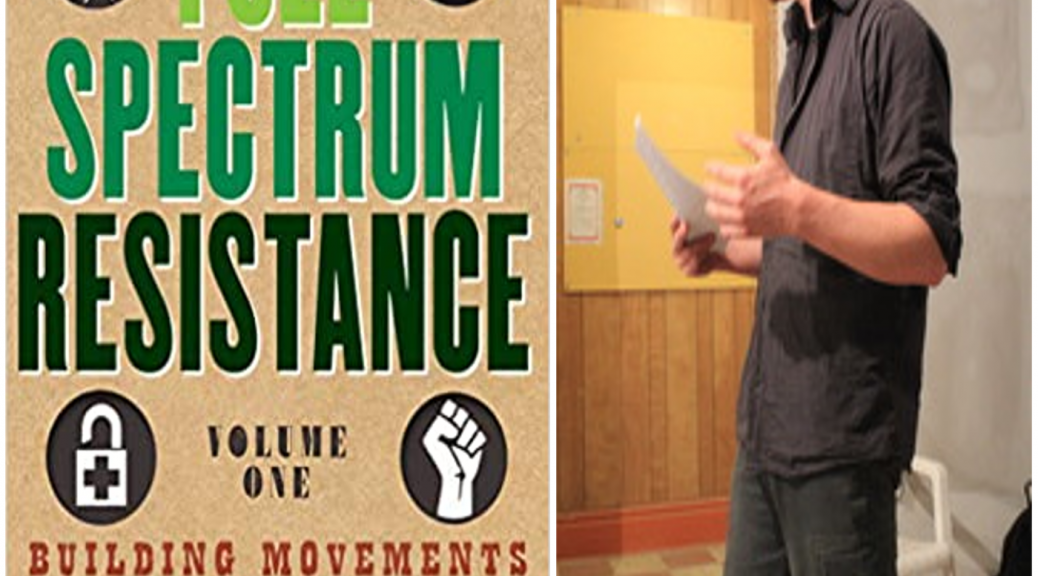
Aric McBay speaking and cover of Vol 1 of "Full Spectrum Resistance"
Download Episode Here

This week we are airing a conversation that we had a few weeks ago with Aric McBay, who is an anarchist, organizer, farmer, and author about his most recent book called Full Spectrum Resistance published by Seven Stories Press in May 2019.

This book is divided into 2 volumes, and from the books website [fullspectrumresistance.org]:

Volume 1: Building movements and fighting to win, explores how movements approach political struggle, recruit members, and structure themselves to get things done and be safe.

Volume 2: Actions and strategies for change, lays out how movements develop critical capacities (from intelligence to logistics), and how they plan and carry out successful actions and campaigns.”

This interview covers a lot of ground, with topics that could be of use to folks newer to movement and ones who have been struggling and building for a while. McBay also talks at length about the somewhat infamous formation Deep Green Resistance, some of its history, and tendencies within that group that led him to break with them.

Links to Indigenous and Migrant led projects for sovereignty and climate justice, and some for further research:

Links for more reading from Aric McBay:

Music for this episode in order of appearance:

– — – —

You can write to Sean Swain at his latest address:

Sean Swain #2015638

Buckingham Correctional

PO Box 430

Dillwyn, VA 23936

You can find his writings, past recordings of his audio segments, and updates on his case at seanswain.org, and follow him on Twitter @swainrocks.

. … . ..

Transcription

TFSR: So I’m very proud to be speaking with farmer, organizer, artist and author Aric McBay. Thank you so much for taking the time to have this conversation. Would you mind telling us a little bit about yourself, what stuff you’re farming, for instance, where you are, and what sorts of organizing you’re involved in?

Aric McBay: Sure. And thank you so much for having me on your show. So I farm just east of Kingston, Ontario. We have a vegetable CSA farm Community Supported Agriculture. So we grow about 40 or 50 different varieties of vegetables, and we provide those to about 250 households in our area. We do kind of a sliding scale to make it more accessible to people. And we normally host a lot of different educational events and workshops. But of course most of those are on pause right now.

In terms of community and activism or community engagement, I have worked on many different causes over the years. I’ve worked with militant conservation organizations like Sea Shepherd or doing tree sits. I’ve been a labor organizer, I’ve been a farm organizer. I’ve helped start community gardens. A lot of the work that I do right now is about climate justice and about other issues that are topical, at different times in my area, especially prisons, and housing right now. Prisons are quite a big issue that the nearest city Kingston has the largest number of prisons per capita of any city in Canada. So prisoners issues continue to be very important and I think that the situation with COVID has only kind of highlighted the ways in which prisoners are treated unfairly, and in which the prison system actually makes us less safe, makes our society more dangerous rather than less so.

TFSR: Well, you did an interview with From Embers at one point, which are friends of ours and members of the Channel Zero Network. They also had a show recently, or I guess a couple of months ago, about the pandemic and the history of pandemics in the Canadian prison system. And it’s like, yeah, it’s pretty sickening. And you’re on occupied Anishinaabe and Haudenosaunee land, right?

AM: That’s correct. Yes.

TFSR: And this is Tsalagi and Creek land where I’m calling you from. So you’ve been thinking and working around big picture ecological survival, and as you said, ecological justice for quite a while. For someone picking this up on the radio and maybe not keen on environmental concerns, can you give a kind of a quick snapshot of where the civilization is in terms of destroying the Earth’s capacity to carry complex life?

AM: Sure, and it’s so easy to forget about or to push aside because the other emergencies in our daily life just keep kind of stacking up. So right now, we are in the middle of really a mass extinction on on this planet. And industrial activity, industrial extraction has destroyed something like 95% of the big fish in the ocean, has fragmented huge amounts of tropical forest and deforested many tropical areas, including much of the Amazon at this point. But it’s really climate change that’s kind of that global, critical problem. The temperature has already gone up nearly one degree from their kind of pre-industrial norm, but the emissions that human industry have put into the atmosphere of the greenhouse gases, like carbon dioxide and methane, are already enough to set us on a path of significantly greater warming. That’s even if we stopped, you know, driving cars, or burning coal today.

And so that produces a bunch of different challenges. Of course, we’re going to see already more and more hot weather heat waves, like we’ve certainly been seeing this summer, more extreme storms happening more frequently. But in the long term, the outlook is potentially very grim. Depending on the emissions that are produced around the globe, we could be looking at not just one or two degrees of warming, but potentially five or six degrees of warming by the end of the century. And that produces a very different world from the one that we live in. Even two degrees of warming would be enough to essentially wipe out all of the coral reefs on the planet, to wipe out entire biomes.

We’re at the point where even relatively conservative international organizations understand that climate change could displace hundreds of millions of people, could create hundreds of millions of climate refugees around the world. And there’s never been any displacement like that. You know, when you talk about making a place where where potentially billions of people live, much harder to live in, and much harder to grow food. And, you know, we’ve seen things like the so called Arab Spring, for example, and the situation in Syria where those areas of unrest or those uprisings were triggered, in part by prolonged droughts and agricultural failures. And we have seen the streams of refugees coming from those places, especially in the United States, has really increased the amount of xenophobia and racism I think that a lot of people on the right feel comfortable demonstrating.

So the ecological crisis is not just about fish and trees, it’s really about the kind of society that we’re going to have in the future. For human beings, are we going to have a society where fascism is considered kind of a necessary response to streams of refugees moving from equatorial areas, as of local economies collapse? Are we going to see an even greater resurgence of racism in order to justify that? Are we going to see much more draconian police response to deal with the unrest and uprisings that could happen? So our future, our future in terms of justice and human rights really depends on us dealing effectively with climate change in the short term, because climate change is not something that we can kind of ignore and come back to and 20 or 30 or 40 years. There’s a real lag effect, that the emissions now those are going to cause warming for decades or even centuries. And the response is really nonlinear. So what I mean by that is, if you double the amount of greenhouse gases that you’re putting out, that doesn’t necessarily double the temperature impact. There are many tipping points. So as the Arctic ice melts in the Arctic Ocean, and that white snow turns to a darker sea, then that is going to absorb more sunlight, more solar energy and accelerate warming. It’s the same thing in the Amazon rainforests, the Amazon rainforest creates its own climate, creates its own rainfall and clouds. So you can easily hit a point where the entire forest is suddenly put into drought and starts to collapse.

We really need to prevent those tipping points from happening and to act as quickly as possible to prevent catastrophic climate change, because it’s going to be almost impossible to deal with, in a fair way once that happens. And that’s really the idea of climate justice, right? That the impacts of global warming are disproportionately put on people of color, on low income people, on poorer countries. And so if we want to have a fairer future, then that means those of us who are living in more affluent economies have a responsibility to reduce those emissions. Those of us who have more affluent lifestyles, their main responsibility to deal with that, to produce a future as well, that is fair and just and where human rights are still important.

TFSR: And like to, I think, reiterate a point in there, it seems like fairness and justice are good rulers to kind of hold ourselves to, but it seems like it’s for the survival of the species, as well as for the betterment and an improvement of all of our lives with these eminent and emergent threats. Resolving this and working towards working together with everyone is the best option.

AM: Yeah, I mean, I think it’s true. And I think one of the reasons that I’m interested in organizing around climate justice is because it’s one of the ultimate areas of common ground, right? It kind of connects people who are in many different places and working on many different struggles. Because activists who I work with, who are mostly anti-racist activists, understand why this is important. I mean, we’re already seeing that impact around the world. And activists who work on food security and hunger, I mean, it’s totally clear why climate change is important, because our ability to grow food in the future depends on avoiding catastrophic climate change. When I’m working with anti-authoritarians, it’s the same thing. So I really do see climate justice as an important movement building issue, something that can connect a lot of causes that might seem more disparate from from kind of a distance.

TFSR: I think your work does a really good job of pulling together, the fabric, sort of like weaving together these pieces and patchwork to say that these are all interrelated. And for us to ignore one of these elements means that we create a much weaker fabric, if even something that’ll hold together at all. Your most recent and huge two part book was entitled Full Spectrum Resistance, and the first subtitle was Building Movements and Fighting to Win, and the second was Action and Strategies for Change. Can you share what you mean by “full spectrum resistance”, and what you hope these books will bring to the table for folks organizing to not only stop the destruction of complex life on Earth, but to increase the quality of our survival and our living together?

AM: Of course. So I wrote this book because I’ve been an activist for more than 20 years, and almost all of the campaigns that I worked on, we were losing ground, right? I mean, that was the case for many environmental struggles, but also in struggles around the gap between the rich and poor, around many other things. But I saw in history and around the world, many examples of movements that had been incredibly successful. And the fact that a lot of the rights that people take for granted today – a lot of our human rights – come from movements that learned really valuable lessons about how to be effective. Movements that didn’t know necessarily know at the beginning, what would create kind of a winning outcome. And so full spectrum resistance is an idea that I think encapsulates some of the key characteristics that successful movements need to have, especially when they want to move beyond maybe a single issue or a local concern.

So one of those components of full spectrum resistance is a diversity of tactics. I think that’s really critical. I think one of the reasons that the left hasn’t been as successful in recent years, is that it’s really been whittled down to a couple of main tactics, it’s been whittled down to voting, and to voting with your dollar, right? To kind of ethical consumerism. And those are very limited tools. And they’re tools that leave out the vast majority of tactics that movements have used in the past, right? Successful movements like the Civil Rights Movement, or the suffragists or their movement against apartheid in South Africa. They used a huge range of tactics. I mean, they certainly use things like petitions and awareness raising tool at different times. But they also use tactics that allowed them to generate political force and disruption. So a lot of people don’t realize that, you know, to win the right to vote suffragist movements use property destruction and arson quite frequently. When people are talking about Nelson Mandela and the anti-apartheid movement, people often use Nelson Mandela, ironically, as a reason why we shouldn’t be disruptive. They think of him as this really peaceful guy because he spent close to 30 years in prison. But Nelson Mandela helped to create the underground armed wing of the African National Congress. That was a struggle that used armed self defense and sabotage extensively in South Africa. And allies used all kinds of economic disruption, especially divestment around the world to try to pressure the South African government. And we can take a look in more detail at some of these case studies if you want. But I think a diversity of tactics is really critical in building movements that win. Because if we stick to only one tactic, then that really limits our ability to escalate, and that limits our ability to adapt. It’s easy for those in power to understand how to undermine one tactic, if it’s the only one that we use.

I think another aspect of full spectrum resistance is cooperation among different kind of…constituencies, you might call them. So those in power can stay in power through divide and conquer, right? That’s one of their primary tools is to split resistance movements or social movements into different manageable chunks, like “militants” and “moderates”. So they can split the people who are willing to go out into the street and protest with kind of maybe a broader, more moderate group of people who support them. And they can just go ahead and arrest you know, a small group of militants in the street, if they’re able to separate those people.

Let me, actually let me give you an example of how a diversity of tactics and this cooperation can work. One of the movements that I talk about, or one of the campaigns that I talk about in the book, is an anti-apartheid group that organized in New York City at Columbia University in the 1980’s. And they were an organization that was trying to get Columbia University to stop investing in companies that did business in South Africa, right? South Africa was kind of a resource empire at the time, there were huge mineral resources that were being extracted, and people were making a lot of money. But because of the racism, because of the authoritarianism of that apartheid system, people around the world were really struggling to generate political force to put the pressure on to end the system of apartheid.

And so Columbia University, like many universities had big endowments, big investments. And there is this group is called the committee for a free South Africa at Columbia University. And they started with kind of classic strategy of awareness raising, so they held discussion groups and teachings about apartheid. They had, you know, petitions to try to convince the government of Columbia University to divest from South Africa. And they really did everything that you were supposed to do, right? They did all of the things that we’re kind of told, told that we are supposed to do in order to succeed. They built that public awareness and understanding, and they hit a wall. They got to the point where the administration and faculty and student representatives in the student government all voted for divestment by the top level of government, their board of trustees overruled them. And I think that point that they reached is a point that a lot of our struggles eventually meet, right? Where we’ve done the things that we’re supposed to do, but still those in power refused to do what is right. And it was a real turning point for those anti-apartheid organizers. And their attendance at events started to decrease after that, because well people thought “hey, this struggle is over, the Board of Trustees isn’t going to diverse, so what can you do, we just lost this one.” But those organizers, they weren’t willing to just give up, they realized they needed to escalate to win.

They decided to plan a series of disruptive simultaneous actions, they started a hunger strike. And they took over a building, they blockaded a building on campus and said “we’re not going to go anywhere until Columbia University divest.” And this was a big risk for them, right? Because they’d seen this declining participation. But it actually worked. They started with a handful of people at this blockade. And more and more people started coming. There’s this fascinating statistic about this campaign. Before the blockade, only 9% of the student body considered themselves at least somewhat active in that campaign for divestment. So only 9% had shown up to a rally or you know, signed a petition. But in the weeks to come, 37% of the entire student body participated in that blockade, by joining rallies or by sleeping overnight on the steps.

So, you know, that kind of divestment campaign, I think is very important. Now, in part because that campaign worked, Columbia University eventually did give in and did agree to divest. And that shows to us, you know, the value of a diversity of tactics, the value of disruption, the value of cooperation between people who are using different kinds of tactics. I think that really is something that we can learn and apply very effectively. And then the current day, another key part of full spectrum resistance is that solidarity between movements, to avoid the divide and conquer tactics that those in power try to use. And the fourth thing is really an intersectional approach is to try to synthesize the different ideas and the different philosophies that motivate different campaigns and that motivate different movements. Because we’re in a time when I don’t think single issue campaigns can succeed anymore, certainly in the context of climate change, but also in the context of rising authoritarianism. We need to look at how we can build that shared analysis, build genuine intersectionality in order to create movements that are truly powerful and effective.

TFSR: So with the Columbia example, it’s really interesting to point to that, I hadn’t heard of that before, and that seems like there’s a lot of lessons to be gathered from that. With what we’re talking about with the scope of climate change, like the larger scope of climate change, obviously, is you can break it down into smaller and smaller points of this extraction thing happens in this place, those materials are transported here, they’re processed here, they’re consumed or subsidized by these populations are these organizations. So I guess, like the level of amplification of resistance that you’re willing to apply to a situation should scale according to what you’re trying to succeed at doing.

With this wider scope of resistance to something that you could look at as a whole as the way that governments backup energy infrastructure, and monocrop industrial agriculture, the scale of this…I get kind of lost between that point of pressuring the people at the top of the university to divest once all the other steps have been denied, like the scaling between that and looking at, say, for instance, the US government and pressuring them…I kind of just get lost in the clouds at that point. I’m like, well, the US government is going to want to continue business as usual as much as it can, in part because of its investors, much like Colombia, but also because it’s sustaining a more “holistic” system. How does the anecdote of Colombia and the resistance there fit into a wider scope of looking at governments and the ecological destruction that they’re involved with?

AM: Yeah, that’s a great question. And I think one of the biggest challenges of the climate justice movement is the way that climate change and fossil fuel emissions, it all just feel so overwhelming and so diffuse, it’s hard to figure out, where should we actually focus our energy. But I think that many, or most movements in history, at some point, faced a similar problem, right? I mean, the anti-apartheid movement that Colombia was was a part of and were supporting. That was a movement that lasted for generations, the African National Congress was founded in 1912. And certainly at different points it was very unclear what people should do, you know, what was actually going to work against such a violently repressive regime. And so for me, I think there are a bunch of things that we can and should do to help address problems that seem really overwhelming or diffuse. And one of them, of course, is just to keep building our movements and to keep building our capacity and our connections. Because as long as we feel like we’re kind of isolated individuals or isolated pockets of resistance, it’s hard for us to see how we can tackle bigger problems. And that isolation is not an accident. Any authoritarian power especially wants to keep people divided and distrustful. So it’s important that we build cultures of resistance, that we build real connections with each other, and that we celebrate movements in the past that have won, so that we can kind of build up our capacity.

And I think it’s also important to look for areas where we can have early wins or kind of low hanging fruit. Areas where the problem is not as diffuse, but where the problem is more, is much more concrete or much more tangible. And so a great example of both of those things that work would be some of the mobilization against fossil fuel that has happened in so-called Canada in this year, and in recent years. So I don’t know if all of your listeners have been following this, but in February and March of this year of 2020, we saw some of the biggest Indigenous solidarity mobilizations in Canadian history. And those were kind of provoked by a particular flashpoint on the west coast. So there’s a settlement called Unist’ot’en which is on a pipeline route, there’s a site where the Canadian government and a variety of oil companies have been trying to build a series of pipelines to the west coast so that oil and fracked natural gas can be exported. And the Indigenous people who live there, the Wet’suwet’en, the traditional hereditary leaders have been very committed for many years to stop that from happening, and have essentially built this community on the pipeline route to assert their traditional rights and to assert their Indigenous sovereignty.

And in February at the beginning of February 2020, the government sent in really large armed force of RCMP officers and other officers, to try to kind of smash through different checkpoints that Indigenous communities had set up on the route leading to this site on the road, and also to destroy the gate that was keeping oil workers from going in and working on the construction of this pipeline. And the community there had been really good at building a culture of resistance over years, not just amongst Indigenous people, but among settler allies across the country. And so when that raid began, there was a really powerful response from many different communities. So a Mohawk community located just west of me, Tyendinaga, they decided to blockade the major east-west rail line that runs through Ontario, and that is kind of a bottleneck for the entire country. And other Indigenous communities started to do this as well, to set up rail blockades. And essentially, the entire rail network of Canada was shut down for weeks. You know, there were massive transportation backlogs.

And there were other disruptive actions as well, things like blockades of bridges – including international bridges – blockades and slowdowns of highways. And there was all of this mobilization that a year or two ago seemed inconceivable, it seemed impossible that any kind of disruption would be able to happen on that scale because nothing like that had happened before. And it was a really powerful movement that did cause the government to back off and cause the police to back off and start these new negotiations. And you know the COVID pandemic was declared at the same time as a lot of this organizing was still happening, so it’s kind of unclear what might have happened if that action had continued without a pandemic. But the rallying cry for a lot of organizers at that point was “shut down Canada”, which the pandemic did on a much larger kind of unanticipated scale.

But I think that example of the Wet’suwet’en solidarity and the disruption around it really points the way to potential successes and potentially more effective styles of organizing for the climate justice movement. And I think they have done a lot of things, right. They built that culture of resistance. So they didn’t just wait around for kind of a spontaneous uprising to happen, which I think almost never happens. They had built these connections over many years and build capacity and people had trained each other and trained themselves. And they had a particular location that they were trying to protect, right? So it wasn’t just “let’s go out and protect the entire world and protect all people.” You know, it’s hard to mobilize movements around something that’s so vague, but there is a particular community of a particular group of Indigenous people on a particular spot. And I think it’s much easier to mobilize folks around tangible sites of conflict like that.

The last thing that they did that was really effective, and that I think we can learn from, is that they turned the weakness of having the fight against this diffuse industrial infrastructure into a strength. So instead of just saying, “Oh, well, there’s so many pipelines, there’s so many rail lines, there’s so many highways, nothing we can do is going to make any difference.” The movement kind of said “Hey, there are all of these pipelines and rail lines and highways that are basically undefended, and that we can go and disrupt – even if it’s only for a day or two – and then move to another site. This actually gives us the potential to be incredibly effective, and to cost oil companies a lot of money and to cost the Canadian economy a lot of money.” Because that’s often what it boils down to right is “can we cost a corporation or a government more than they’re getting from doing this bad thing?” And I think that the Wet’suwet’en struggle has been an example and a demonstration of how to do that.

TFSR: Yeah, absolutely. And I think that that points to a really cogent point in terms of how to think about this sort of resistance. There were, what, 200 years for the Canadian government to think about its relationship to Indigenous communities and the sovereignty of like…them just pushing through sovereign territories to get what they want to extract, to run railways, to put pipelines in or whatever. And so appealing to the logic or the “reasonability”, or the sense of justice of the people that were representing the bodies that were sitting in the chairs in the suits in government – who were enacting the logic of capitalist settler colonial government – was not working.

But what did work was showing that if you do not see this point, we will shut down your ability to do this, or we will escalate to the point that you will have to like, step up further, and push back. And I think it’s a point that often gets lost. And I think, consciously, it’s been inculcated out of us, I guess, that’s a way to say it? Like, in the United States at least, we’re educated that the example of the suffragettes, the example of Gandhi, the example of the resistance to apartheid in South Africa, all of these examples, the winning view that’s given by the power structures when they educate us is that reasonability won out because of the justice of the cause. And because people went out and put their bodies on the line, but also like their petitions were eventually heard, their voting actually was the effective measure that changed the balance of power and that forced those in power to recognize the justice of the demands. And I think that’s like pandemic offers an interesting insight into, again, how that’s BS, like marches don’t stop people in power from making decisions. The threat that marches bring with the amassing of angry people who can do damage, or who can disrupt things, is what actually makes people in power look at marches and why that specific way of engaging is considered dangerous to those in power and why they want to stop that sort of thing.

I think that there’s a parallel to be drawn between that great example with the Wet’suwet’en folks and the resistance that was given to the attack on Unist’ot’en and Gitdimt’en gate, alongside of what we’ve seen, during this pandemic, in a lot of countries, and particularly the United States – where I’ve heard this morning on the radio, which, hopefully, hopefully, it’ll be wrong by the time this gets broadcast – but the US where I’m based, has a quarter of the deaths from COVID-19, around the world, and yet we are something like 5% of the world population. Those are similar numbers to how many people are incarcerated in this country versus the rest of the world. And people in power, at this point are not representing that they have the ability, the capacity, the interest, the will to actually stop this pandemic from spreading, and killing off the people that are most marginalized – starting off with the people that are most marginalized – in our society.

And so it seems like appealing to that same wing of power, the ones that profit off of ecological destruction when it comes to scaling back ecological destruction, and trying to reverse that trend, doesn’t seem that reasonable. But the sort of like direct action instances that you’re talking about, in coordination with other methods of dialogue and culture building, feels really important and exciting to me. I don’t know if you think that seeing the reaction of governments during pandemic is comparable to the vast amount of knowledge of ecological destruction, is an apt comparison or not?

AM: Yeah, I think you make very important points. And I think that, especially under capitalism, one of our continuing challenges with those in power is that they always consider profit more important than life, right? They always consider profit more important than human safety and human wellbeing. And that applies whether we’re talking about incarceration or COVID, or climate change, or police departments. And because of that, those in power are almost never convinced or persuaded by arguments to do the right thing. And that’s the case in the examples that you’ve mentioned, as well. If we look at those historical movements, we have been given a really sanitized kind of false narrative about how things like the Civil Rights Movement worked, or the suffragettes – or the suffragists, rather – we’re told, hey, that, you know, the Civil Rights Movement, just finally convinced people because people like Martin Luther King were willing to risk getting beaten up. And that’s what changed things. But that is not primarily what changed the people who are in positions of power, right? I’m sure there were a lot of people on the sidelines, especially in the north, who saw Black people and white people being beaten up by police on the Freedom Rides, for example, and that changed their opinion about things, or that helped mobilize them to do something about racism. But the racism, especially in the Southern states, and segregation, that didn’t end because of the Civil Rights Movement, giving a good example, that was dismantled, essentially, because of different kinds of force, political force, and sometimes physical force.

So in the Civil Rights Movement, we can look at the example of the Freedom Rides, when groups of white and Black organizers rode buses through the South where they were supposed to be segregated. And those buses were attacked by police and vigilantes, violently attacked, people ended up in hospital, buses were set on fire. And that didn’t actually end until essentially the federal government intervened, the federal government sent in troops to escort those Freedom Riders around the South to kind of complete their journey. And I think that’s something that people forget often, that racist violence didn’t just end because of a good example. It ended because there was some other form of force being employed. And I think people also forget that a lot of the non-violent demonstrations, the Civil Rights Demonstrations in the south, were protected by armed groups like the Deacons for Defense. The Deacons for Defense were an armed group before the Black Panthers, that was in many cases made up of military veterans, Black military veterans, who decided that they were tired of seeing civil rights marches getting attacked by the KKK or their police, and said we’re going to use our right to bear arms, and we’re going to go down there and defend people. And so a lot of the nonviolent actions that happened, were protected by armed Civil Rights activists.

So these sorts of things get written out of the history, especially by the in power, because those in power want to seem like the good guys, right? They want to seem like, “Hey, we are the ones who are going to come down and give you the rights, if you can provide us a good example, we’re just going to gift you these rights, these human rights” and that’s almost never have things will wind they will one because people were willing to struggle and people who are willing to disrupt.

I think that ignorance of social movement struggle is a form of white privilege. I have seen this at many different workshops, and many different talks that I’ve given, that often at the start of a workshop, I’ll ask people when they’re introducing themselves to name movement that inspires you, or name a campaign that inspires you. And oftentimes, the people who are coming to that workshop who are white organizers, who are newer organizers, they don’t have such a large repertoire to draw on, right, they’re much more likely to name a movement that happened locally or a movement that’s been in the news. Whereas a lot of the organizers who are people of color or from other marginalized communities, they can list off a ton of movements that inspire them that they’re learning from. And that’s important because marginalized communities understand better how to deal with those in power, how to get rights and how to protect your rights. And that’s often through social movements and through struggle, whereas people who are used to those in power looking out for their interests, especially, you know, middle class white men, they can afford to ignore social movement history, because they haven’t really needed social movements in the same way, or they don’t appreciate them.

And so when we have situations like we have now with growing authoritarianism, much more obvious racism, the climate emergency, people who are in positions of privilege, they find themselves at a loss, because they don’t know that movement history, so they don’t know how to respond. And it’s often movements of color movements of marginalized people, those are the movements that are going to teach us how to deal with these deep systems of injustice, these deep systems of inequality.

TFSR: So I guess, shifting gears back to like questions of wider approaches towards resisting ecological change, over the last couple of years there have been a few groups that have garnered a lot of headlines, and gained some sort of recognition and interplay with mainstream media, with governments around the world. I’m wondering what your full spectrum approach towards resistance sort of use the efficacy, or the impact of groups. I’m thinking of 350.org, Sunrise Movement and Extinction Rebellion, do those feel like single issue approaches towards ecological struggle? Because I know that there was some critiques definitely in the UK about extinction rebellion, specifically, the leadership weeding out people who are wanting to bring up questions around not only ecological devastation, but also around racism and around the existence of industrial capitalism, and its impact on that.

AM: Yeah. And I think that’s a big problem. I think that you can’t really address climate change without talking about capitalism, you can’t address climate change without talking about racism. And I think that, in general, the big liberal movements against climate change, or the big liberal organizations have failed. Partly for that reason, probably, because they’re not, they’re not looking at the root problems. They’re not radical organizations, right, they’re not going to the root of the issue. And so they’re not going to be able to use the tactics that will resolve it.

I think at this point, companies like Shell Oil, and you know, a variety of petroleum companies were very aware of climate change, going back to the 1960s. I mean, they had more extensive research at that point into climate change than the general public. And when I’ve done research into organizations that have fought against offshore drilling, for example, you can see that even in the 1980’s, oil companies like Shell are already building their oil rigs with taller legs in order to compensate for the sea level rise they expect to see. So the issue is not that those in power are totally ignorant of climate change, it’s that they’re making a lot of money from climate change and they think with all of the money they are making, that they can deal with the consequences for themselves personally, although not for everyone else.

And so that’s a huge problem and in some ways it’s slightly different from COVID. You know, in Canada, I think one of the reasons that we’ve seen a much stronger national response is because very early on the prime minister’s wife tested positive for COVID. And so clearly the impacts of the Coronavirus have been disproportionately bad for communities of color and for low income communities, but there still is much more potential for affluent people to get it. Whereas something like climate change, I think those in power have felt very isolated from especially in more northern countries. So that’s a huge problem. And that’s one of the reasons that just appealing to the good sensibilities of those in power is not going to succeed.

Maybe I’ll speak mostly about Extinction Rebellion, because when I was doing my book tour last here, and traveled from coast to coast in Canada, I ended up doing workshops about direct action and movement strategy for a lot of different Extinction Rebellion groups here. And I think, you know, from what I’ve seen, the people who have participated in those events have been very committed and strongly motivated, they understand that it really is an emergency, but they don’t always have a lot of history in kind of activism, or they don’t have as much movement experience as some of the other groups that I’ve worked with. Which can be good and bad, right? I mean, I think, you know, a lot of the liberal left, the reason that groups keep failing to address the climate crisis is because there’s kind of a standard issue dogma about how we need to convince governments to change and ask politely, and so on. And that’s really a dead end. So I think for people new to a movement or getting newly active, they are potentially more open to new ideas and new ways of doing things.

But I think that the Extinction Rebellion kind of movement in general, in Canada, and definitely in the UK, has not done a very good job of, of including the needs of Indigenous communities, and has not done a good job of including the needs of communities of color. And in particular, I think we see that in the relationship between Extinction Rebellion, and the police. This was a discussion that came up in almost every XR group that I have spoken with, that that kind of official line from XR in the UK is that you’re supposed to have a good relationship with the police, you’re supposed to go to the police in advance of an action and let them know what’s going to happen. And, you know, as a direct action organizer myself, and on many different issues, that sounds absolutely ridiculous, for a lot of reasons. One of which is that you lose the element of surprise, which is one of the key strategic advantages that smaller resistance movements need to have. But also, because if you go and try to cozy up to the police, or try to expect them to give you a good treatment because you’re bringing them a cake or something, I mean, that is really kind of a white focused thing to do, right? And that ignores the long standing grievances of Black and Indigenous communities in particular, because of the violent treatment that they’ve experienced at the hands of police. And of course, that has become even more obvious in recent months, and you know, the amount of attention and mobilization is long overdue. I think that’s been a real weakness of Extinction Rebellion, and I think it’s going to need to address that, and other climate justice movements will need to address that in order to succeed.

I think another challenge to Extinction Rebellion has been that they still are kind of assuming that if they make a strong enough argument that those in power will change their behavior. Because one of their big demands has been for those in power to tell the truth. And from my perspective, as an organizer, that almost never happens, right? Well, those in power rarely tell the truth and you don’t want to give them the opportunity to dominate the messaging. Those in power, whether it’s the corporate PR officers or government PR, I mean, they almost always dominate public discourse. And so if we have an opportunity to put in our own message, we should be doing that not kind of punting it back to those in power so they can either repeat the same business as usual line, or try to co-opt or undercut what we’re saying. I think there’s a huge strategic mistake. And what it means is that even if you’re blocking bridges, you can be doing that essentially as a form of militant lobbying, because you’re putting the potential for change in the hands of other people. And I think that movements that have succeeded in overturning deeply unjust systems In the past, they have been able to build up communities of resistance, they’ve been able to build up movements that can direct the changes that need to happen, and movements that are led by the people who are affected. In climate justice, that means, you know, we really need to highlight the voices of Indigenous communities, we need to highlight the voices of communities of color in the global South. And if we don’t do that, not only is it morally wrong and a moral failing, it’s going to be a strategic failing as well, because we’re not going to have the experience and the perspective we need at the table to create movements that will win and to create strategies that will win. It’s a real dead end.

So, you know, from my perspective, the most exciting movements that I see around climate justice are being led by communities of color, are being led by Indigenous communities, and that are incorporating people from a lot of different backgrounds. But keeping in mind that it’s not an option to fail here, it’s not an option to say, “Oh, the government should reduce emissions. And if they don’t, I guess, oh, well, we’ll go back to what we’re doing”, we actually really have to commit ourselves to to winning this struggle. And I think a lot of affluent white communities, because they’re insulated from the effects of climate change, at least so far, they don’t have that same motivation. They don’t have that same drive to win, they don’t have that same genuine sense, I think maybe of desperation even. So for them, the risk of getting arrested a few times maybe feels like a bigger risk than the risk of the entire planet being destroyed. I think the calculus of risk for Indigenous communities is often different, which is why we see them taking so much leadership like in the case of the Wet’suwet’en.

TFSR: So there’s the example of the Wet’suwet’en in terms of not only a sovereignty issue, but also the ecological impacts and the solidarity that they’re offering to the world by trying to blockade the extraction and eventual burning into the atmosphere of, I believe the tar sands, right, from Alberta. And then skipping to a not specifically ecological movement, the Black leadership and leadership of color in the Movement for Black Lives and the movement against white supremacist violence and police violence that sparked off with George Floyd’s assassination, but also has spread around the world because anti-blackness is so endemic in Western civilization. I’m wondering if there’s any other examples of current movements, particularly around ecological justice, that you feel inspired by that are led by communities of color and frontline communities?

AM: Hmm, that is a great question. I think that we have seen, you know, in Canada in particular, but all over we have seen many different movements that are Indigenous lead, I think that’s often the movements that I end up working with or supporting. The Dakota Access Pipeline is another example of a movement that has been Indigenous lead and has been very successful. I think, around the world, I see a lot of hope in organizations like La Via Campesina – the international povement of peasants and small farmers – which is a very radical movement that looks to overturn not just fossil fuel emissions, but also capitalism in general, that looks to create fundamentally different relationships between people and the planet, and to create community relationships. I think that sort of thing is really exciting. And I think when you look at food and farm based movements, there’s a lot of mobilization potential there, because food, like climate, is one of those commonalities between people that’s common ground. Everyone has to eat every day. And so I’m very excited about the tangibility that movements around food like La Via Campesina have the potential to lead to. I think there are a lot of migrant worker and migrant justice movements as well that really understand the connection between climate and justice in a way that a lot of liberal movements don’t.

I also think that a lot of the really effective movements and groups that are led by people of color, they’re often more local, kind of environmental justice movements, they are not necessarily as big or as well known. And they sometimes don’t want to be, right? I mean, they’re not trying to kind of mimic the corporate structure. They’re not trying to become a gigantic NGO. And I would encourage people to look for those movements that are close to you, to look for those movements that are led by communities of color and that are led by Indigenous people, and to try to connect with them and to support them. If that’s not the work that you’re doing already, how does that work connect? And how can these movements help to support each other, and to develop a shared understanding, and a shared analysis of what’s needed for action.

TFSR: Cool, thank you for responding to that one. One thing I thought of was the Coalition for Immokalee Workers – which is an immigrant led struggle based out of Florida – they do a lot of media work, but they also are addressing like the real impacts of the epidemic on undocumented populations and farm worker populations in so called USA.

So people who are also familiar with your work are going to be familiar with the fact that you co-authored a book called Deep Green Resistance, alongside Lierre Keith and Derrick Jensen some years back. And DGR, besides being a book, is also an organization or a movement, a call out for a movement. And I know one notable thing that was mentioned around Extinction Rebellion was the idea of putting your name out publicly and saying “I’m going to be participating in this direct action”. And that was the thing that I recalled anarchist being critical of DGR, and ecological resistors, where people were asked to sign up publicly and make a pledge to participate in this movement. But I know that you’ve left DGR, you have made public statements about why you have left Deep Green Resistance, but I would wonder if you could reiterate those right here and talk about the group and like why you came to leave it?

AM: Sure. So when writing Deep Green Resistance, what I really wanted to do was help people to understand the climate emergency and to understand better some of the tactics that would be required to deal with it. I do think now versus 10 years ago there’s a much greater understanding that we are in a climate emergency, and that more effective action is called for. It wasn’t my intent for there to be a group or an organization by that name. I kind of figured well, other people who are doing work already and other organizations will hopefully incorporate this analysis, or it will help to mobilize new people as well. And when some of the people who had read the book said, “Oh, we should make an organization about this”. I said, “Well, okay, great”. And it was really a fairly short period that I was participating in that, in kind of the first few months, because unfortunately, what happened when groups started to organize and people started wanting to get together for kind of trainings and conferences, my co authors became very transphobic. There were, you know, people who are asking, very reasonably, “oh, can I use the correct bathroom when I come to this event?” And they would say no. And, you know, it reminds me a lot of what’s been happening with JK Rowling recently. Instead of kind of responding to this critique, or instead of responding to people’s concerns about this, they really doubled down in a way that made it impossible for me to keep working with them, or to keep working with that organization.

I’m someone who is fully in support of trans rights and trans inclusion. And I think that their anti-trans attitudes were really detestable and really destructive. In part, because, you know, a lot of experienced organizers who had been getting connected to the organization left after that, totally understandably. So, it was really disappointing and heartbreaking. And I think that the choice that they made, basically destroyed the potential of that organization to be effective, to be kind of a viable movement organization, because it was such a toxic attitude. And I believe that, in general, it’s good to give people a chance to change their opinions or to learn from their mistakes, because there’s no perfect organization, there’s no perfect movement, right? There has to be potential for growth and for improvement, there has to be potential for everyone to kind of take feedback and learn. But at the same time, if it’s clear that someone is not going to do that, then I’m not going to keep working with them, because it’s not a good use of my energies, and it’s not an I don’t want to be connected with an organization that’s going to be transphobic, or that’s going to endorse any other kind of oppression.

It was a very disappointing experience in a lot of ways, but I think there’s still a lot of valuable content in that book in the book, Deep Green Resistance. I think it still had an an impact and beneficial ways in that it helped to in some communities or in some sub cultures, to accelerate and understanding of the climate emergency. It’s just disappointing that that was the outcome. I think that hopefully it will be a lesson for other activists in the future and for other organizations, to really, from the very beginning of your organization, to set out so much clearer ground rules and clearer points of unity about anti-oppression that everyone will agree on. I think a lot of movements or organizations can emerge out of kind of an ad hoc approach, can kind of coalesce together. And I think it’s really important to pause and make sure that you’re on the same page about everything, before putting in too much effort before putting in too much commitment.

TFSR: So besides the transphobia, another critique that’s come to the DGR approach that that was sort of laid down in the book, was valorization. Maybe not in all instances, but in some instances of like a vanguard, or like a military command structure. Which, in a military scenario and like combat zones, I’ve heard it like I’ve heard anarchist talk about like, yes, it makes sense to have a clear lines of communication, someone who’s maybe elected into that position for a short period of time, and who is recallable, be a person that will make decisions on behalf of whatever like a group is in an activity. Is that an effective approach towards organizing ecological resistance? On what scale is that an effective or appropriate model for decision making? And is there a conflict between concepts of leadership versus vanguard command structure?

AM: Sure, I don’t think that we should be having military style command structures. Part of the critique that I was trying to create speaking for myself, was that consensus is not always the ideal decision making structure for every single situation. And I think, especially in the early 2000s, in a lot of anarchist communities, there was this idea that consensus is the only approach and if you don’t believe in always using consensus, then you’re kind of an authoritarian. And I think that’s really an oversimplification. I think consensus is very good for a lot of situations, right? It’s good for situations where you have a lot of time, it’s good for situations where people have a similar level of investment in the outcome of a decision or where people have a similar level of experience, perhaps.

But consensus has some flaws, as well. And I think one of them is that, you know, if you have a group of, say, mostly white people and a handful of people of color, who are trying to make a consensus-based decision about something that has to do with racism, then you’re not necessarily going to get the outcome that you want, because that is a system that can downplay inequalities in experience that are real, right? Some people have more experience of racism or, or systems of oppression and consensus doesn’t always incorporate that.

So we were talking a lot about the Wet’suwet’en example earlier, the Wet’suwet’en struggle. And when settler allies have gone to Wet’suwet’en territory to help, they actually have to basically sign off and say, “Yeah, I’m fine to accept Indigenous leadership for the duration of my time there. And if I don’t want to accept it any more than I can leave.” And I think there’s a place for a lot of different kinds of decision making structures. So for me, it’s like tactics, right? I mean, there are some tactics that are really good in some situations, and really not very helpful and others. And I feel like with decision making, it’s the same way. For myself, I prefer to work in consensus situations most of the time, because that’s a way of making sure that you’re incorporating a lot of different perspectives. But I think when you do have a very tight timeline, you know, it makes sense, as you mentioned, to consider electing people or to have people who are maybe on a rotating basis kind of in charge for that action. I think that there’s room for a lot of different approaches in terms of decision making. And like our tactics, our form of decision making has to be matched to our situation and to our goals.

TFSR: So it feels like when talking about ecological devastation, and like the precarity of where we’re at as a species, in particular – again in western civilization – that there’s this misanthropic approach towards looking at problems and solutions in terms of human caused ecological unbalance. It’s sort of a Manichaean approach. And people talk about there being too large of human populations, or historically, that sort of numbers game kind of leads to a eugenicism position. That puts blame on poor people or indigent people, and darker skinned people, as they tend to be more marginalized in the settler colonial societies in this parts of the world. And often, like, even just those nations are taking up more resources, those nations are developing in a way that’s inconsistent with you know, ecological balance.

It feels like that sort of approach is one that ignores the question of how populations are interacting – or the economic systems that populations are kept within – with the world with, quote unquote, “resources” with other species. And there’s often a presumption affiliated with that, that we as a species are alien to or above the rest of the world, that we’re not a part of nature, that we’re separate from it. And I think there’s some kind of like Cartesian logic in there, because we can think about ourselves to be self aware, in a way that we understand. We presume that not only is there a lack of agency to other elements, within our surroundings, with other living things…I guess it goes back to, like, in the western sense, stories of genesis. Of human beings being given control over the natural world to determine how those quote unquote “resources” are used, as opposed to being a part of that natural world, and that we have a responsibility for ourselves and for our siblings. Can you talk about why it’s important to challenge like, sort of the fundamental weaknesses of the misanthropic approach that looks as us as outside of the natural world? And how shifting that question actually allows us to make the changes that will be required for us to possibly survive this mess?

AM: Sure, yeah. I mean, I understand why people get frustrated with humanity. But I think, both from a philosophical perspective and from an organizers perspective, blaming humans in general for the problem really kind of obscures the root of the emergencies that we’re facing, and it obscures the things that we need to do. I think some of what you’ve talked about, it’s really different forms of human exceptionalism, right? There are some people who don’t care about the environment at all, who are human exceptionalist, who think humans can do whatever we want, we’re immune to the same kind of rules that other organisms follow. We’re immune from the effects of the weather or the planet or the ecology. And of course that’s ridiculous. But at the same time, we have at the other end, people who really believe a different form of human exceptionalism and believe that humans are doomed to do bad things, that we’re kind of doomed to destroy the planet. And I don’t think either of those things are true. I think, you know, if you look at that history of humanity and our immediate ancestors, for millions of years we managed not to destroy the planet, or even put the planet in peril. It’s really a fairly new phenomenon that specific societies, and especially specific people in specific societies, have been causing this level of destruction. And that destruction is not really about population, it’s about wealth.

If you look at someone like Jeff Bezos, the CEO of Amazon who’s bringing in what? $12 billion a day that he’s adding to his his fortune, $12 billion in profit every day, compared with someone living in, say, Bangladesh, who’s barely emitting any carbon dioxide at all. There’s a huge disparity. And I think that people like Jeff Bezos would probably be happy to have us say, “Oh, well, the problem is just humanity. The problem is we’re going to destroy the planet. And I guess we have to build rocket ships and go to other planets, because that’s the only way to solve this problem.” Whereas really, it’s about wealth and capitalism. It’s that people in very wealthy countries, and especially the richest people in those countries, are doing most of the ecological damage, and who also have the power to stop doing that ecological damage if they chose and if they were willing to give up some of the money that they’re making every day.

So as an organizer, one of the reasons that I avoid that misanthropic approach is because it just doesn’t give us a lot of options, right? Like, if humans inherently are the problem, then do we just wait for humans to go extinct? I mean, I’ve certainly heard people say, “Oh, well, I guess the earth is going to come back into balance.” So you know, that kind of line of thinking. But for me as an organizer who works on many different issues, from prisons to gender equality, to you know, farm worker issues, that’s not a good enough solution. It’s not good enough to just throw your hands up and say, “oh, what can we do? It’s human nature,” because it doesn’t address the root power imbalances. And it also doesn’t give us any models for how to live better. Because that’s also what the misanthropy kind of obscures. It obscures the fact that the majority of Indigenous societies for the majority of history have lived in a way that has been beneficial for the land around them. And there are still many traditional communities and many societies that managed to live without destroying their environment and destroying the land.

And so I think, you know, if we say, “Oh, well, humans are just the problem”, then that kind of frees us up that burden of of learning more and actually changing our lifestyle, maybe, or changing our approach. I think it’s really important we look at the root of the problems that we’re facing, which in terms of climate, and many other things, is really about capitalism, colonialism, white supremacy, patriarchy, these overlapping systems of inequality. And I think, again, the solutions that we need to find have to do with looking to those communities that have been living in a better way, whether that’s Indigenous communities or communities that have struggled for genuine equality, genuine racial equality, gender equality, all of these things. And those are the kinds of communities that can help us to not just survive this climate emergency, but after that, and now to have communities to have societies that are actually worth living in. That are fair and inclusive, and where people aren’t constantly in this competitive struggle, and on the edge of precarity in this, you know, doggy dog situation. I think it’s a very good news story to look past that misanthropy and to look at societies that are worth living in.

TFSR: So your two books, in a lot of ways – just at least by the titles and by what we’ve been talking about – a lot of what they map out is strategies for resistance and strategies for challenging the current system. And I’m not sure if there’s a strong focus on what you’re talking about right now the like, “what are people doing in other places, what have people been doing?” Are there any examples, or any good roads towards gaining that knowledge that you can suggest? You mentioned just listening to people that have been living in other ways and to the people that have been most affected by the impacts of climate change and racialized capitalism? Are there any authors or any movements in addition to the Wet’suwet’en for instance, that you would suggest listening to or looking to?

AM: Sure, well, in closer to me, I think the Indigenous Environmental Network is a movement I look at a lot, the Migrant Rights Alliance is an organization that I’ve been paying a lot of attention to. So a slightly older book that I think is important is called Igniting a Revolution: Voices in Defense of the Earth, which is edited by Steven Best and Anthony J Nochella, and that’s a compilation of writings from many different people that kind of brings together anti-racism, anti-colonialism, anti-capitalism. I think that book is a really great place to start. And I think also, for me, a lot of the case studies that I talked about, a lot of movements that I talked about, are examples of people who’ve tried to kind of bring this intersectionality together in the past; Black Panther Fred Hampton was an incredibly powerful organizer who brought together, you know, this anti-racist, anti-capitalist approach. People like Judi Bari, the environmental activist who put forward a philosophy she called “revolutionary ecology”, that synthesized feminism and Earth First! and kind of working class analysis of capitalism.

I think people like that are really important to listen to. And I think, you know, it’s no coincidence that Fred Hampton was assassinated by the police, or that Judi Bari was bombed by the police. Those in power are really terrified by movements that take this intersectional approach and by people who do this, because, you know, when we start moving in this direction we can be incredibly effective and bring together a lot of different groups and movements, and have a really powerful transformative impact.

TFSR: Thank you so much for having this conversation. Aric, could you tell listeners how they can get ahold of any of your books or where they can find your writings or follow your ongoing journalism?

AM: Yeah, so you can find out more about Full Spectrum Resistance by visiting fullspectrumresistance.org. And you can also download some additional resources and read or listen to the first chapter there. If you want to look at some of my other work, you can visit aricmcbay.org, A-R-I-C-M-C-B-A-Y dot org. And I also have a Facebook page, Aric McBay author.

TFSR: Thank you again, so much, for taking the time to have this conversation. And yeah, I appreciate your work.

AM: Thanks so much. Likewise, it’s been a pleasure.

History Repeats Itself?: Peter Gelderloos On Where We’re At

History Repeats Itself?: Peter Gelderloos On Where We’re At

A shadowy Peter Gelderloos speaking about his book, 'Worshipping Power"
Download This Episode

Its not uncommon to hear pundits and regular folks making comparisons between the crises we are now facing and other historical moments, such as the 1920s in Germany or the global rebellions of the 1960s. But is this an effective approach for gauging the potential of now?

For the hour, anarchist author and activist Peter Gelderloos shares some of his thoughts on those comparisons, on the revolutionary potential of this moment were living in and some lessons from past movements that we might keep in mind now to make the most out of these dire times. You can find many of Peters writings on TheAnarchistLibrary.Org, available through AK Press and independent bookstores. You can hear our past interviews with Peter by visiting our website.

We Need To Spread This Freely: JN On HK Under National Security Law

We Need To Spread This Freely: JN On HK Under National Security Law

A 2019 demonstration with laser pointers in Hong Kong following the arrest of activist, Keith Fong.
Download This Episode

This week, I speak with JN, an anarchist who works with the decolonial, leftist HongKonger platform, Lausan, talks about where the uprising against Chinese integration in Hong Kong stands, the National Security Law, tankie and rightwing narratives and international anti-authoritarian solidarity and resistance.

The interview about Belarus that I mentioned before was from a recent episode of Elephant In The Room, from Dresden, Germany, which is a member of the Channel Zero Network of Anarchist Podcasts.

A few of the media links mentioned by JN are:

Announcements

Charlotte RNC 2020

I’d like to remind folks that the 2020 Republican National Convention is going to partially be held in Charlotte from August 20-24. One group that is doing anti-repression work in the area is CharlotteUprising, which can be found on twitter at @CLTUprising, where you can find info about the protests at the event as well as their jail support, including how to make donations. You can learn more by following the hashtags #CharlotteUprising and #ResistRNC2020

JLS Call For Solidarity Aug 19 – Sept 9

You can read the whole release here:

To all in solidarity with the Prisoners Human Rights Movement:
We are reaching out to those that have been amplifying our voices in these state, federal, or immigration jails and prisons, and to allies that uplifted the national prison strike demands in 2018. We call on you again to organize the communities from August 21st – September 9th, 2020, by hosting actions, events, and demonstrations that call for prisoner human rights and the end to prison slavery…
On August 21 – September 9, we call on everyone in solidarity with the prison class struggle to organize an action, a panel discussion, a rally, an art event, a film screening, or another kind of demonstration to promote prisoners’ human rights. Whatever is within your ability, we ask that you shake the nation out of any fog they may be in about prisoners’ human rights and the criminal legal system (legalized enslavement).
During these solidarity events, we request that organizers amplify immediate issues prisoners in your state face, the demands from the National Prison Strike of 2018, and uplift Jailhouse Lawyers Speak new International Law Project…
The prison strike demands were drafted as a path to alleviate the dehumanizing process and conditions people are subjected to while going through this nation’s judicial system. Following up on these demands communicates to the world that prisoners are heard and that prisoners’ human rights are a priority.
In the spirit of Attica, will you be in the fight to dismantle the prison industrial slave complex by pushing agendas that will shut down jails and prisons like Rikers Island or Attica? Read the Attica Rebellion demands and read the National Prison Strike 2018 demands. Ask yourself what can you do to see the 2018 National Prison Strike demands through.
SHARE THIS RELEASE FAR AND WIDE WITH ALL YOUR CONTACTS!
We rage with George Jackson’s “Blood in my eyes” and move in the spirit of the Attica Rebellion!
image by StudioIncendo on Flickr
. … . ..
featured track:
I Can’t Relate – Beatnuts – Hydrabeats Vol 5 (instrumentals)

Keep Calm and Get Prepared: A Look Into Month 3 and Beyond of the Portland Uprising with the Portland GDC

Keep Calm and Get Prepared: A Look Into Month 3 and Beyond of the Portland Uprising with the Portland GDC

IWW General Defense Committee logo
Download Episode Here

This week we got to sit down with two members of the Portland General Defense Committee, AC (they them) and Raoul (they he), about the ongoing Uprising in Portland OR in the months since the murder of George Floyd. We get to touch on a lot of topics in this interview; the neo-liberal whitewashing of the image of the city of Portland which masks a lot of ultra racist and colonial tendencies, personal timelines of engagement in the Uprising, and a lot of tips and tricks for newer and older anarchists and radicals for dealing with and anticipating state repression and violence.

Here are some notes and links to the topics that our guests spoke on:

-One note on the group Riot Ribs that AC mentions, I think that the group has disbanded for now but have seemingly regrouped as Revolution Ribs, you can find them @RevRibs on Twitter and their Cashapp is $RevolutionRibs. This group does not have a verified Instagram presence as far as I know.

Walidah Imarisha on Oregon’s racist, anti-Black history:

Walidah Imarisha – Why Aren’t There More Black People in Oregon? (YouTube link) approx 1.5 hours long

-You can learn more about the Portland General Defense Committee and donate to their efforts at https://pdxgdc.com/

-Rosehip Medics in Portland : All Fundraising Platforms (rosehipmedics.org)

-Indigenous Mutual Aid is a platform that started up at the start of pandemic and has a very thorough list of Indigenous led and centered projects in their directory (indigenousmutualaid.org)

-Portland Freedom Fund which is a general fund that bails out BIPOC (portlandfreedomfund.org)

Twitter folks to follow for otg news on the PDX Uprising:

Economy Breakfast

Sergio Olmos

Robert Evans

Anti-Repression Resources:

Sprout Distro on Instagram

National Lawyers Guild on Insta

Civil Liberties Defense Center also in Insta

-And finally, there are too many autonomous local bail funds around the country to all name here, but if you do a search for “mutual aid bail fund in [name of town/city]” then that should give you a pretty solid clue about how to support places that haven’t made it into the news as much. You can also do searches for Black Mamas Bail Out in your area to help fund efforts to bail out Black mothers and caregivers.

. … . ..

Music for this episode:

Run DMC – Peter Piper (instrumental)

RANGEEN – BeatByShaheed

Anarchist Prisoners and Updates from the A-Radio Network

Anarchist Prisoners and Updates from the A-Radio Network

BAD News logo like BBC
Download This Episode

This week, we’re continuing our pandemic vacation. First up is some new words on surveillance and resistance by Sean Swain.[00:02:51-00:09:25]

Then you’ll hear audio from the most recent episode of our cousin project, Dissident Island Radio, where they spoke with a fan of London Anarchist Black Cross about the upcoming July 23-30th Week of Solidarity with Anarchist Prisoners. Dissident Island Radio is also a member of the Channel Zero Network and the A-Radio Network, and you can find more of their work, including their shows dating back almost 13 years to the day, at DissidentIsland.Org. The show notes include a lot of notes and links for solidarity. [00:09:25-00:22:31]

Comrade Malik shares his birthday greetings and informs us about the current struggles of anarchist and anti-fascist prisoner, Eric KIng. [00:22:31-00:26:38]

Note that on Sunday, July 19th 2020 at 8pm EST there is a benefit trivia game for Malik’s release and the SF Bay View over Zoom. More info on fedbook, and you can RSVP before the event by emailing blueridgeabc(at )riseup( dot)net!

We’ll also be featuring audio from this months Bad News: Angry Voices From Around The World. Bad News is a monthly, English-language podcast with updates from various participants in the A-Radio Network of anarchist and anti-authoritarian radio and audio projects. If you like what you hear, we invite you to check out other projects in the network, learn more about our work, how get your project involved and to listen to other episodes Bad News by visiting A-Radio-Network.Org and you can keep an eye on our twitter feed for regular retweets of episodes, coming out at roughly the 15th of each month.  [00:26:38-forever]

Contents from BADNews (produced by 1431AM):

1) Radio-zones of Subversive Expression (Athens) about:

  • media foundation by the Greek goverment during the quarntine,
  • the police violence in Exarchia some days after a squat eviction,
  • the violence and eviction of Victoria square

2) Črna Luknja is contributing an antireport from Slovenian unrests, that in the middle of march, because of the virus started with drumming on balconies, went on the bicycles and ended up on foot, against the right-wing government with authoritarian, neoliberalistic and nationalistic intentions.

3) Free Social Radio 1431AM (Thessaloniki) about:

  • the arrest of two anarchist comrades in Thessaloniki,
  • the latest developments on the shutdown and reconnection of espiv.net’s server,
  • the violence and eviction of Victoria square

4) A-radio Berlin: Stop the eviction of the collective bar Syndikat
“In the context of a possible summer of evictions of collective bars, house projects and youth centers in Berlin, the Anarchist Radio Berlin wants to help make it instead a summer of resistance.”

5) Radiofragmata (Athens) with news from Greece.

6) FrequenzA with an interview with somebody from solikomitee 1007 about the street festival “resist-2” about the festival, the resistance against the deportation in the past and the trial against two persons who where part of it.

7) Dissident Island Radioa round-up of UK-related ‘B(A)D News’

William C. Anderson: On Blackness and Anarchy (rebroadcast)

On Blackness and Anarchy

Book cover of "As Black As Resistance" by William C Anderson and Zoe Samudzi (AK Press)
Download This Episode

This week on the Final Straw, we are taking a break from consistently bringing fresh content over the last few months (frequently twice a week, instead of just the usual Sunday episodes) and re-airing this segment form a prior episode 2 years ago. Here we re-present a speech by William C. Anderson, keynote of the 2018 Another Carolina Anarchist Bookfair in so-called Asheville, NC. William is the co-author with Zoe Samudzi of the book “As Black As Resistance: Finding The Conditions For Liberation” (AK Press, 2017).

From the original post:

The talk he is giving here is based heavily on the first chapter of the book called Black in Anarchy, and in addition to laying the groundwork of how he and Samudzi wrote the book, he speaks about the truly conditional nature of so called “citizenship” that many people living in the US face, the continuing evolution of race and the reliance of white supremacy to Black subjugation, and he places Blackness in proximity to Anarchy, and much more.

From the back cover: “As Black As Resistance makes the case for a new program of self-defense and transformative politics for Black Americans, one rooted in an anarchistic framework that the authors liken to the Black experience itself. This is not a book of compromise, nor does it negotiate with intolerance. It is a manifesto for everyone who is ready to continue progressing towards liberation for all people.”

We hope you will enjoy this talk, and if you are curious about the book As Black As Resistance by Zoe Samudzi and William C. Anderson, you can head over to AK Press to learn more!

We’ll be back with new content soon, once we’ve re-energized. If you are in the radio listening audience and are fiending for more voices from the streets, radical authors and more, consider checking our website for a backlog of episodes going back to 2010. You can play on our website, or subscribe to our podcast stream with your smart phone, tablet or computer, and you can also find all of our content for free on those nasty, streaming platforms like spotify, youtube, google podcasts, itunes ad nauseum.

Announcements

Anarchist Media

Comrades at Sub.Media have had some really exciting projects hit the web in the last week or so. First up, after ending their monthly Trouble series, they have inaugurated a new series entitled “System Fail”, this first episode is entitled ‘Riots Across America’, is hosted by a Dee Dos and features an interview with Oluchi Omeoga of Black Visions Collective and Reclaim The Block in so-called Minneapolis. While it’s currently unavailable on youtube, it can be watched via Archive.org and their website, Sub.Media.

Sub.Media has also announced, in collaboration with AntiMidia in Brazil, is launching ‘Kolektiva’, an anarchist and anti-colonial video platform based on peer-tube. This project already features videos in French, German, English, Portuguese, Spanish, Italian, Greek and Arabic and they are looking for more rad video collectives to participate and more folks to help with translation. You can check it out and learn more at Kolektiva.Media

Fundraisers

There are a number of ongoing fundraisers for folks arrested during the Uprising for Black Lives aka ACAB Spring, many of which can be found at ItsGoingDown.org among other places. One group that could use the funds is the Free Deyanna Davis legal defense fund in Buffalo, NY. You can learn more by visiting gofundme.com/f/free-deyanna-davis-legal-defense-fund

Also, from Black Hills Bail and Legal Defense Fund:

“On July 3rd, 2020, Indigenous People and our allies were arrested in the process of defending our sacred lands in the Black Hills. Acts of courage and civil disobedience resulted in arrests and criminal charges. We were protesting the desecration of sacred lands that were stolen by our people.”

To support the 15 arrestees from July 3rd, consider visiting BHLegalFund.org.

The SF Bay View National Black Newspaper has been producing a print newspaper since 1976 featuring voices from the Bay Area in California, voices from imprisoned people, stories about struggles for ecological justice in working class communities of color and views and news online and in print up til today for Black Liberation. The paper is sent to prisoners and thus acts as a powerful conduit for ideas and action behind bars and with the outside. I had a chance to speak with the editor, Mary Ratcliff a few years back about the paper. Mary, who is in her 80’s, has been diagnosed with breast cancer and her husband and the publisher, Willie Ratcliff, has his own serious health issues and she is his care giver. They are fundraising with a GoFundMe at the moment to help bring on board the soon to be released, but currently incarcerated, Comrade Malik to become editor. Malik has been acting as assistant editor of the Behind Enemy Lines column and is set to be released from Federal custody in September and is excited to take on this responsibility. If you are excited and want to learn more about how to help, you can visit GoFundMe.com/f/fund-liberation for more information and how to help sustain the SFBayView in this exciting transition. And you can check out the paper at SFBayVIew.com

Prison Related

Prisoners at Coffee Correctional in Georgia are facing a major spike in the pandemic and are requesting a phone zap beginning Monday, July 6th in response to this crisis. You can learn more at the Atlanta

IWOC facebook, instagram or twitter accounts. And you can hear the audio again with call-in information via the audiogram.

To hear more recent updates about political prisoners and their struggles in the so-called U.S. including some context about the recent uprisings and arrests, check out the latest addition to the ‘Prison Break’ column at ItsGoingDown.Org. For a wider view of the impacts of the pandemic and resistance to it behind bars, IGD also just published a new installment of their ‘Break Out’ column featuring views from members of the Philadelphia chapter of the Revolutionary Abolition Movement and Oakland Abolition and Solidarity (formerly Oakland IWOC). Both are linked in our show notes.

There is an invitation for folks to organize events in their cities and to share the call for an international action week in solidarity with anarchist prisoners August 23-30th. You will find the call at www.solidarity.international (available in 5 languages), on Twitter (@solidarity_week), Facebook (@WeekOfSolidarity), Mastadon (@tillallarefree) and you can share your actions by writing to tillallarefree@riseup.net . Their pgp key is up on the contact page of their website.

. … . ..

The featured track in this episode was:
Unbound Allstars – Mumia 911 (Rocks Tha World Full Length Mix Instrumental)Mumia 911

Justice4Jerry2020, Confederate Monuments + Repression During The Movement for Black Lives

Justice4Jerry2020, Confederate Monuments + Repression During The Movement for Black Lives

Aerial of "Defund The Police" painted on street by Asheville Police Dept in June, 2020
photo by Ben Harper
Download This Episode

This episode has three portions following a segment by anarchist prisoner, Sean Swain, about confederate monuments.

[00:02:31 – 00:09:32]

This episode warrants a general content warning for the mentioning of the murder by shooting of a Black man at the hands of the police.

Justice4Jerry 2020

[00:09:32 – 00:29:36]

First up we got the chance to sit down with Najiyyah Avery Williams, who is a community member, organizer, and mother of Jai Lateef Solveig Williams, also known as Lil Jerry. Jerry, who was a children’s book author, artist, musician, and a 35 year old father was brutally killed by the Asheville Police Department on July 2nd 2016 by Sgt Tyler Radford.

This interview happened outdoors in front of the courthouse and police station in downtown Asheville, where the city was powerwashing a DEFUND THE POLICE street mural which was done autonomously the previous day to honor the life of Jerry Williams, and to call attention to the culture of violence and silence that the police hide behind when they murder Black people. Visit our social media for pictures of this mural before it was taken down!

In this segment we talk about Lil Jerry’s life, his work, the circumstances surrounding his passing, racist violence and harrassment his family has received in the aftermath, and projects his mother is working on and would like to see for the future.

An article by Socialist Worker detailing the initial murder and how contradictions were evidenced at the get go.

To help support Justice for Jerry, which is trying to get his unfinished books published and will go to supporting his family, you can venmo to the handle @J4J2020, or follow them on social media platforms by searching Justice 4 Jerry 2020.

Rural Protest Against Racist Legacy

[00:29:36 – 00:39:10]

After Najiah, we’re happy to share a voice message we received from Gabriel from Tyrrell County, North Carolina, about a protest that happened on the 26th in Columbia, the county seat. Gabriel shares his experience of the protest in this tiny town, giving an insight into some rural experience of confronting confederate monuments and their legacy.

Michael Loadenthal on Repression During 2020 Uprising

[00:39:11 – 02:10:16]

In the third portion of this episode, you’ll hear Michael Loadenthal of The Prosecution Project, which maps how politics impacts the weight of criminal charges attached in the U.S. Michael talks about the scale of repression brought by local, state and federal law enforcement and ideas of resisting it during the uprising against police killings of George Floyd, Breonna Taylor and others, the destruction of racist statues known variously as the rebirth of the Movement for Black Lives, or the #ACABSpring. For a great article on the subject, check out Mapping the State’s Strategy of Repression Against the Rebellion on IGD. Michael talks about the construction of federal felony charges for what would normally be smaller local charges, the use of grand juries to map social networks. He also shares thoughts about safer practices with social media, shifting dialogue around the role of police in society, the role of open source intelligence as well as surveillance technologies like drones and facial recognition.

Some points to follow up on from Michael’s chat:


Pan-African Social Ecology: A conversation with Dr Modibo Kadalie

Pan-African Social Ecology: A conversation with Dr Modibo Kadalie

Book cover of "Pan-African Social Ecology"
Download This Episode

This week, we’re happy to air a conversation I had with the author and activist, Modibo Kadalie, author of Pan-African Social Ecology as well as Internationalism, Pan-Africanism and the Struggle of Social Classes. A version of Dr. Kadalie’s conversation with Andrew Zonneveld of OOA! Publishing, entitled Pan-Africanism, Social Ecology and Intimate Direct Action appeared up in the recently released collection Deciding For Ourselves, edited by Cindy Milstein out from AK Press. Dr. Kadalie has also been involved in political organizing including resisting the draft of the Vietnam War, labor organizing in Detroit and Memphis, ecological protest, community self defense in Atlanta and currently is working on writings about ecology and living in the territories of southeastern Turtle Island, including those of the Creek and Seminole peoples, and working at the Autonomous Research Institute for Direct Democracy and Social Ecology in Midway, Georgia.

In this hour, Modibo talks about autonomous community organizing, the contradictions between the survival of the species and capitalism, CLR James, his read on Pan-Africanism and Social Ecology, the pandemic, and direct democracy. We also talk about Geechee history in south so-called Georgia, the weaknesses of nationalism, hierarchy and revering individual historical figures and the strength of spontaneity and community action.

This conversation was recorded before the killing of George Floyd and but after the increased awareness of the killing of Ahmaud Arbery nearby to Dr. Kadalie in Glynn County, GA, which reflects in the discussion. Modibo shares some criticisms of official Black Lives Matter, liberal cooptation and the veneration of representative leadership.

. … . ..

Featured Tracks:

  • Marvin Gaye – Mercy Mercy Me (The Ecology) – What’s Going On
  • Quincy Jones – Everything Must Change – Body Heat
  • Sam Cooke – A Change Is Gonna Come – Ain’t That Good News

Continue reading Pan-African Social Ecology: A conversation with Dr Modibo Kadalie

“Every Day!”: A View on the Capitol Hill Autonomous Zone

A View on the Capitol Hill Autonomous Zone

Map of the Autonomous Zone from June 10, 2020 on wiki-commons
Download This Podcast

In the past few weeks since the uprising in response to police killings of Black and Brown folks around Turtle Island, amazing chances have presented themselves and folks have seized opportunities. One great and unfolding circumstance is known as the CHAZ or CHOP, an autonomous zone and occupational protest surrounding a police precinct in Seattle’s Capitol Hill neighborhood. The area was opened to community redesign after nights of intense battles with the police leading to the department evacuating the East Precinct to crowds of people chanting “Every Day”, meaning they would continue surrounding the police building. In many ways, the ability of the community, including anarchists and other radicals, to be able to respond to the situation was possible because of the mutual aid work that had been being developed during the covid-19 pandemic and years of building relationships.

In this podcast special, you’ll hear a fresh conversation with D. D is a Black Anarchist who grew up in and around Capitol Hill district in Seattle. He talks for this chat about that neighborhood and adjacent Central District’s rebelliousness and conflictual history with the Eastern Precinct that the Seattle Police abandoned, about his knowledge of the protests of past weeks and the retreat of cops from their pen. D talks about the foundation of what has been called the Capitol Hill Autonomous Zone, aka CHAZ, aka Capitol Hill Occupation Protest (or CHOP), or as D calls it the Chopped City CHAZ. You’ll also hear a tiny bit about the history of occupations during protests in the city, engagement with the zone and indigenous communities in the area, the idea of monolithic Black Leadership, self-defense against the far right, the reproduce-ability of the auonomous zone model and other topics. We’re going to try to bring you more stories from this place soon and are super thankful to D for sharing his perspectives.

note: I was informed by my cohost William that in fact the retaining wall in front of the fourth precinct in Minneapolis that I was referring to was actually constructed by the Minneapolis PD, hence why it looks janky as shit.

A few of the resources that D suggests folks pay attention to include Converge Media,

Some of the occupations that D mentions include:

The website for the Duwamish nation is DuwamishTribe.org

And for the Suquamish nation’s website can be found at Suquamish.nsn.us

Political Prisoner Oso Blanco’s statement on the CHAZ can be found at FreeOsoBlanco.Blogspot.Com.

. … . ..

Music from this podcast:

Liquid Liquid – Cavern – Discography (1981-1984)

. … . ..

Transcription:

// Note from the transcriber: I got rid of some conversational language on part of the speakers, words ‘So, like, well’ and so on. This has created a text that reads a little more formally than the interview itself. The reason for this is that I want to make this as clear as possible to folks who want to read it but are still developing a fluency in English. Apologies for any loss of tone or voice on part of the speakers. If you are studying English and find that it works for you, you may enjoy reading along to get a better feel for the interview.

I put special emphasis on removing words that can be used for approximation when they were being used as placeholders, such as ‘like’ and ‘kind of,’ since without hearing the flow of the conversation meaning might be obscured. I also cleaned up some sentences where the speaker backtracks and corrects themselves, or broke up long flows of speech into shorter punctuated sentences, to give the reader an indication of where an idea wraps up. For example “ …Where I doubt any of the white officers have any roots in Seattle. And Seattle, they’re like cutting edge on shit like community policing and community engagement.“ //

TFSR: Would you be able to identify yourself, maybe what political tendency you identify with, your relationship with Seattle’s Capitol Hill neighborhood, maybe whatever name and pronouns you prefer?

D: Sure. My Name is D, I use he/him pronouns. I’m a Black anarchist born and raised in Seattle, I grew up at the bottom on the east side of the Capitol Hill so I’m really familiar with the history of the area.

TFSR: Thanks for taking the time to chat, I really appreciate it.

D: Yeah, no problem.

TFSR: So there’s this occupation, this autonomous zone that was formed in the Capitol Hill district. Can you talk a little bit about what the protests were like in Seattle following the police murder of George Floyd and other Black folks, and what it looked like in Capitol Hill?

D: It started off with the Friday night protest, the Friday following the burning of the third precinct. I had actually just got back into town and went in not knowing what to expect. It was kind of directionless, some targets were hit that made sense for people, like an Amazon Go store was hit which reflected the sheer hated of Jeff Bezos. Then it was a very confrontational atmosphere in the crowd but also [it was] kind of not knowing what to do or where to go and nightfall happened the demographics of the crowd got very younger and much more Black and there was a newfound energy.

People were going around downtown Seattle and made their way up the hill until like 2am in the morning. The following Saturday were more organized protests that were in the heart of the shopping district in downtown, and before the organized event could really get underway the confrontation with the police occurred and things got really wild throughout the evening. That’s where you see the burning cops cars and the Nordstrom’s getting hit and the different looting occurring downtown. That Sunday, the next day, there were hundreds and hundreds of people out on Capitol Hill marching around and the cops wouldn’t let people downtown. Groups would break off in like groups of 100 and try to find a different way downtown while another group would stay behind at each police line that would be formed.

Over the course of maybe like seven hours people finally made their way downtown in different, smaller groups. Simultaneously with that happening, on the east side of Lake Washington in Bellevue, Bellevue Square Mall got hit and looted with seemingly a coordinated group of people there where the police didn’t know how to respond. All they could do was watch a they got hit and looted. I wasn’t there for any of that, I have no idea how that even happened or came about. It was cool to hear about.

Then, on the following Monday, somehow the line, the gathering point for the protest and the goal was the East Precinct on Capitol Hill. That’s kind of where the siege began and it kind of just stayed there.

TFSR: Can you talk a bit about Capitol Hill: the dynamics in that neighborhood, who all lives there, and what standing conflicts are like with the police? Just to name a reference that I have, I was in Seattle for the protests in ’99 and I remember some rad shit happening in that neighborhood. I think that’s where there was a RCP bookstore or whatever. There were a lot of marches, a lot of burning dumpsters in the street and I remember the difficulty of transiting between downtown and neighborhoods like that because those roads that go over the highway are really easy choke points to block off for the police.

D: Yeah, I can give you a quick rundown. I want to say it was like in the ’50s they got all this funding to build I-5 and they basically cut the side of the hill and built the freeway. In doing so the built these overpasses to get to downtown that you were just talking about, which creates these choke points. I think there’s four main ones on Capitol Hill, popular ways, then there’s maybe two more a little bit north in what people call the hospital district or Pill Hill. It’s a pain because you could go from like one overpass to another and if you have a crowd to take the streets it’s kind of hard for the cops to navigate around to get to the choke point. But I feel like they’ve got really good at spreading out their force and being ready for it and not getting stuck.

The population on Capitol Hill, for me in like the ‘90s and the late ‘80s up to the 2000’s was a very counterculture scene. Capitol Hill is also on the edge of the historically Black neighborhood so there was always this counter-culture/Black-culture mingling that’s existed on Capitol Hill. Grunge came out of there, a lot of punk kids, D.I.Y. people, and the hipsters were a really big thing. Especially post ’99 the hipsters moved into Capitol Hill a lot, and at that point I think Capitol Hill had cemented it’s neighborhood legacy as being like the queer neighborhood. So the hipsters started coming in and started changing a lot of the demographics, it became more hip, more expensive to live on the hill.

TFSR: More white?

D: Yeah, more white, for sure. And even the whiteness changed, it wasn’t like counterculture white anymore, it was conformist but like indie. It’s kind of hard to describe. I always use this reference of being in New York and going to a talk learning about how the hipster culture was bad and that was the first time I realized what a hipster was. I realized they were the ones destroying Capitol Hill, it was weird to go all the way across the country to get a name for what was happening to my town. Now it’s a really interesting demographic because there’s definitely a lot of tech money and a lot of single, or young couples. They’re very liberal and progressive and from those ranks you get a lot of ‘allies,’ a lot of people who want to be down, but you also get those who aren’t at all. The contest-ability of the neighborhood is lost, or i thought I was lost up until recently.

But it was always known for protests. Occupy was camped out there, a lot of the more confrontational protests post-Ferguson were up there and the East Precinct in particular was the police precinct which oversaw the Central District, which is the historically Black neighborhood so there’s a very deep-seated relationship, bad relationship, with the Black community in Seattle and that particular precinct. Like gang unit used to operate out of there, one of the more powerful Black churches is like three blocks away from there. So it’s very dynamic but it’s a very controlled neighborhood.

TFSR: Can you talk a little bit more about your understanding of who the cops are and where they come from? Like are they folks out of Tacoma, are they out of like Bellevue or other suburbs, or are they people – if you want to call them people – who lived and grew up in Seattle?

D: I don’t think any of them grew up in Seattle. I’m probably wrong, there might be a few. A lot of them are from surrounding areas. The cops that I know of what area they live in, most of them are from like Sammamish, which is east of Bellevue, and Bellevue is east of Seattle across the lake, so like up almost into the mountains and passes there are little towns up there and bougie enclaves up there. I wouldn’t be surprised that some of them live as far south as Tacoma or as far north as Everett or even further north, in some of the areas you could get some land, rural areas or whatever. I doubt very few come from Seattle, if any at all. I feel like some of the higher-ups maybe will have their kids in some of the more bougie private high school around, but that’s about it.

TFSR: That’s a pretty common trajectory in a lot of cities police departments. Particularly if there’s concentrations of people of color or communities of color and then you’ve got a mostly white police force that comes in from the suburbs and has absolutely no connection to their lives that their work has.

D: Yeah, Seattle’s interesting. I don’t know about other locations regarding this, but I think the cops of color are probably the ones who are most rooted in Seattle or have the most history and relations to Seattle. Where I doubt any of the white officers have any roots in Seattle. And Seattle, they’re like cutting edge on shit like community policing and community engagement. So like when Trayvon Martin died there was a Black officer, her name is officer Cookie, she had just taken over a community started chess program. Basically by like getting the library where it was held to not hold it anymore, and then took city funding to start her own chess club in the same place and talked to all the parents and had the kids come to her chess club.

So that had been going on for a few months and then when Trayvon Martin died she took photo ops holding a bag of skittles and an iced tea can and stuff like that. And this is a Black woman. And this is a few years back, and even now it’s Carmen Best who’s Chief of Police in Seattle, a Black woman who can hit the talking points like “my grandchildren are out in the protest” and “my son/daughter in law is out in the protest” and that type of stuff. But it’s there’s always been like, even in the neighborhood I grew up with, there was the Black officer who responded to every single call that was every made in the neighborhood. He was the first one there because he was the community liaison and so Seattle’s good for that – their community policing’s cutting edge.

TFSR: Some people in the listening audience may have heard the term ‘community policing’ in a positive way as like it’s a way to de-escalate situations and to decrease the likelihood of use of force through that way by officers, and cement conversations in neighborhoods or whatever, the smiling face of cops. When in fact it’s notably a counterinsurgency method.

D: Yeah, in Seattle it came directly out of Weed & Seed funding. Weed & Seed was a Department of Defense project [transcriber’s note – I checked, it’s Department of Justice] and it was literally like weed out the bad and seed the good. I experienced that growing up in the ‘90s, basically it was like they would send these community police officers or whatever into neighborhoods to build relationships with community councils, which were often grassroots organized, and would build these relationships and convince neighbors to snitch on each other. In doing so people, families, lost their homes. They literally get their homes taken away from them because their kids or families members were breaking the law, and they’d be turned in by neighbors. It was a very insidious program. And community policing was not the like…you know, I never once played basketball with a cop. But the cop would be sitting there staring at all the kids who were playing basketball at the park nearby and would know whose parents were who so it would make rounding up people easier for them, if anything. It created more divisions in our community if anything. It was insidious but it was also that happy, like shake hands, I’m here for you, here’s my direct line, give me a call if you see anything sketchy. Then as new neighbors came in and the gentrification picked up it was the white neighbors who were calling the cops on kids for doing what kids do.

TFSR: Well, to sort of switch gears back to the narrative of what happened in the runup to the police retreat from the east precinct, can you talk about that siege that you mentioned, what that looked like and how that panned out?

D: The police precinct’s on an intersection, so it’s a corner building. Basically a block down from the precinct the cops set up barricades, basically in every direction and the western barricade is where people gathered first, and they kind of kept gathering. It was pretty amazing, one chant that really stuck out to me was “Every Day” and people chanted it all the time, they would just chant “Every Day.” At first it made me chuckle, like, okay, we’re not gonna be out here every day. But people just kept coming and kept staying and they’d be at that barricade which wasn’t a super hard barricade, it was like a metal bike rack. People would be there for hours and hours and then the cops would find some excuse or just get worn out or find some excuse and throw like a flash bang or pepper spray people, people would retreat maybe twenty to 100 feet, then you would hear the chant “Every Day” and people would go right back to the front line again. It was that over and over for a few days.

One of the things, the anarchistic intervention in that, there was a call to build a vigil for all the people who had been killed since the uprising started and we built one and it gave the crowd a place to be emotional and process everything. It was about halfway down the block from where that main front was against the police barricade. I would see people leave the crowd, go and kneel in front of these candles and flowers or light a candle and process everything, and then go right back into the crowd. The crowd size would fluctuate, be small in the morning and late at night and then throughout the day it would get bigger and then into the evening it would get really big and more confrontational. It just got to a point where people were sick of the barricade so they removed it. That led to a pitched street battle and the cops pushed the crowd back three blocks but every time they’d try to make a new line you’d hear the can’t “Every Day” and people would re-form. It was different for me ‘cause I’d never been in a situation like that, it wasn’t a march where you were playing cat-and-mouse with the cops. It was like, they’d throw their flash-bangs, people would try and throw them back or try and retreat, and then if you got shrapnel or stuff in your eyes you’d go to the side and you’d get the care that you’d need and then you’d go right back into it.

So they pushed us back like three blocks, then something really strange happened: they started conceding territory, it was like maybe forty-five minutes where they slowly backpedaled all the three blocks they had pushed us. After they had re-established the barricades and got on the other side of the barricades, then it was like we were right back in the same position we had been in for days. Maybe I missed something but over the course of those days people started setting up mutual aid tents because we had a consistent place. So there was a ton of medics everywhere, as soon as someone would be hurt you’d turn around and scream for the medic and they’re there instantly, probably already taking care of the person who wounded. There was snacks, there was water, there was people consoling – like a mental health tent that was set up early on. People were willing to take care of those places and man those places. The medics had a whole area set up and were rotating shifts and were everywhere. So that helped sustain the siege.

The day after we got pushed back those few blocks, the next day when the crowd got pretty substantial and it got to be kind of late but not quite sunset yet, maybe like 7:30, people completely removed the barricades and passed them through the crowd that time, and inched closer and closer to the police. Every time the police would yell a warning over the blowhard it would either be “Fuck the Police,” a loud “Boo,” or the “Every Day” chant again.

TFSR: [laughter] It’s so ominous.

D: Yeah, it was great. A lot of chants I feel like are used to help us rejuvenate our own spirits and keep our own morale up whereas I feel like this “Every Day” thing was like we’re going to ruin the morale of the cops. It was a siege. I think it was effective.

Yeah, so that day they get really close to the cops – they’re now like a foot away from the cops, the frontline of the crowd. Like directly under the spotlight, directly next to the sound system. There’s basically no more room for the cops to give up, no more space that they could relinquish to us. Then they came, and the day before the day before the mayor banned tear gas. I think the police were a little more on edge and trying to be a little more restrained in their tactics. At that point all restraint went out the window, they started using flash-bangs and tear gas. This time the National Guard was actively with them, not just being behind them but actively in their lines and their ranks and they pushed us back down the street and in doing so split the crowd on two sides. Immediately when that happened all the old police barricades got repurposed to protect our flanks and the backside, and I heard that there were other people at the other police barricades that were set up at different areas. We regrouped under the chant of “Every Day,” people took care of themselves and were able to maintain the siege even though we were divided a little bit. And that went on I think until two or three in the morning, and then the next day there was all these reports of the cops preparing to abandon and the news was publishing photos of moving trucks, and then the cops ceded the precinct, they boarded it up and left. I don’t think a lot of people realized on the ground was that those barricades we had created in order to protect our flanks and our sides became the boundary of the zone immediately after. It kind of just happened.

I don’t many of the anarchists in town were ready for it, or prepared. I don’t think many of the activists or the radicals that had been on the street for years were ready or anticipating that by any means. I think it caught a lot of us off guard in the best possible way.

TFSR: Yeah, I don’t think we have many examples of something that feels like a success or a win when confronting the police. They basically are out there usually out there to distract us and tire us out or injure us. I have a friend who spent a lot of time in Chile during the uprising there and they were talking about how a lot of people on Turtle Island don’t realize this but this is something they saw in so-called Chile, there are bodies in those uniforms and that will tire out and they will give up. They put up this visage of being never ending sources of power and determination and whatever else but ultimately they will tire out and there’s more of us than there are of them. It must have been a crazy thing to see like suddenly the footprint of your self-defense became the outline of this little space.

D: Yeah, and the composition of the crowd was like – it’s weird because everyone’s in masks, so it’s even hard to find friends. I think it was also because the crowd had seen what had happened that Saturday when things were on fire and being looted and they saw the precinct burn in Minneapolis and they saw looting occur other places, that there was a level of militancy that didn’t necessarily line up with people’s political ideology. Like Bernie Bros with gas masks. It was just absurd to see what was going on, how people came, you had like sorority girls in training with like White Claw at the front-line screaming at cops, for the good and the bad that that makes. It was a completely heterogeneous crowd and that might be an understatement. It was so different.

TFSR: I want to ask about what you think about where folks who were there were coming from, and the impacts of cohesion being formed in the neighborhood a little bit later. Since the police actually pulled out their stuff there’s a lot of discussion in media like “Are they going to burn it?” The socialist City Council member was talking about turning it into a community center, there’s been a lot of discussion about what would happen and it’s been a while now since the space has been there. Can you talk about immediately after the cops had left and the cops realized what had happened how the space transformed? There have been gardens built, right, for instance?

D: Yeah.

Yeah, so initially I wasn’t on the ground that morning, I showed up later in the afternoon. But it seemed like people were a little bit unsure what to do and a few people who had been kind of like chosen by the city as “leaders” didn’t want it to burn down and other people were unsure if it should burn down or if we should even there the premises. So just like nothing happened. Which the next day kind of made a weird split, the first split between the Chief of Police and the Mayor because the next morning the Chief of Police went out and made a video directly to the rank and file saying that it wasn’t her decision to withdraw from the precinct and kind of throwing the Mayor under the bus when talking to her rank and file cops. It seems like they were expecting it to burn down and they were preparing for that because all the press conferences and talking points the next day said that, that they had got word from the FBI that there were plans to burn it down. Weirdly it might have been a strategic advantage to not do it, we’re really gonna know the answer to that later, like after this all unfolds.

In terms of the area it was cool to see because there were already mutual aid tents set up, the vigil was set up, the medic tents were set up, people immediately started to use this cop free zone to do what they wanted, and started taking care of each other. The zone is attached to a pretty big park on Capitol Hill, Cal Anderson park, so people immediately started setting up tents on the soccer field that’s there. Just past the soccer field there’s a small grass hill and people immediately started building a garden that grows every day. Around the garden now a tent city kind of popped up around it, and just past that area is an even bigger grass field and people started woking on that field, growing mushrooms I believe. Then some people planted nut trees along the sides, the full length of the park. Every surface became a canvas, basically. I think on that first day when the zone was established someone came in with white paint and wrote “Black Lives Matter” really big across the length of the whole block. The next day local artists came and each one got a letter and they did their own art in the letter. It was all local artists who did it for free as far as I know. It’s a beautiful sight, you see art everywhere, people helping each other. It continued to grow in that manner to the point where last time I was there, they call themselves the ‘No-Cop Co-Op’ or something. There were people doing shopping, get toiletries, fresh produce, snacks and water, Gatorade and juice. They were handing out tote bags so people could do their shopping, it was unbelievable. Then directly in front of the precinct was a stage area, sometime there would be a literal stage there and bands performing. It became a place for speak outs and other organized events that continually tried to ground the space in the Black struggle, to make it so that identity was trying to staying there. I think it’s yet to be determined if that was a success or not. It definitely became like a tourist attraction on weekends. There’s a nightly rotation at the barricades and crews that are doing that, who maintain that.

TFSR: In terms of like the barricades and defense of the space, I’ve heard about community patrols to stop white supremacists attacks. Can you talk briefly about this fear and say what you can about what security’s looked like? Do you have an honest impression of – like, the right wing has all these talking points (and probably a lot of centrists and liberals) about ‘lawlessness’ and ‘violence being created in the space’ and I have no sense from out here if that’s an on the ground reality or if I just have my ideological perspective that people tend to take care of each other if they have the ability to.

D: One thing I can’t stress enough is that the on-the-ground-reality is constantly in flux there, but in terms of your question, the barricades themselves were a response initially to street battle with the cops and then became more fortified, but they’re very modular so people can open them up for cars that need to come in for whatever reason. There’s no checkpoint, anyone could just walk in. I think the difficulty with that is that the heterogeneous nature of the crowd, there were a lot of liberals and a lot of progressive types who were still very adamant about free speech and so as the right-wingers and the alt-right and the white supremacists have been trickling in to see what’s there, confronting them has often leads to a couple of people from the crowd trying to defend their right to be there and their right to free speech, often because they don’t understand who these people are or the history or the violence these people enact. So that’s very difficult. I think once you get enough people who know that or are with it they can get them out of the zone, but I’ve also witnessed some conservatives, maybe not alt-right or people who flirt with that, come to the space and are kind of like disappointed. One person vocalized that they felt lied to by the conservative media and they don’t know what to think anymore. Which was very interesting.

It’s hard, security, there’s different formations that I think if we knew ahead of time what was gonna happen we would have been more organized and maybe politicized those barricades a little bit more. I think again it was like, woah, we were just given this zone, we didn’t expect it. But I think because of the history of Seattle and the radical organizing over the last 15 years in that town people kind of fell into natural roles that they knew needed to be done, maybe natural is the wrong word but it just fell into place.

What safety means in that that space is very different in that space than the rest of the city, for sure. I’ve had multiple like femme bodied people who have mentioned that for them it’s harder to actually confront people who are being inappropriate or touching them in that space because they’re surrounded by liberals, whereas if they were just on the street they could actually do something. They would actually feel a little bit safer defending themselves, which is interesting. Not having police is a very big thing and I don’t think a lot of people who go to that zone are ready to deal with that reality. And it became especially difficult during the weekends when it was such a tourist zone, you’d get a lot of well-off drunk people, or well-off liberals who are coming to see what it’s about and don’t understand a lot of the politics of the alt-right and the white supremacists factions. There’s the video of the armed Black man with his crew running around on the night when we thought some Proud Boys were coming to town. They were kind of behaving like police, they never like physically kicked anyone out but you do have a machismo or a macho culture that’s associated with that crew that’s problematic. It’s hard to describe.

TFSR: It seems like a conversation. I think the way that people keep themselves and their communities safe is imperfect and shifting, and like you said stuff on the ground is shifting. If you’ve got like a peace police instance, not saying the crew with guns are peace police, where people are experiencing getting inappropriately touched or getting attention they don’t want or they can’t just defend themselves and be like “Get out of my space, get out of my business, leave me alone,” because you’ve got liberals who are like “Woah, woah, woah, peace peace!” That’s weird.

D: Yeah, everything’s strange. I wish there were more conversations about the difference between peace policing and self-defense, and more time and avenues to have those conversations with people. I think most of the people who were really invested in the space were having those conversations but I think the overall appeal as a tourist attraction made it hard to really figure out solutions to these problems.

TFSR: Yeah, it sounds kind of like some sort of Exarchia situation where they have to deal with a bunch of drunk western tourists wandering in and being like, “I hear this is a cop free zone.”

D: Yeah, exactly.

TFSR: So at different point’s there’s been talk of there being demands from the commune or from the autonomous zone. Are you aware of any decision making forum in the neighborhood and if so can you talk a little bit about the process and the makeup of it?

D: There was an attempt, they tried to do a general assembly to help facilitate some kind of way to make decisions and breakout groups so smaller groups could figure out what they wanted to do. It seemed like it was going somewhere after a couple of days, but again just the flux of people all the time made that model really hard to implement and people who were on the ground were making autonomous decisions, the people who were really invested in the space. In terms of the demands it seems like three demands came out of the city of Seattle as a whole, or the communities of Seattle as whole which were: defund the police, fund the communities, and then basically amnesty for all protesters or rioters, so, free ‘em all and drop all charges. It seems like ‘Defund the Police’ is a national call, so it seems that that was really popular, and the idea of funding community police was also really popular. I think a lot of people were down the third demand of amnesty for all but maybe when they talked wouldn’t push that line or that would be the one that kind of got left out sometimes. There was one speak out early on in particular where someone was really attentively listening and compiled a list of I think 19 demands out of the while speak out that’s like pretty exhaustive, everything form like free college to like closing the juvenile detention center, no kids in jail anymore, increased diversion plans, defunding the police, I think releasing nonviolent offenders, decriminalizing sex work and all drugs, it’s like pretty exhaustive. That’s really the only demands I’ve seen that come out of the zone.

Right now we’re in an interesting spot because there are certain people who are working with the city and small businesses and they’re working with I think like the Department of Transportation, the Fire Chief and like some of these small businesses nearby and one person from one of these mutual aid tents. They’ve opened up the zone basically, that’s currently underway right now. It seems like they’re trying to make it like a pedestrian zone area. They are allowing the garden to still exist, I think the tent city still exists as of now. But these leaders have been picked out of people who have been on the ground. I think they’re often picked out in the morning when there are very little people around but I’m not 100% sure about that. To me it’s interesting because the city didn’t roll in the mayor or the city council or the police, it was like the fire department and the transportation or department of utilities or something, the aspects of the city that people don’t have a hostility to naturally, they were the ones that came in and made these negotiations to open it up for emergency vehicles, which is I think for the most part and for the average person a really hard thing to fight against. It’s hard to tell the fire department, “No you can’t have the street to put out fires,” or you don’t think of the department of transportation as being, um..

TFSR: ..nefarious.

D: Yeah. Or doing the work of the mayor or the police. So that’s happened but it’s also increased some people’s antagonism again which is great. There are certain barricades that people are trying to keep erected and some people are feeling duped, honestly. They’re feeling like they got played by these department heads.

TFSR: Are people staying in conversation about that? It sounds like it, if you’re hearing it, people aren’t just trowing up their hands and walking away.

D: Yeah, it’s interesting. I feel like the anarchists and other radicals have maybe been a little burnt out and are exhausted to a degree. I’ve felt this way a bunch, where I’m kind of like “okay, that’s the end of that” and then something happens and brings the energy back. So I’m hoping for something like that. The precinct is still there, there’s an underground tunnel to the precinct so every once in a while you’ll see a cop in the building doing stuff. But figuring out what to do with that building beforehand or making sure it doesn’t get back into the hands of the police is a big priority for a lot of the people. The zone is one of these areas where some people are really, really invested with it and are going to hold it down til the last dying breath. Where other people might just be like, so much energy is going to this and our demands aren’t really being discussed with the city or leveraged.

TFSR: Well someone could always just like liberate a cement truck or whatever and fill in that tunnel pretty easy. [laughter] I saw pictures of a precinct in Minneapolis that just got a bunch of cinder blocks sealed up in front of the entrance in front of it.

D: That’s hilarious.

What’s been nice is that here people are like ‘how moveable are these things?” Anything in the zone people are like ‘we could do with it what we want’ which is really cool, that mentality is still there, it’s just how the energy turns. I’m personally waiting for the “Every Day” chants again.

TFSR: Weird question but is it CHAZ or CHOP? What’s the difference?

D: Uh…man, I’m the wrong person to ask. I’m up for either really, I also just don’t really care. The CHAZ thingI think was like a media branding more than anything. I want to say it came out of the Stranger because it sounds like something that they would do. The Stranger is the local, weird independent press that goes in-between being friendly with anarchists to despising anarchists. It seems like a very corporate brands so CHOP was the response to that. I think there’s a lot of misconceptions about the CHAZ, the name. So the argument for the CHOP was that it’s like Capitol Hill Occupied Protest is somehow less offensive to the Duwamish people. Which from what I’ve heard the Duwamish people didn’t really care what this area was called. The Duwamish people are one of the indigenous people who were the original caretakers of what is now Seattle. There’s another argument I heard where someone tried to say that ‘occupied protest’ is more part of the Black radical tradition than autonomous zone, but I couldn’t follow the logic or history they were presenting. I think part of it was that some people felt like the name CHAZ came from the outside and they just wanted to re-brand it for that reason. Some people talked about CHAZ sounding super white and wanting to re-brand it for that reason. I’ve been referring to it as Chopped City CHAZ just to kind of like laugh at the name. But yeah, it’s interesting. I feel like the name being contested is reflective of the on the ground scene where there’s this contact flux and people are having identity problems, I don’t want to go as far as to call it a crisis but the space is still trying to figure out what it is.

TFSR: And the people that you – Suquamish, is that what you were saying?

Duwamish.

TFSR: That’s the S-U-Q-U-A-M-I-S-H?

That’s Suquamish. Duwamish, so yeah, the area of Seattle from the history I know, totally could be wrong, was a shared space from a lot of tribes: Mukilteo, Suquamish, Duwamish, Snohomish, I’m forgetting a bunch probably, maybe the Puyallup. The treaty as far as I know was signed with the Mukilteo people but I could be wrong*. I’m just gonna stop talking about it because I don’t want to mess up anything.

The Duwamish people are, the government considers them a part of the Mukilteo tribe but they’ve been fighting for federal recognition for a long time and they have a longhouse in west Seattle that was actually where the original settlers landed. Oftentimes the opening of an event you would recognize the Duwamish and Suquamish people as the original caretakers of the land. So those are the two that are often recognized as the original caretakers.

*transriber’s note – the treaty was signed in Mukilteo by a number of tribes

TFSR: We had someone come on the show and present an interview that they did with someone from up there who was talking about this community center that I think had an art collective – it was like Rising Star, I think was the name of the indigenous community space.

D: Was it Daybreak Star?

TFSR: Daybreak Star – yeah, I think so.

D: Yeah, that came out of the occupation of a military base. Seattle has a real strong history of occupations and getting those spaces. So Daybreak Star was one, I forget the name of the organization that runs it now.

TFSR: Daybreak Star Indian Cultural Center…

D: Oh, okay. Then there’s El Centro De La Raza which is a Latinx community space that was occupied by Roberto Maestas and his crew back in the day, I dunno the full history very well but they have like a huge building, they have low-income apartments now, the area where it is is kind of a cultural hub for the Beacon Hill neighborhood in South Seattle. And then the Northwest African American Museum (NAAM), it came out of an elementary school building occupation that lasted for years, I think it’s still considered the longest occupation in US history minus the government US itself occupying all the territory of whatever. But it was a couple Black people who held down the school building for years and it was weirdly taken away from them and given to another Black group to then create the African American Museum and it has apartments above it. The people who were holding that down in the original occupation have occupied three other buildings in recent history and have been violently removed from them all. But there’s a radical history of people occupying stuff, I believe in ’99 that was a thing too, there were two or three apartment buildings that got taken over during the WTO thing

TFSR: I didn’t hear about that, that’s awesome. I’ll make sure in the show notes to link to some of these projects and spaces that you’re mentioning. I was wondering about the Suquamish folks because the political prisoner Oso Blanco put out a public statement saying there should be coordination and communication with Suquamish folks since it’s on occupied territory so it’s cool to hear that there is some dialogue and back and forth going on.

D: Yeah, there’s a lot of networks in Seattle that have been established over the years and I feel like a lot of those networks have moderate to pretty deep intimate connections with the CHAZ. I think figuring out how to turn that intimacy into a level of accountability is very, very difficult and takes a lot of energy that I think because people are doing so much stuff in this time they’re not, I dunno, the capacity isn’t all the way there. But I think on the second day of the occupation being established I overheard a phone call with the Duwamish tribe just getting clarification and I haven’t checked, they might have already put out their official statement. For the first week at the CHAZ there was drum circles, indigenous people were leading prayer and ceremony throughout the day at different times. It was indigenous people from tribes all around the region. I think there definitely could have been more connection and it could have been done much better but I think, again, people just not expecting this to happen. I think we were a little underprepared for that.

TFSR: Kinda ad hoc.

D: Exactly

TFSR: Well, also, this is all a process, and accountability requires like you said, intimacy and so hopefully if nothing else this is sparking people to deep their relationships with each other and such.

D: Yeah, I really hope so.

TFSR: Well I just have a couple more questions. Rates of infection and death from the COVID-19 pandemic are rising nationally as states “reopen their economies.” I know Washington was one of the places hit really hard and really early. People aren’t getting public assistance or the public assistance they were offered was pretty paltry and ran out , so people are feeling forced to go back to jobs and maybe are in danger of losing their unemployment if they don’t. These protests nationwide have been expressing rage and challenging disproportionate rates of death at the hands of police of BIPOC but also have presented a dangerous vector for infection, is a fear that I have. Are people in the sustained spaced of Chopped City CHAZ keeping up harm reductive measures around the pandemic, is that a conversation folks are having? Cause I know it’s easy to be like ‘we need to stop Black death in this way’ that’s a demand that’s 400 years old.

D: I think, in terms of conversations I haven’t participated in too many besides like a couple of my friends who thought they maybe got exposed and they went and got tested and they found out it was negative so they came out. But there’s hand sanitizer everywhere, everyone’s wearing masks for the most part, it’s hard to maintain social distance but I feel like if you want to step away, people will let you step away if you want to practice it. I was trying to find the numbers particularly for Seattle and it looks like 1% of everyone who’s gotten tested who’s been at the protest has been infected, so weirdly enough the numbers haven’t risen yet, I dunno if that’s because of the incubation time, I don’t really understand biochemistry very well. I don’t really know why.

I think people are taking the measures that they can take. It’s been interesting for me to see that now racism is being talked about as public health crisis. So I’ve been seeing a lot of talking heads from the medical field who are saying like, this COVID thing’s a thing but we also have to talk about this as being a public health crisis. I’m curious how that conversation continues to grow.

TFSR: Yeah, absolutely. For me too. I’d heard inklings among activist communities and occasionally public health officials about – I mean, are you referring to rates of infection being higher because of disproportionate access to resources and stressors throughout lifetimes among communities and individuals that are affected by immediate racism?

D: Yeah, and I think also it’s like how the medical field itself is governed by white supremacy, so like Black women given birth have a much higher rate of death than white women, or any other category of women. How white supremacy affects the health of Black people and non-white people. I saw someone on I think it was CBS News, a corporate news channel, push back against – I dunno what they’re called, the talking heads, journalists – the guy from the medical field was pushing back saying yeah the COVID thing is a crisis, too, but racism as a health crisis has been affecting people for hundreds of years and we should now acknowledge it and talk about it. I think part of it is related to COVID and the disproportionate infection rates among different communities of color, but it’s also pushing this conversation to a point where we are talking about white supremacy as a public health crisis beyond just COVID, or Corona.

TFSR: I’m really glad people are digging into the roots of this and bringing it up. So I guess the last thing I was gonna ask was folks have been talking about trying to create autonomous zones following the model of Seattle, and it seems like if I understand the situation was kind of ripe in a lot of really material senses for the CHAZ with a lot of neighborhood unity around hated of the police, police stepping back, momentum from the protests, talk about police abolition, and amidst collective traumas of grieving the murder of Mr Floyd and countless others and on the back of months of the pressures of quarantining in this slow strangulation of capitalism, to create autonomous zones it seems like the means to live, like access to water, food, shelter and a wide shared sentiment of solidarity kind of need there for it to sustain itself. I know Asheville had a very, very short lived attempt a few nights ago at an autonomous zone on auto-zone or whatever. It did not stick, it did not plant roots.

D: Yeah, the solidarity point I think is crucial. The goal was never to build an autonomous zone as much it’s its ever a goal to build an autonomous zone. It was a siege, and that’s what we got out of it. It definitely wasn’t the intention of most people that I know, to manifest an autonomous zone. It was just kind of a siege and I think that’s the interesting point, it was a siege and it exhausted that precinct. I haven’t got to the point where I can image we have the capability to force a tactical retreat, I just think it was a siege. I think they were just exhausted and I think the chief of police and the mayor were playing a media game, and not really making their decisions based on what was happening on the ground. I could be wrong. I dunno, I’m not in those halls of power. But the “Every Day” thing – that was huge, just people saying they were gonna be here every day and then living up to that.

I was just watching about, I forget where it was in the country, they were setting up tents and camping outside of a precinct. I think that might lead to something. I think the siege tactic was what got us the zone, not any intention to go out and build the zone, if that makes sense.

TFSR: Yeah, . think so. Were there any things I didn’t ask about that you have a burning desire to talk about or any other pointers that you think people should take with, or good sources for keeping up on this?

D: Sources for keeping up on it? There’s a media outlet called Converge Media, they’ve been on the front-line live-streaming everything. When we were in to confrontation with the cops they were literally on the front-line filming everything. They’re they’re whenever the Proud Boys – when a crowd forms around someone, they tend to get really good video and the guy doing the filming asks pretty good questions for the most part. But there’s even a couple videos on their YouTube where they find someone new to the zone. It’s a Black media outlet, too, but a Black person would come into the zone, really curious and they would meet this person who’s filming, his name’s like Amari. He would give them a nice tour of the zone, there’s like two or three videos where he would do that at different times so you can see how the zone progresses over time.

But just, yeah, keep at it. And the “Every Day” thing, I can’t stress how powerful that was. I think just getting people to say they’ll be there and then just keep coming back, and keep coming back, and keep coming back. I think for anarchists and other radicals just being smart with their interventions and thoughtful and maybe creative, being prepared for the unexpected and hopefully being able to communicate and move together pretty rapidly. And just recognize face-to-face communication is so much better than any kind of text thread or email chain or signal group, and meeting people where they’re at and realizing the people are a little bit more open than they’ve been in the past to typical anarchist talking points.

TFSR: Actually I did think of another question that I didn’t script out, and if you don’t want to tackle it it’s totally fine. One of the things people had passed for me to bring up, was I had written down ‘liberal co-optation’ and that kind of felt covered by the talk of the bureaucracies coming in the mornings and looking for representatives to talk about the demands of the community, or sort of chipping away at the edges of it. I don’t know if you have any views you want to share about the call for taking Black leadership. I know there’s this conflict around this idea of monolithic Black leadership or any kind of community representation and people, like well meaning white folks wanting to be allies or accomplices or whatever word they want to put on it, showing up for things and then in some instances the loudest voice or the voice that has the most amplification from power as it exists, as in institutional power, gaining the mic and directing folks. Do you want to say anything about this?

D: Yes, man, that’s a heavy question. I think it’s important as a Black anarchists who are up in the city and who has been pretty active mostly for like the last 12 years. I’ve seen people who I grew up with who regularly sit down and are in a negotiation with the city and other projects like that, specifically Black capitalist milieus and the Black church and a lot of those people who I know intimately, who I grew up with, who are typically positioned to suck the energy from any Black radical uprising or divert the energy into what they’re doing. When they abandoned the precinct they came up to me and were very congratulatory, like “Good job, keep it up,” things I would never expect to hear from these people. We’re all for Black liberation but our understandings of how to get there are in opposition to each other and we both know it, are now saying “Good job.” They’ve been pushed a little more radical or at least is an opening for them to be amenable to these more radical things happening. I think there’s examples of that of some of the discourse between the civil rights movement and the Black Power movement, but I’ve never experienced that in my lifetime. I think that’s something that’s important to understand now, that the terrain’s different, especially with the recuperative measures from the Black bourgeoisie class or the Black Popular class or whatever you want to call it, and I think for specifically white radicals and white anarchists it’s important to understand that these so-called allies are coming out because they saw a precinct burn. In their mind they’re saying it’s for Floyd, which it may be partly, it may be in their heart. But they’re also responding to a precinct burning it’s not just the death of black bodies that’s bringing people out, it’s the action taken by those brave souls in Minneapolis. The discourse is a little different, that’s not to say these people have been pushed all the way radical but the conversations in Seattle – early on, it was oh this is kinda like Occupy except all the conversations are good.

TFSR: [laughter]

D: You know, you’re not banging your head against some person stuck in their liberal politics or whatever.

TFSR: Or jet fuel burned down the third precinct or whatever.

D: Yeah. I think it’s worth nothing that, and it’s understanding that the Black community is definitely not monolithic. Nuance is very important, but people have changed, this has changed people to some degree and it’s worth acknowledging that. So even though you might have a past history with a certain group, the dynamics have changed so the conversations are going to be different than they might have been in the past, at least in the context of Seattle. I think in terms of following Black leadership I think you’re always going to hit that contradiction like you were saying of the person whose voice is most amplified is probably going to resonate with the same logic of the people who govern over us. So it’s going to be difficult to navigate that, but I think there was initially at least, hopefully it’s still there, an underlying hostility that’s bubbling to the surface. I think things are different, people are different. I think it’s important that formations like John Brown Gun club or any anti-fascist formation or any anti white supremacy formation need to be clear about their politics and what they’re doing, especially when confronting people who are white supremacists or known fascist. And willing to share simple ideas with people they find around them, like: bring an extra t-shirt and if you do something wearing that shirt get rid of it, no souvenirs. That kind of stuff. I think people are really open to hearing it if you just tell them. I think one thing we could have done better is help the people we’ve seen on the ground organize themselves in non-hierarchical ways and faster. I think that would have been very useful. It sucks because it happens but it’s an anti-police uprising and it sucks because there are still some liberals who say we need to dialogue with the police. Or will try to become the peace police, but in Seattle there are a lot less than there used to be. I don’t know in other places how they’re dealing with or facing that. I know personally for me every time I met a Black person who was like,“we need to be peaceful,” it was really easy to be like, “You want to abolish the police, right?” and they’re like “Well, yeah.” To get them to acknowledge that policing is bad in some way, and then to be like “Well, look at Minneapolis. This is what they’re doing and their city council is already trying to figure out how to disband the police. So the simple fact is burning a precinct works.”

I kept going back to that a lot, in my conversations with Black people. I’m also Black so I don’t know how that would work with white people engaging with liberal Black people. I would say maybe don’t do, maybe find people whose ideas are resonating with you and figure out how to move together and be effective and safe.

TFSR: I really, really appreciate that. When you said “Burning a precinct works” makes me think of this artist in the Bay Area who, I was still living out there when the Oscar Grant riots were happening. They put out a poster, just black and white stark, this was their style, with a picture of that cop that killed Oscar Grant behind bars. It just said “Riots Work” in big letters on it. This Overton window, shit is shifting like you say, and without people pushing on it it wouldn’t shift. Sorry to speak over you.

D: Oh, no, no, you’re fine. I was just gonna reiterate what you were saying, like, “Hey, this tactic works” whatever it is. That it’s rioting, burning a police precinct, whatever. It’s something the state does, the state knows that. I once went to a talk during Occupy times. It was shortly after that May Day that the courthouse got hit, that Niketown and some other businesses got hit, and banks got hit.

TFSR: It was 2012.

D: Yeah, I think it was 2012. I went to a talk and there was this person called Connie Rice who’s actually first cousins with Condoleezza Rice, and her job is to basically go to different towns and help them, I dunno if she still does this, but at the time her job was to go to different towns and basically sit in a room with the cops, the fire department, city officials and Uncle Toms and Aunt Sallies and other Black recuperative forces, and explain to them what their job is and how they need to move to recuperate the energy. One of her big lines was “A million dollars of damage,” like once a million dollars of damage is hit you have to concede certain efforts and once that point is made it’s the job of the Uncle Toms to get involved instantly, to immediately be there with the politicians who are making the concessions. That was her thing, they do that, they know that. They know that at a certain level of damage they have to give concessions, and that if the Uncle Toms and Aunt Sallies are there the concessions can be very minimal, and that’s all they need to do to quench the fire, or at least that’s all they used to do to quench the fire. But now it’s a little different, I think. We could use that on our side, at least, explaining to especially Black and Brown folks, “Hey, look, this tactic works, we get what we need, we could live a better life if this happens.” I think specifically anarchists are positions in a way where we can also talk about the repression that comes later and add that to the conversation. I dunno if any of that makes sense.

TFSR: Yeah, absolutely. Well D, thank you very much for taking this time to chat. I really appreciate the candor and you sharing your perspectives. I know you’re super busy, I think people will get a lot out of this.

D: Shit, thanks for having me. Also I dunno if you want to cut this or not, I think it’s worth maybe trying to reach out to one or two other people because I feel like there are so many perspectives to how this all unfolded.

June 11th 2020: Marius Mason support and words from Jeremy Hammond

June 11th 2020: Marius Mason support and words from Jeremy Hammond

june11 loon sticker
Download This Podcast

In this June 11th podcast special, we’re happy to feature two interviews. The first is with Letha, a supporter of anarchist prisoner Marius Mason who is 7 years from release for animal and earth liberation front actions in the late 1990’s. Marius, who tested positive for covid-19 recently at FCI Danbury, continues his activism including on behalf of other trans folks behind bars as well as to write and create. More on his case and how to support him is up at SupportMariusMason.org. Then I spoke with Jeremy Hammond who is an anarchist prisoner supported by June11th for hactivist activities in the early 2010’s as a member of Anonymous and other crews that released information to WikiLeaks to expose corporate and police spying and abuse and war crimes, as well as supporting whistleblowers in the Global War on Terror like Chelsea Manning. Jeremy also recently resisted a Federal Grand Jury around WikiLeaks with Chelsea Manning, he contracted covid-19 recently, and currently produces a podcast with his brother, Jason, called Twin Trouble which is in the Channel Zero Network. More on Jeremy’s case at FreeJeremy.Net.

By way of introduction, June 11th is an important day for Anarchists. It began as a day of solidarity with Jeff “Free” Luers, an eco-anarchist who received a sentence of 22 years and 8 months in 2004 for burning 3 SUIVs on a car lot in Eugene, Oregon. Leurs was eventually released in 2009. In 2010, after the waves of the Green Scare subsided, the day was shifted to support Marius Mason and Eric McDavid. There is a history of June 11th written up at june11.org by Crimethinc from a few years back that is very thorough if you want more details. Suffice to say, Eric was released, Marius continues to sit behind bars. Since then, the list of long term anarchist prisoners has expanded as our numbers keep growing on the outside. The efforts to support those inside and to expand the struggles of those comrades behind bars also builds.

As we recognize and are inspired by those who have stood up to inhuman power structures and suffered huge consequences, remember that not everyone has been caught, that being caught isn’t always the end, and that we still have fight in us. I’d like to invite people to check out June11.org to check out the call for this year’s June11th by the committee, listen the 2020 mixtape of songs curated by current anarchist prisoners J11 supports, find out more about the prisoners and check out where you can donate to them and read or hear statements by the prisoners as to what they want to see around this year’s celebration and rememberance. If you visit the resources page, you can see posters, reportbacks, zines, hear voices of formerly incarcerated anarchists and their supporters from an interview series, read past years prisoner statements and a whole lot more. We also hear that our comrades at the Crimethinc Ex-Worker podcast will be releasing an episode on J11 in coming days which is bound to be worth a listen. Finally, if you’d like to hear past interviews about June 11 and with anarchist prisoners that we’ve done since 2013, including with anarchist prisoners like Michael Kimble, Sean Swain and Eric King, their supporters, folks from the J11 crew, authors like Will Potter and formerly incarcerated anarchist, Eric McDavid, check out our June11 shows. Just an FYI, it is possible that Marius is dead-named and mis-gendered in some of the past shows as he came out as a man in 2015.

. … . ..

Track featured on this episode:

Thee Silver Mt. Zion Memorial Orchestra – This Gentle Hearts Like Shot Bird’s Fallen – Born Into Trouble As The Sparks Fly Upward